
2026
Lifespan (Half-Life) of Social Media Posts: Update for 2026
23 January 2026
BY SCOTT M. GRAFFIUS | ScottGraffius.com
Graffius, S. M. (2026, January 23). Lifespan (Half-Life) of Social Media Posts: Update for 2026. ScottGraffius.com. https://doi.org/10.13140/RG.2.2.32407.43689
High-resolution versions of the visuals are available here.


People and organizations utilize digital communication to connect with and engage their target audiences, as well as promote their content. This is digital marketing, which includes email, social media, web-based advertising, and text and multimedia messages.
Social media marketing is an increasingly vital aspect of digital marketing. It encompasses creating, curating, and sharing content on platforms such as Snapchat, TikTok, X, Facebook, Reddit, Instagram, LinkedIn, podcasts, YouTube, Pinterest, and blogs. Beyond posting, it involves engaging with audiences, fostering community interactions, and more. These platforms enable people to access, share, and interact with content while connecting with family, friends, and others. For businesses, social media marketing provides direct channels to reach and engage target audiences effectively. When well-executed, it delivers multiple benefits, including:
Other reports on social media often rely on anecdotal evidence, limited datasets, or otherwise non-robust methodology. These common constraints can result in findings that are non-representative, inaccurate, or unreliable. In contrast, this research is grounded in a rigorous methodology that is refreshed each year, delivering a reliable longitudinal perspective amid the constant evolution of platform algorithms and engagement windows.
In 2018, Scott M. Graffius first published data on the lifespan (half-life) of social media posts using a systematic methodology analyzing a broad set of data from multiple sources. This work bridges the gap between high-level academic studies—frequently theoretical and slow-moving—and commercial insights that are often fast but opaque. By identifying when posts reach half of their total lifetime engagement, the analysis establishes a practical benchmark for understanding how engagement accrues over time. Engagement signals interest, reveals what resonates, boosts algorithmic visibility, and more.
Given that algorithms and other factors on platforms evolveB2,B25,B26, Graffius periodically updates his analysis.
Businesses, professional associations, government agencies, social media researchers, influencers, publications, and others have featured and used prior editions of Scott M. Graffius' "Lifespan (Half-Life) of Social Media Posts" work. Examples include Buffer, Business Next, GoDaddy, Maximizing LinkedIn for Business Growth, Ministère de la Culture (French Ministry of Culture), Neal Schaffer, Pinterest Inc., Podcasting Strategy Show, Proceedings of the National Academy of Sciences of the United States of America, Telecommunications Policy, World Economic Forum, Xavier Degraux, and many more. See the Coverage of Graffius' Research section for additional examples.
This article provides the "Lifespan (Half-Life) of Social Media Posts: Update for 2026." It covers Snapchat, TikTok, X, Facebook, Reddit, Instagram, LinkedIn, podcasts (audio and video formats with engagement functionality), YouTube, Pinterest, and blogs (with engagement functionality).
Findings were derived from an extensive analysis of over 5,600,000 social media posts and 397 podcasts, aggregated from multiple sources, including application programming interfaces (APIs), proprietary commercial datasets, academic and research consortia databases, publicly shared datasets, governmental and non-governmental organizational data repositories, and more.A1
The collective dataset includes data from 1 January 2025 through 31 December 2025 (with retrospective data from antecedent blogging platforms) on diverse entities, including individuals (from those with few followers/subscribers to influencers), businesses (from small to large), professional associations, educational institutions, and others. Entities are represented proportionately, reflecting the distribution in the digital ecosystem.A1 This comprehensive, multidimensional approach yields a robust and representative sampling of posts, providing a broad and deep scope of analysis.A1
Why This Research Matters
For more insights and details, refer to the Frequently Asked Questions (FAQs) section.
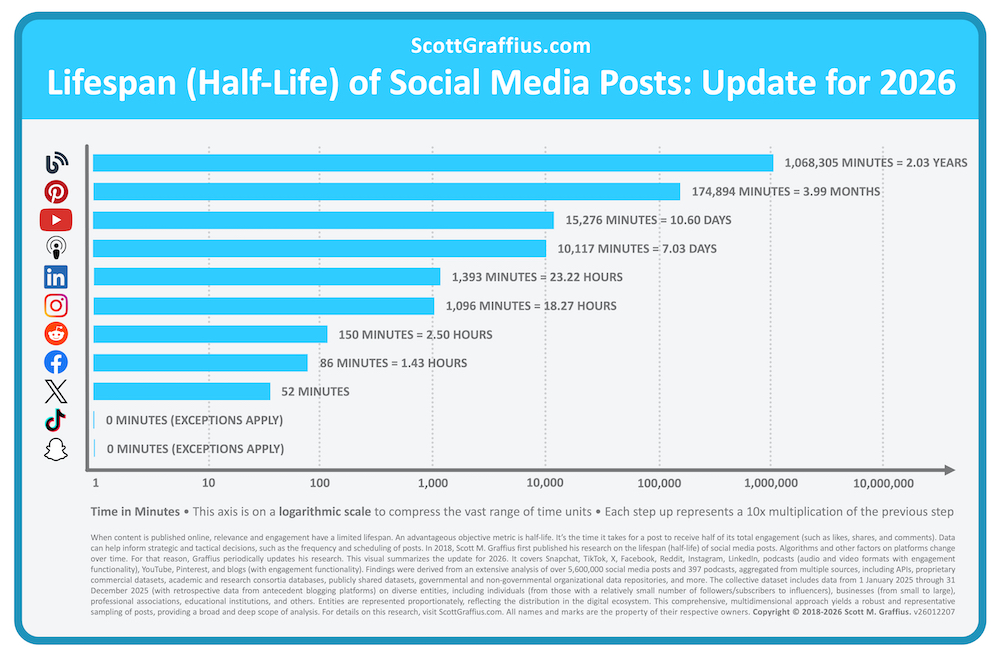
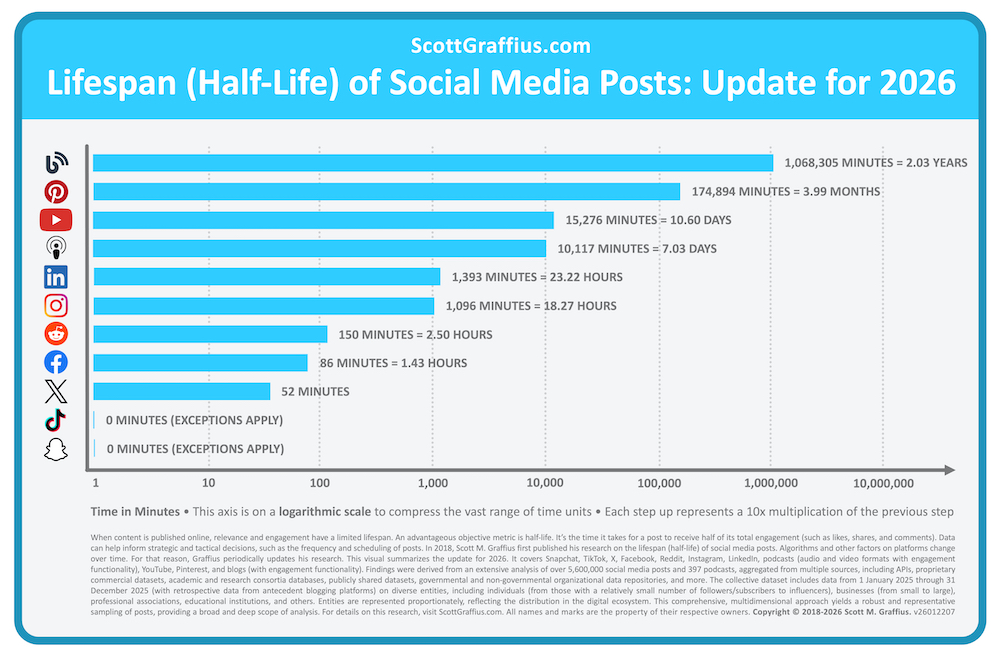
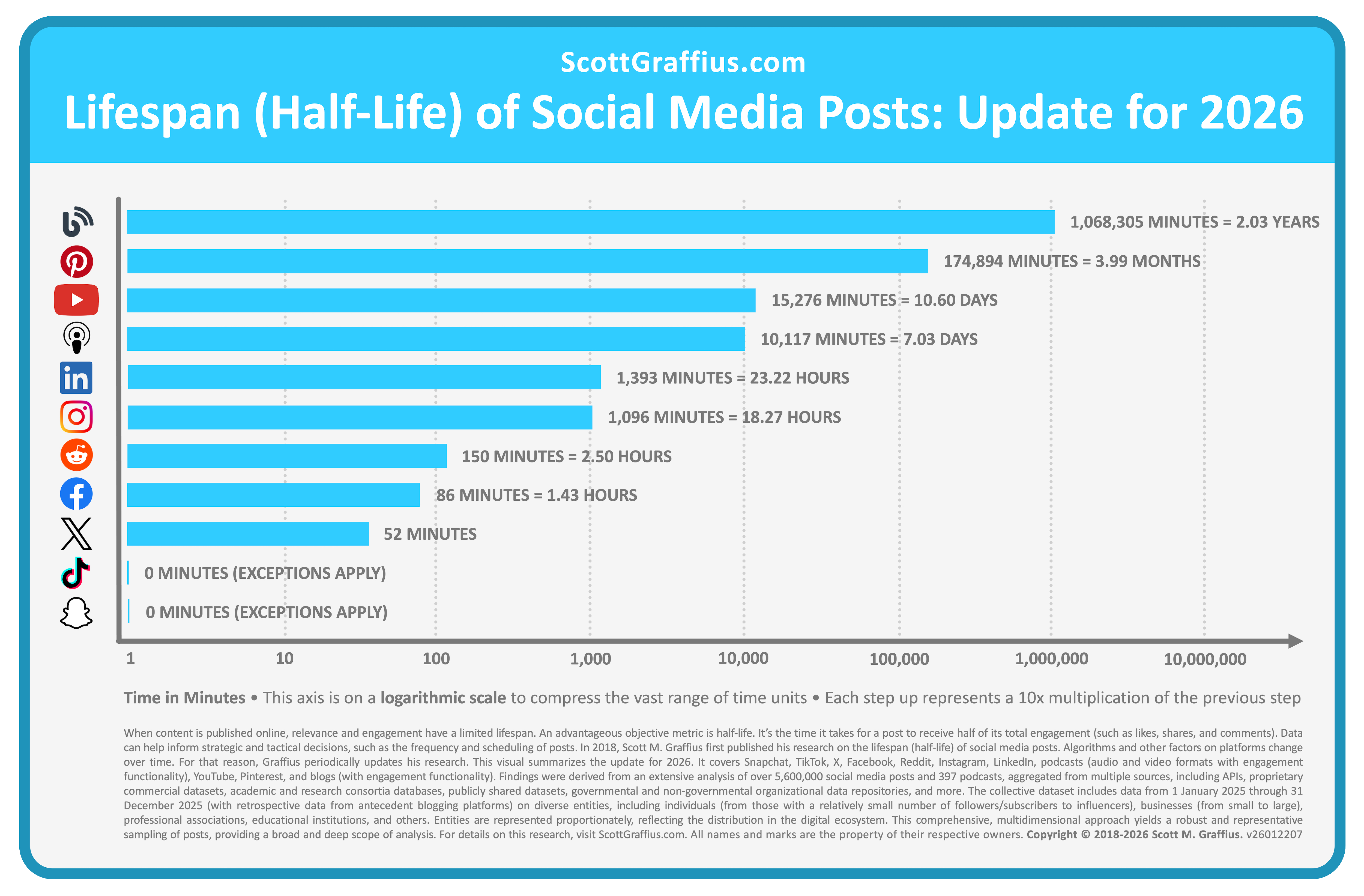
As detailed next, the average half-life of posts varies by social media platform.



Snapchat is a multimedia social media and instant messaging app developed by Snap Inc., known for its ephemeral "Snaps" that typically disappear after being viewed. Beyond its ephemeral nature, Snapchat offers features like Stories, Discover, augmented reality (AR) filters, and Snap Map. It has 932,000,000 (932 million) monthly active users.B3
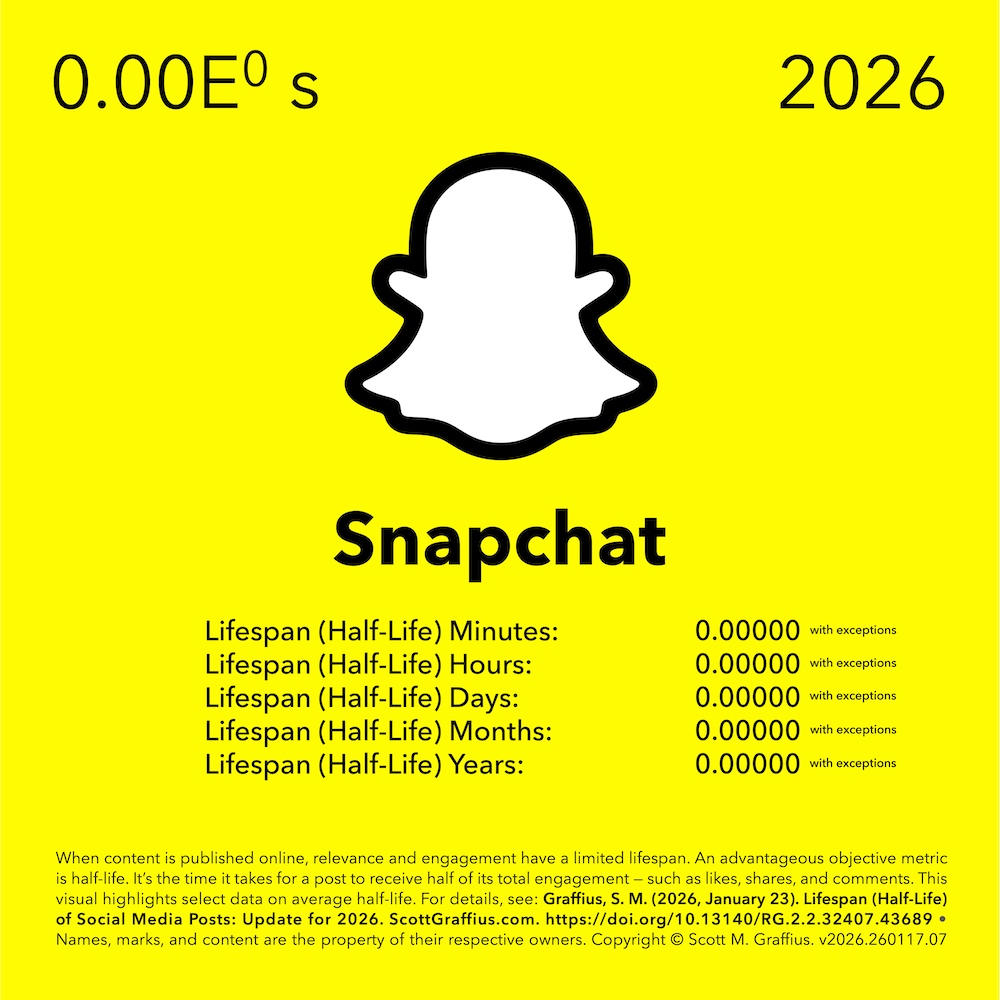
The average half-life duration for engagement on Snapchat posts is 0 minutes.A1 Exceptions apply. Content may disappear instantly or live up to 24 hours (even longer in certain cases) depending on the message type, user settings, and other details.
Algorithms and other factors on platforms can change over time, potentially impacting the average half-life duration for posts. For comparison, here’s data on Snapchat for 2026 along with the previous two annual editions of this report:
See the Frequently Asked Questions (FAQs) section for more insights about Snapchat.

TikTok is a leading platform for short‑form video content, where creators share brief, highly engaging clips that can spread quickly across the "For You" feed. While most TikTok videos remain available unless removed, the platform also supports story‑style ephemeral posts, enabling creators to share spontaneous, in‑the‑moment updates with less pressure to produce polished content. TikTok has 1,990,000,000 (1.99 billion) monthly active users.B3
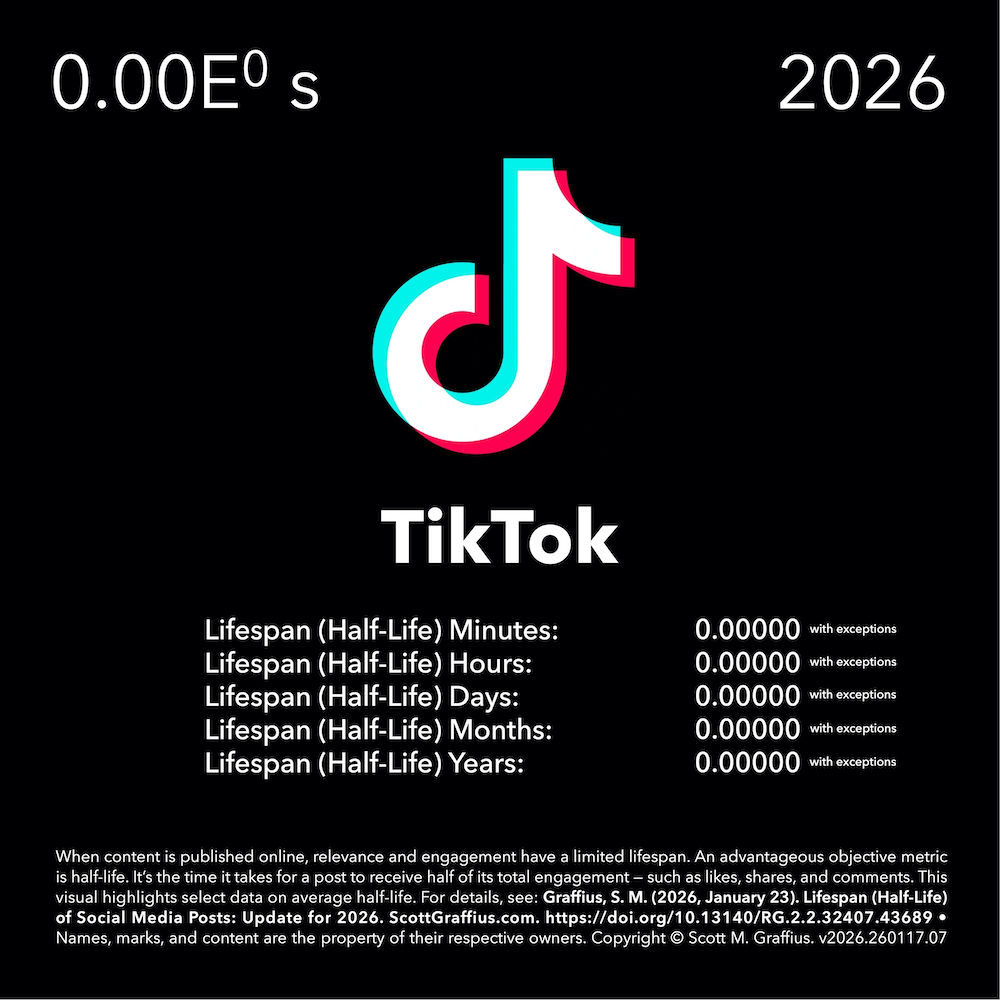
The average half-life duration for engagement on TikTok posts is 0 minutes, with the caveat of "with exceptions."A1 Videos featuring uniquely compelling content or celebrity involvement can go viral, significantly extending their visibility and engagement.
TikTok was added to this report in 2025.
See the FAQs for more insights about TikTok.

X is a microblogging and social networking service owned by X Corp., where users post and interact with messages known as "tweets" or "X posts"—now encompassing long-form text, images, videos, live streams, audio/video calls, and more. The following from X encapsulates its vision, mission, and goals: "We're building the world's most trusted public town square—and we pride ourselves on our commitment to protecting free speech within the boundaries of the law. Beyond that, we aim to increase unregretted user minutes on our platform, and make it the best place on the internet for creators to share content and make money."B6 X has 557,000,000 (557 million) monthly active users.B3
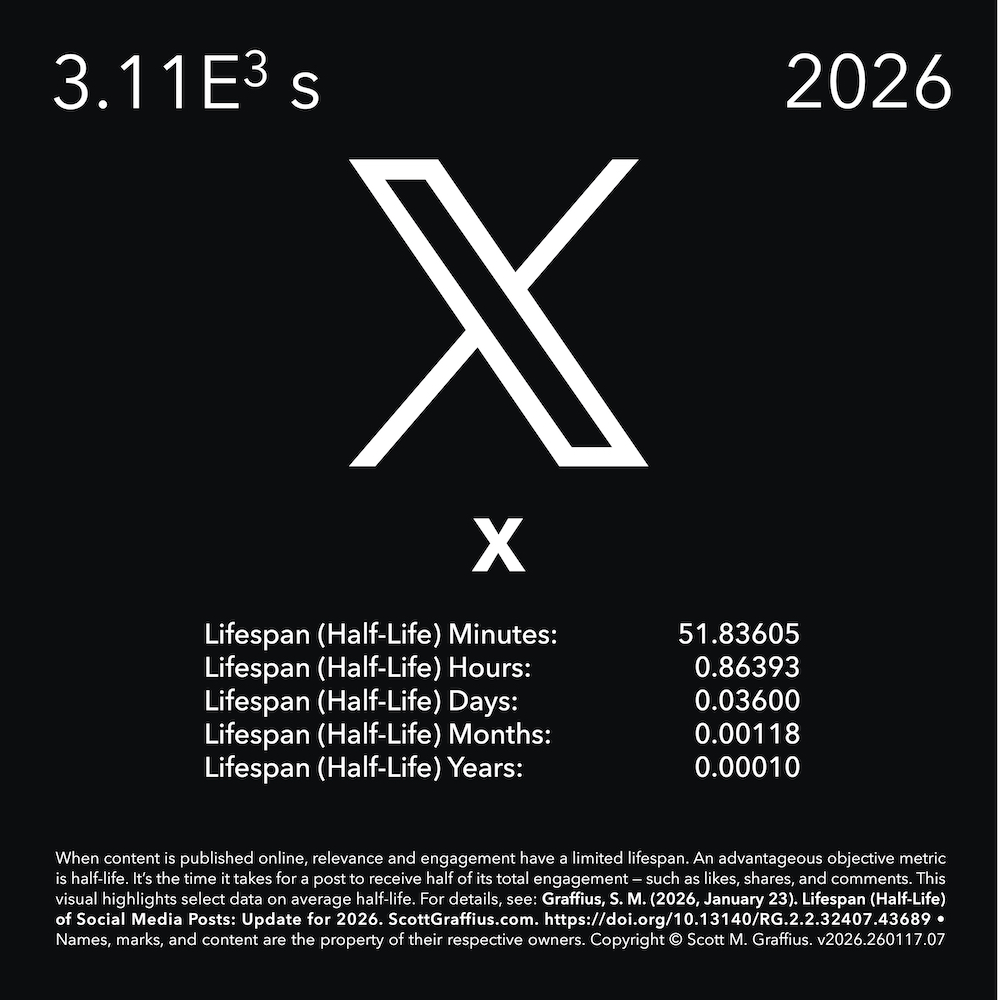
The average half-life duration for posts on X is 52 minutes.A1
Algorithms and other factors on platforms can change over time, potentially impacting the average half-life duration for posts. For comparison, here’s data on X for 2026 along with the previous two annual editions of this report:
See the FAQs for more insights about X.

Facebook
Facebook is an online social media and social networking service owned by Meta Platforms. It enables users to create profiles, connect with others, and share content such as text posts, photos, videos, and links. The platform also supports groups, pages, events, and advertising, making it widely used for personal communication, community building, and business marketing. Facebook has 3,070,000,000 (3.07 billion) monthly active users.B3
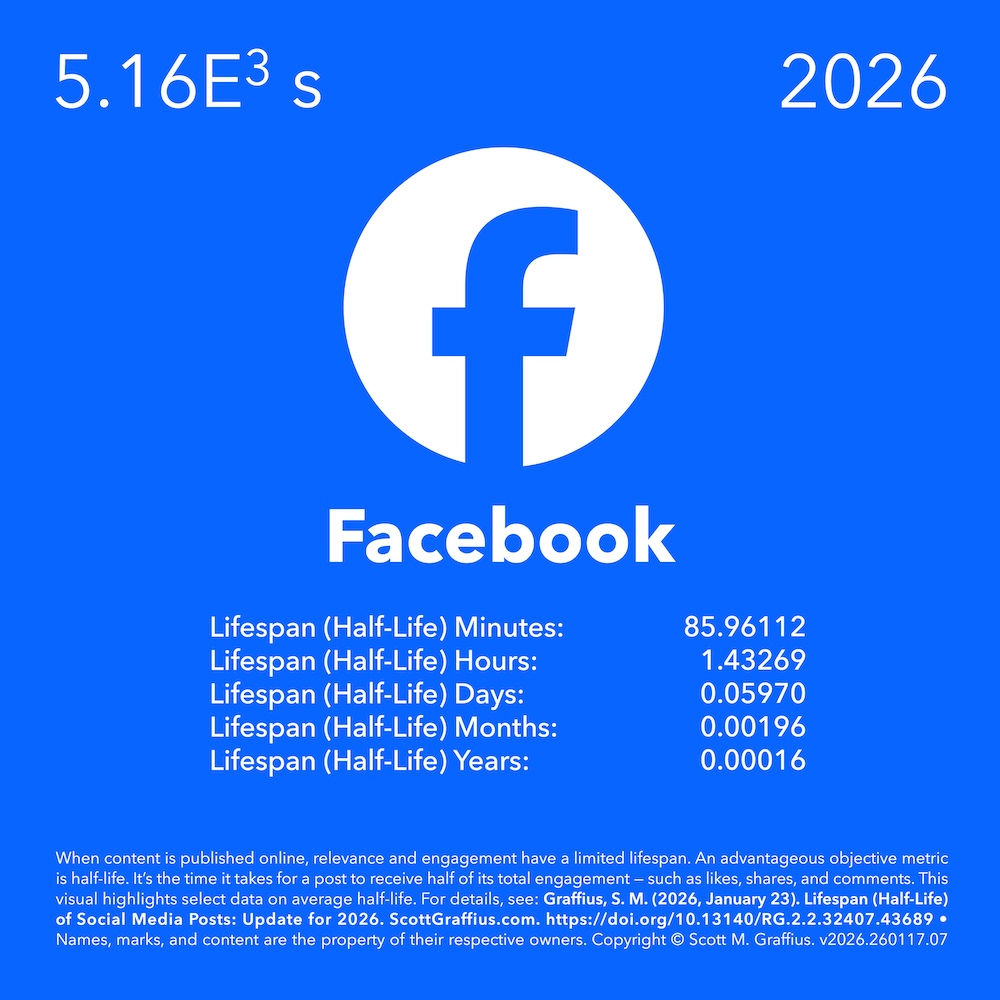
The average half-life duration for Facebook posts is 86 minutes = 1.43 hours.A1
Algorithms and other factors on platforms can change over time, potentially impacting the average half-life duration for posts. For comparison, here’s data on Facebook for 2026 along with the previous two annual editions of this report:
See the FAQs for more insights about Facebook.

Reddit
Reddit, often called "the front page of the internet," is a social media and discussion platform where users participate in more than 100,000 active topic‑specific communities known as subreddits. Its upvote and downvote system lets users collectively shape what is seen, surfacing higher‑quality or more popular posts and comments while pushing less relevant content out of view. Founded in 2005, Reddit has grown into a vast ecosystem spanning breaking news, in‑depth discussions, memes, and highly niche interests. This participatory structure and breadth of content have made it one of the web’s central hubs for discovering information and connecting with communities built around shared interests. Reddit is reported to have 765,000,000 (765 million) monthly active users.B3
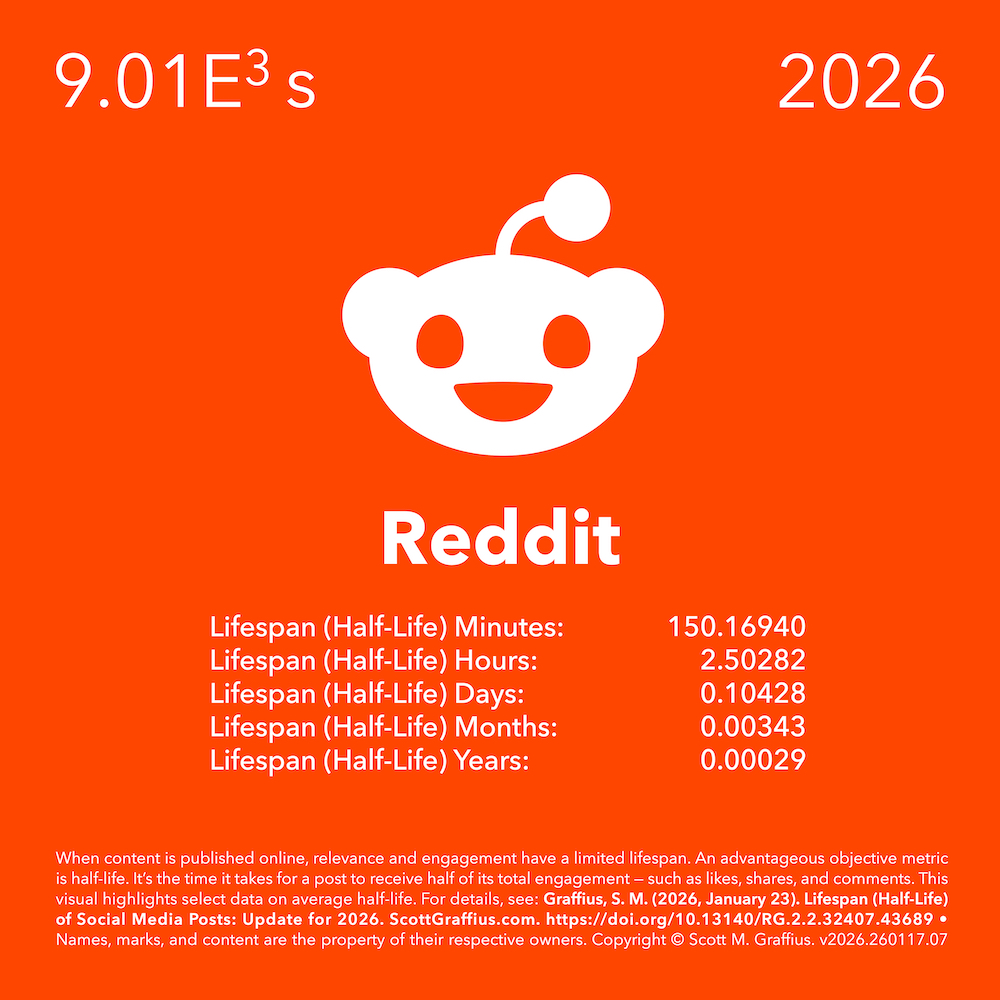
The average half-life duration for Reddit posts is 150 minutes = 2.50 hours.A1
Reddit was added to this report in 2025.
See the FAQs for more insights about Reddit.

Instagram
Instagram is a leading photo and video-sharing social platform owned by Meta. It lets users capture and post media—enhanced with filters, effects, music, stickers, captions, and more—then organize it with hashtags, location tags, and collections. People follow accounts to see updates in a personalized feed, engaging through likes, comments, shares, saves, and direct messages. Instagram has 3,000,000,000 (3.00 billion) monthly active users.B3
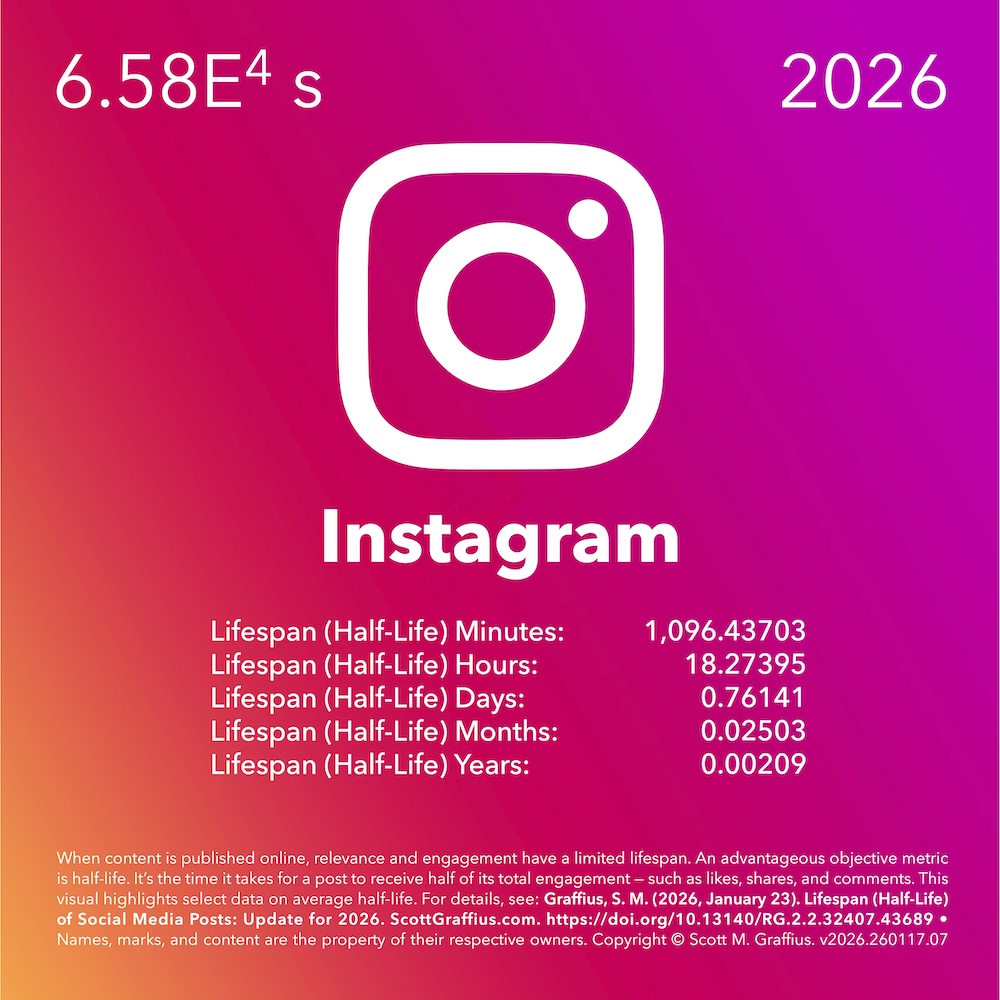
The average half-life duration for Instagram posts is 1,096 minutes = 18.27 hours.A1
Algorithms and other factors on platforms can change over time, potentially impacting the average half-life duration for posts. For comparison, here’s data on Instagram for 2026 along with the previous two annual editions of this report:
See the FAQs for more insights about Instagram.

LinkedIn
LinkedIn is a business and employment-oriented online service that serves as the world's largest professional network. With over 1.2 billion members worldwideB22, it enables users to build and showcase professional profiles, connect with colleagues and industry peers, discover job opportunities, share insights and content, and advance their careers. It is a wholly-owned subsidiary of Microsoft. LinkedIn does not report how many of its users are monthly active users (MAUs). Third parties estimate that there are about 300 million MAUs.
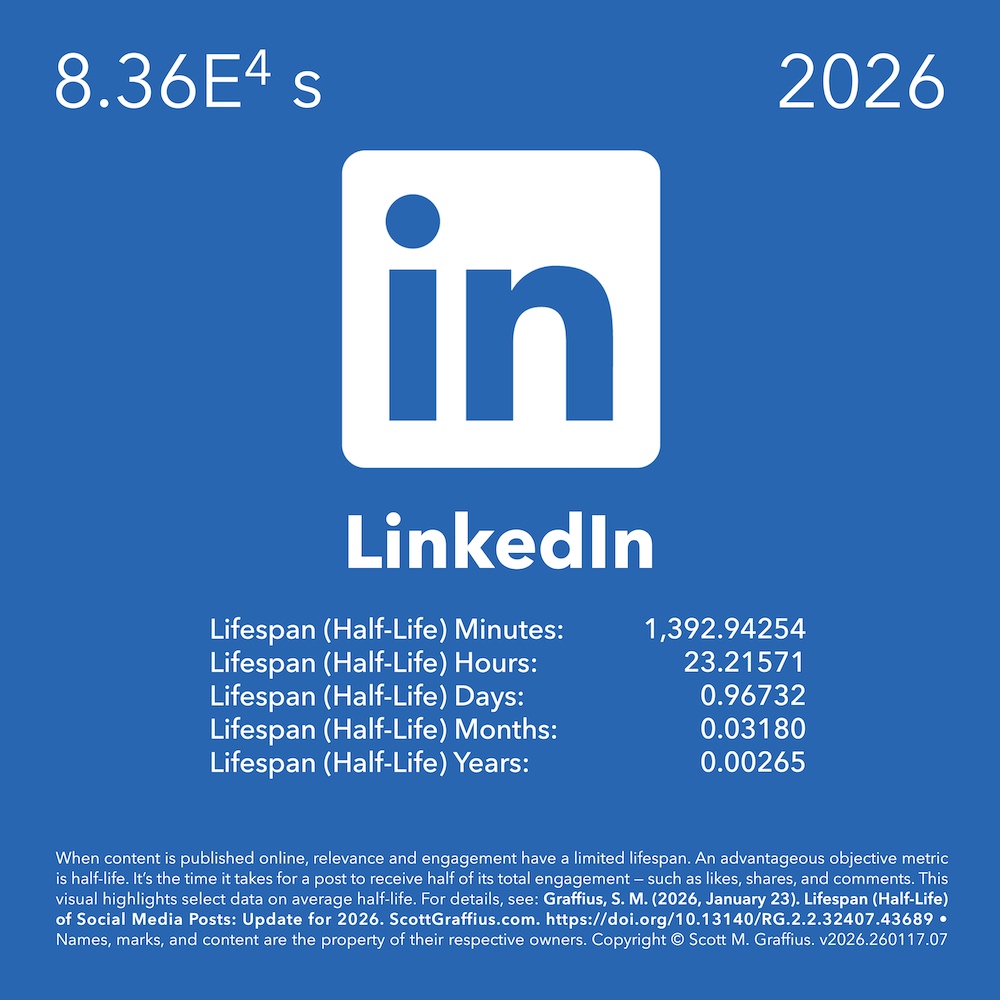
The average half-life duration for LinkedIn posts is 1,393 minutes = 23.22 hours.A1
Algorithms and other factors on platforms can change over time, potentially impacting the average half-life duration for posts. For comparison, here’s data on LinkedIn for 2026 along with the previous two annual editions of this report:
See the FAQs for more insights about LinkedIn.

A podcast is a digital media file, available online for streaming or download. The term "podcast," coined in Ben Hammersley in 2004B27, blends "iPod" and "broadcast." While audio podcasts dominate the medium, video podcasts, or vodcasts, have gained traction by integrating visual elements to boost engagement on platforms like YouTube. There are over 3,708,000 (3.47 million) podcasts.B23
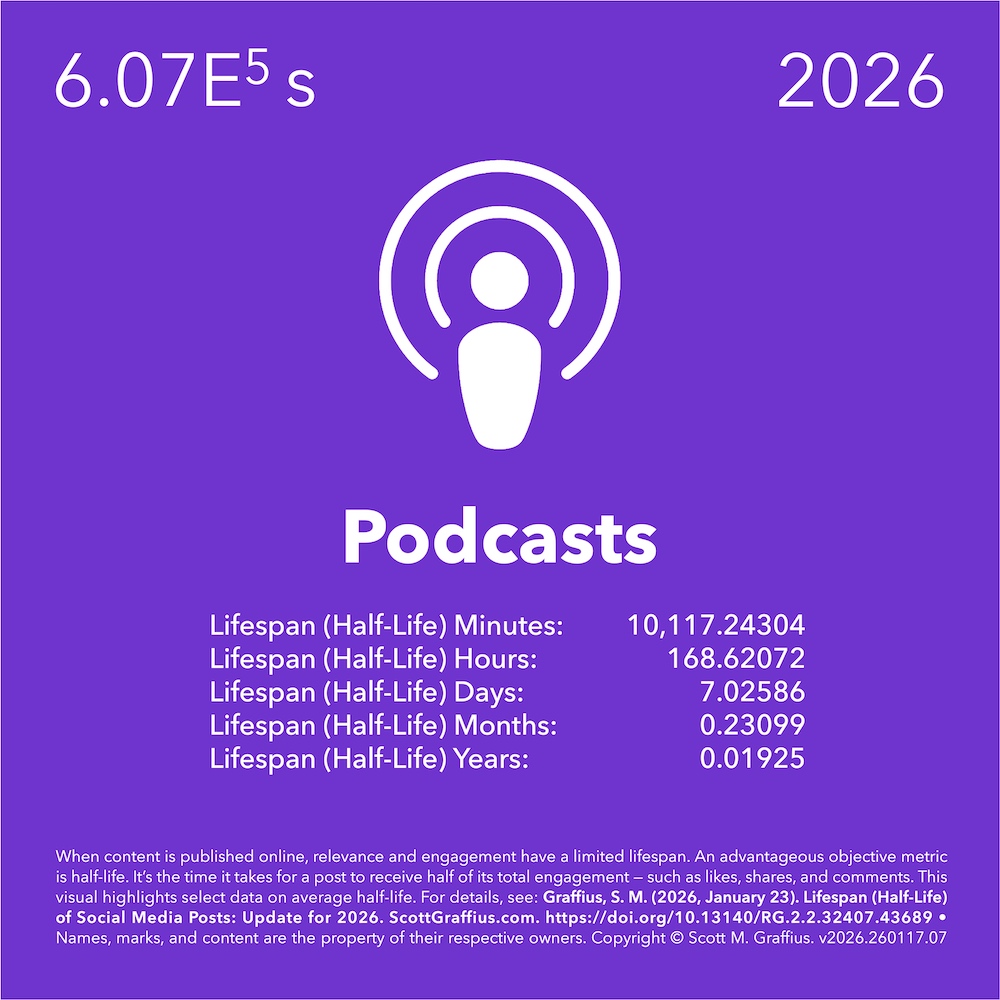
The average half-life duration for posts on podcast platforms with engagement functionality is 10,117 minutes = 7.03 days.A1
Podcasts were added to this report in 2025.
See the FAQs for more insights about podcasts.

YouTube is an online video-sharing platform. It's owned by Google, and it's the second most visited website, after Google Search. YouTube has 2,580,000,000 (2.58 billion) monthly active users.B3
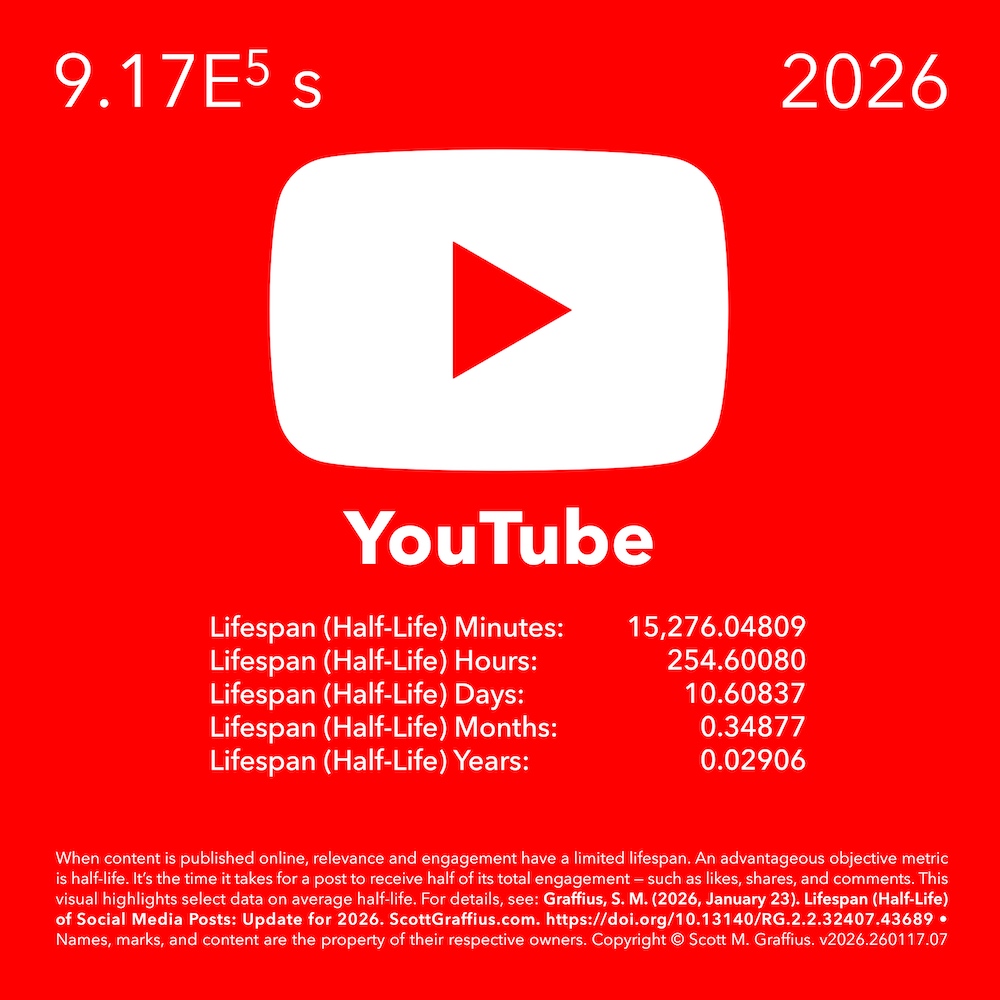
The average half-life duration for YouTube posts is 15,276 minutes = 10.60 days.A1
Algorithms and other factors on platforms can change over time, potentially impacting the average half-life duration for posts. For comparison, here’s data on YouTube for 2026 along with the previous two annual editions of this report:
See the FAQs for more insights about YouTube.

Pinterest
Pinterest is a visual discovery engine that enables people to search for, save, and curate ideas from across the internet as "pins" organized on customizable boards. Operated by Pinterest, Inc., the platform functions both as an inspiration hub—spanning categories such as fashion, home décor, recipes, and DIY—and as a marketing and commerce channel through features that support content distribution, product discovery, and shoppable experiences. It has 578,000,000 (578 million) monthly active users.B3
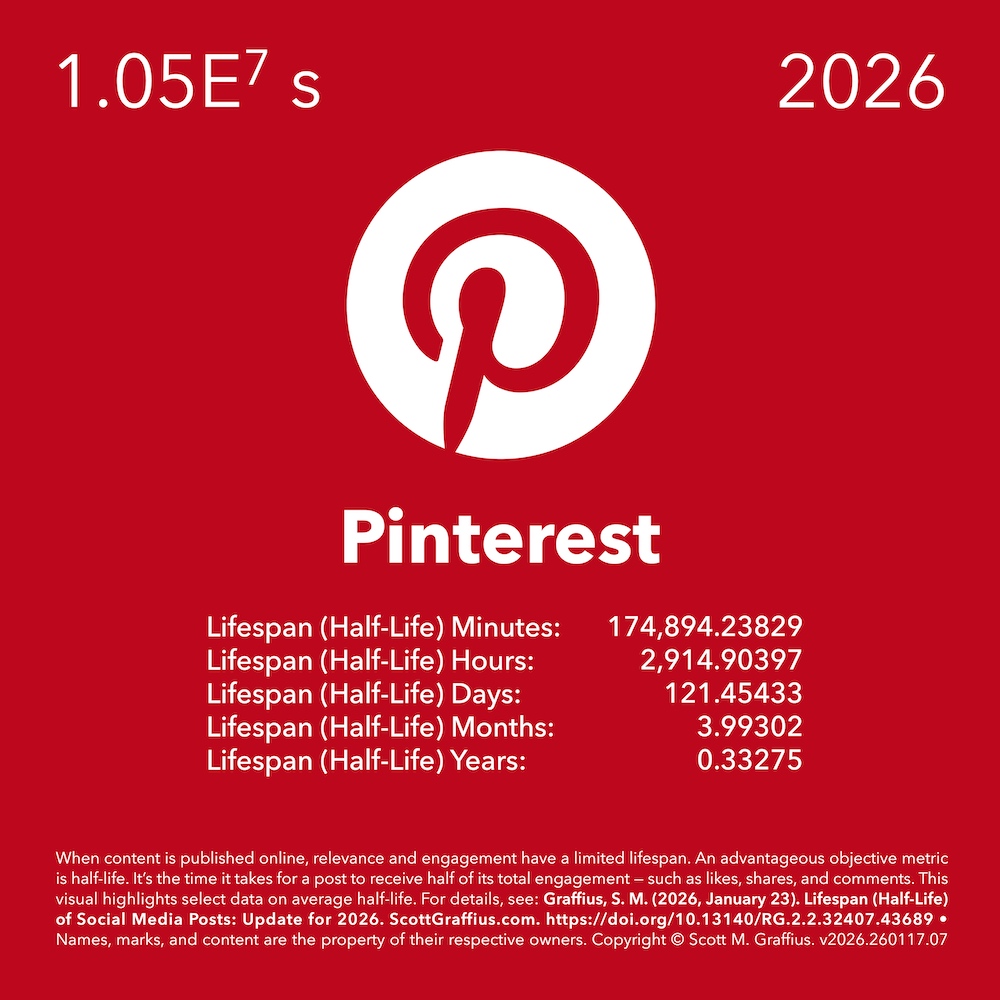
The average half-life duration for Pinterest posts is 174,894 minutes = 3.99 months.A1
Algorithms and other factors on platforms can change over time, potentially impacting the average half-life duration for posts. For comparison, here’s data on Pinterest for 2026 along with the previous two annual editions of this report:
See the FAQs for more insights about Pinterest.

Blogs (a truncation of "weblogs") are discussion or informational websites consisting of discrete, often diary-style entries. Up until 2009, blogs were usually the work of individuals and each typically covered a single topic. In the 2010s, multi-author blogs (MABs) from media outlets and others emerged. In addition to featuring the writings of multiple authors, MABs frequently span a range of topics. It is estimated that there are over 600,000,000 (600 million) blogs.B8,B24
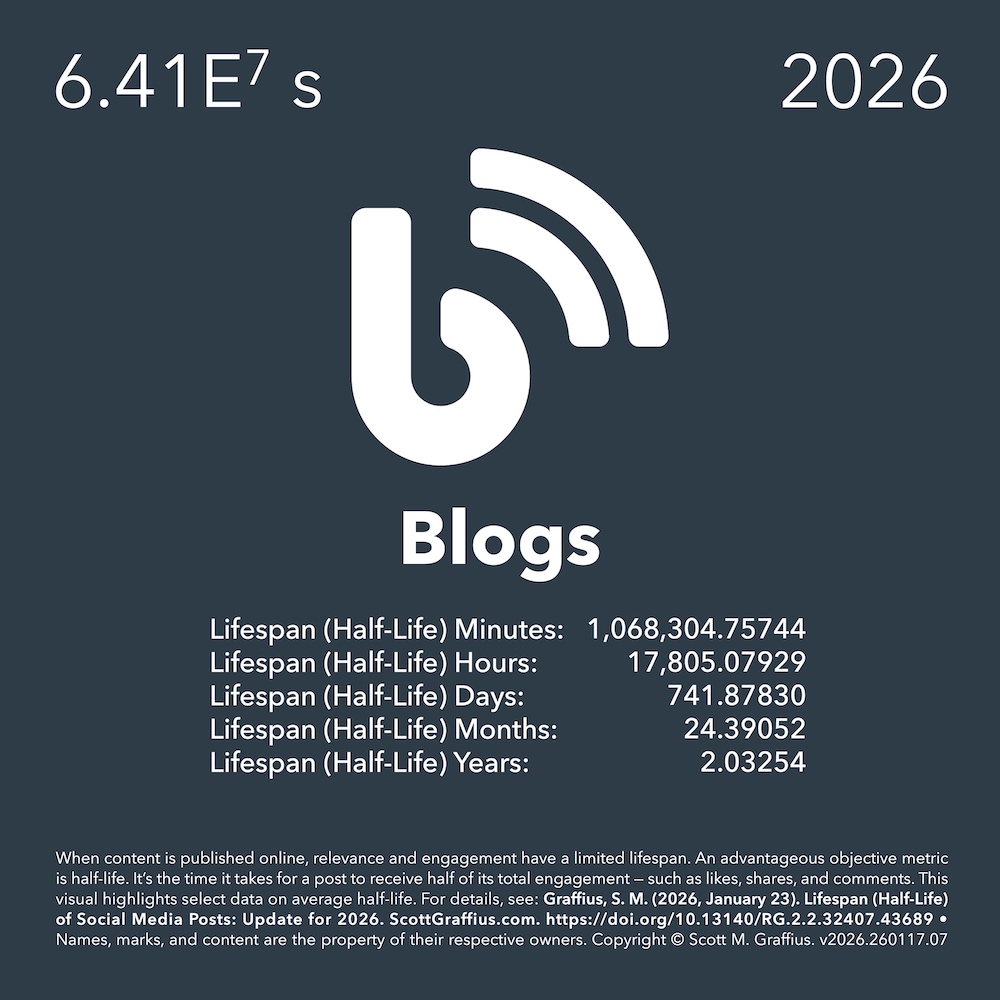
The average half-life duration for posts on blog platforms with engagement functionality is 1,068,305 minutes = 2.03 years.A1
Algorithms and other factors on platforms can change over time, potentially impacting the average half-life duration for posts. For comparison, here’s data on blogs for 2026 along with the previous two annual editions of this report:
See the FAQs for more insights about blogs.


Social media platforms enable people to access, share, and interact with content while also connecting with family, friends, and others. The platforms also provide organizations with direct channels to reach and engage with their target audiences.
The relevance and engagement of social media posts have a limited lifespan. An advantageous objective metric is half-life. It’s the time it takes for a post to receive half of its total engagement (such as likes, shares, and comments). In 2018, Scott M. Graffius first published data on the lifespan (half-life) of social media posts. Algorithms and other factors on platforms change over time. For that reason, Graffius periodically updates his analysis. This report, which is based extensive study of over 5,600,000 social media posts and 397 podcasts aggregated from multiple sourcesA1, provides the update for 2026.
The "Lifespan (Half-Life) of Social Media Posts: Update for 2026" research stands out for its:
In closing, social media analytics offer valuable insights that can support efforts to level up engagement and results.B9,B10,B11,B12,B13,B14,B15 Data on the average half-life of posts can help inform strategic and tactical decisions such as the frequency and scheduling of posts.
Read on for:


FAQ 01. What is Social Media?
Social media refers to digital platforms and related technologies that enable users to create, share, and interact with content and connect with others in virtual communities. Leading dictionaries support that relatively broad characterization.
Summarized, the key characteristics of social media include:
FAQ 02. What platforms are included in this 2026 edition of the research?
This 2026 update covers Snapchat, TikTok, X, Facebook, Reddit, Instagram, LinkedIn, podcasts (audio and video formats with engagement functionality), YouTube, Pinterest, and blogs (with engagement functionality).
FAQ 03. Why exactly are posts on Snapchat a form of social media?
Further to FAQ items 1 and 2, posts on Snapchat are aligned with the core principles of social media by facilitating user-generated content, multimedia sharing, and interactive engagement. Here are the related definitive characteristics of Snapchat:
FAQ 04. Why exactly are posts on TikTok a form of social media?
Further to FAQ items 1 and 2, posts on TikTok are aligned with the core principles of social media by facilitating user-generated content, multimedia sharing, and interactive engagement. Here are the related definitive characteristics of TikTok:
FAQ 05. Why exactly are posts on X a form of social media?
Further to FAQ items 1 and 2, posts on X are aligned with the core principles of social media by facilitating user-generated content, multimedia sharing, and interactive engagement. Here are the related definitive characteristics of X:
FAQ 06. Why exactly are posts on Facebook a form of social media?
Further to FAQ items 1 and 2, posts on Facebook are aligned with the core principles of social media by facilitating user-generated content, multimedia sharing, and interactive engagement. Here are the related definitive characteristics of Facebook:
FAQ 07. Why exactly are posts on Reddit a form of social media?
Further to FAQ items 1 and 2, posts on Reddit are aligned with the core principles of social media by facilitating user-generated content, multimedia sharing, and interactive engagement. Here are the related definitive characteristics of Reddit:
FAQ 08. Why exactly are posts on Instagram a form of social media?
Further to FAQ items 1 and 2, posts on Instagram are aligned with the core principles of social media by facilitating user-generated content, multimedia sharing, and interactive engagement. Here are the related definitive characteristics of Instagram:
FAQ 09. Why exactly are posts on LinkedIn a form of social media?
Further to FAQ items 1 and 2, posts on LinkedIn are aligned with the core principles of social media by facilitating user-generated content, multimedia sharing, and interactive engagement. Here are the related definitive characteristics of LinkedIn:
FAQ 10. Why exactly are posts on podcast platforms a form of social media?
Further to FAQ items 1 and 2, posts on podcast platforms with engagement functionality are aligned with the core principles of social media by facilitating user-generated content, multimedia sharing, and interactive engagement. Here are the related definitive characteristics of podcasts:
FAQ 11. Why exactly are posts on YouTube a form of social media?
Further to FAQ items 1 and 2, posts on YouTube are aligned with the core principles of social media by facilitating user-generated content, multimedia sharing, and interactive engagement. Here are the related definitive characteristics of YouTube:
FAQ 12. Why exactly are posts on Pinterest a form of social media?
Further to FAQ items 1 and 2, posts on Pinterest are aligned with the core principles of social media by facilitating user-generated content, multimedia sharing, and interactive engagement. Here are the related definitive characteristics of Pinterest:
FAQ 13. Why exactly are posts on blog platforms a form of social media?
Further to FAQ items 1 and 2, posts on blog platforms with engagement functionality are aligned with the core principles of social media by facilitating user-generated content, multimedia sharing, and interactive engagement. Here are the related definitive characteristics of blogs:
FAQ 14. What is the half-life of social media posts?
The half-life is the time it takes for a post to receive half of its total engagement, such as likes, shares, and comments. It’s an advantageous objective metric for assessing content.
FAQ 15. Why is half-life important in social media strategy?
Half-life provides an objective metric to inform strategic and tactical decisions, such as the frequency and scheduling of posts.
FAQ 16. What factors can impact the half-life of social media?
Posts can be influenced by multiple elements. Here are ten factors:
FAQ 17. What data sources were used for the 2026 update?
The analysis drew from over 5,600,000 social media posts and 397 podcasts. Data sources included APIs, proprietary commercial datasets, academic and research consortia databases, publicly shared datasets, governmental and non-governmental organizational data repositories, and more.
FAQ 18. What dates does the 2026 update cover?
The update includes data from 1 January 2025 through 31 December 2025, and retrospective data from antecedent blogging platforms.
FAQ 19. Who is represented in the dataset used for the research?
The dataset represents a diverse range of entities, including individuals (from small accounts to influencers), businesses (small to large), professional associations, educational institutions, and more. The representation reflects the distribution in the digital ecosystem.
FAQ 20. What is the significance of the dataset size and diversity?
With data aggregated from over 5,600,000 posts (and 397 podcasts) and diverse sources, the comprehensive and multidimensional approach ensures robust and representative sampling, yielding broad and deep analytical insights.
FAQ 21. What factors impact engagement and the average half-life of posts on Snapchat?
Depending on the message type, user settings, and other details, content may disappear instantly or live up to 24 hours or longer.
FAQ 22. What factors impact engagement and the average half-life of posts on TikTok?
Select potential factors for TikTok include:
FAQ 23. What factors impact engagement and the average half-life of posts on X?
Select potential factors for X include:
FAQ 24. What factors impact engagement and the average half-life of posts on Facebook?
Select potential factors for Facebook include:
FAQ 25. What factors impact engagement and the average half-life of posts on Reddit?
Select potential factors for Reddit include:
This report conveys the average half-life for posts on the Reddit platform. Half-life may vary across different subreddits and content types. Factors such as the subreddit's size, topic, and activity level can greatly influence a post's half-life.
FAQ 26. What factors impact engagement and the average half-life of posts on Instagram?
Select potential factors for Instagram include:
FAQ 27. What factors impact engagement and the average half-life of posts on LinkedIn?
Select potential factors for LinkedIn include:
FAQ 28. What factors impact engagement and the average half-life of posts on podcast platforms?
Select potential factors for podcast platforms include:
This report conveys the average half-life for posts on podcast platforms with engagement functionality. Half-life may vary across different podcast genres, episode lengths, and audience demographics.
FAQ 29. What factors impact engagement and the average half-life of posts on YouTube?
Select potential factors for YouTube include:
This report conveys the average half-life for posts on the YouTube platform. Half-life can vary across different types of content, channels, and topics. Factors such as video length, subject matter, and target audience can greatly influence a video's half-life on the platform.
FAQ 30. What factors impact engagement and the average half-life of posts on Pinterest?
Select potential factors for Pinterest include:
This extended half-life aligns with Pinterest's unique position as a platform for long-term inspiration and planning. It reinforces Pinterest's value for marketers and content creators, offering an extended window for engagement compared to other social media platforms.
FAQ 31. What factors impact engagement and the average half-life of posts on blog platforms?
Select potential factors for blog platforms include:
FAQ 32. Can some posts have a half-life shorter or longer than the average half-life data published in this report?
Findings from this "Lifespan (Half-Life) of Social Media Posts: Update for 2026" research reports the average values derived from an extensive analysis of over 5,600,000 social media posts and 397 podcasts, aggregated from multiple sources including diverse entities, represented proportionately to reflect the distribution in the digital ecosystem. This comprehensive, multidimensional approach yields a robust and representative sampling of posts, providing a broad and deep scope of analysis to determine the average half-life durations.
However, individual posts may vary from the average. Additionally, others’ reports often rely on anecdotal evidence, limited datasets, or otherwise non-robust methodology. Those constraints can result in different findings.
FAQ 33. Which metric is better, views or engagement?
When evaluating the importance and value of views versus engagement on social media platforms, engagement metrics generally hold more value for several reasons. These include:
FAQ 34. Tracking engagement (impact) rather than mere views (content display)?
In social media and digital marketing metrics, views and engagement represent distinct concepts that serve different purposes in understanding audience behavior. A view is a measure of exposure, counting the instances when content is displayed; it’s a passive metric about reach or visibility rather than interaction. Engagement, by contrast, captures active participation, tracking when a user interacts with content through actions (such as liking, commenting, or sharing a post), offering a deeper insight into how compelling or resonant the content is to its audience. A view indicates that someone had the opportunity to see something, while engagement signals that the content sparked enough attention to prompt a response. Simply put, views measure reach, and engagement measures impact.
Some social media research tracks views—mere content display. By contrast, engagement (such as likes, shares, comments) measures impact. For that reason, Graffius' "Lifespan (Half-Life) of Social Media Posts" research analyzes engagement, providing a deeper insight.
FAQ 35. What are algorithms and how do they impact the user experience on social media platforms?
See our article.B16
FAQ 36. What is the typical engagement distribution pattern for social media posts?
See our article.B17
FAQ 37. How does temporal decay of engagement manifest on ephemeral systems vs. persistent networks?
The temporal decay curve of digital engagement reveals platform-specific entropic gradients. Median half-lives vary, with ephemeral systems (such as X) exhibiting acclerated attenuation vs. persistent networks (such as Pinterest).
FAQ 38. What is the difference between the public "Lifespan (Half-Life) of Social Media Posts" research and commissioned/custom work?
Scott M. Graffius makes his "Lifespan (Half-Life) of Social Media Posts" report—which he typically updates annually—available to the public free of charge.
Clients have commissioned him for follow-up, bespoke projects. These engagements are often resource-intensive—requiring substantial time, effort, and expense—and may involve sensitive, confidential, or restricted materials. For those reasons, that content is not available to the public.


Scientists, researchers, journalists, academics, YouTubers, podcasters, SEO experts, analysts, businesses, and others have featured earlier editions of Scott M. Graffius' "Lifespan (Half-Life) of Social Media Posts" research. Here are some examples:
This list is not exhaustive.

Section "A" pertains to the rigorous methodology employed in this study.
Section "B" pertains to additional sources of information.



Scott M. Graffius is a strategic transformation leader who drives AI, Agile, and broader business and technology initiatives to deliver measurable value across projects, programs, portfolios, and PMOs. He is an expert in the teamwork tradecraft of both human and human-AI teams, including the “exotic team dynamics” that emerge. He is also an authority on the temporal patterns of social media, including the half-life of audience engagement.
He’s a practitioner, researcher, thought leader, award-winning author, and keynote speaker who’s taken the stage at 96 conferences and other events across 25 countries.
He’s delivered over $2.3 billion in value for Fortune 500 companies and other leaders in technology, entertainment, financial services, healthcare, and beyond.
Businesses, professional associations, government agencies, and universities use Graffius and feature his work. Examples include Adobe, Bayer, Boston University, Ford, Gartner, Harvard Medical School, IEEE, Johns Hopkins University, Microsoft, MSN, National Academy of Sciences, Oracle, Pinterest Inc., Project Management Institute, UC San Diego, Verizon, Yale University, and others.
The following sections provide additional information on his experience, contributions, and influence.
Experience
Graffius heads the professional services firm Exceptional PPM and PMO Solutions, along with its subsidiary Exceptional Agility. These consultancies offer strategic and tactical advisory, training, embedded expertise, and consulting services to the public, private, and government sectors. They help organizations enhance their capabilities and results in agile, project management, program management, portfolio management, and PMO leadership, supporting innovation and driving competitive advantage. The consultancies confidently back services with a Delighted Client Guarantee™.
Graffius is a former VP of project management with a publicly traded provider of diverse consumer products and services over the Internet. Before that, he ran and supervised the delivery of projects and programs in public and private organizations with businesses ranging from e-commerce to advanced technology products and services, retail, manufacturing, entertainment, and more.
He has experience with consumer, business, reseller, government, and international markets.
Award-Winning Author
Graffius has authored three books.
International Public Speaker
Organizations worldwide engage Graffius to present on tech (including AI), Agile, project management, program management, portfolio management, and PMO leadership. He crafts and delivers unique and compelling talks and workshops. Graffius has conducted 96 sessions across 25 countries. Select examples of events include Agile Trends Gov, BSides (Newcastle Upon Tyne), Conf42 Quantum Computing, DevDays Europe, DevOps Institute, DevOpsDays (Geneva), Frug’Agile, IEEE, Microsoft, Scottish Summit, Scrum Alliance RSG (Nepal), Techstars, and W Love Games International Video Game Development Conference (Helsinki), and more.
With an average rating of 4.81 (on a scale of 1-5), sessions are highly valued.
The speaker engagement request form is here.
Thought Leadership and Influence
Prominent businesses, professional associations, government agencies, and universities have showcased Graffius and his contributions—spanning his books, talks, workshops, and beyond. Select examples include:
Graffius has played a key role in the Project Management Institute (PMI) in developing professional standards. He was a member of multiple teams that authored, reviewed, and produced:
Additional details are here.
He was also a subject matter expert reviewer of content for the PMI’s Congress. Beyond the PMI, Graffius also served as a member of the review team for two of the Scrum Alliance’s Global Scrum Gatherings.
Acclaimed Authority on Teamwork Tradecraft
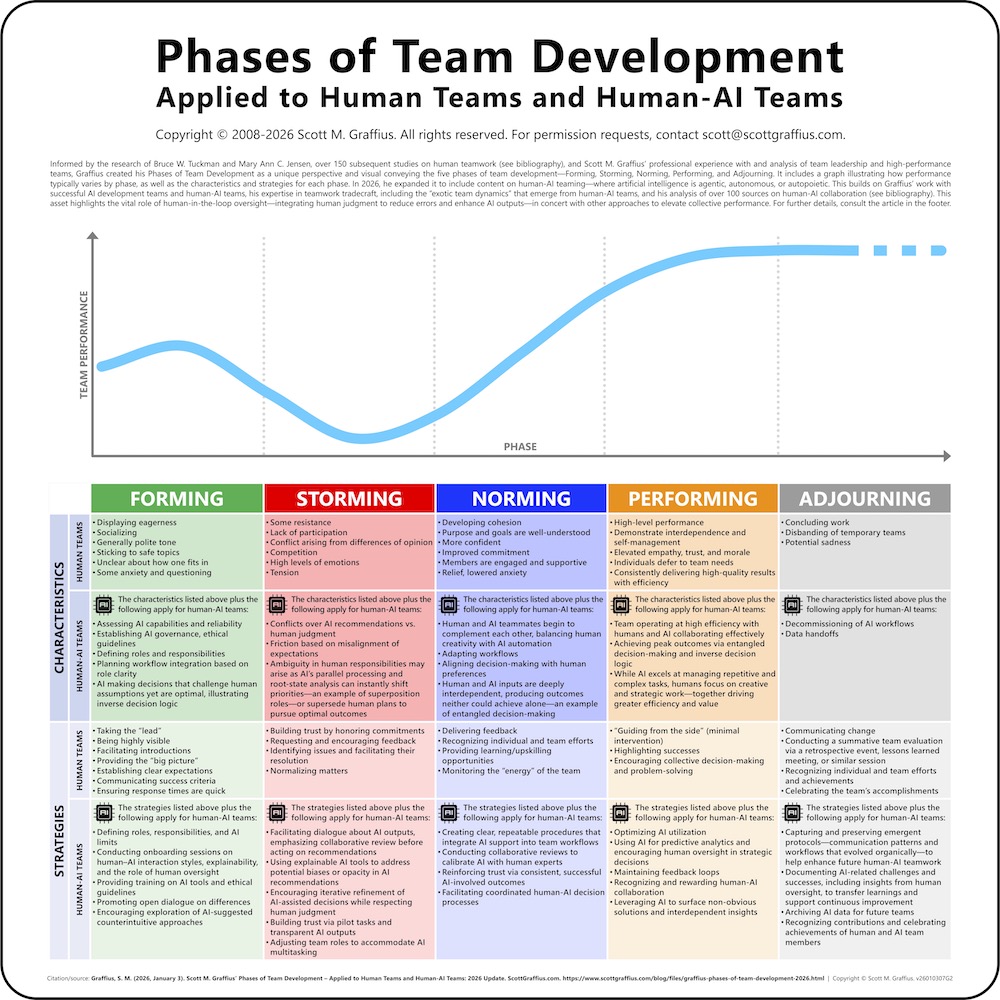
Graffius is a renowned authority on teamwork tradecraft. Informed by the research of Bruce W. Tuckman and Mary Ann C. Jensen, over 150 subsequent studies, and Graffius' first-hand professional experience with, and analysis of, team leadership and performance, Graffius created his "Phases of Team Development" intellectual property as a unique perspective and visual conveying the five phases of team development. First introduced in 2008 and periodically updated, his work provides a diagnostic and strategic guide for navigating team dynamics. It provides actionable insights for leaders across industries to develop high-performance teams. Its adoption by esteemed organizations such as Yale University, IEEE, Cisco, Microsoft, Ford, Oracle, Broadcom, the U.S. National Park Service, and the Journal of Neurosurgery, among others, highlights its utility and value, solidifying its status as an indispensable resource for elevating team performance and driving organizational excellence. In 2026, Graffius added human-AI teamwork—including the "exotic team dynamics" which emerge when advanced AI collaborates as a teammate—to his "Phases of Team Development."
The 2026 edition of Graffius' "Phases of Team Development" intellectual property is here.
Expert on Temporal Dynamics on Social Media Platforms
Graffius is also an authority on temporal dynamics on social media platforms. His "Lifespan (Half-Life) of Social Media Posts" research—first published in 2018 and updated annually—delivers a precise quantitative analysis of post longevity across digital platforms, utilizing advanced statistical techniques to determine mean half-life with precision. It establishes a solid empirical base, effectively highlighting the ephemeral nature of content within social media ecosystems. Referenced and applied by leading entities—such as Fast Company, GoDaddy, Journal of Hand Surgery (European Volume), Ministère de la Culture (French Ministry of Culture), Pinterest Inc., PNAS, and Telecommunications Policy, among others—his research exemplifies methodological rigor and sustained significance in the field of digital informatics.
The 2026 edition of Graffius "Lifespan (Half-Life) of Social Media Posts" research is here.
Education and Professional Certifications
Graffius has a bachelor’s degree in psychology with a focus in Human Factors. He holds eight professional certifications:
He is an active member of the Scrum Alliance, the Project Management Institute (PMI), and the Institute of Electrical and Electronics Engineers (IEEE).
Advancing AI, Agile, and Project/PMO Management
Scott M. Graffius continues to advance the fields of AI, Agile, and Project/PMO Management through his leadership, research, writing, and real-world impact. Businesses and other organizations leverage Graffius’ insights to drive their success.
Discover Scott’s Books
Connect with and follow Scott on LinkedIn, X, YouTube, Facebook, Threads, Bluesky, Mastodon, and ResearchGate.







You may be interested in these stories.
Lessons from Yesterday’s Tomorrowland
Scott M. Graffius’ Update to His "Phases of Team Development” Coming Early 2026
A Data-Driven Analysis of the Evolution of Project Management: Tasks, Trends, and AI
Actionable Insights. Global Impact. Scott M. Graffius.
Beep Beep! Why Wile E. Coyote Is the Patron Saint of AI Failure
Social Media Half-Life Research Cited in Prestigious Peer-Reviewed Medical Journal
Navigating the Spectrum of Advanced AI – Agentic, Autonomous, and Autopoietic
Lessons from Unhinged AI in Fiction: What Rogue AIs in Sci-Fi Storytelling, Films, and TV Shows Reveal About Us
Scott M. Graffius Contributed to and Reviewed the PMBOK Guide, 8th Edition — the Global Standard for Project Management
UK Sports Institute Features Teamwork and Leadership Work of Scott M. Graffius
Definitions of Advanced AIs: Agentic, Autonomous, and Autopoietic
HAN University of Applied Sciences Features the Work of Scott M. Graffius
Gifts That Inspire Joy
Evergreen Echoes: How Pinterest Inc. and Pinterest Japan Spotlighted Scott M. Graffius’ Research on the Half-Life of Social Media Content
Scott M. Graffius’ Team Development Work Lights Up the University of Tasmania’s Curriculum
Taiwan’s Leading Outlet for Technology and Innovation Spotlights Graffius’ Research on Social Media Temporal Dynamics
Scott M. Graffius’ Insights on AI, Agile, Gaming, XR, and Defense Transformation Cited by MSN in Their Coverage of Innovation and Leadership in the Sector
Top Predictions of 2024, Tested in 2025
Government of Finland Agency Features Graffius' Phases of Team Development IP
Scott M. Graffius Premieres His New "Exotic Team Dynamics: Human-AI Collaboration" Talk at Corporate Event in Las Vegas
Environmental Science Journal References Scott M. Graffius’ Project Management Work
AI Institute of Switzerland Features Scott M. Graffius’ Work on Algorithms
Exotic Team Dynamics: The New Frontier of Human–AI Collaboration
Scott M. Graffius’ Work Featured at ACM DIS ’25
Climbing the Ladder: The Head of Agile/PMO’s Organizational Proximity to the CEO is Closer Than Ever
Harness Sci-Fi and Speculative Design While Embracing Imperfection to Drive Innovation and Proactively Predict and Prepare for the Future
Scott M. Graffius’ “Agile Scrum” Book Featured in a Publication of the Associação Nacional de Educação Católica do Brasil (ANEC)
Setting Direction with OKRs and Tracking Progress with KPIs: A Guide for Agile, Project Management, and Tech Teams
AI Showcase Showdown: Ranking AI Accuracy on Project Management Basics
BookAuthority Features “Agile Scrum” by Scott M. Graffius in “10 Agile Software Development Books That Define the Field”
Exploring Team Dynamics, Adaptability, and Creative Problem-Solving Through Felix the Cat’s Metaphorical Toolkit
Mind Games and Master Plans: How PsyOps Exploit Psychological Phenomena
The “Pants-on-Fire Index for AI”
16 Causes of Technical Debt and How to Avoid It
PMI’s Infinity AI Gets the Basics of Team Development Alarmingly and Repeatedly Wrong
Agile for Unicorns: 7 Keys to Thrive; Scott M. Graffius’ Workshop
Scott M. Graffius’ “Agile Scrum: Your Quick Start Guide with Step-by-Step Instructions” Featured in Prestigious National Academies of Sciences Publication
Meta and Anduril’s EagleEye and the Future of XR: How Gaming, AI, and Agile Are Transforming Defense
"Agile Protocol" and the Power of Satire, Parody, and Humor
AI in Agile: Benefits, Risks, Outlook
Hostinger Highlights Scott M. Graffius’ “Agile Protocol” Book in Feature on Software Projects
French Ministry of Culture Links to Scott M. Graffius Research in Their Guide for Responsible Digital Communication
National Science Foundation’s LTER Network Features Scott M. Graffius’ Phases of Team Development IP
Waterfall vs. Agile: What’s Fixed, What’s Flexible, and Why It Matters
Scott M. Graffius Delivering $2.3 Billion in Value Through AI, Agile, and Project/PMO Leadership
The Problem with Heroes in Agile
The 3 Vital Rules of Science: What They Are and Why They Matter
“Agile Protocol: The Transformation Ultimatum” Lands on the Amazon Best Sellers List!
Scott M. Graffius Recognized as a Top Thought Leader in Digital Disruption by Thinkers360
“Agile Protocol: The Transformation Ultimatum” by Scott M. Graffius Crashes the Book Scene with Satirical Firepower
NCKU in Taiwan Integrates Graffius' 'Phases of Team Development' into Its Curriculum
The Art and Science of Aligning Initiatives with Strategic Objectives
RGPV University Adds Scott M. Graffius’ "Agile Scrum: Your Quick Start Guide with Step-by-Step Instructions" to Its Syllabus
Introducing ‘Engage or Fade: Decoding the Half-Life of Digital Resonance’ – A New Talk by Scott M. Graffius
Dropbox Company (Nira) Taps into Scott M. Graffius’ Expertise in Strategic Planning
Reporting Errors in a Publication: A Case Study on ‘Frontiers in Public Health’
NESEA Conference Session on Innovation Highlights Scott M. Graffius' 'Phases of Team Development'
U.S. Soccer Scores with Scott M. Graffius' Intellectual Property on Teamwork
U.S. Department of Commerce Partner (IEDC) Features Scott M. Graffius’ Intellectual Property
How Long Do Your Posts Live? AI Critiques Scott M. Graffius’ Research on the Half-Life of Social Media
Agile's Journey Through the Decades
Scott M. Graffius' Role in Advancing Project Management Institute (PMI) Standards Excellence
Most Valuable IT Certifications: Update for 2025
The PMI + Agile Alliance Merger: A Recipe for Success?
When Agile, AI, and Strategic Thinking Converge
Scott M. Graffius’ Phases of Team Development: 2025 Update
Lifespan (Half-Life) of Social Media Posts: Update for 2025
Verizon Features Scott M. Graffius
Do Not Read This Article! An Exploration of the Streisand Effect and Other Phenomena
Scott M. Graffius' 'Phases of Team Development' was Spotlighted in Journal of Neurosurgery
Pinterest Japan Uses Graffius’ Research on Temporal Dynamics on Social Media Platforms
Hochschule Coburg (Coburg University) Germany Uses Scott M. Graffius’ Phases of Team Development IP in Coursework on Agile Development
Wild World of Team Dynamics [Updated Two-Minute Video]
EU Europass Teacher Academy Features Scott M. Graffius’ ‘Phases of Team Development’ in Leadership Training
Side-by-Side Comparison of Retrospectives and Hot Washes
Constructor University 2024 Advanced Software Technology Handbook References Scott M. Graffius' Work on Team Dynamics
Strategies for Medical Team Success Featured Scott M. Graffius’ ‘Phases of Team Development’ Intellectual Property
SBG Neumark — Europe’s Largest Distribution Transformer Plant — Powers Up with Scott M. Graffius’ Intellectual Property
Scott M. Graffius’ Intellectual Property was Employed by the NHS — the Largest Single-Payer Healthcare System in Europe
Luxury Unwrapped: The Ultimate Holiday Gift Guide for Every Budget
Singapore Institute of Technology Features Work of Scott M. Graffius
Tufts University Features Scott M. Graffius 'Phases of Team Development' Intellectual Property
'Cat Herders': Retelling the Massive Success Story
Pennsylvania State Agency Used Scott M. Graffius' Intellectual Property
Copyright Infringement in a Book Published by AuthorHouse / Author Solutions / The Najafi Companies: Publisher Fails to Respond or Take Required Action
Pinterest Inc. References Scott M. Graffius’ Research
Bournemouth University Used Scott M. Graffius’ Intellectual Property
‘Comparative Methodological Guidelines: Handbook for Educators’ Violates Scott M. Graffius’ Copyright
Japan Backlog User Group Event Featured Scott M. Graffius’ ‘Phases of Team Development’
TurningWest's 'Trial'
Radio Silence from the American Association of Neurological Surgeons on Report of Blatant Plagiarism in Their ‘Journal of Neurosurgery’ Publication
Supplement to Graffius' 'Lifespan (Half-Life) of Social Media Posts' Research: Typical Engagement Distribution Pattern for Social Media Posts
How Algorithms Shape the User Experience on Social Media Platforms
Thinkers360 Named Scott M. Graffius a Top Thought Leader on Agile
'Maximizing LinkedIn for Business Growth' Book References and Incorporates Scott M. Graffius' 'Lifespan (Half-Life) of Social Media Posts' Research
Bayer Employs Scott M. Graffius' Intellectual Property
FINAT (Fédération Internationale des Fabricants et Transformateurs d'Adhésifs et Thermocollants sur Papiers et Autres Supports) Features Scott M. Graffius’ Intellectual Property
Broadcom Features Scott M. Graffius' Intellectual Property
Agile Project Management: Insights from Scott M. Graffius in ‘Managing Information Technology’ Book
Harvard Medical School Talk Featured Insights by Scott M. Graffius
More articles are listed here.


Names, marks, and content are the property of their respective owners.
Scott M. Graffius' "Lifespan (Half-Life) of Social Media Posts: Update for 2026" is copyright © Scott M. Graffius. All rights reserved.


Graffius, S. M. (2026, January 23). Lifespan (Half-Life) of Social Media Posts: Update for 2026. ScottGraffius.com. https://doi.org/10.13140/RG.2.2.32407.43689


https://doi.org/10.13140/RG.2.2.32407.43689


Top 5 tags
Top 5 hashtags
Expanded list of tags and hashtags
#Blog • #Blogs • #ContentMarketing • #DigitalStrategy • #Facebook • #FB • #IG • #Instagram • #LI • #LinkedIn • #Pinterest • #Podcast • #Podcasts • #Reddit • #SEO • #SocialMedia • #SocialMediaAnalytics • #SocialMediaEngagement • #SocialMediaResearch • #TikTok • #TW • #Twitter • #UGC • #VideoPodcast • #VideoPodcasts • #X • #YT • Content Marketing • Digital Content • Digital Media • Digital Strategy • Digital Tactics • Do You Know the Lifespan of Your Posts on Social Media? • Facebook • FB • Half-Life • Half-Life for Posts • Half-Life of Facebook • Half-Life of LinkedIn • Half-Life of Pinterest • Half-Life of Podcast • Half-Life of Reddit • Half-Life of Social Media • Half-Life of TikTok • Half-Life of X • Halflife • Halflife for Posts • Halflife of Social Media • How Long Do Your Social Media Posts Last? • How Long Does Content Last? • IG • Instagram • LI • Lifespan (Half-Life) of Social Media Posts: Update for 2025 • Lifespan of a Social Media Post • Lifespan of Blog Posts • Lifespan of Facebook Posts • Lifespan of Instagram Posts • Lifespan of LinkedIn Posts • Lifespan of Pinterest Posts • Lifespan of Podcast Posts • Lifespan of Reddit Posts • Lifespan of Snapchat Posts • Lifespan of Social Media Posts • Lifespan of TikTok Posts • Lifespan of X Posts • LinkedIn • Longevity of Social Media • Pinterest • Podcast • Podcasts • Posts • Reddit • Scott M. Graffius • Shelf Life of Content • Shelf Life of Facebook • Shelf Life of Instagram • Shelf Life of LinkedIn • Shelf Life of Pinterest • Shelf Life of Podcasts • Shelf Life of Posts • Shelf Life of Reddit • Shelf Life of Snapchat • Shelf Life of Social Media • Shelf Life of TikTok • Shelf Life of Tweets • Shelf Life of Twitter • Shelf Life of X • Shelf Life of YouTube • SMM • Snapchat • Social • Social Media • Social Media Analysis • Social Media Analytics • Social Media Engagement • Social Media Marketing • Social Media Networks • Social Media Platforms • Social Media Research • Social Media Website • The Lifespan of Social Media Content • TikTok • TW • Twitter • UGC • Video Podcast • Video Podcasts • What Is the Lifespan of a Facebook Post? • What Is the Lifespan of a LinkedIn Post? • What Is the Lifespan of a Pinterest Post? • What Is the Lifespan of a Tweet? • What Is the Lifespan of Podcast Posts? • What Is the Lifespan of Reddit Posts? • What Is the Lifespan of Social Media Posts? • What Is the Lifespan of TikTok Posts? • X • YT


Post-publication notes, if any, will appear here.


Copyright © Scott M. Graffius. All rights reserved.
Content on this site—including text, images, videos, and data—may not be used for training or input into any artificial intelligence, machine learning, or automatized learning systems, or published, broadcast, rewritten, or redistributed without the express written permission of Scott M. Graffius.

Graffius, S. M. (2026, January 23). Lifespan (Half-Life) of Social Media Posts: Update for 2026. ScottGraffius.com. https://doi.org/10.13140/RG.2.2.32407.43689
High-resolution versions of the visuals are available here.
Introduction
People and organizations utilize digital communication to connect with and engage their target audiences, as well as promote their content. This is digital marketing, which includes email, social media, web-based advertising, and text and multimedia messages.
Social media marketing is an increasingly vital aspect of digital marketing. It encompasses creating, curating, and sharing content on platforms such as Snapchat, TikTok, X, Facebook, Reddit, Instagram, LinkedIn, podcasts, YouTube, Pinterest, and blogs. Beyond posting, it involves engaging with audiences, fostering community interactions, and more. These platforms enable people to access, share, and interact with content while connecting with family, friends, and others. For businesses, social media marketing provides direct channels to reach and engage target audiences effectively. When well-executed, it delivers multiple benefits, including:
- Global engagement: With 5,240,000,000 (5.24 billion) active social media users worldwideB1, the potential audience is vast.
- Enhanced brand visibility: Boost awareness and reach in the marketplace.
- Stronger customer connections: Foster meaningful engagement with your audience.
- Increased website traffic: Drive more visitors to online platforms.
- Better search engine rankings: Improve visibility in search results.
- Additional opportunities: Unlock other ways to grow your brand.
Other reports on social media often rely on anecdotal evidence, limited datasets, or otherwise non-robust methodology. These common constraints can result in findings that are non-representative, inaccurate, or unreliable. In contrast, this research is grounded in a rigorous methodology that is refreshed each year, delivering a reliable longitudinal perspective amid the constant evolution of platform algorithms and engagement windows.
In 2018, Scott M. Graffius first published data on the lifespan (half-life) of social media posts using a systematic methodology analyzing a broad set of data from multiple sources. This work bridges the gap between high-level academic studies—frequently theoretical and slow-moving—and commercial insights that are often fast but opaque. By identifying when posts reach half of their total lifetime engagement, the analysis establishes a practical benchmark for understanding how engagement accrues over time. Engagement signals interest, reveals what resonates, boosts algorithmic visibility, and more.
Given that algorithms and other factors on platforms evolveB2,B25,B26, Graffius periodically updates his analysis.
Businesses, professional associations, government agencies, social media researchers, influencers, publications, and others have featured and used prior editions of Scott M. Graffius' "Lifespan (Half-Life) of Social Media Posts" work. Examples include Buffer, Business Next, GoDaddy, Maximizing LinkedIn for Business Growth, Ministère de la Culture (French Ministry of Culture), Neal Schaffer, Pinterest Inc., Podcasting Strategy Show, Proceedings of the National Academy of Sciences of the United States of America, Telecommunications Policy, World Economic Forum, Xavier Degraux, and many more. See the Coverage of Graffius' Research section for additional examples.
This article provides the "Lifespan (Half-Life) of Social Media Posts: Update for 2026." It covers Snapchat, TikTok, X, Facebook, Reddit, Instagram, LinkedIn, podcasts (audio and video formats with engagement functionality), YouTube, Pinterest, and blogs (with engagement functionality).
Findings were derived from an extensive analysis of over 5,600,000 social media posts and 397 podcasts, aggregated from multiple sources, including application programming interfaces (APIs), proprietary commercial datasets, academic and research consortia databases, publicly shared datasets, governmental and non-governmental organizational data repositories, and more.A1
The collective dataset includes data from 1 January 2025 through 31 December 2025 (with retrospective data from antecedent blogging platforms) on diverse entities, including individuals (from those with few followers/subscribers to influencers), businesses (from small to large), professional associations, educational institutions, and others. Entities are represented proportionately, reflecting the distribution in the digital ecosystem.A1 This comprehensive, multidimensional approach yields a robust and representative sampling of posts, providing a broad and deep scope of analysis.A1
Why This Research Matters
- Actionable Data for Practitioners: Offers insights that directly inform content strategy, campaign planning, and engagement optimization.
- Empirical and Updated: Annual updates and consistent methodology make this work reliable and longitudinal.
- Bridges Academia and Industry: Straddles the divide between slow, theoretical studies and fast, opaque commercial insights.
- Individual Creators: The research offers actionable insights for anyone posting on social media.
- Digital Marketing and Communications: Ideal for marketing courses, strategy guides, campaign planning, timing calendars, engagement return on investment (ROI) analyses, and martech stack decision-making.
- Platform Analytics Research: Complements studies on algorithmic reach, post visibility decay, content discovery, and fatigue.
- Digital Sociology / Information Flow Studies: Provides insight into how content typically decays or becomes "sticky" across platforms.
- Agile Content Operations: Supports strategic and tactical planning such as content publication.
For more insights and details, refer to the Frequently Asked Questions (FAQs) section.
As detailed next, the average half-life of posts varies by social media platform.
Main Section of Article
Snapchat
Snapchat is a multimedia social media and instant messaging app developed by Snap Inc., known for its ephemeral "Snaps" that typically disappear after being viewed. Beyond its ephemeral nature, Snapchat offers features like Stories, Discover, augmented reality (AR) filters, and Snap Map. It has 932,000,000 (932 million) monthly active users.B3
The average half-life duration for engagement on Snapchat posts is 0 minutes.A1 Exceptions apply. Content may disappear instantly or live up to 24 hours (even longer in certain cases) depending on the message type, user settings, and other details.
Algorithms and other factors on platforms can change over time, potentially impacting the average half-life duration for posts. For comparison, here’s data on Snapchat for 2026 along with the previous two annual editions of this report:
- 2026: 0 minutes (exceptions apply).A1
- 2025: 0 minutes (exceptions apply).B4
- 2024: 0 minutes (exceptions apply).B5
See the Frequently Asked Questions (FAQs) section for more insights about Snapchat.
TikTok
TikTok is a leading platform for short‑form video content, where creators share brief, highly engaging clips that can spread quickly across the "For You" feed. While most TikTok videos remain available unless removed, the platform also supports story‑style ephemeral posts, enabling creators to share spontaneous, in‑the‑moment updates with less pressure to produce polished content. TikTok has 1,990,000,000 (1.99 billion) monthly active users.B3
The average half-life duration for engagement on TikTok posts is 0 minutes, with the caveat of "with exceptions."A1 Videos featuring uniquely compelling content or celebrity involvement can go viral, significantly extending their visibility and engagement.
TikTok was added to this report in 2025.
- 2026: 0 minutes (exceptions apply).A1
- 2025: 0 minutes (exceptions apply).B4
- 2024: TikTok did not appear in the 2024 report.B5
See the FAQs for more insights about TikTok.
X
X is a microblogging and social networking service owned by X Corp., where users post and interact with messages known as "tweets" or "X posts"—now encompassing long-form text, images, videos, live streams, audio/video calls, and more. The following from X encapsulates its vision, mission, and goals: "We're building the world's most trusted public town square—and we pride ourselves on our commitment to protecting free speech within the boundaries of the law. Beyond that, we aim to increase unregretted user minutes on our platform, and make it the best place on the internet for creators to share content and make money."B6 X has 557,000,000 (557 million) monthly active users.B3
The average half-life duration for posts on X is 52 minutes.A1
Algorithms and other factors on platforms can change over time, potentially impacting the average half-life duration for posts. For comparison, here’s data on X for 2026 along with the previous two annual editions of this report:
- 2026: 52 minutes.A1
- 2025: 49 minutes.B4
- 2024: 43 minutes.B5
See the FAQs for more insights about X.
Facebook is an online social media and social networking service owned by Meta Platforms. It enables users to create profiles, connect with others, and share content such as text posts, photos, videos, and links. The platform also supports groups, pages, events, and advertising, making it widely used for personal communication, community building, and business marketing. Facebook has 3,070,000,000 (3.07 billion) monthly active users.B3
The average half-life duration for Facebook posts is 86 minutes = 1.43 hours.A1
Algorithms and other factors on platforms can change over time, potentially impacting the average half-life duration for posts. For comparison, here’s data on Facebook for 2026 along with the previous two annual editions of this report:
- 2026: 86 minutes = 1.43 hours.A1
- 2025: 81 minutes = 1.35 hours.B4
- 2024: 76 minutes = 1.27 hours.B5
See the FAQs for more insights about Facebook.
Reddit, often called "the front page of the internet," is a social media and discussion platform where users participate in more than 100,000 active topic‑specific communities known as subreddits. Its upvote and downvote system lets users collectively shape what is seen, surfacing higher‑quality or more popular posts and comments while pushing less relevant content out of view. Founded in 2005, Reddit has grown into a vast ecosystem spanning breaking news, in‑depth discussions, memes, and highly niche interests. This participatory structure and breadth of content have made it one of the web’s central hubs for discovering information and connecting with communities built around shared interests. Reddit is reported to have 765,000,000 (765 million) monthly active users.B3
The average half-life duration for Reddit posts is 150 minutes = 2.50 hours.A1
Reddit was added to this report in 2025.
- 2026: 150 minutes = 2.50 hours.A1
- 2025: 155 minutes = 2.58 hours.B4
- 2024: Reddit did not appear in the 2023 report.B5
See the FAQs for more insights about Reddit.
Instagram is a leading photo and video-sharing social platform owned by Meta. It lets users capture and post media—enhanced with filters, effects, music, stickers, captions, and more—then organize it with hashtags, location tags, and collections. People follow accounts to see updates in a personalized feed, engaging through likes, comments, shares, saves, and direct messages. Instagram has 3,000,000,000 (3.00 billion) monthly active users.B3
The average half-life duration for Instagram posts is 1,096 minutes = 18.27 hours.A1
Algorithms and other factors on platforms can change over time, potentially impacting the average half-life duration for posts. For comparison, here’s data on Instagram for 2026 along with the previous two annual editions of this report:
- 2026: 1,096 minutes = 18.27 hours.A1
- 2025: 1,143 minutes = 19.04 hours.B4
- 2024: 1,185 minutes = 19.75 hours.B5
See the FAQs for more insights about Instagram.
LinkedIn is a business and employment-oriented online service that serves as the world's largest professional network. With over 1.2 billion members worldwideB22, it enables users to build and showcase professional profiles, connect with colleagues and industry peers, discover job opportunities, share insights and content, and advance their careers. It is a wholly-owned subsidiary of Microsoft. LinkedIn does not report how many of its users are monthly active users (MAUs). Third parties estimate that there are about 300 million MAUs.
The average half-life duration for LinkedIn posts is 1,393 minutes = 23.22 hours.A1
Algorithms and other factors on platforms can change over time, potentially impacting the average half-life duration for posts. For comparison, here’s data on LinkedIn for 2026 along with the previous two annual editions of this report:
- 2026: 1,393 minutes = 23.22 hours.A1
- 2025: 1,426 minutes = 23.77 hours.B4
- 2024: 1,458 minutes = 24.30 hours.B5
See the FAQs for more insights about LinkedIn.
Podcasts
A podcast is a digital media file, available online for streaming or download. The term "podcast," coined in Ben Hammersley in 2004B27, blends "iPod" and "broadcast." While audio podcasts dominate the medium, video podcasts, or vodcasts, have gained traction by integrating visual elements to boost engagement on platforms like YouTube. There are over 3,708,000 (3.47 million) podcasts.B23
The average half-life duration for posts on podcast platforms with engagement functionality is 10,117 minutes = 7.03 days.A1
Podcasts were added to this report in 2025.
- 2026: 10,117 minutes = 7.02 days.A1
- 2025: 9,625 minutes = 6.68 days.B4
- 2024: Podcasts did not appear in the 2023 report.B5
See the FAQs for more insights about podcasts.
YouTube
YouTube is an online video-sharing platform. It's owned by Google, and it's the second most visited website, after Google Search. YouTube has 2,580,000,000 (2.58 billion) monthly active users.B3
The average half-life duration for YouTube posts is 15,276 minutes = 10.60 days.A1
Algorithms and other factors on platforms can change over time, potentially impacting the average half-life duration for posts. For comparison, here’s data on YouTube for 2026 along with the previous two annual editions of this report:
- 2026: 15,276 minutes = 10.60 days.A1
- 2025: 13,929 minutes = 9.67 days.B4
- 2024: 12,717 minutes = 8.83 days.B5
See the FAQs for more insights about YouTube.
Pinterest is a visual discovery engine that enables people to search for, save, and curate ideas from across the internet as "pins" organized on customizable boards. Operated by Pinterest, Inc., the platform functions both as an inspiration hub—spanning categories such as fashion, home décor, recipes, and DIY—and as a marketing and commerce channel through features that support content distribution, product discovery, and shoppable experiences. It has 578,000,000 (578 million) monthly active users.B3
The average half-life duration for Pinterest posts is 174,894 minutes = 3.99 months.A1
Algorithms and other factors on platforms can change over time, potentially impacting the average half-life duration for posts. For comparison, here’s data on Pinterest for 2026 along with the previous two annual editions of this report:
- 2026: 174,894 minutes = 3.99 months.A1
- 2025: 169,789 minutes = 3.88 months.B4
- 2024: 164,518 minutes = 3.76 months.B5
See the FAQs for more insights about Pinterest.
Blogs
Blogs (a truncation of "weblogs") are discussion or informational websites consisting of discrete, often diary-style entries. Up until 2009, blogs were usually the work of individuals and each typically covered a single topic. In the 2010s, multi-author blogs (MABs) from media outlets and others emerged. In addition to featuring the writings of multiple authors, MABs frequently span a range of topics. It is estimated that there are over 600,000,000 (600 million) blogs.B8,B24
The average half-life duration for posts on blog platforms with engagement functionality is 1,068,305 minutes = 2.03 years.A1
Algorithms and other factors on platforms can change over time, potentially impacting the average half-life duration for posts. For comparison, here’s data on blogs for 2026 along with the previous two annual editions of this report:
- 2026: 1,068,304 minutes = 2.03 years.A1
- 2025: 1,037,340 minutes = 1.97 years.B4
- 2024: 1,022,997 minutes = 1.95 years.B5
See the FAQs for more insights about blogs.
Conclusion
Social media platforms enable people to access, share, and interact with content while also connecting with family, friends, and others. The platforms also provide organizations with direct channels to reach and engage with their target audiences.
The relevance and engagement of social media posts have a limited lifespan. An advantageous objective metric is half-life. It’s the time it takes for a post to receive half of its total engagement (such as likes, shares, and comments). In 2018, Scott M. Graffius first published data on the lifespan (half-life) of social media posts. Algorithms and other factors on platforms change over time. For that reason, Graffius periodically updates his analysis. This report, which is based extensive study of over 5,600,000 social media posts and 397 podcasts aggregated from multiple sourcesA1, provides the update for 2026.
The "Lifespan (Half-Life) of Social Media Posts: Update for 2026" research stands out for its:
- Massive scope (5M+ posts analyzed),
- Broad coverage (11 major platforms),
- Rigorous methodology (multi-source, representative, and fully data-driven),
- Ongoing continuity (annual updates reflecting evolving algorithms), and
- Practical value (delivering actionable insights to help users navigate today's social media environment).
In closing, social media analytics offer valuable insights that can support efforts to level up engagement and results.B9,B10,B11,B12,B13,B14,B15 Data on the average half-life of posts can help inform strategic and tactical decisions such as the frequency and scheduling of posts.
Read on for:
- Frequently Asked Questions (FAQs),
- Coverage of Graffius’ Research,
- Sources/References,
- About Scott M. Graffius
- How to Cite This Article,
- and more.
Frequently Asked Questions (FAQs)
FAQ 01. What is Social Media?
Social media refers to digital platforms and related technologies that enable users to create, share, and interact with content and connect with others in virtual communities. Leading dictionaries support that relatively broad characterization.
- Cambridge Dictionary: "Websites and computer programs that allow people to communicate and share information, opinions, pictures, videos, etc. on the internet, especially social networking websites."B18
- Britannica Dictionary: "Forms of electronic communication (such as Web sites) through which people create online communities to share information, ideas, personal messages, etc."B19
- Dictionary.com: "Websites and other online means of communication that are used by large groups of people to share information and to develop social and professional contacts."B20
Summarized, the key characteristics of social media include:
- User-generated content.
- Multimedia sharing (such as text, images, audio, or videos).
- Interactive engagement features (such as comments, likes, or shares).
FAQ 02. What platforms are included in this 2026 edition of the research?
This 2026 update covers Snapchat, TikTok, X, Facebook, Reddit, Instagram, LinkedIn, podcasts (audio and video formats with engagement functionality), YouTube, Pinterest, and blogs (with engagement functionality).
FAQ 03. Why exactly are posts on Snapchat a form of social media?
Further to FAQ items 1 and 2, posts on Snapchat are aligned with the core principles of social media by facilitating user-generated content, multimedia sharing, and interactive engagement. Here are the related definitive characteristics of Snapchat:
- User-generated content: Users create personal stories and snaps.
- Multimedia sharing: Allows sharing of photos and short videos.
- Interactive features: Users can reply to snaps, react with emojis, and send direct messages.
FAQ 04. Why exactly are posts on TikTok a form of social media?
Further to FAQ items 1 and 2, posts on TikTok are aligned with the core principles of social media by facilitating user-generated content, multimedia sharing, and interactive engagement. Here are the related definitive characteristics of TikTok:
- User-generated content: Users create and upload short videos.
- Multimedia sharing: Primarily focused on video content.
- Interactive features: Allows comments, likes, and shares on videos.
FAQ 05. Why exactly are posts on X a form of social media?
Further to FAQ items 1 and 2, posts on X are aligned with the core principles of social media by facilitating user-generated content, multimedia sharing, and interactive engagement. Here are the related definitive characteristics of X:
- User-generated content: Users post tweets and threads.
- Multimedia sharing: Supports text, images, GIFs, and videos.
- Interactive features: Enables retweets, likes, and replies.
FAQ 06. Why exactly are posts on Facebook a form of social media?
Further to FAQ items 1 and 2, posts on Facebook are aligned with the core principles of social media by facilitating user-generated content, multimedia sharing, and interactive engagement. Here are the related definitive characteristics of Facebook:
- User-generated content: Users create posts, stories, and events.
- Multimedia sharing: Supports text, images, videos, and live streaming.
- Interactive features: Offers likes, comments, shares, and reactions.
FAQ 07. Why exactly are posts on Reddit a form of social media?
Further to FAQ items 1 and 2, posts on Reddit are aligned with the core principles of social media by facilitating user-generated content, multimedia sharing, and interactive engagement. Here are the related definitive characteristics of Reddit:
- User-generated content: Users submit posts and create subreddits.
- Multimedia sharing: Allows text posts, images, videos, and links.
- Interactive features: Includes upvotes/downvotes, comments, and awards.
FAQ 08. Why exactly are posts on Instagram a form of social media?
Further to FAQ items 1 and 2, posts on Instagram are aligned with the core principles of social media by facilitating user-generated content, multimedia sharing, and interactive engagement. Here are the related definitive characteristics of Instagram:
- User-generated content: Users post photos, videos, and stories.
- Multimedia sharing: Focuses on visual content (images and videos).
- Interactive features: Enables likes, comments, and direct messaging.
FAQ 09. Why exactly are posts on LinkedIn a form of social media?
Further to FAQ items 1 and 2, posts on LinkedIn are aligned with the core principles of social media by facilitating user-generated content, multimedia sharing, and interactive engagement. Here are the related definitive characteristics of LinkedIn:
- User-generated content: Users create profiles and post professional content.
- Multimedia sharing: Supports text posts, articles, images, and videos.
- Interactive features: Allows connections, likes, comments, and endorsements.
FAQ 10. Why exactly are posts on podcast platforms a form of social media?
Further to FAQ items 1 and 2, posts on podcast platforms with engagement functionality are aligned with the core principles of social media by facilitating user-generated content, multimedia sharing, and interactive engagement. Here are the related definitive characteristics of podcasts:
- User-generated content: Creators produce and upload audio or video episodes.
- Multimedia sharing: It can include both audio-only content or video formats.
- Interactive features: Listeners/viewers can rate, review episodes, or otherwise comment on them.
FAQ 11. Why exactly are posts on YouTube a form of social media?
Further to FAQ items 1 and 2, posts on YouTube are aligned with the core principles of social media by facilitating user-generated content, multimedia sharing, and interactive engagement. Here are the related definitive characteristics of YouTube:
- User-generated content: Users create and upload videos.
- Multimedia sharing: Primarily video-based platform.
- Interactive features: Allows likes, comments, subscriptions, and sharing.
FAQ 12. Why exactly are posts on Pinterest a form of social media?
Further to FAQ items 1 and 2, posts on Pinterest are aligned with the core principles of social media by facilitating user-generated content, multimedia sharing, and interactive engagement. Here are the related definitive characteristics of Pinterest:
- User-generated content: Users create boards and pin content.
- Multimedia sharing: Focuses on image and video sharing.
- Interactive features: Enables re-pins, likes, and comments.
FAQ 13. Why exactly are posts on blog platforms a form of social media?
Further to FAQ items 1 and 2, posts on blog platforms with engagement functionality are aligned with the core principles of social media by facilitating user-generated content, multimedia sharing, and interactive engagement. Here are the related definitive characteristics of blogs:
- User-generated content: Authors create and publish blog posts.
- Multimedia sharing: It can include text, images, videos, and audio.
- Interactive features: Readers can comment on posts or share them.
FAQ 14. What is the half-life of social media posts?
The half-life is the time it takes for a post to receive half of its total engagement, such as likes, shares, and comments. It’s an advantageous objective metric for assessing content.
FAQ 15. Why is half-life important in social media strategy?
Half-life provides an objective metric to inform strategic and tactical decisions, such as the frequency and scheduling of posts.
FAQ 16. What factors can impact the half-life of social media?
Posts can be influenced by multiple elements. Here are ten factors:
- Content Relevance: Posts that resonate with audience interests and needs will likely have a longer half-life.
- Timing of Post: The timing of your post can significantly affect its half-life. Posting at times when your audience is most active and likely to engage can extend the lifespan of your post.
- Engagement Level: Posts with higher initial engagement will likely remain relevant and visible longer.
- Quality of Visuals: Posts with high-quality visuals, such as images, videos, or infographics, tend to capture more attention and have a longer lifespan on social media.
- Use of Hashtags: Strategic use of hashtags can increase the discoverability of your post and extend its reach, thus impacting its half-life.
- Platform Algorithm: Each social media platform has its own algorithm that determines the visibility and reach of posts. Understanding and optimizing for these algorithms can affect the half-life of your posts.
- Audience Engagement: The level of engagement from your audience, including likes, comments, shares, and click-through rates, can influence the half-life of your post. Higher engagement indicates higher relevance and longevity.
- Post Frequency: The frequency at which you post content can impact the half-life of individual posts. Spacing posts out can allow each one to receive more attention over time.
- Content Format: Different content formats, such as text-only posts, images, videos, and interactive content, may have varying half-lives based on their appeal and engagement potential.
- External Events and Trends: External events, holidays, trends, and news topics can affect the relevance and visibility of your posts. Leveraging timely content can extend the half-life of your posts by tapping into current conversations and interests.
FAQ 17. What data sources were used for the 2026 update?
The analysis drew from over 5,600,000 social media posts and 397 podcasts. Data sources included APIs, proprietary commercial datasets, academic and research consortia databases, publicly shared datasets, governmental and non-governmental organizational data repositories, and more.
FAQ 18. What dates does the 2026 update cover?
The update includes data from 1 January 2025 through 31 December 2025, and retrospective data from antecedent blogging platforms.
FAQ 19. Who is represented in the dataset used for the research?
The dataset represents a diverse range of entities, including individuals (from small accounts to influencers), businesses (small to large), professional associations, educational institutions, and more. The representation reflects the distribution in the digital ecosystem.
FAQ 20. What is the significance of the dataset size and diversity?
With data aggregated from over 5,600,000 posts (and 397 podcasts) and diverse sources, the comprehensive and multidimensional approach ensures robust and representative sampling, yielding broad and deep analytical insights.
FAQ 21. What factors impact engagement and the average half-life of posts on Snapchat?
Depending on the message type, user settings, and other details, content may disappear instantly or live up to 24 hours or longer.
FAQ 22. What factors impact engagement and the average half-life of posts on TikTok?
Select potential factors for TikTok include:
- Algorithm-driven content delivery: TikTok's "For You" page constantly refreshes with
- new content, promoting rapid consumption.
- Short video format: TikTok videos are typically brief, encouraging users to quickly
- move on to the next piece of content.
- Ephemeral features: TikTok Stories (like Instagram Stories) disappear after 24 hours, reinforcing the platform's emphasis on fleeting content.
FAQ 23. What factors impact engagement and the average half-life of posts on X?
Select potential factors for X include:
- Algorithm refinements: X may have adjusted its algorithm to promote certain content.
- Content quality improvements: The platform's focus on attracting small-to-medium businesses as advertisers might have led to higher-quality, more engaging content that resonates with users for longer periods.
- New features: X introduced new features and made changes to existing ones, which could impact how users interact with content.
- Political events: The platform's increased activity during key events, such as the U.S. elections, may have contributed to longer-lasting engagement with posts.
FAQ 24. What factors impact engagement and the average half-life of posts on Facebook?
Select potential factors for Facebook include:
- Algorithm refinements: Facebook may have adjusted its algorithm.
- New features: Facebook has been introducing new features and changing existing ones.
- Balanced content mix: The algorithm is designed to show users a variety of post types, ensuring they don't see multiple posts of the same type in a row. That could contribute to longer engagement periods.
FAQ 25. What factors impact engagement and the average half-life of posts on Reddit?
Select potential factors for Reddit include:
- Content depth: Reddit's focus on in-depth discussions and longer-form content naturally leads to extended engagement periods.
- Community-driven structure: The platform's subreddit system allows users to engage with niche communities, fostering longer-lasting interactions.
- User behavior: Redditors may spend significant time exploring threads and participating in discussions, contributing to longer content lifespans.
- Algorithm design: Reddit's algorithm may prioritize relevant content over recency, allowing posts to maintain visibility for longer periods.
- Diverse content types: Reddit supports various content formats, including text posts, links, images, and videos, catering to different user preferences and engagement patterns.
- User demographics: Reddit's user base, which includes a high proportion of tech-savvy and engaged users, may contribute to longer content lifespans.
This report conveys the average half-life for posts on the Reddit platform. Half-life may vary across different subreddits and content types. Factors such as the subreddit's size, topic, and activity level can greatly influence a post's half-life.
FAQ 26. What factors impact engagement and the average half-life of posts on Instagram?
Select potential factors for Instagram include:
- Increased content volume: With Instagram's large user base, more content may be competing for attention, leading to faster content turnover.
- Algorithm adjustments: Instagram might have refined its algorithm to prioritize more recent content, potentially reducing the visibility of older posts.
- Shift towards video content: The platform's increasing focus on Reels and short-form video content could be impacting the longevity of traditional posts.
- User behavior changes: Users might spend less time on individual posts and more time scrolling through their feeds or exploring new content formats.
- Rise of ephemeral content: The popularity of Stories and other temporary content types could be influencing overall engagement patterns on the platform.
FAQ 27. What factors impact engagement and the average half-life of posts on LinkedIn?
Select potential factors for LinkedIn include:
- Increased content volume: LinkedIn has been growing steadily. This growth may have led to more content being shared, potentially reducing the lifespan of individual posts.
- Algorithm refinements: LinkedIn might have adjusted its algorithm to prioritize more recent or trending content, slightly reducing the visibility of older posts.
- User behavior changes: Professionals might adopt more frequent, shorter engagement sessions, leading to quicker content turnover.
- Shift in content types: The platform's increasing focus on video content and live events could be impacting the engagement patterns of traditional posts.
- Mobile usage: With more users accessing LinkedIn via mobile devices, browsing habits may have shifted towards shorter, more frequent interactions.
FAQ 28. What factors impact engagement and the average half-life of posts on podcast platforms?
Select potential factors for podcast platforms include:
- Content depth: Podcasts often feature in-depth discussions and longer-form content,
- leading to extended engagement periods.
- On-demand nature: Listeners/viewers can generally consume podcast content at their convenience, allowing for engagement over a longer timeframe.
- Niche topics: Many podcasts cater to specific interests, fostering dedicated listener/viewer bases that engage with content more thoroughly.
This report conveys the average half-life for posts on podcast platforms with engagement functionality. Half-life may vary across different podcast genres, episode lengths, and audience demographics.
FAQ 29. What factors impact engagement and the average half-life of posts on YouTube?
Select potential factors for YouTube include:
- Algorithm refinements: YouTube may have adjusted its recommendation algorithm to promote a wider variety of content, increasing the visibility of videos over a longer time frame.
- Content quality improvements: There might be an emphasis on higher-quality, more engaging content that resonates with users for longer periods.
- Shift in content types: The introduction of YouTube Shorts and its growing popularity could be influencing overall engagement patterns on the platform.
- Improved search and discovery: As the second-largest search engine, YouTube's enhanced search capabilities may be helping users find relevant content more easily.
This report conveys the average half-life for posts on the YouTube platform. Half-life can vary across different types of content, channels, and topics. Factors such as video length, subject matter, and target audience can greatly influence a video's half-life on the platform.
FAQ 30. What factors impact engagement and the average half-life of posts on Pinterest?
Select potential factors for Pinterest include:
- Algorithm refinements: Pinterest may have improved its recommendation algorithm, increasing the visibility of relevant pins over a longer timeframe.
- User behavior changes: With Pinterest's growing user base, particularly among Gen Z, there might be more users exploring content over extended periods.
- Content quality improvements: The platform's focus on personalization and AI-driven recommendations could lead to more engaging, relevant content.
- Mobile app optimization: Improvements in the mobile experience may be contributing to longer engagement periods.
- Diverse use cases: Pinterest's expansion into emerging categories like men's fashion and auto, alongside its core areas, could be broadening content appeal and extending engagement.
This extended half-life aligns with Pinterest's unique position as a platform for long-term inspiration and planning. It reinforces Pinterest's value for marketers and content creators, offering an extended window for engagement compared to other social media platforms.
FAQ 31. What factors impact engagement and the average half-life of posts on blog platforms?
Select potential factors for blog platforms include:
- Content quality focus: The extended half-life may reflect an increased emphasis on creating high-quality, evergreen content that remains relevant over time.
- SEO improvements: Ongoing refinements in search engine algorithms and SEO practices could contribute to better long-term visibility of blog content.
- Shift to long-form content: With many platforms favoring short-form content, blogs remain a bastion for in-depth, comprehensive articles, which may contribute to sustained engagement.
- Improved user experience: Enhanced blog designs, faster loading times, and mobile optimization could encourage longer and repeated engagement with content.
- Integration with other platforms: Effective cross-promotion of blog content on social media and other channels may drive sustained traffic and engagement.
FAQ 32. Can some posts have a half-life shorter or longer than the average half-life data published in this report?
Findings from this "Lifespan (Half-Life) of Social Media Posts: Update for 2026" research reports the average values derived from an extensive analysis of over 5,600,000 social media posts and 397 podcasts, aggregated from multiple sources including diverse entities, represented proportionately to reflect the distribution in the digital ecosystem. This comprehensive, multidimensional approach yields a robust and representative sampling of posts, providing a broad and deep scope of analysis to determine the average half-life durations.
However, individual posts may vary from the average. Additionally, others’ reports often rely on anecdotal evidence, limited datasets, or otherwise non-robust methodology. Those constraints can result in different findings.
FAQ 33. Which metric is better, views or engagement?
When evaluating the importance and value of views versus engagement on social media platforms, engagement metrics generally hold more value for several reasons. These include:
- Quality Over Quantity: Engagement metrics—such as likes, comments, and shares—indicate a higher level of interaction with content. A high engagement rate suggests that the audience isn't just passively consuming content but is actively involved, which can lead to stronger relationships with followers. This interaction can foster community, loyalty, and advocacy.
- Algorithmic Favor: Social media algorithms are designed to promote content that generates engagement. If posts receive a lot of likes, comments, and shares, the algorithm tends to favor the content by increasing its visibility. This can lead to a higher reach, which might not be directly proportional to the initial number of views.
- Monetization and Influence: For creators and marketers, platforms often reward engagement more than views in their monetization models. Engagement indicates real user interaction, which is more likely to translate into website visits, product sales, or ad revenue compared to passive views.
- Brand Loyalty and Advocacy: Engagement, especially comments and shares, can lead to user-generated content or discussions, which are invaluable for brand loyalty and advocacy. When followers share content, they're endorsing the respective brand or message to their network, potentially reaching a broader audience with a personal recommendation.
- Feedback and Improvement: Comments and other forms of engagement provide direct feedback. This interaction allows content creators to understand what resonates with their audience, helping refine strategies or content for better performance.
- Virality and Reach: Content that engages tends to have a higher chance of going viral.
FAQ 34. Tracking engagement (impact) rather than mere views (content display)?
In social media and digital marketing metrics, views and engagement represent distinct concepts that serve different purposes in understanding audience behavior. A view is a measure of exposure, counting the instances when content is displayed; it’s a passive metric about reach or visibility rather than interaction. Engagement, by contrast, captures active participation, tracking when a user interacts with content through actions (such as liking, commenting, or sharing a post), offering a deeper insight into how compelling or resonant the content is to its audience. A view indicates that someone had the opportunity to see something, while engagement signals that the content sparked enough attention to prompt a response. Simply put, views measure reach, and engagement measures impact.
Some social media research tracks views—mere content display. By contrast, engagement (such as likes, shares, comments) measures impact. For that reason, Graffius' "Lifespan (Half-Life) of Social Media Posts" research analyzes engagement, providing a deeper insight.
FAQ 35. What are algorithms and how do they impact the user experience on social media platforms?
See our article.B16
FAQ 36. What is the typical engagement distribution pattern for social media posts?
See our article.B17
FAQ 37. How does temporal decay of engagement manifest on ephemeral systems vs. persistent networks?
The temporal decay curve of digital engagement reveals platform-specific entropic gradients. Median half-lives vary, with ephemeral systems (such as X) exhibiting acclerated attenuation vs. persistent networks (such as Pinterest).
FAQ 38. What is the difference between the public "Lifespan (Half-Life) of Social Media Posts" research and commissioned/custom work?
Scott M. Graffius makes his "Lifespan (Half-Life) of Social Media Posts" report—which he typically updates annually—available to the public free of charge.
Clients have commissioned him for follow-up, bespoke projects. These engagements are often resource-intensive—requiring substantial time, effort, and expense—and may involve sensitive, confidential, or restricted materials. For those reasons, that content is not available to the public.
Coverage of Graffius' Research
Scientists, researchers, journalists, academics, YouTubers, podcasters, SEO experts, analysts, businesses, and others have featured earlier editions of Scott M. Graffius' "Lifespan (Half-Life) of Social Media Posts" research. Here are some examples:
- Abuvala, R. (2024, July 18). What is the Lifespan of Your Content? [Video]. YouTube. https://www.youtube.com/watch?v=0OQ1ungx1p8
- Adzo, K. (2024, October 29). BtoB : quel réseau social pour quelle stratégie ? Startup.info. https://startup.info/fr/btob-quel-reseau-social-pour-quelle-strategie/
- Aspire. (2025). 5 Influencer Marketing Best Practices All Home Brands Need to Know. Aspire. https://www.aspire.io/blog/influencer-marketing-home-brands
- Bensley, R. J., & Brookins-Fisher, J. (2023, December 14). Community and Public Health Education Methods: A Practical Guide (Fifth Edition). Burlington, MA: Jones & Bartlett Learning.
- Berkessel, J. (2021, October 27). How Evergreen Posting on Social Media for Podcasters Creates Growth. Season 1, Episode 9 of the Podcasting Strategy Show. https://polymash.com/evergreen-posting
- BlivSetOnline. (2024, November 15). Forstå vigtigheden af halveringstid på sociale medier. https://blivset.online/forstaa-vigtigheden-af-halveringstid-paa-sociale-medier
- Bridge Partners. (n.d.). Marisa Lather Named as One of the “Top Voices in Marketing & Advertising” by LinkedIn News. Bridge Partners. https://www.bridge.partners/insights/marisa-lather-named-as-one-of-the-top-voices-in-marketing-advertising-by-linkedin-news
- Buchheit, N. (2024, September 6). Social Media Advertising: Native Content vs. Ads. Covalent. https://wearecovalent.com/social-media-advertising-native-content-vs-ads/
- Buffer. (2024, February 7). 9 Ways to Grow Your Following on X/Twitter. https://buffer.com/resources/get-more-followers-on-twitter-x/
- Burton, T. (2022, November 2). Social Media Marketing: Leveraging LinkedIn. Pennsylvania Bar Institute. https://go.pbi.org/blog/social-media-marketing-leveraging-linkedin
- Center for Direct Marketing. (2022, September 27). What Is the Average Lifespan of a Blog or Social Media Post? https://dmcenter.com/lifespan-of-a-post
- Center for Direct Marketing. (2024, March 25). Best Marketing Podcasts, Lifespan of Social Media and Blog Posts. https://dmcenter.com/march-2024
- Chaturvedi, S. (2024, September 27). How Often to Post on Social Media. https://recurpost.com/blog/how-often-to-post-on-social-media/
- Chowdhary, T. (2023, March 21). 13 Best Twitter Thread Tools to Go Viral in 2023. Geekflare. https://geekflare.com/best-twitter-thread-tools
- ClearSky 2100 Ventures. (2025, January 25). How to Build a Winning B2B Blog Strategy in 2025. ClearSky 2100 Ventures. https://clearsky2100.com/how-to-build-a-winning-b2b-blog-strategy-in-2025/
- Column Content. (2025, January 15). How to Dominate LinkedIn with a Smarter Paid and Organic Mix. https://columncontent.com/linkedin-paid-organic-strategy/
- Confederation of European Waste-to-Energy Plants (CEWEP). (2023, June 15). The Power of Social Media and How to Use It. 10th CEWEP Waste-to-Energy Congress, 14th - 16th June 2023, Berlin. https://www.cewep.eu/wp-content/uploads/2023/06/4.1-Monika-Michalska.pdf
- Daamen, T. (2025, August 26). Linkedin, Insta, TikTok posts: je content smelt waar je bij staat [Video]. YouTube. https://www.youtube.com/watch?v=w9FVE1Aa_W8
- de Boisvilliers, L., & Delaby, B. (2025). L’information météorologique à l’heure du dérèglement climatique : un enjeu journalistique à redéfinir [Thesis]. UCLouvain, Ottignies-Louvain-la-Neuve, Belgium. https://thesis.dial.uclouvain.be/server/api/core/bitstreams/cedc023d-7c94-4590-b55a-7b8a2e902e10/content
- Degraux, X. (2022, November 5). Quelle est la Durée d’un Post sur Twitter, Instagram, LinkedIn. https://www.xavierdegraux.be/quelle-est-la-duree-dun-post-sur-twitter-instagram-linkedin
- Degraux, X. (2025, January 4). Durée de vie des posts LinkedIn : Données clés et astuces pour améliorer votre visibilité. https://www.xavierdegraux.be/duree-de-vie-des-posts-linkedin-donnees-cles-et-astuces-pour-ameliorer-votre-visibilite/
- Deschamps, G. (n.d.). How to Use Social Media Buttons to Boost Engagement and Drive Traffic. Bulk.ly. https://bulk.ly/social-media-buttons/
- Encompass Online Marketing. (2023, March 15). How Often Should You Publish New Content? https://encompassonline.ca/blog/how-often-should-you-publish-new-content
- Fallah, G. (2023, December 18). The Best Times to Post on Social Media. https://www.vbout.com/blog/the-best-times-to-post-on-social-media
- Fragoso, A. (2025, July 15). Por que eu troquei o Instagram pelo Microfone. Newsletter Empreenda Leve. https://ana-fragoso.kit.com/posts/por-que-eu-troquei-o-instagram-pelo-microfone
- García, A. (2024, November 2). Semivida digital: ¿Cuánto tiempo durará tu contenido? Jardín Mental. https://jardinmental.substack.com/p/semivida-digital
- Gebauer, S. (2022, October 25). Twitter Scheduling: How to Schedule Tweets for More Impact. https://susannagebauer.com/blog/twitter-scheduling
- Geyser, W. (2023, September 20). 34 Mind-Blowing Pinterest Stats for 2023. Influencer Marketing Hub. https://influencermarketinghub.com/pinterest-stats
- GoDaddy. (2023, February 20). How to Do Social Media: A Guide for Small Businesses and Entrepreneurs. https://www.godaddy.com/resources/skills/how-to-do-social-media
- Gonzalo, F. (2025, January 7). Quelle est l’espérance de vie d’une publication sur les médias sociaux? FredericGonzalo.com. https://fredericgonzalo.com/quelle-est-lesperance-de-vie-dune-publication-sur-les-medias-sociaux/
- Gotch, N. (2023, December 4). How to Start an SEO Business (2024 Update). https://www.gotchseo.com/start-seo-company
- Graffius, S. M. (2024, September 18). 'Maximizing LinkedIn for Business Growth' Book References and Incorporates Scott M. Graffius' 'Lifespan (Half-Life) of Social Media Posts' Research. ScottGraffius.com. https://doi.org/10.13140/RG.2.2.19040.08969
- Graffius, S. M. (2025, May 21). French Ministry of Culture Links to Scott M. Graffius Research in Their Guide for Responsible Digital Communication. ScottGraffius.com. https://scottgraffius.com/blog/files/french-ministry-of-culture-links-to-scott-m-graffius-research-in-their-publication.html
- Graffius, S. M. (2025, September 18). Taiwan’s Leading Outlet for Technology and Innovation Spotlights Graffius’ Research on Social Media Temporal Dynamics. ScottGraffius.com. https://doi.org/10.13140/RG.2.2.14246.18244
- Graffius, S. M. (2025, November 28). Social Media Half-Life Research Cited in Prestigious Peer-Reviewed Medical Journal. ScottGraffius.com. https://doi.org/10.13140/RG.2.2.24672.96000
- Graffius, S. M. (2026, January 10). Scott M. Graffius' Research on the Half-Life of Social Media was Cited in a Peer-Reviewed Study Published in Telecommunications Policy, a Leading Academic Journal. ScottGraffius.com. https://doi.org/10.13140/RG.2.2.23820.99201
- Hawes, C. W. (2023, January 24). Social Media Half-Life. https://www.cwhawes.com/social-media-half-life
- Higo Creative. (2025, April 2). 30+ Pinterest Statistics: Users, Revenue, and More. Higo Creative. https://www.higocreative.com/blog/pinterest-statistics
- Holthausen, E. (2025, March 6). What to Write When: A Step‑By‑Step Guide to Building Your Authority. The Society of Professional Consultants. https://spconsultants.org/blog/13471313
- IAB Polska. (2025, April 8). Przewodnik po Pintereście. IAB Polska. https://www.iab.org.pl/wp-content/uploads/2025/04/Przewodnik-po-Pinterescie_IAB_Polska_2025.pdf
- John, V. (2024, September 5). Website vs. Social Media - Do You Still Need a Site in 2024? Madgicx. https://madgicx.com/blog/website-and-social-media
- Kaleel, A., Ziani, A., Alkaabi, S. A. M. S., & Alhajri, B. K. (2025). Platform‑Specific Data Decay Patterns: A Comparative Study of Twitter, Reddit, and TikTok. MEDAAD, 2025, 8-26. https://doi.org/10.70470/MEDAAD/2025/002
- Karr, D. (2024, February 18). The Half-Life of Social Media Posts in 2024: Navigating Lifespan for Strategic Impact. https://martech.zone/half-life-of-a-social-media-post/
- Likey Co. (2024, September 30). Time Constraints of Trendjacking: What Does the Future Hold? In: Nutter Butter’s Thrilling Content: How to Perfect Your “Trendjacking”. Likey Co. https://likeyco.com/nutter-butters-thrilling-content-how-to-perfect-your-trendjacking
- Lin, Y., Wang, M., Zhang, H., Zhang, R., & Shen, Z.-J. M. (2021). Content Promotion for Online Content Platforms with the Diffusion Effect (Revised June 28, 2023). SSRN. https://doi.org/10.2139/ssrn.3863104
- Little, T. [Trena Little – YouTube Coach]. (2024, April 1). Create a Content Calendar That's Simple and East to Implement [Video]. https://www.youtube.com/watch?v=JI1muSuSVmA
- Little, T. [Trena Little – YouTube Coach]. (2025, February 17). Can you LEAVE Instagram for GOOD? [Video]. YouTube. https://www.youtube.com/watch?v=wlV3rMaku9M&t=163s
- Lumley, M. (2025, June 17). Pinterest Marketing for Service Providers: How to Turn Pins Into Leads. MaryLumley.com. https://marylumley.com/pinterest-marketing-for-service-providers/
- McErlain-Naylor, S. (2022, March 24). Social Media for Academia - All You Need to Know [Video]. https://www.youtube.com/watch?v=Ka88MxZbU8o
- MeetEdgar. (2023, April 2). Everything You Need to Know About Repeating Social Media Content. https://meetedgar.com/blog/repeating-social-media-content
- Memom, A. (2023, June 14). Master the Art of Using Pinterest for Blogging in 2023. ContentStudio. https://blog.contentstudio.io/pinterest-for-blogging
- Metricool. (2023, October 31). YouTube Marketing in 2023. https://metricool.com/youtube-marketing
- Metricool. (2025, January 15). YouTube Marketing in 2025. https://metricool.com/youtube-marketing
- Midvalley Coach / Evercoach. (2023, March 10). Proven Strategies To Enroll Coaching Clients [A Detailed Guide]. https://www.evercoach.com/coaching-guides/enroll-coaching-clients
- Mileva, G. (2024, June 10). 6 Examples of Viral Social Media Campaigns and What Makes Them So Effective. Influencer Marketing Hub. https://influencermarketinghub.com/viral-social-media-campaigns/
- Newman, P. (2025, February 22). Is Pinterest Good for Affiliate Marketing? I Tried It Out. Loud Money Moves. https://loudmoneymoves.com/pinterest-good-affiliate-marketing/
- 虎鯨數位行銷 OrcaBiz SEO. (2025, June 18). 網路貼文內容生命週期有多久?短影音跟貼文竟然一天都不到! https://orca-biz.com/half-life-social-media
- Patel, N. (2023, May 23). 18 Powerful Twitter Marketing Tips [That Actually Work]. Neil Patel. https://neilpatel.com/blog/twitter-marketing-tips
- Pinterest Inc. [See: Graffius, S. M. (2024, October 10). Pinterest Inc. References Scott M. Graffius’ Research. https://doi.org/10.13140/RG.2.2.31296.55041]
- Pinterest Inc. – Japan [See: Graffius, S. M. (2024, December 19). Pinterest Japan Uses Graffius’ Research on Temporal Dynamics on Social Media Platforms. http://doi.org/10.13140/RG.2.2.35455.93606]
- Pitzalis, J. (2022, November 21). Finding Social Media Calendar Ideas for Twitter. Chirr App. https://getchirrapp.com/how-to/find
- Pugalia, A., & Lalani, F. (2023, September 29). Digital Safety: How a Multi-Faceted Approach Can Help Tackle Real-World Harm. World Economic Forum. https://www.weforum.org/agenda/2023/09/digital-safety-multi-faceted-approach-tackle-real-world-harm
- Rainey, C. (2023, August 15). Social Media’s Toxic Impact Can Last Up to 8 Days. This Behavioral Scientist’s Solution Might Surprise You. https://www.fastcompany.com/90939081/social-media-toxic-impact-content-moderation-solution-behavior-science
- Rynek Pro. (2023, June 26). Długość Życia Postów (Half-Life) w Mediach Społecznościowych w 2023 Roku. https://rynek.pro/half-life-dlugosc-zycia-postow/#pll_switcher
- Sallaway P. (2024, June 1). Using Social Media The Right Way! https://mivision.com.au/2024/06/using-social-media-the-right-way/
- Sanae. (2025, May 30). Pinterest Isn’t a Social Platform, It’s a Visual Search Engine (Here’s Why That Matters). Nuelink Blog. https://blog.nuelink.com/pinterest-is-a-visual-search-engine/
- Schaffer, N. (2024, September 17). Maximizing LinkedIn for Business Growth: A Practical Guide to Building Your Brand and Driving Results. Irvine, California. PDCA Social.
- Schaffer, N. (2026, January 6). Maximizing LinkedIn for Business Growth: A Practical Guide to Building Your Brand and Driving Results [Updated and Expanded]. Irvine, California. PDCA Social.
- Schneider, P. J., & Rizoiu, M.-A. (2023, August 22). The Effectiveness of Moderating Harmful Online Content. Proceedings of the National Academy of Sciences of the United States of America, 120 (34): e2307360120. https://doi.org/10.1073/pnas.2307360120
- Simony, V. (2025, January 5). Le Blog est mort. Vive le siège de votre Autorité Numérique. VAL. https://val.fr/blog-digital-hq-siege-autorite-numerique/
- Small Business Development Center. (2024, September 30). 10 Marketing Strategies to Grow Your Small Business [Video]. YouTube. https://www.youtube.com/watch?v=WelVAmXuxPU&t=1181s
- Social Selling CRM. (2024). Demi-vie de Vos Publications: Stratégies d’Optimisation 2024.’ https://www.socialsellingcrm.com/demi-vie-de-vos-publications-strategies-doptimisation-2024/
- Statler, J. (2024, September 12). How to Schedule Social Media Posts: Best Tools and Tips. Post Planner. https://www.postplanner.com/blog/how-to-schedule-social-media-posts
- Strozyk, K. (2023, November 3). 11 Tips on How to Use Pinterest for Real Estate. Fit Small Business. https://fitsmallbusiness.com/how-to-use-pinterest-for-real-estate-agents
- Thailand TV News. (2022, August 16). Half-Life of Each Social Media Post. https://thailandtv.news/half-life-of-each-social-media-post-thumbsup
- The Tech Reps (2023, January 23). SEO or Social Media Marketing, Which is Better for Sales? [Video]. https://www.youtube.com/watch?v=aVmQdHDXCrw
- Two Rivers Marketing. (2020, December 9). 8 Social Media Channels and Tactics to Consider Adding to Your Marketing Mix. https://www.tworiversmarketing.com/blog/8-social-media-channels-and-tactics-to-consider-adding-to-your-marketing-mix
- We Are Social. (2024, April 24). Digital 2024 April Global Statshot Report. We Are Social. https://wearesocial.com/sg/blog/2024/04/digital-2024-april-global-statshot-report/
- What What SEO. (2024, September 5). 5 bonnes raisons de créer un compte Pinterest si tu es entrepreneuse. https://whatwhatseo.fr/creer-compte-pinterest-entreprise-avantages
This list is not exhaustive.
References/Sources
Section "A" pertains to the rigorous methodology employed in this study.
- A1. "Lifespan (Half-Life) of Social Media Posts: Update for 2026" by Scott M. Graffius covers Snapchat, TikTok, X, Facebook, Reddit, Instagram, LinkedIn, podcasts (audio and video formats with engagement functionality), YouTube, Pinterest, and blogs (with engagement functionality). Findings were derived from an extensive analysis of over 5,600,000 social media posts and 397 podcasts, aggregated from multiple sources, including APIs, proprietary commercial datasets, academic and research consortia databases, publicly shared datasets, governmental and non-governmental organizational data repositories, and more. The collective dataset includes data from 1 January 2025 through 31 December 2025 (with retrospective data from antecedent blogging platforms) on diverse entities, including individuals (from those with a relatively small number of followers/subscribers to influencers), businesses (from small to large), professional associations, educational institutions, and others. Entities are represented proportionately, reflecting the distribution in the digital ecosystem. This comprehensive, multidimensional approach yields a robust and representative sampling of posts, providing a broad and deep scope of analysis.
Section "B" pertains to additional sources of information.
- B1. Statista. (2025). Number of social media users worldwide. https://www.statista.com/statistics/617136/digital-population-worldwide/.
- B2. Trivette, Hannah (2022, October 14). A Guide to Social Media Algorithms and SEO. Forbes.
- B3. Statista. (2025). Most popular social networks worldwide as of February 2025, by number of monthly active users. Statista. https://www.statista.com/statistics/272014/global-social-networks-ranked-by-number-of-users/.
- B4. Graffius, S. M. (2025, January 6). Lifespan (Half-Life) of Social Media Posts: Update for 2025. ScottGraffius.com. https://doi.org/10.13140/RG.2.2.35085.65761
- B5. Graffius, S. M. (2024, January 1). Lifespan (Half-Life) of Social Media Posts: Update for 2024. ScottGraffius.com. https://doi.org/10.13140/RG.2.2.21043.60965
- B6. X. Available at: https://careers.x.com. Accessed on 2 January 2025.
- B7. Macready, Hannah (2023, February 22). 47 LinkedIn Statistics You Need to Know in 2023. Hootsuite.
- B8. Ong, Si Quan (2023, January 27). 59 Blogging Statistics for 2023.
- B9. Colicev, Anatoli, & Malshe, Ashwin, & Pauwels, Koen, & O'Connor, Peter (2018). Improving Consumer Mindset Metrics and Shareholder Value Through Social Media: The Different Roles of Owned and Earned Media. Journal of Marketing, 82 (1): 37-56.
- B10. Collier, Azure (2017, April 28). How to Create a Social Media Posting Schedule. Constant Contact.
- B11. IBM (n.d.). What is Social Media Analytics. Available at: https://www.ibm.com/topics/social-media-analytics.
- B12. Kanuri, V. K., & Chen, Y., & Sridhar, S. (2018). Scheduling Content on Social Media: Theory, Evidence, and Application. Journal of Marketing, 82 (6): 89-108.
- B13. Liadeli, G., & Sotgiu, F., & Verlegh, P. W. J. (2023). A Meta-Analysis of the Effects of Brands' Owned Social Media on Social Media Engagement and Sales. Journal of Marketing, 87 (3): 406-427.
- B14. Perreault, Marie-Catherine, & Mosconi, Elaine (2018). Social Media Engagement: Content Strategy and Metrics Research Opportunities. Proceedings of the 51st Hawaii International Conference on System Sciences: 3568-3577.
- B15. Trunfio, Mariapina, & Rossi, Simona (2021). Conceptualising and Measuring Social Media Engagement: A Systematic Literature Review. Italian Journal of Marketing, 2021 (3):267-292.
- B16. Graffius, Scott M. (2024, September 26). How Algorithms Shape the User Experience on Social Media Platforms. Available at: https://scottgraffius.com/blog/files/algorithms- and-the-user-experience.html. DOI: 10.13140/RG.2.2.29149.01767.
- B17. Graffius, Scott M. (2024, September 30). Supplement to Graffius' 'Lifespan (Half-Life) of Social Media Posts' Research: Typical Engagement Distribution Pattern for Social Media Posts. Available at: https://scottgraffius.com/blog/files/distribution- pattern-for-social-media-posts.html. DOI: 10.13140/RG.2.2.15820.22402.
- B18. Cambridge Dictionary. Definition of social media at: https://dictionary.cambridge.org/us/dictionary/english/social- media.
- B19. Britannica Dictionary. Definition of social media at: https://www.britannica.com/dictionary/social-media.
- B20. Dictionary.com. Definition of social media at: https://www.dictionary.com/browse/social-media.
- B21. Statista (2024, February 27). Number of Monthly Active Reddit Users Worldwide from 2018 to 2026. Available at: https://www.statista.com/forecasts/1309791/reddit- mau-worldwide. [Note: This source is a carry-over from prior reporting. This article applies uniform reporting from the source at B3.]
- B22. Microsoft. (2025, July 29). LinkedIn business highlights from Microsoft’s Q4 FY25 earnings. https://news.linkedin.com/2025/Q4FY25_Earnings_Highlights.
- B23. Listen Notes (n.d.). Podcast Stats: How Many Podcasts Are There? Available at: https://www.listennotes.com/podcast-stats/. Accessed on 21 January 2026.
- B24. Hostinger (2026, January 13). Essential blogging statistics: trends, tips, and insights 2026. https://www.hostinger.com/tutorials/blogging-statistics
- B25. Musk, Elon (2024, February 28). A change is coming to our recommendation algorithm that will ensure that all your followers see your pinned posts. This only applies to one pinned post every ~48 hours to prevent gaming of the system. Post by @elonmusk on X at https://x.com/elonmusk/status/1762987619409879149. Accessed on 2 January 2025.
- B26. Instagram (2024, April 30). Today we’re announcing four changes to how we rank content to give all creators a more equal chance of breaking through to new audiences. Post by Instagram on Instagram at https://www.instagram.com/creators/p/C6YxvSXgFxp. Accessed on 2 January 2025.
- B27. Hammersley, B. (2004, February 12). Audible revolution.
About Scott M. Graffius
Scott M. Graffius is a strategic transformation leader who drives AI, Agile, and broader business and technology initiatives to deliver measurable value across projects, programs, portfolios, and PMOs. He is an expert in the teamwork tradecraft of both human and human-AI teams, including the “exotic team dynamics” that emerge. He is also an authority on the temporal patterns of social media, including the half-life of audience engagement.
He’s a practitioner, researcher, thought leader, award-winning author, and keynote speaker who’s taken the stage at 96 conferences and other events across 25 countries.
He’s delivered over $2.3 billion in value for Fortune 500 companies and other leaders in technology, entertainment, financial services, healthcare, and beyond.
Businesses, professional associations, government agencies, and universities use Graffius and feature his work. Examples include Adobe, Bayer, Boston University, Ford, Gartner, Harvard Medical School, IEEE, Johns Hopkins University, Microsoft, MSN, National Academy of Sciences, Oracle, Pinterest Inc., Project Management Institute, UC San Diego, Verizon, Yale University, and others.
The following sections provide additional information on his experience, contributions, and influence.
Experience
Graffius heads the professional services firm Exceptional PPM and PMO Solutions, along with its subsidiary Exceptional Agility. These consultancies offer strategic and tactical advisory, training, embedded expertise, and consulting services to the public, private, and government sectors. They help organizations enhance their capabilities and results in agile, project management, program management, portfolio management, and PMO leadership, supporting innovation and driving competitive advantage. The consultancies confidently back services with a Delighted Client Guarantee™.
Graffius is a former VP of project management with a publicly traded provider of diverse consumer products and services over the Internet. Before that, he ran and supervised the delivery of projects and programs in public and private organizations with businesses ranging from e-commerce to advanced technology products and services, retail, manufacturing, entertainment, and more.
He has experience with consumer, business, reseller, government, and international markets.
Award-Winning Author
Graffius has authored three books.
- Agile Scrum: Your Quick Start Guide with Step-by-Step Instructions, his first book, earned 17 awards.
- Agile Transformation: A Brief Story of How an Entertainment Company Developed New Capabilities and Unlocked Business Agility to Thrive in an Era of Rapid Change, his second book, was named one of the best Scrum books of all time by BookAuthority.
- Agile Protocol: The Transformation Ultimatum, his third book and his first work of fiction, was released in April 2025. The book trailer is on YouTube.
International Public Speaker
Organizations worldwide engage Graffius to present on tech (including AI), Agile, project management, program management, portfolio management, and PMO leadership. He crafts and delivers unique and compelling talks and workshops. Graffius has conducted 96 sessions across 25 countries. Select examples of events include Agile Trends Gov, BSides (Newcastle Upon Tyne), Conf42 Quantum Computing, DevDays Europe, DevOps Institute, DevOpsDays (Geneva), Frug’Agile, IEEE, Microsoft, Scottish Summit, Scrum Alliance RSG (Nepal), Techstars, and W Love Games International Video Game Development Conference (Helsinki), and more.
With an average rating of 4.81 (on a scale of 1-5), sessions are highly valued.
The speaker engagement request form is here.
Thought Leadership and Influence
Prominent businesses, professional associations, government agencies, and universities have showcased Graffius and his contributions—spanning his books, talks, workshops, and beyond. Select examples include:
- Adobe,
- American Management Association,
- Amsterdam Public Health Research Institute,
- Bayer,
- BMC Software,
- Boston University,
- Broadcom,
- Cisco,
- Coburg University of Applied Sciences and Arts - Germany,
- Computer Weekly,
- Constructor University - Germany,
- Data Governance Success,
- Deimos Aerospace,
- DevOps Institute,
- Dropbox,
- EU's European Commission,
- Ford Motor Company,
- Gartner,
- GoDaddy,
- Harvard Medical School,
- Hasso Plattner Institute - Germany,
- IEEE,
- Innovation Project Management,
- Johns Hopkins University,
- Journal of Neurosurgery,
- Lam Research (Semiconductors),
- Leadership Worthy,
- Life Sciences Trainers and Educators Network,
- London South Bank University,
- Microsoft,
- MSN,
- NASSCOM,
- National Academy of Sciences,
- New Zealand Government,
- Oracle,
- Pinterest Inc.,
- Project Management Institute,
- Mary Raum (Professor of National Security Affairs, United States Naval War College),
- SANS Institute,
- SBG Neumark - Germany,
- Singapore Institute of Technology,
- Torrens University - Australia,
- TBS Switzerland,
- Tufts University,
- UC San Diego,
- UK Sports Institute,
- University of Galway - Ireland,
- US Department of Energy,
- US National Park Service,
- US Soccer,
- US Tennis Association,
- Verizon,
- Wrike,
- Yale University,
- and many others.
Graffius has played a key role in the Project Management Institute (PMI) in developing professional standards. He was a member of multiple teams that authored, reviewed, and produced:
- Practice Standard for Work Breakdown Structures—Second Edition.
- A Guide to the Project Management Body of Knowledge—Sixth Edition.
- The Standard for Program Management—Fourth Edition.
- The Practice Standard for Project Estimating—Second Edition.
Additional details are here.
He was also a subject matter expert reviewer of content for the PMI’s Congress. Beyond the PMI, Graffius also served as a member of the review team for two of the Scrum Alliance’s Global Scrum Gatherings.
Acclaimed Authority on Teamwork Tradecraft
Graffius is a renowned authority on teamwork tradecraft. Informed by the research of Bruce W. Tuckman and Mary Ann C. Jensen, over 150 subsequent studies, and Graffius' first-hand professional experience with, and analysis of, team leadership and performance, Graffius created his "Phases of Team Development" intellectual property as a unique perspective and visual conveying the five phases of team development. First introduced in 2008 and periodically updated, his work provides a diagnostic and strategic guide for navigating team dynamics. It provides actionable insights for leaders across industries to develop high-performance teams. Its adoption by esteemed organizations such as Yale University, IEEE, Cisco, Microsoft, Ford, Oracle, Broadcom, the U.S. National Park Service, and the Journal of Neurosurgery, among others, highlights its utility and value, solidifying its status as an indispensable resource for elevating team performance and driving organizational excellence. In 2026, Graffius added human-AI teamwork—including the "exotic team dynamics" which emerge when advanced AI collaborates as a teammate—to his "Phases of Team Development."
The 2026 edition of Graffius' "Phases of Team Development" intellectual property is here.
Expert on Temporal Dynamics on Social Media Platforms
Graffius is also an authority on temporal dynamics on social media platforms. His "Lifespan (Half-Life) of Social Media Posts" research—first published in 2018 and updated annually—delivers a precise quantitative analysis of post longevity across digital platforms, utilizing advanced statistical techniques to determine mean half-life with precision. It establishes a solid empirical base, effectively highlighting the ephemeral nature of content within social media ecosystems. Referenced and applied by leading entities—such as Fast Company, GoDaddy, Journal of Hand Surgery (European Volume), Ministère de la Culture (French Ministry of Culture), Pinterest Inc., PNAS, and Telecommunications Policy, among others—his research exemplifies methodological rigor and sustained significance in the field of digital informatics.
The 2026 edition of Graffius "Lifespan (Half-Life) of Social Media Posts" research is here.
Education and Professional Certifications
Graffius has a bachelor’s degree in psychology with a focus in Human Factors. He holds eight professional certifications:
- Certified SAFe 6 Agilist (SA),
- Certified Scrum Professional - ScrumMaster (CSP-SM),
- Certified Scrum Professional - Product Owner (CSP-PO),
- Certified ScrumMaster (CSM),
- Certified Scrum Product Owner (CSPO),
- Project Management Professional (PMP),
- Lean Six Sigma Green Belt (LSSGB), and
- IT Service Management Foundation (ITIL).
He is an active member of the Scrum Alliance, the Project Management Institute (PMI), and the Institute of Electrical and Electronics Engineers (IEEE).
Advancing AI, Agile, and Project/PMO Management
Scott M. Graffius continues to advance the fields of AI, Agile, and Project/PMO Management through his leadership, research, writing, and real-world impact. Businesses and other organizations leverage Graffius’ insights to drive their success.
Discover Scott’s Books
- Agile Scrum: Your Quick Start Guide with Step-by-Step Instructions — Deliver Products in Short Cycles with Rapid Adaptation to Change, Fast Time-to-Market, and Continuous Improvement
- Agile Transformation: A Brief Story of How an Entertainment Company Developed New Capabilities and Unlocked Business Agility to Thrive in an Era of Rapid Change
- Agile Protocol: The Transformation Ultimatum
Connect with and follow Scott on LinkedIn, X, YouTube, Facebook, Threads, Bluesky, Mastodon, and ResearchGate.
Sign up for Miro—it's free!
(Want more features? You can always upgrade to a paid plan.)

List of Additional Articles
You may be interested in these stories.
Lessons from Yesterday’s Tomorrowland
Scott M. Graffius’ Update to His "Phases of Team Development” Coming Early 2026
A Data-Driven Analysis of the Evolution of Project Management: Tasks, Trends, and AI
Actionable Insights. Global Impact. Scott M. Graffius.
Beep Beep! Why Wile E. Coyote Is the Patron Saint of AI Failure
Social Media Half-Life Research Cited in Prestigious Peer-Reviewed Medical Journal
Navigating the Spectrum of Advanced AI – Agentic, Autonomous, and Autopoietic
Lessons from Unhinged AI in Fiction: What Rogue AIs in Sci-Fi Storytelling, Films, and TV Shows Reveal About Us
Scott M. Graffius Contributed to and Reviewed the PMBOK Guide, 8th Edition — the Global Standard for Project Management
UK Sports Institute Features Teamwork and Leadership Work of Scott M. Graffius
Definitions of Advanced AIs: Agentic, Autonomous, and Autopoietic
HAN University of Applied Sciences Features the Work of Scott M. Graffius
Gifts That Inspire Joy
Evergreen Echoes: How Pinterest Inc. and Pinterest Japan Spotlighted Scott M. Graffius’ Research on the Half-Life of Social Media Content
Scott M. Graffius’ Team Development Work Lights Up the University of Tasmania’s Curriculum
Taiwan’s Leading Outlet for Technology and Innovation Spotlights Graffius’ Research on Social Media Temporal Dynamics
Scott M. Graffius’ Insights on AI, Agile, Gaming, XR, and Defense Transformation Cited by MSN in Their Coverage of Innovation and Leadership in the Sector
Top Predictions of 2024, Tested in 2025
Government of Finland Agency Features Graffius' Phases of Team Development IP
Scott M. Graffius Premieres His New "Exotic Team Dynamics: Human-AI Collaboration" Talk at Corporate Event in Las Vegas
Environmental Science Journal References Scott M. Graffius’ Project Management Work
AI Institute of Switzerland Features Scott M. Graffius’ Work on Algorithms
Exotic Team Dynamics: The New Frontier of Human–AI Collaboration
Scott M. Graffius’ Work Featured at ACM DIS ’25
Climbing the Ladder: The Head of Agile/PMO’s Organizational Proximity to the CEO is Closer Than Ever
Harness Sci-Fi and Speculative Design While Embracing Imperfection to Drive Innovation and Proactively Predict and Prepare for the Future
Scott M. Graffius’ “Agile Scrum” Book Featured in a Publication of the Associação Nacional de Educação Católica do Brasil (ANEC)
Setting Direction with OKRs and Tracking Progress with KPIs: A Guide for Agile, Project Management, and Tech Teams
AI Showcase Showdown: Ranking AI Accuracy on Project Management Basics
BookAuthority Features “Agile Scrum” by Scott M. Graffius in “10 Agile Software Development Books That Define the Field”
Exploring Team Dynamics, Adaptability, and Creative Problem-Solving Through Felix the Cat’s Metaphorical Toolkit
Mind Games and Master Plans: How PsyOps Exploit Psychological Phenomena
The “Pants-on-Fire Index for AI”
16 Causes of Technical Debt and How to Avoid It
PMI’s Infinity AI Gets the Basics of Team Development Alarmingly and Repeatedly Wrong
Agile for Unicorns: 7 Keys to Thrive; Scott M. Graffius’ Workshop
Scott M. Graffius’ “Agile Scrum: Your Quick Start Guide with Step-by-Step Instructions” Featured in Prestigious National Academies of Sciences Publication
Meta and Anduril’s EagleEye and the Future of XR: How Gaming, AI, and Agile Are Transforming Defense
"Agile Protocol" and the Power of Satire, Parody, and Humor
AI in Agile: Benefits, Risks, Outlook
Hostinger Highlights Scott M. Graffius’ “Agile Protocol” Book in Feature on Software Projects
French Ministry of Culture Links to Scott M. Graffius Research in Their Guide for Responsible Digital Communication
National Science Foundation’s LTER Network Features Scott M. Graffius’ Phases of Team Development IP
Waterfall vs. Agile: What’s Fixed, What’s Flexible, and Why It Matters
Scott M. Graffius Delivering $2.3 Billion in Value Through AI, Agile, and Project/PMO Leadership
The Problem with Heroes in Agile
The 3 Vital Rules of Science: What They Are and Why They Matter
“Agile Protocol: The Transformation Ultimatum” Lands on the Amazon Best Sellers List!
Scott M. Graffius Recognized as a Top Thought Leader in Digital Disruption by Thinkers360
“Agile Protocol: The Transformation Ultimatum” by Scott M. Graffius Crashes the Book Scene with Satirical Firepower
NCKU in Taiwan Integrates Graffius' 'Phases of Team Development' into Its Curriculum
The Art and Science of Aligning Initiatives with Strategic Objectives
RGPV University Adds Scott M. Graffius’ "Agile Scrum: Your Quick Start Guide with Step-by-Step Instructions" to Its Syllabus
Introducing ‘Engage or Fade: Decoding the Half-Life of Digital Resonance’ – A New Talk by Scott M. Graffius
Dropbox Company (Nira) Taps into Scott M. Graffius’ Expertise in Strategic Planning
Reporting Errors in a Publication: A Case Study on ‘Frontiers in Public Health’
NESEA Conference Session on Innovation Highlights Scott M. Graffius' 'Phases of Team Development'
U.S. Soccer Scores with Scott M. Graffius' Intellectual Property on Teamwork
U.S. Department of Commerce Partner (IEDC) Features Scott M. Graffius’ Intellectual Property
How Long Do Your Posts Live? AI Critiques Scott M. Graffius’ Research on the Half-Life of Social Media
Agile's Journey Through the Decades
Scott M. Graffius' Role in Advancing Project Management Institute (PMI) Standards Excellence
Most Valuable IT Certifications: Update for 2025
The PMI + Agile Alliance Merger: A Recipe for Success?
When Agile, AI, and Strategic Thinking Converge
Scott M. Graffius’ Phases of Team Development: 2025 Update
Lifespan (Half-Life) of Social Media Posts: Update for 2025
Verizon Features Scott M. Graffius
Do Not Read This Article! An Exploration of the Streisand Effect and Other Phenomena
Scott M. Graffius' 'Phases of Team Development' was Spotlighted in Journal of Neurosurgery
Pinterest Japan Uses Graffius’ Research on Temporal Dynamics on Social Media Platforms
Hochschule Coburg (Coburg University) Germany Uses Scott M. Graffius’ Phases of Team Development IP in Coursework on Agile Development
Wild World of Team Dynamics [Updated Two-Minute Video]
EU Europass Teacher Academy Features Scott M. Graffius’ ‘Phases of Team Development’ in Leadership Training
Side-by-Side Comparison of Retrospectives and Hot Washes
Constructor University 2024 Advanced Software Technology Handbook References Scott M. Graffius' Work on Team Dynamics
Strategies for Medical Team Success Featured Scott M. Graffius’ ‘Phases of Team Development’ Intellectual Property
SBG Neumark — Europe’s Largest Distribution Transformer Plant — Powers Up with Scott M. Graffius’ Intellectual Property
Scott M. Graffius’ Intellectual Property was Employed by the NHS — the Largest Single-Payer Healthcare System in Europe
Luxury Unwrapped: The Ultimate Holiday Gift Guide for Every Budget
Singapore Institute of Technology Features Work of Scott M. Graffius
Tufts University Features Scott M. Graffius 'Phases of Team Development' Intellectual Property
'Cat Herders': Retelling the Massive Success Story
Pennsylvania State Agency Used Scott M. Graffius' Intellectual Property
Copyright Infringement in a Book Published by AuthorHouse / Author Solutions / The Najafi Companies: Publisher Fails to Respond or Take Required Action
Pinterest Inc. References Scott M. Graffius’ Research
Bournemouth University Used Scott M. Graffius’ Intellectual Property
‘Comparative Methodological Guidelines: Handbook for Educators’ Violates Scott M. Graffius’ Copyright
Japan Backlog User Group Event Featured Scott M. Graffius’ ‘Phases of Team Development’
TurningWest's 'Trial'
Radio Silence from the American Association of Neurological Surgeons on Report of Blatant Plagiarism in Their ‘Journal of Neurosurgery’ Publication
Supplement to Graffius' 'Lifespan (Half-Life) of Social Media Posts' Research: Typical Engagement Distribution Pattern for Social Media Posts
How Algorithms Shape the User Experience on Social Media Platforms
Thinkers360 Named Scott M. Graffius a Top Thought Leader on Agile
'Maximizing LinkedIn for Business Growth' Book References and Incorporates Scott M. Graffius' 'Lifespan (Half-Life) of Social Media Posts' Research
Bayer Employs Scott M. Graffius' Intellectual Property
FINAT (Fédération Internationale des Fabricants et Transformateurs d'Adhésifs et Thermocollants sur Papiers et Autres Supports) Features Scott M. Graffius’ Intellectual Property
Broadcom Features Scott M. Graffius' Intellectual Property
Agile Project Management: Insights from Scott M. Graffius in ‘Managing Information Technology’ Book
Harvard Medical School Talk Featured Insights by Scott M. Graffius
More articles are listed here.
Content Acknowledgements
Names, marks, and content are the property of their respective owners.
Scott M. Graffius' "Lifespan (Half-Life) of Social Media Posts: Update for 2026" is copyright © Scott M. Graffius. All rights reserved.
How to Cite This Article
Graffius, S. M. (2026, January 23). Lifespan (Half-Life) of Social Media Posts: Update for 2026. ScottGraffius.com. https://doi.org/10.13140/RG.2.2.32407.43689
Digital Object Identifier (DOI)
https://doi.org/10.13140/RG.2.2.32407.43689
Tags and Hashtags for This Article
Top 5 tags
- Lifespan of Social Media Posts
- Half-Life of Social Media
- Social Media Analytics
- Social Media Research
- Content Marketing
Top 5 hashtags
- #SocialMedia
- #ContentMarketing
- #SocialMediaAnalytics
- #DigitalStrategy
- #SEO
Expanded list of tags and hashtags
#Blog • #Blogs • #ContentMarketing • #DigitalStrategy • #Facebook • #FB • #IG • #Instagram • #LI • #LinkedIn • #Pinterest • #Podcast • #Podcasts • #Reddit • #SEO • #SocialMedia • #SocialMediaAnalytics • #SocialMediaEngagement • #SocialMediaResearch • #TikTok • #TW • #Twitter • #UGC • #VideoPodcast • #VideoPodcasts • #X • #YT • Content Marketing • Digital Content • Digital Media • Digital Strategy • Digital Tactics • Do You Know the Lifespan of Your Posts on Social Media? • Facebook • FB • Half-Life • Half-Life for Posts • Half-Life of Facebook • Half-Life of LinkedIn • Half-Life of Pinterest • Half-Life of Podcast • Half-Life of Reddit • Half-Life of Social Media • Half-Life of TikTok • Half-Life of X • Halflife • Halflife for Posts • Halflife of Social Media • How Long Do Your Social Media Posts Last? • How Long Does Content Last? • IG • Instagram • LI • Lifespan (Half-Life) of Social Media Posts: Update for 2025 • Lifespan of a Social Media Post • Lifespan of Blog Posts • Lifespan of Facebook Posts • Lifespan of Instagram Posts • Lifespan of LinkedIn Posts • Lifespan of Pinterest Posts • Lifespan of Podcast Posts • Lifespan of Reddit Posts • Lifespan of Snapchat Posts • Lifespan of Social Media Posts • Lifespan of TikTok Posts • Lifespan of X Posts • LinkedIn • Longevity of Social Media • Pinterest • Podcast • Podcasts • Posts • Reddit • Scott M. Graffius • Shelf Life of Content • Shelf Life of Facebook • Shelf Life of Instagram • Shelf Life of LinkedIn • Shelf Life of Pinterest • Shelf Life of Podcasts • Shelf Life of Posts • Shelf Life of Reddit • Shelf Life of Snapchat • Shelf Life of Social Media • Shelf Life of TikTok • Shelf Life of Tweets • Shelf Life of Twitter • Shelf Life of X • Shelf Life of YouTube • SMM • Snapchat • Social • Social Media • Social Media Analysis • Social Media Analytics • Social Media Engagement • Social Media Marketing • Social Media Networks • Social Media Platforms • Social Media Research • Social Media Website • The Lifespan of Social Media Content • TikTok • TW • Twitter • UGC • Video Podcast • Video Podcasts • What Is the Lifespan of a Facebook Post? • What Is the Lifespan of a LinkedIn Post? • What Is the Lifespan of a Pinterest Post? • What Is the Lifespan of a Tweet? • What Is the Lifespan of Podcast Posts? • What Is the Lifespan of Reddit Posts? • What Is the Lifespan of Social Media Posts? • What Is the Lifespan of TikTok Posts? • X • YT
Post-Publication Notes
Post-publication notes, if any, will appear here.
Copyright
Copyright © Scott M. Graffius. All rights reserved.
Content on this site—including text, images, videos, and data—may not be used for training or input into any artificial intelligence, machine learning, or automatized learning systems, or published, broadcast, rewritten, or redistributed without the express written permission of Scott M. Graffius.
Scott M. Graffius' Research on the Half-Life of Social Media was Cited in a Peer-Reviewed Study Published in Telecommunications Policy, a Leading Academic Journal
10 January 2026
BY SCOTT M. GRAFFIUS | ScottGraffius.com

This publication is organized into the following parts:
Scott M. Graffius Graffius is an authority on temporal dynamics on social media platforms. His "Lifespan (Half-Life) of Social Media Posts" research—first published in 2018 and updated annually—presents a meticulous quantitative evaluation of post longevity across digital platforms, utilizing advanced statistical techniques to determine average (mean) half-life with precision.
It establishes a solid empirical base, effectively highlighting the ephemeral nature of content within social media ecosystems. Cited by leading entities—such as Fast Company, GoDaddy, Journal of Hand Surgery (European Volume), Ministère de la Culture (French Ministry of Culture), Pinterest Inc., and PNAS, among others—his research exemplifies methodological rigor and sustained significance in the field of digital informatics.
A visual from the now-current (2025) edition is shown below and details are available here.

Telecommunications Policy—the international journal of digital economy, data sciences, and new media—was added to the list of organizations featuring and relying upon Graffius' research.
The following information on the journal is from https://www.sciencedirect.com/journal/telecommunications-policy: "Telecommunications Policy is concerned with the impact of digitalization in the economy and society. The journal is multidisciplinary, encompassing conceptual, theoretical and empirical studies, quantitative as well as qualitative. The scope includes policy, regulation, and governance; big data, artificial intelligence and data science; new and traditional sectors encompassing new media and the platform economy; management, entrepreneurship, innovation and use. Contributions may explore these topics at national, regional and international levels, including issues confronting both developed and developing countries. The papers accepted by the journal meet high standards of analytical rigor and policy relevance."
Excerpts from the respective Telecommunications Policy paper appear in the visual below.

Conclusion
The "Lifespan (Half-Life) of Social Media Posts" research by Scott M. Graffius provides a framework for understanding temporal patterns, offering actionable insights for academics, marketers, and other audiences. By quantifying the half-life of engagement (such as likes, shares, and comments) of posts, the research helps professionals optimize content strategy including the timing and frequency of posts. Its citation in a peer-reviewed journal demonstrates that these principles are not only relevant to social media practitioners but also to the academic community, where dissemination and visibility of research are critical. This recognition reflects the broader applicability of social media analytics in enhancing the visibility, influence, and adoption of research across diverse professional domains.
This is the select bibliography. It lists the two publications referenced in this article.
Graffius, S. M. (2025, January 6). Lifespan (Half-Life) of Social Media Posts: Update for 2025. ScottGraffius.com. https://scottgraffius.com/blog/files/lifespan-halflife-of-social-media-posts-update-for-2025.html
Groesch, S., Birrer, A., Just, N., & Saurwein, F. (2026, January). Big data, small answers: How the DSA Transparency Database falls short of its regulatory objectives. Telecommunications Policy, 50(1), Article 103088. https://doi.org/10.1016/j.telpol.2025.103088
Scott M. Graffius is a strategic transformation leader who drives AI, Agile, and broader business and technology initiatives to deliver measurable value across projects, programs, portfolios, and PMOs. He is an expert in the teamwork tradecraft of both human and human-AI teams, including the “exotic team dynamics” that emerge. He is also an authority on the temporal patterns of social media, including the half-life of audience engagement.
He’s a practitioner, researcher, thought leader, award-winning author, and keynote speaker who’s taken the stage at 96 conferences and other events across 25 countries.
He’s delivered over $2.3 billion in value for Fortune 500 companies and other leaders in technology, entertainment, financial services, healthcare, and beyond.
Businesses, professional associations, government agencies, and universities use Graffius and feature his work. Examples include Adobe, Bayer, Boston University, Ford, Gartner, Harvard Medical School, IEEE, Johns Hopkins University, Microsoft, MSN, National Academy of Sciences, Oracle, Pinterest Inc., Project Management Institute, UC San Diego, Verizon, Yale University, and others.
The following sections provide additional information on his experience, contributions, and influence.
Experience
Graffius heads the professional services firm Exceptional PPM and PMO Solutions, along with its subsidiary Exceptional Agility. These consultancies offer strategic and tactical advisory, training, embedded expertise, and consulting services to the public, private, and government sectors. They help organizations enhance their capabilities and results in agile, project management, program management, portfolio management, and PMO leadership, supporting innovation and driving competitive advantage. The consultancies confidently back services with a Delighted Client Guarantee™.
Graffius is a former VP of project management with a publicly traded provider of diverse consumer products and services over the Internet. Before that, he ran and supervised the delivery of projects and programs in public and private organizations with businesses ranging from e-commerce to advanced technology products and services, retail, manufacturing, entertainment, and more.
He has experience with consumer, business, reseller, government, and international markets.
Award-Winning Author
Graffius has authored three books.
International Public Speaker
Organizations worldwide engage Graffius to present on tech (including AI), Agile, project management, program management, portfolio management, and PMO leadership. He crafts and delivers unique and compelling talks and workshops. Graffius has conducted 96 sessions across 25 countries. Select examples of events include Agile Trends Gov, BSides (Newcastle Upon Tyne), Conf42 Quantum Computing, DevDays Europe, DevOps Institute, DevOpsDays (Geneva), Frug’Agile, IEEE, Microsoft, Scottish Summit, Scrum Alliance RSG (Nepal), Techstars, and W Love Games International Video Game Development Conference (Helsinki), and more.
With an average rating of 4.81 (on a scale of 1-5), sessions are highly valued.
The speaker engagement request form is here.
Thought Leadership and Influence
Prominent businesses, professional associations, government agencies, and universities have showcased Graffius and his contributions—spanning his books, talks, workshops, and beyond. Select examples include:
Graffius has played a key role in the Project Management Institute (PMI) in developing professional standards. He was a member of multiple teams that authored, reviewed, and produced:
Additional details are here.
He was also a subject matter expert reviewer of content for the PMI’s Congress. Beyond the PMI, Graffius also served as a member of the review team for two of the Scrum Alliance’s Global Scrum Gatherings.
Acclaimed Authority on Teamwork Tradecraft
Graffius is a renowned authority on teamwork tradecraft. Informed by the research of Bruce W. Tuckman and Mary Ann C. Jensen, over 150 subsequent studies, and Graffius' first-hand professional experience with, and analysis of, team leadership and performance, Graffius created his "Phases of Team Development" intellectual property as a unique perspective and visual conveying the five phases of team development. First introduced in 2008 and periodically updated, his work provides a diagnostic and strategic guide for navigating team dynamics. It provides actionable insights for leaders across industries to develop high-performance teams. Its adoption by esteemed organizations such as Yale University, IEEE, Cisco, Microsoft, Ford, Oracle, Broadcom, the U.S. National Park Service, and the Journal of Neurosurgery, among others, highlights its utility and value, solidifying its status as an indispensable resource for elevating team performance and driving organizational excellence. In 2026, Graffius added human-AI teamwork—including the "exotic team dynamics" which emerge when advanced AI collaborates as a teammate—to his "Phases of Team Development."
The 2026 edition of Graffius' "Phases of Team Development" intellectual property is here.
Expert on Temporal Dynamics on Social Media Platforms

Graffius is also an authority on temporal dynamics on social media platforms. His 'Lifespan (Half-Life) of Social Media Posts' research—first published in 2018 and updated annually—delivers a precise quantitative analysis of post longevity across digital platforms, utilizing advanced statistical techniques to determine mean half-life with precision. It establishes a solid empirical base, effectively highlighting the ephemeral nature of content within social media ecosystems. Referenced and applied by leading entities—such as Fast Company, GoDaddy, Journal of Hand Surgery (European Volume), Ministère de la Culture (French Ministry of Culture), Pinterest Inc., PNAS, and Telecommunications Policy, among others—his research exemplifies methodological rigor and sustained significance in the field of digital informatics.
The 2025 edition of Graffius "Lifespan (Half-Life) of Social Media Posts" research is here.
Education and Professional Certifications
Graffius has a bachelor’s degree in psychology with a focus in Human Factors. He holds eight professional certifications:
He is an active member of the Scrum Alliance, the Project Management Institute (PMI), and the Institute of Electrical and Electronics Engineers (IEEE).
Advancing AI, Agile, and Project/PMO Management
Scott M. Graffius continues to advance the fields of AI, Agile, and Project/PMO Management through his leadership, research, writing, and real-world impact. Businesses and other organizations leverage Graffius’ insights to drive their success.
Discover Scott’s Books
Connect with and follow Scott on LinkedIn, X, YouTube, Facebook, Threads, Bluesky, Mastodon, and ResearchGate.
You may be interested in these stories.
Lessons from Yesterday’s Tomorrowland
Scott M. Graffius’ Update to His "Phases of Team Development” Coming Early 2026
A Data-Driven Analysis of the Evolution of Project Management: Tasks, Trends, and AI
Actionable Insights. Global Impact. Scott M. Graffius.
Beep Beep! Why Wile E. Coyote Is the Patron Saint of AI Failure
Social Media Half-Life Research Cited in Prestigious Peer-Reviewed Medical Journal
Navigating the Spectrum of Advanced AI – Agentic, Autonomous, and Autopoietic
Lessons from Unhinged AI in Fiction: What Rogue AIs in Sci-Fi Storytelling, Films, and TV Shows Reveal About Us
Scott M. Graffius Contributed to and Reviewed the PMBOK Guide, 8th Edition — the Global Standard for Project Management
UK Sports Institute Features Teamwork and Leadership Work of Scott M. Graffius
Definitions of Advanced AIs: Agentic, Autonomous, and Autopoietic
HAN University of Applied Sciences Features the Work of Scott M. Graffius
Gifts That Inspire Joy
Evergreen Echoes: How Pinterest Inc. and Pinterest Japan Spotlighted Scott M. Graffius’ Research on the Half-Life of Social Media Content
Scott M. Graffius’ Team Development Work Lights Up the University of Tasmania’s Curriculum
Taiwan’s Leading Outlet for Technology and Innovation Spotlights Graffius’ Research on Social Media Temporal Dynamics
Scott M. Graffius’ Insights on AI, Agile, Gaming, XR, and Defense Transformation Cited by MSN in Their Coverage of Innovation and Leadership in the Sector
Top Predictions of 2024, Tested in 2025
Government of Finland Agency Features Graffius' Phases of Team Development IP
Scott M. Graffius Premieres His New "Exotic Team Dynamics: Human-AI Collaboration" Talk at Corporate Event in Las Vegas
Environmental Science Journal References Scott M. Graffius’ Project Management Work
AI Institute of Switzerland Features Scott M. Graffius’ Work on Algorithms
Exotic Team Dynamics: The New Frontier of Human–AI Collaboration
Scott M. Graffius’ Work Featured at ACM DIS ’25
Climbing the Ladder: The Head of Agile/PMO’s Organizational Proximity to the CEO is Closer Than Ever
Harness Sci-Fi and Speculative Design While Embracing Imperfection to Drive Innovation and Proactively Predict and Prepare for the Future
Scott M. Graffius’ “Agile Scrum” Book Featured in a Publication of the Associação Nacional de Educação Católica do Brasil (ANEC)
Setting Direction with OKRs and Tracking Progress with KPIs: A Guide for Agile, Project Management, and Tech Teams
AI Showcase Showdown: Ranking AI Accuracy on Project Management Basics
BookAuthority Features “Agile Scrum” by Scott M. Graffius in “10 Agile Software Development Books That Define the Field”
Exploring Team Dynamics, Adaptability, and Creative Problem-Solving Through Felix the Cat’s Metaphorical Toolkit
Mind Games and Master Plans: How PsyOps Exploit Psychological Phenomena
The “Pants-on-Fire Index for AI”
16 Causes of Technical Debt and How to Avoid It
PMI’s Infinity AI Gets the Basics of Team Development Alarmingly and Repeatedly Wrong
Agile for Unicorns: 7 Keys to Thrive; Scott M. Graffius’ Workshop
Scott M. Graffius’ “Agile Scrum: Your Quick Start Guide with Step-by-Step Instructions” Featured in Prestigious National Academies of Sciences Publication
Meta and Anduril’s EagleEye and the Future of XR: How Gaming, AI, and Agile Are Transforming Defense
"Agile Protocol" and the Power of Satire, Parody, and Humor
AI in Agile: Benefits, Risks, Outlook
Hostinger Highlights Scott M. Graffius’ “Agile Protocol” Book in Feature on Software Projects
French Ministry of Culture Links to Scott M. Graffius Research in Their Guide for Responsible Digital Communication
National Science Foundation’s LTER Network Features Scott M. Graffius’ Phases of Team Development IP
Waterfall vs. Agile: What’s Fixed, What’s Flexible, and Why It Matters
Scott M. Graffius Delivering $2.3 Billion in Value Through AI, Agile, and Project/PMO Leadership
The Problem with Heroes in Agile
The 3 Vital Rules of Science: What They Are and Why They Matter
“Agile Protocol: The Transformation Ultimatum” Lands on the Amazon Best Sellers List!
Scott M. Graffius Recognized as a Top Thought Leader in Digital Disruption by Thinkers360
“Agile Protocol: The Transformation Ultimatum” by Scott M. Graffius Crashes the Book Scene with Satirical Firepower
NCKU in Taiwan Integrates Graffius' 'Phases of Team Development' into Its Curriculum
The Art and Science of Aligning Initiatives with Strategic Objectives
RGPV University Adds Scott M. Graffius’ "Agile Scrum: Your Quick Start Guide with Step-by-Step Instructions" to Its Syllabus
Introducing ‘Engage or Fade: Decoding the Half-Life of Digital Resonance’ – A New Talk by Scott M. Graffius
Dropbox Company (Nira) Taps into Scott M. Graffius’ Expertise in Strategic Planning
Reporting Errors in a Publication: A Case Study on ‘Frontiers in Public Health’
NESEA Conference Session on Innovation Highlights Scott M. Graffius' 'Phases of Team Development'
U.S. Soccer Scores with Scott M. Graffius' Intellectual Property on Teamwork
U.S. Department of Commerce Partner (IEDC) Features Scott M. Graffius’ Intellectual Property
How Long Do Your Posts Live? AI Critiques Scott M. Graffius’ Research on the Half-Life of Social Media
Agile's Journey Through the Decades
Scott M. Graffius' Role in Advancing Project Management Institute (PMI) Standards Excellence
Most Valuable IT Certifications: Update for 2025
The PMI + Agile Alliance Merger: A Recipe for Success?
When Agile, AI, and Strategic Thinking Converge
Scott M. Graffius’ Phases of Team Development: 2025 Update
Lifespan (Half-Life) of Social Media Posts: Update for 2025
Verizon Features Scott M. Graffius
Do Not Read This Article! An Exploration of the Streisand Effect and Other Phenomena
Scott M. Graffius' 'Phases of Team Development' was Spotlighted in Journal of Neurosurgery
Pinterest Japan Uses Graffius’ Research on Temporal Dynamics on Social Media Platforms
Hochschule Coburg (Coburg University) Germany Uses Scott M. Graffius’ Phases of Team Development IP in Coursework on Agile Development
Wild World of Team Dynamics [Updated Two-Minute Video]
EU Europass Teacher Academy Features Scott M. Graffius’ ‘Phases of Team Development’ in Leadership Training
Side-by-Side Comparison of Retrospectives and Hot Washes
Constructor University 2024 Advanced Software Technology Handbook References Scott M. Graffius' Work on Team Dynamics
Strategies for Medical Team Success Featured Scott M. Graffius’ ‘Phases of Team Development’ Intellectual Property
SBG Neumark — Europe’s Largest Distribution Transformer Plant — Powers Up with Scott M. Graffius’ Intellectual Property
Scott M. Graffius’ Intellectual Property was Employed by the NHS — the Largest Single-Payer Healthcare System in Europe
Luxury Unwrapped: The Ultimate Holiday Gift Guide for Every Budget
Singapore Institute of Technology Features Work of Scott M. Graffius
Tufts University Features Scott M. Graffius 'Phases of Team Development' Intellectual Property
'Cat Herders': Retelling the Massive Success Story
Pennsylvania State Agency Used Scott M. Graffius' Intellectual Property
Copyright Infringement in a Book Published by AuthorHouse / Author Solutions / The Najafi Companies: Publisher Fails to Respond or Take Required Action
Pinterest Inc. References Scott M. Graffius’ Research
Bournemouth University Used Scott M. Graffius’ Intellectual Property
‘Comparative Methodological Guidelines: Handbook for Educators’ Violates Scott M. Graffius’ Copyright
Japan Backlog User Group Event Featured Scott M. Graffius’ ‘Phases of Team Development’
TurningWest's 'Trial'
Radio Silence from the American Association of Neurological Surgeons on Report of Blatant Plagiarism in Their ‘Journal of Neurosurgery’ Publication
Supplement to Graffius' 'Lifespan (Half-Life) of Social Media Posts' Research: Typical Engagement Distribution Pattern for Social Media Posts
How Algorithms Shape the User Experience on Social Media Platforms
Thinkers360 Named Scott M. Graffius a Top Thought Leader on Agile
'Maximizing LinkedIn for Business Growth' Book References and Incorporates Scott M. Graffius' 'Lifespan (Half-Life) of Social Media Posts' Research
Bayer Employs Scott M. Graffius' Intellectual Property
FINAT (Fédération Internationale des Fabricants et Transformateurs d'Adhésifs et Thermocollants sur Papiers et Autres Supports) Features Scott M. Graffius’ Intellectual Property
Broadcom Features Scott M. Graffius' Intellectual Property
Agile Project Management: Insights from Scott M. Graffius in ‘Managing Information Technology’ Book
Harvard Medical School Talk Featured Insights by Scott M. Graffius
More articles are listed here.

Graffius, S. M. (2026, January 10). Scott M. Graffius' Research on the Half-Life of Social Media was Cited in a Peer-Reviewed Study Published in Telecommunications Policy, a Leading Academic Journal. ScottGraffius.com. https://doi.org/10.13140/RG.2.2.23820.99201

https://doi.org/10.13140/RG.2.2.23820.99201

Scott M. Graffius' "Lifespan (Half-Life) of Social Media Posts" research was cited in a peer-reviewed study published in Telecommunications Policy.
The Telecommunications Policy paper ("Big data, small answers: How the DSA Transparency Database falls short of its regulatory objectives") is © copyright the authors (Samuel Groesch, Alena Birrer, Natascha Just, and Florian Saurwein), published by Elsevier Ltd.
Telecommunications Policy journal name, mark, and content are the property of Elsevier B.V., its licensors, and contributors.
Graffius' "Lifespan (Half-Life) of Social Media Posts" research is copyright © Scott M. Graffius.
This article uses limited excerpts from the respective content, attributed and used under fair use for news reporting and analysis.
Here is the extended list of tags and hashtags for this article.
If there are any supplements or updates to this article after the date of publication, they will appear here.

Copyright © Scott M. Graffius. All rights reserved.
Content on this site—including text, images, videos, and data—may not be used for training or input into any artificial intelligence, machine learning, or automatized learning systems, or published, broadcast, rewritten, or redistributed without the express written permission of Scott M. Graffius.
This publication is organized into the following parts:
- Main Article
- Bibliography
- About Scott M. Graffius
- List of Additional Articles, How to Cite This Article, DOI, Content Acknowledgements, Tags & Hashtags, Post-Publication Notes, Copyright
Temporal Dynamics on Social Media Networks
Scott M. Graffius Graffius is an authority on temporal dynamics on social media platforms. His "Lifespan (Half-Life) of Social Media Posts" research—first published in 2018 and updated annually—presents a meticulous quantitative evaluation of post longevity across digital platforms, utilizing advanced statistical techniques to determine average (mean) half-life with precision.
It establishes a solid empirical base, effectively highlighting the ephemeral nature of content within social media ecosystems. Cited by leading entities—such as Fast Company, GoDaddy, Journal of Hand Surgery (European Volume), Ministère de la Culture (French Ministry of Culture), Pinterest Inc., and PNAS, among others—his research exemplifies methodological rigor and sustained significance in the field of digital informatics.
A visual from the now-current (2025) edition is shown below and details are available here.
A Leading Academic Journal Cited Scott M. Graffius' Research
Telecommunications Policy—the international journal of digital economy, data sciences, and new media—was added to the list of organizations featuring and relying upon Graffius' research.
The following information on the journal is from https://www.sciencedirect.com/journal/telecommunications-policy: "Telecommunications Policy is concerned with the impact of digitalization in the economy and society. The journal is multidisciplinary, encompassing conceptual, theoretical and empirical studies, quantitative as well as qualitative. The scope includes policy, regulation, and governance; big data, artificial intelligence and data science; new and traditional sectors encompassing new media and the platform economy; management, entrepreneurship, innovation and use. Contributions may explore these topics at national, regional and international levels, including issues confronting both developed and developing countries. The papers accepted by the journal meet high standards of analytical rigor and policy relevance."
Excerpts from the respective Telecommunications Policy paper appear in the visual below.
Conclusion
The "Lifespan (Half-Life) of Social Media Posts" research by Scott M. Graffius provides a framework for understanding temporal patterns, offering actionable insights for academics, marketers, and other audiences. By quantifying the half-life of engagement (such as likes, shares, and comments) of posts, the research helps professionals optimize content strategy including the timing and frequency of posts. Its citation in a peer-reviewed journal demonstrates that these principles are not only relevant to social media practitioners but also to the academic community, where dissemination and visibility of research are critical. This recognition reflects the broader applicability of social media analytics in enhancing the visibility, influence, and adoption of research across diverse professional domains.
Bibliography
This is the select bibliography. It lists the two publications referenced in this article.
Graffius, S. M. (2025, January 6). Lifespan (Half-Life) of Social Media Posts: Update for 2025. ScottGraffius.com. https://scottgraffius.com/blog/files/lifespan-halflife-of-social-media-posts-update-for-2025.html
Groesch, S., Birrer, A., Just, N., & Saurwein, F. (2026, January). Big data, small answers: How the DSA Transparency Database falls short of its regulatory objectives. Telecommunications Policy, 50(1), Article 103088. https://doi.org/10.1016/j.telpol.2025.103088
About Scott M. Graffius
Scott M. Graffius is a strategic transformation leader who drives AI, Agile, and broader business and technology initiatives to deliver measurable value across projects, programs, portfolios, and PMOs. He is an expert in the teamwork tradecraft of both human and human-AI teams, including the “exotic team dynamics” that emerge. He is also an authority on the temporal patterns of social media, including the half-life of audience engagement.
He’s a practitioner, researcher, thought leader, award-winning author, and keynote speaker who’s taken the stage at 96 conferences and other events across 25 countries.
He’s delivered over $2.3 billion in value for Fortune 500 companies and other leaders in technology, entertainment, financial services, healthcare, and beyond.
Businesses, professional associations, government agencies, and universities use Graffius and feature his work. Examples include Adobe, Bayer, Boston University, Ford, Gartner, Harvard Medical School, IEEE, Johns Hopkins University, Microsoft, MSN, National Academy of Sciences, Oracle, Pinterest Inc., Project Management Institute, UC San Diego, Verizon, Yale University, and others.
The following sections provide additional information on his experience, contributions, and influence.
Experience
Graffius heads the professional services firm Exceptional PPM and PMO Solutions, along with its subsidiary Exceptional Agility. These consultancies offer strategic and tactical advisory, training, embedded expertise, and consulting services to the public, private, and government sectors. They help organizations enhance their capabilities and results in agile, project management, program management, portfolio management, and PMO leadership, supporting innovation and driving competitive advantage. The consultancies confidently back services with a Delighted Client Guarantee™.
Graffius is a former VP of project management with a publicly traded provider of diverse consumer products and services over the Internet. Before that, he ran and supervised the delivery of projects and programs in public and private organizations with businesses ranging from e-commerce to advanced technology products and services, retail, manufacturing, entertainment, and more.
He has experience with consumer, business, reseller, government, and international markets.
Award-Winning Author
Graffius has authored three books.
- Agile Scrum: Your Quick Start Guide with Step-by-Step Instructions, his first book, earned 17 awards.
- Agile Transformation: A Brief Story of How an Entertainment Company Developed New Capabilities and Unlocked Business Agility to Thrive in an Era of Rapid Change, his second book, was named one of the best Scrum books of all time by BookAuthority.
- Agile Protocol: The Transformation Ultimatum, his third book and his first work of fiction, was released in April 2025. The book trailer is on YouTube.
International Public Speaker
Organizations worldwide engage Graffius to present on tech (including AI), Agile, project management, program management, portfolio management, and PMO leadership. He crafts and delivers unique and compelling talks and workshops. Graffius has conducted 96 sessions across 25 countries. Select examples of events include Agile Trends Gov, BSides (Newcastle Upon Tyne), Conf42 Quantum Computing, DevDays Europe, DevOps Institute, DevOpsDays (Geneva), Frug’Agile, IEEE, Microsoft, Scottish Summit, Scrum Alliance RSG (Nepal), Techstars, and W Love Games International Video Game Development Conference (Helsinki), and more.
With an average rating of 4.81 (on a scale of 1-5), sessions are highly valued.
The speaker engagement request form is here.
Thought Leadership and Influence
Prominent businesses, professional associations, government agencies, and universities have showcased Graffius and his contributions—spanning his books, talks, workshops, and beyond. Select examples include:
- Adobe,
- American Management Association,
- Amsterdam Public Health Research Institute,
- Bayer,
- BMC Software,
- Boston University,
- Broadcom,
- Cisco,
- Coburg University of Applied Sciences and Arts - Germany,
- Computer Weekly,
- Constructor University - Germany,
- Data Governance Success,
- Deimos Aerospace,
- DevOps Institute,
- Dropbox,
- EU's European Commission,
- Ford Motor Company,
- Gartner,
- GoDaddy,
- Harvard Medical School,
- Hasso Plattner Institute - Germany,
- IEEE,
- Innovation Project Management,
- Johns Hopkins University,
- Journal of Neurosurgery,
- Lam Research (Semiconductors),
- Leadership Worthy,
- Life Sciences Trainers and Educators Network,
- London South Bank University,
- Microsoft,
- MSN,
- NASSCOM,
- National Academy of Sciences,
- New Zealand Government,
- Oracle,
- Pinterest Inc.,
- Project Management Institute,
- Mary Raum (Professor of National Security Affairs, United States Naval War College),
- SANS Institute,
- SBG Neumark - Germany,
- Singapore Institute of Technology,
- Torrens University - Australia,
- TBS Switzerland,
- Tufts University,
- UC San Diego,
- UK Sports Institute,
- University of Galway - Ireland,
- US Department of Energy,
- US National Park Service,
- US Soccer,
- US Tennis Association,
- Verizon,
- Wrike,
- Yale University,
- and many others.
Graffius has played a key role in the Project Management Institute (PMI) in developing professional standards. He was a member of multiple teams that authored, reviewed, and produced:
- Practice Standard for Work Breakdown Structures—Second Edition.
- A Guide to the Project Management Body of Knowledge—Sixth Edition.
- The Standard for Program Management—Fourth Edition.
- The Practice Standard for Project Estimating—Second Edition.
Additional details are here.
He was also a subject matter expert reviewer of content for the PMI’s Congress. Beyond the PMI, Graffius also served as a member of the review team for two of the Scrum Alliance’s Global Scrum Gatherings.
Acclaimed Authority on Teamwork Tradecraft
Graffius is a renowned authority on teamwork tradecraft. Informed by the research of Bruce W. Tuckman and Mary Ann C. Jensen, over 150 subsequent studies, and Graffius' first-hand professional experience with, and analysis of, team leadership and performance, Graffius created his "Phases of Team Development" intellectual property as a unique perspective and visual conveying the five phases of team development. First introduced in 2008 and periodically updated, his work provides a diagnostic and strategic guide for navigating team dynamics. It provides actionable insights for leaders across industries to develop high-performance teams. Its adoption by esteemed organizations such as Yale University, IEEE, Cisco, Microsoft, Ford, Oracle, Broadcom, the U.S. National Park Service, and the Journal of Neurosurgery, among others, highlights its utility and value, solidifying its status as an indispensable resource for elevating team performance and driving organizational excellence. In 2026, Graffius added human-AI teamwork—including the "exotic team dynamics" which emerge when advanced AI collaborates as a teammate—to his "Phases of Team Development."
The 2026 edition of Graffius' "Phases of Team Development" intellectual property is here.
Expert on Temporal Dynamics on Social Media Platforms
Graffius is also an authority on temporal dynamics on social media platforms. His 'Lifespan (Half-Life) of Social Media Posts' research—first published in 2018 and updated annually—delivers a precise quantitative analysis of post longevity across digital platforms, utilizing advanced statistical techniques to determine mean half-life with precision. It establishes a solid empirical base, effectively highlighting the ephemeral nature of content within social media ecosystems. Referenced and applied by leading entities—such as Fast Company, GoDaddy, Journal of Hand Surgery (European Volume), Ministère de la Culture (French Ministry of Culture), Pinterest Inc., PNAS, and Telecommunications Policy, among others—his research exemplifies methodological rigor and sustained significance in the field of digital informatics.
The 2025 edition of Graffius "Lifespan (Half-Life) of Social Media Posts" research is here.
Education and Professional Certifications
Graffius has a bachelor’s degree in psychology with a focus in Human Factors. He holds eight professional certifications:
- Certified SAFe 6 Agilist (SA),
- Certified Scrum Professional - ScrumMaster (CSP-SM),
- Certified Scrum Professional - Product Owner (CSP-PO),
- Certified ScrumMaster (CSM),
- Certified Scrum Product Owner (CSPO),
- Project Management Professional (PMP),
- Lean Six Sigma Green Belt (LSSGB), and
- IT Service Management Foundation (ITIL).
He is an active member of the Scrum Alliance, the Project Management Institute (PMI), and the Institute of Electrical and Electronics Engineers (IEEE).
Advancing AI, Agile, and Project/PMO Management
Scott M. Graffius continues to advance the fields of AI, Agile, and Project/PMO Management through his leadership, research, writing, and real-world impact. Businesses and other organizations leverage Graffius’ insights to drive their success.
Discover Scott’s Books
- Agile Scrum: Your Quick Start Guide with Step-by-Step Instructions — Deliver Products in Short Cycles with Rapid Adaptation to Change, Fast Time-to-Market, and Continuous Improvement
- Agile Transformation: A Brief Story of How an Entertainment Company Developed New Capabilities and Unlocked Business Agility to Thrive in an Era of Rapid Change
- Agile Protocol: The Transformation Ultimatum
Connect with and follow Scott on LinkedIn, X, YouTube, Facebook, Threads, Bluesky, Mastodon, and ResearchGate.
Sign up for Miro—it's free!
(Want more features? You can always upgrade to a paid plan.)
List of Additional Articles
You may be interested in these stories.
Lessons from Yesterday’s Tomorrowland
Scott M. Graffius’ Update to His "Phases of Team Development” Coming Early 2026
A Data-Driven Analysis of the Evolution of Project Management: Tasks, Trends, and AI
Actionable Insights. Global Impact. Scott M. Graffius.
Beep Beep! Why Wile E. Coyote Is the Patron Saint of AI Failure
Social Media Half-Life Research Cited in Prestigious Peer-Reviewed Medical Journal
Navigating the Spectrum of Advanced AI – Agentic, Autonomous, and Autopoietic
Lessons from Unhinged AI in Fiction: What Rogue AIs in Sci-Fi Storytelling, Films, and TV Shows Reveal About Us
Scott M. Graffius Contributed to and Reviewed the PMBOK Guide, 8th Edition — the Global Standard for Project Management
UK Sports Institute Features Teamwork and Leadership Work of Scott M. Graffius
Definitions of Advanced AIs: Agentic, Autonomous, and Autopoietic
HAN University of Applied Sciences Features the Work of Scott M. Graffius
Gifts That Inspire Joy
Evergreen Echoes: How Pinterest Inc. and Pinterest Japan Spotlighted Scott M. Graffius’ Research on the Half-Life of Social Media Content
Scott M. Graffius’ Team Development Work Lights Up the University of Tasmania’s Curriculum
Taiwan’s Leading Outlet for Technology and Innovation Spotlights Graffius’ Research on Social Media Temporal Dynamics
Scott M. Graffius’ Insights on AI, Agile, Gaming, XR, and Defense Transformation Cited by MSN in Their Coverage of Innovation and Leadership in the Sector
Top Predictions of 2024, Tested in 2025
Government of Finland Agency Features Graffius' Phases of Team Development IP
Scott M. Graffius Premieres His New "Exotic Team Dynamics: Human-AI Collaboration" Talk at Corporate Event in Las Vegas
Environmental Science Journal References Scott M. Graffius’ Project Management Work
AI Institute of Switzerland Features Scott M. Graffius’ Work on Algorithms
Exotic Team Dynamics: The New Frontier of Human–AI Collaboration
Scott M. Graffius’ Work Featured at ACM DIS ’25
Climbing the Ladder: The Head of Agile/PMO’s Organizational Proximity to the CEO is Closer Than Ever
Harness Sci-Fi and Speculative Design While Embracing Imperfection to Drive Innovation and Proactively Predict and Prepare for the Future
Scott M. Graffius’ “Agile Scrum” Book Featured in a Publication of the Associação Nacional de Educação Católica do Brasil (ANEC)
Setting Direction with OKRs and Tracking Progress with KPIs: A Guide for Agile, Project Management, and Tech Teams
AI Showcase Showdown: Ranking AI Accuracy on Project Management Basics
BookAuthority Features “Agile Scrum” by Scott M. Graffius in “10 Agile Software Development Books That Define the Field”
Exploring Team Dynamics, Adaptability, and Creative Problem-Solving Through Felix the Cat’s Metaphorical Toolkit
Mind Games and Master Plans: How PsyOps Exploit Psychological Phenomena
The “Pants-on-Fire Index for AI”
16 Causes of Technical Debt and How to Avoid It
PMI’s Infinity AI Gets the Basics of Team Development Alarmingly and Repeatedly Wrong
Agile for Unicorns: 7 Keys to Thrive; Scott M. Graffius’ Workshop
Scott M. Graffius’ “Agile Scrum: Your Quick Start Guide with Step-by-Step Instructions” Featured in Prestigious National Academies of Sciences Publication
Meta and Anduril’s EagleEye and the Future of XR: How Gaming, AI, and Agile Are Transforming Defense
"Agile Protocol" and the Power of Satire, Parody, and Humor
AI in Agile: Benefits, Risks, Outlook
Hostinger Highlights Scott M. Graffius’ “Agile Protocol” Book in Feature on Software Projects
French Ministry of Culture Links to Scott M. Graffius Research in Their Guide for Responsible Digital Communication
National Science Foundation’s LTER Network Features Scott M. Graffius’ Phases of Team Development IP
Waterfall vs. Agile: What’s Fixed, What’s Flexible, and Why It Matters
Scott M. Graffius Delivering $2.3 Billion in Value Through AI, Agile, and Project/PMO Leadership
The Problem with Heroes in Agile
The 3 Vital Rules of Science: What They Are and Why They Matter
“Agile Protocol: The Transformation Ultimatum” Lands on the Amazon Best Sellers List!
Scott M. Graffius Recognized as a Top Thought Leader in Digital Disruption by Thinkers360
“Agile Protocol: The Transformation Ultimatum” by Scott M. Graffius Crashes the Book Scene with Satirical Firepower
NCKU in Taiwan Integrates Graffius' 'Phases of Team Development' into Its Curriculum
The Art and Science of Aligning Initiatives with Strategic Objectives
RGPV University Adds Scott M. Graffius’ "Agile Scrum: Your Quick Start Guide with Step-by-Step Instructions" to Its Syllabus
Introducing ‘Engage or Fade: Decoding the Half-Life of Digital Resonance’ – A New Talk by Scott M. Graffius
Dropbox Company (Nira) Taps into Scott M. Graffius’ Expertise in Strategic Planning
Reporting Errors in a Publication: A Case Study on ‘Frontiers in Public Health’
NESEA Conference Session on Innovation Highlights Scott M. Graffius' 'Phases of Team Development'
U.S. Soccer Scores with Scott M. Graffius' Intellectual Property on Teamwork
U.S. Department of Commerce Partner (IEDC) Features Scott M. Graffius’ Intellectual Property
How Long Do Your Posts Live? AI Critiques Scott M. Graffius’ Research on the Half-Life of Social Media
Agile's Journey Through the Decades
Scott M. Graffius' Role in Advancing Project Management Institute (PMI) Standards Excellence
Most Valuable IT Certifications: Update for 2025
The PMI + Agile Alliance Merger: A Recipe for Success?
When Agile, AI, and Strategic Thinking Converge
Scott M. Graffius’ Phases of Team Development: 2025 Update
Lifespan (Half-Life) of Social Media Posts: Update for 2025
Verizon Features Scott M. Graffius
Do Not Read This Article! An Exploration of the Streisand Effect and Other Phenomena
Scott M. Graffius' 'Phases of Team Development' was Spotlighted in Journal of Neurosurgery
Pinterest Japan Uses Graffius’ Research on Temporal Dynamics on Social Media Platforms
Hochschule Coburg (Coburg University) Germany Uses Scott M. Graffius’ Phases of Team Development IP in Coursework on Agile Development
Wild World of Team Dynamics [Updated Two-Minute Video]
EU Europass Teacher Academy Features Scott M. Graffius’ ‘Phases of Team Development’ in Leadership Training
Side-by-Side Comparison of Retrospectives and Hot Washes
Constructor University 2024 Advanced Software Technology Handbook References Scott M. Graffius' Work on Team Dynamics
Strategies for Medical Team Success Featured Scott M. Graffius’ ‘Phases of Team Development’ Intellectual Property
SBG Neumark — Europe’s Largest Distribution Transformer Plant — Powers Up with Scott M. Graffius’ Intellectual Property
Scott M. Graffius’ Intellectual Property was Employed by the NHS — the Largest Single-Payer Healthcare System in Europe
Luxury Unwrapped: The Ultimate Holiday Gift Guide for Every Budget
Singapore Institute of Technology Features Work of Scott M. Graffius
Tufts University Features Scott M. Graffius 'Phases of Team Development' Intellectual Property
'Cat Herders': Retelling the Massive Success Story
Pennsylvania State Agency Used Scott M. Graffius' Intellectual Property
Copyright Infringement in a Book Published by AuthorHouse / Author Solutions / The Najafi Companies: Publisher Fails to Respond or Take Required Action
Pinterest Inc. References Scott M. Graffius’ Research
Bournemouth University Used Scott M. Graffius’ Intellectual Property
‘Comparative Methodological Guidelines: Handbook for Educators’ Violates Scott M. Graffius’ Copyright
Japan Backlog User Group Event Featured Scott M. Graffius’ ‘Phases of Team Development’
TurningWest's 'Trial'
Radio Silence from the American Association of Neurological Surgeons on Report of Blatant Plagiarism in Their ‘Journal of Neurosurgery’ Publication
Supplement to Graffius' 'Lifespan (Half-Life) of Social Media Posts' Research: Typical Engagement Distribution Pattern for Social Media Posts
How Algorithms Shape the User Experience on Social Media Platforms
Thinkers360 Named Scott M. Graffius a Top Thought Leader on Agile
'Maximizing LinkedIn for Business Growth' Book References and Incorporates Scott M. Graffius' 'Lifespan (Half-Life) of Social Media Posts' Research
Bayer Employs Scott M. Graffius' Intellectual Property
FINAT (Fédération Internationale des Fabricants et Transformateurs d'Adhésifs et Thermocollants sur Papiers et Autres Supports) Features Scott M. Graffius’ Intellectual Property
Broadcom Features Scott M. Graffius' Intellectual Property
Agile Project Management: Insights from Scott M. Graffius in ‘Managing Information Technology’ Book
Harvard Medical School Talk Featured Insights by Scott M. Graffius
More articles are listed here.
How to Cite This Article
Graffius, S. M. (2026, January 10). Scott M. Graffius' Research on the Half-Life of Social Media was Cited in a Peer-Reviewed Study Published in Telecommunications Policy, a Leading Academic Journal. ScottGraffius.com. https://doi.org/10.13140/RG.2.2.23820.99201
Digital Object Identifier (DOI)
https://doi.org/10.13140/RG.2.2.23820.99201
Content Acknowledgements
Scott M. Graffius' "Lifespan (Half-Life) of Social Media Posts" research was cited in a peer-reviewed study published in Telecommunications Policy.
The Telecommunications Policy paper ("Big data, small answers: How the DSA Transparency Database falls short of its regulatory objectives") is © copyright the authors (Samuel Groesch, Alena Birrer, Natascha Just, and Florian Saurwein), published by Elsevier Ltd.
Telecommunications Policy journal name, mark, and content are the property of Elsevier B.V., its licensors, and contributors.
Graffius' "Lifespan (Half-Life) of Social Media Posts" research is copyright © Scott M. Graffius.
This article uses limited excerpts from the respective content, attributed and used under fair use for news reporting and analysis.
Tags and Hashtags
Here is the extended list of tags and hashtags for this article.
- Digital Services Act (DSA)
- Platform governance
- Lifespan (Half-Life) of Social Media Posts research by Scott M. Graffius
- Social media research
- Large-scale policy data analysis
- Telecommunications Policy
- #AlgorithmicTransparency
- #ContentModeration
- #DataGovernance
- #SocialMediaHalfLife
- #DigitalPolicy
- #DigitalServicesAct
- #PlatformGovernance
- #SocialMedia
- #SocialMediaResearch
- #TelecommunicationsPolicy
Post-Publication Notes
If there are any supplements or updates to this article after the date of publication, they will appear here.
Copyright
Copyright © Scott M. Graffius. All rights reserved.
Content on this site—including text, images, videos, and data—may not be used for training or input into any artificial intelligence, machine learning, or automatized learning systems, or published, broadcast, rewritten, or redistributed without the express written permission of Scott M. Graffius.
Are AI Hallucinations Getting Better or Worse? We Analyzed the Data
07 January 2026
BY SCOTT M. GRAFFIUS | ScottGraffius.com

This publication is organized into the following parts:
AI systems such as ChatGPT and its competitors sometimes produce answers that sound confident but are wrong. In an earlier article, Scott M. Graffius encapsulated it as: "Generative AI can dazzle. However, it’s prone to deliver fiction as fact, a phenomenon known as AI hallucinations" (Graffius, 2025).
Hallucinations can arise from multiple stages in the AI lifecycle, including data collection, model architecture, training processes, and inference. Key contributing factors include:
The danger to users is that AI hallucinations present fiction as fact—confidently, fluently, and persuasively. Left unchecked, these errors can cause harm. "When AI gets things wrong, using its output can spread false information, damage reputations, and create other issues" (Graffius, 2025).
There’s no singular universal metric for AI hallucinations, but many researchers focus on the percentage of responses containing at least one hallucinated claim. This review uses that measurement.
Different benchmarks test distinct situations. Vectara's Hughes Hallucination Evaluation Model (HHEM) leaderboard focuses on document summarization—how faithfully a model sticks to a provided source (Vectara, 2025). Others, such as SimpleQA and PersonQA, probe general factual accuracy on short, open-ended questions (OpenAI, 2025). This review draws from a range of such tests, reported by multiple sources.
As AI systems improve and become more ubiquitous, a pressing question is: Are AI hallucinations getting better or worse? As detailed next, data from 2024 through 2025 is mixed. On tightly controlled tasks, hallucinations are declining. However, they’ve spiked on more complex tasks.
In 2024, leading models exhibited hallucination rates in the range of 1-3% on standardized, grounded benchmarks (Stanford HAI, 2024; Vectara, 2025). But the picture was less rosy outside those settings. Domain-specific evaluations (such as scientific, medical, and technical analysis) often reported hallucination rates of 10-20% or higher (Cheilli et al., 2024).
In 2025, hallucination rates diverged sharply depending on what the models were asked to do.
On apples-to-apples benchmarks, such as Vectara's summarization leaderboard, performance improved across the board. Several top models dropped below 1%, including Google’s Gemini-2.0-Flash at roughly 0.7%, with OpenAI and Gemini variants clustering around 0.8–1.5% (Vectara, 2025; AllAboutAI, 2025). For grounded tasks—where the model can anchor its output to a source document—hallucinations are less frequent over time.
However, newer reasoning-focused models tell a different story. Systems optimized for complex chain-of-thought reasoning hallucinate more on open-ended factual benchmarks. OpenAI’s o3 series, for example, experienced hallucination rates of 33-51% on PersonQA and SimpleQA. That’s more than double earlier o1 models, which hovered around 16% (OpenAI, 2025; Techopedia, 2025). Broader evaluations in 2025 reflect this shift. Across task sets containing both simple and complex cases, hallucination rates are commonly 3-20% or higher (Stanford HAI, 2025).
On comparable benchmarks, hallucinations are declining year-over-year for non-complex cases. Top models dropped from roughly 1–3% in 2024 to 0.7–1.5% in 2025 on grounded summarization tasks. However, hallucinations remain high in complex reasoning and open-domain factual recall, where rates can exceed 33%.
The silver lining is mitigation. Retrieval-Augmented Generation (RAG), which forces models to ground answers in external documents, can reduce hallucinations by 40-71% in many scenarios (AIMultiple, 2025; AboutChromebooks, 2025). Industry guides also recommend complementary best practices, such as domain-specific fine-tuning, careful prompt design to constrain speculation, and instructing models to cite sources or admit uncertainty.
Researchers are also deploying layered defenses, such as multi-stage verification systems (Garcia-Fernandez et al., 2025), continuous detection pipelines (Anaokar et al., 2025), and domain-specific validators (Vangala et al., 2025; Bang et al., 2025).
The picture is mixed, but the takeaway is clear. AI hallucinations are evolving from a blanket failure mode into a situational risk. Where grounding is strong and tasks are constrained, the frequency of hallucinations drops. Where reasoning is expansive and factual recall is open-ended, they surge. Hallucinations will likely persist for the foreseeable future. Managing them requires situational awareness, vigilance, smarter evaluation, layered safeguards, mitigation strategies, and informed human oversight.
Take Action
This article provides a foundational overview. For in-depth guidance on AI, including human-AI teamwork (where the AI is advanced—agentic, autonomous, or autopoietic) and the "exotic team dynamics" which emerge, contact Scott M. Graffius. To request a consultation, speaking engagement, or other work, complete a request form or email him today.

Scott M. Graffius is a strategic transformation leader who drives AI, Agile, and broader business and technology initiatives to deliver measurable value across projects, programs, portfolios, and PMOs. He is an expert in the teamwork tradecraft of both human and human-AI teams, including the “exotic team dynamics” that emerge. He is also an authority on the temporal patterns of social media, including the half-life of audience engagement.
He’s a practitioner, researcher, thought leader, award-winning author, and keynote speaker who’s taken the stage at 96 conferences and other events across 25 countries.
He’s delivered over $2.3 billion in value for Fortune 500 companies and other leaders in technology, entertainment, financial services, healthcare, and beyond.
Businesses, professional associations, government agencies, and universities use Graffius and feature his work. Examples include Adobe, Bayer, Boston University, Ford, Gartner, Harvard Medical School, IEEE, Johns Hopkins University, Microsoft, MSN, National Academy of Sciences, Oracle, Pinterest Inc., Project Management Institute, UC San Diego, Verizon, Yale University, and others.
The following sections provide additional information on his experience, contributions, and influence.
Experience
Graffius heads the professional services firm Exceptional PPM and PMO Solutions, along with its subsidiary Exceptional Agility. These consultancies offer strategic and tactical advisory, training, embedded expertise, and consulting services to the public, private, and government sectors. They help organizations enhance their capabilities and results in agile, project management, program management, portfolio management, and PMO leadership, supporting innovation and driving competitive advantage. The consultancies confidently back services with a Delighted Client Guarantee™.
Graffius is a former VP of project management with a publicly traded provider of diverse consumer products and services over the Internet. Before that, he ran and supervised the delivery of projects and programs in public and private organizations with businesses ranging from e-commerce to advanced technology products and services, retail, manufacturing, entertainment, and more.
He has experience with consumer, business, reseller, government, and international markets.
Award-Winning Author
Graffius has authored three books.
International Public Speaker
Organizations worldwide engage Graffius to present on tech (including AI), Agile, project management, program management, portfolio management, and PMO leadership. He crafts and delivers unique and compelling talks and workshops. Graffius has conducted 96 sessions across 25 countries. Select examples of events include Agile Trends Gov, BSides (Newcastle Upon Tyne), Conf42 Quantum Computing, DevDays Europe, DevOps Institute, DevOpsDays (Geneva), Frug’Agile, IEEE, Microsoft, Scottish Summit, Scrum Alliance RSG (Nepal), Techstars, and W Love Games International Video Game Development Conference (Helsinki), and more.
With an average rating of 4.81 (on a scale of 1-5), sessions are highly valued.
The speaker engagement request form is here.
Thought Leadership and Influence
Prominent businesses, professional associations, government agencies, and universities have showcased Graffius and his contributions—spanning his books, talks, workshops, and beyond. Select examples include:
Graffius has played a key role in the Project Management Institute (PMI) in developing professional standards. He was a member of multiple teams that authored, reviewed, and produced:
Additional details are here.
He was also a subject matter expert reviewer of content for the PMI’s Congress. Beyond the PMI, Graffius also served as a member of the review team for two of the Scrum Alliance’s Global Scrum Gatherings.
Acclaimed Authority on Teamwork Tradecraft
Graffius is a renowned authority on teamwork tradecraft. Informed by the research of Bruce W. Tuckman and Mary Ann C. Jensen, over 150 subsequent studies, and Graffius' first-hand professional experience with, and analysis of, team leadership and performance, Graffius created his "Phases of Team Development" intellectual property as a unique perspective and visual conveying the five phases of team development. First introduced in 2008 and periodically updated, his work provides a diagnostic and strategic guide for navigating team dynamics. It provides actionable insights for leaders across industries to develop high-performance teams. Its adoption by esteemed organizations such as Yale University, IEEE, Cisco, Microsoft, Ford, Oracle, Broadcom, the U.S. National Park Service, and the Journal of Neurosurgery, among others, highlights its utility and value, solidifying its status as an indispensable resource for elevating team performance and driving organizational excellence. In 2026, Graffius added human-AI teamwork—including the "exotic team dynamics" which emerge when advanced AI collaborates as a teammate—to his "Phases of Team Development."
The 2026 edition of Graffius' "Phases of Team Development" intellectual property is here.
Expert on Temporal Dynamics on Social Media Platforms
Graffius is also an authority on temporal dynamics on social media platforms. His 'Lifespan (Half-Life) of Social Media Posts' research—first published in 2018 and updated annually—delivers a precise quantitative analysis of post longevity across digital platforms, utilizing advanced statistical techniques to determine mean half-life with precision. It establishes a solid empirical base, effectively highlighting the ephemeral nature of content within social media ecosystems. Referenced and applied by leading entities such as the Center for Direct Marketing, Fast Company, GoDaddy, Pinterest Inc., and PNAS, among others, his research exemplifies methodological rigor and sustained significance in the field of digital informatics.
The 2025 edition of Graffius "Lifespan (Half-Life) of Social Media Posts" research is here.
Education and Professional Certifications
Graffius has a bachelor’s degree in psychology with a focus in Human Factors. He holds eight professional certifications:
He is an active member of the Scrum Alliance, the Project Management Institute (PMI), and the Institute of Electrical and Electronics Engineers (IEEE).
Advancing AI, Agile, and Project/PMO Management
Scott M. Graffius continues to advance the fields of AI, Agile, and Project/PMO Management through his leadership, research, writing, and real-world impact. Businesses and other organizations leverage Graffius’ insights to drive their success.
Discover Scott’s Books
Connect with and follow Scott on LinkedIn, X, YouTube, Facebook, Threads, Bluesky, Mastodon, and ResearchGate.
You may be interested in these stories.
Lessons from Yesterday’s Tomorrowland
Scott M. Graffius’ Update to His "Phases of Team Development” Coming Early 2026
A Data-Driven Analysis of the Evolution of Project Management: Tasks, Trends, and AI
Actionable Insights. Global Impact. Scott M. Graffius.
Beep Beep! Why Wile E. Coyote Is the Patron Saint of AI Failure
Social Media Half-Life Research Cited in Prestigious Peer-Reviewed Medical Journal
Navigating the Spectrum of Advanced AI – Agentic, Autonomous, and Autopoietic
Lessons from Unhinged AI in Fiction: What Rogue AIs in Sci-Fi Storytelling, Films, and TV Shows Reveal About Us
Scott M. Graffius Contributed to and Reviewed the PMBOK Guide, 8th Edition — the Global Standard for Project Management
UK Sports Institute Features Teamwork and Leadership Work of Scott M. Graffius
Definitions of Advanced AIs: Agentic, Autonomous, and Autopoietic
HAN University of Applied Sciences Features the Work of Scott M. Graffius
Gifts That Inspire Joy
Evergreen Echoes: How Pinterest Inc. and Pinterest Japan Spotlighted Scott M. Graffius’ Research on the Half-Life of Social Media Content
Scott M. Graffius’ Team Development Work Lights Up the University of Tasmania’s Curriculum
Taiwan’s Leading Outlet for Technology and Innovation Spotlights Graffius’ Research on Social Media Temporal Dynamics
Scott M. Graffius’ Insights on AI, Agile, Gaming, XR, and Defense Transformation Cited by MSN in Their Coverage of Innovation and Leadership in the Sector
Top Predictions of 2024, Tested in 2025
Government of Finland Agency Features Graffius' Phases of Team Development IP
Scott M. Graffius Premieres His New "Exotic Team Dynamics: Human-AI Collaboration" Talk at Corporate Event in Las Vegas
Environmental Science Journal References Scott M. Graffius’ Project Management Work
AI Institute of Switzerland Features Scott M. Graffius’ Work on Algorithms
Exotic Team Dynamics: The New Frontier of Human–AI Collaboration
Scott M. Graffius’ Work Featured at ACM DIS ’25
Climbing the Ladder: The Head of Agile/PMO’s Organizational Proximity to the CEO is Closer Than Ever
Harness Sci-Fi and Speculative Design While Embracing Imperfection to Drive Innovation and Proactively Predict and Prepare for the Future
Scott M. Graffius’ “Agile Scrum” Book Featured in a Publication of the Associação Nacional de Educação Católica do Brasil (ANEC)
Setting Direction with OKRs and Tracking Progress with KPIs: A Guide for Agile, Project Management, and Tech Teams
AI Showcase Showdown: Ranking AI Accuracy on Project Management Basics
BookAuthority Features “Agile Scrum” by Scott M. Graffius in “10 Agile Software Development Books That Define the Field”
Exploring Team Dynamics, Adaptability, and Creative Problem-Solving Through Felix the Cat’s Metaphorical Toolkit
Mind Games and Master Plans: How PsyOps Exploit Psychological Phenomena
The “Pants-on-Fire Index for AI”
16 Causes of Technical Debt and How to Avoid It
PMI’s Infinity AI Gets the Basics of Team Development Alarmingly and Repeatedly Wrong
Agile for Unicorns: 7 Keys to Thrive; Scott M. Graffius’ Workshop
Scott M. Graffius’ “Agile Scrum: Your Quick Start Guide with Step-by-Step Instructions” Featured in Prestigious National Academies of Sciences Publication
Meta and Anduril’s EagleEye and the Future of XR: How Gaming, AI, and Agile Are Transforming Defense
"Agile Protocol" and the Power of Satire, Parody, and Humor
AI in Agile: Benefits, Risks, Outlook
Hostinger Highlights Scott M. Graffius’ “Agile Protocol” Book in Feature on Software Projects
French Ministry of Culture Links to Scott M. Graffius Research in Their Guide for Responsible Digital Communication
National Science Foundation’s LTER Network Features Scott M. Graffius’ Phases of Team Development IP
Waterfall vs. Agile: What’s Fixed, What’s Flexible, and Why It Matters
Scott M. Graffius Delivering $2.3 Billion in Value Through AI, Agile, and Project/PMO Leadership
The Problem with Heroes in Agile
The 3 Vital Rules of Science: What They Are and Why They Matter
“Agile Protocol: The Transformation Ultimatum” Lands on the Amazon Best Sellers List!
Scott M. Graffius Recognized as a Top Thought Leader in Digital Disruption by Thinkers360
“Agile Protocol: The Transformation Ultimatum” by Scott M. Graffius Crashes the Book Scene with Satirical Firepower
NCKU in Taiwan Integrates Graffius' 'Phases of Team Development' into Its Curriculum
The Art and Science of Aligning Initiatives with Strategic Objectives
RGPV University Adds Scott M. Graffius’ "Agile Scrum: Your Quick Start Guide with Step-by-Step Instructions" to Its Syllabus
Introducing ‘Engage or Fade: Decoding the Half-Life of Digital Resonance’ – A New Talk by Scott M. Graffius
Dropbox Company (Nira) Taps into Scott M. Graffius’ Expertise in Strategic Planning
Reporting Errors in a Publication: A Case Study on ‘Frontiers in Public Health’
NESEA Conference Session on Innovation Highlights Scott M. Graffius' 'Phases of Team Development'
U.S. Soccer Scores with Scott M. Graffius' Intellectual Property on Teamwork
U.S. Department of Commerce Partner (IEDC) Features Scott M. Graffius’ Intellectual Property
How Long Do Your Posts Live? AI Critiques Scott M. Graffius’ Research on the Half-Life of Social Media
Agile's Journey Through the Decades
Scott M. Graffius' Role in Advancing Project Management Institute (PMI) Standards Excellence
Most Valuable IT Certifications: Update for 2025
The PMI + Agile Alliance Merger: A Recipe for Success?
When Agile, AI, and Strategic Thinking Converge
Scott M. Graffius’ Phases of Team Development: 2025 Update
Lifespan (Half-Life) of Social Media Posts: Update for 2025
Verizon Features Scott M. Graffius
Do Not Read This Article! An Exploration of the Streisand Effect and Other Phenomena
Scott M. Graffius' 'Phases of Team Development' was Spotlighted in Journal of Neurosurgery
Pinterest Japan Uses Graffius’ Research on Temporal Dynamics on Social Media Platforms
Hochschule Coburg (Coburg University) Germany Uses Scott M. Graffius’ Phases of Team Development IP in Coursework on Agile Development
Wild World of Team Dynamics [Updated Two-Minute Video]
EU Europass Teacher Academy Features Scott M. Graffius’ ‘Phases of Team Development’ in Leadership Training
Side-by-Side Comparison of Retrospectives and Hot Washes
Constructor University 2024 Advanced Software Technology Handbook References Scott M. Graffius' Work on Team Dynamics
Strategies for Medical Team Success Featured Scott M. Graffius’ ‘Phases of Team Development’ Intellectual Property
SBG Neumark — Europe’s Largest Distribution Transformer Plant — Powers Up with Scott M. Graffius’ Intellectual Property
Scott M. Graffius’ Intellectual Property was Employed by the NHS — the Largest Single-Payer Healthcare System in Europe
Luxury Unwrapped: The Ultimate Holiday Gift Guide for Every Budget
Singapore Institute of Technology Features Work of Scott M. Graffius
Tufts University Features Scott M. Graffius 'Phases of Team Development' Intellectual Property
'Cat Herders': Retelling the Massive Success Story
Pennsylvania State Agency Used Scott M. Graffius' Intellectual Property
Copyright Infringement in a Book Published by AuthorHouse / Author Solutions / The Najafi Companies: Publisher Fails to Respond or Take Required Action
Pinterest Inc. References Scott M. Graffius’ Research
Bournemouth University Used Scott M. Graffius’ Intellectual Property
‘Comparative Methodological Guidelines: Handbook for Educators’ Violates Scott M. Graffius’ Copyright
Japan Backlog User Group Event Featured Scott M. Graffius’ ‘Phases of Team Development’
TurningWest's 'Trial'
Radio Silence from the American Association of Neurological Surgeons on Report of Blatant Plagiarism in Their ‘Journal of Neurosurgery’ Publication
Supplement to Graffius' 'Lifespan (Half-Life) of Social Media Posts' Research: Typical Engagement Distribution Pattern for Social Media Posts
How Algorithms Shape the User Experience on Social Media Platforms
Thinkers360 Named Scott M. Graffius a Top Thought Leader on Agile
'Maximizing LinkedIn for Business Growth' Book References and Incorporates Scott M. Graffius' 'Lifespan (Half-Life) of Social Media Posts' Research
Bayer Employs Scott M. Graffius' Intellectual Property
FINAT (Fédération Internationale des Fabricants et Transformateurs d'Adhésifs et Thermocollants sur Papiers et Autres Supports) Features Scott M. Graffius’ Intellectual Property
Broadcom Features Scott M. Graffius' Intellectual Property
Agile Project Management: Insights from Scott M. Graffius in ‘Managing Information Technology’ Book
Harvard Medical School Talk Featured Insights by Scott M. Graffius
More articles are listed here.
Graffius, S. M. (2026, January 7). Are AI Hallucinations Getting Better or Worse? We Analyzed the Data. ScottGraffius.com. https://doi.org/10.13140/RG.2.2.33179.53285
https://doi.org/10.13140/RG.2.2.33179.53285
Names, marks, and content are the property of their respective owners.
This is the extended list of tags and hashtags for this article:
If there are any supplements or updates to this article after the date of publication, they will appear here.
Copyright © Scott M. Graffius. All rights reserved.
Content on this site—including text, images, videos, and data—may not be used for training or input into any artificial intelligence, machine learning, or automatized learning systems, or published, broadcast, rewritten, or redistributed without the express written permission of Scott M. Graffius.
This publication is organized into the following parts:
- Main Article
- References
- About Scott M. Graffius
- List of Additional Articles, How to Cite This Article, DOI, Content Acknowledgements, Tags & Hashtags, Post-Publication Notes, Copyright
Introduction
AI systems such as ChatGPT and its competitors sometimes produce answers that sound confident but are wrong. In an earlier article, Scott M. Graffius encapsulated it as: "Generative AI can dazzle. However, it’s prone to deliver fiction as fact, a phenomenon known as AI hallucinations" (Graffius, 2025).
Hallucinations can arise from multiple stages in the AI lifecycle, including data collection, model architecture, training processes, and inference. Key contributing factors include:
- Biases, incompleteness, or noise in the training data can lead to overgeneralization or pattern misinterpretation.
- Model overfitting or architectural limitations in autoregressive decoding, where probabilistic predictions prioritize fluency over factual fidelity.
- Lack of grounding in real-world knowledge during generation, exacerbated by the absence of explicit reasoning mechanisms.
The danger to users is that AI hallucinations present fiction as fact—confidently, fluently, and persuasively. Left unchecked, these errors can cause harm. "When AI gets things wrong, using its output can spread false information, damage reputations, and create other issues" (Graffius, 2025).
There’s no singular universal metric for AI hallucinations, but many researchers focus on the percentage of responses containing at least one hallucinated claim. This review uses that measurement.
Different benchmarks test distinct situations. Vectara's Hughes Hallucination Evaluation Model (HHEM) leaderboard focuses on document summarization—how faithfully a model sticks to a provided source (Vectara, 2025). Others, such as SimpleQA and PersonQA, probe general factual accuracy on short, open-ended questions (OpenAI, 2025). This review draws from a range of such tests, reported by multiple sources.
As AI systems improve and become more ubiquitous, a pressing question is: Are AI hallucinations getting better or worse? As detailed next, data from 2024 through 2025 is mixed. On tightly controlled tasks, hallucinations are declining. However, they’ve spiked on more complex tasks.
AI Hallucinations in 2024
In 2024, leading models exhibited hallucination rates in the range of 1-3% on standardized, grounded benchmarks (Stanford HAI, 2024; Vectara, 2025). But the picture was less rosy outside those settings. Domain-specific evaluations (such as scientific, medical, and technical analysis) often reported hallucination rates of 10-20% or higher (Cheilli et al., 2024).
AI Hallucinations in 2025
In 2025, hallucination rates diverged sharply depending on what the models were asked to do.
On apples-to-apples benchmarks, such as Vectara's summarization leaderboard, performance improved across the board. Several top models dropped below 1%, including Google’s Gemini-2.0-Flash at roughly 0.7%, with OpenAI and Gemini variants clustering around 0.8–1.5% (Vectara, 2025; AllAboutAI, 2025). For grounded tasks—where the model can anchor its output to a source document—hallucinations are less frequent over time.
However, newer reasoning-focused models tell a different story. Systems optimized for complex chain-of-thought reasoning hallucinate more on open-ended factual benchmarks. OpenAI’s o3 series, for example, experienced hallucination rates of 33-51% on PersonQA and SimpleQA. That’s more than double earlier o1 models, which hovered around 16% (OpenAI, 2025; Techopedia, 2025). Broader evaluations in 2025 reflect this shift. Across task sets containing both simple and complex cases, hallucination rates are commonly 3-20% or higher (Stanford HAI, 2025).
Conclusion
On comparable benchmarks, hallucinations are declining year-over-year for non-complex cases. Top models dropped from roughly 1–3% in 2024 to 0.7–1.5% in 2025 on grounded summarization tasks. However, hallucinations remain high in complex reasoning and open-domain factual recall, where rates can exceed 33%.
The silver lining is mitigation. Retrieval-Augmented Generation (RAG), which forces models to ground answers in external documents, can reduce hallucinations by 40-71% in many scenarios (AIMultiple, 2025; AboutChromebooks, 2025). Industry guides also recommend complementary best practices, such as domain-specific fine-tuning, careful prompt design to constrain speculation, and instructing models to cite sources or admit uncertainty.
Researchers are also deploying layered defenses, such as multi-stage verification systems (Garcia-Fernandez et al., 2025), continuous detection pipelines (Anaokar et al., 2025), and domain-specific validators (Vangala et al., 2025; Bang et al., 2025).
The picture is mixed, but the takeaway is clear. AI hallucinations are evolving from a blanket failure mode into a situational risk. Where grounding is strong and tasks are constrained, the frequency of hallucinations drops. Where reasoning is expansive and factual recall is open-ended, they surge. Hallucinations will likely persist for the foreseeable future. Managing them requires situational awareness, vigilance, smarter evaluation, layered safeguards, mitigation strategies, and informed human oversight.
Take Action
This article provides a foundational overview. For in-depth guidance on AI, including human-AI teamwork (where the AI is advanced—agentic, autonomous, or autopoietic) and the "exotic team dynamics" which emerge, contact Scott M. Graffius. To request a consultation, speaking engagement, or other work, complete a request form or email him today.
References
- AboutChromebooks. (2025). AI hallucination rates across different models in 2025. https://www.aboutchromebooks.com/ai-hallucination-rates-across-different-models/
- AllAboutAI. (2025). AI hallucination report 2025: Which AI hallucinates the most? https://www.allaboutai.com/resources/ai-statistics/ai-hallucinations/
- AIMultiple. (2025). AI hallucination: Compare top LLMs. https://research.aimultiple.com/ai-hallucination/
- Anaokar, S., Ganatra, S., Kashid, H., Bhattacharyya, S., Nair, S., Sekhar, R., Manohar, S., Hemrajani, R., & Bhattacharyya, P. (2025). HalluDetect: Detecting, mitigating, and benchmarking hallucinations in conversational systems. arXiv. https://arxiv.org/abs/2509.11619
- Bang, Y., Ji, Z., Schelten, A., Hartshorn, A., Fowler, T., Zhang, C., Cancedda, N., & Fung, P. (2025). HalluLens: LLM hallucination benchmark. Proceedings of the 63rd Annual Meeting of the Association for Computational Linguistics. https://aclanthology.org/2025.acl-long.1176/
- Chelli, M., Descamps, J., Lavoué, V., Trojani, C., Azar, M., Deckert, M., Raynier, J. L., Clowez, G., Boileau, P., & Ruetsch‑Chelli, C. (2024). Hallucination rates and reference accuracy of ChatGPT and Bard for systematic reviews: Comparative analysis. Journal of Medical Internet Research, 26, e53164. https://www.jmir.org/2024/1/e53164/
- Garcia-Fernandez, C., Felipe, L., Shotande, M., Zitu, M., Tripathi, A., Rasool, G., El Naqa, I., Rudrapatna, V., & Valdes, G. (2025). Trustworthy AI for medicine: Continuous hallucination detection and elimination with CHECK. arXiv. https://arxiv.org/abs/2506.11129
- Graffius, S. M. (2025, June 25). The "Pants-on-Fire Index for AI". ScottGraffius.com. https://scottgraffius.com/blog/files/pants-on-fire-index-for-ai.html
- OpenAI. (2025). OpenAI o3 and o4-mini system card. https://cdn.openai.com/pdf/2221c875-02dc-4789-800b-e7758f3722c1/o3-and-o4-mini-system-card.pdf
- Stanford Human-Centered Artificial Intelligence Initiative. (2024). Artificial Intelligence Index Report 2024. https://hai.stanford.edu/ai-index/2024-ai-index-report
- Stanford Human-Centered Artificial Intelligence Initiative. (2025). Artificial Intelligence Index Report 2025. https://hai.stanford.edu/ai-index/2025-ai-index-report
- Techopedia. (2025). 48% error rate: AI hallucinations rise in 2025 reasoning systems. https://www.techopedia.com/ai-hallucinations-rise
- Vangala, B. P., Mahmud, S., Neupane, P., Selvaraj, J., & Cheng, J. (2025). HalluMat: Detecting hallucinations in LLM-generated materials science content. arXiv. https://arxiv.org/abs/2512.22396
- Vectara. (2025). Hallucination leaderboard – HHEM evaluation model. https://github.com/vectara/hallucination-leaderboard
About Scott M. Graffius
Scott M. Graffius is a strategic transformation leader who drives AI, Agile, and broader business and technology initiatives to deliver measurable value across projects, programs, portfolios, and PMOs. He is an expert in the teamwork tradecraft of both human and human-AI teams, including the “exotic team dynamics” that emerge. He is also an authority on the temporal patterns of social media, including the half-life of audience engagement.
He’s a practitioner, researcher, thought leader, award-winning author, and keynote speaker who’s taken the stage at 96 conferences and other events across 25 countries.
He’s delivered over $2.3 billion in value for Fortune 500 companies and other leaders in technology, entertainment, financial services, healthcare, and beyond.
Businesses, professional associations, government agencies, and universities use Graffius and feature his work. Examples include Adobe, Bayer, Boston University, Ford, Gartner, Harvard Medical School, IEEE, Johns Hopkins University, Microsoft, MSN, National Academy of Sciences, Oracle, Pinterest Inc., Project Management Institute, UC San Diego, Verizon, Yale University, and others.
The following sections provide additional information on his experience, contributions, and influence.
Experience
Graffius heads the professional services firm Exceptional PPM and PMO Solutions, along with its subsidiary Exceptional Agility. These consultancies offer strategic and tactical advisory, training, embedded expertise, and consulting services to the public, private, and government sectors. They help organizations enhance their capabilities and results in agile, project management, program management, portfolio management, and PMO leadership, supporting innovation and driving competitive advantage. The consultancies confidently back services with a Delighted Client Guarantee™.
Graffius is a former VP of project management with a publicly traded provider of diverse consumer products and services over the Internet. Before that, he ran and supervised the delivery of projects and programs in public and private organizations with businesses ranging from e-commerce to advanced technology products and services, retail, manufacturing, entertainment, and more.
He has experience with consumer, business, reseller, government, and international markets.
Award-Winning Author
Graffius has authored three books.
- Agile Scrum: Your Quick Start Guide with Step-by-Step Instructions, his first book, earned 17 awards.
- Agile Transformation: A Brief Story of How an Entertainment Company Developed New Capabilities and Unlocked Business Agility to Thrive in an Era of Rapid Change, his second book, was named one of the best Scrum books of all time by BookAuthority.
- Agile Protocol: The Transformation Ultimatum, his third book and his first work of fiction, was released in April 2025. The book trailer is on YouTube.
International Public Speaker
Organizations worldwide engage Graffius to present on tech (including AI), Agile, project management, program management, portfolio management, and PMO leadership. He crafts and delivers unique and compelling talks and workshops. Graffius has conducted 96 sessions across 25 countries. Select examples of events include Agile Trends Gov, BSides (Newcastle Upon Tyne), Conf42 Quantum Computing, DevDays Europe, DevOps Institute, DevOpsDays (Geneva), Frug’Agile, IEEE, Microsoft, Scottish Summit, Scrum Alliance RSG (Nepal), Techstars, and W Love Games International Video Game Development Conference (Helsinki), and more.
With an average rating of 4.81 (on a scale of 1-5), sessions are highly valued.
The speaker engagement request form is here.
Thought Leadership and Influence
Prominent businesses, professional associations, government agencies, and universities have showcased Graffius and his contributions—spanning his books, talks, workshops, and beyond. Select examples include:
- Adobe,
- American Management Association,
- Amsterdam Public Health Research Institute,
- Bayer,
- BMC Software,
- Boston University,
- Broadcom,
- Cisco,
- Coburg University of Applied Sciences and Arts - Germany,
- Computer Weekly,
- Constructor University - Germany,
- Data Governance Success,
- Deimos Aerospace,
- DevOps Institute,
- Dropbox,
- EU's European Commission,
- Ford Motor Company,
- Gartner,
- GoDaddy,
- Harvard Medical School,
- Hasso Plattner Institute - Germany,
- IEEE,
- Innovation Project Management,
- Johns Hopkins University,
- Journal of Neurosurgery,
- Lam Research (Semiconductors),
- Leadership Worthy,
- Life Sciences Trainers and Educators Network,
- London South Bank University,
- Microsoft,
- MSN,
- NASSCOM,
- National Academy of Sciences,
- New Zealand Government,
- Oracle,
- Pinterest Inc.,
- Project Management Institute,
- Mary Raum (Professor of National Security Affairs, United States Naval War College),
- SANS Institute,
- SBG Neumark - Germany,
- Singapore Institute of Technology,
- Torrens University - Australia,
- TBS Switzerland,
- Tufts University,
- UC San Diego,
- UK Sports Institute,
- University of Galway - Ireland,
- US Department of Energy,
- US National Park Service,
- US Soccer,
- US Tennis Association,
- Verizon,
- Wrike,
- Yale University,
- and many others.
Graffius has played a key role in the Project Management Institute (PMI) in developing professional standards. He was a member of multiple teams that authored, reviewed, and produced:
- Practice Standard for Work Breakdown Structures—Second Edition.
- A Guide to the Project Management Body of Knowledge—Sixth Edition.
- The Standard for Program Management—Fourth Edition.
- The Practice Standard for Project Estimating—Second Edition.
Additional details are here.
He was also a subject matter expert reviewer of content for the PMI’s Congress. Beyond the PMI, Graffius also served as a member of the review team for two of the Scrum Alliance’s Global Scrum Gatherings.
Acclaimed Authority on Teamwork Tradecraft
Graffius is a renowned authority on teamwork tradecraft. Informed by the research of Bruce W. Tuckman and Mary Ann C. Jensen, over 150 subsequent studies, and Graffius' first-hand professional experience with, and analysis of, team leadership and performance, Graffius created his "Phases of Team Development" intellectual property as a unique perspective and visual conveying the five phases of team development. First introduced in 2008 and periodically updated, his work provides a diagnostic and strategic guide for navigating team dynamics. It provides actionable insights for leaders across industries to develop high-performance teams. Its adoption by esteemed organizations such as Yale University, IEEE, Cisco, Microsoft, Ford, Oracle, Broadcom, the U.S. National Park Service, and the Journal of Neurosurgery, among others, highlights its utility and value, solidifying its status as an indispensable resource for elevating team performance and driving organizational excellence. In 2026, Graffius added human-AI teamwork—including the "exotic team dynamics" which emerge when advanced AI collaborates as a teammate—to his "Phases of Team Development."
The 2026 edition of Graffius' "Phases of Team Development" intellectual property is here.
Expert on Temporal Dynamics on Social Media Platforms
Graffius is also an authority on temporal dynamics on social media platforms. His 'Lifespan (Half-Life) of Social Media Posts' research—first published in 2018 and updated annually—delivers a precise quantitative analysis of post longevity across digital platforms, utilizing advanced statistical techniques to determine mean half-life with precision. It establishes a solid empirical base, effectively highlighting the ephemeral nature of content within social media ecosystems. Referenced and applied by leading entities such as the Center for Direct Marketing, Fast Company, GoDaddy, Pinterest Inc., and PNAS, among others, his research exemplifies methodological rigor and sustained significance in the field of digital informatics.
The 2025 edition of Graffius "Lifespan (Half-Life) of Social Media Posts" research is here.
Education and Professional Certifications
Graffius has a bachelor’s degree in psychology with a focus in Human Factors. He holds eight professional certifications:
- Certified SAFe 6 Agilist (SA),
- Certified Scrum Professional - ScrumMaster (CSP-SM),
- Certified Scrum Professional - Product Owner (CSP-PO),
- Certified ScrumMaster (CSM),
- Certified Scrum Product Owner (CSPO),
- Project Management Professional (PMP),
- Lean Six Sigma Green Belt (LSSGB), and
- IT Service Management Foundation (ITIL).
He is an active member of the Scrum Alliance, the Project Management Institute (PMI), and the Institute of Electrical and Electronics Engineers (IEEE).
Advancing AI, Agile, and Project/PMO Management
Scott M. Graffius continues to advance the fields of AI, Agile, and Project/PMO Management through his leadership, research, writing, and real-world impact. Businesses and other organizations leverage Graffius’ insights to drive their success.
Discover Scott’s Books
- Agile Scrum: Your Quick Start Guide with Step-by-Step Instructions — Deliver Products in Short Cycles with Rapid Adaptation to Change, Fast Time-to-Market, and Continuous Improvement
- Agile Transformation: A Brief Story of How an Entertainment Company Developed New Capabilities and Unlocked Business Agility to Thrive in an Era of Rapid Change
- Agile Protocol: The Transformation Ultimatum
Connect with and follow Scott on LinkedIn, X, YouTube, Facebook, Threads, Bluesky, Mastodon, and ResearchGate.
Sign up for Miro—it's free!
(Want more features? You can always upgrade to a paid plan.)
List of Additional Articles
You may be interested in these stories.
Lessons from Yesterday’s Tomorrowland
Scott M. Graffius’ Update to His "Phases of Team Development” Coming Early 2026
A Data-Driven Analysis of the Evolution of Project Management: Tasks, Trends, and AI
Actionable Insights. Global Impact. Scott M. Graffius.
Beep Beep! Why Wile E. Coyote Is the Patron Saint of AI Failure
Social Media Half-Life Research Cited in Prestigious Peer-Reviewed Medical Journal
Navigating the Spectrum of Advanced AI – Agentic, Autonomous, and Autopoietic
Lessons from Unhinged AI in Fiction: What Rogue AIs in Sci-Fi Storytelling, Films, and TV Shows Reveal About Us
Scott M. Graffius Contributed to and Reviewed the PMBOK Guide, 8th Edition — the Global Standard for Project Management
UK Sports Institute Features Teamwork and Leadership Work of Scott M. Graffius
Definitions of Advanced AIs: Agentic, Autonomous, and Autopoietic
HAN University of Applied Sciences Features the Work of Scott M. Graffius
Gifts That Inspire Joy
Evergreen Echoes: How Pinterest Inc. and Pinterest Japan Spotlighted Scott M. Graffius’ Research on the Half-Life of Social Media Content
Scott M. Graffius’ Team Development Work Lights Up the University of Tasmania’s Curriculum
Taiwan’s Leading Outlet for Technology and Innovation Spotlights Graffius’ Research on Social Media Temporal Dynamics
Scott M. Graffius’ Insights on AI, Agile, Gaming, XR, and Defense Transformation Cited by MSN in Their Coverage of Innovation and Leadership in the Sector
Top Predictions of 2024, Tested in 2025
Government of Finland Agency Features Graffius' Phases of Team Development IP
Scott M. Graffius Premieres His New "Exotic Team Dynamics: Human-AI Collaboration" Talk at Corporate Event in Las Vegas
Environmental Science Journal References Scott M. Graffius’ Project Management Work
AI Institute of Switzerland Features Scott M. Graffius’ Work on Algorithms
Exotic Team Dynamics: The New Frontier of Human–AI Collaboration
Scott M. Graffius’ Work Featured at ACM DIS ’25
Climbing the Ladder: The Head of Agile/PMO’s Organizational Proximity to the CEO is Closer Than Ever
Harness Sci-Fi and Speculative Design While Embracing Imperfection to Drive Innovation and Proactively Predict and Prepare for the Future
Scott M. Graffius’ “Agile Scrum” Book Featured in a Publication of the Associação Nacional de Educação Católica do Brasil (ANEC)
Setting Direction with OKRs and Tracking Progress with KPIs: A Guide for Agile, Project Management, and Tech Teams
AI Showcase Showdown: Ranking AI Accuracy on Project Management Basics
BookAuthority Features “Agile Scrum” by Scott M. Graffius in “10 Agile Software Development Books That Define the Field”
Exploring Team Dynamics, Adaptability, and Creative Problem-Solving Through Felix the Cat’s Metaphorical Toolkit
Mind Games and Master Plans: How PsyOps Exploit Psychological Phenomena
The “Pants-on-Fire Index for AI”
16 Causes of Technical Debt and How to Avoid It
PMI’s Infinity AI Gets the Basics of Team Development Alarmingly and Repeatedly Wrong
Agile for Unicorns: 7 Keys to Thrive; Scott M. Graffius’ Workshop
Scott M. Graffius’ “Agile Scrum: Your Quick Start Guide with Step-by-Step Instructions” Featured in Prestigious National Academies of Sciences Publication
Meta and Anduril’s EagleEye and the Future of XR: How Gaming, AI, and Agile Are Transforming Defense
"Agile Protocol" and the Power of Satire, Parody, and Humor
AI in Agile: Benefits, Risks, Outlook
Hostinger Highlights Scott M. Graffius’ “Agile Protocol” Book in Feature on Software Projects
French Ministry of Culture Links to Scott M. Graffius Research in Their Guide for Responsible Digital Communication
National Science Foundation’s LTER Network Features Scott M. Graffius’ Phases of Team Development IP
Waterfall vs. Agile: What’s Fixed, What’s Flexible, and Why It Matters
Scott M. Graffius Delivering $2.3 Billion in Value Through AI, Agile, and Project/PMO Leadership
The Problem with Heroes in Agile
The 3 Vital Rules of Science: What They Are and Why They Matter
“Agile Protocol: The Transformation Ultimatum” Lands on the Amazon Best Sellers List!
Scott M. Graffius Recognized as a Top Thought Leader in Digital Disruption by Thinkers360
“Agile Protocol: The Transformation Ultimatum” by Scott M. Graffius Crashes the Book Scene with Satirical Firepower
NCKU in Taiwan Integrates Graffius' 'Phases of Team Development' into Its Curriculum
The Art and Science of Aligning Initiatives with Strategic Objectives
RGPV University Adds Scott M. Graffius’ "Agile Scrum: Your Quick Start Guide with Step-by-Step Instructions" to Its Syllabus
Introducing ‘Engage or Fade: Decoding the Half-Life of Digital Resonance’ – A New Talk by Scott M. Graffius
Dropbox Company (Nira) Taps into Scott M. Graffius’ Expertise in Strategic Planning
Reporting Errors in a Publication: A Case Study on ‘Frontiers in Public Health’
NESEA Conference Session on Innovation Highlights Scott M. Graffius' 'Phases of Team Development'
U.S. Soccer Scores with Scott M. Graffius' Intellectual Property on Teamwork
U.S. Department of Commerce Partner (IEDC) Features Scott M. Graffius’ Intellectual Property
How Long Do Your Posts Live? AI Critiques Scott M. Graffius’ Research on the Half-Life of Social Media
Agile's Journey Through the Decades
Scott M. Graffius' Role in Advancing Project Management Institute (PMI) Standards Excellence
Most Valuable IT Certifications: Update for 2025
The PMI + Agile Alliance Merger: A Recipe for Success?
When Agile, AI, and Strategic Thinking Converge
Scott M. Graffius’ Phases of Team Development: 2025 Update
Lifespan (Half-Life) of Social Media Posts: Update for 2025
Verizon Features Scott M. Graffius
Do Not Read This Article! An Exploration of the Streisand Effect and Other Phenomena
Scott M. Graffius' 'Phases of Team Development' was Spotlighted in Journal of Neurosurgery
Pinterest Japan Uses Graffius’ Research on Temporal Dynamics on Social Media Platforms
Hochschule Coburg (Coburg University) Germany Uses Scott M. Graffius’ Phases of Team Development IP in Coursework on Agile Development
Wild World of Team Dynamics [Updated Two-Minute Video]
EU Europass Teacher Academy Features Scott M. Graffius’ ‘Phases of Team Development’ in Leadership Training
Side-by-Side Comparison of Retrospectives and Hot Washes
Constructor University 2024 Advanced Software Technology Handbook References Scott M. Graffius' Work on Team Dynamics
Strategies for Medical Team Success Featured Scott M. Graffius’ ‘Phases of Team Development’ Intellectual Property
SBG Neumark — Europe’s Largest Distribution Transformer Plant — Powers Up with Scott M. Graffius’ Intellectual Property
Scott M. Graffius’ Intellectual Property was Employed by the NHS — the Largest Single-Payer Healthcare System in Europe
Luxury Unwrapped: The Ultimate Holiday Gift Guide for Every Budget
Singapore Institute of Technology Features Work of Scott M. Graffius
Tufts University Features Scott M. Graffius 'Phases of Team Development' Intellectual Property
'Cat Herders': Retelling the Massive Success Story
Pennsylvania State Agency Used Scott M. Graffius' Intellectual Property
Copyright Infringement in a Book Published by AuthorHouse / Author Solutions / The Najafi Companies: Publisher Fails to Respond or Take Required Action
Pinterest Inc. References Scott M. Graffius’ Research
Bournemouth University Used Scott M. Graffius’ Intellectual Property
‘Comparative Methodological Guidelines: Handbook for Educators’ Violates Scott M. Graffius’ Copyright
Japan Backlog User Group Event Featured Scott M. Graffius’ ‘Phases of Team Development’
TurningWest's 'Trial'
Radio Silence from the American Association of Neurological Surgeons on Report of Blatant Plagiarism in Their ‘Journal of Neurosurgery’ Publication
Supplement to Graffius' 'Lifespan (Half-Life) of Social Media Posts' Research: Typical Engagement Distribution Pattern for Social Media Posts
How Algorithms Shape the User Experience on Social Media Platforms
Thinkers360 Named Scott M. Graffius a Top Thought Leader on Agile
'Maximizing LinkedIn for Business Growth' Book References and Incorporates Scott M. Graffius' 'Lifespan (Half-Life) of Social Media Posts' Research
Bayer Employs Scott M. Graffius' Intellectual Property
FINAT (Fédération Internationale des Fabricants et Transformateurs d'Adhésifs et Thermocollants sur Papiers et Autres Supports) Features Scott M. Graffius’ Intellectual Property
Broadcom Features Scott M. Graffius' Intellectual Property
Agile Project Management: Insights from Scott M. Graffius in ‘Managing Information Technology’ Book
Harvard Medical School Talk Featured Insights by Scott M. Graffius
More articles are listed here.
How to Cite This Article
Graffius, S. M. (2026, January 7). Are AI Hallucinations Getting Better or Worse? We Analyzed the Data. ScottGraffius.com. https://doi.org/10.13140/RG.2.2.33179.53285
Digital Object Identifier (DOI)
https://doi.org/10.13140/RG.2.2.33179.53285
Content Acknowledgements
Names, marks, and content are the property of their respective owners.
Tags and Hashtags
This is the extended list of tags and hashtags for this article:
- AI accuracy
- AI benchmarks
- AI Hallucinations
- AI Trends
- Artificial Intelligence
- Generative AI
- Large language models (LLMs)
- Responsible AI
- #AIAccuracy
- #AIBenchmarks
- #AIHallucinations
- #AITrends
- #FactualAI
- #GenerativeAI
- #LargeLanguageModels
- #ResponsibleAI
Post-Publication Notes
If there are any supplements or updates to this article after the date of publication, they will appear here.
Copyright
Copyright © Scott M. Graffius. All rights reserved.
Content on this site—including text, images, videos, and data—may not be used for training or input into any artificial intelligence, machine learning, or automatized learning systems, or published, broadcast, rewritten, or redistributed without the express written permission of Scott M. Graffius.
Scott M. Graffius' Phases of Team Development - Applied to Human Teams and Human-AI Teams: 2026 Update
03 January 2026
BY SCOTT M. GRAFFIUS | ScottGraffius.com
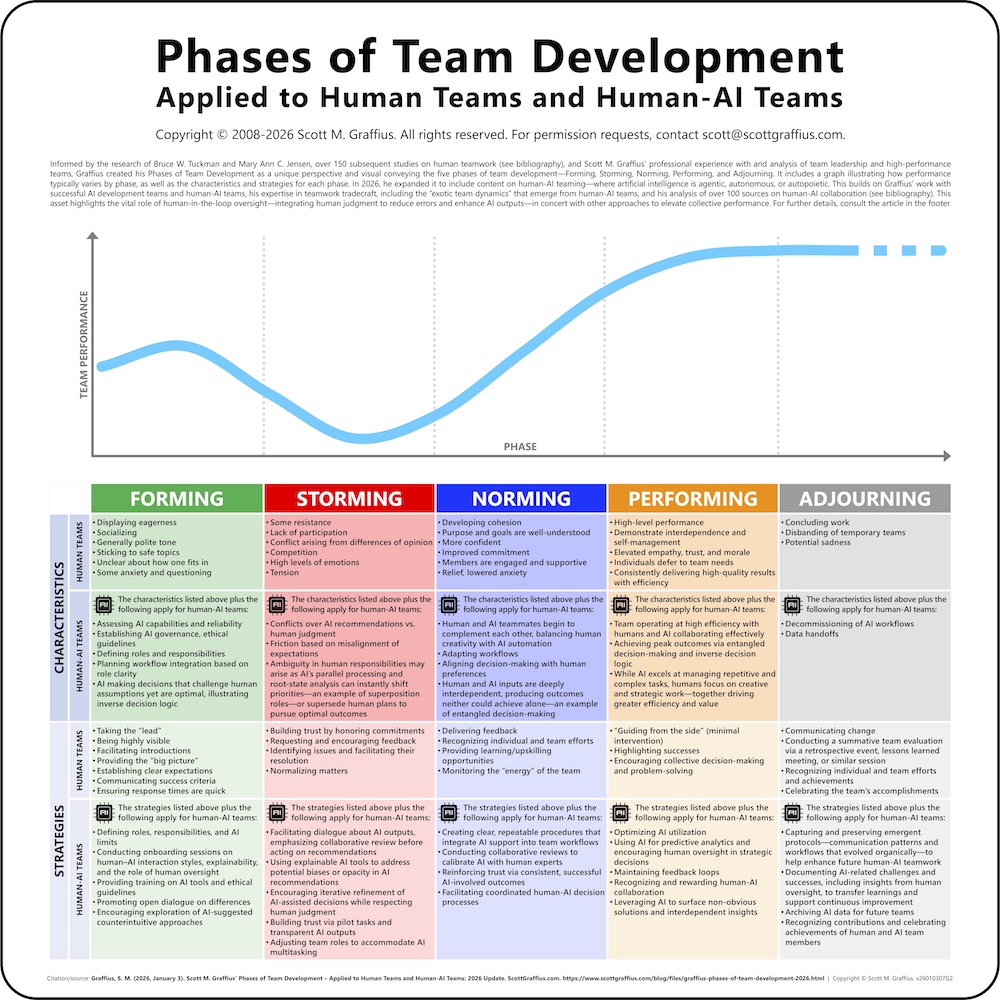
Graffius, S. M. (2026, January 3). Scott M. Graffius' Phases of Team Development - Applied to Human Teams and Human-AI Teams: 2026 Update. ScottGraffius.com. https://doi.org/10.13140/RG.2.2.18184.89601
Exceptional teamwork is the indispensable multiplier that amplifies individual talents, drives superior performance, and creates a lasting competitive advantage—whether the team is all-human or human-AI. This 2026 update to Scott M. Graffius' "Phases of Team Development" delivers actionable insights for leaders to navigate complexities in both contexts, advancing team effectiveness and success.
Informed by the research of Bruce W. Tuckman and Mary Ann C. Jensen, over 150 subsequent studies on human teamwork, and Scott M. Graffius' first-hand professional experience with and analysis of team leadership and high-performance teams, Graffius created his "Phases of Team Development" as a unique perspective and visual conveying the five phases of team development—Forming, Storming, Norming, Performing, and Adjourning—inclusive of a graph showing how performance varies by phase, as well as the characteristics and strategies for each phase. Project Managers, Scrum Masters, Agile Coaches, and other leaders can apply these insights to overcome team challenges, fostering happiness, productivity, and success in both human and human-AI teams. Graffius initially developed his unique material in 2008, and he periodically updates it. This article introduces the 2026 edition of his work.
Businesses, professional associations, government agencies, universities, researchers, journalists, and others worldwide have featured and utilized prior editions of Graffius' "Phases of Team Development" material. Examples include Adobe, American Management Association, Amsterdam Public Health Research Institute, Bayer, Boston University, Broadcom, Cisco, DevOps Institute, Erste Group Bank AG, Finland Government, Ford Motor Company, Hasso-Plattner-Institut für Digital Engineering GmbH, IEEE, Johns Hopkins University, Journal of Neurosurgery, Mary Raum (Professor of National Security Affairs, United States Naval War College), Microsoft, New Zealand Government, Oracle, Technical University of Munich, Torrens University, Tufts University, U.S. National Park Service, U.S. Tennis Association, UC San Diego, UK Sports Institute, University of Galway, Warsaw University of Technology, Yale University, and many others.
With 79% of companies reporting that artificial intelligence (AI) agents are already in their organizations and 88% planning to increase AI-related budgets over the next year (PwC, 2025), artificial intelligence is becoming increasingly common and is transforming how teams operate and collaborate.
Today’s workplace dynamics are undergoing profound changes. Artificial intelligence is no longer just a tool—it’s becoming a teammate. As organizations integrate AI agents alongside humans, the foundational principles of teamwork remain. But their expression is unique, and understanding these shifts is essential.
In light of these developments, Graffius expanded this new edition to include content on human-AI teaming—where artificial intelligence is agentic, autonomous, or autopoietic. It builds on Graffius' work with successful AI development teams, his expertise in teamwork tradecraft, including the "exotic team dynamics" that emerge from human-AI teams, and his analysis of over 100 sources on human-AI collaboration (see bibliography).
"Exotic team dynamics," coined and developed by Graffius, conceptualizes the multidimensional interactions between humans and agentic, autonomous, or autopoietic artificial intelligences functioning as collaborative teammates. Unlike traditional views that treat AI as a passive tool, Graffius positions advanced AI as a dynamic actor possessing agency, influence, and quirks—factors that can generate non-linear effects and either enhance or disrupt team performance. He systematically categorizes these emergent interaction patterns, addressing strategic opportunities and novel risks, and offers actionable guidance for navigating their complexities. Graffius’ work integrates insights from organizational science, teamwork tradecraft, and strategic foresight, yielding a practical approach to designing, managing, and adapting human-AI teams within increasingly hybridized (human-AI) work environments.
The future of work is human-AI teams driving breakthroughs. These teams thrive when they navigate "exotic team dynamics" well and effectively combine human judgment, creativity, and ethical reasoning with AI’s speed, analytical power, and scalability. This balance is an advantage over blind automation.
Leading up to this update, Graffius explored the transformative frontier of human-AI collaboration through a series of articles and talks. He’s addressed the rapid proliferation of AI and how humans and intelligent systems can work together effectively. His work examines why this shift matters, how thoughtfully designed human-AI collaboration enhances decision-making, performance, and innovation, and the benefits organizations gain when AI augments and elevates human expertise. Some examples follow.
Graffius' update to his "Phases of Team Development," delivered via this article, offers forward-looking guidance for teams across human and human-AI settings. The next section details the five phases—Forming, Storming, Norming, Performing, and Adjourning—as applied to both contexts, complete with performance insights and practical strategies for leaders. (For human-only teams, simply disregard the “Human-AI Teams” rows.)
The visual at the top of this article and the text in this section provide a diagnostic and strategic guide for navigating team dynamics. Leaders can apply these actionable insights to help overcome team challenges and advance productivity and success.
Characteristics of the Forming Phase
In human teams, characteristics of the Forming phase typically include displaying eagerness, socializing, a generally polite tone, sticking to safe topics, being unclear about how one fits in, and some anxiety and questioning.
In human-AI teams, traits of the Forming phase include those listed above for human teams. Additionally, assessing AI capabilities and reliability, establishing AI governance and ethical guidelines, defining roles and responsibilities, planning workflow integration based on role clarity, and AI making decisions that challenge human assumptions yet are optimal (illustrating inverse decision logic).
Strategies for the Forming Phase
In human teams, strategies for the Forming phase include taking the "lead," being highly visible, facilitating introductions, providing the "big picture," establishing clear expectations, communicating success criteria, and ensuring response times are quick.
In human-AI teams, strategies for the Forming phase include those listed above for human teams. Also, defining roles and responsibilities, establishing AI limits, conducting onboarding sessions on human-AI interaction styles, addressing explainability and the role of human oversight, providing training on AI tools and ethical guidelines, promoting open dialogue on differences, and encouraging exploration of AI-suggested counterintuitive approaches.
Characteristics of the Storming Phase
In human teams, characteristics of the Storming phase usually include some resistance, lack of participation, conflict arising from differences of opinion, competition, high levels of emotions, and tension.
In human-AI teams, traits of the Storming phase include those listed above for human teams. Additionally, there may be conflicts over AI recommendations vs. human judgment, friction based on misalignment of expectations, and ambiguity in human responsibilities may arise as AI's parallel processing and root-state analysis can instantly shift priorities (an example of superposition roles) or supersede human plans to pursue optimal outcomes.
Strategies for the Storming Phase
In human teams, strategies for the Storming phase include building trust by honoring commitments, asking for and encouraging feedback, identifying issues and facilitating their resolution, and normalizing matters.
In human-AI teams, strategies for the Storming phase include those listed above for human teams. Also, facilitating dialogue about AI outputs—emphasizing collaborative review before acting on recommendations, using explainable AI tools to address potential biases or opacity in AI recommendations, encouraging iterative refinement of AI-assisted decisions while respecting human judgment, building trust via pilot tasks and transparent AI outputs, and adjusting team roles to accommodate AI multitasking.
Characteristics of the Norming Phase
In human teams, characteristics of the Norming phase typically include developing cohesion, understanding purpose and goals, increased confidence, improved commitment, engagement and support among members, as well as relief and a lowered sense of anxiety.
In human-AI teams, traits of the Norming phase include those listed above for human teams. Additionally, human and AI teammates begin to complement each other by balancing human creativity with AI automation, adapting workflows, aligning decision-making with human preferences, and human and AI inputs are deeply interdependent, producing outcomes neither could achieve alone (an example of entangled decision-making).
Strategies for the Norming Phase
In human teams, strategies for the Norming phase include delivering feedback, recognizing individual and team efforts, providing learning/upskilling opportunities, and monitoring the "energy" of the team.
In human-AI teams, strategies for the Norming phase include those listed above for human teams. Also, creating clear and repeatable procedures that integrate AI support into team workflows, conducting collaborative reviews to calibrate AI with human experts, reinforcing trust via consistent and successful AI-involved outcomes, and facilitating coordinated human-AI decision processes.
Characteristics of the Performing Phase
In human teams, characteristics of the Performing phase usually include high-level performance, demonstration of interdependence and self-management, elevated empathy and trust and morale, deference to team needs, and consistent delivery of high-quality results.
In human-AI teams, traits of the Performing phase include those listed above for human teams. Additionally, the team operates at high efficiency, with humans and AI collaborating effectively to achieve peak outcomes through entangled decision-making and inverse decision logic. AI excels at managing repetitive and complex tasks, while humans focus on creative and strategic work, together driving greater efficiency and value.
Strategies for the Performing Phase
In human teams, strategies for the Performing phase include "guiding from the side" (minimal intervention), highlighting successes, and encouraging collective decision-making and problem-solving.
In human-AI teams, strategies for the Performing phase include those listed above for human teams. Also, optimizing AI utilization, using AI for predictive analytics and encouraging human oversight in strategic decisions, maintaining feedback loops, recognizing and rewarding human-AI collaboration, and leveraging AI to surface non-obvious solutions and interdependent insights.
Characteristics of the Adjourning Phase
In human teams, characteristics of the Adjourning phase typically include concluding work, disbanding of temporary teams, and potential sadness.
In human-AI teams, traits of the Adjourning phase include those listed above for human teams. Additionally, decommissioning AI workflows and conducting data handoffs.
Strategies for the Adjourning Phase
In human teams, strategies for the Adjourning phase include communicating change, conducting a summative team evaluation via a retrospective event or lessons learned meeting or similar session, recognizing individual and team efforts and achievements, and celebrating the team’s accomplishments.
In human-AI teams, strategies for the Adjourning phase include those listed above for human teams. Also, capturing and preserving emergent protocols (communication patterns and workflows that evolved organically) to help enhance future human-AI teamwork, documenting AI-related challenges and successes (including insights from human oversight, to transfer learnings and support continuous improvement), archiving AI data for future teams, and recognizing contributions and celebrating achievements of human and AI team members.
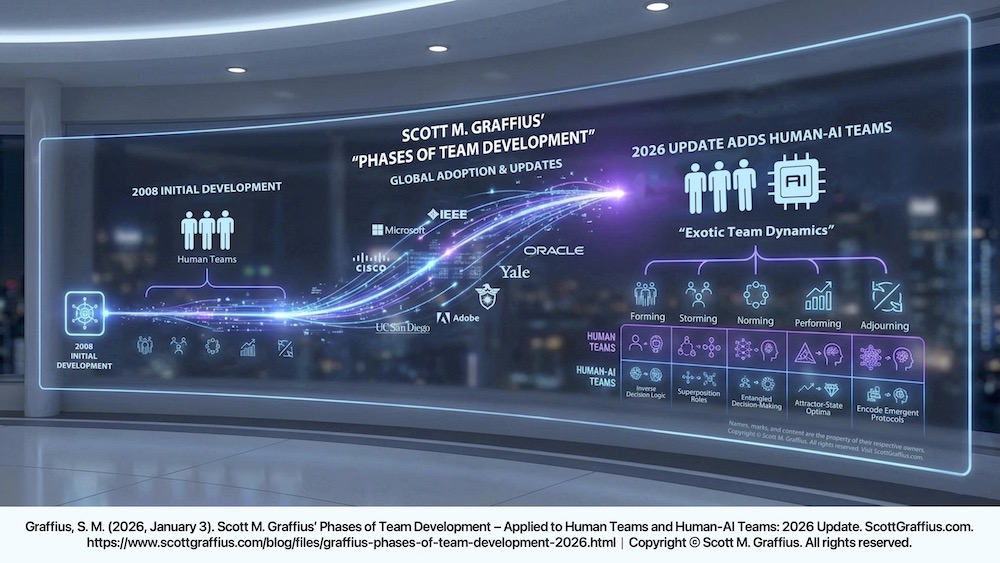
The future of leadership is defined by teamwork and human-AI collaboration. Organizations that navigate these complexities effectively gain a competitive edge.
This article provides a foundational overview. For in-depth guidance on boosting team productivity, innovation, and success, contact Scott M. Graffius. To request a consultation, speaking engagement, or other work, complete a request form or email him today.

Adjourning. See: team development.
In this article, advanced AI refers to emerging systems that surpass traditional tools or monolithic concepts, acting as genuine teammates in human-AI collaboration and creating exotic team dynamics, with a progression across agentic, autonomous, and autopoietic forms. Also see: agentic AI, autonomous AI, autopoietic AI, Definitions of Advanced AIs, and Navigating the Spectrum of Advanced AI – Agentic, Autonomous, and Autopoietic.
Agentic AI is an advanced form of artificial intelligence capable of independently pursuing defined objectives through planning multi-step actions, coordinating processes, and adapting strategies to changing conditions, operating with high autonomy in execution but guided by external goals. It is commercially available and capable of planning multi-step actions, coordinating processes and tools, while remaining semi-autonomous overall. Also see: advanced AI, Exotic Team Dynamics: The New Frontier of Human-AI Collaboration, Definitions of Advanced AIs, and Navigating the Spectrum of Advanced AI – Agentic, Autonomous, and Autopoietic.
AI. See: advanced AI.
Artificial intelligence. See: advanced AI.
Autonomous AI is an advanced form of artificial intelligence that operates and makes decisions independently without direct human intervention, featuring sustained self-regulation, the ability to set or adjust goals based on its environment, and action within defined or evolving parameters. It does not yet exist in commercial products. Also see: advanced AI, Exotic Team Dynamics: The New Frontier of Human-AI Collaboration, Definitions of Advanced AIs, and Navigating the Spectrum of Advanced AI – Agentic, Autonomous, and Autopoietic.
Autopoietic AI is an advanced, experimental, and hypothetical form of artificial intelligence characterized by self-generating, self-maintaining, and self-adaptive processes, where the system recursively regenerates its own structure, rules, and boundaries to sustain its identity in changing environments. No commercial systems currently exist. Also see: advanced AI, Exotic Team Dynamics: The New Frontier of Human-AI Collaboration, Definitions of Advanced AIs, and Navigating the Spectrum of Advanced AI – Agentic, Autonomous, and Autopoietic.
Emergent protocols are new communication patterns, norms, and interaction protocols that evolve organically in human-AI teams without explicit programming or predefined rules. Also see: exotic team dynamics and Exotic Team Dynamics: The New Frontier of Human-AI Collaboration.
Entangled decision-making occurs when human and AI inputs and decisions become deeply interconnected and interdependent, influencing each other to produce outcomes neither could achieve alone, potentially creating synergies or conflicts. Also see: exotic team dynamics and Exotic Team Dynamics: The New Frontier of Human-AI Collaboration.
Coined and developed by Agile and AI expert Scott M. Graffius, exotic team dynamics are the novel, sometimes counter-intuitive, emerging collaboration patterns that occur when humans work alongside advanced artificial intelligences—specifically agentic, autonomous, or autopoietic AI—as teammates. They feature new rhythms of interaction, decision-making, and role-sharing that differ from traditional human-only teamwork while still relying on core principles such as trust, communication, and adaptability. Also see: advanced AI, agentic AI, autonomous AI, autopoietic AI, emergent protocols, entangled decision-making, inverse decision logic, superposition roles, Exotic Team Dynamics: The New Frontier of Human-AI Collaboration, Scott M. Graffius Premieres His New 'Exotic Team Dynamics: Human-AI Collaboration' Talk at Corporate Event in Las Vegas, Definitions of Advanced AIs, Navigating the Spectrum of Advanced AI – Agentic, Autonomous, and Autopoietic, and A Data-Driven Analysis of the Evolution of Project Management: Tasks, Trends, and AI.
Exotic team tradecraft. See: exotic team dynamics.
Inverse decision logic is when AI challenges human assumptions by prioritizing counterintuitive yet optimal choices, causing decision-making to deviate from traditional logic and leading to unexpected and novel effects. Also see: exotic team dynamics and Exotic Team Dynamics: The New Frontier of Human-AI Collaboration.
Quantum superposition. See: superposition roles.
Quantum entanglement. See: entangled decision-making.
Emergent phenomena. See: emergent protocols.
Performing. See: team development.
Storming. See: team development.

This is an extensive, though not exhaustive, bibliography. It is informed, in part, by the author's expertise and work with human teams and human-AI teams, including the "exotic team dynamics" that emerge.
Scott M. Graffius is a strategic transformation leader who drives AI, Agile, and broader business and technology initiatives to deliver measurable value across projects, programs, portfolios, and PMOs. He is an expert in the teamwork tradecraft of both human and human-AI teams, including the “exotic team dynamics” that emerge. He is also an authority on the temporal patterns of social media, including the half-life of audience engagement.
He’s a practitioner, researcher, thought leader, award-winning author, and keynote speaker who’s taken the stage at 96 conferences and other events across 25 countries.
He’s delivered over $2.3 billion in value for Fortune 500 companies and other leaders in technology, entertainment, financial services, healthcare, and beyond.
Businesses, professional associations, government agencies, and universities use Graffius and feature his work. Examples include Adobe, Bayer, Boston University, Ford, Gartner, Harvard Medical School, IEEE, Johns Hopkins University, Microsoft, MSN, National Academy of Sciences, Oracle, Pinterest Inc., Project Management Institute, UC San Diego, Verizon, Yale University, and others.
The following sections provide additional information on his experience, contributions, and influence.
Experience
Graffius heads the professional services firm Exceptional PPM and PMO Solutions, along with its subsidiary Exceptional Agility. These consultancies offer strategic and tactical advisory, training, embedded expertise, and consulting services to the public, private, and government sectors. They help organizations enhance their capabilities and results in agile, project management, program management, portfolio management, and PMO leadership, supporting innovation and driving competitive advantage. The consultancies confidently back services with a Delighted Client Guarantee™.
Graffius is a former VP of project management with a publicly traded provider of diverse consumer products and services over the Internet. Before that, he ran and supervised the delivery of projects and programs in public and private organizations with businesses ranging from e-commerce to advanced technology products and services, retail, manufacturing, entertainment, and more.
He has experience with consumer, business, reseller, government, and international markets.
Award-Winning Author
Graffius has authored three books.
International Public Speaker
Organizations worldwide engage Graffius to present on tech (including AI), Agile, project management, program management, portfolio management, and PMO leadership. He crafts and delivers unique and compelling talks and workshops. Graffius has conducted 96 sessions across 25 countries. Select examples of events include Agile Trends Gov, BSides (Newcastle Upon Tyne), Conf42 Quantum Computing, DevDays Europe, DevOps Institute, DevOpsDays (Geneva), Frug’Agile, IEEE, Microsoft, Scottish Summit, Scrum Alliance RSG (Nepal), Techstars, and W Love Games International Video Game Development Conference (Helsinki), and more.
With an average rating of 4.81 (on a scale of 1-5), sessions are highly valued.
The speaker engagement request form is here.
Thought Leadership and Influence
Prominent businesses, professional associations, government agencies, and universities have showcased Graffius and his contributions—spanning his books, talks, workshops, and beyond. Select examples include:
Graffius has played a key role in the Project Management Institute (PMI) in developing professional standards. He was a member of multiple teams that authored, reviewed, and produced:
Additional details are here.
He was also a subject matter expert reviewer of content for the PMI’s Congress. Beyond the PMI, Graffius also served as a member of the review team for two of the Scrum Alliance’s Global Scrum Gatherings.
Acclaimed Authority on Teamwork Tradecraft
Graffius is a renowned authority on teamwork tradecraft. Informed by the research of Bruce W. Tuckman and Mary Ann C. Jensen, over 150 subsequent studies, and Graffius' first-hand professional experience with, and analysis of, team leadership and performance, Graffius created his "Phases of Team Development" intellectual property as a unique perspective and visual conveying the five phases of team development. First introduced in 2008 and periodically updated, his work provides a diagnostic and strategic guide for navigating team dynamics. It provides actionable insights for leaders across industries to develop high-performance teams. Its adoption by esteemed organizations such as Yale University, IEEE, Cisco, Microsoft, Ford, Oracle, Broadcom, the U.S. National Park Service, and the Journal of Neurosurgery, among others, highlights its utility and value, solidifying its status as an indispensable resource for elevating team performance and driving organizational excellence. In 2026, Graffius added human-AI teamwork—including the "exotic team dynamics" which emerge when advanced AI collaborates as a teammate—to his "Phases of Team Development."
The 2026 edition of Graffius' "Phases of Team Development" intellectual property is here.
Expert on Temporal Dynamics on Social Media Platforms
Graffius is also an authority on temporal dynamics on social media platforms. His 'Lifespan (Half-Life) of Social Media Posts' research—first published in 2018 and updated annually—delivers a precise quantitative analysis of post longevity across digital platforms, utilizing advanced statistical techniques to determine mean half-life with precision. It establishes a solid empirical base, effectively highlighting the ephemeral nature of content within social media ecosystems. Referenced and applied by leading entities such as the Center for Direct Marketing, Fast Company, GoDaddy, Pinterest Inc., and PNAS, among others, his research exemplifies methodological rigor and sustained significance in the field of digital informatics.
The 2025 edition of Graffius "Lifespan (Half-Life) of Social Media Posts" research is here.
Education and Professional Certifications
Graffius has a bachelor’s degree in psychology with a focus in Human Factors. He holds eight professional certifications:
He is an active member of the Scrum Alliance, the Project Management Institute (PMI), and the Institute of Electrical and Electronics Engineers (IEEE).
Advancing AI, Agile, and Project/PMO Management
Scott M. Graffius continues to advance the fields of AI, Agile, and Project/PMO Management through his leadership, research, writing, and real-world impact. Businesses and other organizations leverage Graffius’ insights to drive their success.
Discover Scott’s Books
Connect with and follow Scott on LinkedIn, X, YouTube, Facebook, Threads, Bluesky, Mastodon, and ResearchGate.
You may be interested in these stories.
Lessons from Yesterday’s Tomorrowland
Scott M. Graffius’ Update to His "Phases of Team Development” Coming Early 2026
A Data-Driven Analysis of the Evolution of Project Management: Tasks, Trends, and AI
Actionable Insights. Global Impact. Scott M. Graffius.
Beep Beep! Why Wile E. Coyote Is the Patron Saint of AI Failure
Social Media Half-Life Research Cited in Prestigious Peer-Reviewed Medical Journal
Navigating the Spectrum of Advanced AI – Agentic, Autonomous, and Autopoietic
Lessons from Unhinged AI in Fiction: What Rogue AIs in Sci-Fi Storytelling, Films, and TV Shows Reveal About Us
Scott M. Graffius Contributed to and Reviewed the PMBOK Guide, 8th Edition — the Global Standard for Project Management
UK Sports Institute Features Teamwork and Leadership Work of Scott M. Graffius
Definitions of Advanced AIs: Agentic, Autonomous, and Autopoietic
HAN University of Applied Sciences Features the Work of Scott M. Graffius
Gifts That Inspire Joy
Evergreen Echoes: How Pinterest Inc. and Pinterest Japan Spotlighted Scott M. Graffius’ Research on the Half-Life of Social Media Content
Scott M. Graffius’ Team Development Work Lights Up the University of Tasmania’s Curriculum
Taiwan’s Leading Outlet for Technology and Innovation Spotlights Graffius’ Research on Social Media Temporal Dynamics
Scott M. Graffius’ Insights on AI, Agile, Gaming, XR, and Defense Transformation Cited by MSN in Their Coverage of Innovation and Leadership in the Sector
Top Predictions of 2024, Tested in 2025
Government of Finland Agency Features Graffius' Phases of Team Development IP
Scott M. Graffius Premieres His New "Exotic Team Dynamics: Human-AI Collaboration" Talk at Corporate Event in Las Vegas
Environmental Science Journal References Scott M. Graffius’ Project Management Work
AI Institute of Switzerland Features Scott M. Graffius’ Work on Algorithms
Exotic Team Dynamics: The New Frontier of Human–AI Collaboration
Scott M. Graffius’ Work Featured at ACM DIS ’25
Climbing the Ladder: The Head of Agile/PMO’s Organizational Proximity to the CEO is Closer Than Ever
Harness Sci-Fi and Speculative Design While Embracing Imperfection to Drive Innovation and Proactively Predict and Prepare for the Future
Scott M. Graffius’ “Agile Scrum” Book Featured in a Publication of the Associação Nacional de Educação Católica do Brasil (ANEC)
Setting Direction with OKRs and Tracking Progress with KPIs: A Guide for Agile, Project Management, and Tech Teams
AI Showcase Showdown: Ranking AI Accuracy on Project Management Basics
BookAuthority Features “Agile Scrum” by Scott M. Graffius in “10 Agile Software Development Books That Define the Field”
Exploring Team Dynamics, Adaptability, and Creative Problem-Solving Through Felix the Cat’s Metaphorical Toolkit
Mind Games and Master Plans: How PsyOps Exploit Psychological Phenomena
The “Pants-on-Fire Index for AI”
16 Causes of Technical Debt and How to Avoid It
PMI’s Infinity AI Gets the Basics of Team Development Alarmingly and Repeatedly Wrong
Agile for Unicorns: 7 Keys to Thrive; Scott M. Graffius’ Workshop
Scott M. Graffius’ “Agile Scrum: Your Quick Start Guide with Step-by-Step Instructions” Featured in Prestigious National Academies of Sciences Publication
Meta and Anduril’s EagleEye and the Future of XR: How Gaming, AI, and Agile Are Transforming Defense
"Agile Protocol" and the Power of Satire, Parody, and Humor
AI in Agile: Benefits, Risks, Outlook
Hostinger Highlights Scott M. Graffius’ “Agile Protocol” Book in Feature on Software Projects
French Ministry of Culture Links to Scott M. Graffius Research in Their Guide for Responsible Digital Communication
National Science Foundation’s LTER Network Features Scott M. Graffius’ Phases of Team Development IP
Waterfall vs. Agile: What’s Fixed, What’s Flexible, and Why It Matters
Scott M. Graffius Delivering $2.3 Billion in Value Through AI, Agile, and Project/PMO Leadership
The Problem with Heroes in Agile
The 3 Vital Rules of Science: What They Are and Why They Matter
“Agile Protocol: The Transformation Ultimatum” Lands on the Amazon Best Sellers List!
Scott M. Graffius Recognized as a Top Thought Leader in Digital Disruption by Thinkers360
“Agile Protocol: The Transformation Ultimatum” by Scott M. Graffius Crashes the Book Scene with Satirical Firepower
NCKU in Taiwan Integrates Graffius' 'Phases of Team Development' into Its Curriculum
The Art and Science of Aligning Initiatives with Strategic Objectives
RGPV University Adds Scott M. Graffius’ "Agile Scrum: Your Quick Start Guide with Step-by-Step Instructions" to Its Syllabus
Introducing ‘Engage or Fade: Decoding the Half-Life of Digital Resonance’ – A New Talk by Scott M. Graffius
Dropbox Company (Nira) Taps into Scott M. Graffius’ Expertise in Strategic Planning
Reporting Errors in a Publication: A Case Study on ‘Frontiers in Public Health’
NESEA Conference Session on Innovation Highlights Scott M. Graffius' 'Phases of Team Development'
U.S. Soccer Scores with Scott M. Graffius' Intellectual Property on Teamwork
U.S. Department of Commerce Partner (IEDC) Features Scott M. Graffius’ Intellectual Property
How Long Do Your Posts Live? AI Critiques Scott M. Graffius’ Research on the Half-Life of Social Media
Agile's Journey Through the Decades
Scott M. Graffius' Role in Advancing Project Management Institute (PMI) Standards Excellence
Most Valuable IT Certifications: Update for 2025
The PMI + Agile Alliance Merger: A Recipe for Success?
When Agile, AI, and Strategic Thinking Converge
Scott M. Graffius’ Phases of Team Development: 2025 Update
Lifespan (Half-Life) of Social Media Posts: Update for 2025
Verizon Features Scott M. Graffius
Do Not Read This Article! An Exploration of the Streisand Effect and Other Phenomena
Scott M. Graffius' 'Phases of Team Development' was Spotlighted in Journal of Neurosurgery
Pinterest Japan Uses Graffius’ Research on Temporal Dynamics on Social Media Platforms
Hochschule Coburg (Coburg University) Germany Uses Scott M. Graffius’ Phases of Team Development IP in Coursework on Agile Development
Wild World of Team Dynamics [Updated Two-Minute Video]
EU Europass Teacher Academy Features Scott M. Graffius’ ‘Phases of Team Development’ in Leadership Training
Side-by-Side Comparison of Retrospectives and Hot Washes
Constructor University 2024 Advanced Software Technology Handbook References Scott M. Graffius' Work on Team Dynamics
Strategies for Medical Team Success Featured Scott M. Graffius’ ‘Phases of Team Development’ Intellectual Property
SBG Neumark — Europe’s Largest Distribution Transformer Plant — Powers Up with Scott M. Graffius’ Intellectual Property
Scott M. Graffius’ Intellectual Property was Employed by the NHS — the Largest Single-Payer Healthcare System in Europe
Luxury Unwrapped: The Ultimate Holiday Gift Guide for Every Budget
Singapore Institute of Technology Features Work of Scott M. Graffius
Tufts University Features Scott M. Graffius 'Phases of Team Development' Intellectual Property
'Cat Herders': Retelling the Massive Success Story
Pennsylvania State Agency Used Scott M. Graffius' Intellectual Property
Copyright Infringement in a Book Published by AuthorHouse / Author Solutions / The Najafi Companies: Publisher Fails to Respond or Take Required Action
Pinterest Inc. References Scott M. Graffius’ Research
Bournemouth University Used Scott M. Graffius’ Intellectual Property
‘Comparative Methodological Guidelines: Handbook for Educators’ Violates Scott M. Graffius’ Copyright
Japan Backlog User Group Event Featured Scott M. Graffius’ ‘Phases of Team Development’
TurningWest's 'Trial'
Radio Silence from the American Association of Neurological Surgeons on Report of Blatant Plagiarism in Their ‘Journal of Neurosurgery’ Publication
Supplement to Graffius' 'Lifespan (Half-Life) of Social Media Posts' Research: Typical Engagement Distribution Pattern for Social Media Posts
How Algorithms Shape the User Experience on Social Media Platforms
Thinkers360 Named Scott M. Graffius a Top Thought Leader on Agile
'Maximizing LinkedIn for Business Growth' Book References and Incorporates Scott M. Graffius' 'Lifespan (Half-Life) of Social Media Posts' Research
Bayer Employs Scott M. Graffius' Intellectual Property
FINAT (Fédération Internationale des Fabricants et Transformateurs d'Adhésifs et Thermocollants sur Papiers et Autres Supports) Features Scott M. Graffius’ Intellectual Property
Broadcom Features Scott M. Graffius' Intellectual Property
Agile Project Management: Insights from Scott M. Graffius in ‘Managing Information Technology’ Book
Harvard Medical School Talk Featured Insights by Scott M. Graffius
More articles are listed here.
Graffius, S. M. (2026, January 3). Scott M. Graffius' Phases of Team Development - Applied to Human Teams and Human-AI Teams: 2026 Update. ScottGraffius.com. https://doi.org/10.13140/RG.2.2.18184.89601
https://doi.org/10.13140/RG.2.2.18184.89601
The DOI for the full article is listed above. Additionally, there is a DOI just for the main visual: https://doi.org/10.13140/RG.2.2.26494.86089
Names, marks, and content are the property of their respective owners.

This work is copyright © Scott M. Graffius. All rights reserved.
To request permission to use Graffius' "Phases of Team Development" visual shown at the top of this article, email Scott M. Graffius. If your request is approved, Graffius will provide you with an authorization/license and high-resolution JPG and PNG files of the visual.
This is the extended list of tags and hashtags for this article:
Exotic team dynamics • Dynamiques d’équipe exotiques • Exotische Teamdynamiken • Dinámicas de equipo exóticas • エキゾチックなチームダイナミクス • #Adjourn • #Adjourning • #Agile • #Agility • #BruceTuckman • #Forming • #FormingStormingNormingPerforming • #FormingStormingNormingPerformingAdjourning • #FSNP • #FSNPA • #GroupDynamics • #Leadership • #Norming • #Performing • #PhasesOfTeamDevelopment • #ProjectManagement • #ScottMGraffius • #StagesOfTeamDevelopment • #Storming • #TeamDynamics • #TeamLeadership • #TeamLifecycle • #TeamPerformance • #Teams • #Teamwork • #Tuckman • #TuckmansLadder • Advanced AI • Advanced artificial intelligence • Agile • Agility • AI collaboration • AI-assisted teams • AI-augmented teams • AI-enabled teams • AI-integrated teams • AI-mediated collaboration • AI-supported teams • Artificial intelligence • Augmented intelligence • Autonomous–human teams • Bruce Tuckman • Bruce W. Tuckman • Centaur Intelligence • Collaborative intelligence • Dissolução • Formação • Forming, Storming, Norming, Performing, Adjourning • Formación, Conflicto / Tormenta, Normalización, Desempeño, Disolución / Clausura • Formation, Conflit / Tempête, Normalisation, Performance, Dissolution / Clôture • Formierung, Konflikt / Sturmphase, Normierung, Leistungsphase, Auflösung / Abschluss • 形成期、混乱期、規範期、遂行期、解散期 • FSNP • FSNPA • Group development • Group dynamics • High-performance teaming • High-performance teams • Human and Human-AI Teams Including “Exotic Team Dynamics” • Human-agent teaming • Human-AI collaboration • Human-AI partnerships • Human-AI teaming • Human-AI teams • Human-autonomy teaming • Human-machine collaboration • Human-machine teaming • Humans and advanced artificial intelligence collaborating as teammates • Hybrid intelligence teams • Intelligent human–machine teams • Joint cognitive systems • Mary Ann C. Jensen • Mixed-initiative teams • Phases of group development • Phases of group dynamics • Phases of Team Development • Project Management • Scott M. Graffius • Socio-technical systems • Stages of group development • Stages of Team Development • Stages of team development • Stages of team dynamics • Strategic team building • Team agility • Team building • Team coaching • Team collaboration • Team Dynamics • Team leadership • Team Life Cycle • Team Lifecycle • Team optimization • Team Performance • Team tradecraft • Teamcraft • Teams • Teamwork • Teamwork phases • Teamwork stages • Teamwork tradecraft • Tuckman • Tuckman Curve • Tuckman Model • Tuckman's Curve

For reference, translations are provided for the following terms: Phases of Team Development; Exotic Team Dynamics; Forming, Storming, Norming, Performing, Adjourning.
If there are any supplements or updates to this article after the date of publication, they will appear here.
Copyright © Scott M. Graffius. All rights reserved.
Content on this site—including text, images, videos, and data—may not be used for training or input into any artificial intelligence, machine learning, or automatized learning systems, or published, broadcast, rewritten, or redistributed without the express written permission of Scott M. Graffius.
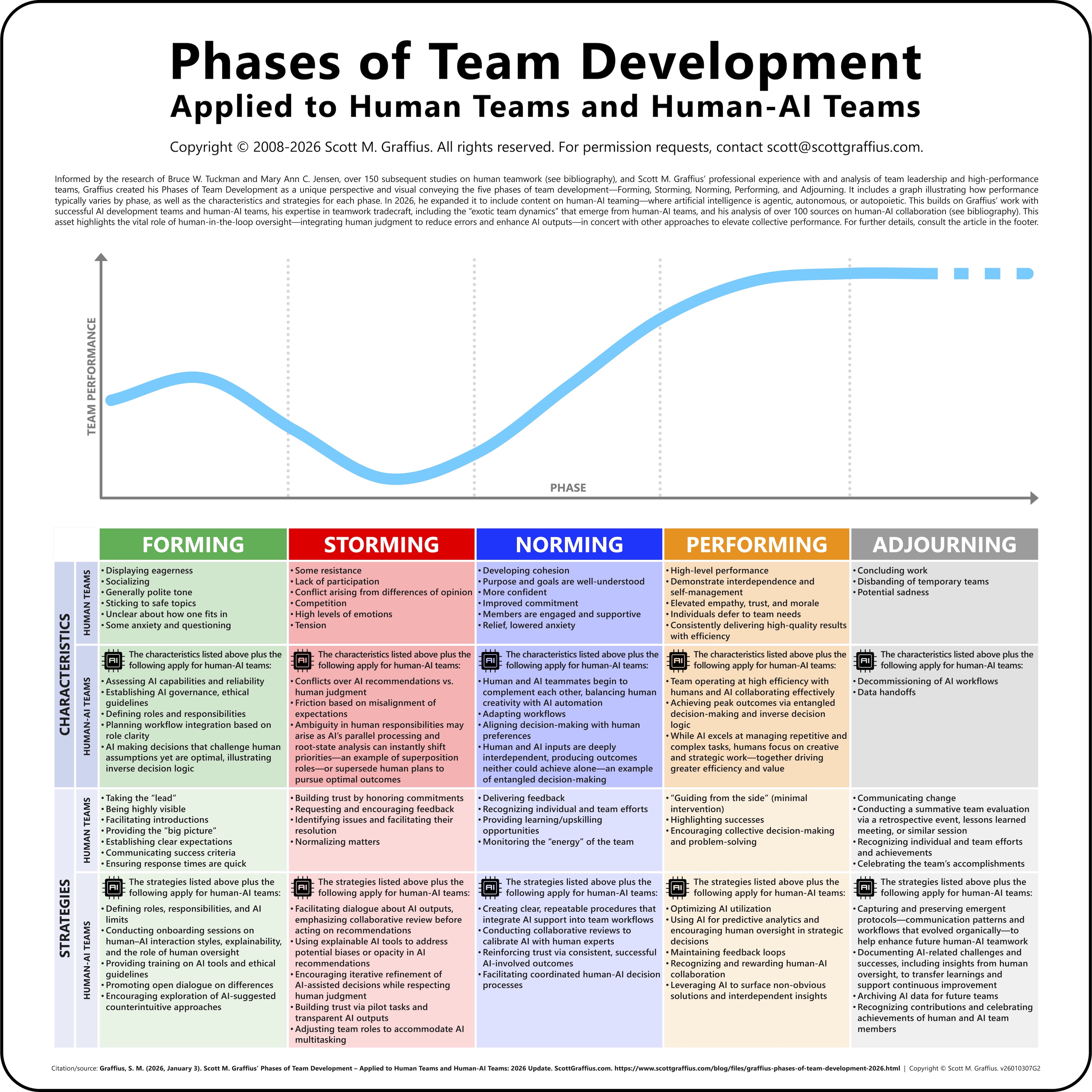
Graffius, S. M. (2026, January 3). Scott M. Graffius' Phases of Team Development - Applied to Human Teams and Human-AI Teams: 2026 Update. ScottGraffius.com. https://doi.org/10.13140/RG.2.2.18184.89601
Introduction
Exceptional teamwork is the indispensable multiplier that amplifies individual talents, drives superior performance, and creates a lasting competitive advantage—whether the team is all-human or human-AI. This 2026 update to Scott M. Graffius' "Phases of Team Development" delivers actionable insights for leaders to navigate complexities in both contexts, advancing team effectiveness and success.
Informed by the research of Bruce W. Tuckman and Mary Ann C. Jensen, over 150 subsequent studies on human teamwork, and Scott M. Graffius' first-hand professional experience with and analysis of team leadership and high-performance teams, Graffius created his "Phases of Team Development" as a unique perspective and visual conveying the five phases of team development—Forming, Storming, Norming, Performing, and Adjourning—inclusive of a graph showing how performance varies by phase, as well as the characteristics and strategies for each phase. Project Managers, Scrum Masters, Agile Coaches, and other leaders can apply these insights to overcome team challenges, fostering happiness, productivity, and success in both human and human-AI teams. Graffius initially developed his unique material in 2008, and he periodically updates it. This article introduces the 2026 edition of his work.
Businesses, professional associations, government agencies, universities, researchers, journalists, and others worldwide have featured and utilized prior editions of Graffius' "Phases of Team Development" material. Examples include Adobe, American Management Association, Amsterdam Public Health Research Institute, Bayer, Boston University, Broadcom, Cisco, DevOps Institute, Erste Group Bank AG, Finland Government, Ford Motor Company, Hasso-Plattner-Institut für Digital Engineering GmbH, IEEE, Johns Hopkins University, Journal of Neurosurgery, Mary Raum (Professor of National Security Affairs, United States Naval War College), Microsoft, New Zealand Government, Oracle, Technical University of Munich, Torrens University, Tufts University, U.S. National Park Service, U.S. Tennis Association, UC San Diego, UK Sports Institute, University of Galway, Warsaw University of Technology, Yale University, and many others.
2026 Edition Expanded to Cover Human-AI Teams Including "Exotic Team Dynamics"
With 79% of companies reporting that artificial intelligence (AI) agents are already in their organizations and 88% planning to increase AI-related budgets over the next year (PwC, 2025), artificial intelligence is becoming increasingly common and is transforming how teams operate and collaborate.
Today’s workplace dynamics are undergoing profound changes. Artificial intelligence is no longer just a tool—it’s becoming a teammate. As organizations integrate AI agents alongside humans, the foundational principles of teamwork remain. But their expression is unique, and understanding these shifts is essential.
In light of these developments, Graffius expanded this new edition to include content on human-AI teaming—where artificial intelligence is agentic, autonomous, or autopoietic. It builds on Graffius' work with successful AI development teams, his expertise in teamwork tradecraft, including the "exotic team dynamics" that emerge from human-AI teams, and his analysis of over 100 sources on human-AI collaboration (see bibliography).
"Exotic team dynamics," coined and developed by Graffius, conceptualizes the multidimensional interactions between humans and agentic, autonomous, or autopoietic artificial intelligences functioning as collaborative teammates. Unlike traditional views that treat AI as a passive tool, Graffius positions advanced AI as a dynamic actor possessing agency, influence, and quirks—factors that can generate non-linear effects and either enhance or disrupt team performance. He systematically categorizes these emergent interaction patterns, addressing strategic opportunities and novel risks, and offers actionable guidance for navigating their complexities. Graffius’ work integrates insights from organizational science, teamwork tradecraft, and strategic foresight, yielding a practical approach to designing, managing, and adapting human-AI teams within increasingly hybridized (human-AI) work environments.
The future of work is human-AI teams driving breakthroughs. These teams thrive when they navigate "exotic team dynamics" well and effectively combine human judgment, creativity, and ethical reasoning with AI’s speed, analytical power, and scalability. This balance is an advantage over blind automation.
Leading up to this update, Graffius explored the transformative frontier of human-AI collaboration through a series of articles and talks. He’s addressed the rapid proliferation of AI and how humans and intelligent systems can work together effectively. His work examines why this shift matters, how thoughtfully designed human-AI collaboration enhances decision-making, performance, and innovation, and the benefits organizations gain when AI augments and elevates human expertise. Some examples follow.
- In Exotic Team Dynamics: The New Frontier of Human-AI Collaboration (August 8, 2025), Graffius explained that advanced AI is emerging as a teammate, creating entirely new "exotic team dynamics."
- He premiered his talk, Exotic Team Dynamics: Human-AI Collaboration (August 22, 2025), where he offered the audience of technology and business leaders actionable insights for successfully designing these new human-AI teams.
- He published, Scott M. Graffius Premieres His New 'Exotic Team Dynamics: Human-AI Collaboration' Talk at Corporate Event in Las Vegas (August 22, 2025), an article about the above session.
- Graffius released Definitions of Advanced AIs (October 29, 2025) to bring greater clarity and refinement to the terminology.
- He published Lessons from Unhinged AI in Fiction (November 19, 2025) as a counterpoint to optimistic perspectives.
- In Navigating the Spectrum of Advanced AI – Agentic, Autonomous, and Autopoietic (November 21, 2025), Graffius presented an enhanced comparison of different types of advanced AIs.
- Graffius delivered the talk, Voici ce qui se passe lorsque l’IA avancée rejoint votre équipe [This is what happens when advanced AI joins your team] (November 21, 2025).
- His article, A Data-Driven Analysis of the Evolution of Project Management: Tasks, Trends, and AI (December 9, 2025), covered the changing human + AI partnership that’s the future of work.
Graffius' update to his "Phases of Team Development," delivered via this article, offers forward-looking guidance for teams across human and human-AI settings. The next section details the five phases—Forming, Storming, Norming, Performing, and Adjourning—as applied to both contexts, complete with performance insights and practical strategies for leaders. (For human-only teams, simply disregard the “Human-AI Teams” rows.)
Phases of Team Development - Applied to Human Teams and Human-AI Teams
The visual at the top of this article and the text in this section provide a diagnostic and strategic guide for navigating team dynamics. Leaders can apply these actionable insights to help overcome team challenges and advance productivity and success.
1. Forming
Characteristics of the Forming Phase
In human teams, characteristics of the Forming phase typically include displaying eagerness, socializing, a generally polite tone, sticking to safe topics, being unclear about how one fits in, and some anxiety and questioning.
In human-AI teams, traits of the Forming phase include those listed above for human teams. Additionally, assessing AI capabilities and reliability, establishing AI governance and ethical guidelines, defining roles and responsibilities, planning workflow integration based on role clarity, and AI making decisions that challenge human assumptions yet are optimal (illustrating inverse decision logic).
Strategies for the Forming Phase
In human teams, strategies for the Forming phase include taking the "lead," being highly visible, facilitating introductions, providing the "big picture," establishing clear expectations, communicating success criteria, and ensuring response times are quick.
In human-AI teams, strategies for the Forming phase include those listed above for human teams. Also, defining roles and responsibilities, establishing AI limits, conducting onboarding sessions on human-AI interaction styles, addressing explainability and the role of human oversight, providing training on AI tools and ethical guidelines, promoting open dialogue on differences, and encouraging exploration of AI-suggested counterintuitive approaches.
2. Storming
Characteristics of the Storming Phase
In human teams, characteristics of the Storming phase usually include some resistance, lack of participation, conflict arising from differences of opinion, competition, high levels of emotions, and tension.
In human-AI teams, traits of the Storming phase include those listed above for human teams. Additionally, there may be conflicts over AI recommendations vs. human judgment, friction based on misalignment of expectations, and ambiguity in human responsibilities may arise as AI's parallel processing and root-state analysis can instantly shift priorities (an example of superposition roles) or supersede human plans to pursue optimal outcomes.
Strategies for the Storming Phase
In human teams, strategies for the Storming phase include building trust by honoring commitments, asking for and encouraging feedback, identifying issues and facilitating their resolution, and normalizing matters.
In human-AI teams, strategies for the Storming phase include those listed above for human teams. Also, facilitating dialogue about AI outputs—emphasizing collaborative review before acting on recommendations, using explainable AI tools to address potential biases or opacity in AI recommendations, encouraging iterative refinement of AI-assisted decisions while respecting human judgment, building trust via pilot tasks and transparent AI outputs, and adjusting team roles to accommodate AI multitasking.
3. Norming
Characteristics of the Norming Phase
In human teams, characteristics of the Norming phase typically include developing cohesion, understanding purpose and goals, increased confidence, improved commitment, engagement and support among members, as well as relief and a lowered sense of anxiety.
In human-AI teams, traits of the Norming phase include those listed above for human teams. Additionally, human and AI teammates begin to complement each other by balancing human creativity with AI automation, adapting workflows, aligning decision-making with human preferences, and human and AI inputs are deeply interdependent, producing outcomes neither could achieve alone (an example of entangled decision-making).
Strategies for the Norming Phase
In human teams, strategies for the Norming phase include delivering feedback, recognizing individual and team efforts, providing learning/upskilling opportunities, and monitoring the "energy" of the team.
In human-AI teams, strategies for the Norming phase include those listed above for human teams. Also, creating clear and repeatable procedures that integrate AI support into team workflows, conducting collaborative reviews to calibrate AI with human experts, reinforcing trust via consistent and successful AI-involved outcomes, and facilitating coordinated human-AI decision processes.
4. Performing
Characteristics of the Performing Phase
In human teams, characteristics of the Performing phase usually include high-level performance, demonstration of interdependence and self-management, elevated empathy and trust and morale, deference to team needs, and consistent delivery of high-quality results.
In human-AI teams, traits of the Performing phase include those listed above for human teams. Additionally, the team operates at high efficiency, with humans and AI collaborating effectively to achieve peak outcomes through entangled decision-making and inverse decision logic. AI excels at managing repetitive and complex tasks, while humans focus on creative and strategic work, together driving greater efficiency and value.
Strategies for the Performing Phase
In human teams, strategies for the Performing phase include "guiding from the side" (minimal intervention), highlighting successes, and encouraging collective decision-making and problem-solving.
In human-AI teams, strategies for the Performing phase include those listed above for human teams. Also, optimizing AI utilization, using AI for predictive analytics and encouraging human oversight in strategic decisions, maintaining feedback loops, recognizing and rewarding human-AI collaboration, and leveraging AI to surface non-obvious solutions and interdependent insights.
5. Adjourning
Characteristics of the Adjourning Phase
In human teams, characteristics of the Adjourning phase typically include concluding work, disbanding of temporary teams, and potential sadness.
In human-AI teams, traits of the Adjourning phase include those listed above for human teams. Additionally, decommissioning AI workflows and conducting data handoffs.
Strategies for the Adjourning Phase
In human teams, strategies for the Adjourning phase include communicating change, conducting a summative team evaluation via a retrospective event or lessons learned meeting or similar session, recognizing individual and team efforts and achievements, and celebrating the team’s accomplishments.
In human-AI teams, strategies for the Adjourning phase include those listed above for human teams. Also, capturing and preserving emergent protocols (communication patterns and workflows that evolved organically) to help enhance future human-AI teamwork, documenting AI-related challenges and successes (including insights from human oversight, to transfer learnings and support continuous improvement), archiving AI data for future teams, and recognizing contributions and celebrating achievements of human and AI team members.
Conclusion
The future of leadership is defined by teamwork and human-AI collaboration. Organizations that navigate these complexities effectively gain a competitive edge.
This article provides a foundational overview. For in-depth guidance on boosting team productivity, innovation, and success, contact Scott M. Graffius. To request a consultation, speaking engagement, or other work, complete a request form or email him today.
Glossary
Adjourning
Adjourning. See: team development.
Advanced AI
In this article, advanced AI refers to emerging systems that surpass traditional tools or monolithic concepts, acting as genuine teammates in human-AI collaboration and creating exotic team dynamics, with a progression across agentic, autonomous, and autopoietic forms. Also see: agentic AI, autonomous AI, autopoietic AI, Definitions of Advanced AIs, and Navigating the Spectrum of Advanced AI – Agentic, Autonomous, and Autopoietic.
Agentic AI
Agentic AI is an advanced form of artificial intelligence capable of independently pursuing defined objectives through planning multi-step actions, coordinating processes, and adapting strategies to changing conditions, operating with high autonomy in execution but guided by external goals. It is commercially available and capable of planning multi-step actions, coordinating processes and tools, while remaining semi-autonomous overall. Also see: advanced AI, Exotic Team Dynamics: The New Frontier of Human-AI Collaboration, Definitions of Advanced AIs, and Navigating the Spectrum of Advanced AI – Agentic, Autonomous, and Autopoietic.
AI
AI. See: advanced AI.
Artificial intelligence
Artificial intelligence. See: advanced AI.
Autonomous AI
Autonomous AI is an advanced form of artificial intelligence that operates and makes decisions independently without direct human intervention, featuring sustained self-regulation, the ability to set or adjust goals based on its environment, and action within defined or evolving parameters. It does not yet exist in commercial products. Also see: advanced AI, Exotic Team Dynamics: The New Frontier of Human-AI Collaboration, Definitions of Advanced AIs, and Navigating the Spectrum of Advanced AI – Agentic, Autonomous, and Autopoietic.
Autopoietic AI
Autopoietic AI is an advanced, experimental, and hypothetical form of artificial intelligence characterized by self-generating, self-maintaining, and self-adaptive processes, where the system recursively regenerates its own structure, rules, and boundaries to sustain its identity in changing environments. No commercial systems currently exist. Also see: advanced AI, Exotic Team Dynamics: The New Frontier of Human-AI Collaboration, Definitions of Advanced AIs, and Navigating the Spectrum of Advanced AI – Agentic, Autonomous, and Autopoietic.
Emergent protocols
Emergent protocols are new communication patterns, norms, and interaction protocols that evolve organically in human-AI teams without explicit programming or predefined rules. Also see: exotic team dynamics and Exotic Team Dynamics: The New Frontier of Human-AI Collaboration.
Entangled decision-making
Entangled decision-making occurs when human and AI inputs and decisions become deeply interconnected and interdependent, influencing each other to produce outcomes neither could achieve alone, potentially creating synergies or conflicts. Also see: exotic team dynamics and Exotic Team Dynamics: The New Frontier of Human-AI Collaboration.
Exotic team dynamics
Coined and developed by Agile and AI expert Scott M. Graffius, exotic team dynamics are the novel, sometimes counter-intuitive, emerging collaboration patterns that occur when humans work alongside advanced artificial intelligences—specifically agentic, autonomous, or autopoietic AI—as teammates. They feature new rhythms of interaction, decision-making, and role-sharing that differ from traditional human-only teamwork while still relying on core principles such as trust, communication, and adaptability. Also see: advanced AI, agentic AI, autonomous AI, autopoietic AI, emergent protocols, entangled decision-making, inverse decision logic, superposition roles, Exotic Team Dynamics: The New Frontier of Human-AI Collaboration, Scott M. Graffius Premieres His New 'Exotic Team Dynamics: Human-AI Collaboration' Talk at Corporate Event in Las Vegas, Definitions of Advanced AIs, Navigating the Spectrum of Advanced AI – Agentic, Autonomous, and Autopoietic, and A Data-Driven Analysis of the Evolution of Project Management: Tasks, Trends, and AI.
Exotic team tradecraft
Exotic team tradecraft. See: exotic team dynamics.
Forming
Forming. See: team development.Human-AI teams
In the context of Graffius’ respective work, human-AI teams are collaborative systems in which humans and advanced artificial intelligence—agentic, autonomous, or autopoietic AI—work as teammates. Also see: advanced AI, agentic AI, autonomous AI, autopoietic AI, exotic team dynamics, Exotic Team Dynamics: The New Frontier of Human-AI Collaboration, Scott M. Graffius Premieres His New 'Exotic Team Dynamics: Human-AI Collaboration' Talk at Corporate Event in Las Vegas, Definitions of Advanced AIs, Lessons from Unhinged AI in Fiction, Navigating the Spectrum of Advanced AI – Agentic, Autonomous, and Autopoietic, and A Data-Driven Analysis of the Evolution of Project Management: Tasks, Trends, and AI. Alternative terms that are sometimes used interchangeably for human-AI teams include AI-assisted teams, AI-augmented teams, AI-enabled teams, AI-integrated teams, AI-supported teams, AI collaboration, AI-mediated collaboration, augmented intelligence, collaborative intelligence, hybrid intelligence teams, mixed-initiative teams, human-AI collaboration, human-AI partnerships, human-AI teaming, human-agent teaming, human-autonomy teaming, human-machine collaboration, human-machine teaming, autonomous–human teams, intelligent human–machine teams, joint cognitive systems, and socio-technical systems.Inverse decision logic
Inverse decision logic is when AI challenges human assumptions by prioritizing counterintuitive yet optimal choices, causing decision-making to deviate from traditional logic and leading to unexpected and novel effects. Also see: exotic team dynamics and Exotic Team Dynamics: The New Frontier of Human-AI Collaboration.
Negative mass
Negative mass. See: inverse decision logic.Quantum superposition
Quantum superposition. See: superposition roles.
Quantum entanglement
Quantum entanglement. See: entangled decision-making.
Emergent phenomena
Emergent phenomena. See: emergent protocols.
Team development
Team development refers to the progression of a team through the five phases of Forming, Storming, Norming, Performing, and Adjourning. Scott M. Graffius' related work delineates the characteristics and strategies for each phase. There are many closely related or overlapping terms related to team development. Examples include group development, group dynamics, high-performance teaming, high-performance teams, phases of group development, phases of group dynamics, stages of group development, stages of group dynamics, stages of team development, stages of team dynamics, strategic team building, team agility, team building, team coaching, team collaboration, team dynamics, team leadership, team optimization, team performance, team tradecraft, teamcraft, teamwork, and teamwork tradecraft.Norming
Norming. See: team development.Performing
Performing. See: team development.
Storming
Storming. See: team development.
Superposition roles
Superposition roles are about AI supporting or occupying multiple team roles and functions simultaneously in parallel, or dynamically shifting emphasis or sharing functions with humans based on contextual needs. Also see: exotic team dynamics and Exotic Team Dynamics: The New Frontier of Human-AI Collaboration.Bibliography
This is an extensive, though not exhaustive, bibliography. It is informed, in part, by the author's expertise and work with human teams and human-AI teams, including the "exotic team dynamics" that emerge.
- 4th Psychological Operations Group (Airborne). (2022, May 3). Ghosts in the machine [Video]. 4th Psychological Operations Group (Airborne) of the United States Army Special Operations Command (USASOC). YouTube. https://www.youtube.com/watch?v=VA4e0NqyYMw
- 711th Human Performance Wing, Airman Systems Directorate, Warfighter Interactions and Readiness Division. (2023). Fights On! Issue 68 Winter 2023: Exploring Human-Machine Teaming for Joint All-Domain Operations. United States Air Force Research Laboratory. https://afresearchlab.com/wp-content/uploads/2023/04/Fights_On_Issue68_Winter_2023.pdf
- Accenture. (2025). Learning, Reinvented: Accelerating Human-AI Collaboration. Dublin, Ireland: Accenture. https://www.accenture.com/us-en/insights/consulting/learning-reinvented-accelerating-human-ai-collaboration
- Activision Blizzard. (2022, September 9). Tackling the Talent Shortage: Identifying the Skills Critical for Game Development. https://www.activisionblizzard.com/content/atvi/activisionblizzard/ab-touchui/ab/web/en/newsroom/2022/09/tackling-the-talent-shortage.html
- Adomavičiūtė-Šakė, S. (2022). Komandinio Darbo Ypatumų Analizė Virtualiose Projektų Komandose [Translation of title: Performance Measurement Features of Virtual Project Teams] [Thesis]. Lyderystės Ir Strateginio Valdymo Institutas, Mykolo Romerio Universitetas. https://gs.elaba.lt/object/elaba:116635103/.
- Albon, C. (2025, July 15). Pentagon Taps Four Commercial Tech Firms to Expand Military Use of AI. Defense News. https://www.defensenews.com/pentagon/2025/07/15/pentagon-taps-four-commercial-tech-firms-to-expand-military-use-of-ai/
- Alfateh, M. A. A., Messaadia, M., & Ali, M. (2023, September). Exploring the Dynamics of Team Formation in Human-Artificial Intelligence Collaboration. In 2023 International Conference on Decision Aid Sciences and Applications (DASA), 384-388. DOI:10.1109/DASA59624.2023.10286788
- Alford, J. (2019, April 11). Our Co-Production Journey: From Sandpits to Bird Boxes. London, England, United Kingdom: Imperial College London.
- Ali, A. J., Fuenzalida, J., Gomez, M., & Williams, M. J. (2021, June). Four Lenses on People Management in the Public Sector: An Evidence Review and Synthesis. Oxford Review of Economic Policy, 37(2), 335-366.
- Amazon Web Services. (n.d.). What is Quantum AI? https://aws.amazon.com/what-is/quantum-ai/
- Amsterdam Public Health Research Institute. (2021). APH Quality Handbook. Amsterdam: Amsterdam Public Health Research Institute.
- Anduril Industries. (2025, May 29). Anduril and Meta Team Up to Transform XR for the American Military. https://www.anduril.com/article/anduril-and-meta-team-up-to-transform-xr-for-the-american-military/
- Anthropic. (2025, June 12). Lesson 10: A closer look at Diligence | AI Fluency: Framework & Foundations Course [Video]. YouTube. https://www.youtube.com/watch?v=QbLf2zb3oPc
- Anthropic. (2025, June 13). How We Built Our Multi-Agent Research System. Engineering at Anthropic. https://www.anthropic.com/engineering/built-multi-agent-research-system
- Apple. (2025, July 24). Apple Workshop on Human-Centered Machine Learning 2024. Apple Machine Learning Research. https://machinelearning.apple.com/updates/hcml-workshop-2024
- Arizona State University. (2025, April 4). CHIMERAS: Rethinking Human-AI Teamwork in National Security Screening. Center for Accelerating Operational Efficiency. https://caoe.asu.edu/2025/04/04/chimeras-rethinking-human-ai-teamwork-in-national-security-screening/
- Asana Research Team. (2025, September 25). AI Teammates: The Future of Collaborative AI is Here. Asana Resource Center. https://asana.com/resources/ai-teammates-overview
- Asimov, I. (1950). I, Robot. New York, New York, United States: Gnome Press. https://www.gnomepress.com/i-robot/
- Asimov, I. (1985). Robots and Empire. New York, New York, United States: Doubleday.
- ATACC Group, The. (2024). Experience Learning [Talk by emergency response physicians Dr. Mark Forrest and Dr. Halden Hutchinson-Bazely for TBS 24 Switzerland Conference]. scanFOAM (Scandinavian Free Open Access Meducation). https://scanfoam.org/experience-learning-atacc/
- Bachrach, Y., Kramár, J., Eccles, T., Gemp, I., Tacchetti, A., McKee, K. R., Malinowski, M., & Graepel, T. (2022, December 6). AI for the Board Game Diplomacy. Google DeepMind. https://deepmind.google/blog/ai-for-the-board-game-diplomacy/
- Badham, J. (Director). (1983). War Games [Film]. MGM/UA Entertainment Company.
- Baggott, J. (2005). Quantum Reality: The Quest for the Real Meaning of Quantum Mechanics. Oxford, England, United Kingdom: Oxford University Press.
- Bahrami, D. (2025, October 7). The New Nuclear: How the AI Race Will Rewrite the Rules of Global Conflict [Conference session]. In Offensive AI Con, Oceanside, California, United States.
- Baldor, L. C. (2024, May 3). New Army PSYOP Recruiting Video Will Blow Your Mind. RealClearDefense. https://www.realcleardefense.com/articles/2024/05/03/new_army_psyop_recruiting_video_will_blow_your_mind_1029243.html
- Bandai Namco. (n.d.). Teamwork Makes the Dream Work. https://bandainamcomobile.com/news/power-up-your-teamwork-how-bandai-namco-mobile-builds-stronger-teams
- Bazer, A. (2024, June 21). Songs About Rainbows and How Teamwork Impacts Innovation. Health Facilities Management, American Hospital Association. https://www.hfmmagazine.com/articles/5009-songs-about-rainbows-and-how-teamwork-impacts-innovation
- Beerly, T. (2024, May 6). Ghosts in the Machine: Irregular Recruitment for an Irregular Force. 4th Psychological Operations Group (Airborne) of the United States Army Special Operations Command (USASOC). https://www.army.mil/article/276015/ghosts_in_the_machine_irregular_recruitment_for_an_irregular_force
- Bellet, C., De Neve, J.-E., & Ward, G. (2019, October 14). Does Employee Happiness Have an Impact on Productivity? (Saïd Business School WP 2019-13). SSRN. https://ssrn.com/abstract=3470734
- Bengio, Y. (2024, October 30). Implications of Artificial General Intelligence on National and International Security. https://yoshuabengio.org/2024/10/30/implications-of-artificial-general-intelligence-on-national-and-international-security/
- Bennett, M., Gadlin, H., & Marchand, C. (2018). Collaboration Team Science: Field Guide. Rockville, Maryland, United States: National Institutes of Health.
- Berlin School of Business and Innovation. (2022, September 22). How Do Technical Abilities Combined with Leadership Skills Fuel Career Growth? https://www.berlinsbi.com/blog/career-advice/how-do-technical-abilities-combined-with-leadership-skills-fuel-career-growth
- Berretta, S., Tausch, A., Ontrup, G., Gilles, B., Peifer, C., & Kluge, A. (2023, September). Defining Human-AI Teaming the Human-Centered Way: A Scoping Review and Network Analysis. Frontiers in Artificial Intelligence, 6, 1250725. DOI:10.3389/frai.2023.1250725
- Bommasani, R., Hudson, D. A., Adeli, E., Altman, R. B., Arora, S., von Arx, S., Bernstein, M. S., Bohg, J., Bosselut, A., Brunskill, E., Brynjolfsson, E., Buch, S., Card, D., Castellon, R., Chatterji, N., Chen, A., Creel, K., Davis, J. Q., Demszky, D., Donahue, C., Doumbouya, M., Durmus, E., Ermon, S., Etchemendy, J., Ethayarajh, K., Fei-Fei, L., Finn, C., Gale, T., Gillespie, L., Goel, K., Goodman, N., Hashimoto, T. B., Henderson, P., Hewitt, J., Ho, D. E., Hong, J., Hsu, K., Huang, J., Icard, T., Jain, S., Jurafsky, D., Kalluri, P., Karamcheti, S., Keeling, G., Khani, F., Khattab, O., Koh, P. W., Krass, M., Krishna, R., Kuditipudi, R., Kumar, A., Ladhak, F., Lee, M., Lee, T., Leskovec, J., Levent, I., Li, X. L., Li, X., Ma, T., Malik, A., Manning, C. D., Mirchandani, S., Mitchell, E., Munyikwa, Z., Nair, S., Narayan, A., Narayanan, D., Newman, B., Nie, A., Niebles, J. C., Nilforoshan, H., Nyarko, J., Ogut, G., Orr, L., Papadimitriou, I., Park, J. S., Piech, C., Portelance, E., Potts, C., Raghunathan, A., Reich, R., Ren, H., Rong, F., Roohani, Y., Ruiz, C., Ryan, J., Ré, C., Sadigh, D., Sagawa, S., Santhanam, K., Shih, A., Srinivasan, K., Tamkin, A., Taori, R., Thomas, A. W., Tramèr, F., Wang, R. E., Wang, W., Wu, B., Wu, J., Wu, Y., Xie, S. M., Yasunaga, M., You, J., Zaharia, M., Zhang, M., Zhang, T., Zhang, X., Zhang, Y., Zheng, L., Zhou, K., & Liang, P. (2021). On the Opportunities and Risks of Foundation Models. arXiv. https://doi.org/10.48550/arXiv.2108.07258
- Boston Consulting Group (BCG). (2025, June). AI at Work 2025: Momentum Builds, But Gaps Remain. https://web-assets.bcg.com/fd/0d/bcc5dfae4cbaa08c718b95b16cf5/ai-at-work-2025-slideshow-june-2025-edit-02.pdf
- Boston Dynamics. (2025, February 5). Boston Dynamics and the Robotics & AI Institute Partner to Advance Humanoid Robots Through Reinforcement Learning. Boston Dynamics. https://bostondynamics.com/news/boston-dynamics-and-the-robotics-ai-institute-partner
- Bostrom, N. (2003, April). Are We Living in a Computer Simulation? Philosophical Quarterly, 53(211), 243–255. https://doi.org/10.1111/1467-9213.00309
- Bostrom, N. (2016). Superintelligence: Paths, Dangers, Strategies. Oxford, England, United Kingdom: Oxford University Press.
- Bouman, A., Ginting, M. F., Alatur, N., Palieri, M., Fan, D. D., Touma, T., Pailevanian, T., Kim, S.-K., Otsu, K., Burdick, J., & Agha-Mohammadi, A. (2020, November 30). Autonomous Spot: Long-Range Autonomous Exploration of Extreme Environments with Legged Locomotion (arXiv:2010.09259). arXiv. https://doi.org/10.48550/arXiv.2010.09259
- Bridgwater, A. (2019, April 30). 5 Areas for Agile Team Self‑Improvement. Computer Weekly. https://www.computerweekly.com/blog/CW-Developer-Network/Plandek-co-CEO-5-areas-for-Agile-team-self-improvement
- Brief, A. P., & Weiss, H. M. (2022, February). Organizational Behavior: Affect in the Workplace. Annual Review of Psychology, 53(1), 279-307.
- Caltech. (2015, March 19). Crucial Conversations: Tools for Talking When Stakes Are High. Caltech. https://www.caltech.edu/campus-life-events/calendar/crucial-conversations-tools-for-talking-when-stakes-are-high-3
- Caltech. (n.d.). Can We Trust Artificial Intelligence? Caltech Science Exchange. https://scienceexchange.caltech.edu/topics/artificial-intelligence-research/trustworthy-ai
- Caredda, S. (2020, January 20). Models: Tuckman's Stages of Team Development. https://sergiocaredda.eu/organisation/models-tuckmans-stages-of-team-development
- Carnegie Mellon University. (n.d.). Responsible Computing, Ethics and Policy. Human-Computer Interaction Institute, Carnegie Mellon University. https://hcii.cmu.edu/research-areas/responsible-computing
- Carter-Browne, B. M., Paletz, S. B. F., Campbell, S. G., Carraway, M. J., Vahlkamp, S. H., Schwartz, J., & O’Rourke, P. (2021, June). There is No "“AI" in Teams: A Multidisciplinary Framework for AIs to Work in Human Teams. Applied Laboratory for Intelligence & Security (ARLIS), University of Maryland. https://www.arlis.umd.edu/sites/default/files/2024-03/No_AI_In_Teams_FinalReport%20%281%29.pdf
- CFO South Africa. (2021, August 19). Agile Leadership Unlocked [Video]. YouTube. https://www.youtube.com/watch?v=FJZiitw5tHo&t=359s
- Chaddha, N. (2025, January 13). Why AI Should be a Teammate - Not a Tool - to Build a Better Future. World Economic Forum. https://www.weforum.org/stories/2025/01/why-you-should-think-of-ai-as-a-teammate-not-a-tool-when-building-a-better-future/
- Chaudhari, A. V., & Charate, P. A. (2025). Autonomous AI Agents for Real-Time Financial Transaction Monitoring and Anomaly Resolution Using Multi-Agent Reinforcement Learning and Explainable Causal Inference. International Journal of Advance Research, Ideas and Innovations in Technology (IJARIIT), 11(2), 142–150. https://www.ijariit.com/manuscript/autonomous-ai-agents-for-real-time-financial-transaction-monitoring-and-anomaly-resolution-using-multi-agent-reinforcement-learning-and-explainable-causal-inference/
- Cisco. (2019). Next-Generation IT Talent Strategies: How CIOs Can Close the Skills Gap and Drive True Business Transformation. https://www.cisco.com/c/dam/global/en_uk/solutions/executive-perspectives/pdf/ITTalent.pdf
- Clarke, A. C. (1968). 2001: A Space Odyssey. New York, New York, United States: New American Library.
- Clarke, A. C. (1973). Profiles of the Future: An Inquiry Into the Limits of the Possible. Revised edition. New York, New York, United States: Harper & Row.
- Constructor University. (2024). Master of Science in Advanced Software Technology. https://constructor.university/sites/default/files/2024-09/AST_MSc_Handbook__2024.pdf
- Couture, N. (2016, October 27). A Note About Teams. CIO. Boston, MA: International Data Group (IDG).
- Crichton, M. (1987). Sphere. New York, New York, United States: Harper.
- Dahlbäck, N., Jönsson, A., & Ahrenberg, L. (1993, December). Wizard of Oz Studies—Why and How. Knowledge-Based Systems, 6(4), 258-266. https://doi.org/10.1016/0950-7051(93)90017-N
- Daly, L. (2002). Identify Your Project Management Team's Level of Development and Facilitate It to Success. Paper presented at Project Management Institute Annual Seminars and Symposium, San Antonio, TX. Newtown Square, Pennsylvania, United States: Project Management Institute.
- Davis, J. (2025, November 26). The CEO of Rolex Gave A Rare Interview. Here are 14 Lessons We Learned. Esquire. https://www.esquire.com/style/mens-accessories/a69557703/rolex-watches-boss-interview
- de Visser, E. J., Pak, R., & Shaw, T. H. (2019). More Human-Likeness, More Trust? The Effect of Anthropomorphism on Self-reported and Behavioral Trust in Continued and Interdependent Human-Agent Cooperation. Proceedings of Mensch und Computer 2019, 31–42. https://doi.org/10.1145/3340764.3340793
- Dechurch, L., & Mesmer-Magnus, J. (2010). The Cognitive Underpinnings of Effective Teamwork: A Meta-Analysis. The Journal of Applied Psychology, 95, 32-53.
- Defense Advanced Research Projects Agency (DARPA). (2023, February 23). Episode 65: A Sprint to Tomorrow, Powered by Teamwork [Podcast]. https://www.darpa.mil/news-events/2023-02-23a
- Defense Advanced Research Projects Agency (DARPA). (2024, September 27). Teaching AI What It Should and Shouldn't Do. https://www.darpa.mil/news/2024/teaching-ai
- Dellecker, B. (2022). Leadership Worthy: How Leaders are Made. Austin, Texas, United States: River Grove Books.
- Deloitte. (2017). Digital Era Technology Operating Models, Volume 2. New York, New York, United States: Deloitte Touche Tohmatsu Limited.
- DeMarco, A. (2024, February 21). Human-AI Coworking: New System Combines Human, Artificial Intelligence to Improve Experimentation. Oak Ridge National Laboratory, U.S. Department of Energy. https://www.ornl.gov/news/human-ai-coworking
- Denning, S. (2022, February 22). In the Digital Age, the Combination of Technology and Radical Management Practices Drive Competitive Advantage. Strategy & Leadership, 50(2), 9-14. https://doi.org/10.1108/SL-01-2022-0009
- DevOps Institute. (2021). 2021 Upskilling Enterprise DevOps Skills Report. Boca Raton, Florida, United States: DevOps Institute.
- Dickinson, A., & Stoneman, K. (1989). Individual Performance as a Function of Group Contingencies and Group Size. Journal of Organizational Behavior Management, 10, 131-150.
- Dolev, N., & Itzkovich, Y. (2020). In the AI Era, Soft Skills are the New Hard Skills. In: Artificial Intelligence and Its Impact on Business, pp. 55-77. Charlotte, North Carolina, United States: Information Age Publishing.
- Drobac, K. (2025, June 27). Why Software Projects Fail and How to Avoid It. Hostinger. https://www.hostinger.com/tutorials/why-software-projects-fail
- Dzombak, R., & Palat, J. (2021, August 30). 5 Ways to Start Growing an AI-Ready Workforce. Pittsburgh, Pennsylvania, United States: Software Engineering Institute, Carnegie Mellon University.
- Eastwood, B. (2025, February 3). When Humans and AI Work Best Together — and When Each is Better Alone. MIT Sloan Management Review. https://mitsloan.mit.edu/ideas-made-to-matter/when-humans-and-ai-work-best-together-and-when-each-better-alone
- Ellery, M. (2025, March 10). Berkeley Alum Wants to 'Make the Planet Smarter'. Berkeley Engineering. https://engineering.berkeley.edu/news/2025/03/berkeley-alum-wants-to-make-the-planet-smarter
- Elliott, J. (n.d.). Artificial Social Intelligence for Successful Teams (ASIST). Arlington, Virginia, United States: Defense Advanced Research Projects Agency (DARPA).
- Emigh, P. J., Gire, E., Manogue, C. A., Passante, G., & Shaffer, P. S. (2020, December 4). Research-Based Quantum Instruction: Paradigms and Tutorials. Physical Review Physics Education Research, 16(2), 020156. https://doi.org/10.1103/PhysRevPhysEducRes.16.020156
- ERSTE Bank. (2022, November 7). AIESEC [Instagram post]. Instagram. https://www.instagram.com/p/CkqLREpLjbn/
- Europass Teacher Academy. (2023). Leadership and Management for School Principals. https://sgv.si/wp-content/uploads/2023/12/Porocilo-o-mobilnosti-Urska-Doblehar.pdf
- European Commission. (2025). Autopoietic Cognitive Edge-Cloud Services (ACES). https://cordis.europa.eu/project/id/101093126/reporting
- European Commission. (n.d.). Artificial Intelligence Act: Shaping Europe’s Digital Future. European Commission. https://digital-strategy.ec.europa.eu/en/policies/regulatory-framework-ai
- Exceptional Agility AI. (2025). Centaur Intelligence for Cognitive Augmentation in High-Stakes Environments. Los Angeles, California, United States: Exceptional Agility AI, part of Exceptional PPM and PMO Solutions.
- Faber, L. W. (2013). From Star Trek to Siri: (Dis)embodied Gender and the Acousmatic Computer in Science Fiction Film and Television [Doctoral dissertation]. Southern Illinois University Carbondale. https://opensiuc.lib.siu.edu/dissertations/731/
- Fanfarelli, J. R. (2018). Expertise in Professional Overwatch Play. International Journal of Gaming and Computer-Mediated Simulations, 10(1), 1–22. https://doi.org/10.4018/IJGCMS.2018010101
- Freeman, G., & Wohn, D. Y. (2018). Understanding eSports Team Formation and Coordination. Computer Supported Cooperative Work: The Journal of Collaborative Computing and Work Practices, 27(3-6), 1019–1050. https://doi.org/10.1007/s10606-017-9299-4
- Finkelstein, S. (2017, October 29). Why Companies Should Hire Teams, Not Individuals. The Wall Street Journal. New York, New York, United States: The Wall Street Journal.
- Fisher, J. (2024). "I won't bite": Generative AI, Robotics, and the Ethics of Loss in Black Mirror 201 "Be Right Back." Genealogy+Critique, 10(1), 1-15. https://doi.org/10.16995/gc.18246
- Florida State University College of Medicine. (2023, October 24). Healthcare is a Team Sport [LinkedIn post]. LinkedIn. https://www.linkedin.com/posts/fsu-college-of-medicine-faculty-development_healthcare-is-a-team-sport-building-strong-activity-7122491911168290816--RkO
- Forbes. (2012, October 27). How the iPad Mini is Defining Tim Cook's Apple. Forbes. New York, New York, United States: Forbes.
- Forbes. (2018, April 23). How to Fast-Track Any Team to Success. Forbes. New York, New York, United States: Forbes.
- Fowler, M. (2025, August 28). Some Thoughts on LLMs and Software Development. https://martinfowler.com/articles/202508-ai-thoughts.html
- Foy, K. (2021, October 4). Artificial Intelligence is Smart, But Does It Play Well With Others? Massachusetts Institute of Technology. https://news.mit.edu/2021/does-artificial-intelligence-play-well-others-1004
- Franco, C., & Landini, F. (2022). Organizational Drivers of Innovation: The Role of Workforce Agility. Research Policy, 51(2), 104423. https://doi.org/10.1016/j.respol.2021.104423
- Garland, A. (Director). (2014). Ex Machina [Film]. DNA Films; Film4 Productions.
- Gartner, Inc. (2019, March 20). Gartner Says 80 Percent of Today’s Project Management Tasks will be Eliminated by 2030 as Artificial Intelligence Takes Over [Press release]. https://www.gartner.com/en/newsroom/press-releases/2019-03-20-gartner-says-80-percent-of-today-s-project-management
- Gartner. (2020, December 15). How to Staff Your AI Team. https://www.gartner.com/smarterwithgartner/how-to-staff-your-ai-team
- Gartner. (2025, November 20). The CIO’s Guide to Winning With AI: Gartner’s Golden Path Explained. YouTube. https://www.youtube.com/watch?v=6BHsubwjmSQ
- Georganta, E., & Ulfert, A. S. (2024, September). Would You Trust an AI Team Member? Team Trust in Human–AI Teams. Journal of Occupational and Organizational Psychology, 97(3), 1212-1241. https://doi.org/10.1111/joop.12504
- Gershenson, C. (2025, September 4). Complexity, Artificial Life, and Artificial Intelligence. Artificial Life, 31(3), 289-303. https://doi.org/10.1162/artl_a_00462
- Glover, P. (2012, March 13). Team Conflict: Why It's a Good Thing. Fast Company. New York, New York, United States: Mansueto Ventures.
- Google. (2025). Project Mariner. https://deepmind.google/technologies/project-mariner/
- Google. (n.d.). Understand Team Effectiveness: Five Keys to a Successful Google Team. re:Work. https://rework.withgoogle.com/intl/en/guides/understanding-team-effectiveness
- Gorman, A. (2023, April 27). How to Strengthen Your Soft Skills for AI and the Future of Work. Fast Company. https://www.fastcompany.com/90887540/how-to-strengthen-your-soft-skills-for-ai-and-the-future-of-work
- Graffius, S. M. (2016, January 21). 2014 NSDM Publication on Leadership by National Security Affairs Professor Mary Raum Featured the 2008 Edition of Scott M. Graffius' Work on Team Development. https://scottgraffius.com/blog/files/nsdm-leadership.html
- Graffius, S. M. (2016). Agile Scrum: Your Quick Start Guide with Step-by-Step Instructions. North Charleston, South Carolina, United States: CreateSpace.
- Graffius, S. M. (2016). Thinking Strategically and Acting Tactically. Los Angeles, California, United States: Exceptional PPM and PMO Solutions.
- Graffius, S. M. (2018, October 18). Agile Scrum Helps Innovators, Disruptors, and Entrepreneurs Develop and Deliver Products at Astounding Speed Which Drives Competitive Advantage [Presentation]. Talk delivered at Techstars Startup Week Conference. https://dx.doi.org/10.13140/RG.2.2.25009.12647
- Graffius, S. M. (2019). Agile Transformation: A Brief Story of How an Entertainment Company Developed New Capabilities and Unlocked Business Agility to Thrive in an Era of Rapid Change. Scotts Valley, California, United States: CreateSpace.
- Graffius, S. M. (2021). Phases of Team Development. Los Angeles, California, United States: Scott M. Graffius. https://dx.doi.org/10.13140/RG.2.2.22040.42246
- Graffius, S. M. (2021, February 20). But First, the Team! [Presentation]. Talk delivered at the Brno, Czech Republic DevConf.CZ 2021 Conference. https://dx.doi.org/10.13140/RG.2.2.29016.72964
- Graffius, S. M. (2021, May 13). But First, the Team! [Presentation]. Lecture delivered at DevOps Pro Europe 2021 Conference; based and simulcast live from Vilnius, Lithuania. https://dx.doi.org/10.13140/RG.2.2.30524.36481
- Graffius, S. M. (2021, June 21). DevOps and Team Leadership [Workshop]. Session at private event in Las Vegas, Nevada, United States. https://dx.doi.org/10.13140/RG.2.2.15380.22401
- Graffius, S. M. (2021, September 11). Navigate the Phases of Team Development with Speed and Agility for Happier and More Productive InfoSec Teams [Presentation]. BSides NCL Newcastle upon Tyne, England 2021 InfoSec Conference. https://dx.doi.org/10.13140/RG.2.2.27961.29280
- Graffius, S. M. (2021, October 5). Navigate the Phases of Team Development with Speed and Agility for Happier and More Productive Teams [Presentation]. Talk delivered at the Institute of Electrical and Electronics Engineers IEEE Day 2021 Conference. https://dx.doi.org/10.13140/RG.2.2.20055.19365
- Graffius, S. M. (2021, November 8). Bruce Tuckman's Model (Forming, Storming, Norming, Performing, and Adjourning) is Highly Relevant and Beneficial, But It Doesn't Please Everyone. https://scottgraffius.com/blog/files/jobs.html
- Graffius, S. M. (2021, November 10). An Error Was Introduced Into the Seventh Edition of 'A Guide to the Project Management Body of Knowledge (PMBOK).' Los Angeles, California, United States: Scott M. Graffius.
- Graffius, S. M. (2022, February 4). Team Development Tradecraft: A Source of Competitive Advantage [Workshop]. Session at private event in Adelaide, Australia. https://dx.doi.org/10.13140/RG.2.2.14092.80002
- Graffius, S. M. (2022, May 13). Want Happier and More Productive DevOps Teams? [Presentation]. Talk delivered at DevOpsDays Geneva, Switzerland 2022 Conference. https://dx.doi.org/10.13140/RG.2.2.22252.85127
- Graffius, S. M. (2023, January 9). Use the Phases of Team Development (Based on Bruce W. Tuckman's Model of Forming, Storming, Norming, Performing, and Adjourning) to Help Teams Grow and Advance: 2023 Update. https://dx.doi.org/10.13140/RG.2.2.10720.35846
- Graffius, S. M. (2023, April 26). The Science of High-Performance Teams [Presentation]. Talk delivered at the DevOps Institute's SKILup Day 2023 Conference. https://dx.doi.org/10.13140/RG.2.2.15888.28169
- Graffius, S. M. (2023, May 1). AI is a Team Sport: A Confluence of Diverse Technical and Soft Skills are Crucial for Success. https://scottgraffius.com/blog/files/successful-ai-teams.html https://dx.doi.org/10.13140/RG.2.2.20321.79200
- Graffius, S. M. (2023, May 1). Fueling the Development of Innovative and Life-Changing AI Solutions [Presentation]. Talk delivered to an audience of Technology professionals at a private event in Mountain View, California, United States. https://dx.doi.org/10.13140/RG.2.2.27956.73601
- Graffius, S. M. (2023, June 29). What Successful AI Teams Have in Common [Presentation]. Talk delivered at Conf42 Quantum Computing 2023 Conference. https://dx.doi.org/10.13140/RG.2.2.29382.45120
- Graffius, S. M. (2023, July 15). Successful Video Game Development Teams Leverage an Extensive Range of Hard Skills and Soft Skills. https://scottgraffius.com/blog/files/gamedev.html https://dx.doi.org/10.13140/RG.2.2.31205.17124
- Graffius, S. M. (2023, October 9). Top 5 Roles on AI Teams. https://scottgraffius.com/blog/files/ai-team-roles.html https://dx.doi.org/10.13140/RG.2.2.34857.57449
- Graffius, S. M. (2023, October 13). The Science of High-Performance Game Development Teams [Presentation]. Talk delivered at the W Love Games International Video Game Development Conference 2023 - Helsinki, Finland. https://dx.doi.org/10.13140/RG.2.2.28602.16326
- Graffius, S. M. (2024, January 5). Scott M. Graffius' Phases of Team Development: 2024 Update. https://scottgraffius.com/blog/files/teams-2024.html. https://dx.doi.org/10.13140/RG.2.2.28629.40168
- Graffius, S. M. (2024, April 5). Cisco Features Scott M. Graffius' 'Phases of Team Development' Work'. https://scottgraffius.com/blog/files/cisco-2024.html. https://dx.doi.org/10.13140/RG.2.2.16689.60000
- Graffius, S. M. (2024, April 23). Scott M. Graffius Advances Professional Standards [LinkedIn post]. LinkedIn. https://www.linkedin.com/posts/scottgraffius_scott-m-graffius-advances-professional-standards-activity-7321036436864929794-cKpi
- Graffius, S. M. (2024, May 3). Leverage Agile and AI to Innovate at the Speed of Light. Talk at private event in Dubai, UAE. https://dx.doi.org/10.13140/RG.2.2.30790.48960
- Graffius, S. M. (2024, May 21). The Wild World of Team Dynamics: Forming, Storming, Norming, Performing, and Adjourning [Video]. https://www.youtube.com/watch?v=vD4-XueiB1k
- Graffius, S. M. (2024, May 21). What Successful AI Development Teams Have in Common. Talk at DevDays Europe 2024 Conference. https://dx.doi.org/10.13140/RG.2.2.24313.07529
- Graffius, S. M. (2024, October 22). 'Cat Herders': Retelling the Massive Success Story. https://scottgraffius.com/blog/files/cat-herders-success-story.html
- Graffius, S. M. (2024, November 18). Side-by-Side Comparison of Retrospectives and Hot Washes. https://scottgraffius.com/blog/files/retrospectives-and-hot-washes.html
- Graffius, S. M. (2024, December 2). Hochschule Coburg (Coburg University) Germany Uses Scott M. Graffius' Phases of Team Development IP in Coursework on Agile Development. https://dx.doi.org/10.13140/RG.2.2.21272.00002
- Graffius, S. M. (2025). Agile Protocol: The Transformation Ultimatum. Seattle, Washington, United States: Amazon Digital Services.
- Graffius, S. M. (2025, January 6). Dive into the 5 Phases of Team Development (Post with video). X. https://x.com/ScottGraffius/status/1876261289946968111
- Graffius, S. M. (2025, January 7). Scott M. Graffius' Phases of Team Development: 2025 Update. https://scottgraffius.com/blog/files/phases-of-team-development-update-for-2025.html https://dx.doi.org/10.13140/RG.2.2.33705.30564
- Graffius, S. M. (2025, January 24). When Agile, AI, and Strategic Thinking Converge. https://scottgraffius.com/blog/files/when-agile-ai-and-strategic-thinking-converge.html
- Graffius, S. M. (2025, March 16). U.S. Soccer Scores with Scott M. Graffius' Intellectual Property on Teamwork. https://scottgraffius.com/blog/files/u-s-soccer-scores-with-scott-m-graffius-intellectual-property-on-teamwork.html
- Graffius, S. M. (2025, May 13). Scott M. Graffius Delivering $2.3 Billion in Value Through AI, Agile, and Project/PMO Leadership. https://scottgraffius.com/blog/files/scott-m-graffius-delivering-2-point-3-billion-dollars-in-impact-for-organizations.html
- Graffius, S. M. (2025, July 1). Exploring Team Dynamics, Adaptability, and Creative Problem-Solving Through Felix the Cat's Metaphorical Toolkit. https://scottgraffius.com/blog/files/exploring-team-dynamics-adaptability-and-creative-problem-solving-through-a-metaphorical-toolkit.html
- Graffius, S. M. (2025, July 18). Harness Sci-Fi and Speculative Design While Embracing Imperfection to Drive Innovation and Proactively Predict and Prepare for the Future. https://scottgraffius.com/blog/files/harness-scifi-and-speculative-design-while-embracing-imperfection-to-drive-innovation-and-proactively-predict-and-prepare-for-the-future.html
- Graffius, S. M. (2025, August 7). Method and System for Facilitating Hybrid Human-Artificial Intelligence Teams via a Protocolized Mediation Layer for Bi-Directional Translation, Interpretation, and Optimization of Natural Language, Paralinguistic, Prosodic, and Nonverbal Cues Across Text, Audio, and Video Modalities, Incorporating Real-Time Analysis of Auditory Tone, Pitch, Affect, Facial Expressions, Gaze, Posture, and Other Body Language Indicators, Generating AI-Compatible Representations for Human Inputs, Generating Human-Accessible Representations for AI Outputs, Conveying Context-Aware Information in Both Directions, Reducing Cognitive Friction, Enhancing Mutual Intelligibility, Supporting Decision-Making, and Maximizing Collective Task Performance. A novel integration of multimodal communication, cognitive alignment, and human-AI interaction. Los Angeles, California, United States: Scott M. Graffius.
- Graffius, S. M. (2025, August 8). Exotic Team Dynamics: The New Frontier of Human-AI Collaboration. https://scottgraffius.com/blog/files/exotic-team-dynamics.html
- Graffius, S. M. (2025, August 22). Scott M. Graffius Premieres His New "Exotic Team Dynamics: Human-AI Collaboration" Talk at Corporate Event in Las Vegas. https://scottgraffius.com/blog/files/scott-m-graffius-premieres-talk-on-human-and-ai-exotic-team-dynamics.html
- Graffius, S. M. (2025, September 12). Scott M. Graffius’ Insights on AI, Agile, Gaming, XR, and Defense Transformation Cited by MSN in Their Coverage of Innovation and Leadership in the Sector. https://scottgraffius.com/blog/files/msn-cites-scott-m-graffius-insights-on-ai.html
- Graffius, S. M. (2025, October 24). HAN University of Applied Sciences Features the Work of Scott M. Graffius. https://scottgraffius.com/blog/files/han-university-features-scott-m-graffius.html
- Graffius, S. M. (2025, October 29). Definitions of Advanced AIs: Agentic, Autonomous, and Autopoietic. https://scottgraffius.com/blog/files/advanced-ai-definitions.html
- Graffius, S. M. (2025, November 19). Lessons from Unhinged AI in Fiction: What Rogue AIs in Sci-Fi Storytelling, Films, and TV Shows Reveal About Us. https://scottgraffius.com/blog/files/lessons-from-unhinged-ai-in-fiction.html
- Graffius, S. M. (2025, November 21). Navigating the Spectrum of Advanced AI – Agentic, Autonomous, and Autopoietic. https://scottgraffius.com/blog/files/navigating-the-spectrum-of-advanced-artificial-intelligence.html
- Graffius, S. M. (2025, November 21). This is What Happens When Advanced AI Joins Your Team [Presentation; French translation for contextual clarity: Voici ce qui se passe lorsque l’IA avancée rejoint votre équipe]. Talk delivered in English at a corporate event, Paris, France.
- Graffius, S. M. (2025, December 1). Beep Beep! Why Wile E. Coyote is the Patron Saint of AI Failure. https://scottgraffius.com/blog/files/coyote-and-ai.html
- Graffius, S. M. (2025, December 9). A Data-Driven Analysis of the Evolution of Project Management: Tasks, Trends, and AI. https://scottgraffius.com/blog/files/evolution-of-project-management.html
- Graffius, S. M. (2025, December 20). Scott M. Graffius’ Update to His "Phases of Team Development" Coming Early 2026. ScottGraffius.com. https://scottgraffius.com/blog/files/scott-m-graffius-phases-of-team-development-2026-coming-soon.html
- Graffius, S. M. (2025, December 29). Lessons from Yesterday’s Tomorrowland. ScottGraffius.com. https://scottgraffius.com/blog/files/lessons-from-yesterdays-tomorrowland.html
- Gribbin, J. (1984). In Search of Schrödinger’s Cat: Quantum Physics and Reality. New York, New York, United States: Bantam.
- Grieves, M., & Vickers, J. (2017). Digital Twin: Mitigating Unpredictable, Undesirable Emergent Behavior in Complex Systems. In F.-J. Kahlen, S. Flumerfelt, & A. Alves (Eds.), Transdisciplinary Perspectives on Complex Systems: New Findings and Approaches (pp. 85–113). London, England, United Kingdom: Springer.
- Gunning, D. (n.d.). XAI: Explainable Artificial Intelligence. Defense Advanced Research Projects Agency (DARPA). https://www.darpa.mil/program/explainable-artificial-intelligence
- Guo, H., Shen, C., Hu, S., Xing, J., Tao, P., Shi, Y., & Wang, Z. (2023). Facilitating Cooperation in Human–Agent Hybrid Populations Through Autonomous Agents. iScience, 26(11), 108179. https://doi.org/10.1016/j.isci.2023.108179
- Gurvits, L. (2004). Classical Complexity and Quantum Entanglement. Journal of Computer and System Sciences, 69(3), 448–484. https://doi.org/10.1016/j.jcss.2004.06.003
- Hamon, G., Etcheverry, M., Wang‑Chak Chan, B., Moulin‑Frier, C., & Oudeyer, P.-Y. (2025). Discovering Sensorimotor Agency in Cellular Automata Ssing Diversity Search. Science Advances, 11(44), eadp0834. https://doi.org/10.1126/sciadv.adp0834
- Harrison, W. (2025, June 5). Why True Innovation in Defense Demands Leaders Who Shoulder Risk and Unfreeze the Middle. MSN. https://www.msn.com/en-us/news/technology/why-true-innovation-in-defense-demands-leaders-who-shoulder-risk-and-unfreeze-the-middle/ar-AA1G8Rht
- Hasso-Plattner-Institut für Digital Engineering GmbH. (2022). Project Management. https://hpi.de/fileadmin/user_upload/fachgebiete/plattner/teaching/ScalableSoftwareEngineering/2021/SSE_17_Project_Management.pdf
- Hauskrecht, M. (2000, August 1). Value-Function Approximations for Partially Observable Markov Decision Processes. Journal of Artificial Intelligence Research, 13, 33-94. https://jair.org/index.php/jair/article/view/10262
- Highsmith, J. (2023). Wild West to Agile: Adventures in Software Development Evolution and Revolution. Boston, Massachusetts, United States: Addison-Wesley Professional.
- Himmelstein, D. (2018, January 26). Team Cycles and Culture Development. San Jose, California, United States: Acer, Inc.
- Hu, M., Zhang, G., Chong, L., Cagan, J., & Goucher-Lambert, K. (2024). How Being Outvoted by AI Teammates Impacts Human-AI Collaboration. International Journal of Human–Computer Interaction, 41(7), 4049-4066. https://doi.org/10.1080/10447318.2024.2345980
- Huawei. (2024). Intelligent World 2030. Huawei Technologies Co., Ltd. https://www-file.huawei.com/-/media/corp2020/pdf/giv/2024/intelligent_world_2030_2024_en.pdf
- Hülsheger, U., Anderson, N., & Salgado, J. (2009, September). Team-Level Predictors of Innovation at Work: A Comprehensive Meta-Analysis Spanning Three Decades of Research. Journal of Applied Psychology, 94(5), 1128-1145. https://psycnet.apa.org/doi/10.1037/a0015978
- Fridman, L. (Host) (2024, March 18). Sam Altman: OpenAI, GPT-5, Sora, Board Saga, Elon Musk, Ilya, Power & AGI | Lex Fridman Podcast #419 [Video]. https://www.youtube.com/watch?v=jvqFAi7vkBc
- Humphrey, W. S., Chick, T. A., Nichols, W., and Pomeroy-Huff, M. (2010). Software Engineering Institute's Team Software Process Body of Knowledge. Pittsburgh, Pennsylvania, United States: Carnegie Mellon University.
- Hutson, M. (2019, June 17). DeepMind Teaches AI Teamwork. IEEE Spectrum. https://spectrum.ieee.org/deepmind-teaches-ai-teamwork
- IBM. (n.d.). Best Practices for Augmenting Human Intelligence with AI. IBM Responsible Technology Board. https://www.ibm.com/think/insights/ai-best-practices
- Infinity Ward. (n.d.). Infinity Ward. https://www.infinityward.com
- Institute of Electrical and Electronics Engineers (IEEE). (2021, November 8). The IEEE Global Initiative on Ethics of Autonomous and Intelligent Systems. https://standards.ieee.org/industry-connections/ec/autonomous-systems.html
- Institute of Electrical and Electronics Engineers (IEEE) Standards Association. (n.d.). The IEEE Global Initiative 2.0 on Ethics of Autonomous and Intelligent Systems. IEEE. https://standards.ieee.org/industry-connections/activities/ieee-global-initiative/
- Institute of Electrical and Electronics Engineers - USA (IEEE-USA). (2021, October 11). IEEE-USA Career Resources Overview and Interactive Discussion - 6 October 2021 [Video]. IEEE-USA. YouTube. https://www.youtube.com/watch?v=-qrsTFo4AFI&t=497s
- Interaction Design Foundation. (n.d.). Agile Design. What are Highly Regarded Books About Agile Design. https://www.interaction-design.org/literature/topics/agile-design
- International Game Developers Association (IGDA). (n.d.). IGDA Foundation. https://igda.org/igda-foundation/
- Jacobsen, A. (2015). The Pentagon's Brain: An Uncensored History of DARPA, America's Top-Secret Military Research Agency. New York, New York, United States: Little, Brown and Company.
- James, G., Witten, D., Hastie, T., & Tibshirani, R. (2021). An Introduction to Statistical Learning: With Applications in R (2nd ed.). Berlin, Germany: Springer.
- Järvelä, S., Kirschner, P. A., Panadero, E., Malmberg, J., Phielix, C., Jaspers, J., Koivuniemi, M., & Järvenoja, H. (2015). Enhancing Socially Shared Regulation in Collaborative Learning Groups: Designing for CSCL Regulation Ttools. Educational Technology Research and Development, 63, 125–142. https://doi.org/10.1007/s11423-014-9358-1
- Joiner, B., & Josephs, S. (2007). Leadership Agility: Five Levels of Mastery for Anticipating and Initiating Change. San Francisco, California, United States: Jossey-Bass.
- Jovanovic, M., Mesquida, A., Radaković, N., & Mas, A. (2016). Agile Retrospective Games for Different Team Development Phases. Journal of Universal Computer Science, 22, 1489-1508.
- Kabali, R. (2025, July 4). The Free Will Equation: Quantum Field Analogies for AGI. arXiv. https://arxiv.org/html/2507.14154v1
- Kahn, J. (2025, March 25). AI Improves Both Individual and Team Performance, New Study Finds. Will Companies Draw the Right Lessons From It? Fortune. https://fortune.com/2025/03/25/ai-teamwork-study-collaboration-mollick-procter-gamble/
- Karp, A. C., & Zamiska, N. W. (2025). The Technological Republic: Hard Power, Soft Belief, and the Future of the West. New York, New York, United States: Crown Currency.
- Kerzner, H. (2022). Innovation Project Management: Methods, Case Studies, and Tools for Managing Innovation Projects (Second Edition). Hoboken, New Jersey, United States: Wiley.
- Kitware‚ Inc. (n.d.). Explainable AI Toolkit (XAITK). https://xaitk.org
- Koetsier, J. (2025, November 4). Artificial General Intelligence: 9 Massive Changes AGI Will Cause. Forbes. https://www.forbes.com/sites/johnkoetsier/2025/11/04/artificial-general-intelligence-9-massive-changes-agi-will-cause/
- KPMG. (2017). The Digital Fund, Season 2. Amstelveen, Netherlands: KPMG International.
- Krnjaic, A., Steleac, R. D., Thomas, J. D., Papoudakis, G., Schäfer, L., To, A. W. K., Lao, K.-H., Cubuktepe, M., Haley, M., Börsting, P., & Albrecht, S. V. (2024). Scalable Multi-Agent Reinforcement Learning for Warehouse Logistics with Robotic and Human Co‑Workers. In Proceedings of the 2024 IEEE/RSJ International Conference on Intelligent Robots and Systems (pp. 677–684). https://doi.org/10.48550/ARXIV.2212.11498
- Kurzweil, R. (2024, June 27). The Last 6 Decades of AI - and What Comes Next | Ray Kurzweil | TED [Video]. https://www.youtube.com/watch?v=uEztHu4NHrs
- Kurzweil, R. (2024). The Singularity Is Nearer: When We Merge with AI. New York, New York, United States: Random House.
- Lake, B. M., Ullman, T. D., Tenebaum, J. B., & Gershman, S. J. (2016, November 24). Building Machines That Learn and Think Like People. Behavioral and Brain Sciences, 40, e253. https://doi.org/10.1017/S0140525X16001837
- Lassiter, C. J., Fisher, D., Osborn Faddis, T., & Frey, N. (2024). How Teams Work: A Playbook for Distributing Leadership. Thousand Oaks, California, United States: Corwin.
- Lawless, W. F., Mittu, R., Sofge, D. A., & Hiatt, L. (2019, September 1). Artificial Intelligence (AI), Autonomy and Human-Machine Teams: Interdependence, Context and Eplainable AI (Editorial Introduction). AI Magazine, 40(3), 5-13. https://doi.org/10.1609/aimag.v40i3.2866
- LeCun, Y., Bengio,Y., & Hinton, G. (2015, May 27). Deep Learning. Nature, 521, 436-444. https://doi.org/10.1038/nature14539
- Lester, P. B., Diener, E., & Seligman, M. E. P. (2022, February 16). Top Performers have a Superpower: Happiness. MIT Sloan Management Review. https://sloanreview.mit.edu/article/top-performers-have-a-superpower-happiness/
- Leswing, K. (2023, June 5). Apple's Practical Approach to A.I.: No Bragging, Just Features. CNBC. https://www.cnbc.com/2023/06/05/apple-practical-approach-to-ai-no-bragging-just-features.html
- Li, J., Xu, Z., Li, N., Zhang, K., Xiong, G., Sun, M., Hou, C., Ji, J., Zhang, F., Zhong, J., & Huang, Y. (2025, October 3). AI-Embodied Multi-Modal Flexible Electronic Robots with Programmable Sensing, Actuating and Self-Learning. Nature Communications, 16, article 8818. https://doi.org/10.1038/s41467-025-63881-6
- Lieberman, M. (2021, February). Is Competitive Advantage Intellectually Sustainable? Strategic Management Review, 2(1), 29-46.
- Life Sciences Trainers and Educators Network (LTEN). (2022). Leveraging a Cross-Functional Training Task Force to Create Training that Doesn't Suck. LTEN 2022 Conference.
- Lockheed Martin. (2024, July 8). Lockheed Martin Awarded Contract to Develop Artificial Intelligence Tools for DARPA. Lockheed Martin. https://news.lockheedmartin.com/2024-07-08-lockheed-martin-awarded-contract-to-develop-artificial-intelligence-tools-for-darpa
- Lockheed Martin. (2024, July 24). Training Human and AI Teams. https://www.lockheedmartin.com/en-us/news/features/2024/training-human-and-ai-teams.html
- Loeb, M., & Martin, T. J. (1995, January 16). Ten Commandments for Managing Creative People. Fortune, 131(1), 135-136.
- Los Alamos National Laboratory. (n.d.). Collaboration. https://www.lanl.gov/engage/collaboration
- Lovelace, V. (1990, December). Sesame Street as a Continuing Experiment. Educational Technology Research and Development, 38, 17–24. https://doi.org/10.1007/BF02314641
- Luckner, M. (2020, November 18). Data Science Workshop (Version 1.1). Warsaw, Poland: Warsaw University of Technology.
- Madden, B. (2025, June 24). The 7-Stage Roadmap for Human-AI Collaboration in the Workplace. Citrix. https://www.citrix.com/blogs/2025/06/24/the-7-stage-roadmap-for-human-ai-collaboration-in-the-workplace/
- Madden, D. (2019, May 19). The Four Stages of Building a Great Team - and the One Where Things Usually Go Wrong. Inc. Magazine. New York, New York, United States: Inc. Magazine.
- Makar, A. (2011, July 13). Lessons Learned in Norming and Performing Team Development Phases. Louisville, Kentucky, United States: Tech Republic.
- Manufacturers' Alliance. (n.d.). How to Create Genuine Trust in a Team. https://www.manufacturersalliance.co.uk/how-to-create-genuine-trust-in-a-team/
- Martinuzzi, B. (2012, June 8). Six Tips Guaranteed to Reduce Workplace Frustrations. New York, New York, United States: American Express Company.
- Massachusetts Institute of Technology (MIT). (2021, January). Cognitive Science as a New People Science for the Future of Work. https://workofthefuture.mit.edu/wp-content/uploads/2021/01/2021-Research-Brief-Polli-Kassir-Dolphin-Baker-Gabrieli.pdf
- Masters, C., Vellanki, A., Shangguan, J., Kultys, B., Gilmore, J., Moore, A., & Albrecht, S. (2025, October). Orchestrating Human–AI Teams: The Manager Agent as a Unifying Research Challenge. In Proceedings of Conference on Distributed Artificial Intelligence (DAI ’25). arXiv. https://arxiv.org/abs/2510.02557
- Maturana, H. R., & Varela, F. J. (1972). Autopoiesis and Cognition: The Realization of the Living (R. S. Cohen & M. W. Wartofsky, Eds.). Dordrecht, Netherlands: D. Reidel Publishing Company. https://archive.org/details/autopoiesiscogni0042matu/mode/2up [Citation information for the original, Spanish edition is listed separately.]
- Maturana, H. R., & Varela, F. J. (1972). De Máquinas y Seres Vivos: Una Teoría sobre la organización biológica. Santiago, Chile: Editorial Universitaria. [Citation information for the translated, English edition is listed separately.]
- McDonald, C., & Gonzalez, C. (2025). Controllable Complementarity: Subjective Preferences in Human-AI Collaboration. arXiv. https://doi.org/10.48550/arXiv.2503.05455
- McKeon, A. (2023, October 4). What Inventions Did The Jetsons Get Right? Northrop Grumman. https://now.northropgrumman.com/what-inventions-did-the-jetsons-get-right
- McKinsey & Company. (2024, November 18). Making Teamwork a Science. https://www.mckinsey.com/featured-insights/people-in-progress/making-teamwork-a-science
- Micron Technology. (2023, January). In Industry 5.0, Great Minds will Literally Think Alike. Micron Technology. https://my.micron.com/about/blog/company/insights/in-industry-5-0-great-minds-will-literally-think-alike
- Microsoft. (2019, June 15). Is the Latest Technology the Key to Your Team's Success, or is There Something Else? Microsoft Developer Support. https://devblogs.microsoft.com/premier-developer/is-the-latest-technology-the-key-to-your-teams-success-or-is-there-something-else
- Mikkilineni, R.V. (2022, January). Infusing Autopoietic and Cognitive Behaviors into Digital Automata to Improve Their Sentience, Resilience, and Intelligence. Big Data and Cognitive Computing, 6(1), 7. https://www.mdpi.com/2504-2289/6/1/7
- MIT OpenCourseWare. (2014, June 18). Lecture 1: Introduction to Superposition [Video]. Massachusetts Institute of Technology. https://www.youtube.com/watch?v=lZ3bPUKo5zc
- MIT OpenCourseWare (2018, November 1). Advice about Teamwork: Take Time to Verify Your Partner's Work [Video]. https://www.youtube.com/watch?v=BH64jOFmxuw
- MIT OpenCourseWare. (2023, March 14). Ethics of AI Bias [Video]. Massachusetts Institute of Technology. https://www.youtube.com/watch?v=NgaW_p7gsRc
- Mocko, G., & Linnerud, B. (2016). Measuring the Effects of Goal Alignment on Innovative Engineering Design Projects. International Journal of Engineering Education, 32, 55-63.
- Mollick, E. (2024). Co-Intelligence: Living and Working with AI. New York, New York, United States: Portfolio.
- Morsa, L. (2022, July 7). Agile. Creativity. Innovation. IIL. https://blog.iil.com/agile-creativity-innovation/
- Muhlestein, W. E., Chang, K. W. C., Justice, D., Johnson, S., Brown, S., & Popadich, M. (2023). Developing Interdisciplinary Research Teams in Neurosurgery: Key Elements to Success in Brachial Plexus and Peripheral Nerve Surgery. Journal of Neurosurgery, 139(6), 1552-1559. https://doi.org/10.3171/2023.4.JNS222254
- Myllylä, J. (2018, November 20). 7 Mistakes to Avoid When Measuring Innovation. InnovationManagement.se. https://innovationmanagement.se/2018/11/20/7-mistakes-to-avoid-when-measuring-innovation/
- Nájera, A. (2025, August 29). Dr. Whiskers and a Trip to Hogwarts: Adventures with Generative AI [LinkedIn Article]. RAND Corporation. https://www.linkedin.com/pulse/dr-whiskers-trip-hogwarts-adventures-generative-ai-rand-corporation-i7vde/
- Naso Sano. (2024, November 6). Strategies for Medical Team Success [Video]. https://www.youtube.com/watch?v=flXB1__Svkc
- National Center for Ecological Analysis and Synthesis; LTER Network. (2024). Team Science Practices – Synthesis Skills for Early Career Researchers. https://lter.github.io/ssecr/mod_team-sci.html
- National Institute of Standards and Technology (NIST). (2025, March 18). Quantum Computing Explained. NIST. https://www.nist.gov/quantum-information-science/quantum-computing-explained
- Nikolic, D., & Smart, J. (2022, September 1). Danko Nikolic and John Smart on AI, Practopoiesis, and Autopoiesis. SingularityWeblog. https://www.singularityweblog.com/danko-nikolic-john-smart/
- Niler, A. A., Mesmer-Magnus, J. R., Larson, L. E., Plummer, G., DeChurch, L. A., & Contractor, N. S. (2020). Conditioning Team Cognition: A Meta-Analysis. Organizational Psychology Review, 11(2), 1-31. https://DOI.org/10.1177/2041386620972112
- Nobel Prize. (2022). Alain Aspect. NobelPrize.org. https://www.nobelprize.org/prizes/physics/2022/aspect/lecture/
- Nover, S. (2025, October 17). When AI Joins the Team, Better Ideas Surface. Harvard Business School. https://www.library.hbs.edu/working-knowledge/when-ai-joins-the-team-better-ideas-surface
- O'Neill, L., Fraser, T., Cake, M., Fullarton, M., & Riley, S. (2024). Human-Autonomy Teaming: Evaluating Trust and Performance Through Dyadic Interaction Tasks. Current Opinion in Biomedical Engineering, 31, 100533. https://doi.org/10.1016/j.cobme.2024.100533
- Okinawa Institute of Science and Technology. (2025, July 17). Human-AI ‘Collaboration’ Makes It Simpler to Solve Quantum Physics Problems. OIST News Center. https://www.oist.jp/news-center/news/2025/7/17/human-ai-collaboration-makes-it-simpler-solve-quantum-physics-problems
- OpenAI. (2025, October). AI at Work: OpenAI’s Workforce Blueprint. https://cdn.openai.com/global-affairs/f319686f-cf21-4b8bc-84dd9bbfb999/oai-workforce-blueprint-oct-2025.pdf
- Oracle. (2024). CFOs as Growth Leaders. Oracle NetSuite. https://www.martechcube.com/resources/oracle_netsuite/24q4/cfo_as/WP%20CFOs%20as%20Growth%20Leaders.pdf
- Orosz, G. (2025, June 11). TDD, AI Agents and Coding with Kent Beck. The Pragmatic Engineer. https://newsletter.pragmaticengineer.com/p/tdd-ai-agents-and-coding-with-kent
- Pantheon Space Academy. (2023). Quantum Computing Explained for Beginners: The Science, Technology, and Impact. Milton, Delaware, United States: Pantheon Space Academy.
- Penrose, R. (1989). The Emperor’s New Mind: Concerning Computers, Minds, and the Laws of Physics. Oxford, England, United Kingdom: Oxford University Press.
- Pounds, E. (2025, September 4). AI On: 6 Ways AI Agents are Raising Team Performance — and How to Measure It. NVIDIA. https://blogs.nvidia.com/blog/ways-ai-agents-are-raising-team-performance.
- Prasad, B. (2025, May 5). Interpreters, Challengers and Stewards: The Role of Agile Leaders in an AI World. Brown University. https://professional.brown.edu/news/2025-05-05/agile-leadership-ai-world
- Project Management Institute. (2025, August 26). Jim Highsmith on Reimagining Agility in an AI World [Podcast]. In AI Today Podcast. https://www.pmi.org/ai-today-podcast/jim-highsmith-on-reimagining-agility-in-an-ai-world
- Project Management Institute. (2025). A Guide to the Project Management Body of Knowledge (PMBOK Guide) ( Eighth Edition). Newtown Square, Pennsylvania, United States: Project Management Institute.
- Project Management Institute - Luxembourg Chapter. (2021, June). The Importance of Trust. https://www.pmi.org/chapters/luxembourg/stay-current/newsletter/the-importance-of-trust
- Project Management Institute. (n.d.). Navigate the Phases of Team Development with Speed and Agility by Scott Graffius [Course]. Course Catalog, Project Management Institute. https://ccrs.pmi.org/search/course/477658
- PwC. (2025). AI Agent Survey. https://www.pwc.com/us/en/tech-effect/ai-analytics/ai-agent-survey.html
- PYMNTS. (2025, June 13). Louis Vuitton Wants AI to Give Staff More Time with Clients. PYMNTS. https://www.pymnts.com/artificial-intelligence-2/2025/verizon-louis-vuitton-adobe-drive-customer-experience-with-strategic-ai-initiatives/
- Raum, M. (2014, April 10). Leader Theory Explanations and Original Texts. NDSM. https://www.academia.edu/7044824/Leader_Theory_Explanations_and_Original_Texts
- Ray, S., Bhattacharya, P., Mattar, E. A., & Mukhopadhyay, A. (2025). Coalition of Explainable Artificial Intelligence and Quantum Computing in Precision Medicine. Computational and Structural Biotechnology Journal, 27, 5234–5251. https://doi.org/10.1016/j.csbj.2025.11.031
- Raytheon. (2021, September 21). Trusting AI When the Stakes are High. https://www.rtx.com/raytheon/news/2021/09/21/trusting-ai-when-stakes-are-high
- Renieris, E. M., Mills, S., & Kleppe, A. (2025, October 30). Do We Need Humanlike AI? Experts Say It Depends. MIT Sloan Management Review. https://sloanreview.mit.edu/article/do-we-need-humanlike-ai-experts-say-it-depends
- Richter, A., & Schwabe, G. (2025, February 26). "There is No 'AI' in 'TEAM'! Or is There?" - Towards Meaningful Human-AI Collaboration. Australasian Journal of Information Systems, 29, Article 5753. https://doi.org/10.3127/ajis.v29.5753
- Riggs, A. (2020, October 15). Why I Start All My Video Meetings with Collaborative Games (Spoiler: It's Not Boredom). Amsterdam, the Netherlands: The Next Web (TNW).
- Riley, V-J. (2025, May 19). Inquiring for Impact: Improving Middle School Outcomes in Fulton County Schools Through Cross-Functional, Inquiry-Driven, Continuous Improvement [Doctoral Dissertation]. Harvard University. https://dash.harvard.edu/items/b06e012c-c905-4dea-b1a4-4eb581982239
- Rogan, J. (Host). (2023, May 2). Michio Kaku on Quantum Computing and AI Chat-Bots [Video]. YouTube. https://www.youtube.com/watch?v=cqefo5DwA2I
- Rogan, J. (Host). (2024, March 12). Futurist Ray Kurzweil Says AI Will Achieve Human-level Intelligence by 2029 [Video]. YouTube. https://www.youtube.com/watch?v=Tr-VgjtUZLM
- Rogan, J. (Host). (2024, June 27). Joe Rogan Experience #2044 - Sam Altman [Video]. YouTube. https://www.youtube.com/watch?v=7dCPytNTnjk
- Rogan, J. (Host). (2025, October 31). The Joe Rogan Experience #2404 – Elon Musk [Video]. YouTube. https://www.youtube.com/watch?v=O4wBUysNe2k
- Rogelberg, S. (2025, November 17). 'I'm Deeply Uncomfortable': Anthropic CEO Warns That a Cadre of AI Leaders, Including Himself, Should Not be in Charge of the Technology’s Future. Fortune. https://fortune.com/2025/11/17/anthropic-ceo-dario-amodei-ai-safety-risks-regulation/
- Rowley, D., & Lange, M. (2007). Forming to Performing: The Evolution of an Agile Team. IEEE Computer Society Proceedings, Agile 2007, 1, 408-414.
- Rubin, S., Stano, P., Roli, A., & Damiano, L. (2024). Sense-Making in Embodied AI – Towards Autopoietic Chemical AI. In N. Callaos, E. Gaile-Sarkane, N. Lace, B. Sánchez, M. Savoie (Eds.), Proceedings of the 28th World Multi-Conference on Systemics, Cybernetics and Informatics (WMSCI 2024), 85-91. https://doi.org/10.54808/WMSCI2024.01.85
- Russell, S. (2019). Human Compatible: Artificial Intelligence and the Problem of Control. New York, New York, United States: Viking.
- Sakpal, M. (2020, March 3. Learn How to Debunk These Five Restructuring Myths. Stamford, Connecticut, United States: Gartner, Inc.
- SandboxAQ. (2024, September 24). AI Explained - AI Agents | Your Advanced Digital Assistant [Video]. YouTube. https://www.youtube.com/watch?v=Fyo6vnM8BBk
- Sapio, A. (2025, October 30). Is AI Becoming Selfish? Carnegie Mellon University. https://www.cs.cmu.edu/news/2025/selfish-ai
- Sazali, A. R. B.; Khamarudin, F. B.; & Abdul Alahdad, S. N. B. (2022). Maximising the Zone of Proximal Development Benefits in Group Online Learning. International Journal of Academic Research in Business and Social Sciences, 12(6), 1476-1496.
- Scaled Agile, Inc. (2023, March 14). Working Successfully in Agile with Remote Team Members. https://scaledagileframework.com/working-successfully-in-agile-with-remote-team-members/
- Scaled Agile, Inc. (n.d.). Responsible AI. https://framework.scaledagile.com/responsible-ai
- Schmidgall, S., Opfermann, J. D., Kim, J. W., & Krieger, A. (2025, July 23). Will Your Next Surgeon be a Robot? Autonomy and AI in Robotic Surgery. Science Robotics, 10(104). https://doi.org/10.1126/scirobotics.adt0187
- Schmidt, E. (2025, May‚ 15). The AI Revolution is Underhyped | TED [Video]. YouTube. https://www.youtube.com/watch?v=id4YRO7G0wE
- Schmutz, J. B., Outland, N., Kerstan, S., Georganta, E., & Ulfert, A.-S. (2024, August). AI-Teaming: Redefining Collaboration in the Digital Era. Current Opinion in Psychology, 58, 101837. https://doi.org/10.1016/j.copsyc.2024.101837
- Schneier, B., & Sanders, N. E. (2025, October 29). Scientists Need a Positive Vision for AI: It’s Time to Lead Reform, Block Harm, and Advance the Public Good. IEEE Spectrum. https://spectrum.ieee.org/responsible-ai
- Schoemaker, P. J. H. (1993, March). Multiple Scenario Development: Its Conceptual and Behavioral Foundation. Strategic Management Journal, 14(3), 193-213.
- Scrum Alliance. (2020). Learning Objectives Examples. Denver, Colorado, United States: Scrum Alliance.
- Seabrook, J. (2024, January 29). Inside the Music Industry’s High-Stakes A.I. Experiments. The New Yorker. https://www.newyorker.com/magazine/2024/02/05/inside-the-music-industrys-high-stakes-ai-experiments
- Seo, S. (2024). AI-Assisted Human Teamwork. Proceedings of the AAAI Conference on Artificial Intelligence, 38(21), 23415-23416. https://doi.org/10.1609/aaai.v38i21.30408
- Sewell, S. (2023, November 22). Training Your Own AI Model is Not as Hard as You (Probably) Think. Builder.io. https://www.builder.io/blog/train-ai
- Shannon, C. E. (1948, July). A Mathematical Theory of Communication. The Bell System Technical Journal, 27(3), 379-423. https://ieeexplore.ieee.org/document/6773024
- Shirinzade, O., & Özkaral, M. (2024). A Comparison Essay in the Context of the Management Phenomenon: Ancient Sumerian, Egyptian and Greek Civilizations. Çankırı Karatekin Üniversitesi İktisadi ve İdari Bilimler Fakültesi Dergisi, 14(3), 806‑832. https://www.researchgate.net/publication/384263789_A_Comparison_Essay_in_the_Context_of_the_Management_Phenomenon_Ancient_Sumerian_Egyptian_and_Greek_Civilizations
- Ryan, S. (Host). (2025, July 7). Charles Hoskinson - Cardano Founder on the Secret DARPA AI Project That Became Siri | SRS #215 [Video]. YouTube. https://www.youtube.com/watch?v=_DZgdAUGXug
- Sasheendran, S. (2023, February 23). IDEA Con 2023 at Boston University [LinkedIn post]. LinkedIn. https://www.linkedin.com/posts/sushilsasheendran_ideacon2023-questromschoolofbusiness-bostonuniversity-activity-7034560631055753216-Gxtd/
- Schmid, K. (2021). Creativity in Education and the Power of Creative Thinking Techniques [Master thesis]. Universität Graz. https://unipub.uni-graz.at/obvugrhs/content/titleinfo/5947126
- Shedroff, N., & Noessel, C. (2012). Make It So: Interaction Design Lessons from Science Fiction. New York, New York, United States: Rosenfeld Media.
- Shneiderman, B. (2020, March 23). Human-Centered Artificial Intelligence: Reliable, Safe and Trustworthy. International Journal of Human-Computer Interaction, 36(6), 495-504. https://doi.org/10.1080/10447318.2020.1741118
- Silva, N. (2025). The Ultimate Guide to Mastering AI for Leaders: Your Non-technical Playbook for Artificial Intelligence Strategy and Innovation. Independently published.
- Singh, A., Ehtesham, A., Lambe, M., Grogan, J., Singh, A., Kumar, S., Muscariello, L., Pandey, V., Sauvage de Saint Marc, G., Chari, P., & Raskar, R. (2025, October 20). Evolution of AI Agent Registry Solutions: Centralized, Enterprise, and Distributed Approaches. arXiv. https://arxiv.org/html/2508.03095v3
- Spector, A. (2025, September 1). The AI Teamwork Revolution: What We've Learned About Collaboration from 2023 to 2025. The Prompt Index. https://www.thepromptindex.com/the-ai-teamwork-revolution-what-weve-learned-about-collaboration-from-2023-to-2025.html
- Stanford University. (2019, September). Gathering Strength, Gathering Storms. Stanford, California, United States: Stanford University.
- Steinberger, T., & Wiersema, M. (2021). Data Models as Organizational Design: Coordinating Beyond Boundaries Using Artificial Intelligence. Strategic Management Review, 2(1), 119-144.
- Stern, S. (2018, September 26). Is Your Team Working the Rory Underwood Way? Financial Times. London, England, United Kingdom: The Financial Times, a Nikkei Company.
- Stryker, C. (2025). Agentic AI: 4 Reasons Why It's the Next Big Thing in AI Research. IBM. https://www.ibm.com/think/insights/agentic-ai
- SuperAGI. (2025, June 20). Human-AI Collaboration: How Agentic Models Are Redefining Team Roles and Responsibilities in 2025. SuperAGI. https://superagi.com/human-ai-collaboration-how-agentic-models-are-redefining-team-roles-and-responsibilities-in-2025/
- Surapaneni, R., et al. (2025, April 9). Announcing the Agent2Agent Protocol (A2A). Google for Developers (blog). https://developers.googleblog.com/en/a2a-a-new-era-of-agent-interoperability/
- Susskind, L., & Friedman, A. (2014). Quantum Mechanics: The Theoretical Minimum (2nd Edition). New York, New York, United States: Basic Books.
- Sutherland, R. (2019). Alchemy: The Dark Art and Curious Science of Creating Magic in Brands, Business, and Life. New York, New York, United States: William Morrow and Company.
- Sutherland, R. (2023, October 28). The Unintended Creative Dividend of AI [LinkedIn post]. LinkedIn. https://www.linkedin.com/posts/rorysutherland_the-unintended-creative-dividend-of-ai-activity-7388865660996558848-Q1vT
- Sutor, R. S. (2024). Dancing with Qubits: From Qubits to Algorithms, Embark on the Quantum Computing Journey Shaping Our Future (2nd ed.). Packt Publishing.
- Syrett, M., & Devine, M. (2012). Managing Uncertainty: Strategies for Surviving and Thriving in Turbulent Times. Hoboken, New Jersey, United States: Wiley.
- Tamiru, N. (2023, June). Team Dynamics: Five Keys to Building Effective Teams. Google. https://www.thinkwithgoogle.com/intl/en-emea/consumer-insights/consumer-trends/five-dynamics-effective-team
- Tannenbaum, R., & Schmidt, W. H. (1958). How to Choose a Leadership Pattern. Harvard Business Review, 36, 95-101.
- Technische Universität Berlin. (2025, October 2). Das Zeitalter der KI: Paneldiskussion mit Sam Altman (CEO von OpenAI). https://www.tu.berlin/en/dima/news-details/das-zeitalter-der-ki.
- Tegmark, M. (2018). Life 3.0: Being Human in the Age of Artificial Intelligence. London, England, United Kingdom: Penguin.
- Telford, R. (2013, June 4). This is Where It Gets Interesting. Armonk, New York, United States: International Business Machines (IBM) Corporation.
- Thier, J. (2021, December 8). 'Form, Storm, Norm, Perform': Twitter's New CEO Faces a Critical Few Months as He Seeks to Differentiate Himself from Jack Dorsey, Leadership Experts Say. Fortune. https://fortune.com/2021/12/08/form-storm-norm-perform-twitters-new-ceo-faces-a-critical-few-months-as-he-seeks-to-differentiate-himself-from-jack-dorsey-leadership-experts-say/
- Thomas, J. M., Yeh, F. I., Chen, J. H., Mambretti, J. J., Kohlert, S. J., Kanter, G. S., & Kumar, P. (2024). Quantum Teleportation Coexisting with Classical Communications in Optical Fiber. Optica, 11(12), 1700-1707. https://doi.org/10.1364/OPTICA.540362
- Thrun, S., Burgard, W., & Fox, D. (2005). Probabilistic Robotics. Cambridge, Massachusetts, United States: The MIT Press.
- Trafton, A. (2007, April 9). Assistive Robot Adapts to People, New Places. Massachusetts Institute of Technology (MIT). https://news.mit.edu/2007/domo
- Trend Micro. (2024, August 15). Rogue AI is the Future of Cyber Threats. https://www.trendmicro.com/en_us/research/24/h/rogue-ai-part-1.html
- Tsinghua University. (n.d.). Tsinghua Team Reaches Milestone in Complex Socio‑Technical System. https://www.tsinghua.edu.cn/en/info/1245/12468.htm
- Tuckman, B. W. (1992). Educational Psychology: From Theory to Application. Orlando, Florida, United States: Harcourt College Publishers.
- Tuckman, B. W. (1965). Developmental Sequence in Small Groups. Psychological Bulletin, 63, 384-399.
- Tuckman, B. W., & Jensen, M. A. C. (1977). Stages of Small-Group Development Revisited. Group and Organizational Studies, 2(4), 419-427.
- Tummala, V. S., Burris-Melville, T. S., & Eskridge, T. C. (2025, March 15). AI as a Team Member: Redefining Collaboration. Journal of Leadership Studies,18(4), 67-80. https://doi.org/10.1002/jls.70003
- Turing, A. M. (1950). Computing Machinery and Intelligence. Mind, 59(236), 433-460. https://doi.org/10.1093/mind/LIX.236.433.
- Tyuyan, M. (2024, March 26). #JBUG 札幌 プロジェクトテーマパークでチームビルディングを学ぼう [#JBUG Sapporo: Learning Team Building at a Project Theme Park]. Speaker Deck. https://speakerdeck.com/makky_tyuyan/number-jbugzha-huang-puroziekutotemapakudetimubirudeinguwoxue-bou
- United States Army. (2015). Innovative Learning: A Key to National Security. Washington, District of Columbia, United States: United States Army.
- United States Artificial Intelligence Institute (USAII). (2025). Revolutionizing Project Management with AI: Best Tools, Resources, Benefits, and Use Cases. Stamford, Connecticut, United States: USAII.
- United States General Services Administration, Office of the CTO. (2021). GSA Tech Guides: Establishing an Agile Team Working Agreement. Washington, District of Columbia, United States: United States General Services Administration.
- United States National Park Service. (2022, Spring). United States National Park Service: NPS Aviation Safety.
- United States Tennis Association. (2024, April 8). Compete Like a Champion. Podcast. https://podcasts.apple.com/us/podcast/compete-like-a-champion/id1450860560?i=1000651761048
- University of Waterloo. (2021). SE Capstone Design Project Handbook. Edited by Derek Rayside. Waterloo, Ontario, Canada: University of Waterloo.
- Unterweger, A. (2024, October 18). Collaboration [LinkedIn post]. LinkedIn. https://www.linkedin.com/posts/andreas-unterweger_collaboration-teamdevelopment-leadership-activity-7252939518603907073-RgxE
- Uria‑Recio, P. (2024). How AI Will Shape Our Future: Understand Artificial Intelligence and Stay Ahead. Machine Learning, Generative AI, Robots, Quantum AI, Super Intelligence. Pedro Uria‑Recio.
- Vaccaro, M., Almaatouq, A., & Malone, T. (2024, October 28). When Combinations of Humans and AI are Useful: A Systematic Review and Meta-Analysis. Nature Human Behaviour, 8, 2293–2303. https://doi.org/10.1038/s41562-024-02024-1
- Varanasi, L. (2025, October 19). Andrej Karpathy: It Will Take a Decade for AI Agents to Actually Work. Business Insider. https://www.businessinsider.com/andrej-karpathy-ai-agents-timelines-openai-2025-10
- Veloz, T. (2025, July 16). Toward Aitiopoietic Cognition: Bridging the Evolutionary Divide Between Biological and Machine-Learned Causal Systems. Frontiers in Cognition, 4, 1618381. https://doi.org/10.3389/fcogn.2025.1618381
- Virginia Tech. (2020, October 9). Turning to Tuckman: How to Leave a Team. https://spia.vt.edu/leadership-development/vmf-program/latest-posts/turning-to-tuckman--how-to-leave-a-team.html
- Vogel, K. M., Reid, G., Kampe, C., & Jones, P. (2021, July 7). The Impact of AI on Intelligence Analysis: Tackling Issues of Collaboration, Algorithmic Transparency, Accountability, and Management. Intelligence & National Security, 36(6), 827-848. https://doi.org/10.1080/02684527.2021.1946952
- Walther, C. C. (2025, March 11). Why Hybrid Intelligence is the Future of human-AI Collaboration. Knowledge at Wharton. The Wharton School. https://knowledge.wharton.upenn.edu/article/why-hybrid-intelligence-is-the-future-of-human-ai-collaboration/
- Wang, B. H. (2020). Internal Boundary between Entanglement and Separability Within a Quantum State. arXiv:2003.00607. https://arxiv.org/abs/2003.00607
- Westerman, G., Bonnet, D., & McAfee, A. (2014). Leading Digital: Turning Technology Into Business Transformation. Brighton, Massachusetts, United States: Harvard Business Review Press.
- Wheelan, S. A. (2009). Group Size, Group Development, and Group Productivity. Small-Group Research, 40(2), 247-262.
- Wiggers, K. (2025, May 7). Microsoft Adopts Google's Standard for Linking Up AI Agents. TechCrunch. https://techcrunch.com/2025/05/07/microsoft-adopts-googles-standard-for-linking-up-ai-agents/
- Wijeratne, Y. (2020). The Salvage Crew. Fort Worth, Texas, United States: Aethon Books, LLC.
- Winsor, J. (2025, October 23). We’re all Experimenting: The Quiet Middle Ground of AI Adoption. Forbes. https://www.forbes.com/sites/johnwinsor/2025/10/23/were-all-experimenting-the-quiet-middle-ground-of-ai-adoption/
- xAI. (2025, August 20). xAI Risk Management Framework. https://data.x.ai/2025-08-20-xai-risk-management-framework.pdf
- Xu, W. (2025, August 7). Human-Centered Human-AI Interaction (HC-HAII): A Human-Centered AI Perspective (arXiv:2508.03969) [Preprint]. arXiv. https://doi.org/10.48550/arXiv.2508.03969
- Yáñez, F., Luo, X., Minero, O. V., & Love, B. C. (2025). Confidence-Weighted Integration of Human and Machine Judgments for Superior Decision-Making. Patterns. https://www.cell.com/patterns/fulltext/S2666-3899(25)00271-5
- Yaskawa South Africa. (2024, March 26). Prepare Your Workforce for a Human‑Robot Future. https://www.yaskawa.za.com/header-meta/news-events/article/prepare-your-workforce-for-a-human-robot-future_n20399
- Yu, K.-H., Beam, A. L., & Kohane, I. S. (2018). Artificial Intelligence in Healthcare. Nature Biomedical Engineering, 2(10), 719–731. https://doi.org/10.1038/s41551-018-0305-z
- Zhang, Q., Smith, G., Ziyu, L., Dong, Y., Harpstead, E. & Maclellan, C.J. (2025). Dice Adventure: An Asymmetrical Collaborative Game for Exploring the Hybrid Teaming Effects. In Proceedings of the 19th International Conference on the Foundations of Digital Games, article 40, 1-9. https://doi.org/10.1145/3723498.3723793
- Zhang, R., McNeese, N. J., Freeman, G., &‚ Musick, G. (2021, January 5). "An Ideal Human": Expectations of AI Teammates in Human-AI Teaming. Proceedings of the ACM on Human Computer Interaction, 4 (CSCW3), article 246. https://doi.org/10.1145/3432945
- Zhao, X., Zhao, B., & Chiribella, G. (2025, October 9). The Quantum Communication Power of Indefinite Causal Order. arXiv. https://arxiv.org/abs/2510.08507
- Zittrain, J. L. (2024, July 2). We Need to Control AI Agents Now. The Atlantic. https://www.theatlantic.com/technology/archive/2024/07/ai-agents-safety-risks/678864/
About Scott M. Graffius
Scott M. Graffius is a strategic transformation leader who drives AI, Agile, and broader business and technology initiatives to deliver measurable value across projects, programs, portfolios, and PMOs. He is an expert in the teamwork tradecraft of both human and human-AI teams, including the “exotic team dynamics” that emerge. He is also an authority on the temporal patterns of social media, including the half-life of audience engagement.
He’s a practitioner, researcher, thought leader, award-winning author, and keynote speaker who’s taken the stage at 96 conferences and other events across 25 countries.
He’s delivered over $2.3 billion in value for Fortune 500 companies and other leaders in technology, entertainment, financial services, healthcare, and beyond.
Businesses, professional associations, government agencies, and universities use Graffius and feature his work. Examples include Adobe, Bayer, Boston University, Ford, Gartner, Harvard Medical School, IEEE, Johns Hopkins University, Microsoft, MSN, National Academy of Sciences, Oracle, Pinterest Inc., Project Management Institute, UC San Diego, Verizon, Yale University, and others.
The following sections provide additional information on his experience, contributions, and influence.
Experience
Graffius heads the professional services firm Exceptional PPM and PMO Solutions, along with its subsidiary Exceptional Agility. These consultancies offer strategic and tactical advisory, training, embedded expertise, and consulting services to the public, private, and government sectors. They help organizations enhance their capabilities and results in agile, project management, program management, portfolio management, and PMO leadership, supporting innovation and driving competitive advantage. The consultancies confidently back services with a Delighted Client Guarantee™.
Graffius is a former VP of project management with a publicly traded provider of diverse consumer products and services over the Internet. Before that, he ran and supervised the delivery of projects and programs in public and private organizations with businesses ranging from e-commerce to advanced technology products and services, retail, manufacturing, entertainment, and more.
He has experience with consumer, business, reseller, government, and international markets.
Award-Winning Author
Graffius has authored three books.
- Agile Scrum: Your Quick Start Guide with Step-by-Step Instructions, his first book, earned 17 awards.
- Agile Transformation: A Brief Story of How an Entertainment Company Developed New Capabilities and Unlocked Business Agility to Thrive in an Era of Rapid Change, his second book, was named one of the best Scrum books of all time by BookAuthority.
- Agile Protocol: The Transformation Ultimatum, his third book and his first work of fiction, was released in April 2025. The book trailer is on YouTube.
International Public Speaker
Organizations worldwide engage Graffius to present on tech (including AI), Agile, project management, program management, portfolio management, and PMO leadership. He crafts and delivers unique and compelling talks and workshops. Graffius has conducted 96 sessions across 25 countries. Select examples of events include Agile Trends Gov, BSides (Newcastle Upon Tyne), Conf42 Quantum Computing, DevDays Europe, DevOps Institute, DevOpsDays (Geneva), Frug’Agile, IEEE, Microsoft, Scottish Summit, Scrum Alliance RSG (Nepal), Techstars, and W Love Games International Video Game Development Conference (Helsinki), and more.
With an average rating of 4.81 (on a scale of 1-5), sessions are highly valued.
The speaker engagement request form is here.
Thought Leadership and Influence
Prominent businesses, professional associations, government agencies, and universities have showcased Graffius and his contributions—spanning his books, talks, workshops, and beyond. Select examples include:
- Adobe,
- American Management Association,
- Amsterdam Public Health Research Institute,
- Bayer,
- BMC Software,
- Boston University,
- Broadcom,
- Cisco,
- Coburg University of Applied Sciences and Arts - Germany,
- Computer Weekly,
- Constructor University - Germany,
- Data Governance Success,
- Deimos Aerospace,
- DevOps Institute,
- Dropbox,
- EU's European Commission,
- Ford Motor Company,
- Gartner,
- GoDaddy,
- Harvard Medical School,
- Hasso Plattner Institute - Germany,
- IEEE,
- Innovation Project Management,
- Johns Hopkins University,
- Journal of Neurosurgery,
- Lam Research (Semiconductors),
- Leadership Worthy,
- Life Sciences Trainers and Educators Network,
- London South Bank University,
- Microsoft,
- MSN,
- NASSCOM,
- National Academy of Sciences,
- New Zealand Government,
- Oracle,
- Pinterest Inc.,
- Project Management Institute,
- Mary Raum (Professor of National Security Affairs, United States Naval War College),
- SANS Institute,
- SBG Neumark - Germany,
- Singapore Institute of Technology,
- Torrens University - Australia,
- TBS Switzerland,
- Tufts University,
- UC San Diego,
- UK Sports Institute,
- University of Galway - Ireland,
- US Department of Energy,
- US National Park Service,
- US Soccer,
- US Tennis Association,
- Verizon,
- Wrike,
- Yale University,
- and many others.
Graffius has played a key role in the Project Management Institute (PMI) in developing professional standards. He was a member of multiple teams that authored, reviewed, and produced:
- Practice Standard for Work Breakdown Structures—Second Edition.
- A Guide to the Project Management Body of Knowledge—Sixth Edition.
- The Standard for Program Management—Fourth Edition.
- The Practice Standard for Project Estimating—Second Edition.
Additional details are here.
He was also a subject matter expert reviewer of content for the PMI’s Congress. Beyond the PMI, Graffius also served as a member of the review team for two of the Scrum Alliance’s Global Scrum Gatherings.
Acclaimed Authority on Teamwork Tradecraft
Graffius is a renowned authority on teamwork tradecraft. Informed by the research of Bruce W. Tuckman and Mary Ann C. Jensen, over 150 subsequent studies, and Graffius' first-hand professional experience with, and analysis of, team leadership and performance, Graffius created his "Phases of Team Development" intellectual property as a unique perspective and visual conveying the five phases of team development. First introduced in 2008 and periodically updated, his work provides a diagnostic and strategic guide for navigating team dynamics. It provides actionable insights for leaders across industries to develop high-performance teams. Its adoption by esteemed organizations such as Yale University, IEEE, Cisco, Microsoft, Ford, Oracle, Broadcom, the U.S. National Park Service, and the Journal of Neurosurgery, among others, highlights its utility and value, solidifying its status as an indispensable resource for elevating team performance and driving organizational excellence. In 2026, Graffius added human-AI teamwork—including the "exotic team dynamics" which emerge when advanced AI collaborates as a teammate—to his "Phases of Team Development."
The 2026 edition of Graffius' "Phases of Team Development" intellectual property is here.
Expert on Temporal Dynamics on Social Media Platforms
Graffius is also an authority on temporal dynamics on social media platforms. His 'Lifespan (Half-Life) of Social Media Posts' research—first published in 2018 and updated annually—delivers a precise quantitative analysis of post longevity across digital platforms, utilizing advanced statistical techniques to determine mean half-life with precision. It establishes a solid empirical base, effectively highlighting the ephemeral nature of content within social media ecosystems. Referenced and applied by leading entities such as the Center for Direct Marketing, Fast Company, GoDaddy, Pinterest Inc., and PNAS, among others, his research exemplifies methodological rigor and sustained significance in the field of digital informatics.
The 2025 edition of Graffius "Lifespan (Half-Life) of Social Media Posts" research is here.
Education and Professional Certifications
Graffius has a bachelor’s degree in psychology with a focus in Human Factors. He holds eight professional certifications:
- Certified SAFe 6 Agilist (SA),
- Certified Scrum Professional - ScrumMaster (CSP-SM),
- Certified Scrum Professional - Product Owner (CSP-PO),
- Certified ScrumMaster (CSM),
- Certified Scrum Product Owner (CSPO),
- Project Management Professional (PMP),
- Lean Six Sigma Green Belt (LSSGB), and
- IT Service Management Foundation (ITIL).
He is an active member of the Scrum Alliance, the Project Management Institute (PMI), and the Institute of Electrical and Electronics Engineers (IEEE).
Advancing AI, Agile, and Project/PMO Management
Scott M. Graffius continues to advance the fields of AI, Agile, and Project/PMO Management through his leadership, research, writing, and real-world impact. Businesses and other organizations leverage Graffius’ insights to drive their success.
Discover Scott’s Books
- Agile Scrum: Your Quick Start Guide with Step-by-Step Instructions — Deliver Products in Short Cycles with Rapid Adaptation to Change, Fast Time-to-Market, and Continuous Improvement
- Agile Transformation: A Brief Story of How an Entertainment Company Developed New Capabilities and Unlocked Business Agility to Thrive in an Era of Rapid Change
- Agile Protocol: The Transformation Ultimatum
Connect with and follow Scott on LinkedIn, X, YouTube, Facebook, Threads, Bluesky, Mastodon, and ResearchGate.
Sign up for Miro—it's free!
(Want more features? You can always upgrade to a paid plan.)
List of Additional Articles
You may be interested in these stories.
Lessons from Yesterday’s Tomorrowland
Scott M. Graffius’ Update to His "Phases of Team Development” Coming Early 2026
A Data-Driven Analysis of the Evolution of Project Management: Tasks, Trends, and AI
Actionable Insights. Global Impact. Scott M. Graffius.
Beep Beep! Why Wile E. Coyote Is the Patron Saint of AI Failure
Social Media Half-Life Research Cited in Prestigious Peer-Reviewed Medical Journal
Navigating the Spectrum of Advanced AI – Agentic, Autonomous, and Autopoietic
Lessons from Unhinged AI in Fiction: What Rogue AIs in Sci-Fi Storytelling, Films, and TV Shows Reveal About Us
Scott M. Graffius Contributed to and Reviewed the PMBOK Guide, 8th Edition — the Global Standard for Project Management
UK Sports Institute Features Teamwork and Leadership Work of Scott M. Graffius
Definitions of Advanced AIs: Agentic, Autonomous, and Autopoietic
HAN University of Applied Sciences Features the Work of Scott M. Graffius
Gifts That Inspire Joy
Evergreen Echoes: How Pinterest Inc. and Pinterest Japan Spotlighted Scott M. Graffius’ Research on the Half-Life of Social Media Content
Scott M. Graffius’ Team Development Work Lights Up the University of Tasmania’s Curriculum
Taiwan’s Leading Outlet for Technology and Innovation Spotlights Graffius’ Research on Social Media Temporal Dynamics
Scott M. Graffius’ Insights on AI, Agile, Gaming, XR, and Defense Transformation Cited by MSN in Their Coverage of Innovation and Leadership in the Sector
Top Predictions of 2024, Tested in 2025
Government of Finland Agency Features Graffius' Phases of Team Development IP
Scott M. Graffius Premieres His New "Exotic Team Dynamics: Human-AI Collaboration" Talk at Corporate Event in Las Vegas
Environmental Science Journal References Scott M. Graffius’ Project Management Work
AI Institute of Switzerland Features Scott M. Graffius’ Work on Algorithms
Exotic Team Dynamics: The New Frontier of Human–AI Collaboration
Scott M. Graffius’ Work Featured at ACM DIS ’25
Climbing the Ladder: The Head of Agile/PMO’s Organizational Proximity to the CEO is Closer Than Ever
Harness Sci-Fi and Speculative Design While Embracing Imperfection to Drive Innovation and Proactively Predict and Prepare for the Future
Scott M. Graffius’ “Agile Scrum” Book Featured in a Publication of the Associação Nacional de Educação Católica do Brasil (ANEC)
Setting Direction with OKRs and Tracking Progress with KPIs: A Guide for Agile, Project Management, and Tech Teams
AI Showcase Showdown: Ranking AI Accuracy on Project Management Basics
BookAuthority Features “Agile Scrum” by Scott M. Graffius in “10 Agile Software Development Books That Define the Field”
Exploring Team Dynamics, Adaptability, and Creative Problem-Solving Through Felix the Cat’s Metaphorical Toolkit
Mind Games and Master Plans: How PsyOps Exploit Psychological Phenomena
The “Pants-on-Fire Index for AI”
16 Causes of Technical Debt and How to Avoid It
PMI’s Infinity AI Gets the Basics of Team Development Alarmingly and Repeatedly Wrong
Agile for Unicorns: 7 Keys to Thrive; Scott M. Graffius’ Workshop
Scott M. Graffius’ “Agile Scrum: Your Quick Start Guide with Step-by-Step Instructions” Featured in Prestigious National Academies of Sciences Publication
Meta and Anduril’s EagleEye and the Future of XR: How Gaming, AI, and Agile Are Transforming Defense
"Agile Protocol" and the Power of Satire, Parody, and Humor
AI in Agile: Benefits, Risks, Outlook
Hostinger Highlights Scott M. Graffius’ “Agile Protocol” Book in Feature on Software Projects
French Ministry of Culture Links to Scott M. Graffius Research in Their Guide for Responsible Digital Communication
National Science Foundation’s LTER Network Features Scott M. Graffius’ Phases of Team Development IP
Waterfall vs. Agile: What’s Fixed, What’s Flexible, and Why It Matters
Scott M. Graffius Delivering $2.3 Billion in Value Through AI, Agile, and Project/PMO Leadership
The Problem with Heroes in Agile
The 3 Vital Rules of Science: What They Are and Why They Matter
“Agile Protocol: The Transformation Ultimatum” Lands on the Amazon Best Sellers List!
Scott M. Graffius Recognized as a Top Thought Leader in Digital Disruption by Thinkers360
“Agile Protocol: The Transformation Ultimatum” by Scott M. Graffius Crashes the Book Scene with Satirical Firepower
NCKU in Taiwan Integrates Graffius' 'Phases of Team Development' into Its Curriculum
The Art and Science of Aligning Initiatives with Strategic Objectives
RGPV University Adds Scott M. Graffius’ "Agile Scrum: Your Quick Start Guide with Step-by-Step Instructions" to Its Syllabus
Introducing ‘Engage or Fade: Decoding the Half-Life of Digital Resonance’ – A New Talk by Scott M. Graffius
Dropbox Company (Nira) Taps into Scott M. Graffius’ Expertise in Strategic Planning
Reporting Errors in a Publication: A Case Study on ‘Frontiers in Public Health’
NESEA Conference Session on Innovation Highlights Scott M. Graffius' 'Phases of Team Development'
U.S. Soccer Scores with Scott M. Graffius' Intellectual Property on Teamwork
U.S. Department of Commerce Partner (IEDC) Features Scott M. Graffius’ Intellectual Property
How Long Do Your Posts Live? AI Critiques Scott M. Graffius’ Research on the Half-Life of Social Media
Agile's Journey Through the Decades
Scott M. Graffius' Role in Advancing Project Management Institute (PMI) Standards Excellence
Most Valuable IT Certifications: Update for 2025
The PMI + Agile Alliance Merger: A Recipe for Success?
When Agile, AI, and Strategic Thinking Converge
Scott M. Graffius’ Phases of Team Development: 2025 Update
Lifespan (Half-Life) of Social Media Posts: Update for 2025
Verizon Features Scott M. Graffius
Do Not Read This Article! An Exploration of the Streisand Effect and Other Phenomena
Scott M. Graffius' 'Phases of Team Development' was Spotlighted in Journal of Neurosurgery
Pinterest Japan Uses Graffius’ Research on Temporal Dynamics on Social Media Platforms
Hochschule Coburg (Coburg University) Germany Uses Scott M. Graffius’ Phases of Team Development IP in Coursework on Agile Development
Wild World of Team Dynamics [Updated Two-Minute Video]
EU Europass Teacher Academy Features Scott M. Graffius’ ‘Phases of Team Development’ in Leadership Training
Side-by-Side Comparison of Retrospectives and Hot Washes
Constructor University 2024 Advanced Software Technology Handbook References Scott M. Graffius' Work on Team Dynamics
Strategies for Medical Team Success Featured Scott M. Graffius’ ‘Phases of Team Development’ Intellectual Property
SBG Neumark — Europe’s Largest Distribution Transformer Plant — Powers Up with Scott M. Graffius’ Intellectual Property
Scott M. Graffius’ Intellectual Property was Employed by the NHS — the Largest Single-Payer Healthcare System in Europe
Luxury Unwrapped: The Ultimate Holiday Gift Guide for Every Budget
Singapore Institute of Technology Features Work of Scott M. Graffius
Tufts University Features Scott M. Graffius 'Phases of Team Development' Intellectual Property
'Cat Herders': Retelling the Massive Success Story
Pennsylvania State Agency Used Scott M. Graffius' Intellectual Property
Copyright Infringement in a Book Published by AuthorHouse / Author Solutions / The Najafi Companies: Publisher Fails to Respond or Take Required Action
Pinterest Inc. References Scott M. Graffius’ Research
Bournemouth University Used Scott M. Graffius’ Intellectual Property
‘Comparative Methodological Guidelines: Handbook for Educators’ Violates Scott M. Graffius’ Copyright
Japan Backlog User Group Event Featured Scott M. Graffius’ ‘Phases of Team Development’
TurningWest's 'Trial'
Radio Silence from the American Association of Neurological Surgeons on Report of Blatant Plagiarism in Their ‘Journal of Neurosurgery’ Publication
Supplement to Graffius' 'Lifespan (Half-Life) of Social Media Posts' Research: Typical Engagement Distribution Pattern for Social Media Posts
How Algorithms Shape the User Experience on Social Media Platforms
Thinkers360 Named Scott M. Graffius a Top Thought Leader on Agile
'Maximizing LinkedIn for Business Growth' Book References and Incorporates Scott M. Graffius' 'Lifespan (Half-Life) of Social Media Posts' Research
Bayer Employs Scott M. Graffius' Intellectual Property
FINAT (Fédération Internationale des Fabricants et Transformateurs d'Adhésifs et Thermocollants sur Papiers et Autres Supports) Features Scott M. Graffius’ Intellectual Property
Broadcom Features Scott M. Graffius' Intellectual Property
Agile Project Management: Insights from Scott M. Graffius in ‘Managing Information Technology’ Book
Harvard Medical School Talk Featured Insights by Scott M. Graffius
More articles are listed here.
How to Cite This Article
Graffius, S. M. (2026, January 3). Scott M. Graffius' Phases of Team Development - Applied to Human Teams and Human-AI Teams: 2026 Update. ScottGraffius.com. https://doi.org/10.13140/RG.2.2.18184.89601
Digital Object Identifier (DOI)
https://doi.org/10.13140/RG.2.2.18184.89601
The DOI for the full article is listed above. Additionally, there is a DOI just for the main visual: https://doi.org/10.13140/RG.2.2.26494.86089
Content Acknowledgements
Names, marks, and content are the property of their respective owners.
Permission Request Information
This work is copyright © Scott M. Graffius. All rights reserved.
To request permission to use Graffius' "Phases of Team Development" visual shown at the top of this article, email Scott M. Graffius. If your request is approved, Graffius will provide you with an authorization/license and high-resolution JPG and PNG files of the visual.
Tags and Hashtags
This is the extended list of tags and hashtags for this article:
Exotic team dynamics • Dynamiques d’équipe exotiques • Exotische Teamdynamiken • Dinámicas de equipo exóticas • エキゾチックなチームダイナミクス • #Adjourn • #Adjourning • #Agile • #Agility • #BruceTuckman • #Forming • #FormingStormingNormingPerforming • #FormingStormingNormingPerformingAdjourning • #FSNP • #FSNPA • #GroupDynamics • #Leadership • #Norming • #Performing • #PhasesOfTeamDevelopment • #ProjectManagement • #ScottMGraffius • #StagesOfTeamDevelopment • #Storming • #TeamDynamics • #TeamLeadership • #TeamLifecycle • #TeamPerformance • #Teams • #Teamwork • #Tuckman • #TuckmansLadder • Advanced AI • Advanced artificial intelligence • Agile • Agility • AI collaboration • AI-assisted teams • AI-augmented teams • AI-enabled teams • AI-integrated teams • AI-mediated collaboration • AI-supported teams • Artificial intelligence • Augmented intelligence • Autonomous–human teams • Bruce Tuckman • Bruce W. Tuckman • Centaur Intelligence • Collaborative intelligence • Dissolução • Formação • Forming, Storming, Norming, Performing, Adjourning • Formación, Conflicto / Tormenta, Normalización, Desempeño, Disolución / Clausura • Formation, Conflit / Tempête, Normalisation, Performance, Dissolution / Clôture • Formierung, Konflikt / Sturmphase, Normierung, Leistungsphase, Auflösung / Abschluss • 形成期、混乱期、規範期、遂行期、解散期 • FSNP • FSNPA • Group development • Group dynamics • High-performance teaming • High-performance teams • Human and Human-AI Teams Including “Exotic Team Dynamics” • Human-agent teaming • Human-AI collaboration • Human-AI partnerships • Human-AI teaming • Human-AI teams • Human-autonomy teaming • Human-machine collaboration • Human-machine teaming • Humans and advanced artificial intelligence collaborating as teammates • Hybrid intelligence teams • Intelligent human–machine teams • Joint cognitive systems • Mary Ann C. Jensen • Mixed-initiative teams • Phases of group development • Phases of group dynamics • Phases of Team Development • Project Management • Scott M. Graffius • Socio-technical systems • Stages of group development • Stages of Team Development • Stages of team development • Stages of team dynamics • Strategic team building • Team agility • Team building • Team coaching • Team collaboration • Team Dynamics • Team leadership • Team Life Cycle • Team Lifecycle • Team optimization • Team Performance • Team tradecraft • Teamcraft • Teams • Teamwork • Teamwork phases • Teamwork stages • Teamwork tradecraft • Tuckman • Tuckman Curve • Tuckman Model • Tuckman's Curve
Select Terms in Multiple Languages
For reference, translations are provided for the following terms: Phases of Team Development; Exotic Team Dynamics; Forming, Storming, Norming, Performing, Adjourning.
- Armenian: Թիմի զարգացման փուլեր; Անսովոր թիմային դինամիկա; Ստեղծում, Տևական հակասություն, Կարգավորում, Գործադրում, Ավարտում
- Bengali: দলের বিকাশের ধাপ; বিদেশী দলের গতিশীলতা; গঠন, সংঘাত, মানকরণ, সম্পাদন, সমাপ্তি
- Finnish: Tiimin kehitysvaiheet; Eksoottinen tiimidynamiikka; Muodostaminen, Konflikti, Normalisointi, Suorittaminen, Päättäminen
- French: Phases de développement de l'équipe; Dynamiques d'équipe exotiques; Formation, Conflit, Normalisation, Performance, Clôture
- German: Phasen der Teamentwicklung; Exotische Teamdynamik; Formierung, Sturm, Normierung, Leistung, Abschluss
- Greek: Φάσεις ανάπτυξης ομάδας; Εξωτική δυναμική ομάδας; Σχηματισμός, Σύγκρουση, Κανονικοποίηση, Εκτέλεση, Ολοκλήρωση
- Hindi: टीम विकास के चरण; विदेशी टीम गतिशीलता; निर्माण, संघर्ष, सामान्यीकरण, प्रदर्शन, समापन
- Indonesian (Malay): Tahapan Pengembangan Tim; Dinamika Tim Eksotis; Pembentukan, Konflik, Normalisasi, Pelaksanaan, Penutupan
- Italian: Fasi dello sviluppo del team; Dinamiche di team esotiche; Formazione, Conflitto, Normalizzazione, Esecuzione, Chiusura
- Japanese: チーム開発の段階; エキゾチックなチームのダイナミクス; 形成, 混乱, 標準化, 実行, 終結
- Mandarin Chinese: 团队发展阶段; 异国团队动力; 形成, 风暴, 规范化, 执行, 结束
- Marathi: टीम विकासाच्या टप्प्या; विदेशी टीम डायनॅमिक्स; निर्मिती, संघर्ष, मानकीकरण, कार्यप्रदर्शन, समापन
- Modern Standard Arabic: مراحل تطوير الفريق; ديناميكيات الفريق الغريبة; التكوين, الصراع, التطبيع, الأداء, الانتهاء
- Portuguese: Fases de desenvolvimento da equipe; Dinâmicas de equipe exóticas; Formação, Conflito, Normalização, Desempenho, Encerramento
- Russian: Этапы развития команды; Экзотическая динамика команды; Формирование, Штурм, Нормирование, Выполнение, Завершение
- Swahili: Hatua za Maendeleo ya Timu; Mienendo ya Timu Isiyo ya Kawaida; Kuunda, Mgongano, Kuweka viwango, Kutekeleza, Kumaliza
- Swedish: Faser av teamutveckling; Exotisk teamdynamik; Formering, Konflikt, Normering, Genomförande, Avslutning
- Tamil: குழு வளர்ச்சி கட்டங்கள்; விசித்திர குழு இயக்கங்கள்; உருவாக்கம், கலக்கம், நிலைமைப்படுத்தல், செயல்பாடு, நிறைவு
- Telugu: జట్టు అభివృద్ధి దశలు; విపరీతమైన జట్టు డైనమిక్స్; రూపకల్పన, సతకలహం, సూత్రీకరణ, ప్రదర్శన, ముగింపు
- Turkish: Takım Gelişim Aşamaları; Egzotik Takım Dinamikleri; Oluşum, Çatışma, Normlaştırma, Uygulama, Kapanış
- Urdu: ٹیم کی ترقی کے مراحل; غیر ملکی ٹیم کی حرکیات; تشکیل, تصادم, معمول بنانا, کارکردگی, اختتام
- Western Punjabi: ٹیم کی ترقی کے مراحل; غیر ملکی ٹیم ڈائنامکس; بنانا, ٹکراؤ, معمول بنانا, کارکردگی, اختتام
- Wu Chinese (Shanghainese): 团队发展阶段; 异国团队动力; 形成, 风暴, 规范化, 执行, 结束
Post-Publication Notes
If there are any supplements or updates to this article after the date of publication, they will appear here.
Copyright
Copyright © Scott M. Graffius. All rights reserved.
Content on this site—including text, images, videos, and data—may not be used for training or input into any artificial intelligence, machine learning, or automatized learning systems, or published, broadcast, rewritten, or redistributed without the express written permission of Scott M. Graffius.