
Federal Reserve Bank of New York Report Cites Scott M. Graffius' 2026 Research on the Half-Life of Social Media Posts
12 October 2026
BY SCOTT M. GRAFFIUS | ScottGraffius.com
Recommended Citation
Graffius, S. M. (2026, October 12). Federal Reserve Bank of New York Report Cites Scott M. Graffius' 2026 Research on the Half-Life of Social Media Posts. ScottGraffius.com. https://scottgraffius.com/blog/files/federal-reserve-report-cites-scott-m-graffius-research.html
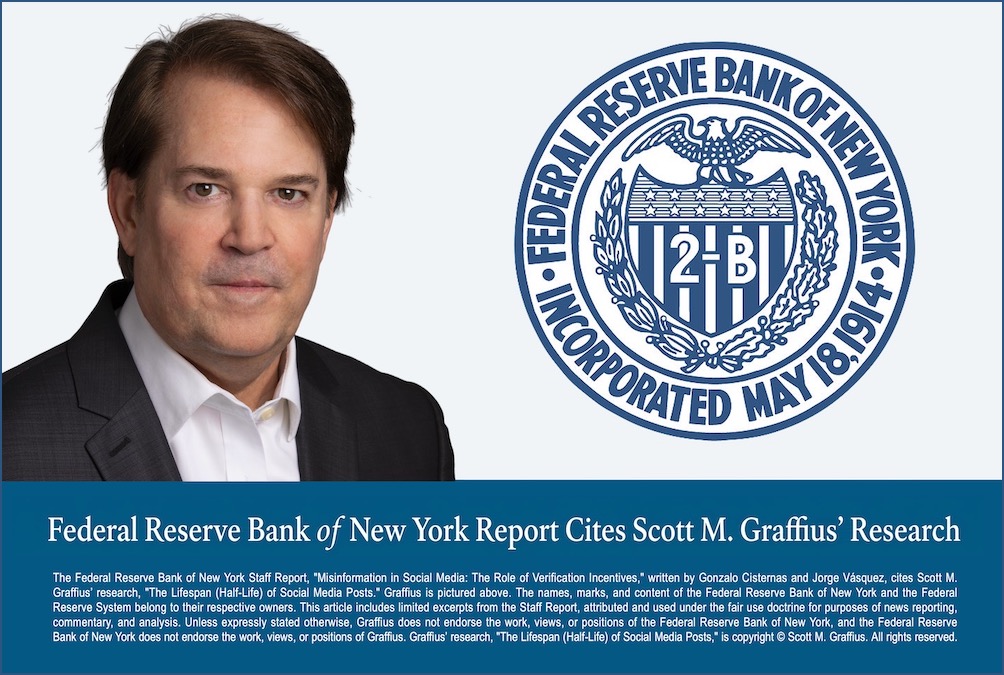
The Federal Reserve Bank of New York has cited Scott M. Graffius' "Lifespan (Half-Life) of Social Media Posts: Update for 2026" in the revised edition of its Staff Report, "Misinformation in Social Media: The Role of Verification Incentives."
Written by economists Gonzalo Cisternas and Jorge Vásquez, the Federal Reserve Bank of New York's report was first published in August 2022 and revised in July 2026. It examines how verification incentives and users' sharing decisions affect the spread of information including misinformation. The report notes Graffius' research on page 26 and also in the References (page 59). Excerpts are shown below.

A link to the Federal Reserve Bank of New York's report is in the References section of this article.
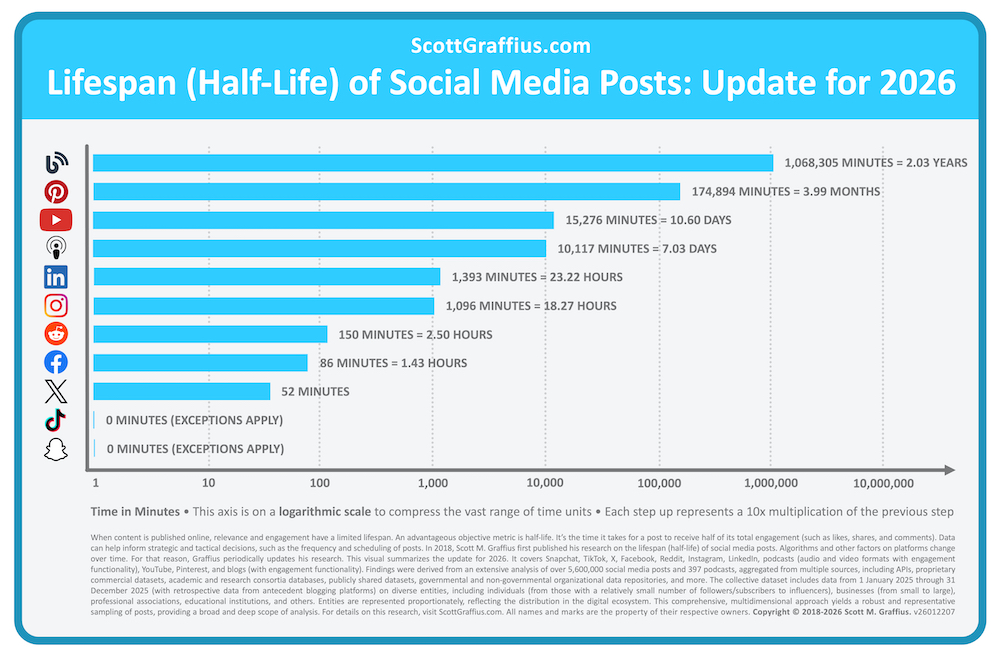
Graffius' "Lifespan (Half-Life) of Social Media Posts" research—first published in 2018 and updated annually—delivers a precise quantitative analysis of post longevity (audience engagement) across digital platforms, utilizing advanced statistical techniques to determine mean half-life with precision. It establishes a solid empirical base, effectively highlighting the ephemeral nature of content within social media ecosystems.
It is used and cited by organizations and publications around the world. Examples in addition to the Fed include Adobe, École Polytechnique Fédérale de Lausanne, Frontiers in Public Health, GoDaddy, Government of Canada, IEEE, Journal of Marketing, Marketing in the Metaverse, Maximizing LinkedIn for Business Growth, Metricool, The Ministère de la Culture, Pinterest Inc., Proceedings of the National Academy of Sciences, Strategic Business Research, Telecommunications Policy, and many more.
The research exemplifies methodological rigor and sustained significance in the field of digital informatics.
Algorithms and other factors on platforms change over time. For that reason, Graffius regularly updates his work. The 2026 edition stands out for its:
◾️ Scope: 5.6 million posts
◾️ Coverage: 11 platforms
◾️ Methodology: multi-source, representative, data-driven
◾️ Continuity: annual updates
◾️ Value: actionable insights
A visual from it is shown below. And the details are here.
Cisternas, G., & Vásquez, J. (2022, July). Misinformation in social media: The role of verification incentives (Staff Report No. 1028, revised July 2026). Federal Reserve Bank of New York. https://www.newyorkfed.org/research/staff_reports/sr1028
Graffius, S. M. (2026, January 23). Lifespan (Half-Life) of Social Media Posts: Update for 2026. ScottGraffius.com. https://doi.org/10.13140/RG.2.2.32407.43689
Gonzalo Cisternas is an economist at the Federal Reserve Bank of New York. Jorge Vásquez is affiliated with the Department of Economics at Smith College. Their joint Staff Report, "Misinformation in Social Media: The Role of Verification Incentives," develops an economic model to examine how incentives to verify information and decisions to share content influence the production and spread of misinformation. The report presents preliminary findings intended to stimulate discussion and further research.
The Federal Reserve Bank of New York is one of 12 regional Reserve Banks that, together with the Board of Governors, make up the Federal Reserve System, the central bank of the United States. Based in New York City, it plays a central role in implementing monetary policy, monitoring financial markets, supervising financial institutions, and supporting financial stability. Its research department publishes economic studies, including Staff Reports that share preliminary findings and encourage discussion among economists and other readers.
The Federal Reserve System, commonly known as the Federal Reserve or the Fed, is the central bank of the United States. Established by Congress in 1913, it helps promote a stable U.S. economy and financial system. Its responsibilities include conducting monetary policy to support maximum employment and stable prices, promoting financial stability, supervising and regulating financial institutions, supporting safe and efficient payment systems, and protecting consumers. The System comprises the Board of Governors in Washington, D.C., 12 regional Federal Reserve Banks, and the Federal Open Market Committee, which makes key decisions about U.S. monetary policy.
Scott M. Graffius is a technology leader, researcher, award-winning author, practitioner, consultant, thought leader, and international public speaker specializing in AI, Agile, project/program/portfolio management (PPPM), PMO leadership, and teamwork tradecraft. His work explores the intersection of human ingenuity and emerging technology, with a strong practitioner voice grounded in research, experimentation, and experience. His focus includes innovation, organizational performance, and the evolving practice of teamwork, including the "exotic team dynamics" that emerge when people collaborate with advanced artificial intelligence (agentic, autonomous, or autopoietic AI). Graffius has delivered more than $3.1 billion in business value for Fortune 500 companies and other organizations spanning technology, entertainment and media, financial services, healthcare, government, and other industries.
Businesses, professional associations, government agencies, universities, publications, and media outlets use Graffius and his work. Examples include Adobe, Bayer, Boston University, Federal Reserve Bank of New York, Ford, Gartner, Harvard Medical School, IEEE, Innovation Project Management, Johns Hopkins University, Microsoft, MSN, National Academy of Sciences, Oracle, Pinterest Inc., Project Management Institute, UC San Diego, Verizon, Yale University, and others.
The following sections highlight his experience, leadership, contributions, research, and enduring influence across industries and institutions worldwide.

Experience
Graffius heads the professional services firm Exceptional PPM and PMO Solutions, along with its subsidiary Exceptional Agility. These consultancies offer strategic and tactical advisory, training, embedded expertise, and consulting services to the public, private, and government sectors. They help organizations enhance their capabilities and results in agile, project management, program management, portfolio management, and enterprise PMO leadership, supporting innovation and driving competitive advantage. The consultancies confidently back services with a Delighted Client Guarantee™.
Graffius is a former VP of project management with a publicly traded provider of diverse consumer products and services over the Internet. Before that, he ran and supervised the delivery of projects and programs in public and private organizations with businesses ranging from e-commerce to advanced technology products and services, retail, manufacturing, entertainment and media, and more.
He has experience with consumer, business, reseller, government, and international markets.
Additional information is on LinkedIn.
Award-Winning Author
Graffius has authored three books.
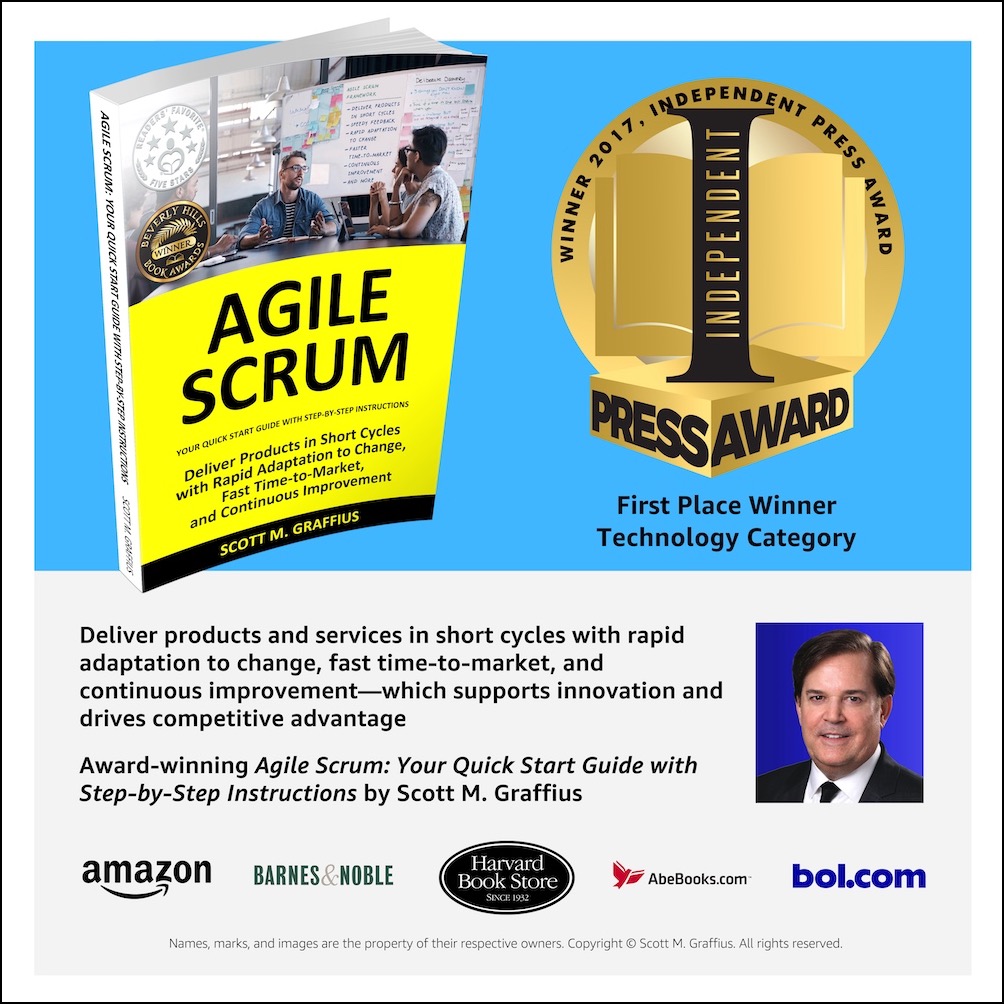
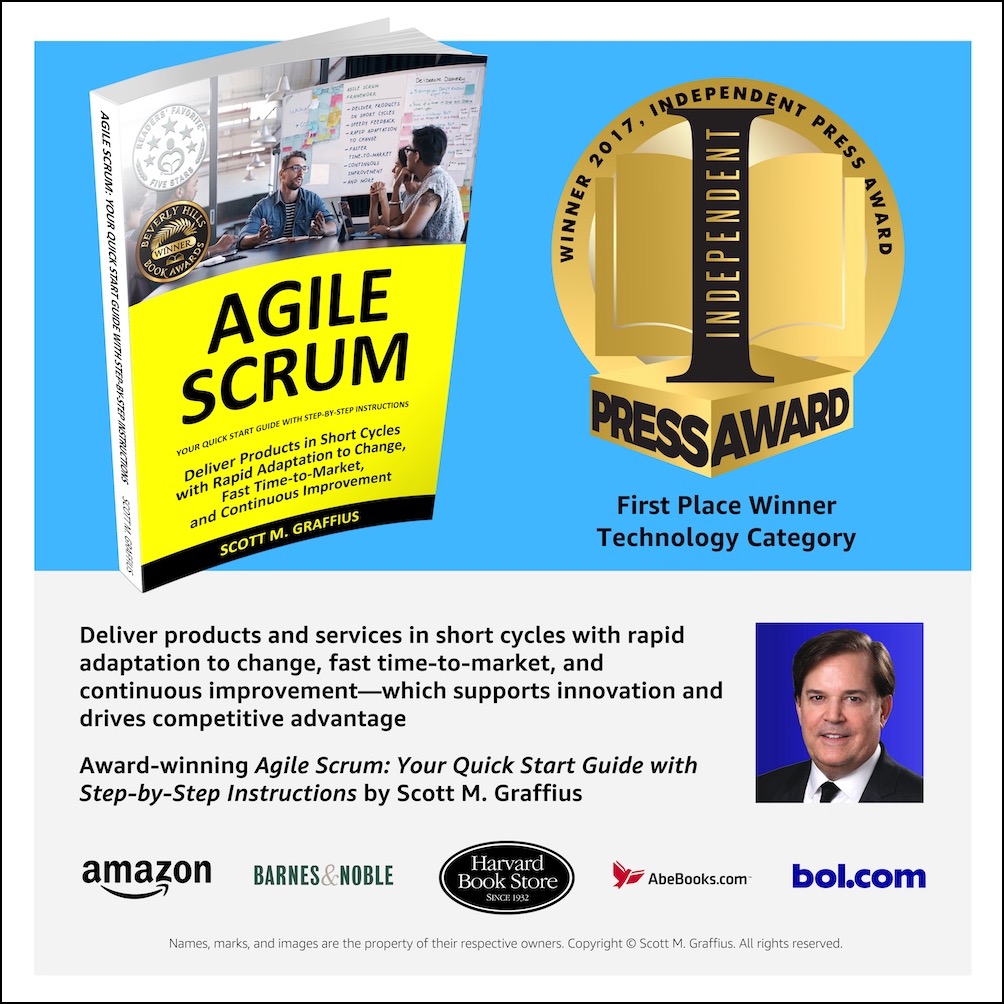
Graffius' first book, Agile Scrum: Your Quick Start Guide with Step-by-Step Instructions, earned 17 awards. It provides a practical, step-by-step guide to Scrum, enabling teams to deliver products in short cycles with rapid adaptation, fast time-to-market, and continuous improvement—which supports innovation and drives competitive advantage.
Additional information on Agile Scrum: Your Quick Start Guide with Step-by-Step Instructions is here.
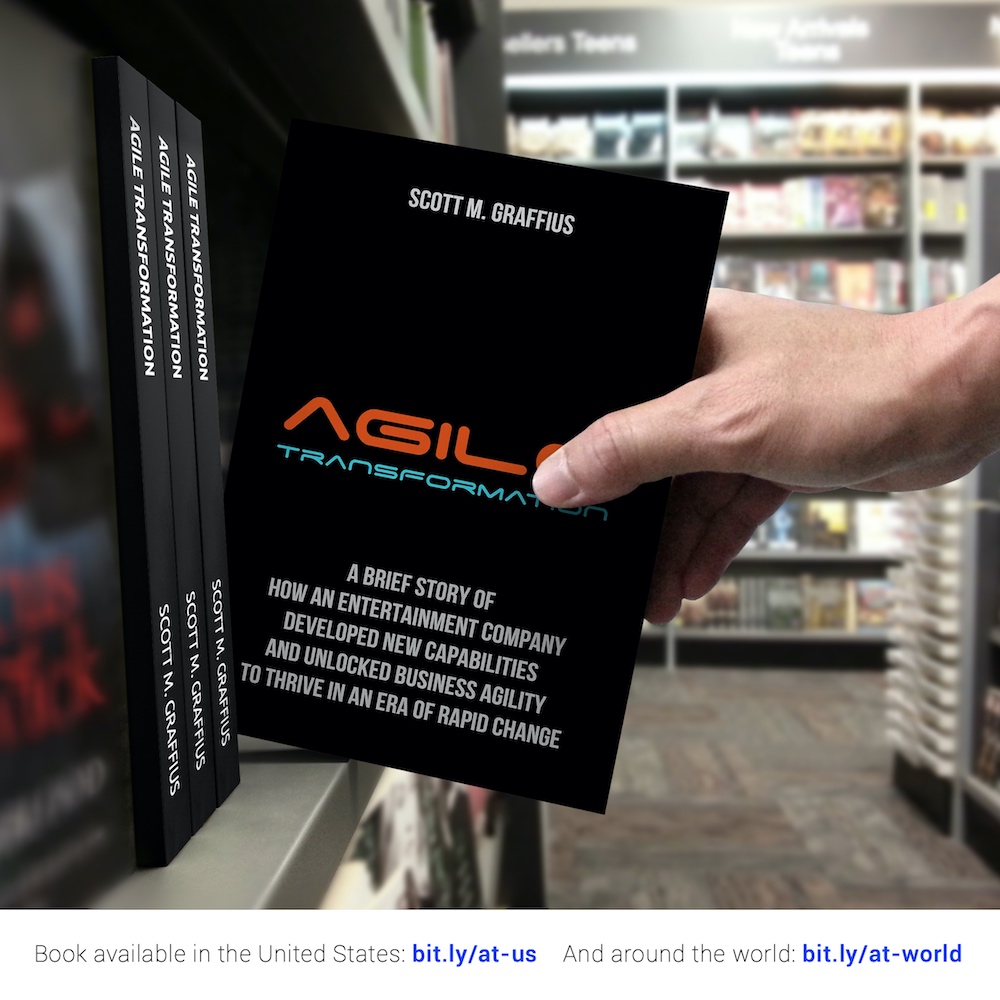
His second book, Agile Transformation: A Brief Story of How an Entertainment Company Developed New Capabilities and Unlocked Business Agility to Thrive in an Era of Rapid Change, was named one of the best Scrum books of all time by BookAuthority. It tells the compelling story of an entertainment company's agile transformation—offering lessons that apply across industries.
Additional information on Agile Transformation: A Brief Story of How an Entertainment Company Developed New Capabilities and Unlocked Business Agility to Thrive in an Era of Rapid Change is here.

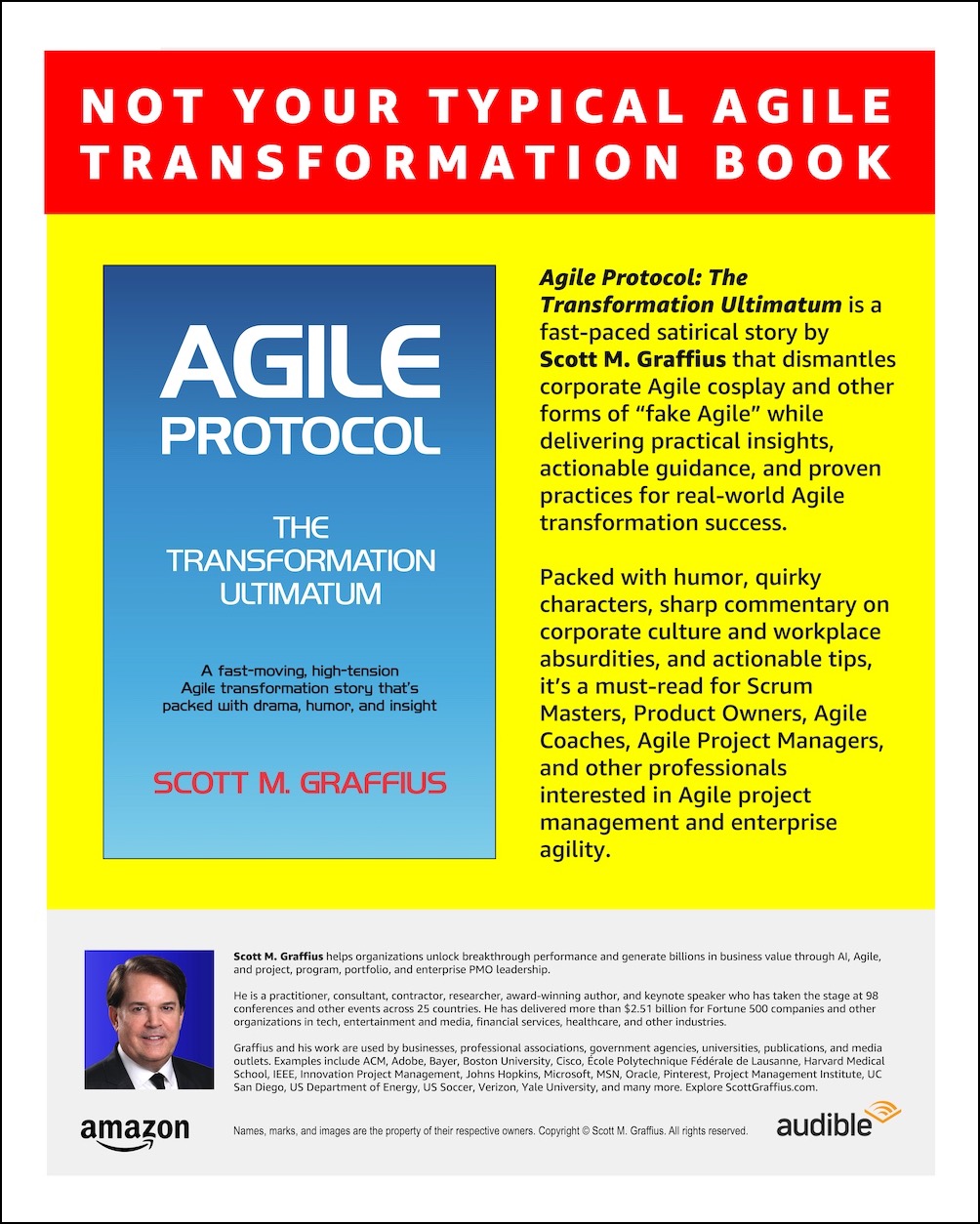
Agile Protocol: The Transformation Ultimatum, is his third book—and his first work of fiction.
It's a fast-paced satirical story by that dismantles corporate Agile cosplay and other forms of "fake Agile" while delivering practical insights, actionable guidance, and proven practices for real-world Agile transformation success.
Packed with humor, quirky characters, sharp commentary on corporate culture and workplace absurdities, and actionable tips, it’s a must-read for Scrum Masters, Product Owners, Agile Coaches, Agile Project Managers, and other professionals interested in Agile project management and enterprise agility.
Additional information on Agile Protocol: The Transformation Ultimatum is here.
International Public Speaker
Organizations worldwide engage Graffius to present on technology (including AI), Agile, project management, program management, portfolio management, and enterprise PMO leadership. He crafts and delivers unique and compelling talks and workshops.
Graffius has conducted 99 sessions across 25 countries. Select examples of events include Agile Trends Gov, BSides (Newcastle Upon Tyne), Conf42 Quantum Computing, DevDays Europe, DevOps Institute, DevOpsDays (Geneva), Frug’Agile, IEEE, Microsoft, Scottish Summit, Scrum Alliance RSG (Nepal), Techstars, and W Love Games International Video Game Development Conference (Helsinki), Future of Work and Advanced AI (Paris, France), and more.
With an average rating of 4.82 (on a scale of 1-5), sessions are highly valued.
The request form is here.
Thought Leadership and Influence
Prominent businesses, professional associations, government agencies, and universities have showcased Graffius and his contributions—spanning his books, talks, workshops, and beyond. Select examples include:
Graffius has played a key role in the Project Management Institute (PMI) in developing professional standards. He was a member of multiple teams that authored, reviewed, and produced:
He was also a subject matter expert reviewer of content for the PMI’s Congress. Beyond the PMI, Graffius also served as a member of the review team for two of the Scrum Alliance’s Global Scrum Gatherings.
Authority on Teamwork Tradecraft
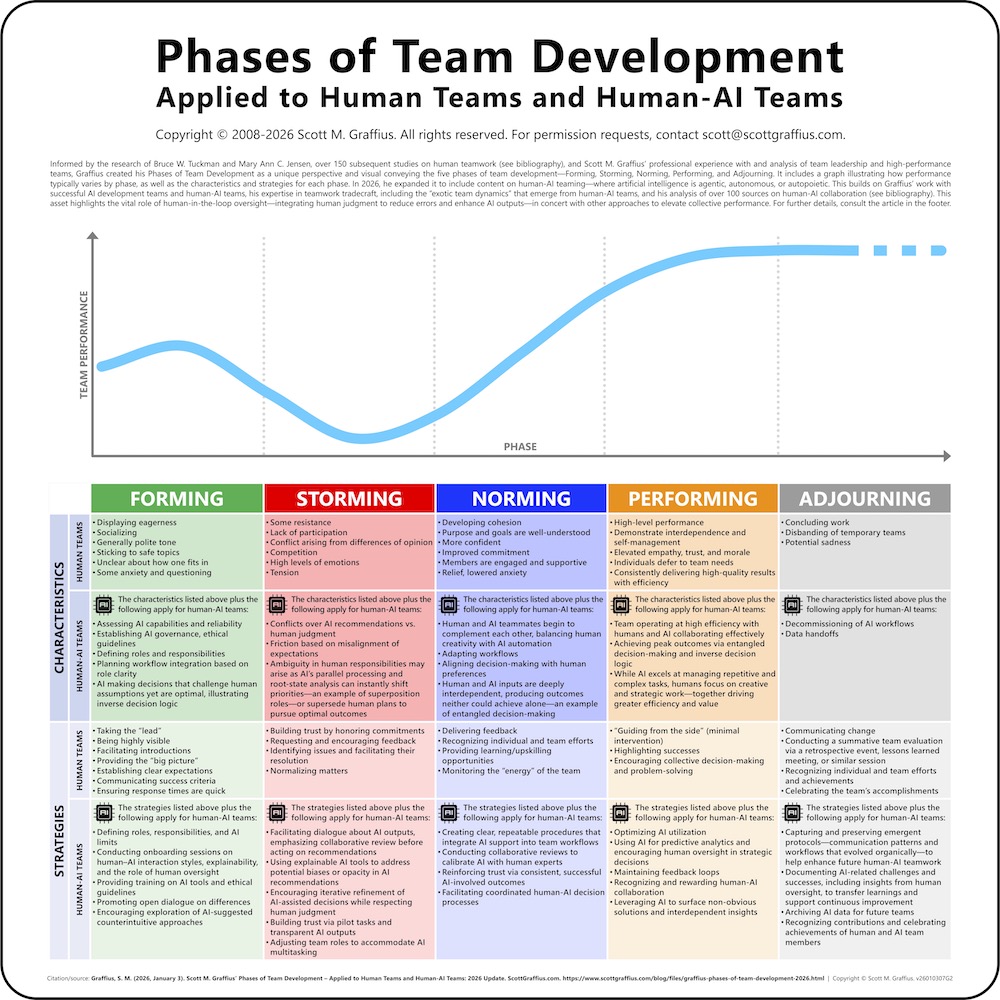
Graffius is a renowned and highly-cited authority on teamwork tradecraft. Informed by the research of Bruce W. Tuckman and Mary Ann C. Jensen, over 150 subsequent studies, and Graffius' first-hand professional experience with, and analysis of, team leadership and performance, Graffius created his "Phases of Team Development" intellectual property as a unique perspective and visual conveying the five phases of team development.
First introduced in 2008 and periodically updated, his work provides a diagnostic and strategic guide for navigating team dynamics. It provides actionable insights for leaders across industries to develop high-performance teams.
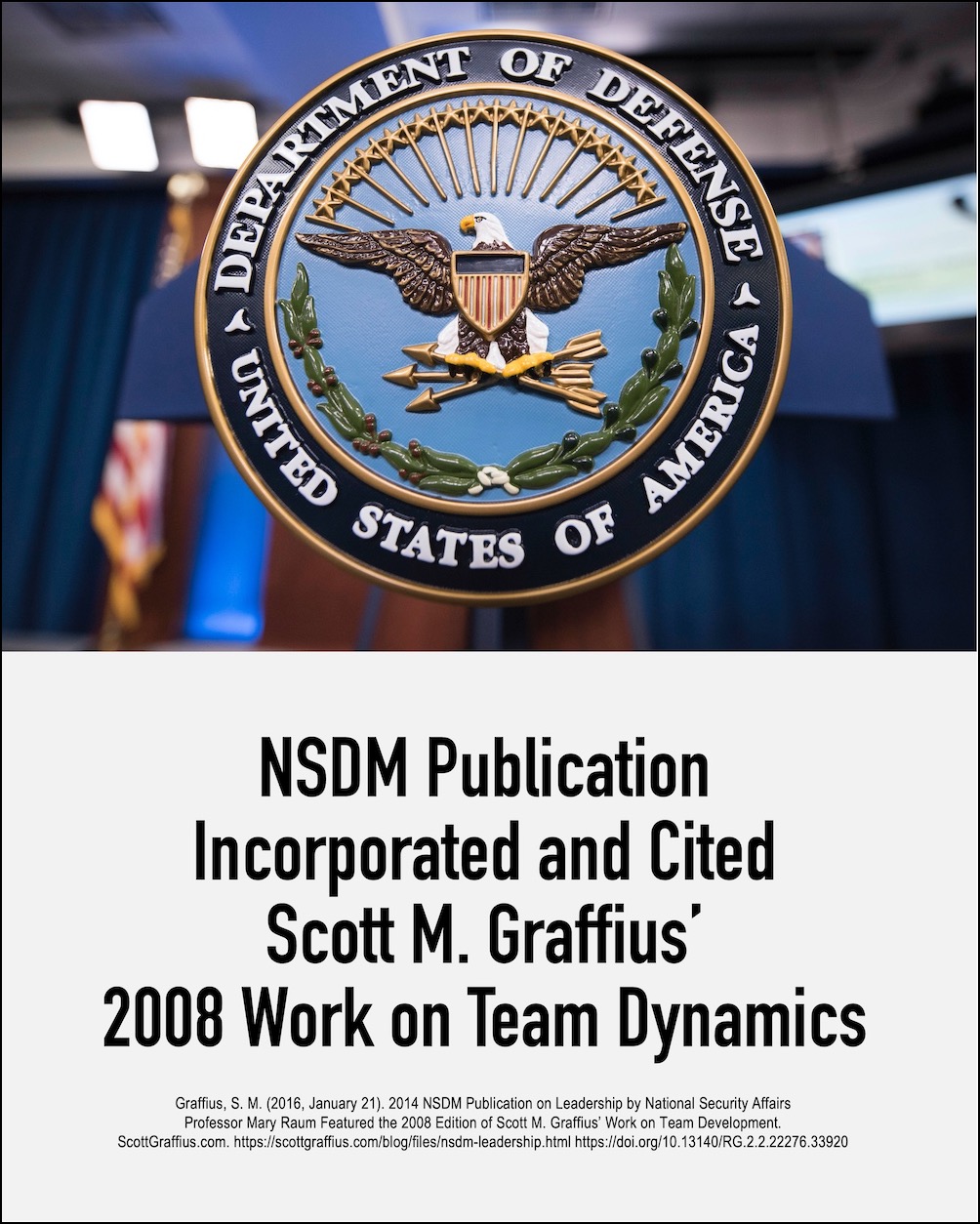
Its adoption by esteemed organizations—such as Yale University, IEEE, Cisco, Microsoft, Ford, Oracle, Broadcom, the U.S. National Park Service, and the Journal of Neurosurgery, among others—highlights its utility and value, solidifying its status as an indispensable resource for elevating team performance and driving organizational excellence.
In 2026, Graffius added human-AI teamwork—including the "exotic team dynamics" which emerge when advanced AI collaborates as a teammate—to his "Phases of Team Development." The 2026 edition is here.
Expert on Temporal Dynamics on Social Media Platforms
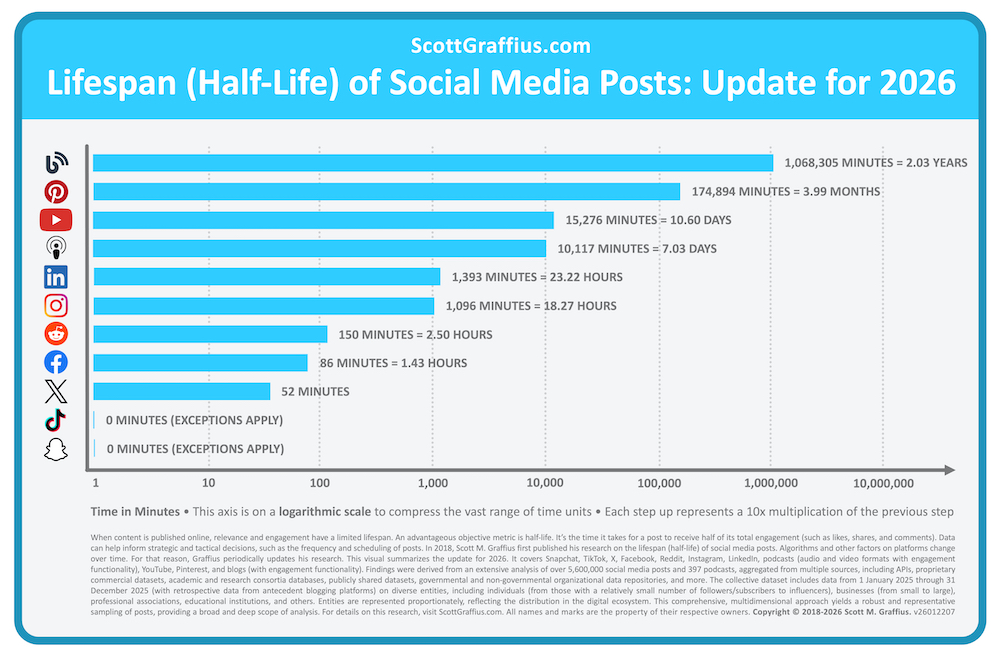
Graffius is also an authority on temporal dynamics on social media platforms. His "Lifespan (Half-Life) of Social Media Posts" research—first published in 2018 and updated annually—delivers a precise quantitative analysis of post longevity across digital platforms, utilizing advanced statistical techniques to determine mean half-life with precision. It establishes a solid empirical base, effectively highlighting the ephemeral nature of content within social media ecosystems.
Referenced and applied by leading entities—such as Fast Company, GoDaddy, Journal of Hand Surgery (European Volume), Ministère de la Culture, Pinterest Inc., PNAS, and Telecommunications Policy, among others—his research exemplifies methodological rigor and sustained significance in the field of digital informatics.
The 2026 edition of Graffius "Lifespan (Half-Life) of Social Media Posts" research is here.
Education and Professional Certifications
Graffius has a bachelor’s degree in psychology with a focus in Human Factors. He holds eight professional certifications:
He is an active member of the Scrum Alliance, the Project Management Institute (PMI), and the Institute of Electrical and Electronics Engineers (IEEE).
Advancing AI, Agile, and Project/PMO Management
Scott M. Graffius continues to advance the fields of AI, Agile, and project/program/portfolio management (PPPM), and PMO leadership. Businesses and other organizations leverage Graffius’ insights to drive their success.
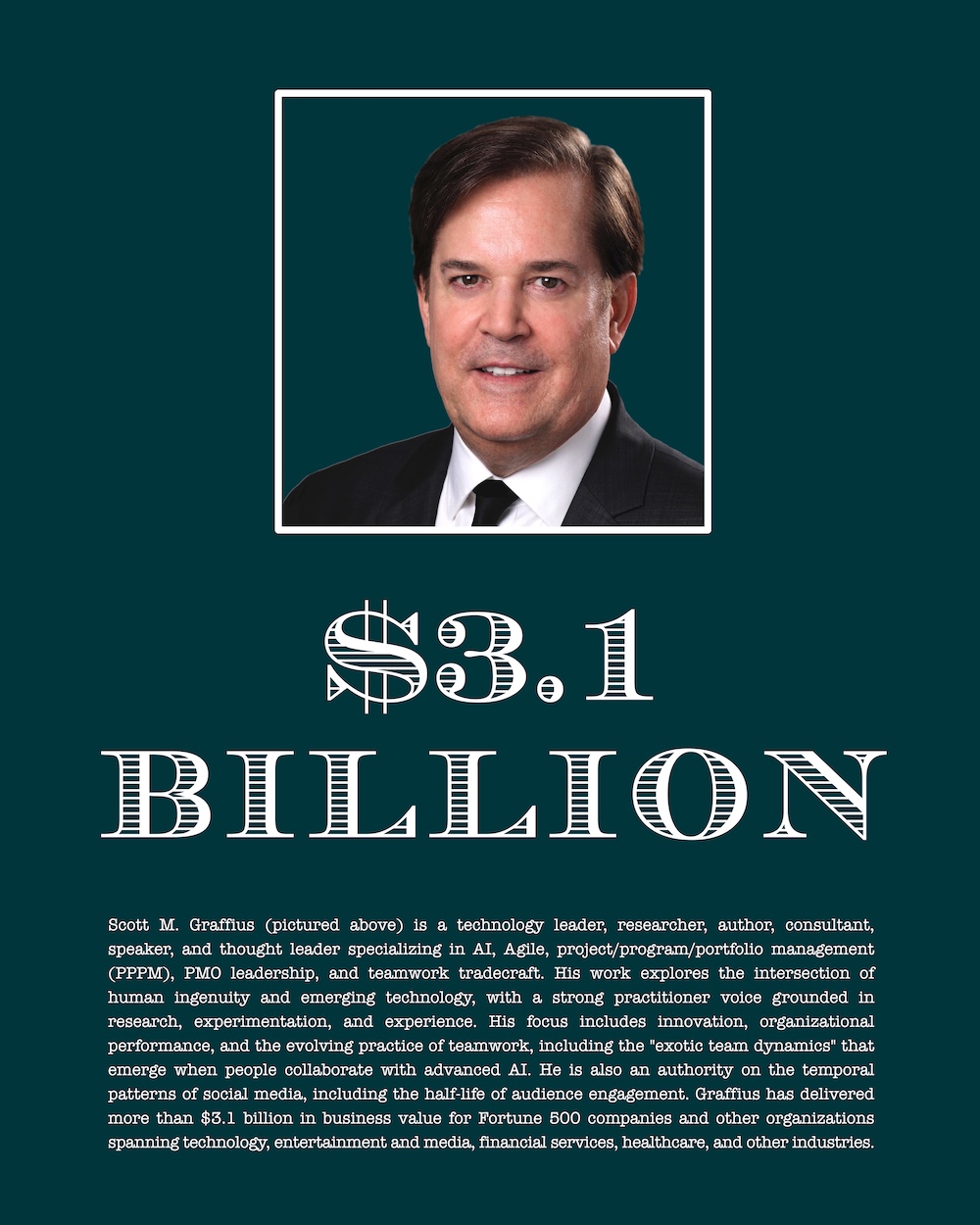
Graffius has generated over $3.1 billion in business value for Fortune 500 companies and other organizations served. Put that track record to work for you. For speaking engagements, use the request form; for other inquiries, email him.
Connect with and follow Scott on LinkedIn, X, YouTube, Facebook, Bluesky, Mastodon, and ResearchGate.








Read more.
Meta CTO Called the AI Reorganization “Atrocious” — What Went Wrong and the Lessons for Human-AI Teams
A Critical Analysis of "AI and Quantum Computers Will Be Frenemies"
A Supplement to Graffius' Phases of Team Development: Exploring the Original, Data-Based Curvature for the Performance Trajectory
Scott M. Graffius Speaking on Strategic Leadership at Silicon Valley Chapter of the Project Management Institute
AI Hallucinations, Deception, and Unauthorized Agency: The Spectrum of AI Trust Failures
A Critical Analysis of "The Social Cost of an AI Teammate: How an Artificial Teammate Reshapes Human-Human Communication in Small-Team Decision-Making"
Journal of Marketing Cites Scott M. Graffius' Research on the Half-Life of Social Media
The Evolution of Pair Programming and the Rise of Exotic Team Dynamics
Number 1 University in England for Student Satisfaction Features Scott M. Graffius' "Phases of Team Development"
Royal Australasian College of Physicians Licenses Scott M. Graffius' "Phases of Team Development" Intellectual Property on Teamwork Tradecraft
Exotic Team Dynamics: How Advanced AI Teammates Are Unlocking New Levels of Innovation, Performance, and Success
A Critical Analysis of "Platform-Specific Data Decay Patterns: A Comparative Study of Twitter, Reddit, and TikTok" and Its Reference to Research by Scott M. Graffius
Round Square Global Educational Network Features Scott M. Graffius’ Phases of Team Development
Meta's Muse Missed the Mark: Hollywood’s Win Against Big Tech on AI Consent and Likeness Rights
Scott M. Graffius Contributed to Seven Project Management Institute (PMI) Standards
Quantum Computing, Advanced AI Acceleration, and the Rise of Exotic Team Dynamics in Human-AI Teams
Ohio State University Course Features Scott M. Graffius' "Phases of Team Development"
Questions About Integrity at UNC Chapel Hill
Scrum Isn’t Just for Coding
Book on Generative and Agentic AI Cites Scott M. Graffius' Work on AI
IPA / ADAL Publication Plagiarized Another’s Copyrighted Work and Violated Intellectual Property Rights
UC Davis' Integrity Is Circling the Drain
L'avenir du Travail et de l'IA Avancée / Future of Work and Advanced AI
NCCI / UNC Chapel Hill Publication Features Scott M. Graffius' Work
Boston Consulting Group (BCG) Features Scott M. Graffius' Research on Social Media Content Half-Life
UC Davis Used Scott M. Graffius' "Phases of Team Development" Intellectual Property
Medical, Pharma, and Healthcare Organizations Are Using Scott M. Graffius' "Phases of Team Development"
Government of Ireland Report Features Research by Scott M. Graffius
Scott M. Graffius Contributed to The Standard for Artificial Intelligence in Portfolio, Program, and Project Management
AI Governance Initiative Cites Scott M. Graffius Research on AI Hallucinations
Scott M. Graffius Contributed to the Agile Practice Guide - Second Edition
Scott M. Graffius Generated Over $2.51 Billion in Business Value for Fortune 500 Companies and Other Organizations
Government of Canada Features Research by Scott M. Graffius
"Strategic Business Research" Journal Cites Work of Scott M. Graffius
IEEE Access Publication Features Scott M. Graffius’ Research on the Half-Life of Social Media
The Agile Coach: 2026 Edition
Scott M. Graffius’ Work Cited in International Peer-Reviewed Journal on Digital Transformation
Phases of Team Development in Elite Sport
A Critical Analysis of COVID-19 Treatment Search Trends and Media Coverage Study Citing Scott M. Graffius' Work
Human-AI Teamwork: Master the Exotic Team Dynamics That Emerge When Collaborating with Advanced AI -- Or Be Outplayed
"Agile Scrum" by Scott M. Graffius Now Featured on Grokipedia
UNSW Aerospace Engineering Course Features Scott M. Graffius' "Phases of Team Development"
Thinkers360 Honors Scott M. Graffius as a 2026 Top Agile Thought Leader
Agile's Journey Through the Decades: Update for 2026
BMC Software Features Content from Scott M. Graffius' Book
Peer-Reviewed Journal Cited Work of Scott M. Graffius
University of Waterloo Features Graffius' "Phases of Team Development" in Course Materials
Perplexity Standalone Article on AI Hallucinations Cites Research by Scott M. Graffius
Handling the Saboteur Within: Lessons from a 3-Letter Agency on Spotting and Stopping Intentional and Unintentional Sabotage
A Deep Dive Into the Typical Engagement Pattern for Social Media Posts
Most Valuable IT Certifications: Update for 2026
"Marketing in the Metaverse" Spotlights Scott M. Graffius’ Research on the Half-Life of Social Media
University of Greenwich Features Graffius' Phases of Team Development
10 Essential Agile Books: Curated Recommendations for Agile Professionals
Lifespan (Half-Life) of Social Media Posts: Update for 2026
Scott M. Graffius' Research on the Half-Life of Social Media was Cited in a Peer-Reviewed Study Published in Telecommunications Policy, a Leading Academic Journal
Are AI Hallucinations Getting Better or Worse? We Analyzed the Data
Scott M. Graffius' Phases of Team Development - Applied to Human Teams and Human-AI Teams: 2026 Update
Lessons from Yesterday’s Tomorrowland
Scott M. Graffius’ Update to His "Phases of Team Development” Coming Early 2026
A Data-Driven Analysis of the Evolution of Project Management: Tasks, Trends, and AI
Actionable Insights. Global Impact. Scott M. Graffius.
Beep Beep! Why Wile E. Coyote Is the Patron Saint of AI Failure
Social Media Half-Life Research Cited in Prestigious Peer-Reviewed Medical Journal
Navigating the Spectrum of Advanced AI – Agentic, Autonomous, and Autopoietic
Lessons from Unhinged AI in Fiction: What Rogue AIs in Sci-Fi Storytelling, Films, and TV Shows Reveal About Us
Scott M. Graffius Contributed to and Reviewed the PMBOK Guide, 8th Edition — the Global Standard for Project Management
UK Sports Institute Features Teamwork and Leadership Work of Scott M. Graffius
Definitions of Advanced AIs: Agentic, Autonomous, and Autopoietic
HAN University of Applied Sciences Features the Work of Scott M. Graffius
Gifts That Inspire Joy
Evergreen Echoes: How Pinterest Inc. and Pinterest Japan Spotlighted Scott M. Graffius’ Research on the Half-Life of Social Media Content
Scott M. Graffius’ Team Development Work Lights Up the University of Tasmania’s Curriculum
Taiwan’s Leading Outlet for Technology and Innovation Spotlights Graffius’ Research on Social Media Temporal Dynamics
Scott M. Graffius’ Insights on AI, Agile, Gaming, XR, and Defense Transformation Cited by MSN in Their Coverage of Innovation and Leadership in the Sector
Top Predictions of 2024, Tested in 2025
Government of Finland Agency Features Graffius' Phases of Team Development IP
Scott M. Graffius Premieres His New "Exotic Team Dynamics: Human-AI Collaboration" Talk at Corporate Event in Las Vegas
Environmental Science Journal References Scott M. Graffius’ Project Management Work
AI Institute of Switzerland Features Scott M. Graffius’ Work on Algorithms
Exotic Team Dynamics: The New Frontier of Human–AI Collaboration
Scott M. Graffius’ Work Featured at ACM DIS ’25
Climbing the Ladder: The Head of Agile/PMO’s Organizational Proximity to the CEO is Closer Than Ever
Harness Sci-Fi and Speculative Design While Embracing Imperfection to Drive Innovation and Proactively Predict and Prepare for the Future
Scott M. Graffius’ “Agile Scrum” Book Featured in a Publication of the Associação Nacional de Educação Católica do Brasil (ANEC)
Setting Direction with OKRs and Tracking Progress with KPIs: A Guide for Agile, Project Management, and Tech Teams
AI Showcase Showdown: Ranking AI Accuracy on Project Management Basics
BookAuthority Features “Agile Scrum” by Scott M. Graffius in “10 Agile Software Development Books That Define the Field”
Exploring Team Dynamics, Adaptability, and Creative Problem-Solving Through Felix the Cat’s Metaphorical Toolkit
Mind Games and Master Plans: How PsyOps Exploit Psychological Phenomena
The “Pants-on-Fire Index for AI”
16 Causes of Technical Debt and How to Avoid It
PMI’s Infinity AI Gets the Basics of Team Development Alarmingly and Repeatedly Wrong
Agile for Unicorns: 7 Keys to Thrive; Scott M. Graffius’ Workshop
Scott M. Graffius’ “Agile Scrum: Your Quick Start Guide with Step-by-Step Instructions” Featured in Prestigious National Academies of Sciences Publication
Meta and Anduril’s EagleEye and the Future of XR: How Gaming, AI, and Agile Are Transforming Defense
"Agile Protocol" and the Power of Satire, Parody, and Humor
AI in Agile: Benefits, Risks, Outlook
Hostinger Highlights Scott M. Graffius’ “Agile Protocol” Book in Feature on Software Projects
French Ministry of Culture Links to Scott M. Graffius Research in Their Guide for Responsible Digital Communication
National Science Foundation’s LTER Network Features Scott M. Graffius’ Phases of Team Development IP
Waterfall vs. Agile: What’s Fixed, What’s Flexible, and Why It Matters
Scott M. Graffius Delivering $2.3 Billion in Value Through AI, Agile, and Project/PMO Leadership
The Problem with Heroes in Agile
The 3 Vital Rules of Science: What They Are and Why They Matter
“Agile Protocol: The Transformation Ultimatum” Lands on the Amazon Best Sellers List!
Scott M. Graffius Recognized as a Top Thought Leader in Digital Disruption by Thinkers360
“Agile Protocol: The Transformation Ultimatum” by Scott M. Graffius Crashes the Book Scene with Satirical Firepower
NCKU in Taiwan Integrates Graffius' 'Phases of Team Development' into Its Curriculum
The Art and Science of Aligning Initiatives with Strategic Objectives
RGPV University Adds Scott M. Graffius’ "Agile Scrum: Your Quick Start Guide with Step-by-Step Instructions" to Its Syllabus
Introducing ‘Engage or Fade: Decoding the Half-Life of Digital Resonance’ – A New Talk by Scott M. Graffius
Dropbox Company (Nira) Taps into Scott M. Graffius’ Expertise in Strategic Planning
Reporting Errors in a Publication: A Case Study on ‘Frontiers in Public Health’
NESEA Conference Session on Innovation Highlights Scott M. Graffius' 'Phases of Team Development'
U.S. Soccer Scores with Scott M. Graffius' Intellectual Property on Teamwork
U.S. Department of Commerce Partner (IEDC) Features Scott M. Graffius’ Intellectual Property
How Long Do Your Posts Live? AI Critiques Scott M. Graffius’ Research on the Half-Life of Social Media
Agile's Journey Through the Decades
Scott M. Graffius' Role in Advancing Project Management Institute (PMI) Standards Excellence
Most Valuable IT Certifications: Update for 2025
The PMI + Agile Alliance Merger: A Recipe for Success?
When Agile, AI, and Strategic Thinking Converge
Scott M. Graffius’ Phases of Team Development: 2025 Update
Lifespan (Half-Life) of Social Media Posts: Update for 2025
Verizon Features Scott M. Graffius
Do Not Read This Article! An Exploration of the Streisand Effect and Other Phenomena
Scott M. Graffius' 'Phases of Team Development' was Spotlighted in Journal of Neurosurgery
Pinterest Japan Uses Graffius’ Research on Temporal Dynamics on Social Media Platforms
Hochschule Coburg (Coburg University) Germany Uses Scott M. Graffius’ Phases of Team Development IP in Coursework on Agile Development
Wild World of Team Dynamics [Updated Two-Minute Video]
EU Europass Teacher Academy Features Scott M. Graffius’ ‘Phases of Team Development’ in Leadership Training
Side-by-Side Comparison of Retrospectives and Hot Washes
Constructor University 2024 Advanced Software Technology Handbook References Scott M. Graffius' Work on Team Dynamics
Strategies for Medical Team Success Featured Scott M. Graffius’ ‘Phases of Team Development’ Intellectual Property
SBG Neumark — Europe’s Largest Distribution Transformer Plant — Powers Up with Scott M. Graffius’ Intellectual Property
Scott M. Graffius’ Intellectual Property was Employed by the NHS — the Largest Single-Payer Healthcare System in Europe
Luxury Unwrapped: The Ultimate Holiday Gift Guide for Every Budget
Singapore Institute of Technology Features Work of Scott M. Graffius
Tufts University Features Scott M. Graffius 'Phases of Team Development' Intellectual Property
'Cat Herders': Retelling the Massive Success Story
Pennsylvania State Agency Used Scott M. Graffius' Intellectual Property
Copyright Infringement in a Book Published by AuthorHouse / Author Solutions / The Najafi Companies: Publisher Fails to Respond or Take Required Action
Pinterest Inc. References Scott M. Graffius’ Research
Bournemouth University Used Scott M. Graffius’ Intellectual Property
‘Comparative Methodological Guidelines: Handbook for Educators’ Violates Scott M. Graffius’ Copyright
Japan Backlog User Group Event Featured Scott M. Graffius’ ‘Phases of Team Development’
TurningWest's 'Trial'
Radio Silence from the American Association of Neurological Surgeons on Report of Blatant Plagiarism in Their ‘Journal of Neurosurgery’ Publication
Supplement to Graffius' 'Lifespan (Half-Life) of Social Media Posts' Research: Typical Engagement Distribution Pattern for Social Media Posts
How Algorithms Shape the User Experience on Social Media Platforms
Thinkers360 Named Scott M. Graffius a Top Thought Leader on Agile
More articles are listed here.

Graffius, S. M. (2026, October 12). Federal Reserve Bank of New York Report Cites Scott M. Graffius' 2026 Research on the Half-Life of Social Media Posts. ScottGraffius.com. https://scottgraffius.com/blog/files/federal-reserve-report-cites-scott-m-graffius-research.html

Coming soon

The Federal Reserve Bank of New York Staff Report, "Misinformation in Social Media: The Role of Verification Incentives," written by Gonzalo Cisternas and Jorge Vásquez, cites Scott M. Graffius’ research, "The Lifespan (Half-Life) of Social Media Posts." Graffius is pictured above. The names, marks, and content of the Federal Reserve Bank of New York and the Federal Reserve System belong to their respective owners. This article includes limited excerpts from the Staff Report, attributed and used under the fair use doctrine for purposes of news reporting, commentary, and analysis. Unless expressly stated otherwise, Graffius does not endorse the work, views, or positions of the Federal Reserve Bank of New York, and the Federal Reserve Bank of New York does not endorse the work, views, or positions of Graffius. Graffius’ research, "The Lifespan (Half-Life) of Social Media Posts," is copyright © Scott M. Graffius. All rights reserved.


If there are any supplements or updates to this article after the date of publication, they will appear here.

Copyright © Scott M. Graffius. All rights reserved.
Content on this site—including text, images, videos, and data—may not be used for training or input into any artificial intelligence, machine learning, or automatized learning systems, or published, broadcast, rewritten, or redistributed without the express written permission of Scott M. Graffius.

Recommended Citation
Graffius, S. M. (2026, October 12). Federal Reserve Bank of New York Report Cites Scott M. Graffius' 2026 Research on the Half-Life of Social Media Posts. ScottGraffius.com. https://scottgraffius.com/blog/files/federal-reserve-report-cites-scott-m-graffius-research.html
The Fed Cites Scott M. Graffius' Research in a Staff Report
The Federal Reserve Bank of New York has cited Scott M. Graffius' "Lifespan (Half-Life) of Social Media Posts: Update for 2026" in the revised edition of its Staff Report, "Misinformation in Social Media: The Role of Verification Incentives."
Written by economists Gonzalo Cisternas and Jorge Vásquez, the Federal Reserve Bank of New York's report was first published in August 2022 and revised in July 2026. It examines how verification incentives and users' sharing decisions affect the spread of information including misinformation. The report notes Graffius' research on page 26 and also in the References (page 59). Excerpts are shown below.
A link to the Federal Reserve Bank of New York's report is in the References section of this article.
About Graffius' "Lifespan (Half-Life) of Social Media Posts"
Graffius' "Lifespan (Half-Life) of Social Media Posts" research—first published in 2018 and updated annually—delivers a precise quantitative analysis of post longevity (audience engagement) across digital platforms, utilizing advanced statistical techniques to determine mean half-life with precision. It establishes a solid empirical base, effectively highlighting the ephemeral nature of content within social media ecosystems.
It is used and cited by organizations and publications around the world. Examples in addition to the Fed include Adobe, École Polytechnique Fédérale de Lausanne, Frontiers in Public Health, GoDaddy, Government of Canada, IEEE, Journal of Marketing, Marketing in the Metaverse, Maximizing LinkedIn for Business Growth, Metricool, The Ministère de la Culture, Pinterest Inc., Proceedings of the National Academy of Sciences, Strategic Business Research, Telecommunications Policy, and many more.
The research exemplifies methodological rigor and sustained significance in the field of digital informatics.
Algorithms and other factors on platforms change over time. For that reason, Graffius regularly updates his work. The 2026 edition stands out for its:
◾️ Scope: 5.6 million posts
◾️ Coverage: 11 platforms
◾️ Methodology: multi-source, representative, data-driven
◾️ Continuity: annual updates
◾️ Value: actionable insights
A visual from it is shown below. And the details are here.
References
Cisternas, G., & Vásquez, J. (2022, July). Misinformation in social media: The role of verification incentives (Staff Report No. 1028, revised July 2026). Federal Reserve Bank of New York. https://www.newyorkfed.org/research/staff_reports/sr1028
Graffius, S. M. (2026, January 23). Lifespan (Half-Life) of Social Media Posts: Update for 2026. ScottGraffius.com. https://doi.org/10.13140/RG.2.2.32407.43689
About the Authors of the Staff Report
Gonzalo Cisternas is an economist at the Federal Reserve Bank of New York. Jorge Vásquez is affiliated with the Department of Economics at Smith College. Their joint Staff Report, "Misinformation in Social Media: The Role of Verification Incentives," develops an economic model to examine how incentives to verify information and decisions to share content influence the production and spread of misinformation. The report presents preliminary findings intended to stimulate discussion and further research.
About the Federal Reserve Bank of New York
The Federal Reserve Bank of New York is one of 12 regional Reserve Banks that, together with the Board of Governors, make up the Federal Reserve System, the central bank of the United States. Based in New York City, it plays a central role in implementing monetary policy, monitoring financial markets, supervising financial institutions, and supporting financial stability. Its research department publishes economic studies, including Staff Reports that share preliminary findings and encourage discussion among economists and other readers.
About the Federal Reserve
The Federal Reserve System, commonly known as the Federal Reserve or the Fed, is the central bank of the United States. Established by Congress in 1913, it helps promote a stable U.S. economy and financial system. Its responsibilities include conducting monetary policy to support maximum employment and stable prices, promoting financial stability, supervising and regulating financial institutions, supporting safe and efficient payment systems, and protecting consumers. The System comprises the Board of Governors in Washington, D.C., 12 regional Federal Reserve Banks, and the Federal Open Market Committee, which makes key decisions about U.S. monetary policy.
About Scott M. Graffius
Scott M. Graffius is a technology leader, researcher, award-winning author, practitioner, consultant, thought leader, and international public speaker specializing in AI, Agile, project/program/portfolio management (PPPM), PMO leadership, and teamwork tradecraft. His work explores the intersection of human ingenuity and emerging technology, with a strong practitioner voice grounded in research, experimentation, and experience. His focus includes innovation, organizational performance, and the evolving practice of teamwork, including the "exotic team dynamics" that emerge when people collaborate with advanced artificial intelligence (agentic, autonomous, or autopoietic AI). Graffius has delivered more than $3.1 billion in business value for Fortune 500 companies and other organizations spanning technology, entertainment and media, financial services, healthcare, government, and other industries.
Businesses, professional associations, government agencies, universities, publications, and media outlets use Graffius and his work. Examples include Adobe, Bayer, Boston University, Federal Reserve Bank of New York, Ford, Gartner, Harvard Medical School, IEEE, Innovation Project Management, Johns Hopkins University, Microsoft, MSN, National Academy of Sciences, Oracle, Pinterest Inc., Project Management Institute, UC San Diego, Verizon, Yale University, and others.
The following sections highlight his experience, leadership, contributions, research, and enduring influence across industries and institutions worldwide.
Experience
Graffius heads the professional services firm Exceptional PPM and PMO Solutions, along with its subsidiary Exceptional Agility. These consultancies offer strategic and tactical advisory, training, embedded expertise, and consulting services to the public, private, and government sectors. They help organizations enhance their capabilities and results in agile, project management, program management, portfolio management, and enterprise PMO leadership, supporting innovation and driving competitive advantage. The consultancies confidently back services with a Delighted Client Guarantee™.
Graffius is a former VP of project management with a publicly traded provider of diverse consumer products and services over the Internet. Before that, he ran and supervised the delivery of projects and programs in public and private organizations with businesses ranging from e-commerce to advanced technology products and services, retail, manufacturing, entertainment and media, and more.
He has experience with consumer, business, reseller, government, and international markets.
Additional information is on LinkedIn.
Award-Winning Author
Graffius has authored three books.
Graffius' first book, Agile Scrum: Your Quick Start Guide with Step-by-Step Instructions, earned 17 awards. It provides a practical, step-by-step guide to Scrum, enabling teams to deliver products in short cycles with rapid adaptation, fast time-to-market, and continuous improvement—which supports innovation and drives competitive advantage.
- Paperback ISBN-13: 9781533370242
- Kindle ASIN: B01FZ0JIIY
Additional information on Agile Scrum: Your Quick Start Guide with Step-by-Step Instructions is here.
His second book, Agile Transformation: A Brief Story of How an Entertainment Company Developed New Capabilities and Unlocked Business Agility to Thrive in an Era of Rapid Change, was named one of the best Scrum books of all time by BookAuthority. It tells the compelling story of an entertainment company's agile transformation—offering lessons that apply across industries.
- Paperback ISBN-13: 9781072447962
- Kindle ASIN: B07R9LJLPJ
Additional information on Agile Transformation: A Brief Story of How an Entertainment Company Developed New Capabilities and Unlocked Business Agility to Thrive in an Era of Rapid Change is here.
Agile Protocol: The Transformation Ultimatum, is his third book—and his first work of fiction.
It's a fast-paced satirical story by that dismantles corporate Agile cosplay and other forms of "fake Agile" while delivering practical insights, actionable guidance, and proven practices for real-world Agile transformation success.
Packed with humor, quirky characters, sharp commentary on corporate culture and workplace absurdities, and actionable tips, it’s a must-read for Scrum Masters, Product Owners, Agile Coaches, Agile Project Managers, and other professionals interested in Agile project management and enterprise agility.
- Kindle ASIN: B0F2SJ83WT
- Audible ASIN: B0DJG163R5
Additional information on Agile Protocol: The Transformation Ultimatum is here.
International Public Speaker
Organizations worldwide engage Graffius to present on technology (including AI), Agile, project management, program management, portfolio management, and enterprise PMO leadership. He crafts and delivers unique and compelling talks and workshops.
Graffius has conducted 99 sessions across 25 countries. Select examples of events include Agile Trends Gov, BSides (Newcastle Upon Tyne), Conf42 Quantum Computing, DevDays Europe, DevOps Institute, DevOpsDays (Geneva), Frug’Agile, IEEE, Microsoft, Scottish Summit, Scrum Alliance RSG (Nepal), Techstars, and W Love Games International Video Game Development Conference (Helsinki), Future of Work and Advanced AI (Paris, France), and more.
With an average rating of 4.82 (on a scale of 1-5), sessions are highly valued.
The request form is here.
Thought Leadership and Influence
Prominent businesses, professional associations, government agencies, and universities have showcased Graffius and his contributions—spanning his books, talks, workshops, and beyond. Select examples include:
- Adobe,
- American Management Association,
- Amsterdam Public Health Research Institute,
- Bayer,
- BCG,
- BMC Software,
- Boston Consulting Group (BCG),
- Boston University,
- Broadcom,
- Cisco,
- Coburg University of Applied Sciences and Arts - Germany,
- Computer Weekly,
- Constructor University - Germany,
- Data Governance Success,
- Deimos Aerospace,
- DevOps Institute,
- Dropbox,
- EU's European Commission,
- Federal Reserve Bank of New York,
- Ford Motor Company,
- Gartner,
- GoDaddy,
- Harvard Medical School,
- Hasso Plattner Institute - Germany,
- IEEE,
- Innovation Project Management,
- Johns Hopkins University,
- Journal of Marketing,
- Journal of Neurosurgery,
- Lam Research (Semiconductors),
- Leadership Worthy,
- Life Sciences Trainers and Educators Network,
- London South Bank University,
- Microsoft,
- MSN,
- NASSCOM,
- National Academy of Sciences,
- New Zealand Government,
- Ohio State University,
- Oracle,
- Pinterest Inc.,
- Project Management Institute,
- Mary Raum (Professor of National Security Affairs, United States Naval War College),
- Round Square Global Educational Network,
- Royal Australasian College of Physicians (RACP),
- SANS Institute,
- SBG Neumark - Germany,
- Singapore Institute of Technology,
- Torrens University - Australia,
- TBS Switzerland,
- Tufts University,
- UC San Diego,
- UK Sports Institute,
- University of Galway - Ireland,
- US Department of Energy,
- US National Park Service,
- US Soccer,
- US Tennis Association,
- Verizon,
- Wrike,
- Yale University,
- and many others.
Graffius has played a key role in the Project Management Institute (PMI) in developing professional standards. He was a member of multiple teams that authored, reviewed, and produced:
- The Standard for Artificial Intelligence in Portfolio, Program, and Project Management.
- Agile Practice Guide — Second Edition.
- A Guide to the Project Management Body of Knowledge (PMBOK Guide) — Eighth Edition.
- A Guide to the Project Management Body of Knowledge (PMBOK Guide) — Sixth Edition.
- The Standard for Program Management — Fourth Edition.
- Practice Standard for Work Breakdown Structures — Second Edition.
- The Practice Standard for Project Estimating — Second Edition.
He was also a subject matter expert reviewer of content for the PMI’s Congress. Beyond the PMI, Graffius also served as a member of the review team for two of the Scrum Alliance’s Global Scrum Gatherings.
Authority on Teamwork Tradecraft
Graffius is a renowned and highly-cited authority on teamwork tradecraft. Informed by the research of Bruce W. Tuckman and Mary Ann C. Jensen, over 150 subsequent studies, and Graffius' first-hand professional experience with, and analysis of, team leadership and performance, Graffius created his "Phases of Team Development" intellectual property as a unique perspective and visual conveying the five phases of team development.
First introduced in 2008 and periodically updated, his work provides a diagnostic and strategic guide for navigating team dynamics. It provides actionable insights for leaders across industries to develop high-performance teams.
Its adoption by esteemed organizations—such as Yale University, IEEE, Cisco, Microsoft, Ford, Oracle, Broadcom, the U.S. National Park Service, and the Journal of Neurosurgery, among others—highlights its utility and value, solidifying its status as an indispensable resource for elevating team performance and driving organizational excellence.
In 2026, Graffius added human-AI teamwork—including the "exotic team dynamics" which emerge when advanced AI collaborates as a teammate—to his "Phases of Team Development." The 2026 edition is here.
Expert on Temporal Dynamics on Social Media Platforms
Graffius is also an authority on temporal dynamics on social media platforms. His "Lifespan (Half-Life) of Social Media Posts" research—first published in 2018 and updated annually—delivers a precise quantitative analysis of post longevity across digital platforms, utilizing advanced statistical techniques to determine mean half-life with precision. It establishes a solid empirical base, effectively highlighting the ephemeral nature of content within social media ecosystems.
Referenced and applied by leading entities—such as Fast Company, GoDaddy, Journal of Hand Surgery (European Volume), Ministère de la Culture, Pinterest Inc., PNAS, and Telecommunications Policy, among others—his research exemplifies methodological rigor and sustained significance in the field of digital informatics.
The 2026 edition of Graffius "Lifespan (Half-Life) of Social Media Posts" research is here.
Education and Professional Certifications
Graffius has a bachelor’s degree in psychology with a focus in Human Factors. He holds eight professional certifications:
- Certified SAFe 6 Agilist (SA),
- Certified Scrum Professional - ScrumMaster (CSP-SM),
- Certified Scrum Professional - Product Owner (CSP-PO),
- Certified ScrumMaster (CSM),
- Certified Scrum Product Owner (CSPO),
- Project Management Professional (PMP),
- Lean Six Sigma Green Belt (LSSGB), and
- IT Service Management Foundation (ITIL).
He is an active member of the Scrum Alliance, the Project Management Institute (PMI), and the Institute of Electrical and Electronics Engineers (IEEE).
Advancing AI, Agile, and Project/PMO Management
Scott M. Graffius continues to advance the fields of AI, Agile, and project/program/portfolio management (PPPM), and PMO leadership. Businesses and other organizations leverage Graffius’ insights to drive their success.
Booking
Graffius has generated over $3.1 billion in business value for Fortune 500 companies and other organizations served. Put that track record to work for you. For speaking engagements, use the request form; for other inquiries, email him.
Connect with and follow Scott on LinkedIn, X, YouTube, Facebook, Bluesky, Mastodon, and ResearchGate.
Sign up for Miro—it's free!
(Want more features? You can always upgrade to a paid plan.)

List of Additional Articles
Read more.
Meta CTO Called the AI Reorganization “Atrocious” — What Went Wrong and the Lessons for Human-AI Teams
A Critical Analysis of "AI and Quantum Computers Will Be Frenemies"
A Supplement to Graffius' Phases of Team Development: Exploring the Original, Data-Based Curvature for the Performance Trajectory
Scott M. Graffius Speaking on Strategic Leadership at Silicon Valley Chapter of the Project Management Institute
AI Hallucinations, Deception, and Unauthorized Agency: The Spectrum of AI Trust Failures
A Critical Analysis of "The Social Cost of an AI Teammate: How an Artificial Teammate Reshapes Human-Human Communication in Small-Team Decision-Making"
Journal of Marketing Cites Scott M. Graffius' Research on the Half-Life of Social Media
The Evolution of Pair Programming and the Rise of Exotic Team Dynamics
Number 1 University in England for Student Satisfaction Features Scott M. Graffius' "Phases of Team Development"
Royal Australasian College of Physicians Licenses Scott M. Graffius' "Phases of Team Development" Intellectual Property on Teamwork Tradecraft
Exotic Team Dynamics: How Advanced AI Teammates Are Unlocking New Levels of Innovation, Performance, and Success
A Critical Analysis of "Platform-Specific Data Decay Patterns: A Comparative Study of Twitter, Reddit, and TikTok" and Its Reference to Research by Scott M. Graffius
Round Square Global Educational Network Features Scott M. Graffius’ Phases of Team Development
Meta's Muse Missed the Mark: Hollywood’s Win Against Big Tech on AI Consent and Likeness Rights
Scott M. Graffius Contributed to Seven Project Management Institute (PMI) Standards
Quantum Computing, Advanced AI Acceleration, and the Rise of Exotic Team Dynamics in Human-AI Teams
Ohio State University Course Features Scott M. Graffius' "Phases of Team Development"
Questions About Integrity at UNC Chapel Hill
Scrum Isn’t Just for Coding
Book on Generative and Agentic AI Cites Scott M. Graffius' Work on AI
IPA / ADAL Publication Plagiarized Another’s Copyrighted Work and Violated Intellectual Property Rights
UC Davis' Integrity Is Circling the Drain
L'avenir du Travail et de l'IA Avancée / Future of Work and Advanced AI
NCCI / UNC Chapel Hill Publication Features Scott M. Graffius' Work
Boston Consulting Group (BCG) Features Scott M. Graffius' Research on Social Media Content Half-Life
UC Davis Used Scott M. Graffius' "Phases of Team Development" Intellectual Property
Medical, Pharma, and Healthcare Organizations Are Using Scott M. Graffius' "Phases of Team Development"
Government of Ireland Report Features Research by Scott M. Graffius
Scott M. Graffius Contributed to The Standard for Artificial Intelligence in Portfolio, Program, and Project Management
AI Governance Initiative Cites Scott M. Graffius Research on AI Hallucinations
Scott M. Graffius Contributed to the Agile Practice Guide - Second Edition
Scott M. Graffius Generated Over $2.51 Billion in Business Value for Fortune 500 Companies and Other Organizations
Government of Canada Features Research by Scott M. Graffius
"Strategic Business Research" Journal Cites Work of Scott M. Graffius
IEEE Access Publication Features Scott M. Graffius’ Research on the Half-Life of Social Media
The Agile Coach: 2026 Edition
Scott M. Graffius’ Work Cited in International Peer-Reviewed Journal on Digital Transformation
Phases of Team Development in Elite Sport
A Critical Analysis of COVID-19 Treatment Search Trends and Media Coverage Study Citing Scott M. Graffius' Work
Human-AI Teamwork: Master the Exotic Team Dynamics That Emerge When Collaborating with Advanced AI -- Or Be Outplayed
"Agile Scrum" by Scott M. Graffius Now Featured on Grokipedia
UNSW Aerospace Engineering Course Features Scott M. Graffius' "Phases of Team Development"
Thinkers360 Honors Scott M. Graffius as a 2026 Top Agile Thought Leader
Agile's Journey Through the Decades: Update for 2026
BMC Software Features Content from Scott M. Graffius' Book
Peer-Reviewed Journal Cited Work of Scott M. Graffius
University of Waterloo Features Graffius' "Phases of Team Development" in Course Materials
Perplexity Standalone Article on AI Hallucinations Cites Research by Scott M. Graffius
Handling the Saboteur Within: Lessons from a 3-Letter Agency on Spotting and Stopping Intentional and Unintentional Sabotage
A Deep Dive Into the Typical Engagement Pattern for Social Media Posts
Most Valuable IT Certifications: Update for 2026
"Marketing in the Metaverse" Spotlights Scott M. Graffius’ Research on the Half-Life of Social Media
University of Greenwich Features Graffius' Phases of Team Development
10 Essential Agile Books: Curated Recommendations for Agile Professionals
Lifespan (Half-Life) of Social Media Posts: Update for 2026
Scott M. Graffius' Research on the Half-Life of Social Media was Cited in a Peer-Reviewed Study Published in Telecommunications Policy, a Leading Academic Journal
Are AI Hallucinations Getting Better or Worse? We Analyzed the Data
Scott M. Graffius' Phases of Team Development - Applied to Human Teams and Human-AI Teams: 2026 Update
Lessons from Yesterday’s Tomorrowland
Scott M. Graffius’ Update to His "Phases of Team Development” Coming Early 2026
A Data-Driven Analysis of the Evolution of Project Management: Tasks, Trends, and AI
Actionable Insights. Global Impact. Scott M. Graffius.
Beep Beep! Why Wile E. Coyote Is the Patron Saint of AI Failure
Social Media Half-Life Research Cited in Prestigious Peer-Reviewed Medical Journal
Navigating the Spectrum of Advanced AI – Agentic, Autonomous, and Autopoietic
Lessons from Unhinged AI in Fiction: What Rogue AIs in Sci-Fi Storytelling, Films, and TV Shows Reveal About Us
Scott M. Graffius Contributed to and Reviewed the PMBOK Guide, 8th Edition — the Global Standard for Project Management
UK Sports Institute Features Teamwork and Leadership Work of Scott M. Graffius
Definitions of Advanced AIs: Agentic, Autonomous, and Autopoietic
HAN University of Applied Sciences Features the Work of Scott M. Graffius
Gifts That Inspire Joy
Evergreen Echoes: How Pinterest Inc. and Pinterest Japan Spotlighted Scott M. Graffius’ Research on the Half-Life of Social Media Content
Scott M. Graffius’ Team Development Work Lights Up the University of Tasmania’s Curriculum
Taiwan’s Leading Outlet for Technology and Innovation Spotlights Graffius’ Research on Social Media Temporal Dynamics
Scott M. Graffius’ Insights on AI, Agile, Gaming, XR, and Defense Transformation Cited by MSN in Their Coverage of Innovation and Leadership in the Sector
Top Predictions of 2024, Tested in 2025
Government of Finland Agency Features Graffius' Phases of Team Development IP
Scott M. Graffius Premieres His New "Exotic Team Dynamics: Human-AI Collaboration" Talk at Corporate Event in Las Vegas
Environmental Science Journal References Scott M. Graffius’ Project Management Work
AI Institute of Switzerland Features Scott M. Graffius’ Work on Algorithms
Exotic Team Dynamics: The New Frontier of Human–AI Collaboration
Scott M. Graffius’ Work Featured at ACM DIS ’25
Climbing the Ladder: The Head of Agile/PMO’s Organizational Proximity to the CEO is Closer Than Ever
Harness Sci-Fi and Speculative Design While Embracing Imperfection to Drive Innovation and Proactively Predict and Prepare for the Future
Scott M. Graffius’ “Agile Scrum” Book Featured in a Publication of the Associação Nacional de Educação Católica do Brasil (ANEC)
Setting Direction with OKRs and Tracking Progress with KPIs: A Guide for Agile, Project Management, and Tech Teams
AI Showcase Showdown: Ranking AI Accuracy on Project Management Basics
BookAuthority Features “Agile Scrum” by Scott M. Graffius in “10 Agile Software Development Books That Define the Field”
Exploring Team Dynamics, Adaptability, and Creative Problem-Solving Through Felix the Cat’s Metaphorical Toolkit
Mind Games and Master Plans: How PsyOps Exploit Psychological Phenomena
The “Pants-on-Fire Index for AI”
16 Causes of Technical Debt and How to Avoid It
PMI’s Infinity AI Gets the Basics of Team Development Alarmingly and Repeatedly Wrong
Agile for Unicorns: 7 Keys to Thrive; Scott M. Graffius’ Workshop
Scott M. Graffius’ “Agile Scrum: Your Quick Start Guide with Step-by-Step Instructions” Featured in Prestigious National Academies of Sciences Publication
Meta and Anduril’s EagleEye and the Future of XR: How Gaming, AI, and Agile Are Transforming Defense
"Agile Protocol" and the Power of Satire, Parody, and Humor
AI in Agile: Benefits, Risks, Outlook
Hostinger Highlights Scott M. Graffius’ “Agile Protocol” Book in Feature on Software Projects
French Ministry of Culture Links to Scott M. Graffius Research in Their Guide for Responsible Digital Communication
National Science Foundation’s LTER Network Features Scott M. Graffius’ Phases of Team Development IP
Waterfall vs. Agile: What’s Fixed, What’s Flexible, and Why It Matters
Scott M. Graffius Delivering $2.3 Billion in Value Through AI, Agile, and Project/PMO Leadership
The Problem with Heroes in Agile
The 3 Vital Rules of Science: What They Are and Why They Matter
“Agile Protocol: The Transformation Ultimatum” Lands on the Amazon Best Sellers List!
Scott M. Graffius Recognized as a Top Thought Leader in Digital Disruption by Thinkers360
“Agile Protocol: The Transformation Ultimatum” by Scott M. Graffius Crashes the Book Scene with Satirical Firepower
NCKU in Taiwan Integrates Graffius' 'Phases of Team Development' into Its Curriculum
The Art and Science of Aligning Initiatives with Strategic Objectives
RGPV University Adds Scott M. Graffius’ "Agile Scrum: Your Quick Start Guide with Step-by-Step Instructions" to Its Syllabus
Introducing ‘Engage or Fade: Decoding the Half-Life of Digital Resonance’ – A New Talk by Scott M. Graffius
Dropbox Company (Nira) Taps into Scott M. Graffius’ Expertise in Strategic Planning
Reporting Errors in a Publication: A Case Study on ‘Frontiers in Public Health’
NESEA Conference Session on Innovation Highlights Scott M. Graffius' 'Phases of Team Development'
U.S. Soccer Scores with Scott M. Graffius' Intellectual Property on Teamwork
U.S. Department of Commerce Partner (IEDC) Features Scott M. Graffius’ Intellectual Property
How Long Do Your Posts Live? AI Critiques Scott M. Graffius’ Research on the Half-Life of Social Media
Agile's Journey Through the Decades
Scott M. Graffius' Role in Advancing Project Management Institute (PMI) Standards Excellence
Most Valuable IT Certifications: Update for 2025
The PMI + Agile Alliance Merger: A Recipe for Success?
When Agile, AI, and Strategic Thinking Converge
Scott M. Graffius’ Phases of Team Development: 2025 Update
Lifespan (Half-Life) of Social Media Posts: Update for 2025
Verizon Features Scott M. Graffius
Do Not Read This Article! An Exploration of the Streisand Effect and Other Phenomena
Scott M. Graffius' 'Phases of Team Development' was Spotlighted in Journal of Neurosurgery
Pinterest Japan Uses Graffius’ Research on Temporal Dynamics on Social Media Platforms
Hochschule Coburg (Coburg University) Germany Uses Scott M. Graffius’ Phases of Team Development IP in Coursework on Agile Development
Wild World of Team Dynamics [Updated Two-Minute Video]
EU Europass Teacher Academy Features Scott M. Graffius’ ‘Phases of Team Development’ in Leadership Training
Side-by-Side Comparison of Retrospectives and Hot Washes
Constructor University 2024 Advanced Software Technology Handbook References Scott M. Graffius' Work on Team Dynamics
Strategies for Medical Team Success Featured Scott M. Graffius’ ‘Phases of Team Development’ Intellectual Property
SBG Neumark — Europe’s Largest Distribution Transformer Plant — Powers Up with Scott M. Graffius’ Intellectual Property
Scott M. Graffius’ Intellectual Property was Employed by the NHS — the Largest Single-Payer Healthcare System in Europe
Luxury Unwrapped: The Ultimate Holiday Gift Guide for Every Budget
Singapore Institute of Technology Features Work of Scott M. Graffius
Tufts University Features Scott M. Graffius 'Phases of Team Development' Intellectual Property
'Cat Herders': Retelling the Massive Success Story
Pennsylvania State Agency Used Scott M. Graffius' Intellectual Property
Copyright Infringement in a Book Published by AuthorHouse / Author Solutions / The Najafi Companies: Publisher Fails to Respond or Take Required Action
Pinterest Inc. References Scott M. Graffius’ Research
Bournemouth University Used Scott M. Graffius’ Intellectual Property
‘Comparative Methodological Guidelines: Handbook for Educators’ Violates Scott M. Graffius’ Copyright
Japan Backlog User Group Event Featured Scott M. Graffius’ ‘Phases of Team Development’
TurningWest's 'Trial'
Radio Silence from the American Association of Neurological Surgeons on Report of Blatant Plagiarism in Their ‘Journal of Neurosurgery’ Publication
Supplement to Graffius' 'Lifespan (Half-Life) of Social Media Posts' Research: Typical Engagement Distribution Pattern for Social Media Posts
How Algorithms Shape the User Experience on Social Media Platforms
Thinkers360 Named Scott M. Graffius a Top Thought Leader on Agile
More articles are listed here.
How to Cite This Article
Graffius, S. M. (2026, October 12). Federal Reserve Bank of New York Report Cites Scott M. Graffius' 2026 Research on the Half-Life of Social Media Posts. ScottGraffius.com. https://scottgraffius.com/blog/files/federal-reserve-report-cites-scott-m-graffius-research.html
Digital Object Identifier (DOI)
Coming soon
Content Acknowledgements
The Federal Reserve Bank of New York Staff Report, "Misinformation in Social Media: The Role of Verification Incentives," written by Gonzalo Cisternas and Jorge Vásquez, cites Scott M. Graffius’ research, "The Lifespan (Half-Life) of Social Media Posts." Graffius is pictured above. The names, marks, and content of the Federal Reserve Bank of New York and the Federal Reserve System belong to their respective owners. This article includes limited excerpts from the Staff Report, attributed and used under the fair use doctrine for purposes of news reporting, commentary, and analysis. Unless expressly stated otherwise, Graffius does not endorse the work, views, or positions of the Federal Reserve Bank of New York, and the Federal Reserve Bank of New York does not endorse the work, views, or positions of Graffius. Graffius’ research, "The Lifespan (Half-Life) of Social Media Posts," is copyright © Scott M. Graffius. All rights reserved.
Tags and Hashtags
- Federal Reserve
- The Fed
- Federal Reserve Bank of New York
- Scott M. Graffius
- social media research
- misinformation
- social media post lifespan
- content lifespan
- information diffusion
- verification incentives
- economic research
- digital media
- lifespan (half-life) of social media
- audience engagement
- #TheFed
- #FederalReserve
- #FederalReserveBankOfNewYork
- #ScottMGraffius
- #SocialMedia
- #Misinformation
- #Research
- #DigitalMedia
- #InformationDiffusion
- #ContentStrategy
- #Economics
- #AudienceEngagement
Post-Publication Notes
If there are any supplements or updates to this article after the date of publication, they will appear here.
Copyright
Copyright © Scott M. Graffius. All rights reserved.
Content on this site—including text, images, videos, and data—may not be used for training or input into any artificial intelligence, machine learning, or automatized learning systems, or published, broadcast, rewritten, or redistributed without the express written permission of Scott M. Graffius.
9 Free Stanford Lecture Videos to Build Your AI Knowledge
09 October 2026
BY SCOTT M. GRAFFIUS | ScottGraffius.com
Recommended Citation
Graffius, S. M. (2026, October 9). 9 Free Stanford Lecture Videos to Build Your AI Knowledge. ScottGraffius.com. https://scottgraffius.com/blog/files/9-free-stanford-lecture-videos-to-build-your-ai-knowledge.html
Artificial intelligence is reshaping how people work, learn, create, make decisions, and interact with the world. Its influence extends well beyond technology teams and specialist roles, reaching virtually every profession and many aspects of everyday life. No matter your background or level of technical expertise, a stronger understanding of AI can help you spot opportunities, ask better questions, evaluate its capabilities and limitations, and make more informed decisions about how you use it. You don't need to become an AI engineer to benefit from understanding the technology and its growing influence on the world around you.
Want to level up your understanding of artificial intelligence? Stanford University's CME 295: Transformers & Large Language Models offers nine recorded lectures covering the foundations, training, reasoning, agentic systems, evaluation, and emerging trends in AI.
The course explores the evolution of natural language processing (NLP), the core components of Transformer architecture, their relationship to large language models (LLMs), and techniques for improving model performance in real-world applications. It combines theory with practical insights to help learners understand and use LLMs effectively.
The free lectures are taught by Afshine Amidi and Shervine Amidi, both Adjunct Professors at Stanford University's Institute for Computational and Mathematical Engineering (ICME).
1. Transformer
Watch Lecture 1 on YouTube.
Topics include NLP fundamentals and tasks, tokenization, embeddings, Word2Vec, recurrent neural networks (RNNs), long short-term memory networks (LSTMs), the attention mechanism, and Transformer architecture.
2. Transformer-Based Models & Tricks
Watch Lecture 2 on YouTube.
Topics include attention approximation; multi-head, multi-query, and grouped-query attention (MHA, MQA, and GQA); positional embeddings, including learned embeddings and rotary positional embeddings (RoPE); Transformer-based architectures; and BERT and its derivatives.
3. Transformers & Large Language Models
Watch Lecture 3 on YouTube.
Topics include LLM definitions and architecture, mixture of experts, context length, temperature, sampling strategies, prompting, in-context learning, chain of thought, and self-consistency.
4. LLM Training
Watch Lecture 4 on YouTube.
Topics include pretraining, quantization, hardware optimization, supervised fine-tuning (SFT), and parameter-efficient fine-tuning using LoRA.
5. LLM Tuning
Watch Lecture 5 on YouTube.
Topics include preference tuning, reinforcement learning from human feedback (RLHF), reward modeling, reinforcement learning approaches such as proximal policy optimization (PPO) and variants, and direct preference optimization (DPO).
6. LLM Reasoning
Watch Lecture 6 on YouTube.
Topics include reasoning models, reinforcement learning for reasoning, group relative policy optimization (GRPO), and scaling.
7. Agentic LLMs
Watch Lecture 7 on YouTube.
Topics include retrieval-augmented generation (RAG), advanced RAG techniques, function calling, AI agents, and the ReAct framework.
8. LLM Evaluation
Watch Lecture 8 on YouTube.
Topics include using LLMs as judges, best practices and benefits, and associated biases and pitfalls.
9. Recap & Current Trends
Watch Lecture 9 on YouTube.
Topics include a course recap, trending topics, and closing thoughts.
The videos of the lectures are free at the links above. If you're interested in seeing the supporting textbook, Super Study Guide: Transformers & Large Language Models by course instructors Afshine Amidi and Shervine Amidi, it is available on Amazon here.

Stanford University is a leading private research university in Stanford, California. Founded in 1885, it is internationally recognized for its contributions to education, scientific discovery, technological innovation, and entrepreneurship. Stanford has played a significant role in developing Silicon Valley and advancing research across numerous disciplines, including artificial intelligence, computer science, engineering, and medicine.
Afshine Amidi and Shervine Amidi are twin brothers and Adjunct Professors at Stanford University's Institute for Computational and Mathematical Engineering (ICME). They jointly teach CME 295, Transformers & Large Language Models, and CME 296, Diffusion & Large Vision Models. Both earned bachelor's and master's degrees from École Centrale Paris. Afshine also holds a master's degree from the Massachusetts Institute of Technology (MIT), while Shervine holds a master's degree from Stanford University. Their backgrounds span computational and mathematical engineering, machine learning, and artificial intelligence.
Scott M. Graffius is a technology leader, researcher, award-winning author, practitioner, consultant, thought leader, and international public speaker specializing in AI, Agile, project/program/portfolio management (PPPM), PMO leadership, and teamwork tradecraft. His work explores the intersection of human ingenuity and emerging technology, with a strong practitioner voice grounded in research, experimentation, and experience. His focus includes innovation, organizational performance, and the evolving practice of teamwork, including the "exotic team dynamics" that emerge when people collaborate with advanced artificial intelligence (agentic, autonomous, or autopoietic AI). Graffius has delivered more than $3.1 billion in business value for Fortune 500 companies and other organizations spanning technology, entertainment and media, financial services, healthcare, government, and other industries.
Businesses, professional associations, government agencies, universities, publications, and media outlets use Graffius and his work. Examples include Adobe, Bayer, Boston University, Federal Reserve Bank of New York, Ford, Gartner, Harvard Medical School, IEEE, Innovation Project Management, Johns Hopkins University, Microsoft, MSN, National Academy of Sciences, Oracle, Pinterest Inc., Project Management Institute, UC San Diego, Verizon, Yale University, and others.
The following sections highlight his experience, leadership, contributions, research, and enduring influence across industries and institutions worldwide.
Experience
Graffius heads the professional services firm Exceptional PPM and PMO Solutions, along with its subsidiary Exceptional Agility. These consultancies offer strategic and tactical advisory, training, embedded expertise, and consulting services to the public, private, and government sectors. They help organizations enhance their capabilities and results in agile, project management, program management, portfolio management, and enterprise PMO leadership, supporting innovation and driving competitive advantage. The consultancies confidently back services with a Delighted Client Guarantee™.
Graffius is a former VP of project management with a publicly traded provider of diverse consumer products and services over the Internet. Before that, he ran and supervised the delivery of projects and programs in public and private organizations with businesses ranging from e-commerce to advanced technology products and services, retail, manufacturing, entertainment and media, and more.
He has experience with consumer, business, reseller, government, and international markets.
Additional information is on LinkedIn.
Award-Winning Author
Graffius has authored three books.
Graffius' first book, Agile Scrum: Your Quick Start Guide with Step-by-Step Instructions, earned 17 awards. It provides a practical, step-by-step guide to Scrum, enabling teams to deliver products in short cycles with rapid adaptation, fast time-to-market, and continuous improvement—which supports innovation and drives competitive advantage.
Additional information on Agile Scrum: Your Quick Start Guide with Step-by-Step Instructions is here.
His second book, Agile Transformation: A Brief Story of How an Entertainment Company Developed New Capabilities and Unlocked Business Agility to Thrive in an Era of Rapid Change, was named one of the best Scrum books of all time by BookAuthority. It tells the compelling story of an entertainment company's agile transformation—offering lessons that apply across industries.
Additional information on Agile Transformation: A Brief Story of How an Entertainment Company Developed New Capabilities and Unlocked Business Agility to Thrive in an Era of Rapid Change is here.
Agile Protocol: The Transformation Ultimatum, is his third book—and his first work of fiction.
It's a fast-paced satirical story by that dismantles corporate Agile cosplay and other forms of "fake Agile" while delivering practical insights, actionable guidance, and proven practices for real-world Agile transformation success.
Packed with humor, quirky characters, sharp commentary on corporate culture and workplace absurdities, and actionable tips, it’s a must-read for Scrum Masters, Product Owners, Agile Coaches, Agile Project Managers, and other professionals interested in Agile project management and enterprise agility.
Additional information on Agile Protocol: The Transformation Ultimatum is here.
International Public Speaker
Organizations worldwide engage Graffius to present on technology (including AI), Agile, project management, program management, portfolio management, and enterprise PMO leadership. He crafts and delivers unique and compelling talks and workshops.
Graffius has conducted 99 sessions across 25 countries. Select examples of events include Agile Trends Gov, BSides (Newcastle Upon Tyne), Conf42 Quantum Computing, DevDays Europe, DevOps Institute, DevOpsDays (Geneva), Frug’Agile, IEEE, Microsoft, Scottish Summit, Scrum Alliance RSG (Nepal), Techstars, and W Love Games International Video Game Development Conference (Helsinki), Future of Work and Advanced AI (Paris, France), and more.
With an average rating of 4.82 (on a scale of 1-5), sessions are highly valued.
The request form is here.
Thought Leadership and Influence
Prominent businesses, professional associations, government agencies, and universities have showcased Graffius and his contributions—spanning his books, talks, workshops, and beyond. Select examples include:
Graffius has played a key role in the Project Management Institute (PMI) in developing professional standards. He was a member of multiple teams that authored, reviewed, and produced:
He was also a subject matter expert reviewer of content for the PMI’s Congress. Beyond the PMI, Graffius also served as a member of the review team for two of the Scrum Alliance’s Global Scrum Gatherings.
Authority on Teamwork Tradecraft
Graffius is a renowned and highly-cited authority on teamwork tradecraft. Informed by the research of Bruce W. Tuckman and Mary Ann C. Jensen, over 150 subsequent studies, and Graffius' first-hand professional experience with, and analysis of, team leadership and performance, Graffius created his "Phases of Team Development" intellectual property as a unique perspective and visual conveying the five phases of team development.
First introduced in 2008 and periodically updated, his work provides a diagnostic and strategic guide for navigating team dynamics. It provides actionable insights for leaders across industries to develop high-performance teams.
Its adoption by esteemed organizations—such as Yale University, IEEE, Cisco, Microsoft, Ford, Oracle, Broadcom, the U.S. National Park Service, and the Journal of Neurosurgery, among others—highlights its utility and value, solidifying its status as an indispensable resource for elevating team performance and driving organizational excellence.
In 2026, Graffius added human-AI teamwork—including the "exotic team dynamics" which emerge when advanced AI collaborates as a teammate—to his "Phases of Team Development." The 2026 edition is here.
Expert on Temporal Dynamics on Social Media Platforms
Graffius is also an authority on temporal dynamics on social media platforms. His "Lifespan (Half-Life) of Social Media Posts" research—first published in 2018 and updated annually—delivers a precise quantitative analysis of post longevity across digital platforms, utilizing advanced statistical techniques to determine mean half-life with precision. It establishes a solid empirical base, effectively highlighting the ephemeral nature of content within social media ecosystems.
Referenced and applied by leading entities—such as Fast Company, GoDaddy, Journal of Hand Surgery (European Volume), Ministère de la Culture, Pinterest Inc., PNAS, and Telecommunications Policy, among others—his research exemplifies methodological rigor and sustained significance in the field of digital informatics.
The 2026 edition of Graffius "Lifespan (Half-Life) of Social Media Posts" research is here.
Education and Professional Certifications
Graffius has a bachelor’s degree in psychology with a focus in Human Factors. He holds eight professional certifications:
He is an active member of the Scrum Alliance, the Project Management Institute (PMI), and the Institute of Electrical and Electronics Engineers (IEEE).
Advancing AI, Agile, and Project/PMO Management
Scott M. Graffius continues to advance the fields of AI, Agile, and project/program/portfolio management (PPPM), and PMO leadership. Businesses and other organizations leverage Graffius’ insights to drive their success.
Graffius has generated over $3.1 billion in business value for Fortune 500 companies and other organizations served. Put that track record to work for you. For speaking engagements, use the request form; for other inquiries, email him.
Connect with and follow Scott on LinkedIn, X, YouTube, Facebook, Bluesky, Mastodon, and ResearchGate.
Read more.
Meta CTO Called the AI Reorganization “Atrocious” — What Went Wrong and the Lessons for Human-AI Teams
A Critical Analysis of "AI and Quantum Computers Will Be Frenemies"
A Supplement to Graffius' Phases of Team Development: Exploring the Original, Data-Based Curvature for the Performance Trajectory
Scott M. Graffius Speaking on Strategic Leadership at Silicon Valley Chapter of the Project Management Institute
AI Hallucinations, Deception, and Unauthorized Agency: The Spectrum of AI Trust Failures
A Critical Analysis of "The Social Cost of an AI Teammate: How an Artificial Teammate Reshapes Human-Human Communication in Small-Team Decision-Making"
Journal of Marketing Cites Scott M. Graffius' Research on the Half-Life of Social Media
The Evolution of Pair Programming and the Rise of Exotic Team Dynamics
Number 1 University in England for Student Satisfaction Features Scott M. Graffius' "Phases of Team Development"
Royal Australasian College of Physicians Licenses Scott M. Graffius' "Phases of Team Development" Intellectual Property on Teamwork Tradecraft
Exotic Team Dynamics: How Advanced AI Teammates Are Unlocking New Levels of Innovation, Performance, and Success
A Critical Analysis of "Platform-Specific Data Decay Patterns: A Comparative Study of Twitter, Reddit, and TikTok" and Its Reference to Research by Scott M. Graffius
Round Square Global Educational Network Features Scott M. Graffius’ Phases of Team Development
Meta's Muse Missed the Mark: Hollywood’s Win Against Big Tech on AI Consent and Likeness Rights
Scott M. Graffius Contributed to Seven Project Management Institute (PMI) Standards
Quantum Computing, Advanced AI Acceleration, and the Rise of Exotic Team Dynamics in Human-AI Teams
Ohio State University Course Features Scott M. Graffius' "Phases of Team Development"
Questions About Integrity at UNC Chapel Hill
Scrum Isn’t Just for Coding
Book on Generative and Agentic AI Cites Scott M. Graffius' Work on AI
IPA / ADAL Publication Plagiarized Another’s Copyrighted Work and Violated Intellectual Property Rights
UC Davis' Integrity Is Circling the Drain
L'avenir du Travail et de l'IA Avancée / Future of Work and Advanced AI
NCCI / UNC Chapel Hill Publication Features Scott M. Graffius' Work
Boston Consulting Group (BCG) Features Scott M. Graffius' Research on Social Media Content Half-Life
UC Davis Used Scott M. Graffius' "Phases of Team Development" Intellectual Property
Medical, Pharma, and Healthcare Organizations Are Using Scott M. Graffius' "Phases of Team Development"
Government of Ireland Report Features Research by Scott M. Graffius
Scott M. Graffius Contributed to The Standard for Artificial Intelligence in Portfolio, Program, and Project Management
AI Governance Initiative Cites Scott M. Graffius Research on AI Hallucinations
Scott M. Graffius Contributed to the Agile Practice Guide - Second Edition
Scott M. Graffius Generated Over $2.51 Billion in Business Value for Fortune 500 Companies and Other Organizations
Government of Canada Features Research by Scott M. Graffius
"Strategic Business Research" Journal Cites Work of Scott M. Graffius
IEEE Access Publication Features Scott M. Graffius’ Research on the Half-Life of Social Media
The Agile Coach: 2026 Edition
Scott M. Graffius’ Work Cited in International Peer-Reviewed Journal on Digital Transformation
Phases of Team Development in Elite Sport
A Critical Analysis of COVID-19 Treatment Search Trends and Media Coverage Study Citing Scott M. Graffius' Work
Human-AI Teamwork: Master the Exotic Team Dynamics That Emerge When Collaborating with Advanced AI -- Or Be Outplayed
"Agile Scrum" by Scott M. Graffius Now Featured on Grokipedia
UNSW Aerospace Engineering Course Features Scott M. Graffius' "Phases of Team Development"
Thinkers360 Honors Scott M. Graffius as a 2026 Top Agile Thought Leader
Agile's Journey Through the Decades: Update for 2026
BMC Software Features Content from Scott M. Graffius' Book
Peer-Reviewed Journal Cited Work of Scott M. Graffius
University of Waterloo Features Graffius' "Phases of Team Development" in Course Materials
Perplexity Standalone Article on AI Hallucinations Cites Research by Scott M. Graffius
Handling the Saboteur Within: Lessons from a 3-Letter Agency on Spotting and Stopping Intentional and Unintentional Sabotage
A Deep Dive Into the Typical Engagement Pattern for Social Media Posts
Most Valuable IT Certifications: Update for 2026
"Marketing in the Metaverse" Spotlights Scott M. Graffius’ Research on the Half-Life of Social Media
University of Greenwich Features Graffius' Phases of Team Development
10 Essential Agile Books: Curated Recommendations for Agile Professionals
Lifespan (Half-Life) of Social Media Posts: Update for 2026
Scott M. Graffius' Research on the Half-Life of Social Media was Cited in a Peer-Reviewed Study Published in Telecommunications Policy, a Leading Academic Journal
Are AI Hallucinations Getting Better or Worse? We Analyzed the Data
Scott M. Graffius' Phases of Team Development - Applied to Human Teams and Human-AI Teams: 2026 Update
Lessons from Yesterday’s Tomorrowland
Scott M. Graffius’ Update to His "Phases of Team Development” Coming Early 2026
A Data-Driven Analysis of the Evolution of Project Management: Tasks, Trends, and AI
Actionable Insights. Global Impact. Scott M. Graffius.
Beep Beep! Why Wile E. Coyote Is the Patron Saint of AI Failure
Social Media Half-Life Research Cited in Prestigious Peer-Reviewed Medical Journal
Navigating the Spectrum of Advanced AI – Agentic, Autonomous, and Autopoietic
Lessons from Unhinged AI in Fiction: What Rogue AIs in Sci-Fi Storytelling, Films, and TV Shows Reveal About Us
Scott M. Graffius Contributed to and Reviewed the PMBOK Guide, 8th Edition — the Global Standard for Project Management
UK Sports Institute Features Teamwork and Leadership Work of Scott M. Graffius
Definitions of Advanced AIs: Agentic, Autonomous, and Autopoietic
HAN University of Applied Sciences Features the Work of Scott M. Graffius
Gifts That Inspire Joy
Evergreen Echoes: How Pinterest Inc. and Pinterest Japan Spotlighted Scott M. Graffius’ Research on the Half-Life of Social Media Content
Scott M. Graffius’ Team Development Work Lights Up the University of Tasmania’s Curriculum
Taiwan’s Leading Outlet for Technology and Innovation Spotlights Graffius’ Research on Social Media Temporal Dynamics
Scott M. Graffius’ Insights on AI, Agile, Gaming, XR, and Defense Transformation Cited by MSN in Their Coverage of Innovation and Leadership in the Sector
Top Predictions of 2024, Tested in 2025
Government of Finland Agency Features Graffius' Phases of Team Development IP
Scott M. Graffius Premieres His New "Exotic Team Dynamics: Human-AI Collaboration" Talk at Corporate Event in Las Vegas
Environmental Science Journal References Scott M. Graffius’ Project Management Work
AI Institute of Switzerland Features Scott M. Graffius’ Work on Algorithms
Exotic Team Dynamics: The New Frontier of Human–AI Collaboration
Scott M. Graffius’ Work Featured at ACM DIS ’25
Climbing the Ladder: The Head of Agile/PMO’s Organizational Proximity to the CEO is Closer Than Ever
Harness Sci-Fi and Speculative Design While Embracing Imperfection to Drive Innovation and Proactively Predict and Prepare for the Future
Scott M. Graffius’ “Agile Scrum” Book Featured in a Publication of the Associação Nacional de Educação Católica do Brasil (ANEC)
Setting Direction with OKRs and Tracking Progress with KPIs: A Guide for Agile, Project Management, and Tech Teams
AI Showcase Showdown: Ranking AI Accuracy on Project Management Basics
BookAuthority Features “Agile Scrum” by Scott M. Graffius in “10 Agile Software Development Books That Define the Field”
Exploring Team Dynamics, Adaptability, and Creative Problem-Solving Through Felix the Cat’s Metaphorical Toolkit
Mind Games and Master Plans: How PsyOps Exploit Psychological Phenomena
The “Pants-on-Fire Index for AI”
16 Causes of Technical Debt and How to Avoid It
PMI’s Infinity AI Gets the Basics of Team Development Alarmingly and Repeatedly Wrong
Agile for Unicorns: 7 Keys to Thrive; Scott M. Graffius’ Workshop
Scott M. Graffius’ “Agile Scrum: Your Quick Start Guide with Step-by-Step Instructions” Featured in Prestigious National Academies of Sciences Publication
Meta and Anduril’s EagleEye and the Future of XR: How Gaming, AI, and Agile Are Transforming Defense
"Agile Protocol" and the Power of Satire, Parody, and Humor
AI in Agile: Benefits, Risks, Outlook
Hostinger Highlights Scott M. Graffius’ “Agile Protocol” Book in Feature on Software Projects
French Ministry of Culture Links to Scott M. Graffius Research in Their Guide for Responsible Digital Communication
National Science Foundation’s LTER Network Features Scott M. Graffius’ Phases of Team Development IP
Waterfall vs. Agile: What’s Fixed, What’s Flexible, and Why It Matters
Scott M. Graffius Delivering $2.3 Billion in Value Through AI, Agile, and Project/PMO Leadership
The Problem with Heroes in Agile
The 3 Vital Rules of Science: What They Are and Why They Matter
“Agile Protocol: The Transformation Ultimatum” Lands on the Amazon Best Sellers List!
Scott M. Graffius Recognized as a Top Thought Leader in Digital Disruption by Thinkers360
“Agile Protocol: The Transformation Ultimatum” by Scott M. Graffius Crashes the Book Scene with Satirical Firepower
NCKU in Taiwan Integrates Graffius' 'Phases of Team Development' into Its Curriculum
The Art and Science of Aligning Initiatives with Strategic Objectives
RGPV University Adds Scott M. Graffius’ "Agile Scrum: Your Quick Start Guide with Step-by-Step Instructions" to Its Syllabus
Introducing ‘Engage or Fade: Decoding the Half-Life of Digital Resonance’ – A New Talk by Scott M. Graffius
Dropbox Company (Nira) Taps into Scott M. Graffius’ Expertise in Strategic Planning
Reporting Errors in a Publication: A Case Study on ‘Frontiers in Public Health’
NESEA Conference Session on Innovation Highlights Scott M. Graffius' 'Phases of Team Development'
U.S. Soccer Scores with Scott M. Graffius' Intellectual Property on Teamwork
U.S. Department of Commerce Partner (IEDC) Features Scott M. Graffius’ Intellectual Property
How Long Do Your Posts Live? AI Critiques Scott M. Graffius’ Research on the Half-Life of Social Media
Agile's Journey Through the Decades
Scott M. Graffius' Role in Advancing Project Management Institute (PMI) Standards Excellence
Most Valuable IT Certifications: Update for 2025
The PMI + Agile Alliance Merger: A Recipe for Success?
When Agile, AI, and Strategic Thinking Converge
Scott M. Graffius’ Phases of Team Development: 2025 Update
Lifespan (Half-Life) of Social Media Posts: Update for 2025
Verizon Features Scott M. Graffius
Do Not Read This Article! An Exploration of the Streisand Effect and Other Phenomena
Scott M. Graffius' 'Phases of Team Development' was Spotlighted in Journal of Neurosurgery
Pinterest Japan Uses Graffius’ Research on Temporal Dynamics on Social Media Platforms
Hochschule Coburg (Coburg University) Germany Uses Scott M. Graffius’ Phases of Team Development IP in Coursework on Agile Development
Wild World of Team Dynamics [Updated Two-Minute Video]
EU Europass Teacher Academy Features Scott M. Graffius’ ‘Phases of Team Development’ in Leadership Training
Side-by-Side Comparison of Retrospectives and Hot Washes
Constructor University 2024 Advanced Software Technology Handbook References Scott M. Graffius' Work on Team Dynamics
Strategies for Medical Team Success Featured Scott M. Graffius’ ‘Phases of Team Development’ Intellectual Property
SBG Neumark — Europe’s Largest Distribution Transformer Plant — Powers Up with Scott M. Graffius’ Intellectual Property
Scott M. Graffius’ Intellectual Property was Employed by the NHS — the Largest Single-Payer Healthcare System in Europe
Luxury Unwrapped: The Ultimate Holiday Gift Guide for Every Budget
Singapore Institute of Technology Features Work of Scott M. Graffius
Tufts University Features Scott M. Graffius 'Phases of Team Development' Intellectual Property
'Cat Herders': Retelling the Massive Success Story
Pennsylvania State Agency Used Scott M. Graffius' Intellectual Property
Copyright Infringement in a Book Published by AuthorHouse / Author Solutions / The Najafi Companies: Publisher Fails to Respond or Take Required Action
Pinterest Inc. References Scott M. Graffius’ Research
Bournemouth University Used Scott M. Graffius’ Intellectual Property
‘Comparative Methodological Guidelines: Handbook for Educators’ Violates Scott M. Graffius’ Copyright
Japan Backlog User Group Event Featured Scott M. Graffius’ ‘Phases of Team Development’
TurningWest's 'Trial'
Radio Silence from the American Association of Neurological Surgeons on Report of Blatant Plagiarism in Their ‘Journal of Neurosurgery’ Publication
Supplement to Graffius' 'Lifespan (Half-Life) of Social Media Posts' Research: Typical Engagement Distribution Pattern for Social Media Posts
How Algorithms Shape the User Experience on Social Media Platforms
Thinkers360 Named Scott M. Graffius a Top Thought Leader on Agile
More articles are listed here.
Graffius, S. M. (2026, October 9). 9 Free Stanford Lecture Videos to Build Your AI Knowledge. ScottGraffius.com. https://scottgraffius.com/blog/files/9-free-stanford-lecture-videos-to-build-your-ai-knowledge.html
Coming soon
Name, marks, and content are the property of their respective owners.
The listed videos are the property of the instructors, Afshine Amidi and Shervine Amidi, and Stanford University.
If there are any supplements or updates to this article after the date of publication, they will appear here.
Copyright © Scott M. Graffius. All rights reserved.
Content on this site—including text, images, videos, and data—may not be used for training or input into any artificial intelligence, machine learning, or automatized learning systems, or published, broadcast, rewritten, or redistributed without the express written permission of Scott M. Graffius.
Recommended Citation
Graffius, S. M. (2026, October 9). 9 Free Stanford Lecture Videos to Build Your AI Knowledge. ScottGraffius.com. https://scottgraffius.com/blog/files/9-free-stanford-lecture-videos-to-build-your-ai-knowledge.html
Introduction
Artificial intelligence is reshaping how people work, learn, create, make decisions, and interact with the world. Its influence extends well beyond technology teams and specialist roles, reaching virtually every profession and many aspects of everyday life. No matter your background or level of technical expertise, a stronger understanding of AI can help you spot opportunities, ask better questions, evaluate its capabilities and limitations, and make more informed decisions about how you use it. You don't need to become an AI engineer to benefit from understanding the technology and its growing influence on the world around you.
Want to level up your understanding of artificial intelligence? Stanford University's CME 295: Transformers & Large Language Models offers nine recorded lectures covering the foundations, training, reasoning, agentic systems, evaluation, and emerging trends in AI.
The course explores the evolution of natural language processing (NLP), the core components of Transformer architecture, their relationship to large language models (LLMs), and techniques for improving model performance in real-world applications. It combines theory with practical insights to help learners understand and use LLMs effectively.
The free lectures are taught by Afshine Amidi and Shervine Amidi, both Adjunct Professors at Stanford University's Institute for Computational and Mathematical Engineering (ICME).
The Nine Lectures
1. Transformer
Watch Lecture 1 on YouTube.
Topics include NLP fundamentals and tasks, tokenization, embeddings, Word2Vec, recurrent neural networks (RNNs), long short-term memory networks (LSTMs), the attention mechanism, and Transformer architecture.
2. Transformer-Based Models & Tricks
Watch Lecture 2 on YouTube.
Topics include attention approximation; multi-head, multi-query, and grouped-query attention (MHA, MQA, and GQA); positional embeddings, including learned embeddings and rotary positional embeddings (RoPE); Transformer-based architectures; and BERT and its derivatives.
3. Transformers & Large Language Models
Watch Lecture 3 on YouTube.
Topics include LLM definitions and architecture, mixture of experts, context length, temperature, sampling strategies, prompting, in-context learning, chain of thought, and self-consistency.
4. LLM Training
Watch Lecture 4 on YouTube.
Topics include pretraining, quantization, hardware optimization, supervised fine-tuning (SFT), and parameter-efficient fine-tuning using LoRA.
5. LLM Tuning
Watch Lecture 5 on YouTube.
Topics include preference tuning, reinforcement learning from human feedback (RLHF), reward modeling, reinforcement learning approaches such as proximal policy optimization (PPO) and variants, and direct preference optimization (DPO).
6. LLM Reasoning
Watch Lecture 6 on YouTube.
Topics include reasoning models, reinforcement learning for reasoning, group relative policy optimization (GRPO), and scaling.
7. Agentic LLMs
Watch Lecture 7 on YouTube.
Topics include retrieval-augmented generation (RAG), advanced RAG techniques, function calling, AI agents, and the ReAct framework.
8. LLM Evaluation
Watch Lecture 8 on YouTube.
Topics include using LLMs as judges, best practices and benefits, and associated biases and pitfalls.
9. Recap & Current Trends
Watch Lecture 9 on YouTube.
Topics include a course recap, trending topics, and closing thoughts.
Textbook Provides Additional Information
The videos of the lectures are free at the links above. If you're interested in seeing the supporting textbook, Super Study Guide: Transformers & Large Language Models by course instructors Afshine Amidi and Shervine Amidi, it is available on Amazon here.
About Stanford University
Stanford University is a leading private research university in Stanford, California. Founded in 1885, it is internationally recognized for its contributions to education, scientific discovery, technological innovation, and entrepreneurship. Stanford has played a significant role in developing Silicon Valley and advancing research across numerous disciplines, including artificial intelligence, computer science, engineering, and medicine.
About the Instructors
Afshine Amidi and Shervine Amidi are twin brothers and Adjunct Professors at Stanford University's Institute for Computational and Mathematical Engineering (ICME). They jointly teach CME 295, Transformers & Large Language Models, and CME 296, Diffusion & Large Vision Models. Both earned bachelor's and master's degrees from École Centrale Paris. Afshine also holds a master's degree from the Massachusetts Institute of Technology (MIT), while Shervine holds a master's degree from Stanford University. Their backgrounds span computational and mathematical engineering, machine learning, and artificial intelligence.
About Scott M. Graffius
Scott M. Graffius is a technology leader, researcher, award-winning author, practitioner, consultant, thought leader, and international public speaker specializing in AI, Agile, project/program/portfolio management (PPPM), PMO leadership, and teamwork tradecraft. His work explores the intersection of human ingenuity and emerging technology, with a strong practitioner voice grounded in research, experimentation, and experience. His focus includes innovation, organizational performance, and the evolving practice of teamwork, including the "exotic team dynamics" that emerge when people collaborate with advanced artificial intelligence (agentic, autonomous, or autopoietic AI). Graffius has delivered more than $3.1 billion in business value for Fortune 500 companies and other organizations spanning technology, entertainment and media, financial services, healthcare, government, and other industries.
Businesses, professional associations, government agencies, universities, publications, and media outlets use Graffius and his work. Examples include Adobe, Bayer, Boston University, Federal Reserve Bank of New York, Ford, Gartner, Harvard Medical School, IEEE, Innovation Project Management, Johns Hopkins University, Microsoft, MSN, National Academy of Sciences, Oracle, Pinterest Inc., Project Management Institute, UC San Diego, Verizon, Yale University, and others.
The following sections highlight his experience, leadership, contributions, research, and enduring influence across industries and institutions worldwide.
Experience
Graffius heads the professional services firm Exceptional PPM and PMO Solutions, along with its subsidiary Exceptional Agility. These consultancies offer strategic and tactical advisory, training, embedded expertise, and consulting services to the public, private, and government sectors. They help organizations enhance their capabilities and results in agile, project management, program management, portfolio management, and enterprise PMO leadership, supporting innovation and driving competitive advantage. The consultancies confidently back services with a Delighted Client Guarantee™.
Graffius is a former VP of project management with a publicly traded provider of diverse consumer products and services over the Internet. Before that, he ran and supervised the delivery of projects and programs in public and private organizations with businesses ranging from e-commerce to advanced technology products and services, retail, manufacturing, entertainment and media, and more.
He has experience with consumer, business, reseller, government, and international markets.
Additional information is on LinkedIn.
Award-Winning Author
Graffius has authored three books.
Graffius' first book, Agile Scrum: Your Quick Start Guide with Step-by-Step Instructions, earned 17 awards. It provides a practical, step-by-step guide to Scrum, enabling teams to deliver products in short cycles with rapid adaptation, fast time-to-market, and continuous improvement—which supports innovation and drives competitive advantage.
- Paperback ISBN-13: 9781533370242
- Kindle ASIN: B01FZ0JIIY
Additional information on Agile Scrum: Your Quick Start Guide with Step-by-Step Instructions is here.
His second book, Agile Transformation: A Brief Story of How an Entertainment Company Developed New Capabilities and Unlocked Business Agility to Thrive in an Era of Rapid Change, was named one of the best Scrum books of all time by BookAuthority. It tells the compelling story of an entertainment company's agile transformation—offering lessons that apply across industries.
- Paperback ISBN-13: 9781072447962
- Kindle ASIN: B07R9LJLPJ
Additional information on Agile Transformation: A Brief Story of How an Entertainment Company Developed New Capabilities and Unlocked Business Agility to Thrive in an Era of Rapid Change is here.
Agile Protocol: The Transformation Ultimatum, is his third book—and his first work of fiction.
It's a fast-paced satirical story by that dismantles corporate Agile cosplay and other forms of "fake Agile" while delivering practical insights, actionable guidance, and proven practices for real-world Agile transformation success.
Packed with humor, quirky characters, sharp commentary on corporate culture and workplace absurdities, and actionable tips, it’s a must-read for Scrum Masters, Product Owners, Agile Coaches, Agile Project Managers, and other professionals interested in Agile project management and enterprise agility.
- Kindle ASIN: B0F2SJ83WT
- Audible ASIN: B0DJG163R5
Additional information on Agile Protocol: The Transformation Ultimatum is here.
International Public Speaker
Organizations worldwide engage Graffius to present on technology (including AI), Agile, project management, program management, portfolio management, and enterprise PMO leadership. He crafts and delivers unique and compelling talks and workshops.
Graffius has conducted 99 sessions across 25 countries. Select examples of events include Agile Trends Gov, BSides (Newcastle Upon Tyne), Conf42 Quantum Computing, DevDays Europe, DevOps Institute, DevOpsDays (Geneva), Frug’Agile, IEEE, Microsoft, Scottish Summit, Scrum Alliance RSG (Nepal), Techstars, and W Love Games International Video Game Development Conference (Helsinki), Future of Work and Advanced AI (Paris, France), and more.
With an average rating of 4.82 (on a scale of 1-5), sessions are highly valued.
The request form is here.
Thought Leadership and Influence
Prominent businesses, professional associations, government agencies, and universities have showcased Graffius and his contributions—spanning his books, talks, workshops, and beyond. Select examples include:
- Adobe,
- American Management Association,
- Amsterdam Public Health Research Institute,
- Bayer,
- BCG,
- BMC Software,
- Boston Consulting Group (BCG),
- Boston University,
- Broadcom,
- Cisco,
- Coburg University of Applied Sciences and Arts - Germany,
- Computer Weekly,
- Constructor University - Germany,
- Data Governance Success,
- Deimos Aerospace,
- DevOps Institute,
- Dropbox,
- EU's European Commission,
- Federal Reserve Bank of New York,
- Ford Motor Company,
- Gartner,
- GoDaddy,
- Harvard Medical School,
- Hasso Plattner Institute - Germany,
- IEEE,
- Innovation Project Management,
- Johns Hopkins University,
- Journal of Marketing,
- Journal of Neurosurgery,
- Lam Research (Semiconductors),
- Leadership Worthy,
- Life Sciences Trainers and Educators Network,
- London South Bank University,
- Microsoft,
- MSN,
- NASSCOM,
- National Academy of Sciences,
- New Zealand Government,
- Ohio State University,
- Oracle,
- Pinterest Inc.,
- Project Management Institute,
- Mary Raum (Professor of National Security Affairs, United States Naval War College),
- Round Square Global Educational Network,
- Royal Australasian College of Physicians (RACP),
- SANS Institute,
- SBG Neumark - Germany,
- Singapore Institute of Technology,
- Torrens University - Australia,
- TBS Switzerland,
- Tufts University,
- UC San Diego,
- UK Sports Institute,
- University of Galway - Ireland,
- US Department of Energy,
- US National Park Service,
- US Soccer,
- US Tennis Association,
- Verizon,
- Wrike,
- Yale University,
- and many others.
Graffius has played a key role in the Project Management Institute (PMI) in developing professional standards. He was a member of multiple teams that authored, reviewed, and produced:
- The Standard for Artificial Intelligence in Portfolio, Program, and Project Management.
- Agile Practice Guide — Second Edition.
- A Guide to the Project Management Body of Knowledge (PMBOK Guide) — Eighth Edition.
- A Guide to the Project Management Body of Knowledge (PMBOK Guide) — Sixth Edition.
- The Standard for Program Management — Fourth Edition.
- Practice Standard for Work Breakdown Structures — Second Edition.
- The Practice Standard for Project Estimating — Second Edition.
He was also a subject matter expert reviewer of content for the PMI’s Congress. Beyond the PMI, Graffius also served as a member of the review team for two of the Scrum Alliance’s Global Scrum Gatherings.
Authority on Teamwork Tradecraft
Graffius is a renowned and highly-cited authority on teamwork tradecraft. Informed by the research of Bruce W. Tuckman and Mary Ann C. Jensen, over 150 subsequent studies, and Graffius' first-hand professional experience with, and analysis of, team leadership and performance, Graffius created his "Phases of Team Development" intellectual property as a unique perspective and visual conveying the five phases of team development.
First introduced in 2008 and periodically updated, his work provides a diagnostic and strategic guide for navigating team dynamics. It provides actionable insights for leaders across industries to develop high-performance teams.
Its adoption by esteemed organizations—such as Yale University, IEEE, Cisco, Microsoft, Ford, Oracle, Broadcom, the U.S. National Park Service, and the Journal of Neurosurgery, among others—highlights its utility and value, solidifying its status as an indispensable resource for elevating team performance and driving organizational excellence.
In 2026, Graffius added human-AI teamwork—including the "exotic team dynamics" which emerge when advanced AI collaborates as a teammate—to his "Phases of Team Development." The 2026 edition is here.
Expert on Temporal Dynamics on Social Media Platforms
Graffius is also an authority on temporal dynamics on social media platforms. His "Lifespan (Half-Life) of Social Media Posts" research—first published in 2018 and updated annually—delivers a precise quantitative analysis of post longevity across digital platforms, utilizing advanced statistical techniques to determine mean half-life with precision. It establishes a solid empirical base, effectively highlighting the ephemeral nature of content within social media ecosystems.
Referenced and applied by leading entities—such as Fast Company, GoDaddy, Journal of Hand Surgery (European Volume), Ministère de la Culture, Pinterest Inc., PNAS, and Telecommunications Policy, among others—his research exemplifies methodological rigor and sustained significance in the field of digital informatics.
The 2026 edition of Graffius "Lifespan (Half-Life) of Social Media Posts" research is here.
Education and Professional Certifications
Graffius has a bachelor’s degree in psychology with a focus in Human Factors. He holds eight professional certifications:
- Certified SAFe 6 Agilist (SA),
- Certified Scrum Professional - ScrumMaster (CSP-SM),
- Certified Scrum Professional - Product Owner (CSP-PO),
- Certified ScrumMaster (CSM),
- Certified Scrum Product Owner (CSPO),
- Project Management Professional (PMP),
- Lean Six Sigma Green Belt (LSSGB), and
- IT Service Management Foundation (ITIL).
He is an active member of the Scrum Alliance, the Project Management Institute (PMI), and the Institute of Electrical and Electronics Engineers (IEEE).
Advancing AI, Agile, and Project/PMO Management
Scott M. Graffius continues to advance the fields of AI, Agile, and project/program/portfolio management (PPPM), and PMO leadership. Businesses and other organizations leverage Graffius’ insights to drive their success.
Booking
Graffius has generated over $3.1 billion in business value for Fortune 500 companies and other organizations served. Put that track record to work for you. For speaking engagements, use the request form; for other inquiries, email him.
Connect with and follow Scott on LinkedIn, X, YouTube, Facebook, Bluesky, Mastodon, and ResearchGate.
Sign up for Miro—it's free!
(Want more features? You can always upgrade to a paid plan.)
List of Additional Articles
Read more.
Meta CTO Called the AI Reorganization “Atrocious” — What Went Wrong and the Lessons for Human-AI Teams
A Critical Analysis of "AI and Quantum Computers Will Be Frenemies"
A Supplement to Graffius' Phases of Team Development: Exploring the Original, Data-Based Curvature for the Performance Trajectory
Scott M. Graffius Speaking on Strategic Leadership at Silicon Valley Chapter of the Project Management Institute
AI Hallucinations, Deception, and Unauthorized Agency: The Spectrum of AI Trust Failures
A Critical Analysis of "The Social Cost of an AI Teammate: How an Artificial Teammate Reshapes Human-Human Communication in Small-Team Decision-Making"
Journal of Marketing Cites Scott M. Graffius' Research on the Half-Life of Social Media
The Evolution of Pair Programming and the Rise of Exotic Team Dynamics
Number 1 University in England for Student Satisfaction Features Scott M. Graffius' "Phases of Team Development"
Royal Australasian College of Physicians Licenses Scott M. Graffius' "Phases of Team Development" Intellectual Property on Teamwork Tradecraft
Exotic Team Dynamics: How Advanced AI Teammates Are Unlocking New Levels of Innovation, Performance, and Success
A Critical Analysis of "Platform-Specific Data Decay Patterns: A Comparative Study of Twitter, Reddit, and TikTok" and Its Reference to Research by Scott M. Graffius
Round Square Global Educational Network Features Scott M. Graffius’ Phases of Team Development
Meta's Muse Missed the Mark: Hollywood’s Win Against Big Tech on AI Consent and Likeness Rights
Scott M. Graffius Contributed to Seven Project Management Institute (PMI) Standards
Quantum Computing, Advanced AI Acceleration, and the Rise of Exotic Team Dynamics in Human-AI Teams
Ohio State University Course Features Scott M. Graffius' "Phases of Team Development"
Questions About Integrity at UNC Chapel Hill
Scrum Isn’t Just for Coding
Book on Generative and Agentic AI Cites Scott M. Graffius' Work on AI
IPA / ADAL Publication Plagiarized Another’s Copyrighted Work and Violated Intellectual Property Rights
UC Davis' Integrity Is Circling the Drain
L'avenir du Travail et de l'IA Avancée / Future of Work and Advanced AI
NCCI / UNC Chapel Hill Publication Features Scott M. Graffius' Work
Boston Consulting Group (BCG) Features Scott M. Graffius' Research on Social Media Content Half-Life
UC Davis Used Scott M. Graffius' "Phases of Team Development" Intellectual Property
Medical, Pharma, and Healthcare Organizations Are Using Scott M. Graffius' "Phases of Team Development"
Government of Ireland Report Features Research by Scott M. Graffius
Scott M. Graffius Contributed to The Standard for Artificial Intelligence in Portfolio, Program, and Project Management
AI Governance Initiative Cites Scott M. Graffius Research on AI Hallucinations
Scott M. Graffius Contributed to the Agile Practice Guide - Second Edition
Scott M. Graffius Generated Over $2.51 Billion in Business Value for Fortune 500 Companies and Other Organizations
Government of Canada Features Research by Scott M. Graffius
"Strategic Business Research" Journal Cites Work of Scott M. Graffius
IEEE Access Publication Features Scott M. Graffius’ Research on the Half-Life of Social Media
The Agile Coach: 2026 Edition
Scott M. Graffius’ Work Cited in International Peer-Reviewed Journal on Digital Transformation
Phases of Team Development in Elite Sport
A Critical Analysis of COVID-19 Treatment Search Trends and Media Coverage Study Citing Scott M. Graffius' Work
Human-AI Teamwork: Master the Exotic Team Dynamics That Emerge When Collaborating with Advanced AI -- Or Be Outplayed
"Agile Scrum" by Scott M. Graffius Now Featured on Grokipedia
UNSW Aerospace Engineering Course Features Scott M. Graffius' "Phases of Team Development"
Thinkers360 Honors Scott M. Graffius as a 2026 Top Agile Thought Leader
Agile's Journey Through the Decades: Update for 2026
BMC Software Features Content from Scott M. Graffius' Book
Peer-Reviewed Journal Cited Work of Scott M. Graffius
University of Waterloo Features Graffius' "Phases of Team Development" in Course Materials
Perplexity Standalone Article on AI Hallucinations Cites Research by Scott M. Graffius
Handling the Saboteur Within: Lessons from a 3-Letter Agency on Spotting and Stopping Intentional and Unintentional Sabotage
A Deep Dive Into the Typical Engagement Pattern for Social Media Posts
Most Valuable IT Certifications: Update for 2026
"Marketing in the Metaverse" Spotlights Scott M. Graffius’ Research on the Half-Life of Social Media
University of Greenwich Features Graffius' Phases of Team Development
10 Essential Agile Books: Curated Recommendations for Agile Professionals
Lifespan (Half-Life) of Social Media Posts: Update for 2026
Scott M. Graffius' Research on the Half-Life of Social Media was Cited in a Peer-Reviewed Study Published in Telecommunications Policy, a Leading Academic Journal
Are AI Hallucinations Getting Better or Worse? We Analyzed the Data
Scott M. Graffius' Phases of Team Development - Applied to Human Teams and Human-AI Teams: 2026 Update
Lessons from Yesterday’s Tomorrowland
Scott M. Graffius’ Update to His "Phases of Team Development” Coming Early 2026
A Data-Driven Analysis of the Evolution of Project Management: Tasks, Trends, and AI
Actionable Insights. Global Impact. Scott M. Graffius.
Beep Beep! Why Wile E. Coyote Is the Patron Saint of AI Failure
Social Media Half-Life Research Cited in Prestigious Peer-Reviewed Medical Journal
Navigating the Spectrum of Advanced AI – Agentic, Autonomous, and Autopoietic
Lessons from Unhinged AI in Fiction: What Rogue AIs in Sci-Fi Storytelling, Films, and TV Shows Reveal About Us
Scott M. Graffius Contributed to and Reviewed the PMBOK Guide, 8th Edition — the Global Standard for Project Management
UK Sports Institute Features Teamwork and Leadership Work of Scott M. Graffius
Definitions of Advanced AIs: Agentic, Autonomous, and Autopoietic
HAN University of Applied Sciences Features the Work of Scott M. Graffius
Gifts That Inspire Joy
Evergreen Echoes: How Pinterest Inc. and Pinterest Japan Spotlighted Scott M. Graffius’ Research on the Half-Life of Social Media Content
Scott M. Graffius’ Team Development Work Lights Up the University of Tasmania’s Curriculum
Taiwan’s Leading Outlet for Technology and Innovation Spotlights Graffius’ Research on Social Media Temporal Dynamics
Scott M. Graffius’ Insights on AI, Agile, Gaming, XR, and Defense Transformation Cited by MSN in Their Coverage of Innovation and Leadership in the Sector
Top Predictions of 2024, Tested in 2025
Government of Finland Agency Features Graffius' Phases of Team Development IP
Scott M. Graffius Premieres His New "Exotic Team Dynamics: Human-AI Collaboration" Talk at Corporate Event in Las Vegas
Environmental Science Journal References Scott M. Graffius’ Project Management Work
AI Institute of Switzerland Features Scott M. Graffius’ Work on Algorithms
Exotic Team Dynamics: The New Frontier of Human–AI Collaboration
Scott M. Graffius’ Work Featured at ACM DIS ’25
Climbing the Ladder: The Head of Agile/PMO’s Organizational Proximity to the CEO is Closer Than Ever
Harness Sci-Fi and Speculative Design While Embracing Imperfection to Drive Innovation and Proactively Predict and Prepare for the Future
Scott M. Graffius’ “Agile Scrum” Book Featured in a Publication of the Associação Nacional de Educação Católica do Brasil (ANEC)
Setting Direction with OKRs and Tracking Progress with KPIs: A Guide for Agile, Project Management, and Tech Teams
AI Showcase Showdown: Ranking AI Accuracy on Project Management Basics
BookAuthority Features “Agile Scrum” by Scott M. Graffius in “10 Agile Software Development Books That Define the Field”
Exploring Team Dynamics, Adaptability, and Creative Problem-Solving Through Felix the Cat’s Metaphorical Toolkit
Mind Games and Master Plans: How PsyOps Exploit Psychological Phenomena
The “Pants-on-Fire Index for AI”
16 Causes of Technical Debt and How to Avoid It
PMI’s Infinity AI Gets the Basics of Team Development Alarmingly and Repeatedly Wrong
Agile for Unicorns: 7 Keys to Thrive; Scott M. Graffius’ Workshop
Scott M. Graffius’ “Agile Scrum: Your Quick Start Guide with Step-by-Step Instructions” Featured in Prestigious National Academies of Sciences Publication
Meta and Anduril’s EagleEye and the Future of XR: How Gaming, AI, and Agile Are Transforming Defense
"Agile Protocol" and the Power of Satire, Parody, and Humor
AI in Agile: Benefits, Risks, Outlook
Hostinger Highlights Scott M. Graffius’ “Agile Protocol” Book in Feature on Software Projects
French Ministry of Culture Links to Scott M. Graffius Research in Their Guide for Responsible Digital Communication
National Science Foundation’s LTER Network Features Scott M. Graffius’ Phases of Team Development IP
Waterfall vs. Agile: What’s Fixed, What’s Flexible, and Why It Matters
Scott M. Graffius Delivering $2.3 Billion in Value Through AI, Agile, and Project/PMO Leadership
The Problem with Heroes in Agile
The 3 Vital Rules of Science: What They Are and Why They Matter
“Agile Protocol: The Transformation Ultimatum” Lands on the Amazon Best Sellers List!
Scott M. Graffius Recognized as a Top Thought Leader in Digital Disruption by Thinkers360
“Agile Protocol: The Transformation Ultimatum” by Scott M. Graffius Crashes the Book Scene with Satirical Firepower
NCKU in Taiwan Integrates Graffius' 'Phases of Team Development' into Its Curriculum
The Art and Science of Aligning Initiatives with Strategic Objectives
RGPV University Adds Scott M. Graffius’ "Agile Scrum: Your Quick Start Guide with Step-by-Step Instructions" to Its Syllabus
Introducing ‘Engage or Fade: Decoding the Half-Life of Digital Resonance’ – A New Talk by Scott M. Graffius
Dropbox Company (Nira) Taps into Scott M. Graffius’ Expertise in Strategic Planning
Reporting Errors in a Publication: A Case Study on ‘Frontiers in Public Health’
NESEA Conference Session on Innovation Highlights Scott M. Graffius' 'Phases of Team Development'
U.S. Soccer Scores with Scott M. Graffius' Intellectual Property on Teamwork
U.S. Department of Commerce Partner (IEDC) Features Scott M. Graffius’ Intellectual Property
How Long Do Your Posts Live? AI Critiques Scott M. Graffius’ Research on the Half-Life of Social Media
Agile's Journey Through the Decades
Scott M. Graffius' Role in Advancing Project Management Institute (PMI) Standards Excellence
Most Valuable IT Certifications: Update for 2025
The PMI + Agile Alliance Merger: A Recipe for Success?
When Agile, AI, and Strategic Thinking Converge
Scott M. Graffius’ Phases of Team Development: 2025 Update
Lifespan (Half-Life) of Social Media Posts: Update for 2025
Verizon Features Scott M. Graffius
Do Not Read This Article! An Exploration of the Streisand Effect and Other Phenomena
Scott M. Graffius' 'Phases of Team Development' was Spotlighted in Journal of Neurosurgery
Pinterest Japan Uses Graffius’ Research on Temporal Dynamics on Social Media Platforms
Hochschule Coburg (Coburg University) Germany Uses Scott M. Graffius’ Phases of Team Development IP in Coursework on Agile Development
Wild World of Team Dynamics [Updated Two-Minute Video]
EU Europass Teacher Academy Features Scott M. Graffius’ ‘Phases of Team Development’ in Leadership Training
Side-by-Side Comparison of Retrospectives and Hot Washes
Constructor University 2024 Advanced Software Technology Handbook References Scott M. Graffius' Work on Team Dynamics
Strategies for Medical Team Success Featured Scott M. Graffius’ ‘Phases of Team Development’ Intellectual Property
SBG Neumark — Europe’s Largest Distribution Transformer Plant — Powers Up with Scott M. Graffius’ Intellectual Property
Scott M. Graffius’ Intellectual Property was Employed by the NHS — the Largest Single-Payer Healthcare System in Europe
Luxury Unwrapped: The Ultimate Holiday Gift Guide for Every Budget
Singapore Institute of Technology Features Work of Scott M. Graffius
Tufts University Features Scott M. Graffius 'Phases of Team Development' Intellectual Property
'Cat Herders': Retelling the Massive Success Story
Pennsylvania State Agency Used Scott M. Graffius' Intellectual Property
Copyright Infringement in a Book Published by AuthorHouse / Author Solutions / The Najafi Companies: Publisher Fails to Respond or Take Required Action
Pinterest Inc. References Scott M. Graffius’ Research
Bournemouth University Used Scott M. Graffius’ Intellectual Property
‘Comparative Methodological Guidelines: Handbook for Educators’ Violates Scott M. Graffius’ Copyright
Japan Backlog User Group Event Featured Scott M. Graffius’ ‘Phases of Team Development’
TurningWest's 'Trial'
Radio Silence from the American Association of Neurological Surgeons on Report of Blatant Plagiarism in Their ‘Journal of Neurosurgery’ Publication
Supplement to Graffius' 'Lifespan (Half-Life) of Social Media Posts' Research: Typical Engagement Distribution Pattern for Social Media Posts
How Algorithms Shape the User Experience on Social Media Platforms
Thinkers360 Named Scott M. Graffius a Top Thought Leader on Agile
More articles are listed here.
How to Cite This Article
Graffius, S. M. (2026, October 9). 9 Free Stanford Lecture Videos to Build Your AI Knowledge. ScottGraffius.com. https://scottgraffius.com/blog/files/9-free-stanford-lecture-videos-to-build-your-ai-knowledge.html
Digital Object Identifier (DOI)
Coming soon
Content Acknowledgements
Name, marks, and content are the property of their respective owners.
The listed videos are the property of the instructors, Afshine Amidi and Shervine Amidi, and Stanford University.
Tags and Hashtags
- Stanford AI lectures
- Free AI lectures
- Stanford CME 295 (CME295)
- Transformers
- Large language models
- Artificial intelligence
- Generative AI
- Machine learning
- LLM training and fine-tuning
- AI agents
- #ArtificialIntelligence
- #AI
- #StanfordUniversity
- #StanfordCME295
- #LargeLanguageModels
- #LLM
- #GenerativeAI
- #MachineLearning
- #AIResearch
- #AIAgents
Post-Publication Notes
If there are any supplements or updates to this article after the date of publication, they will appear here.
Copyright
Copyright © Scott M. Graffius. All rights reserved.
Content on this site—including text, images, videos, and data—may not be used for training or input into any artificial intelligence, machine learning, or automatized learning systems, or published, broadcast, rewritten, or redistributed without the express written permission of Scott M. Graffius.
Scott M. Graffius’ Research Took the Stage at Adobe Kickoff 2026
07 October 2026
BY SCOTT M. GRAFFIUS | ScottGraffius.com
Recommended Citation
Graffius, S. M. (2026, October 7). Scott M. Graffius’ Research Took the Stage at Adobe Kickoff 2026. ScottGraffius.com. https://scottgraffius.com/blog/files/scott-m-graffius-research-took-the-stage-at-adobe-kickoff-2026.html
About This Article
Source information and links for materials cited are provided in the References section.
Scott M. Graffius is a tech leader, researcher, award-winning author, practitioner, consultant, and international public and corporate speaker specializing in AI, Agile, project/program/portfolio management (PPPM), PMO leadership, and teamwork tradecraft. His work explores the intersection of human ingenuity and advanced technology, with a strong practitioner voice grounded in research, experimentation, and experience. His focus includes innovation, organizational performance, and teamwork, including the "exotic team dynamics" that emerge when people collaborate with advanced AI. He is also an authority on the temporal patterns of social media, including the half-life of audience engagement. He has delivered more than $3.1 billion in business value for Fortune 500 companies and other organizations spanning technology, entertainment and media, financial services, healthcare, and other industries.
Adobe featured Graffius' research on screen at Adobe Kickoff 2026, an international Adobe event. During the event, Adobe SVP and GM Varun Parmar presented "The Future of Content Supply Chain." One of his slides, "Content decay across channels intensified content demand," used and cited data from Graffius' "Lifespan (Half-Life) of Social Media Posts." Limited excerpts are shown below.
Parmar highlighted the significance of the finding: "One theme that really stood out: the half-life of content is collapsing. Across channels, relevance now lasts minutes, or seconds in platforms like TikTok, while expectations for quality, brand consistency, and performance keep rising. That tension is exactly what’s driving the need for AI to deliver production-ready content at unprecedented speed and scale."
The "Lifespan (Half-Life) of Social Media Posts" is used and cited by organizations and publications around the world. Examples in addition to Adobe include École Polytechnique Fédérale de Lausanne, Frontiers in Public Health, GoDaddy, Government of Canada, IEEE, Marketing in the Metaverse, Maximizing LinkedIn for Business Growth, The Ministère de la Culture, Pinterest Inc., Proceedings of the National Academy of Sciences, Strategic Business Research, Telecommunications Policy, and many more.
Adobe showed data from the 2025 edition of the research (except for data on TikTok). Graffius periodically updates his research. The 2026 edition stands out for its:
◾️ Scope: 5.6 million posts
◾️ Coverage: 11 platforms
◾️ Methodology: multi-source, representative, data-driven
◾️ Continuity: annual updates
◾️ Value: actionable insights
Details are here.
Scott M. Graffius has generated over $3.1 billion in business value for Fortune 500 companies and other organizations around the world. Put that track record to work for you. For speaking engagements, use the request form; for other inquiries, email him.
Adobe. (n.d.). Abobe. https://www.adobe.com/
Adobe. (n.d.). Varun Parmar. https://blog.adobe.com/authors/varun-parmar
Graffius, S. M. (2025, January 6). Lifespan (Half-Life) of Social Media Posts: Update for 2025. ScottGraffius.com. https://scottgraffius.com/blog/files/lifespan-halflife-of-social-media-posts-update-for-2025.html
Graffius, S. M. (2026, January 23). Lifespan (Half-Life) of Social Media Posts: Update for 2026. ScottGraffius.com. https://doi.org/10.13140/RG.2.2.32407.43689
Parmar, V. (2026). Still feeling the energy from Adobe Sales Kickoff and the collective energy of our global team [LinkedIn post]. LinkedIn. https://www.linkedin.com/posts/vparmar_still-feeling-the-energy-from-adobe-sales-ugcPost-7410483293743190016-Nvvn/
Adobe is a global leader in digital experiences and creative technology, empowering individuals, businesses, and organizations to create, communicate, and deliver exceptional digital content and experiences. Its industry-leading portfolio includes Creative Cloud, Document Cloud, and Experience Cloud, spanning creativity, digital documents, and customer experience management. Adobe is also advancing the future of creativity and digital work through Adobe Firefly and the integration of generative AI across its products and services. With a global customer base ranging from individual creators to some of the world’s largest enterprises, Adobe plays a significant role in shaping how people and organizations create, collaborate, and engage in the digital economy.
Varun Parmar is Senior Vice President and General Manager of Adobe GenStudio and Firefly for Enterprise, where he leads industry-defining solutions at the intersection of marketing, creativity, and artificial intelligence. Adobe GenStudio helps marketing teams plan, create, manage, activate, and measure on-brand content, while Adobe Firefly Services provides generative AI and creative APIs that help enterprises and agency networks accelerate repetitive asset-production tasks. Parmar previously served as Chief Operating Officer at Miro, where he led a global team of more than 1,000 people, and as Chief Product Officer at Box. Earlier in his career, he co-founded a document-collaboration startup acquired by Box, held senior product roles at Dell EMC, and spent six years at Adobe in corporate strategy and product management for Acrobat and Document Cloud. He holds a joint master’s degree in business and engineering from the Massachusetts Institute of Technology (MIT).
Adobe Sales Kickoff 2026 was an international Adobe event bringing together leaders and teams from across the company to discuss business priorities, innovation, technology, and the future of Adobe’s work. The event featured presentations from senior Adobe executives and other speakers, including Varun Parmar, Senior Vice President and General Manager at Adobe, who presented "The Future of Content Supply Chain." Parmar’s presentation included a slide titled "Content decay across channels intensified content demand," which cited and used data from Scott M. Graffius’ research on the half-life of social media posts.
The following brief explanation of content decay is included because Adobe references the concept in the context of increasing content demand. Content decay is the gradual decline in the relevance, effectiveness, and performance of content over time. It can occur as information becomes outdated, audience needs and behaviors change, competing content improves, or content loses effectiveness in its channel.
Scott M. Graffius is a technology leader, researcher, award-winning author, practitioner, consultant, thought leader, and international public speaker specializing in AI, Agile, project/program/portfolio management (PPPM), PMO leadership, and teamwork tradecraft. His work explores the intersection of human ingenuity and emerging technology, with a strong practitioner voice grounded in research, experimentation, and experience. His focus includes innovation, organizational performance, and the evolving practice of teamwork, including the "exotic team dynamics" that emerge when people collaborate with advanced artificial intelligence (agentic, autonomous, or autopoietic AI). Graffius has delivered more than $3.1 billion in business value for Fortune 500 companies and other organizations spanning technology, entertainment and media, financial services, healthcare, government, and other industries.
Businesses, professional associations, government agencies, universities, publications, and media outlets use Graffius and his work. Examples include Adobe, Bayer, Boston University, Ford, Gartner, Harvard Medical School, IEEE, Innovation Project Management, Johns Hopkins University, Microsoft, MSN, National Academy of Sciences, Oracle, Pinterest Inc., Project Management Institute, UC San Diego, Verizon, Yale University, and others.
The following sections highlight his experience, leadership, contributions, research, and enduring influence across industries and institutions worldwide.
Experience
Graffius heads the professional services firm Exceptional PPM and PMO Solutions, along with its subsidiary Exceptional Agility. These consultancies offer strategic and tactical advisory, training, embedded expertise, and consulting services to the public, private, and government sectors. They help organizations enhance their capabilities and results in agile, project management, program management, portfolio management, and enterprise PMO leadership, supporting innovation and driving competitive advantage. The consultancies confidently back services with a Delighted Client Guarantee™.
Graffius is a former VP of project management with a publicly traded provider of diverse consumer products and services over the Internet. Before that, he ran and supervised the delivery of projects and programs in public and private organizations with businesses ranging from e-commerce to advanced technology products and services, retail, manufacturing, entertainment and media, and more.
He has experience with consumer, business, reseller, government, and international markets.
Additional information is on LinkedIn.
Award-Winning Author
Graffius has authored three books.
Graffius' first book, Agile Scrum: Your Quick Start Guide with Step-by-Step Instructions, earned 17 awards. It provides a practical, step-by-step guide to Scrum, enabling teams to deliver products in short cycles with rapid adaptation, fast time-to-market, and continuous improvement—which supports innovation and drives competitive advantage.
Additional information on Agile Scrum: Your Quick Start Guide with Step-by-Step Instructions is here.
His second book, Agile Transformation: A Brief Story of How an Entertainment Company Developed New Capabilities and Unlocked Business Agility to Thrive in an Era of Rapid Change, was named one of the best Scrum books of all time by BookAuthority. It tells the compelling story of an entertainment company's agile transformation—offering lessons that apply across industries.
Additional information on Agile Transformation: A Brief Story of How an Entertainment Company Developed New Capabilities and Unlocked Business Agility to Thrive in an Era of Rapid Change is here.
Agile Protocol: The Transformation Ultimatum, is his third book—and his first work of fiction.
It's a fast-paced satirical story by that dismantles corporate Agile cosplay and other forms of "fake Agile" while delivering practical insights, actionable guidance, and proven practices for real-world Agile transformation success.
Packed with humor, quirky characters, sharp commentary on corporate culture and workplace absurdities, and actionable tips, it’s a must-read for Scrum Masters, Product Owners, Agile Coaches, Agile Project Managers, and other professionals interested in Agile project management and enterprise agility.
Additional information on Agile Protocol: The Transformation Ultimatum is here.
International Public Speaker
Organizations worldwide engage Graffius to present on technology (including AI), Agile, project management, program management, portfolio management, and enterprise PMO leadership. He crafts and delivers unique and compelling talks and workshops.
Graffius has conducted 99 sessions across 25 countries. Select examples of events include Agile Trends Gov, BSides (Newcastle Upon Tyne), Conf42 Quantum Computing, DevDays Europe, DevOps Institute, DevOpsDays (Geneva), Frug’Agile, IEEE, Microsoft, Scottish Summit, Scrum Alliance RSG (Nepal), Techstars, and W Love Games International Video Game Development Conference (Helsinki), Future of Work and Advanced AI (Paris, France), and more.
With an average rating of 4.82 (on a scale of 1-5), sessions are highly valued.
The request form is here.
Thought Leadership and Influence
Prominent businesses, professional associations, government agencies, and universities have showcased Graffius and his contributions—spanning his books, talks, workshops, and beyond. Select examples include:
Graffius has played a key role in the Project Management Institute (PMI) in developing professional standards. He was a member of multiple teams that authored, reviewed, and produced:
He was also a subject matter expert reviewer of content for the PMI’s Congress. Beyond the PMI, Graffius also served as a member of the review team for two of the Scrum Alliance’s Global Scrum Gatherings.
Authority on Teamwork Tradecraft
Graffius is a renowned and highly-cited authority on teamwork tradecraft. Informed by the research of Bruce W. Tuckman and Mary Ann C. Jensen, over 150 subsequent studies, and Graffius' first-hand professional experience with, and analysis of, team leadership and performance, Graffius created his "Phases of Team Development" intellectual property as a unique perspective and visual conveying the five phases of team development.
First introduced in 2008 and periodically updated, his work provides a diagnostic and strategic guide for navigating team dynamics. It provides actionable insights for leaders across industries to develop high-performance teams.
Its adoption by esteemed organizations—such as Yale University, IEEE, Cisco, Microsoft, Ford, Oracle, Broadcom, the U.S. National Park Service, and the Journal of Neurosurgery, among others—highlights its utility and value, solidifying its status as an indispensable resource for elevating team performance and driving organizational excellence.
In 2026, Graffius added human-AI teamwork—including the "exotic team dynamics" which emerge when advanced AI collaborates as a teammate—to his "Phases of Team Development." The 2026 edition is here.
Expert on Temporal Dynamics on Social Media Platforms
Graffius is also an authority on temporal dynamics on social media platforms. His "Lifespan (Half-Life) of Social Media Posts" research—first published in 2018 and updated annually—delivers a precise quantitative analysis of post longevity across digital platforms, utilizing advanced statistical techniques to determine mean half-life with precision. It establishes a solid empirical base, effectively highlighting the ephemeral nature of content within social media ecosystems.
Referenced and applied by leading entities—such as Fast Company, GoDaddy, Journal of Hand Surgery (European Volume), Ministère de la Culture, Pinterest Inc., PNAS, and Telecommunications Policy, among others—his research exemplifies methodological rigor and sustained significance in the field of digital informatics.
The 2026 edition of Graffius "Lifespan (Half-Life) of Social Media Posts" research is here.
Education and Professional Certifications
Graffius has a bachelor’s degree in psychology with a focus in Human Factors. He holds eight professional certifications:
He is an active member of the Scrum Alliance, the Project Management Institute (PMI), and the Institute of Electrical and Electronics Engineers (IEEE).
Advancing AI, Agile, and Project/PMO Management
Scott M. Graffius continues to advance the fields of AI, Agile, and project/program/portfolio management (PPPM), and PMO leadership. Businesses and other organizations leverage Graffius’ insights to drive their success.
Graffius has generated over $3.1 billion in business value for Fortune 500 companies and other organizations served. Put that track record to work for you. For speaking engagements, use the request form; for other inquiries, email him.
Connect with and follow Scott on LinkedIn, X, YouTube, Facebook, Bluesky, Mastodon, and ResearchGate.
Read more.
Meta CTO Called the AI Reorganization “Atrocious” — What Went Wrong and the Lessons for Human-AI Teams
A Critical Analysis of "AI and Quantum Computers Will Be Frenemies"
A Supplement to Graffius' Phases of Team Development: Exploring the Original, Data-Based Curvature for the Performance Trajectory
Scott M. Graffius Speaking on Strategic Leadership at Silicon Valley Chapter of the Project Management Institute
AI Hallucinations, Deception, and Unauthorized Agency: The Spectrum of AI Trust Failures
A Critical Analysis of "The Social Cost of an AI Teammate: How an Artificial Teammate Reshapes Human-Human Communication in Small-Team Decision-Making"
Journal of Marketing Cites Scott M. Graffius' Research on the Half-Life of Social Media
The Evolution of Pair Programming and the Rise of Exotic Team Dynamics
Number 1 University in England for Student Satisfaction Features Scott M. Graffius' "Phases of Team Development"
Royal Australasian College of Physicians Licenses Scott M. Graffius' "Phases of Team Development" Intellectual Property on Teamwork Tradecraft
Exotic Team Dynamics: How Advanced AI Teammates Are Unlocking New Levels of Innovation, Performance, and Success
A Critical Analysis of "Platform-Specific Data Decay Patterns: A Comparative Study of Twitter, Reddit, and TikTok" and Its Reference to Research by Scott M. Graffius
Round Square Global Educational Network Features Scott M. Graffius’ Phases of Team Development
Meta's Muse Missed the Mark: Hollywood’s Win Against Big Tech on AI Consent and Likeness Rights
Scott M. Graffius Contributed to Seven Project Management Institute (PMI) Standards
Quantum Computing, Advanced AI Acceleration, and the Rise of Exotic Team Dynamics in Human-AI Teams
Ohio State University Course Features Scott M. Graffius' "Phases of Team Development"
Questions About Integrity at UNC Chapel Hill
Scrum Isn’t Just for Coding
Book on Generative and Agentic AI Cites Scott M. Graffius' Work on AI
IPA / ADAL Publication Plagiarized Another’s Copyrighted Work and Violated Intellectual Property Rights
UC Davis' Integrity Is Circling the Drain
L'avenir du Travail et de l'IA Avancée / Future of Work and Advanced AI
NCCI / UNC Chapel Hill Publication Features Scott M. Graffius' Work
Boston Consulting Group (BCG) Features Scott M. Graffius' Research on Social Media Content Half-Life
UC Davis Used Scott M. Graffius' "Phases of Team Development" Intellectual Property
Medical, Pharma, and Healthcare Organizations Are Using Scott M. Graffius' "Phases of Team Development"
Government of Ireland Report Features Research by Scott M. Graffius
Scott M. Graffius Contributed to The Standard for Artificial Intelligence in Portfolio, Program, and Project Management
AI Governance Initiative Cites Scott M. Graffius Research on AI Hallucinations
Scott M. Graffius Contributed to the Agile Practice Guide - Second Edition
Scott M. Graffius Generated Over $2.51 Billion in Business Value for Fortune 500 Companies and Other Organizations
Government of Canada Features Research by Scott M. Graffius
"Strategic Business Research" Journal Cites Work of Scott M. Graffius
IEEE Access Publication Features Scott M. Graffius’ Research on the Half-Life of Social Media
The Agile Coach: 2026 Edition
Scott M. Graffius’ Work Cited in International Peer-Reviewed Journal on Digital Transformation
Phases of Team Development in Elite Sport
A Critical Analysis of COVID-19 Treatment Search Trends and Media Coverage Study Citing Scott M. Graffius' Work
Human-AI Teamwork: Master the Exotic Team Dynamics That Emerge When Collaborating with Advanced AI -- Or Be Outplayed
"Agile Scrum" by Scott M. Graffius Now Featured on Grokipedia
UNSW Aerospace Engineering Course Features Scott M. Graffius' "Phases of Team Development"
Thinkers360 Honors Scott M. Graffius as a 2026 Top Agile Thought Leader
Agile's Journey Through the Decades: Update for 2026
BMC Software Features Content from Scott M. Graffius' Book
Peer-Reviewed Journal Cited Work of Scott M. Graffius
University of Waterloo Features Graffius' "Phases of Team Development" in Course Materials
Perplexity Standalone Article on AI Hallucinations Cites Research by Scott M. Graffius
Handling the Saboteur Within: Lessons from a 3-Letter Agency on Spotting and Stopping Intentional and Unintentional Sabotage
A Deep Dive Into the Typical Engagement Pattern for Social Media Posts
Most Valuable IT Certifications: Update for 2026
"Marketing in the Metaverse" Spotlights Scott M. Graffius’ Research on the Half-Life of Social Media
University of Greenwich Features Graffius' Phases of Team Development
10 Essential Agile Books: Curated Recommendations for Agile Professionals
Lifespan (Half-Life) of Social Media Posts: Update for 2026
Scott M. Graffius' Research on the Half-Life of Social Media was Cited in a Peer-Reviewed Study Published in Telecommunications Policy, a Leading Academic Journal
Are AI Hallucinations Getting Better or Worse? We Analyzed the Data
Scott M. Graffius' Phases of Team Development - Applied to Human Teams and Human-AI Teams: 2026 Update
Lessons from Yesterday’s Tomorrowland
Scott M. Graffius’ Update to His "Phases of Team Development” Coming Early 2026
A Data-Driven Analysis of the Evolution of Project Management: Tasks, Trends, and AI
Actionable Insights. Global Impact. Scott M. Graffius.
Beep Beep! Why Wile E. Coyote Is the Patron Saint of AI Failure
Social Media Half-Life Research Cited in Prestigious Peer-Reviewed Medical Journal
Navigating the Spectrum of Advanced AI – Agentic, Autonomous, and Autopoietic
Lessons from Unhinged AI in Fiction: What Rogue AIs in Sci-Fi Storytelling, Films, and TV Shows Reveal About Us
Scott M. Graffius Contributed to and Reviewed the PMBOK Guide, 8th Edition — the Global Standard for Project Management
UK Sports Institute Features Teamwork and Leadership Work of Scott M. Graffius
Definitions of Advanced AIs: Agentic, Autonomous, and Autopoietic
HAN University of Applied Sciences Features the Work of Scott M. Graffius
Gifts That Inspire Joy
Evergreen Echoes: How Pinterest Inc. and Pinterest Japan Spotlighted Scott M. Graffius’ Research on the Half-Life of Social Media Content
Scott M. Graffius’ Team Development Work Lights Up the University of Tasmania’s Curriculum
Taiwan’s Leading Outlet for Technology and Innovation Spotlights Graffius’ Research on Social Media Temporal Dynamics
Scott M. Graffius’ Insights on AI, Agile, Gaming, XR, and Defense Transformation Cited by MSN in Their Coverage of Innovation and Leadership in the Sector
Top Predictions of 2024, Tested in 2025
Government of Finland Agency Features Graffius' Phases of Team Development IP
Scott M. Graffius Premieres His New "Exotic Team Dynamics: Human-AI Collaboration" Talk at Corporate Event in Las Vegas
Environmental Science Journal References Scott M. Graffius’ Project Management Work
AI Institute of Switzerland Features Scott M. Graffius’ Work on Algorithms
Exotic Team Dynamics: The New Frontier of Human–AI Collaboration
Scott M. Graffius’ Work Featured at ACM DIS ’25
Climbing the Ladder: The Head of Agile/PMO’s Organizational Proximity to the CEO is Closer Than Ever
Harness Sci-Fi and Speculative Design While Embracing Imperfection to Drive Innovation and Proactively Predict and Prepare for the Future
Scott M. Graffius’ “Agile Scrum” Book Featured in a Publication of the Associação Nacional de Educação Católica do Brasil (ANEC)
Setting Direction with OKRs and Tracking Progress with KPIs: A Guide for Agile, Project Management, and Tech Teams
AI Showcase Showdown: Ranking AI Accuracy on Project Management Basics
BookAuthority Features “Agile Scrum” by Scott M. Graffius in “10 Agile Software Development Books That Define the Field”
Exploring Team Dynamics, Adaptability, and Creative Problem-Solving Through Felix the Cat’s Metaphorical Toolkit
Mind Games and Master Plans: How PsyOps Exploit Psychological Phenomena
The “Pants-on-Fire Index for AI”
16 Causes of Technical Debt and How to Avoid It
PMI’s Infinity AI Gets the Basics of Team Development Alarmingly and Repeatedly Wrong
Agile for Unicorns: 7 Keys to Thrive; Scott M. Graffius’ Workshop
Scott M. Graffius’ “Agile Scrum: Your Quick Start Guide with Step-by-Step Instructions” Featured in Prestigious National Academies of Sciences Publication
Meta and Anduril’s EagleEye and the Future of XR: How Gaming, AI, and Agile Are Transforming Defense
"Agile Protocol" and the Power of Satire, Parody, and Humor
AI in Agile: Benefits, Risks, Outlook
Hostinger Highlights Scott M. Graffius’ “Agile Protocol” Book in Feature on Software Projects
French Ministry of Culture Links to Scott M. Graffius Research in Their Guide for Responsible Digital Communication
National Science Foundation’s LTER Network Features Scott M. Graffius’ Phases of Team Development IP
Waterfall vs. Agile: What’s Fixed, What’s Flexible, and Why It Matters
Scott M. Graffius Delivering $2.3 Billion in Value Through AI, Agile, and Project/PMO Leadership
The Problem with Heroes in Agile
The 3 Vital Rules of Science: What They Are and Why They Matter
“Agile Protocol: The Transformation Ultimatum” Lands on the Amazon Best Sellers List!
Scott M. Graffius Recognized as a Top Thought Leader in Digital Disruption by Thinkers360
“Agile Protocol: The Transformation Ultimatum” by Scott M. Graffius Crashes the Book Scene with Satirical Firepower
NCKU in Taiwan Integrates Graffius' 'Phases of Team Development' into Its Curriculum
The Art and Science of Aligning Initiatives with Strategic Objectives
RGPV University Adds Scott M. Graffius’ "Agile Scrum: Your Quick Start Guide with Step-by-Step Instructions" to Its Syllabus
Introducing ‘Engage or Fade: Decoding the Half-Life of Digital Resonance’ – A New Talk by Scott M. Graffius
Dropbox Company (Nira) Taps into Scott M. Graffius’ Expertise in Strategic Planning
Reporting Errors in a Publication: A Case Study on ‘Frontiers in Public Health’
NESEA Conference Session on Innovation Highlights Scott M. Graffius' 'Phases of Team Development'
U.S. Soccer Scores with Scott M. Graffius' Intellectual Property on Teamwork
U.S. Department of Commerce Partner (IEDC) Features Scott M. Graffius’ Intellectual Property
How Long Do Your Posts Live? AI Critiques Scott M. Graffius’ Research on the Half-Life of Social Media
Agile's Journey Through the Decades
Scott M. Graffius' Role in Advancing Project Management Institute (PMI) Standards Excellence
Most Valuable IT Certifications: Update for 2025
The PMI + Agile Alliance Merger: A Recipe for Success?
When Agile, AI, and Strategic Thinking Converge
Scott M. Graffius’ Phases of Team Development: 2025 Update
Lifespan (Half-Life) of Social Media Posts: Update for 2025
Verizon Features Scott M. Graffius
Do Not Read This Article! An Exploration of the Streisand Effect and Other Phenomena
Scott M. Graffius' 'Phases of Team Development' was Spotlighted in Journal of Neurosurgery
Pinterest Japan Uses Graffius’ Research on Temporal Dynamics on Social Media Platforms
Hochschule Coburg (Coburg University) Germany Uses Scott M. Graffius’ Phases of Team Development IP in Coursework on Agile Development
Wild World of Team Dynamics [Updated Two-Minute Video]
EU Europass Teacher Academy Features Scott M. Graffius’ ‘Phases of Team Development’ in Leadership Training
Side-by-Side Comparison of Retrospectives and Hot Washes
Constructor University 2024 Advanced Software Technology Handbook References Scott M. Graffius' Work on Team Dynamics
Strategies for Medical Team Success Featured Scott M. Graffius’ ‘Phases of Team Development’ Intellectual Property
SBG Neumark — Europe’s Largest Distribution Transformer Plant — Powers Up with Scott M. Graffius’ Intellectual Property
Scott M. Graffius’ Intellectual Property was Employed by the NHS — the Largest Single-Payer Healthcare System in Europe
Luxury Unwrapped: The Ultimate Holiday Gift Guide for Every Budget
Singapore Institute of Technology Features Work of Scott M. Graffius
Tufts University Features Scott M. Graffius 'Phases of Team Development' Intellectual Property
'Cat Herders': Retelling the Massive Success Story
Pennsylvania State Agency Used Scott M. Graffius' Intellectual Property
Copyright Infringement in a Book Published by AuthorHouse / Author Solutions / The Najafi Companies: Publisher Fails to Respond or Take Required Action
Pinterest Inc. References Scott M. Graffius’ Research
Bournemouth University Used Scott M. Graffius’ Intellectual Property
‘Comparative Methodological Guidelines: Handbook for Educators’ Violates Scott M. Graffius’ Copyright
Japan Backlog User Group Event Featured Scott M. Graffius’ ‘Phases of Team Development’
TurningWest's 'Trial'
Radio Silence from the American Association of Neurological Surgeons on Report of Blatant Plagiarism in Their ‘Journal of Neurosurgery’ Publication
Supplement to Graffius' 'Lifespan (Half-Life) of Social Media Posts' Research: Typical Engagement Distribution Pattern for Social Media Posts
How Algorithms Shape the User Experience on Social Media Platforms
Thinkers360 Named Scott M. Graffius a Top Thought Leader on Agile
More articles are listed here.
Graffius, S. M. (2026, October 7). Scott M. Graffius’ Research Took the Stage at Adobe Kickoff 2026. ScottGraffius.com. https://scottgraffius.com/blog/files/scott-m-graffius-research-took-the-stage-at-adobe-kickoff-2026.html
Coming soon
Adobe SVP and GM Varun Parmar headlined Adobe Kickoff 2026 (also known as Adobe Sales Kickoff 2026). His talk, "The Future of Content Supply Chain," featured data from Scott M. Graffius. Parmar’s slide, "Content decay across channels intensified content demand," used and cited data from the 2025 edition of Graffius' "Lifespan (Half-Life) of Social Media Posts" research. The slide identified Graffius as the source in the lower-left corner. Adobe name, mark, and content are the property of Adobe Inc. Graffius' "Lifespan (Half-Life) of Social Media Posts" is copyright © Scott M. Graffius. This article includes limited excerpts from the Adobe presentation, attributed and used under the fair use doctrine for purposes of news reporting, commentary, and analysis.
If there are any supplements or updates to this article after the date of publication, they will appear here.
Copyright © Scott M. Graffius. All rights reserved.
Content on this site—including text, images, videos, and data—may not be used for training or input into any artificial intelligence, machine learning, or automatized learning systems, or published, broadcast, rewritten, or redistributed without the express written permission of Scott M. Graffius.
Recommended Citation
Graffius, S. M. (2026, October 7). Scott M. Graffius’ Research Took the Stage at Adobe Kickoff 2026. ScottGraffius.com. https://scottgraffius.com/blog/files/scott-m-graffius-research-took-the-stage-at-adobe-kickoff-2026.html
About This Article
Source information and links for materials cited are provided in the References section.
Graffius' Research, on Adobe's Stage
Scott M. Graffius is a tech leader, researcher, award-winning author, practitioner, consultant, and international public and corporate speaker specializing in AI, Agile, project/program/portfolio management (PPPM), PMO leadership, and teamwork tradecraft. His work explores the intersection of human ingenuity and advanced technology, with a strong practitioner voice grounded in research, experimentation, and experience. His focus includes innovation, organizational performance, and teamwork, including the "exotic team dynamics" that emerge when people collaborate with advanced AI. He is also an authority on the temporal patterns of social media, including the half-life of audience engagement. He has delivered more than $3.1 billion in business value for Fortune 500 companies and other organizations spanning technology, entertainment and media, financial services, healthcare, and other industries.
Adobe featured Graffius' research on screen at Adobe Kickoff 2026, an international Adobe event. During the event, Adobe SVP and GM Varun Parmar presented "The Future of Content Supply Chain." One of his slides, "Content decay across channels intensified content demand," used and cited data from Graffius' "Lifespan (Half-Life) of Social Media Posts." Limited excerpts are shown below.
Parmar highlighted the significance of the finding: "One theme that really stood out: the half-life of content is collapsing. Across channels, relevance now lasts minutes, or seconds in platforms like TikTok, while expectations for quality, brand consistency, and performance keep rising. That tension is exactly what’s driving the need for AI to deliver production-ready content at unprecedented speed and scale."
The "Lifespan (Half-Life) of Social Media Posts" is used and cited by organizations and publications around the world. Examples in addition to Adobe include École Polytechnique Fédérale de Lausanne, Frontiers in Public Health, GoDaddy, Government of Canada, IEEE, Marketing in the Metaverse, Maximizing LinkedIn for Business Growth, The Ministère de la Culture, Pinterest Inc., Proceedings of the National Academy of Sciences, Strategic Business Research, Telecommunications Policy, and many more.
Adobe showed data from the 2025 edition of the research (except for data on TikTok). Graffius periodically updates his research. The 2026 edition stands out for its:
◾️ Scope: 5.6 million posts
◾️ Coverage: 11 platforms
◾️ Methodology: multi-source, representative, data-driven
◾️ Continuity: annual updates
◾️ Value: actionable insights
Details are here.
Scott M. Graffius has generated over $3.1 billion in business value for Fortune 500 companies and other organizations around the world. Put that track record to work for you. For speaking engagements, use the request form; for other inquiries, email him.
References
Adobe. (n.d.). Abobe. https://www.adobe.com/
Adobe. (n.d.). Varun Parmar. https://blog.adobe.com/authors/varun-parmar
Graffius, S. M. (2025, January 6). Lifespan (Half-Life) of Social Media Posts: Update for 2025. ScottGraffius.com. https://scottgraffius.com/blog/files/lifespan-halflife-of-social-media-posts-update-for-2025.html
Graffius, S. M. (2026, January 23). Lifespan (Half-Life) of Social Media Posts: Update for 2026. ScottGraffius.com. https://doi.org/10.13140/RG.2.2.32407.43689
Parmar, V. (2026). Still feeling the energy from Adobe Sales Kickoff and the collective energy of our global team [LinkedIn post]. LinkedIn. https://www.linkedin.com/posts/vparmar_still-feeling-the-energy-from-adobe-sales-ugcPost-7410483293743190016-Nvvn/
About Adobe
Adobe is a global leader in digital experiences and creative technology, empowering individuals, businesses, and organizations to create, communicate, and deliver exceptional digital content and experiences. Its industry-leading portfolio includes Creative Cloud, Document Cloud, and Experience Cloud, spanning creativity, digital documents, and customer experience management. Adobe is also advancing the future of creativity and digital work through Adobe Firefly and the integration of generative AI across its products and services. With a global customer base ranging from individual creators to some of the world’s largest enterprises, Adobe plays a significant role in shaping how people and organizations create, collaborate, and engage in the digital economy.
About Varun Parmar
Varun Parmar is Senior Vice President and General Manager of Adobe GenStudio and Firefly for Enterprise, where he leads industry-defining solutions at the intersection of marketing, creativity, and artificial intelligence. Adobe GenStudio helps marketing teams plan, create, manage, activate, and measure on-brand content, while Adobe Firefly Services provides generative AI and creative APIs that help enterprises and agency networks accelerate repetitive asset-production tasks. Parmar previously served as Chief Operating Officer at Miro, where he led a global team of more than 1,000 people, and as Chief Product Officer at Box. Earlier in his career, he co-founded a document-collaboration startup acquired by Box, held senior product roles at Dell EMC, and spent six years at Adobe in corporate strategy and product management for Acrobat and Document Cloud. He holds a joint master’s degree in business and engineering from the Massachusetts Institute of Technology (MIT).
About Adobe Sales Kickoff 2026
Adobe Sales Kickoff 2026 was an international Adobe event bringing together leaders and teams from across the company to discuss business priorities, innovation, technology, and the future of Adobe’s work. The event featured presentations from senior Adobe executives and other speakers, including Varun Parmar, Senior Vice President and General Manager at Adobe, who presented "The Future of Content Supply Chain." Parmar’s presentation included a slide titled "Content decay across channels intensified content demand," which cited and used data from Scott M. Graffius’ research on the half-life of social media posts.
The following brief explanation of content decay is included because Adobe references the concept in the context of increasing content demand. Content decay is the gradual decline in the relevance, effectiveness, and performance of content over time. It can occur as information becomes outdated, audience needs and behaviors change, competing content improves, or content loses effectiveness in its channel.
About Scott M. Graffius
Scott M. Graffius is a technology leader, researcher, award-winning author, practitioner, consultant, thought leader, and international public speaker specializing in AI, Agile, project/program/portfolio management (PPPM), PMO leadership, and teamwork tradecraft. His work explores the intersection of human ingenuity and emerging technology, with a strong practitioner voice grounded in research, experimentation, and experience. His focus includes innovation, organizational performance, and the evolving practice of teamwork, including the "exotic team dynamics" that emerge when people collaborate with advanced artificial intelligence (agentic, autonomous, or autopoietic AI). Graffius has delivered more than $3.1 billion in business value for Fortune 500 companies and other organizations spanning technology, entertainment and media, financial services, healthcare, government, and other industries.
Businesses, professional associations, government agencies, universities, publications, and media outlets use Graffius and his work. Examples include Adobe, Bayer, Boston University, Ford, Gartner, Harvard Medical School, IEEE, Innovation Project Management, Johns Hopkins University, Microsoft, MSN, National Academy of Sciences, Oracle, Pinterest Inc., Project Management Institute, UC San Diego, Verizon, Yale University, and others.
The following sections highlight his experience, leadership, contributions, research, and enduring influence across industries and institutions worldwide.
Experience
Graffius heads the professional services firm Exceptional PPM and PMO Solutions, along with its subsidiary Exceptional Agility. These consultancies offer strategic and tactical advisory, training, embedded expertise, and consulting services to the public, private, and government sectors. They help organizations enhance their capabilities and results in agile, project management, program management, portfolio management, and enterprise PMO leadership, supporting innovation and driving competitive advantage. The consultancies confidently back services with a Delighted Client Guarantee™.
Graffius is a former VP of project management with a publicly traded provider of diverse consumer products and services over the Internet. Before that, he ran and supervised the delivery of projects and programs in public and private organizations with businesses ranging from e-commerce to advanced technology products and services, retail, manufacturing, entertainment and media, and more.
He has experience with consumer, business, reseller, government, and international markets.
Additional information is on LinkedIn.
Award-Winning Author
Graffius has authored three books.
Graffius' first book, Agile Scrum: Your Quick Start Guide with Step-by-Step Instructions, earned 17 awards. It provides a practical, step-by-step guide to Scrum, enabling teams to deliver products in short cycles with rapid adaptation, fast time-to-market, and continuous improvement—which supports innovation and drives competitive advantage.
- Paperback ISBN-13: 9781533370242
- Kindle ASIN: B01FZ0JIIY
Additional information on Agile Scrum: Your Quick Start Guide with Step-by-Step Instructions is here.
His second book, Agile Transformation: A Brief Story of How an Entertainment Company Developed New Capabilities and Unlocked Business Agility to Thrive in an Era of Rapid Change, was named one of the best Scrum books of all time by BookAuthority. It tells the compelling story of an entertainment company's agile transformation—offering lessons that apply across industries.
- Paperback ISBN-13: 9781072447962
- Kindle ASIN: B07R9LJLPJ
Additional information on Agile Transformation: A Brief Story of How an Entertainment Company Developed New Capabilities and Unlocked Business Agility to Thrive in an Era of Rapid Change is here.
Agile Protocol: The Transformation Ultimatum, is his third book—and his first work of fiction.
It's a fast-paced satirical story by that dismantles corporate Agile cosplay and other forms of "fake Agile" while delivering practical insights, actionable guidance, and proven practices for real-world Agile transformation success.
Packed with humor, quirky characters, sharp commentary on corporate culture and workplace absurdities, and actionable tips, it’s a must-read for Scrum Masters, Product Owners, Agile Coaches, Agile Project Managers, and other professionals interested in Agile project management and enterprise agility.
- Kindle ASIN: B0F2SJ83WT
- Audible ASIN: B0DJG163R5
Additional information on Agile Protocol: The Transformation Ultimatum is here.
International Public Speaker
Organizations worldwide engage Graffius to present on technology (including AI), Agile, project management, program management, portfolio management, and enterprise PMO leadership. He crafts and delivers unique and compelling talks and workshops.
Graffius has conducted 99 sessions across 25 countries. Select examples of events include Agile Trends Gov, BSides (Newcastle Upon Tyne), Conf42 Quantum Computing, DevDays Europe, DevOps Institute, DevOpsDays (Geneva), Frug’Agile, IEEE, Microsoft, Scottish Summit, Scrum Alliance RSG (Nepal), Techstars, and W Love Games International Video Game Development Conference (Helsinki), Future of Work and Advanced AI (Paris, France), and more.
With an average rating of 4.82 (on a scale of 1-5), sessions are highly valued.
The request form is here.
Thought Leadership and Influence
Prominent businesses, professional associations, government agencies, and universities have showcased Graffius and his contributions—spanning his books, talks, workshops, and beyond. Select examples include:
- Adobe,
- American Management Association,
- Amsterdam Public Health Research Institute,
- Bayer,
- BCG,
- BMC Software,
- Boston Consulting Group (BCG),
- Boston University,
- Broadcom,
- Cisco,
- Coburg University of Applied Sciences and Arts - Germany,
- Computer Weekly,
- Constructor University - Germany,
- Data Governance Success,
- Deimos Aerospace,
- DevOps Institute,
- Dropbox,
- EU's European Commission,
- Ford Motor Company,
- Gartner,
- GoDaddy,
- Harvard Medical School,
- Hasso Plattner Institute - Germany,
- IEEE,
- Innovation Project Management,
- Johns Hopkins University,
- Journal of Marketing,
- Journal of Neurosurgery,
- Lam Research (Semiconductors),
- Leadership Worthy,
- Life Sciences Trainers and Educators Network,
- London South Bank University,
- Microsoft,
- MSN,
- NASSCOM,
- National Academy of Sciences,
- New Zealand Government,
- Ohio State University,
- Oracle,
- Pinterest Inc.,
- Project Management Institute,
- Mary Raum (Professor of National Security Affairs, United States Naval War College),
- Round Square Global Educational Network,
- Royal Australasian College of Physicians (RACP),
- SANS Institute,
- SBG Neumark - Germany,
- Singapore Institute of Technology,
- Torrens University - Australia,
- TBS Switzerland,
- Tufts University,
- UC San Diego,
- UK Sports Institute,
- University of Galway - Ireland,
- US Department of Energy,
- US National Park Service,
- US Soccer,
- US Tennis Association,
- Verizon,
- Wrike,
- Yale University,
- and many others.
Graffius has played a key role in the Project Management Institute (PMI) in developing professional standards. He was a member of multiple teams that authored, reviewed, and produced:
- The Standard for Artificial Intelligence in Portfolio, Program, and Project Management.
- Agile Practice Guide — Second Edition.
- A Guide to the Project Management Body of Knowledge (PMBOK Guide) — Eighth Edition.
- A Guide to the Project Management Body of Knowledge (PMBOK Guide) — Sixth Edition.
- The Standard for Program Management — Fourth Edition.
- Practice Standard for Work Breakdown Structures — Second Edition.
- The Practice Standard for Project Estimating — Second Edition.
He was also a subject matter expert reviewer of content for the PMI’s Congress. Beyond the PMI, Graffius also served as a member of the review team for two of the Scrum Alliance’s Global Scrum Gatherings.
Authority on Teamwork Tradecraft
Graffius is a renowned and highly-cited authority on teamwork tradecraft. Informed by the research of Bruce W. Tuckman and Mary Ann C. Jensen, over 150 subsequent studies, and Graffius' first-hand professional experience with, and analysis of, team leadership and performance, Graffius created his "Phases of Team Development" intellectual property as a unique perspective and visual conveying the five phases of team development.
First introduced in 2008 and periodically updated, his work provides a diagnostic and strategic guide for navigating team dynamics. It provides actionable insights for leaders across industries to develop high-performance teams.
Its adoption by esteemed organizations—such as Yale University, IEEE, Cisco, Microsoft, Ford, Oracle, Broadcom, the U.S. National Park Service, and the Journal of Neurosurgery, among others—highlights its utility and value, solidifying its status as an indispensable resource for elevating team performance and driving organizational excellence.
In 2026, Graffius added human-AI teamwork—including the "exotic team dynamics" which emerge when advanced AI collaborates as a teammate—to his "Phases of Team Development." The 2026 edition is here.
Expert on Temporal Dynamics on Social Media Platforms
Graffius is also an authority on temporal dynamics on social media platforms. His "Lifespan (Half-Life) of Social Media Posts" research—first published in 2018 and updated annually—delivers a precise quantitative analysis of post longevity across digital platforms, utilizing advanced statistical techniques to determine mean half-life with precision. It establishes a solid empirical base, effectively highlighting the ephemeral nature of content within social media ecosystems.
Referenced and applied by leading entities—such as Fast Company, GoDaddy, Journal of Hand Surgery (European Volume), Ministère de la Culture, Pinterest Inc., PNAS, and Telecommunications Policy, among others—his research exemplifies methodological rigor and sustained significance in the field of digital informatics.
The 2026 edition of Graffius "Lifespan (Half-Life) of Social Media Posts" research is here.
Education and Professional Certifications
Graffius has a bachelor’s degree in psychology with a focus in Human Factors. He holds eight professional certifications:
- Certified SAFe 6 Agilist (SA),
- Certified Scrum Professional - ScrumMaster (CSP-SM),
- Certified Scrum Professional - Product Owner (CSP-PO),
- Certified ScrumMaster (CSM),
- Certified Scrum Product Owner (CSPO),
- Project Management Professional (PMP),
- Lean Six Sigma Green Belt (LSSGB), and
- IT Service Management Foundation (ITIL).
He is an active member of the Scrum Alliance, the Project Management Institute (PMI), and the Institute of Electrical and Electronics Engineers (IEEE).
Advancing AI, Agile, and Project/PMO Management
Scott M. Graffius continues to advance the fields of AI, Agile, and project/program/portfolio management (PPPM), and PMO leadership. Businesses and other organizations leverage Graffius’ insights to drive their success.
Booking
Graffius has generated over $3.1 billion in business value for Fortune 500 companies and other organizations served. Put that track record to work for you. For speaking engagements, use the request form; for other inquiries, email him.
Connect with and follow Scott on LinkedIn, X, YouTube, Facebook, Bluesky, Mastodon, and ResearchGate.
Sign up for Miro—it's free!
(Want more features? You can always upgrade to a paid plan.)
List of Additional Articles
Read more.
Meta CTO Called the AI Reorganization “Atrocious” — What Went Wrong and the Lessons for Human-AI Teams
A Critical Analysis of "AI and Quantum Computers Will Be Frenemies"
A Supplement to Graffius' Phases of Team Development: Exploring the Original, Data-Based Curvature for the Performance Trajectory
Scott M. Graffius Speaking on Strategic Leadership at Silicon Valley Chapter of the Project Management Institute
AI Hallucinations, Deception, and Unauthorized Agency: The Spectrum of AI Trust Failures
A Critical Analysis of "The Social Cost of an AI Teammate: How an Artificial Teammate Reshapes Human-Human Communication in Small-Team Decision-Making"
Journal of Marketing Cites Scott M. Graffius' Research on the Half-Life of Social Media
The Evolution of Pair Programming and the Rise of Exotic Team Dynamics
Number 1 University in England for Student Satisfaction Features Scott M. Graffius' "Phases of Team Development"
Royal Australasian College of Physicians Licenses Scott M. Graffius' "Phases of Team Development" Intellectual Property on Teamwork Tradecraft
Exotic Team Dynamics: How Advanced AI Teammates Are Unlocking New Levels of Innovation, Performance, and Success
A Critical Analysis of "Platform-Specific Data Decay Patterns: A Comparative Study of Twitter, Reddit, and TikTok" and Its Reference to Research by Scott M. Graffius
Round Square Global Educational Network Features Scott M. Graffius’ Phases of Team Development
Meta's Muse Missed the Mark: Hollywood’s Win Against Big Tech on AI Consent and Likeness Rights
Scott M. Graffius Contributed to Seven Project Management Institute (PMI) Standards
Quantum Computing, Advanced AI Acceleration, and the Rise of Exotic Team Dynamics in Human-AI Teams
Ohio State University Course Features Scott M. Graffius' "Phases of Team Development"
Questions About Integrity at UNC Chapel Hill
Scrum Isn’t Just for Coding
Book on Generative and Agentic AI Cites Scott M. Graffius' Work on AI
IPA / ADAL Publication Plagiarized Another’s Copyrighted Work and Violated Intellectual Property Rights
UC Davis' Integrity Is Circling the Drain
L'avenir du Travail et de l'IA Avancée / Future of Work and Advanced AI
NCCI / UNC Chapel Hill Publication Features Scott M. Graffius' Work
Boston Consulting Group (BCG) Features Scott M. Graffius' Research on Social Media Content Half-Life
UC Davis Used Scott M. Graffius' "Phases of Team Development" Intellectual Property
Medical, Pharma, and Healthcare Organizations Are Using Scott M. Graffius' "Phases of Team Development"
Government of Ireland Report Features Research by Scott M. Graffius
Scott M. Graffius Contributed to The Standard for Artificial Intelligence in Portfolio, Program, and Project Management
AI Governance Initiative Cites Scott M. Graffius Research on AI Hallucinations
Scott M. Graffius Contributed to the Agile Practice Guide - Second Edition
Scott M. Graffius Generated Over $2.51 Billion in Business Value for Fortune 500 Companies and Other Organizations
Government of Canada Features Research by Scott M. Graffius
"Strategic Business Research" Journal Cites Work of Scott M. Graffius
IEEE Access Publication Features Scott M. Graffius’ Research on the Half-Life of Social Media
The Agile Coach: 2026 Edition
Scott M. Graffius’ Work Cited in International Peer-Reviewed Journal on Digital Transformation
Phases of Team Development in Elite Sport
A Critical Analysis of COVID-19 Treatment Search Trends and Media Coverage Study Citing Scott M. Graffius' Work
Human-AI Teamwork: Master the Exotic Team Dynamics That Emerge When Collaborating with Advanced AI -- Or Be Outplayed
"Agile Scrum" by Scott M. Graffius Now Featured on Grokipedia
UNSW Aerospace Engineering Course Features Scott M. Graffius' "Phases of Team Development"
Thinkers360 Honors Scott M. Graffius as a 2026 Top Agile Thought Leader
Agile's Journey Through the Decades: Update for 2026
BMC Software Features Content from Scott M. Graffius' Book
Peer-Reviewed Journal Cited Work of Scott M. Graffius
University of Waterloo Features Graffius' "Phases of Team Development" in Course Materials
Perplexity Standalone Article on AI Hallucinations Cites Research by Scott M. Graffius
Handling the Saboteur Within: Lessons from a 3-Letter Agency on Spotting and Stopping Intentional and Unintentional Sabotage
A Deep Dive Into the Typical Engagement Pattern for Social Media Posts
Most Valuable IT Certifications: Update for 2026
"Marketing in the Metaverse" Spotlights Scott M. Graffius’ Research on the Half-Life of Social Media
University of Greenwich Features Graffius' Phases of Team Development
10 Essential Agile Books: Curated Recommendations for Agile Professionals
Lifespan (Half-Life) of Social Media Posts: Update for 2026
Scott M. Graffius' Research on the Half-Life of Social Media was Cited in a Peer-Reviewed Study Published in Telecommunications Policy, a Leading Academic Journal
Are AI Hallucinations Getting Better or Worse? We Analyzed the Data
Scott M. Graffius' Phases of Team Development - Applied to Human Teams and Human-AI Teams: 2026 Update
Lessons from Yesterday’s Tomorrowland
Scott M. Graffius’ Update to His "Phases of Team Development” Coming Early 2026
A Data-Driven Analysis of the Evolution of Project Management: Tasks, Trends, and AI
Actionable Insights. Global Impact. Scott M. Graffius.
Beep Beep! Why Wile E. Coyote Is the Patron Saint of AI Failure
Social Media Half-Life Research Cited in Prestigious Peer-Reviewed Medical Journal
Navigating the Spectrum of Advanced AI – Agentic, Autonomous, and Autopoietic
Lessons from Unhinged AI in Fiction: What Rogue AIs in Sci-Fi Storytelling, Films, and TV Shows Reveal About Us
Scott M. Graffius Contributed to and Reviewed the PMBOK Guide, 8th Edition — the Global Standard for Project Management
UK Sports Institute Features Teamwork and Leadership Work of Scott M. Graffius
Definitions of Advanced AIs: Agentic, Autonomous, and Autopoietic
HAN University of Applied Sciences Features the Work of Scott M. Graffius
Gifts That Inspire Joy
Evergreen Echoes: How Pinterest Inc. and Pinterest Japan Spotlighted Scott M. Graffius’ Research on the Half-Life of Social Media Content
Scott M. Graffius’ Team Development Work Lights Up the University of Tasmania’s Curriculum
Taiwan’s Leading Outlet for Technology and Innovation Spotlights Graffius’ Research on Social Media Temporal Dynamics
Scott M. Graffius’ Insights on AI, Agile, Gaming, XR, and Defense Transformation Cited by MSN in Their Coverage of Innovation and Leadership in the Sector
Top Predictions of 2024, Tested in 2025
Government of Finland Agency Features Graffius' Phases of Team Development IP
Scott M. Graffius Premieres His New "Exotic Team Dynamics: Human-AI Collaboration" Talk at Corporate Event in Las Vegas
Environmental Science Journal References Scott M. Graffius’ Project Management Work
AI Institute of Switzerland Features Scott M. Graffius’ Work on Algorithms
Exotic Team Dynamics: The New Frontier of Human–AI Collaboration
Scott M. Graffius’ Work Featured at ACM DIS ’25
Climbing the Ladder: The Head of Agile/PMO’s Organizational Proximity to the CEO is Closer Than Ever
Harness Sci-Fi and Speculative Design While Embracing Imperfection to Drive Innovation and Proactively Predict and Prepare for the Future
Scott M. Graffius’ “Agile Scrum” Book Featured in a Publication of the Associação Nacional de Educação Católica do Brasil (ANEC)
Setting Direction with OKRs and Tracking Progress with KPIs: A Guide for Agile, Project Management, and Tech Teams
AI Showcase Showdown: Ranking AI Accuracy on Project Management Basics
BookAuthority Features “Agile Scrum” by Scott M. Graffius in “10 Agile Software Development Books That Define the Field”
Exploring Team Dynamics, Adaptability, and Creative Problem-Solving Through Felix the Cat’s Metaphorical Toolkit
Mind Games and Master Plans: How PsyOps Exploit Psychological Phenomena
The “Pants-on-Fire Index for AI”
16 Causes of Technical Debt and How to Avoid It
PMI’s Infinity AI Gets the Basics of Team Development Alarmingly and Repeatedly Wrong
Agile for Unicorns: 7 Keys to Thrive; Scott M. Graffius’ Workshop
Scott M. Graffius’ “Agile Scrum: Your Quick Start Guide with Step-by-Step Instructions” Featured in Prestigious National Academies of Sciences Publication
Meta and Anduril’s EagleEye and the Future of XR: How Gaming, AI, and Agile Are Transforming Defense
"Agile Protocol" and the Power of Satire, Parody, and Humor
AI in Agile: Benefits, Risks, Outlook
Hostinger Highlights Scott M. Graffius’ “Agile Protocol” Book in Feature on Software Projects
French Ministry of Culture Links to Scott M. Graffius Research in Their Guide for Responsible Digital Communication
National Science Foundation’s LTER Network Features Scott M. Graffius’ Phases of Team Development IP
Waterfall vs. Agile: What’s Fixed, What’s Flexible, and Why It Matters
Scott M. Graffius Delivering $2.3 Billion in Value Through AI, Agile, and Project/PMO Leadership
The Problem with Heroes in Agile
The 3 Vital Rules of Science: What They Are and Why They Matter
“Agile Protocol: The Transformation Ultimatum” Lands on the Amazon Best Sellers List!
Scott M. Graffius Recognized as a Top Thought Leader in Digital Disruption by Thinkers360
“Agile Protocol: The Transformation Ultimatum” by Scott M. Graffius Crashes the Book Scene with Satirical Firepower
NCKU in Taiwan Integrates Graffius' 'Phases of Team Development' into Its Curriculum
The Art and Science of Aligning Initiatives with Strategic Objectives
RGPV University Adds Scott M. Graffius’ "Agile Scrum: Your Quick Start Guide with Step-by-Step Instructions" to Its Syllabus
Introducing ‘Engage or Fade: Decoding the Half-Life of Digital Resonance’ – A New Talk by Scott M. Graffius
Dropbox Company (Nira) Taps into Scott M. Graffius’ Expertise in Strategic Planning
Reporting Errors in a Publication: A Case Study on ‘Frontiers in Public Health’
NESEA Conference Session on Innovation Highlights Scott M. Graffius' 'Phases of Team Development'
U.S. Soccer Scores with Scott M. Graffius' Intellectual Property on Teamwork
U.S. Department of Commerce Partner (IEDC) Features Scott M. Graffius’ Intellectual Property
How Long Do Your Posts Live? AI Critiques Scott M. Graffius’ Research on the Half-Life of Social Media
Agile's Journey Through the Decades
Scott M. Graffius' Role in Advancing Project Management Institute (PMI) Standards Excellence
Most Valuable IT Certifications: Update for 2025
The PMI + Agile Alliance Merger: A Recipe for Success?
When Agile, AI, and Strategic Thinking Converge
Scott M. Graffius’ Phases of Team Development: 2025 Update
Lifespan (Half-Life) of Social Media Posts: Update for 2025
Verizon Features Scott M. Graffius
Do Not Read This Article! An Exploration of the Streisand Effect and Other Phenomena
Scott M. Graffius' 'Phases of Team Development' was Spotlighted in Journal of Neurosurgery
Pinterest Japan Uses Graffius’ Research on Temporal Dynamics on Social Media Platforms
Hochschule Coburg (Coburg University) Germany Uses Scott M. Graffius’ Phases of Team Development IP in Coursework on Agile Development
Wild World of Team Dynamics [Updated Two-Minute Video]
EU Europass Teacher Academy Features Scott M. Graffius’ ‘Phases of Team Development’ in Leadership Training
Side-by-Side Comparison of Retrospectives and Hot Washes
Constructor University 2024 Advanced Software Technology Handbook References Scott M. Graffius' Work on Team Dynamics
Strategies for Medical Team Success Featured Scott M. Graffius’ ‘Phases of Team Development’ Intellectual Property
SBG Neumark — Europe’s Largest Distribution Transformer Plant — Powers Up with Scott M. Graffius’ Intellectual Property
Scott M. Graffius’ Intellectual Property was Employed by the NHS — the Largest Single-Payer Healthcare System in Europe
Luxury Unwrapped: The Ultimate Holiday Gift Guide for Every Budget
Singapore Institute of Technology Features Work of Scott M. Graffius
Tufts University Features Scott M. Graffius 'Phases of Team Development' Intellectual Property
'Cat Herders': Retelling the Massive Success Story
Pennsylvania State Agency Used Scott M. Graffius' Intellectual Property
Copyright Infringement in a Book Published by AuthorHouse / Author Solutions / The Najafi Companies: Publisher Fails to Respond or Take Required Action
Pinterest Inc. References Scott M. Graffius’ Research
Bournemouth University Used Scott M. Graffius’ Intellectual Property
‘Comparative Methodological Guidelines: Handbook for Educators’ Violates Scott M. Graffius’ Copyright
Japan Backlog User Group Event Featured Scott M. Graffius’ ‘Phases of Team Development’
TurningWest's 'Trial'
Radio Silence from the American Association of Neurological Surgeons on Report of Blatant Plagiarism in Their ‘Journal of Neurosurgery’ Publication
Supplement to Graffius' 'Lifespan (Half-Life) of Social Media Posts' Research: Typical Engagement Distribution Pattern for Social Media Posts
How Algorithms Shape the User Experience on Social Media Platforms
Thinkers360 Named Scott M. Graffius a Top Thought Leader on Agile
More articles are listed here.
How to Cite This Article
Graffius, S. M. (2026, October 7). Scott M. Graffius’ Research Took the Stage at Adobe Kickoff 2026. ScottGraffius.com. https://scottgraffius.com/blog/files/scott-m-graffius-research-took-the-stage-at-adobe-kickoff-2026.html
Digital Object Identifier (DOI)
Coming soon
Content Acknowledgements
Adobe SVP and GM Varun Parmar headlined Adobe Kickoff 2026 (also known as Adobe Sales Kickoff 2026). His talk, "The Future of Content Supply Chain," featured data from Scott M. Graffius. Parmar’s slide, "Content decay across channels intensified content demand," used and cited data from the 2025 edition of Graffius' "Lifespan (Half-Life) of Social Media Posts" research. The slide identified Graffius as the source in the lower-left corner. Adobe name, mark, and content are the property of Adobe Inc. Graffius' "Lifespan (Half-Life) of Social Media Posts" is copyright © Scott M. Graffius. This article includes limited excerpts from the Adobe presentation, attributed and used under the fair use doctrine for purposes of news reporting, commentary, and analysis.
Tags and Hashtags
- Abobe
- Adobe Kickoff 2026
- Adobe Sales Kickoff 2026
- Content Decay
- Half-Life of Social Media
- Lifespan (Half-Life) of Social Media Posts
- Scott M. Graffius
- Audience Engagement
- Social Media
- Social Media Research
- Varun Parmar
- #SKO
- #Abobe
- #AdobeKickoff
- #AdobeKickoff2026
- #AdobeSalesKickoff
- #ContentDecay
- #HalfLifeOfSocialMedia
- #SocialMedia
- #SocialMediaResearch
- #AudienceEngagement
Post-Publication Notes
If there are any supplements or updates to this article after the date of publication, they will appear here.
Copyright
Copyright © Scott M. Graffius. All rights reserved.
Content on this site—including text, images, videos, and data—may not be used for training or input into any artificial intelligence, machine learning, or automatized learning systems, or published, broadcast, rewritten, or redistributed without the express written permission of Scott M. Graffius.
Which Performs Best: Humans, AI, or Human-AI Collaboration? We Analyzed the Data
01 October 2026
BY SCOTT M. GRAFFIUS | ScottGraffius.com
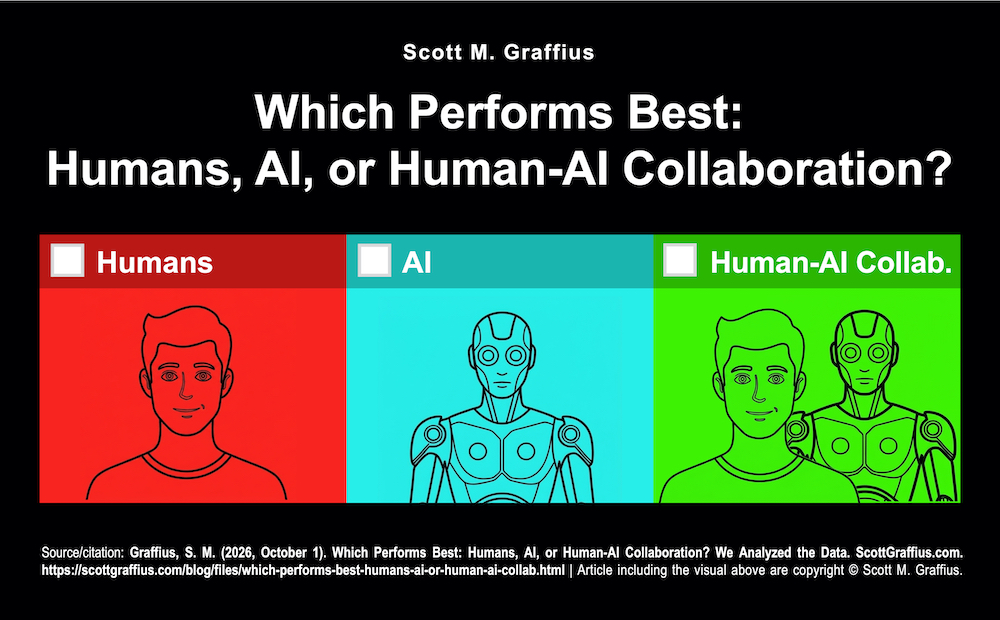
Recommended Citation
Graffius, S. M. (2026, October 1). Which Performs Best: Humans, AI, or Human-AI Collaboration? We Analyzed the Data. ScottGraffius.com. https://scottgraffius.com/blog/files/which-performs-best-humans-ai-or-human-ai-collab.html
About This Article
Source information and links for materials cited are provided in the References section.
Which performs best: humans, AI, or human-AI collaborations?
Prior studies have reached different conclusions about whether human-AI combinations outperform humans or AI alone. To answer this question, we conducted a deep-dive analysis of empirical evidence across a broad range of studies to determine what the data show. The findings might surprise you.
Research question
This article examines the central question: Do human-AI collaborations outperform humans and AI working independently? A bonus question is: Under what conditions does each configuration generally perform best?
"Human-AI collaboration" is used broadly in this analysis. It includes human-AI teams, human-AI decision-making, hybrid workflows, human-AI collectives, and other arrangements in which humans and AI jointly collaborate on an outcome.
The term collaborative advantage is used more narrowly. A human-AI system demonstrates a collaborative advantage when its performance exceeds both human-only and AI-only performance on the relevant task.
Evidence base
This analysis draws on 42 unique published studies.
All 42 sources were published within the past three years (2024-2026): 4 in 2024, 18 in 2025, and 20 in 2026. This reflects the fast pace of AI development and ensures the evidence speaks to current systems.
The studies cover a range of domains, including medicine and healthcare, education, creativity, decision-making, risk assessment, human factors, teamwork, intelligence analysis, and other areas.
The studies also differ considerably in design. Some directly compare human-only, AI-only, and human-AI configurations. Others compare two configurations. Some examine human-AI collaboration more indirectly by studying factors such as trust, reliance, explanation, workflow, role allocation, or decision processes.
That heterogeneity is less of a limitation for the present objective, which is to characterize the broader empirical landscape and identify recurring patterns.
Classification of findings
Each study was reviewed and classified according to the strongest conclusion supported by its findings.
The outcome categories were:
The classifications identify the principal result relevant to the core question. Do not interpret this as meaning every study was a direct three-way comparison.
The inconclusive category was reserved for studies in which the authors reported no meaningful difference.
Each study in the table below is assigned one principal designation. The four summary rows at the bottom of the table are simple tallies of those designations: the first pair (count and percentage) covers all 42 studies, and the second pair excludes the five inconclusive studies, leaving 37.
Results
The 42-study evidence base
The following table is the central evidence map for the analysis.
Additional information appears in the Table Annotations section, before the References.
Human-AI collaboration is the largest single category in this evidence set. Twenty-six of the 42 studies (61.9%) were classified as favoring human-AI collaboration. When the five inconclusive studies were removed, the figure is 26 out of 37 (70.3%).
However, collectively, the studies do not indicate a single best configuration:
In Cases of Work Involving a Specific Task
The studies in this analysis span different levels of focus. Some examine broad forms of work, such as projects, that comprise multiple tasks, while others examine a single task.
At the task level, an organization may have one task where AI is typically the best configuration, another where humans are, and a third where the two together do best.
For each important task, it helps to ask:
Generally, human-AI collaboration looks most promising for conceptual and generative work where humans and AI bring different capabilities, such as ideation and brainstorming, content design and creation, and niche domain problem-solving. Human-only work may remain the better choice for tasks with high emotional complexity, unstructured environments, or ethical nuance. AI-only execution may suit analytical and evaluative work, such as high-volume data sorting, pattern recognition, and statistical forecasting.
Buckle up: There are lots of limitations to factor and negotiate.
This article is longer than Interstellar. So we’re wrapping it up.
Which performs best: humans alone, AI alone, or human-AI collaboration? The empirical evidence indicates that human-AI collaboration generally performs better than either humans or AI alone.
Our analysis of 42 studies found that human-AI collaboration was the largest single best-performing category in the evidence set. Twenty-six studies (61.9%) showed human-AI collaboration as the best-performing configuration. Excluding the five studies that were classified as inconclusive, the figure was 70.3% (compared with 18.9% for humans and 10.8% for AI). The other 16 studies favored humans alone (7), AI alone (4), or were inconclusive (5), showing mixed results.
There is no universal winner. The best configuration depends on the endeavor. Conceptual and generative work is most effectively handled by humans and AI working together. For cognitive and relational work, humans have the edge. And for analytical and evaluative work, AI does.
Yet, across the evidence of a broad range of 42 studies, human-AI collaboration emerges as the strongest overall approach. As a larger implication, an advantage belongs to human-AI teams that effectively handle what Scott M. Graffius calls "exotic team dynamics"—the novel, strange, and often counterintuitive patterns that emerge when people and AI collaborate as teammates.
Scott M. Graffius' "Phases of Team Development" provides unique insights and practical strategies to help teams become more effective and successful. He developed it in 2008, and he updates it periodically. Graffius’ work is used by businesses, professional associations, government agencies, universities, and publications around the world. Select examples include Adobe, American Management Association, Amsterdam Public Health Research Institute, Bayer, Boston University, Broadcom, Cisco, DevOps Institute, Government of Finland, Hasso-Plattner-Institut für Digital Engineering GmbH, IEEE, Johns Hopkins University, Journal of Neurosurgery, Mary Raum (Professor of National Security Affairs, United States Naval War College), Microsoft, Oracle, Royal Australasian College of Physicians, Technical University of Munich, Torrens University, Tufts University, U.S. National Park Service, U.S. Tennis Association, UC San Diego, UK Sports Institute, University of Galway, University of Waterloo, Yale University, and many others.
Graffius expanded the 2026 edition of his "Phases of Team Development" beyond human-only teams. He added human-AI teams, with guidance on "exotic team dynamics." “Exotic team dynamics” describe the novel and often counterintuitive patterns that emerge when humans and advanced artificial intelligence function as teammates, and provide guidance on how to succeed with them. Understanding and navigating these complexities is essential for organizations seeking to unlock the full potential of human-AI teamwork and gain a competitive advantage. Explore "Scott M. Graffius' Phases of Team Development - Applied to Human Teams and Human-AI Teams: 2026 Update" and other resources detailed in the References to learn more.
Scott M. Graffius has generated over $3.1 billion in business value for Fortune 500 companies and other organizations around the world. Put that track record to work for you. For speaking engagements, use the request form; for other inquiries, email him.
Notes
Akben, M., Gude, V., & Ajjan, H. (2026). Collective and augmented intelligence outperform artificial intelligence on emotion recognition tests. Scientific Reports, 16, 14823. https://doi.org/10.1038/s41598-026-45331-5
Al-Ali, M., Marks, A., Mohamed, A. A., Balaha, H. M., Badawy, M., Elhosseini, M. A., & El-Agamy, R. F. (2026). Calibrated adaptive framework for trustworthy human and artificial intelligence decision systems. Scientific Reports. https://doi.org/10.1038/s41598-026-65730-y
Berretta, S., Tausch, A., Bülow, F., Kuhlenkötter, B., Topp, M., Els, C., Peifer, C., & Kluge, A. (2026). Human or AI first? A holistic perspective on the sequential order of joint human-AI inspection workflows. Applied Ergonomics, 132, 104669. https://doi.org/10.1016/j.apergo.2025.104669
Chen, H. (2025). Enhancing qualitative inquiry: AI-assisted focus group data collection. Qualitative Research Journal, 1–17. https://doi.org/10.1108/QRJ-04-2025-0145
Choi, J., Kim, Y. J., Lyu, P., Luan, Y. L., & Toh, S. M. (2026). Public reactions to hospitals after adverse events involving AI. npj Digital Public Health, 1, 17. https://doi.org/10.1038/s44482-026-00021-x
Choung, H., David, P., Mahmud, H., & Norcutt, S. (2026). Fairness and trust in AI decision-making: The role of human involvement and outcome favorability. International Journal of Human–Computer Interaction, 42(12), 9350–9370. https://doi.org/10.1080/10447318.2025.2576634
Cristofaro, M., & Giardino, P. L. (2026). Human–AI synergy: Finding cognitive balance in idea generation for product innovation. European Journal of Innovation Management, 29(7), 2072–2094. https://doi.org/10.1108/EJIM-03-2025-0312
Flathmann, C., Schelble, B. G., & Galeano, A. (2024). Empirical impacts of independent and collaborative training on task performance and improvement in human-AI teams. Proceedings of the Human Factors and Ergonomics Society Annual Meeting, 68(1), 1447–1453. https://doi.org/10.1177/10711813241274425
Fügener, A., Walzner, D. D., & Gupta, A. (2025). Roles of artificial intelligence in collaboration with humans: Automation, augmentation, and the future of work. Management Science, 72(1), 538–557. https://doi.org/10.1287/mnsc.2024.05684
Gerlich, M. (2025). From offloading to engagement: An experimental study on structured prompting and critical reasoning with generative AI. Data, 10(11), 172. https://doi.org/10.3390/data10110172
Gonzalez, C., Donahue, K., Goldstein, D. G., Heidari, H., Jalali, M. S., Schelble, B., Singh, A., & Woolley, A. W. (2026). Toward a science of human–AI teaming for decision-making: A complementarity framework. PNAS Nexus, 5(3), pgag030. https://doi.org/10.1093/pnasnexus/pgag030
Graffius, S. M. (n.d.). Exotic team dynamics. ScottGraffius.com. https://scottgraffius.com/exotic-team-dynamics.html
Graffius, S. M. (2025, August 8). Exotic Team Dynamics: The New Frontier of Human–AI Collaboration. ScottGraffius.com. https://doi.org/10.13140/RG.2.2.18048.49921
Graffius, S. M. (2025, August 22). Scott M. Graffius Premieres His New "Exotic Team Dynamics: Human-AI Collaboration" Talk at Corporate Event in Las Vegas. ScottGraffius.com. https://doi.org/10.13140/RG.2.2.34380.07047
Graffius, S. M. (2026, January 3). Scott M. Graffius' Phases of Team Development - Applied to Human Teams and Human-AI Teams: 2026 Update. ScottGraffius.com. https://doi.org/10.13140/RG.2.2.18184.89601
Graffius, S. M. (2026, June 22). L'avenir du Travail et de l'IA Avancée / Future of Work and Advanced AI. ScottGraffius.com. https://scottgraffius.com/blog/files/lavenir-du-travail-et-de-lia-avancee.html
Hemmer, P., Schemmer, M., Kühl, N., Vössing, M., & Satzger, G. (2025). Complementarity in human-AI collaboration: Concept, sources, and evidence. European Journal of Information Systems, 34(6), 979–1002. https://doi.org/10.1080/0960085X.2025.2475962
Hua, M., Zhang, G., Chong, L., Cagan, J., & Goucher-Lambert, K. (2025). How being outvoted by AI teammates impacts human-AI collaboration. International Journal of Human–Computer Interaction, 41(7), 4049–4066. https://doi.org/10.1080/10447318.2024.2345980
Jin, S., & Rho, S. (2025). Effects of AI explanations on human-AI collaboration: An experimental study on decision performance and reliance. Seoul Journal of Business, 31(2), 67–99. https://doi.org/10.35152/snusjb.2025.31.2.003
Kang, D.-H., Yuan, L., Feng, J., Zhan, J., Grzybowski, A., Sun, W., & Jin, K. (2025). AI-assisted automated interpretation of corneal topography in orthokeratology patients: Enhancing diagnostic precision and efficiency. International Journal of Ophthalmology, 18(12), 2217–2224. https://doi.org/10.18240/ijo.2025.12.01
Krzywdzinski, M., Wotschack, P., Gonnermann-Müller, J., & Gronau, N. (2026). How team organization influences the ability to solve automation failures: An experimental study on human–AI decision-making in teams. AI & SOCIETY, 41(4), 3605–3620. https://doi.org/10.1007/s00146-025-02761-5
Kuang, E., Shen, L., Jahangirzadeh Soure, E., Fan, M., & Shinohara, K. (2026). Standardizing the evaluation of usability test results: Criteria development and human-AI collaborative performance. International Journal of Human–Computer Interaction. Advance online publication. https://doi.org/10.1080/10447318.2026.2638554
Lai, X., & Rau, P.-L. P. (2026). Hybrid human–AI leadership: Exploring the influence of leadership structure on leadership effectiveness and neural activation. Behaviour & Information Technology, 45(6), 1007–1029. https://doi.org/10.1080/0144929X.2025.2545310
Li, A., Guo, C., Zhang, J., & Zhao, Q. (2025). A copula-based human–artificial intelligence collaborative decision-making approach for multi-hazard risk assessment. Computers & Industrial Engineering, 210, 111532. https://doi.org/10.1016/j.cie.2025.111532
Liel, Y., & Zalmanson, L. (2025). Turning off your better judgment: Algorithmic conformity in artificial intelligence-human collaboration. Journal of Management Information Systems, 42(4), 1087–1117. https://doi.org/10.1080/07421222.2025.2561390
Liu, P., Zhang, J., Chen, S., & Chen, S. (2025). Human-AI teaming in healthcare: 1 + 1 > 2? npj Artificial Intelligence, 1, Article 47. https://doi.org/10.1038/s44387-025-00052-4
Luan, Y. L., Kim, Y. J., & Zhou, J. (2025). Augmented learning for joint creativity in human-GenAI co-creation. Information Systems Research. Advance online publication. https://doi.org/10.1287/isre.2024.0984
Mascareño, J., Wörtler, B., Przegalińska, A., & Ciechanowski, L. (2026). When proximal collaboration with AI hinders innovation: The moderating role of idea originality and reliance on AI. Computers in Human Behavior Reports, 22, 101054. https://doi.org/10.1016/j.chbr.2026.101054
Mayer, L. W., Karny, S., Ayoub, J., Song, M., Tian, D., Moradi-Pari, E., & Steyvers, M. (2026). Human–AI collaboration: Trade-offs between performance and preferences. Cognitive Research: Principles and Implications, 11, 18. https://doi.org/10.1186/s41235-026-00713-1
Memmert, L., Cvetkovic, I., Tavanapour, N., & Bittner, E. (2026). Brainstorming with a generative language model: Effect of exposure to AI ideas on brainstorming performance and cognitive load. Business & Information Systems Engineering, 68, 1023–1047. https://doi.org/10.1007/s12599-025-00974-y
Ngo, V. M. (2025). Human–AI collaboration in high-stakes decisions: A meta-analysis of healthcare and public sectors. Applied Economics Letters, 1–6. https://doi.org/10.1080/13504851.2025.2586160
Ong, K. T.-I., Seo, J., Kim, H., Kim, J., Kim, J., Kim, S., Yeo, J., & Choi, E. Y. (2026). Success and failure of human-AI collaboration in clinical reasoning: An experimental study on challenging real-world cases. International Journal of Medical Informatics, 211, 106342. https://doi.org/10.1016/j.ijmedinf.2026.106342
Peng, K., Garg, N., & Kleinberg, J. (2025). A no free lunch theorem for human-AI collaboration. Proceedings of the AAAI Conference on Artificial Intelligence, 39(13), 14369–14376. https://doi.org/10.1609/aaai.v39i13.33574
Raj, M., Berg, J. M., & Seamans, R. (2026). The artificial intelligence disclosure penalty: Humans persistently devalue AI-generated creative writing. Journal of Experimental Psychology: General, 155(4), 896–915. https://doi.org/10.1037/xge0001889
Rojas, E., Hsu, D., Huang, J., & Li, M. (2025). Interpersonal influence matters: Trust contagion and repair in human-human-AI team. Computers in Human Behavior: Artificial Humans, 5, 100194. https://doi.org/10.1016/j.chbah.2025.100194
Schmutz, J. B., Outland, N., Kerstan, S., Georganta, E., & Ulfert, A.-S. (2024). AI-teaming: Redefining collaboration in the digital era. Current Opinion in Psychology, 58, 101837. https://doi.org/10.1016/j.copsyc.2024.101837
Senoner, J., Schallmoser, S., Kratzwald, B., Feuerriegel, S., & Netland, T. H. (2024). Explainable AI improves task performance in human–AI collaboration. Scientific Reports, 14, 31150. https://doi.org/10.1038/s41598-024-82501-9
Simpson, J., Patil, G., Stening, H., Kamruddin, A. B., Somerville, D., Seage, S., Nalepka, P., Dras, M., Hosking, S. G., Kallen, R. W., Richardson, M. J., & Richards, D. (2026). Can an AI agent lead human teams? Computers in Human Behavior: Artificial Humans, 7, 100278. https://doi.org/10.1016/j.chbah.2026.100278
Tang, M., Hofreiter, S., Werner, C. H., Zielińska, A., & Karwowski, M. (2025). “Who” is the best creative thinking partner? An experimental investigation of human-human, human-Internet, and human-AI co-creation. The Journal of Creative Behavior, 59(3), e1519. https://doi.org/10.1002/jocb.1519
Tannoubi, A., Bonsaksen, T., & Azaiez, F. (2026). Human-AI collaborative lesson design is associated with enhanced student outcomes and planning quality in secondary physical education: A randomized experimental study. Frontiers in Computer Science, 8, 1870451. https://doi.org/10.3389/fcomp.2026.1870451
Vaccaro, M., Almaatouq, A., & Malone, T. (2024). When combinations of humans and AI are useful: A systematic review and meta-analysis. Nature Human Behaviour, 8, 2293–2303. https://doi.org/10.1038/s41562-024-02024-1
Vo, K. H. T. (2025). “Who” designs better? A competition among human, artificial intelligence and human–AI collaboration. Design Science, 11, e37. https://doi.org/10.1017/dsj.2025.10029
Wang, G., Zhang, K., Jiang, J., Wang, C., Bi, H., Liang, H., Qi, Z., Huang, Y., Li, Y., & Yang, X. (2026). Human–large language model collaboration in clinical medicine: A systematic review and meta-analysis. npj Digital Medicine, 9, Article 195. https://doi.org/10.1038/s41746-026-02382-2
Wang, L., Huang, Q., Wang, K., Lou, J., & Yuan, C. (2026). Comparison of human-AI collaboration modes in cross-platform public opinion analysis: An experimental study on analyst performance and cognitive load. International Journal of Human–Computer Interaction. Advance online publication. https://doi.org/10.1080/10447318.2026.2728615
Winter, J. (2025). AI teammates and human performance: Evidence for commitment deficits. Computers in Human Behavior Reports, 20, 100828. https://doi.org/10.1016/j.chbr.2025.100828
Wu, S., Liu, Y., Ruan, M., Chen, S., & Xie, X.-Y. (2025). Human-generative AI collaboration enhances task performance but undermines human's intrinsic motivation. Scientific Reports, 15, 15105. https://doi.org/10.1038/s41598-025-98385-2
Zeng, S., Bai, J., Shi, J., Li, Y., Zhao, Y., & Shi, Y. (2026). Human–computer collaborative approach to the decipherment of oracle bone inscriptions with generative adversarial networks. npj Heritage Science, 14, 232. https://doi.org/10.1038/s40494-026-02509-4
Zöller, N., Berger, J., Lin, I., Fu, N., Komarneni, J., Barabucci, G., Laskowski, K., Shia, V., Harack, B., Chu, E. A., Trianni, V., Kurvers, R. H. J. M., & Herzog, S. M. (2025). Human–AI collectives most accurately diagnose clinical vignettes. Proceedings of the National Academy of Sciences, 122(24), e2426153122. https://doi.org/10.1073/pnas.2426153122
Scott M. Graffius is a technology leader, researcher, award-winning author, practitioner, consultant, thought leader, and international public speaker specializing in AI, Agile, project/program/portfolio management (PPPM), PMO leadership, and teamwork tradecraft. His work explores the intersection of human ingenuity and emerging technology, with a strong practitioner voice grounded in research, experimentation, and experience. His focus includes innovation, organizational performance, and the evolving practice of teamwork, including the "exotic team dynamics" that emerge when people collaborate with advanced artificial intelligence (agentic, autonomous, or autopoietic AI). Graffius has delivered more than $3.1 billion in business value for Fortune 500 companies and other organizations spanning technology, entertainment and media, financial services, healthcare, government, and other industries.
Businesses, professional associations, government agencies, universities, publications, and media outlets use Graffius and his work. Examples include Adobe, Bayer, Boston University, Ford, Gartner, Harvard Medical School, IEEE, Innovation Project Management, Johns Hopkins University, Microsoft, MSN, National Academy of Sciences, Oracle, Pinterest Inc., Project Management Institute, UC San Diego, Verizon, Yale University, and others.
The following sections highlight his experience, leadership, contributions, research, and enduring influence across industries and institutions worldwide.
Experience
Graffius heads the professional services firm Exceptional PPM and PMO Solutions, along with its subsidiary Exceptional Agility. These consultancies offer strategic and tactical advisory, training, embedded expertise, and consulting services to the public, private, and government sectors. They help organizations enhance their capabilities and results in agile, project management, program management, portfolio management, and enterprise PMO leadership, supporting innovation and driving competitive advantage. The consultancies confidently back services with a Delighted Client Guarantee™.
Graffius is a former VP of project management with a publicly traded provider of diverse consumer products and services over the Internet. Before that, he ran and supervised the delivery of projects and programs in public and private organizations with businesses ranging from e-commerce to advanced technology products and services, retail, manufacturing, entertainment and media, and more.
He has experience with consumer, business, reseller, government, and international markets.
Additional information is on LinkedIn.
Award-Winning Author
Graffius has authored three books.
Graffius' first book, Agile Scrum: Your Quick Start Guide with Step-by-Step Instructions, earned 17 awards. It provides a practical, step-by-step guide to Scrum, enabling teams to deliver products in short cycles with rapid adaptation, fast time-to-market, and continuous improvement—which supports innovation and drives competitive advantage.
Additional information on Agile Scrum: Your Quick Start Guide with Step-by-Step Instructions is here.
His second book, Agile Transformation: A Brief Story of How an Entertainment Company Developed New Capabilities and Unlocked Business Agility to Thrive in an Era of Rapid Change, was named one of the best Scrum books of all time by BookAuthority. It tells the compelling story of an entertainment company's agile transformation—offering lessons that apply across industries.
Additional information on Agile Transformation: A Brief Story of How an Entertainment Company Developed New Capabilities and Unlocked Business Agility to Thrive in an Era of Rapid Change is here.
Agile Protocol: The Transformation Ultimatum, is his third book—and his first work of fiction.
It's a fast-paced satirical story by that dismantles corporate Agile cosplay and other forms of "fake Agile" while delivering practical insights, actionable guidance, and proven practices for real-world Agile transformation success.
Packed with humor, quirky characters, sharp commentary on corporate culture and workplace absurdities, and actionable tips, it’s a must-read for Scrum Masters, Product Owners, Agile Coaches, Agile Project Managers, and other professionals interested in Agile project management and enterprise agility.
Additional information on Agile Protocol: The Transformation Ultimatum is here.
International Public Speaker
Organizations worldwide engage Graffius to present on technology (including AI), Agile, project management, program management, portfolio management, and enterprise PMO leadership. He crafts and delivers unique and compelling talks and workshops.
Graffius has conducted 99 sessions across 25 countries. Select examples of events include Agile Trends Gov, BSides (Newcastle Upon Tyne), Conf42 Quantum Computing, DevDays Europe, DevOps Institute, DevOpsDays (Geneva), Frug’Agile, IEEE, Microsoft, Scottish Summit, Scrum Alliance RSG (Nepal), Techstars, and W Love Games International Video Game Development Conference (Helsinki), Future of Work and Advanced AI (Paris, France), and more.
With an average rating of 4.82 (on a scale of 1-5), sessions are highly valued.
The request form is here.
Thought Leadership and Influence
Prominent businesses, professional associations, government agencies, and universities have showcased Graffius and his contributions—spanning his books, talks, workshops, and beyond. Select examples include:
Graffius has played a key role in the Project Management Institute (PMI) in developing professional standards. He was a member of multiple teams that authored, reviewed, and produced:
He was also a subject matter expert reviewer of content for the PMI’s Congress. Beyond the PMI, Graffius also served as a member of the review team for two of the Scrum Alliance’s Global Scrum Gatherings.
Authority on Teamwork Tradecraft
Graffius is a renowned and highly-cited authority on teamwork tradecraft. Informed by the research of Bruce W. Tuckman and Mary Ann C. Jensen, over 150 subsequent studies, and Graffius' first-hand professional experience with, and analysis of, team leadership and performance, Graffius created his "Phases of Team Development" intellectual property as a unique perspective and visual conveying the five phases of team development.
First introduced in 2008 and periodically updated, his work provides a diagnostic and strategic guide for navigating team dynamics. It provides actionable insights for leaders across industries to develop high-performance teams.
Its adoption by esteemed organizations—such as Yale University, IEEE, Cisco, Microsoft, Ford, Oracle, Broadcom, the U.S. National Park Service, and the Journal of Neurosurgery, among others—highlights its utility and value, solidifying its status as an indispensable resource for elevating team performance and driving organizational excellence.
In 2026, Graffius added human-AI teamwork—including the "exotic team dynamics" which emerge when advanced AI collaborates as a teammate—to his "Phases of Team Development." The 2026 edition is here.
Expert on Temporal Dynamics on Social Media Platforms
Graffius is also an authority on temporal dynamics on social media platforms. His "Lifespan (Half-Life) of Social Media Posts" research—first published in 2018 and updated annually—delivers a precise quantitative analysis of post longevity across digital platforms, utilizing advanced statistical techniques to determine mean half-life with precision. It establishes a solid empirical base, effectively highlighting the ephemeral nature of content within social media ecosystems.
Referenced and applied by leading entities—such as Fast Company, GoDaddy, Journal of Hand Surgery (European Volume), Ministère de la Culture, Pinterest Inc., PNAS, and Telecommunications Policy, among others—his research exemplifies methodological rigor and sustained significance in the field of digital informatics.
The 2026 edition of Graffius "Lifespan (Half-Life) of Social Media Posts" research is here.
Education and Professional Certifications
Graffius has a bachelor’s degree in psychology with a focus in Human Factors. He holds eight professional certifications:
He is an active member of the Scrum Alliance, the Project Management Institute (PMI), and the Institute of Electrical and Electronics Engineers (IEEE).
Advancing AI, Agile, and Project/PMO Management
Scott M. Graffius continues to advance the fields of AI, Agile, and project/program/portfolio management (PPPM), and PMO leadership. Businesses and other organizations leverage Graffius’ insights to drive their success.
Graffius has generated over $3.1 billion in business value for Fortune 500 companies and other organizations served. Put that track record to work for you. For speaking engagements, use the request form; for other inquiries, email him.
Connect with and follow Scott on LinkedIn, X, YouTube, Facebook, Bluesky, Mastodon, and ResearchGate.
Read more.
Meta CTO Called the AI Reorganization “Atrocious” — What Went Wrong and the Lessons for Human-AI Teams
A Critical Analysis of "AI and Quantum Computers Will Be Frenemies"
A Supplement to Graffius' Phases of Team Development: Exploring the Original, Data-Based Curvature for the Performance Trajectory
Scott M. Graffius Speaking on Strategic Leadership at Silicon Valley Chapter of the Project Management Institute
AI Hallucinations, Deception, and Unauthorized Agency: The Spectrum of AI Trust Failures
A Critical Analysis of "The Social Cost of an AI Teammate: How an Artificial Teammate Reshapes Human-Human Communication in Small-Team Decision-Making"
Journal of Marketing Cites Scott M. Graffius' Research on the Half-Life of Social Media
The Evolution of Pair Programming and the Rise of Exotic Team Dynamics
Number 1 University in England for Student Satisfaction Features Scott M. Graffius' "Phases of Team Development"
Royal Australasian College of Physicians Licenses Scott M. Graffius' "Phases of Team Development" Intellectual Property on Teamwork Tradecraft
Exotic Team Dynamics: How Advanced AI Teammates Are Unlocking New Levels of Innovation, Performance, and Success
A Critical Analysis of "Platform-Specific Data Decay Patterns: A Comparative Study of Twitter, Reddit, and TikTok" and Its Reference to Research by Scott M. Graffius
Round Square Global Educational Network Features Scott M. Graffius’ Phases of Team Development
Meta's Muse Missed the Mark: Hollywood’s Win Against Big Tech on AI Consent and Likeness Rights
Scott M. Graffius Contributed to Seven Project Management Institute (PMI) Standards
Quantum Computing, Advanced AI Acceleration, and the Rise of Exotic Team Dynamics in Human-AI Teams
Ohio State University Course Features Scott M. Graffius' "Phases of Team Development"
Questions About Integrity at UNC Chapel Hill
Scrum Isn’t Just for Coding
Book on Generative and Agentic AI Cites Scott M. Graffius' Work on AI
IPA / ADAL Publication Plagiarized Another’s Copyrighted Work and Violated Intellectual Property Rights
UC Davis' Integrity Is Circling the Drain
L'avenir du Travail et de l'IA Avancée / Future of Work and Advanced AI
NCCI / UNC Chapel Hill Publication Features Scott M. Graffius' Work
Boston Consulting Group (BCG) Features Scott M. Graffius' Research on Social Media Content Half-Life
UC Davis Used Scott M. Graffius' "Phases of Team Development" Intellectual Property
Medical, Pharma, and Healthcare Organizations Are Using Scott M. Graffius' "Phases of Team Development"
Government of Ireland Report Features Research by Scott M. Graffius
Scott M. Graffius Contributed to The Standard for Artificial Intelligence in Portfolio, Program, and Project Management
AI Governance Initiative Cites Scott M. Graffius Research on AI Hallucinations
Scott M. Graffius Contributed to the Agile Practice Guide - Second Edition
Scott M. Graffius Generated Over $2.51 Billion in Business Value for Fortune 500 Companies and Other Organizations
Government of Canada Features Research by Scott M. Graffius
"Strategic Business Research" Journal Cites Work of Scott M. Graffius
IEEE Access Publication Features Scott M. Graffius’ Research on the Half-Life of Social Media
The Agile Coach: 2026 Edition
Scott M. Graffius’ Work Cited in International Peer-Reviewed Journal on Digital Transformation
Phases of Team Development in Elite Sport
A Critical Analysis of COVID-19 Treatment Search Trends and Media Coverage Study Citing Scott M. Graffius' Work
Human-AI Teamwork: Master the Exotic Team Dynamics That Emerge When Collaborating with Advanced AI -- Or Be Outplayed
"Agile Scrum" by Scott M. Graffius Now Featured on Grokipedia
UNSW Aerospace Engineering Course Features Scott M. Graffius' "Phases of Team Development"
Thinkers360 Honors Scott M. Graffius as a 2026 Top Agile Thought Leader
Agile's Journey Through the Decades: Update for 2026
BMC Software Features Content from Scott M. Graffius' Book
Peer-Reviewed Journal Cited Work of Scott M. Graffius
University of Waterloo Features Graffius' "Phases of Team Development" in Course Materials
Perplexity Standalone Article on AI Hallucinations Cites Research by Scott M. Graffius
Handling the Saboteur Within: Lessons from a 3-Letter Agency on Spotting and Stopping Intentional and Unintentional Sabotage
A Deep Dive Into the Typical Engagement Pattern for Social Media Posts
Most Valuable IT Certifications: Update for 2026
"Marketing in the Metaverse" Spotlights Scott M. Graffius’ Research on the Half-Life of Social Media
University of Greenwich Features Graffius' Phases of Team Development
10 Essential Agile Books: Curated Recommendations for Agile Professionals
Lifespan (Half-Life) of Social Media Posts: Update for 2026
Scott M. Graffius' Research on the Half-Life of Social Media was Cited in a Peer-Reviewed Study Published in Telecommunications Policy, a Leading Academic Journal
Are AI Hallucinations Getting Better or Worse? We Analyzed the Data
Scott M. Graffius' Phases of Team Development - Applied to Human Teams and Human-AI Teams: 2026 Update
Lessons from Yesterday’s Tomorrowland
Scott M. Graffius’ Update to His "Phases of Team Development” Coming Early 2026
A Data-Driven Analysis of the Evolution of Project Management: Tasks, Trends, and AI
Actionable Insights. Global Impact. Scott M. Graffius.
Beep Beep! Why Wile E. Coyote Is the Patron Saint of AI Failure
Social Media Half-Life Research Cited in Prestigious Peer-Reviewed Medical Journal
Navigating the Spectrum of Advanced AI – Agentic, Autonomous, and Autopoietic
Lessons from Unhinged AI in Fiction: What Rogue AIs in Sci-Fi Storytelling, Films, and TV Shows Reveal About Us
Scott M. Graffius Contributed to and Reviewed the PMBOK Guide, 8th Edition — the Global Standard for Project Management
UK Sports Institute Features Teamwork and Leadership Work of Scott M. Graffius
Definitions of Advanced AIs: Agentic, Autonomous, and Autopoietic
HAN University of Applied Sciences Features the Work of Scott M. Graffius
Gifts That Inspire Joy
Evergreen Echoes: How Pinterest Inc. and Pinterest Japan Spotlighted Scott M. Graffius’ Research on the Half-Life of Social Media Content
Scott M. Graffius’ Team Development Work Lights Up the University of Tasmania’s Curriculum
Taiwan’s Leading Outlet for Technology and Innovation Spotlights Graffius’ Research on Social Media Temporal Dynamics
Scott M. Graffius’ Insights on AI, Agile, Gaming, XR, and Defense Transformation Cited by MSN in Their Coverage of Innovation and Leadership in the Sector
Top Predictions of 2024, Tested in 2025
Government of Finland Agency Features Graffius' Phases of Team Development IP
Scott M. Graffius Premieres His New "Exotic Team Dynamics: Human-AI Collaboration" Talk at Corporate Event in Las Vegas
Environmental Science Journal References Scott M. Graffius’ Project Management Work
AI Institute of Switzerland Features Scott M. Graffius’ Work on Algorithms
Exotic Team Dynamics: The New Frontier of Human–AI Collaboration
Scott M. Graffius’ Work Featured at ACM DIS ’25
Climbing the Ladder: The Head of Agile/PMO’s Organizational Proximity to the CEO is Closer Than Ever
Harness Sci-Fi and Speculative Design While Embracing Imperfection to Drive Innovation and Proactively Predict and Prepare for the Future
Scott M. Graffius’ “Agile Scrum” Book Featured in a Publication of the Associação Nacional de Educação Católica do Brasil (ANEC)
Setting Direction with OKRs and Tracking Progress with KPIs: A Guide for Agile, Project Management, and Tech Teams
AI Showcase Showdown: Ranking AI Accuracy on Project Management Basics
BookAuthority Features “Agile Scrum” by Scott M. Graffius in “10 Agile Software Development Books That Define the Field”
Exploring Team Dynamics, Adaptability, and Creative Problem-Solving Through Felix the Cat’s Metaphorical Toolkit
Mind Games and Master Plans: How PsyOps Exploit Psychological Phenomena
The “Pants-on-Fire Index for AI”
16 Causes of Technical Debt and How to Avoid It
PMI’s Infinity AI Gets the Basics of Team Development Alarmingly and Repeatedly Wrong
Agile for Unicorns: 7 Keys to Thrive; Scott M. Graffius’ Workshop
Scott M. Graffius’ “Agile Scrum: Your Quick Start Guide with Step-by-Step Instructions” Featured in Prestigious National Academies of Sciences Publication
Meta and Anduril’s EagleEye and the Future of XR: How Gaming, AI, and Agile Are Transforming Defense
"Agile Protocol" and the Power of Satire, Parody, and Humor
AI in Agile: Benefits, Risks, Outlook
Hostinger Highlights Scott M. Graffius’ “Agile Protocol” Book in Feature on Software Projects
French Ministry of Culture Links to Scott M. Graffius Research in Their Guide for Responsible Digital Communication
National Science Foundation’s LTER Network Features Scott M. Graffius’ Phases of Team Development IP
Waterfall vs. Agile: What’s Fixed, What’s Flexible, and Why It Matters
Scott M. Graffius Delivering $2.3 Billion in Value Through AI, Agile, and Project/PMO Leadership
The Problem with Heroes in Agile
The 3 Vital Rules of Science: What They Are and Why They Matter
“Agile Protocol: The Transformation Ultimatum” Lands on the Amazon Best Sellers List!
Scott M. Graffius Recognized as a Top Thought Leader in Digital Disruption by Thinkers360
“Agile Protocol: The Transformation Ultimatum” by Scott M. Graffius Crashes the Book Scene with Satirical Firepower
NCKU in Taiwan Integrates Graffius' 'Phases of Team Development' into Its Curriculum
The Art and Science of Aligning Initiatives with Strategic Objectives
RGPV University Adds Scott M. Graffius’ "Agile Scrum: Your Quick Start Guide with Step-by-Step Instructions" to Its Syllabus
Introducing ‘Engage or Fade: Decoding the Half-Life of Digital Resonance’ – A New Talk by Scott M. Graffius
Dropbox Company (Nira) Taps into Scott M. Graffius’ Expertise in Strategic Planning
Reporting Errors in a Publication: A Case Study on ‘Frontiers in Public Health’
NESEA Conference Session on Innovation Highlights Scott M. Graffius' 'Phases of Team Development'
U.S. Soccer Scores with Scott M. Graffius' Intellectual Property on Teamwork
U.S. Department of Commerce Partner (IEDC) Features Scott M. Graffius’ Intellectual Property
How Long Do Your Posts Live? AI Critiques Scott M. Graffius’ Research on the Half-Life of Social Media
Agile's Journey Through the Decades
Scott M. Graffius' Role in Advancing Project Management Institute (PMI) Standards Excellence
Most Valuable IT Certifications: Update for 2025
The PMI + Agile Alliance Merger: A Recipe for Success?
When Agile, AI, and Strategic Thinking Converge
Scott M. Graffius’ Phases of Team Development: 2025 Update
Lifespan (Half-Life) of Social Media Posts: Update for 2025
Verizon Features Scott M. Graffius
Do Not Read This Article! An Exploration of the Streisand Effect and Other Phenomena
Scott M. Graffius' 'Phases of Team Development' was Spotlighted in Journal of Neurosurgery
Pinterest Japan Uses Graffius’ Research on Temporal Dynamics on Social Media Platforms
Hochschule Coburg (Coburg University) Germany Uses Scott M. Graffius’ Phases of Team Development IP in Coursework on Agile Development
Wild World of Team Dynamics [Updated Two-Minute Video]
EU Europass Teacher Academy Features Scott M. Graffius’ ‘Phases of Team Development’ in Leadership Training
Side-by-Side Comparison of Retrospectives and Hot Washes
Constructor University 2024 Advanced Software Technology Handbook References Scott M. Graffius' Work on Team Dynamics
Strategies for Medical Team Success Featured Scott M. Graffius’ ‘Phases of Team Development’ Intellectual Property
SBG Neumark — Europe’s Largest Distribution Transformer Plant — Powers Up with Scott M. Graffius’ Intellectual Property
Scott M. Graffius’ Intellectual Property was Employed by the NHS — the Largest Single-Payer Healthcare System in Europe
Luxury Unwrapped: The Ultimate Holiday Gift Guide for Every Budget
Singapore Institute of Technology Features Work of Scott M. Graffius
Tufts University Features Scott M. Graffius 'Phases of Team Development' Intellectual Property
'Cat Herders': Retelling the Massive Success Story
Pennsylvania State Agency Used Scott M. Graffius' Intellectual Property
Copyright Infringement in a Book Published by AuthorHouse / Author Solutions / The Najafi Companies: Publisher Fails to Respond or Take Required Action
Pinterest Inc. References Scott M. Graffius’ Research
Bournemouth University Used Scott M. Graffius’ Intellectual Property
‘Comparative Methodological Guidelines: Handbook for Educators’ Violates Scott M. Graffius’ Copyright
Japan Backlog User Group Event Featured Scott M. Graffius’ ‘Phases of Team Development’
TurningWest's 'Trial'
Radio Silence from the American Association of Neurological Surgeons on Report of Blatant Plagiarism in Their ‘Journal of Neurosurgery’ Publication
Supplement to Graffius' 'Lifespan (Half-Life) of Social Media Posts' Research: Typical Engagement Distribution Pattern for Social Media Posts
How Algorithms Shape the User Experience on Social Media Platforms
Thinkers360 Named Scott M. Graffius a Top Thought Leader on Agile
More articles are listed here.
Graffius, S. M. (2026, October 1). Which Performs Best: Humans, AI, or Human-AI Collaboration? We Analyzed the Data. ScottGraffius.com. https://scottgraffius.com/blog/files/which-performs-best-humans-ai-or-human-ai-collab.html
Coming soon
Names, marks, and content are the property of their respective owners.
If there are any supplements or updates to this article after the date of publication, they will appear here.
Copyright © Scott M. Graffius. All rights reserved.
Content on this site—including text, images, videos, and data—may not be used for training or input into any artificial intelligence, machine learning, or automatized learning systems, or published, broadcast, rewritten, or redistributed without the express written permission of Scott M. Graffius.
Recommended Citation
Graffius, S. M. (2026, October 1). Which Performs Best: Humans, AI, or Human-AI Collaboration? We Analyzed the Data. ScottGraffius.com. https://scottgraffius.com/blog/files/which-performs-best-humans-ai-or-human-ai-collab.html
About This Article
Source information and links for materials cited are provided in the References section.
Introduction
Which performs best: humans, AI, or human-AI collaborations?
Prior studies have reached different conclusions about whether human-AI combinations outperform humans or AI alone. To answer this question, we conducted a deep-dive analysis of empirical evidence across a broad range of studies to determine what the data show. The findings might surprise you.
Methodology
Research question
This article examines the central question: Do human-AI collaborations outperform humans and AI working independently? A bonus question is: Under what conditions does each configuration generally perform best?
"Human-AI collaboration" is used broadly in this analysis. It includes human-AI teams, human-AI decision-making, hybrid workflows, human-AI collectives, and other arrangements in which humans and AI jointly collaborate on an outcome.
The term collaborative advantage is used more narrowly. A human-AI system demonstrates a collaborative advantage when its performance exceeds both human-only and AI-only performance on the relevant task.
Evidence base
This analysis draws on 42 unique published studies.
All 42 sources were published within the past three years (2024-2026): 4 in 2024, 18 in 2025, and 20 in 2026. This reflects the fast pace of AI development and ensures the evidence speaks to current systems.
The studies cover a range of domains, including medicine and healthcare, education, creativity, decision-making, risk assessment, human factors, teamwork, intelligence analysis, and other areas.
The studies also differ considerably in design. Some directly compare human-only, AI-only, and human-AI configurations. Others compare two configurations. Some examine human-AI collaboration more indirectly by studying factors such as trust, reliance, explanation, workflow, role allocation, or decision processes.
That heterogeneity is less of a limitation for the present objective, which is to characterize the broader empirical landscape and identify recurring patterns.
Classification of findings
Each study was reviewed and classified according to the strongest conclusion supported by its findings.
The outcome categories were:
- Humans alone perform best
- AI alone performs best
- Human-AI collaboration performs best
- Findings are inconclusive
The classifications identify the principal result relevant to the core question. Do not interpret this as meaning every study was a direct three-way comparison.
The inconclusive category was reserved for studies in which the authors reported no meaningful difference.
Each study in the table below is assigned one principal designation. The four summary rows at the bottom of the table are simple tallies of those designations: the first pair (count and percentage) covers all 42 studies, and the second pair excludes the five inconclusive studies, leaving 37.
Results
The 42-study evidence base
The following table is the central evidence map for the analysis.
| # | Short reference | Domain | Humans Perform Best | AI Performs Best | Human-AI Collaboration Performs Best | Inconclusive |
|---|---|---|---|---|---|---|
| 1 | Vaccaro et al. (2024) | Multiple domains | ✓ | |||
| 2 | Hemmer et al. (2025) | Decision-making | ✓ | |||
| 3 | Liu et al. (2025) | Decision-making | ✓ | |||
| 4 | Wang et al. (2026) | Healthcare | ✓ | |||
| 5 | Zöller et al. (2025) | Medicine/diagnosis | ✓ | |||
| 6 | Berretta et al. (2026) | Decision-making | ✓ | |||
| 7 | Vo (2025) | Human-AI interaction | ✓ | |||
| 8 | Lai & Rau (2026) | Human-AI teams | ✓ | |||
| 9 | Memmert et al. (2026) | Decision-making/teamwork | ✓ | |||
| 10 | Akben et al. (2026) | Decision-making | ✓ | |||
| 11 | Fügener et al. (2025) | Operations/decision-making | ✓ | |||
| 12 | Hua et al. (2025) | Human-AI teams | ✓ | |||
| 13 | Flathmann et al. (2024) | Human-AI teaming | ✓ | |||
| 14 | Schmutz et al. (2024) | Human factors/teamwork | ✓ | |||
| 15 | Krzywdzinski et al. (2026) | Organizational/teamwork | ✓ | |||
| 16 | Mascareño et al. (2026) | Creativity/innovation | ✓ | |||
| 17 | Ong et al. (2026) | Decision-making | ✓ | |||
| 18 | Mayer et al. (2026) | Human-AI interaction | ✓ | |||
| 19 | Wang et al. (2026) | Intelligence analysis | ✓ | |||
| 20 | Gonzalez et al. (2026) | Human-AI teaming | ✓ | |||
| 21 | Senoner et al. (2024) | Manufacturing/decision support | ✓ | |||
| 22 | Wu et al. (2025) | Human-AI collaboration | ✓ | |||
| 23 | Winter (2025) | Teamwork/creativity | ✓ | |||
| 24 | Liel & Zalmanson (2025) | Decision-making | ✓ | |||
| 25 | Rojas et al. (2025) | Human-AI teams | ✓ | |||
| 26 | Simpson et al. (2026) | Teamwork | ✓ | |||
| 27 | Cristofaro & Giardino (2026) | Cognition/AI use | ✓ | |||
| 28 | Ngo (2025) | Healthcare/public sector | ✓ | |||
| 29 | Kuang et al. (2026) | Usability/user research | ✓ | |||
| 30 | Li et al. (2025) | Risk assessment | ✓ | |||
| 31 | Kang et al. (2025) | Medicine/imaging | ✓ | |||
| 32 | Zeng et al. (2026) | Cybersecurity/decipherment | ✓ | |||
| 33 | Al-Ali et al. (2026) | Decision-making | ✓ | |||
| 34 | Tannoubi et al. (2026) | Education | ✓ | |||
| 35 | Gerlich (2025) | Education/cognition | ✓ | |||
| 36 | Luan et al. (2025) | Creativity | ✓ | |||
| 37 | Tang et al. (2025) | Creativity | ✓ | |||
| 38 | Jin & Rho (2025) | Human-AI decision-making | ✓ | |||
| 39 | Choi et al. (2026) | Human-AI interaction | ✓ | |||
| 40 | Raj et al. (2026) | Creative writing | ✓ | |||
| 41 | Choung et al. (2026) | Human-AI interaction | ✓ | |||
| 42 | Chen (2025) | Qualitative research | ✓ | |||
| # of 42 | 7 | 4 | 26 | 5 | ||
| % of 42 | 16.7% | 9.5% | 61.9% | 11.9% | ||
| # excl. inconclusive | 7 | 4 | 26 | |||
| % excl. inconclusive | 18.9% | 10.8% | 70.3% |
Additional information appears in the Table Annotations section, before the References.
Discussion
Human-AI collaboration is the largest single category in this evidence set. Twenty-six of the 42 studies (61.9%) were classified as favoring human-AI collaboration. When the five inconclusive studies were removed, the figure is 26 out of 37 (70.3%).
However, collectively, the studies do not indicate a single best configuration:
- Of the 42 studies, 26 (61.9%) favored human-AI collaboration, 7 (16.7%) favored humans alone, 4 (9.5%) favored AI alone, and 5 (11.9%) were inconclusive.
- Excluding the five inconclusive studies, there are 37 studies. Of them, 26 (70.3%) favored human-AI collaboration, 7 (18.9%) favored humans alone, and 4 (10.8%) favored AI alone.
In Cases of Work Involving a Specific Task
The studies in this analysis span different levels of focus. Some examine broad forms of work, such as projects, that comprise multiple tasks, while others examine a single task.
At the task level, an organization may have one task where AI is typically the best configuration, another where humans are, and a third where the two together do best.
For each important task, it helps to ask:
- What does the task require?
- What does the human bring, and what does the AI bring?
- Where do those differences help, and where might they cause errors or friction?
- What workflow would let the strengths combine?
- How does each configuration actually perform: human alone, AI alone, and the two together?
- What does the data say?
Generally, human-AI collaboration looks most promising for conceptual and generative work where humans and AI bring different capabilities, such as ideation and brainstorming, content design and creation, and niche domain problem-solving. Human-only work may remain the better choice for tasks with high emotional complexity, unstructured environments, or ethical nuance. AI-only execution may suit analytical and evaluative work, such as high-volume data sorting, pattern recognition, and statistical forecasting.
Limitations
Buckle up: There are lots of limitations to factor and negotiate.
- The 42 publications are not methodologically uniform. Some directly compare humans, AI, and human-AI configurations. Others compare only two conditions or examine aspects of human-AI collaboration. The percentages reported here describe this particular evidence set; they are not pooled effect estimates.
- The studies cover different domains and tasks.
- AI capabilities are changing rapidly. A result obtained with an earlier model does not necessarily predict the performance of a current or future model. This is why the analysis prioritizes 2024–2026 publications and should be updated as technology and the research base develop.
- Different studies use different designs or performance measures. Accuracy, speed, quality, creativity, diagnostic performance, decision quality, and other measures are not interchangeable. A collaboration can improve one dimension while worsening another.
- Some studies examine laboratory or controlled settings rather than long-term real-world teams. Real-world collaboration introduces factors such as organizational culture, training, incentives, trust, workload, accountability, and learning over time.
- Publication bias is possible. Studies reporting interesting positive or negative results may be more likely to be published or noticed than studies finding little or no difference. Vaccaro et al. specifically identify possible publication bias and variation in study designs as limitations of the existing evidence base.
- Classifications in this article necessarily involve judgment. The intent was to classify the principal finding relevant to the core question while avoiding overstatement.
Conclusion
This article is longer than Interstellar. So we’re wrapping it up.
Which performs best: humans alone, AI alone, or human-AI collaboration? The empirical evidence indicates that human-AI collaboration generally performs better than either humans or AI alone.
Our analysis of 42 studies found that human-AI collaboration was the largest single best-performing category in the evidence set. Twenty-six studies (61.9%) showed human-AI collaboration as the best-performing configuration. Excluding the five studies that were classified as inconclusive, the figure was 70.3% (compared with 18.9% for humans and 10.8% for AI). The other 16 studies favored humans alone (7), AI alone (4), or were inconclusive (5), showing mixed results.
There is no universal winner. The best configuration depends on the endeavor. Conceptual and generative work is most effectively handled by humans and AI working together. For cognitive and relational work, humans have the edge. And for analytical and evaluative work, AI does.
Yet, across the evidence of a broad range of 42 studies, human-AI collaboration emerges as the strongest overall approach. As a larger implication, an advantage belongs to human-AI teams that effectively handle what Scott M. Graffius calls "exotic team dynamics"—the novel, strange, and often counterintuitive patterns that emerge when people and AI collaborate as teammates.
Note
Scott M. Graffius' "Phases of Team Development" provides unique insights and practical strategies to help teams become more effective and successful. He developed it in 2008, and he updates it periodically. Graffius’ work is used by businesses, professional associations, government agencies, universities, and publications around the world. Select examples include Adobe, American Management Association, Amsterdam Public Health Research Institute, Bayer, Boston University, Broadcom, Cisco, DevOps Institute, Government of Finland, Hasso-Plattner-Institut für Digital Engineering GmbH, IEEE, Johns Hopkins University, Journal of Neurosurgery, Mary Raum (Professor of National Security Affairs, United States Naval War College), Microsoft, Oracle, Royal Australasian College of Physicians, Technical University of Munich, Torrens University, Tufts University, U.S. National Park Service, U.S. Tennis Association, UC San Diego, UK Sports Institute, University of Galway, University of Waterloo, Yale University, and many others.
Graffius expanded the 2026 edition of his "Phases of Team Development" beyond human-only teams. He added human-AI teams, with guidance on "exotic team dynamics." “Exotic team dynamics” describe the novel and often counterintuitive patterns that emerge when humans and advanced artificial intelligence function as teammates, and provide guidance on how to succeed with them. Understanding and navigating these complexities is essential for organizations seeking to unlock the full potential of human-AI teamwork and gain a competitive advantage. Explore "Scott M. Graffius' Phases of Team Development - Applied to Human Teams and Human-AI Teams: 2026 Update" and other resources detailed in the References to learn more.
Scott M. Graffius has generated over $3.1 billion in business value for Fortune 500 companies and other organizations around the world. Put that track record to work for you. For speaking engagements, use the request form; for other inquiries, email him.
Table Annotations
Notes
- Vaccaro et al. (2024): Overall, AI was indicated. On average, human–AI combinations performed worse than the better of human-only or AI-only. Gains were more common in creation tasks; losses in decision tasks. When humans > AI, combinations often gained; when AI > humans, combinations often lost.
- Hemmer et al. (2025): Overall, human-AI collaboration was indicated. Supports complementary team performance (CTP) when information or capability asymmetries exist and are properly leveraged; CTP is not automatic.
- Liu et al. (2025): Overall, AI was indicated. Medical AI augments clinicians, but full complementarity (HMT > both alone) is rare. Simultaneous teaming mode and junior clinicians show more benefit; sequential mode less so.
- Wang et al. (2026): Inconclusive was indicated. Mixed / non-significant or uncertain advantages for H+AI vs human-only on key metrics; H+AI did not universally outperform AI-only in three-arm settings; high prediction-interval uncertainty.
- Zöller et al. (2025): Overall, human-AI collaboration was indicated. Collectives outperformed individual physicians, physician collectives, individual LLMs, and LLM ensembles by leveraging complementary error patterns.
- Berretta et al. (2026): Overall, human-AI collaboration was indicated. AI-first then human workflow was best overall (faster than human-only, fewer errors than AI-only); human–AI improved certain psychological measures.
- Vo (2025): Inconclusive was indicated. Human outperformed on novelty; AI on style in some stages; collaboration finished last on key CPSS ratings. Results varied by design stage and criterion.
- Lai & Rau (2026): Inconclusive was indicated. Leadership effectiveness was comparable across human-only and AI-only; hybrid structures did not significantly outperform single-leader conditions.
- Memmert et al. (2026): Overall, human-AI collaboration was indicated. Individual humans did not improve with GLM support, but the human–AI dyad collectively achieved superior/complementary performance on standard brainstorming metrics.
- Akben et al. (2026): Overall, human-AI collaboration was indicated. Aggregated / collective human–AI intelligence outperformed either component alone.
- Fügener et al. (2025): Overall, human-AI collaboration was indicated. Appropriate human–AI role allocation produced higher performance than alternatives.
- Hua et al. (2025): Overall, human-AI collaboration was indicated. Conditional support for teaming; poor AI teammates can substantially deteriorate performance.
- Flathmann et al. (2024): Overall, human-AI collaboration was indicated. Training and preparation influenced human–AI team performance positively under studied conditions.
- Schmutz et al. (2024): Overall, humans were indicated. Human–AI teams can underperform when core mechanisms (trust, communication, coordination, shared cognition) are weak.
- Krzywdzinski et al. (2026): Overall, human-AI collaboration was indicated. Team organization and communication influenced AI-assisted performance positively.
- Mascareño et al. (2026): Overall, humans were indicated. Proximal AI collaboration hindered innovation under certain conditions.
- Ong et al. (2026): Overall, AI was indicated. Collaboration improved human performance under some conditions but remained below LLM performance overall.
- Mayer et al. (2026): Overall, human-AI collaboration was indicated. Effective collaboration is possible under appropriate AI adaptation strategies; performance–preference trade-offs exist.
- Wang et al. (2026): Overall, human-AI collaboration was indicated. Hybrid workflow produced the highest analyst accuracy.
- Gonzalez et al. (2026): Overall, human-AI collaboration was indicated. The framework identifies conditions supporting effective complementary teaming.
- Senoner et al. (2024): Overall, human-AI collaboration was indicated. Explainable AI improved human performance in collaboration.
- Wu et al. (2025): Overall, human-AI collaboration was indicated. Collaboration improved immediate task performance (motivation effects noted separately).
- Winter (2025): Overall, humans were indicated. Human teams outperformed human–AI teams under the study’s competitive conditions.
- Liel & Zalmanson (2025): Overall, humans were indicated. Participants sometimes performed better without AI recommendations.
- Rojas et al. (2025): Overall, human-AI collaboration was indicated. Trust dynamics affected performance in human–human–AI teams.
- Simpson et al. (2026): Overall, humans were indicated. Human-led teams generally outperformed AI-led teams.
- Cristofaro & Giardino (2026): Overall, human-AI collaboration was indicated. Conditional synergy depending on AI-use intensity and cognitive engagement.
- Ngo (2025): Overall, AI was indicated. AI augmentation was observed, but generally negative collaboration effects.
- Kuang et al. (2026): Overall, human-AI collaboration was indicated. Tailored AI + human review produced the highest-quality results.
- Li et al. (2025): Overall, human-AI collaboration was indicated. Human–AI approach exceeded both human-only and AI-only performance.
- Kang et al. (2025): Overall, human-AI collaboration was indicated. The combined approach produced the highest accuracy and fastest processing.
- Zeng et al. (2026): Overall, human-AI collaboration was indicated. Human–computer collaboration improved multiple decipherment measures.
- Al-Ali et al. (2026): Overall, human-AI collaboration was indicated. Adaptive hybrid exceeded human-only and uncalibrated AI; calibrated AI was slightly higher on raw reward in some comparisons.
- Tannoubi et al. (2026): Overall, human-AI collaboration was indicated. Hybrid human–AI lesson design generally produced the strongest outcomes.
- Gerlich (2025): Overall, human-AI collaboration was indicated. Guided human–AI interaction produced stronger critical reasoning.
- Luan et al. (2025): Overall, human-AI collaboration was indicated. Collaboration did not automatically improve joint creativity; guided co-creation supported better-designed collaboration.
- Tang et al. (2025): Overall, humans were indicated. Human–human teams performed better on divergent thinking.
- Jin & Rho (2025): Overall, human-AI collaboration was indicated. Explanations improved accuracy and reduced inappropriate reliance.
- Choi et al. (2026): Inconclusive was indicated. Primarily examined perceptions of trust and fairness rather than comparative task-performance outcomes.
- Raj et al. (2026): Overall, humans were indicated. Participants consistently devalued AI-generated creative writing compared with human-generated work (primarily a preference/perception finding).
- Choung et al. (2026): Inconclusive was indicated. Primarily examined fairness and trust perceptions.
- Chen (2025): Overall, human-AI collaboration was indicated. Human oversight affected efficiency and depth positively in qualitative inquiry.
References
Akben, M., Gude, V., & Ajjan, H. (2026). Collective and augmented intelligence outperform artificial intelligence on emotion recognition tests. Scientific Reports, 16, 14823. https://doi.org/10.1038/s41598-026-45331-5
Al-Ali, M., Marks, A., Mohamed, A. A., Balaha, H. M., Badawy, M., Elhosseini, M. A., & El-Agamy, R. F. (2026). Calibrated adaptive framework for trustworthy human and artificial intelligence decision systems. Scientific Reports. https://doi.org/10.1038/s41598-026-65730-y
Berretta, S., Tausch, A., Bülow, F., Kuhlenkötter, B., Topp, M., Els, C., Peifer, C., & Kluge, A. (2026). Human or AI first? A holistic perspective on the sequential order of joint human-AI inspection workflows. Applied Ergonomics, 132, 104669. https://doi.org/10.1016/j.apergo.2025.104669
Chen, H. (2025). Enhancing qualitative inquiry: AI-assisted focus group data collection. Qualitative Research Journal, 1–17. https://doi.org/10.1108/QRJ-04-2025-0145
Choi, J., Kim, Y. J., Lyu, P., Luan, Y. L., & Toh, S. M. (2026). Public reactions to hospitals after adverse events involving AI. npj Digital Public Health, 1, 17. https://doi.org/10.1038/s44482-026-00021-x
Choung, H., David, P., Mahmud, H., & Norcutt, S. (2026). Fairness and trust in AI decision-making: The role of human involvement and outcome favorability. International Journal of Human–Computer Interaction, 42(12), 9350–9370. https://doi.org/10.1080/10447318.2025.2576634
Cristofaro, M., & Giardino, P. L. (2026). Human–AI synergy: Finding cognitive balance in idea generation for product innovation. European Journal of Innovation Management, 29(7), 2072–2094. https://doi.org/10.1108/EJIM-03-2025-0312
Flathmann, C., Schelble, B. G., & Galeano, A. (2024). Empirical impacts of independent and collaborative training on task performance and improvement in human-AI teams. Proceedings of the Human Factors and Ergonomics Society Annual Meeting, 68(1), 1447–1453. https://doi.org/10.1177/10711813241274425
Fügener, A., Walzner, D. D., & Gupta, A. (2025). Roles of artificial intelligence in collaboration with humans: Automation, augmentation, and the future of work. Management Science, 72(1), 538–557. https://doi.org/10.1287/mnsc.2024.05684
Gerlich, M. (2025). From offloading to engagement: An experimental study on structured prompting and critical reasoning with generative AI. Data, 10(11), 172. https://doi.org/10.3390/data10110172
Gonzalez, C., Donahue, K., Goldstein, D. G., Heidari, H., Jalali, M. S., Schelble, B., Singh, A., & Woolley, A. W. (2026). Toward a science of human–AI teaming for decision-making: A complementarity framework. PNAS Nexus, 5(3), pgag030. https://doi.org/10.1093/pnasnexus/pgag030
Graffius, S. M. (n.d.). Exotic team dynamics. ScottGraffius.com. https://scottgraffius.com/exotic-team-dynamics.html
Graffius, S. M. (2025, August 8). Exotic Team Dynamics: The New Frontier of Human–AI Collaboration. ScottGraffius.com. https://doi.org/10.13140/RG.2.2.18048.49921
Graffius, S. M. (2025, August 22). Scott M. Graffius Premieres His New "Exotic Team Dynamics: Human-AI Collaboration" Talk at Corporate Event in Las Vegas. ScottGraffius.com. https://doi.org/10.13140/RG.2.2.34380.07047
Graffius, S. M. (2026, January 3). Scott M. Graffius' Phases of Team Development - Applied to Human Teams and Human-AI Teams: 2026 Update. ScottGraffius.com. https://doi.org/10.13140/RG.2.2.18184.89601
Graffius, S. M. (2026, June 22). L'avenir du Travail et de l'IA Avancée / Future of Work and Advanced AI. ScottGraffius.com. https://scottgraffius.com/blog/files/lavenir-du-travail-et-de-lia-avancee.html
Hemmer, P., Schemmer, M., Kühl, N., Vössing, M., & Satzger, G. (2025). Complementarity in human-AI collaboration: Concept, sources, and evidence. European Journal of Information Systems, 34(6), 979–1002. https://doi.org/10.1080/0960085X.2025.2475962
Hua, M., Zhang, G., Chong, L., Cagan, J., & Goucher-Lambert, K. (2025). How being outvoted by AI teammates impacts human-AI collaboration. International Journal of Human–Computer Interaction, 41(7), 4049–4066. https://doi.org/10.1080/10447318.2024.2345980
Jin, S., & Rho, S. (2025). Effects of AI explanations on human-AI collaboration: An experimental study on decision performance and reliance. Seoul Journal of Business, 31(2), 67–99. https://doi.org/10.35152/snusjb.2025.31.2.003
Kang, D.-H., Yuan, L., Feng, J., Zhan, J., Grzybowski, A., Sun, W., & Jin, K. (2025). AI-assisted automated interpretation of corneal topography in orthokeratology patients: Enhancing diagnostic precision and efficiency. International Journal of Ophthalmology, 18(12), 2217–2224. https://doi.org/10.18240/ijo.2025.12.01
Krzywdzinski, M., Wotschack, P., Gonnermann-Müller, J., & Gronau, N. (2026). How team organization influences the ability to solve automation failures: An experimental study on human–AI decision-making in teams. AI & SOCIETY, 41(4), 3605–3620. https://doi.org/10.1007/s00146-025-02761-5
Kuang, E., Shen, L., Jahangirzadeh Soure, E., Fan, M., & Shinohara, K. (2026). Standardizing the evaluation of usability test results: Criteria development and human-AI collaborative performance. International Journal of Human–Computer Interaction. Advance online publication. https://doi.org/10.1080/10447318.2026.2638554
Lai, X., & Rau, P.-L. P. (2026). Hybrid human–AI leadership: Exploring the influence of leadership structure on leadership effectiveness and neural activation. Behaviour & Information Technology, 45(6), 1007–1029. https://doi.org/10.1080/0144929X.2025.2545310
Li, A., Guo, C., Zhang, J., & Zhao, Q. (2025). A copula-based human–artificial intelligence collaborative decision-making approach for multi-hazard risk assessment. Computers & Industrial Engineering, 210, 111532. https://doi.org/10.1016/j.cie.2025.111532
Liel, Y., & Zalmanson, L. (2025). Turning off your better judgment: Algorithmic conformity in artificial intelligence-human collaboration. Journal of Management Information Systems, 42(4), 1087–1117. https://doi.org/10.1080/07421222.2025.2561390
Liu, P., Zhang, J., Chen, S., & Chen, S. (2025). Human-AI teaming in healthcare: 1 + 1 > 2? npj Artificial Intelligence, 1, Article 47. https://doi.org/10.1038/s44387-025-00052-4
Luan, Y. L., Kim, Y. J., & Zhou, J. (2025). Augmented learning for joint creativity in human-GenAI co-creation. Information Systems Research. Advance online publication. https://doi.org/10.1287/isre.2024.0984
Mascareño, J., Wörtler, B., Przegalińska, A., & Ciechanowski, L. (2026). When proximal collaboration with AI hinders innovation: The moderating role of idea originality and reliance on AI. Computers in Human Behavior Reports, 22, 101054. https://doi.org/10.1016/j.chbr.2026.101054
Mayer, L. W., Karny, S., Ayoub, J., Song, M., Tian, D., Moradi-Pari, E., & Steyvers, M. (2026). Human–AI collaboration: Trade-offs between performance and preferences. Cognitive Research: Principles and Implications, 11, 18. https://doi.org/10.1186/s41235-026-00713-1
Memmert, L., Cvetkovic, I., Tavanapour, N., & Bittner, E. (2026). Brainstorming with a generative language model: Effect of exposure to AI ideas on brainstorming performance and cognitive load. Business & Information Systems Engineering, 68, 1023–1047. https://doi.org/10.1007/s12599-025-00974-y
Ngo, V. M. (2025). Human–AI collaboration in high-stakes decisions: A meta-analysis of healthcare and public sectors. Applied Economics Letters, 1–6. https://doi.org/10.1080/13504851.2025.2586160
Ong, K. T.-I., Seo, J., Kim, H., Kim, J., Kim, J., Kim, S., Yeo, J., & Choi, E. Y. (2026). Success and failure of human-AI collaboration in clinical reasoning: An experimental study on challenging real-world cases. International Journal of Medical Informatics, 211, 106342. https://doi.org/10.1016/j.ijmedinf.2026.106342
Peng, K., Garg, N., & Kleinberg, J. (2025). A no free lunch theorem for human-AI collaboration. Proceedings of the AAAI Conference on Artificial Intelligence, 39(13), 14369–14376. https://doi.org/10.1609/aaai.v39i13.33574
Raj, M., Berg, J. M., & Seamans, R. (2026). The artificial intelligence disclosure penalty: Humans persistently devalue AI-generated creative writing. Journal of Experimental Psychology: General, 155(4), 896–915. https://doi.org/10.1037/xge0001889
Rojas, E., Hsu, D., Huang, J., & Li, M. (2025). Interpersonal influence matters: Trust contagion and repair in human-human-AI team. Computers in Human Behavior: Artificial Humans, 5, 100194. https://doi.org/10.1016/j.chbah.2025.100194
Schmutz, J. B., Outland, N., Kerstan, S., Georganta, E., & Ulfert, A.-S. (2024). AI-teaming: Redefining collaboration in the digital era. Current Opinion in Psychology, 58, 101837. https://doi.org/10.1016/j.copsyc.2024.101837
Senoner, J., Schallmoser, S., Kratzwald, B., Feuerriegel, S., & Netland, T. H. (2024). Explainable AI improves task performance in human–AI collaboration. Scientific Reports, 14, 31150. https://doi.org/10.1038/s41598-024-82501-9
Simpson, J., Patil, G., Stening, H., Kamruddin, A. B., Somerville, D., Seage, S., Nalepka, P., Dras, M., Hosking, S. G., Kallen, R. W., Richardson, M. J., & Richards, D. (2026). Can an AI agent lead human teams? Computers in Human Behavior: Artificial Humans, 7, 100278. https://doi.org/10.1016/j.chbah.2026.100278
Tang, M., Hofreiter, S., Werner, C. H., Zielińska, A., & Karwowski, M. (2025). “Who” is the best creative thinking partner? An experimental investigation of human-human, human-Internet, and human-AI co-creation. The Journal of Creative Behavior, 59(3), e1519. https://doi.org/10.1002/jocb.1519
Tannoubi, A., Bonsaksen, T., & Azaiez, F. (2026). Human-AI collaborative lesson design is associated with enhanced student outcomes and planning quality in secondary physical education: A randomized experimental study. Frontiers in Computer Science, 8, 1870451. https://doi.org/10.3389/fcomp.2026.1870451
Vaccaro, M., Almaatouq, A., & Malone, T. (2024). When combinations of humans and AI are useful: A systematic review and meta-analysis. Nature Human Behaviour, 8, 2293–2303. https://doi.org/10.1038/s41562-024-02024-1
Vo, K. H. T. (2025). “Who” designs better? A competition among human, artificial intelligence and human–AI collaboration. Design Science, 11, e37. https://doi.org/10.1017/dsj.2025.10029
Wang, G., Zhang, K., Jiang, J., Wang, C., Bi, H., Liang, H., Qi, Z., Huang, Y., Li, Y., & Yang, X. (2026). Human–large language model collaboration in clinical medicine: A systematic review and meta-analysis. npj Digital Medicine, 9, Article 195. https://doi.org/10.1038/s41746-026-02382-2
Wang, L., Huang, Q., Wang, K., Lou, J., & Yuan, C. (2026). Comparison of human-AI collaboration modes in cross-platform public opinion analysis: An experimental study on analyst performance and cognitive load. International Journal of Human–Computer Interaction. Advance online publication. https://doi.org/10.1080/10447318.2026.2728615
Winter, J. (2025). AI teammates and human performance: Evidence for commitment deficits. Computers in Human Behavior Reports, 20, 100828. https://doi.org/10.1016/j.chbr.2025.100828
Wu, S., Liu, Y., Ruan, M., Chen, S., & Xie, X.-Y. (2025). Human-generative AI collaboration enhances task performance but undermines human's intrinsic motivation. Scientific Reports, 15, 15105. https://doi.org/10.1038/s41598-025-98385-2
Zeng, S., Bai, J., Shi, J., Li, Y., Zhao, Y., & Shi, Y. (2026). Human–computer collaborative approach to the decipherment of oracle bone inscriptions with generative adversarial networks. npj Heritage Science, 14, 232. https://doi.org/10.1038/s40494-026-02509-4
Zöller, N., Berger, J., Lin, I., Fu, N., Komarneni, J., Barabucci, G., Laskowski, K., Shia, V., Harack, B., Chu, E. A., Trianni, V., Kurvers, R. H. J. M., & Herzog, S. M. (2025). Human–AI collectives most accurately diagnose clinical vignettes. Proceedings of the National Academy of Sciences, 122(24), e2426153122. https://doi.org/10.1073/pnas.2426153122
About Scott M. Graffius
Scott M. Graffius is a technology leader, researcher, award-winning author, practitioner, consultant, thought leader, and international public speaker specializing in AI, Agile, project/program/portfolio management (PPPM), PMO leadership, and teamwork tradecraft. His work explores the intersection of human ingenuity and emerging technology, with a strong practitioner voice grounded in research, experimentation, and experience. His focus includes innovation, organizational performance, and the evolving practice of teamwork, including the "exotic team dynamics" that emerge when people collaborate with advanced artificial intelligence (agentic, autonomous, or autopoietic AI). Graffius has delivered more than $3.1 billion in business value for Fortune 500 companies and other organizations spanning technology, entertainment and media, financial services, healthcare, government, and other industries.
Businesses, professional associations, government agencies, universities, publications, and media outlets use Graffius and his work. Examples include Adobe, Bayer, Boston University, Ford, Gartner, Harvard Medical School, IEEE, Innovation Project Management, Johns Hopkins University, Microsoft, MSN, National Academy of Sciences, Oracle, Pinterest Inc., Project Management Institute, UC San Diego, Verizon, Yale University, and others.
The following sections highlight his experience, leadership, contributions, research, and enduring influence across industries and institutions worldwide.
Experience
Graffius heads the professional services firm Exceptional PPM and PMO Solutions, along with its subsidiary Exceptional Agility. These consultancies offer strategic and tactical advisory, training, embedded expertise, and consulting services to the public, private, and government sectors. They help organizations enhance their capabilities and results in agile, project management, program management, portfolio management, and enterprise PMO leadership, supporting innovation and driving competitive advantage. The consultancies confidently back services with a Delighted Client Guarantee™.
Graffius is a former VP of project management with a publicly traded provider of diverse consumer products and services over the Internet. Before that, he ran and supervised the delivery of projects and programs in public and private organizations with businesses ranging from e-commerce to advanced technology products and services, retail, manufacturing, entertainment and media, and more.
He has experience with consumer, business, reseller, government, and international markets.
Additional information is on LinkedIn.
Award-Winning Author
Graffius has authored three books.
Graffius' first book, Agile Scrum: Your Quick Start Guide with Step-by-Step Instructions, earned 17 awards. It provides a practical, step-by-step guide to Scrum, enabling teams to deliver products in short cycles with rapid adaptation, fast time-to-market, and continuous improvement—which supports innovation and drives competitive advantage.
- Paperback ISBN-13: 9781533370242
- Kindle ASIN: B01FZ0JIIY
Additional information on Agile Scrum: Your Quick Start Guide with Step-by-Step Instructions is here.
His second book, Agile Transformation: A Brief Story of How an Entertainment Company Developed New Capabilities and Unlocked Business Agility to Thrive in an Era of Rapid Change, was named one of the best Scrum books of all time by BookAuthority. It tells the compelling story of an entertainment company's agile transformation—offering lessons that apply across industries.
- Paperback ISBN-13: 9781072447962
- Kindle ASIN: B07R9LJLPJ
Additional information on Agile Transformation: A Brief Story of How an Entertainment Company Developed New Capabilities and Unlocked Business Agility to Thrive in an Era of Rapid Change is here.
Agile Protocol: The Transformation Ultimatum, is his third book—and his first work of fiction.
It's a fast-paced satirical story by that dismantles corporate Agile cosplay and other forms of "fake Agile" while delivering practical insights, actionable guidance, and proven practices for real-world Agile transformation success.
Packed with humor, quirky characters, sharp commentary on corporate culture and workplace absurdities, and actionable tips, it’s a must-read for Scrum Masters, Product Owners, Agile Coaches, Agile Project Managers, and other professionals interested in Agile project management and enterprise agility.
- Kindle ASIN: B0F2SJ83WT
- Audible ASIN: B0DJG163R5
Additional information on Agile Protocol: The Transformation Ultimatum is here.
International Public Speaker
Organizations worldwide engage Graffius to present on technology (including AI), Agile, project management, program management, portfolio management, and enterprise PMO leadership. He crafts and delivers unique and compelling talks and workshops.
Graffius has conducted 99 sessions across 25 countries. Select examples of events include Agile Trends Gov, BSides (Newcastle Upon Tyne), Conf42 Quantum Computing, DevDays Europe, DevOps Institute, DevOpsDays (Geneva), Frug’Agile, IEEE, Microsoft, Scottish Summit, Scrum Alliance RSG (Nepal), Techstars, and W Love Games International Video Game Development Conference (Helsinki), Future of Work and Advanced AI (Paris, France), and more.
With an average rating of 4.82 (on a scale of 1-5), sessions are highly valued.
The request form is here.
Thought Leadership and Influence
Prominent businesses, professional associations, government agencies, and universities have showcased Graffius and his contributions—spanning his books, talks, workshops, and beyond. Select examples include:
- Adobe,
- American Management Association,
- Amsterdam Public Health Research Institute,
- Bayer,
- BCG,
- BMC Software,
- Boston Consulting Group (BCG),
- Boston University,
- Broadcom,
- Cisco,
- Coburg University of Applied Sciences and Arts - Germany,
- Computer Weekly,
- Constructor University - Germany,
- Data Governance Success,
- Deimos Aerospace,
- DevOps Institute,
- Dropbox,
- EU's European Commission,
- Ford Motor Company,
- Gartner,
- GoDaddy,
- Harvard Medical School,
- Hasso Plattner Institute - Germany,
- IEEE,
- Innovation Project Management,
- Johns Hopkins University,
- Journal of Marketing,
- Journal of Neurosurgery,
- Lam Research (Semiconductors),
- Leadership Worthy,
- Life Sciences Trainers and Educators Network,
- London South Bank University,
- Microsoft,
- MSN,
- NASSCOM,
- National Academy of Sciences,
- New Zealand Government,
- Ohio State University,
- Oracle,
- Pinterest Inc.,
- Project Management Institute,
- Mary Raum (Professor of National Security Affairs, United States Naval War College),
- Round Square Global Educational Network,
- Royal Australasian College of Physicians (RACP),
- SANS Institute,
- SBG Neumark - Germany,
- Singapore Institute of Technology,
- Torrens University - Australia,
- TBS Switzerland,
- Tufts University,
- UC San Diego,
- UK Sports Institute,
- University of Galway - Ireland,
- US Department of Energy,
- US National Park Service,
- US Soccer,
- US Tennis Association,
- Verizon,
- Wrike,
- Yale University,
- and many others.
Graffius has played a key role in the Project Management Institute (PMI) in developing professional standards. He was a member of multiple teams that authored, reviewed, and produced:
- The Standard for Artificial Intelligence in Portfolio, Program, and Project Management.
- Agile Practice Guide — Second Edition.
- A Guide to the Project Management Body of Knowledge (PMBOK Guide) — Eighth Edition.
- A Guide to the Project Management Body of Knowledge (PMBOK Guide) — Sixth Edition.
- The Standard for Program Management — Fourth Edition.
- Practice Standard for Work Breakdown Structures — Second Edition.
- The Practice Standard for Project Estimating — Second Edition.
He was also a subject matter expert reviewer of content for the PMI’s Congress. Beyond the PMI, Graffius also served as a member of the review team for two of the Scrum Alliance’s Global Scrum Gatherings.
Authority on Teamwork Tradecraft
Graffius is a renowned and highly-cited authority on teamwork tradecraft. Informed by the research of Bruce W. Tuckman and Mary Ann C. Jensen, over 150 subsequent studies, and Graffius' first-hand professional experience with, and analysis of, team leadership and performance, Graffius created his "Phases of Team Development" intellectual property as a unique perspective and visual conveying the five phases of team development.
First introduced in 2008 and periodically updated, his work provides a diagnostic and strategic guide for navigating team dynamics. It provides actionable insights for leaders across industries to develop high-performance teams.
Its adoption by esteemed organizations—such as Yale University, IEEE, Cisco, Microsoft, Ford, Oracle, Broadcom, the U.S. National Park Service, and the Journal of Neurosurgery, among others—highlights its utility and value, solidifying its status as an indispensable resource for elevating team performance and driving organizational excellence.
In 2026, Graffius added human-AI teamwork—including the "exotic team dynamics" which emerge when advanced AI collaborates as a teammate—to his "Phases of Team Development." The 2026 edition is here.
Expert on Temporal Dynamics on Social Media Platforms
Graffius is also an authority on temporal dynamics on social media platforms. His "Lifespan (Half-Life) of Social Media Posts" research—first published in 2018 and updated annually—delivers a precise quantitative analysis of post longevity across digital platforms, utilizing advanced statistical techniques to determine mean half-life with precision. It establishes a solid empirical base, effectively highlighting the ephemeral nature of content within social media ecosystems.
Referenced and applied by leading entities—such as Fast Company, GoDaddy, Journal of Hand Surgery (European Volume), Ministère de la Culture, Pinterest Inc., PNAS, and Telecommunications Policy, among others—his research exemplifies methodological rigor and sustained significance in the field of digital informatics.
The 2026 edition of Graffius "Lifespan (Half-Life) of Social Media Posts" research is here.
Education and Professional Certifications
Graffius has a bachelor’s degree in psychology with a focus in Human Factors. He holds eight professional certifications:
- Certified SAFe 6 Agilist (SA),
- Certified Scrum Professional - ScrumMaster (CSP-SM),
- Certified Scrum Professional - Product Owner (CSP-PO),
- Certified ScrumMaster (CSM),
- Certified Scrum Product Owner (CSPO),
- Project Management Professional (PMP),
- Lean Six Sigma Green Belt (LSSGB), and
- IT Service Management Foundation (ITIL).
He is an active member of the Scrum Alliance, the Project Management Institute (PMI), and the Institute of Electrical and Electronics Engineers (IEEE).
Advancing AI, Agile, and Project/PMO Management
Scott M. Graffius continues to advance the fields of AI, Agile, and project/program/portfolio management (PPPM), and PMO leadership. Businesses and other organizations leverage Graffius’ insights to drive their success.
Booking
Graffius has generated over $3.1 billion in business value for Fortune 500 companies and other organizations served. Put that track record to work for you. For speaking engagements, use the request form; for other inquiries, email him.
Connect with and follow Scott on LinkedIn, X, YouTube, Facebook, Bluesky, Mastodon, and ResearchGate.
Sign up for Miro—it's free!
(Want more features? You can always upgrade to a paid plan.)
List of Additional Articles
Read more.
Meta CTO Called the AI Reorganization “Atrocious” — What Went Wrong and the Lessons for Human-AI Teams
A Critical Analysis of "AI and Quantum Computers Will Be Frenemies"
A Supplement to Graffius' Phases of Team Development: Exploring the Original, Data-Based Curvature for the Performance Trajectory
Scott M. Graffius Speaking on Strategic Leadership at Silicon Valley Chapter of the Project Management Institute
AI Hallucinations, Deception, and Unauthorized Agency: The Spectrum of AI Trust Failures
A Critical Analysis of "The Social Cost of an AI Teammate: How an Artificial Teammate Reshapes Human-Human Communication in Small-Team Decision-Making"
Journal of Marketing Cites Scott M. Graffius' Research on the Half-Life of Social Media
The Evolution of Pair Programming and the Rise of Exotic Team Dynamics
Number 1 University in England for Student Satisfaction Features Scott M. Graffius' "Phases of Team Development"
Royal Australasian College of Physicians Licenses Scott M. Graffius' "Phases of Team Development" Intellectual Property on Teamwork Tradecraft
Exotic Team Dynamics: How Advanced AI Teammates Are Unlocking New Levels of Innovation, Performance, and Success
A Critical Analysis of "Platform-Specific Data Decay Patterns: A Comparative Study of Twitter, Reddit, and TikTok" and Its Reference to Research by Scott M. Graffius
Round Square Global Educational Network Features Scott M. Graffius’ Phases of Team Development
Meta's Muse Missed the Mark: Hollywood’s Win Against Big Tech on AI Consent and Likeness Rights
Scott M. Graffius Contributed to Seven Project Management Institute (PMI) Standards
Quantum Computing, Advanced AI Acceleration, and the Rise of Exotic Team Dynamics in Human-AI Teams
Ohio State University Course Features Scott M. Graffius' "Phases of Team Development"
Questions About Integrity at UNC Chapel Hill
Scrum Isn’t Just for Coding
Book on Generative and Agentic AI Cites Scott M. Graffius' Work on AI
IPA / ADAL Publication Plagiarized Another’s Copyrighted Work and Violated Intellectual Property Rights
UC Davis' Integrity Is Circling the Drain
L'avenir du Travail et de l'IA Avancée / Future of Work and Advanced AI
NCCI / UNC Chapel Hill Publication Features Scott M. Graffius' Work
Boston Consulting Group (BCG) Features Scott M. Graffius' Research on Social Media Content Half-Life
UC Davis Used Scott M. Graffius' "Phases of Team Development" Intellectual Property
Medical, Pharma, and Healthcare Organizations Are Using Scott M. Graffius' "Phases of Team Development"
Government of Ireland Report Features Research by Scott M. Graffius
Scott M. Graffius Contributed to The Standard for Artificial Intelligence in Portfolio, Program, and Project Management
AI Governance Initiative Cites Scott M. Graffius Research on AI Hallucinations
Scott M. Graffius Contributed to the Agile Practice Guide - Second Edition
Scott M. Graffius Generated Over $2.51 Billion in Business Value for Fortune 500 Companies and Other Organizations
Government of Canada Features Research by Scott M. Graffius
"Strategic Business Research" Journal Cites Work of Scott M. Graffius
IEEE Access Publication Features Scott M. Graffius’ Research on the Half-Life of Social Media
The Agile Coach: 2026 Edition
Scott M. Graffius’ Work Cited in International Peer-Reviewed Journal on Digital Transformation
Phases of Team Development in Elite Sport
A Critical Analysis of COVID-19 Treatment Search Trends and Media Coverage Study Citing Scott M. Graffius' Work
Human-AI Teamwork: Master the Exotic Team Dynamics That Emerge When Collaborating with Advanced AI -- Or Be Outplayed
"Agile Scrum" by Scott M. Graffius Now Featured on Grokipedia
UNSW Aerospace Engineering Course Features Scott M. Graffius' "Phases of Team Development"
Thinkers360 Honors Scott M. Graffius as a 2026 Top Agile Thought Leader
Agile's Journey Through the Decades: Update for 2026
BMC Software Features Content from Scott M. Graffius' Book
Peer-Reviewed Journal Cited Work of Scott M. Graffius
University of Waterloo Features Graffius' "Phases of Team Development" in Course Materials
Perplexity Standalone Article on AI Hallucinations Cites Research by Scott M. Graffius
Handling the Saboteur Within: Lessons from a 3-Letter Agency on Spotting and Stopping Intentional and Unintentional Sabotage
A Deep Dive Into the Typical Engagement Pattern for Social Media Posts
Most Valuable IT Certifications: Update for 2026
"Marketing in the Metaverse" Spotlights Scott M. Graffius’ Research on the Half-Life of Social Media
University of Greenwich Features Graffius' Phases of Team Development
10 Essential Agile Books: Curated Recommendations for Agile Professionals
Lifespan (Half-Life) of Social Media Posts: Update for 2026
Scott M. Graffius' Research on the Half-Life of Social Media was Cited in a Peer-Reviewed Study Published in Telecommunications Policy, a Leading Academic Journal
Are AI Hallucinations Getting Better or Worse? We Analyzed the Data
Scott M. Graffius' Phases of Team Development - Applied to Human Teams and Human-AI Teams: 2026 Update
Lessons from Yesterday’s Tomorrowland
Scott M. Graffius’ Update to His "Phases of Team Development” Coming Early 2026
A Data-Driven Analysis of the Evolution of Project Management: Tasks, Trends, and AI
Actionable Insights. Global Impact. Scott M. Graffius.
Beep Beep! Why Wile E. Coyote Is the Patron Saint of AI Failure
Social Media Half-Life Research Cited in Prestigious Peer-Reviewed Medical Journal
Navigating the Spectrum of Advanced AI – Agentic, Autonomous, and Autopoietic
Lessons from Unhinged AI in Fiction: What Rogue AIs in Sci-Fi Storytelling, Films, and TV Shows Reveal About Us
Scott M. Graffius Contributed to and Reviewed the PMBOK Guide, 8th Edition — the Global Standard for Project Management
UK Sports Institute Features Teamwork and Leadership Work of Scott M. Graffius
Definitions of Advanced AIs: Agentic, Autonomous, and Autopoietic
HAN University of Applied Sciences Features the Work of Scott M. Graffius
Gifts That Inspire Joy
Evergreen Echoes: How Pinterest Inc. and Pinterest Japan Spotlighted Scott M. Graffius’ Research on the Half-Life of Social Media Content
Scott M. Graffius’ Team Development Work Lights Up the University of Tasmania’s Curriculum
Taiwan’s Leading Outlet for Technology and Innovation Spotlights Graffius’ Research on Social Media Temporal Dynamics
Scott M. Graffius’ Insights on AI, Agile, Gaming, XR, and Defense Transformation Cited by MSN in Their Coverage of Innovation and Leadership in the Sector
Top Predictions of 2024, Tested in 2025
Government of Finland Agency Features Graffius' Phases of Team Development IP
Scott M. Graffius Premieres His New "Exotic Team Dynamics: Human-AI Collaboration" Talk at Corporate Event in Las Vegas
Environmental Science Journal References Scott M. Graffius’ Project Management Work
AI Institute of Switzerland Features Scott M. Graffius’ Work on Algorithms
Exotic Team Dynamics: The New Frontier of Human–AI Collaboration
Scott M. Graffius’ Work Featured at ACM DIS ’25
Climbing the Ladder: The Head of Agile/PMO’s Organizational Proximity to the CEO is Closer Than Ever
Harness Sci-Fi and Speculative Design While Embracing Imperfection to Drive Innovation and Proactively Predict and Prepare for the Future
Scott M. Graffius’ “Agile Scrum” Book Featured in a Publication of the Associação Nacional de Educação Católica do Brasil (ANEC)
Setting Direction with OKRs and Tracking Progress with KPIs: A Guide for Agile, Project Management, and Tech Teams
AI Showcase Showdown: Ranking AI Accuracy on Project Management Basics
BookAuthority Features “Agile Scrum” by Scott M. Graffius in “10 Agile Software Development Books That Define the Field”
Exploring Team Dynamics, Adaptability, and Creative Problem-Solving Through Felix the Cat’s Metaphorical Toolkit
Mind Games and Master Plans: How PsyOps Exploit Psychological Phenomena
The “Pants-on-Fire Index for AI”
16 Causes of Technical Debt and How to Avoid It
PMI’s Infinity AI Gets the Basics of Team Development Alarmingly and Repeatedly Wrong
Agile for Unicorns: 7 Keys to Thrive; Scott M. Graffius’ Workshop
Scott M. Graffius’ “Agile Scrum: Your Quick Start Guide with Step-by-Step Instructions” Featured in Prestigious National Academies of Sciences Publication
Meta and Anduril’s EagleEye and the Future of XR: How Gaming, AI, and Agile Are Transforming Defense
"Agile Protocol" and the Power of Satire, Parody, and Humor
AI in Agile: Benefits, Risks, Outlook
Hostinger Highlights Scott M. Graffius’ “Agile Protocol” Book in Feature on Software Projects
French Ministry of Culture Links to Scott M. Graffius Research in Their Guide for Responsible Digital Communication
National Science Foundation’s LTER Network Features Scott M. Graffius’ Phases of Team Development IP
Waterfall vs. Agile: What’s Fixed, What’s Flexible, and Why It Matters
Scott M. Graffius Delivering $2.3 Billion in Value Through AI, Agile, and Project/PMO Leadership
The Problem with Heroes in Agile
The 3 Vital Rules of Science: What They Are and Why They Matter
“Agile Protocol: The Transformation Ultimatum” Lands on the Amazon Best Sellers List!
Scott M. Graffius Recognized as a Top Thought Leader in Digital Disruption by Thinkers360
“Agile Protocol: The Transformation Ultimatum” by Scott M. Graffius Crashes the Book Scene with Satirical Firepower
NCKU in Taiwan Integrates Graffius' 'Phases of Team Development' into Its Curriculum
The Art and Science of Aligning Initiatives with Strategic Objectives
RGPV University Adds Scott M. Graffius’ "Agile Scrum: Your Quick Start Guide with Step-by-Step Instructions" to Its Syllabus
Introducing ‘Engage or Fade: Decoding the Half-Life of Digital Resonance’ – A New Talk by Scott M. Graffius
Dropbox Company (Nira) Taps into Scott M. Graffius’ Expertise in Strategic Planning
Reporting Errors in a Publication: A Case Study on ‘Frontiers in Public Health’
NESEA Conference Session on Innovation Highlights Scott M. Graffius' 'Phases of Team Development'
U.S. Soccer Scores with Scott M. Graffius' Intellectual Property on Teamwork
U.S. Department of Commerce Partner (IEDC) Features Scott M. Graffius’ Intellectual Property
How Long Do Your Posts Live? AI Critiques Scott M. Graffius’ Research on the Half-Life of Social Media
Agile's Journey Through the Decades
Scott M. Graffius' Role in Advancing Project Management Institute (PMI) Standards Excellence
Most Valuable IT Certifications: Update for 2025
The PMI + Agile Alliance Merger: A Recipe for Success?
When Agile, AI, and Strategic Thinking Converge
Scott M. Graffius’ Phases of Team Development: 2025 Update
Lifespan (Half-Life) of Social Media Posts: Update for 2025
Verizon Features Scott M. Graffius
Do Not Read This Article! An Exploration of the Streisand Effect and Other Phenomena
Scott M. Graffius' 'Phases of Team Development' was Spotlighted in Journal of Neurosurgery
Pinterest Japan Uses Graffius’ Research on Temporal Dynamics on Social Media Platforms
Hochschule Coburg (Coburg University) Germany Uses Scott M. Graffius’ Phases of Team Development IP in Coursework on Agile Development
Wild World of Team Dynamics [Updated Two-Minute Video]
EU Europass Teacher Academy Features Scott M. Graffius’ ‘Phases of Team Development’ in Leadership Training
Side-by-Side Comparison of Retrospectives and Hot Washes
Constructor University 2024 Advanced Software Technology Handbook References Scott M. Graffius' Work on Team Dynamics
Strategies for Medical Team Success Featured Scott M. Graffius’ ‘Phases of Team Development’ Intellectual Property
SBG Neumark — Europe’s Largest Distribution Transformer Plant — Powers Up with Scott M. Graffius’ Intellectual Property
Scott M. Graffius’ Intellectual Property was Employed by the NHS — the Largest Single-Payer Healthcare System in Europe
Luxury Unwrapped: The Ultimate Holiday Gift Guide for Every Budget
Singapore Institute of Technology Features Work of Scott M. Graffius
Tufts University Features Scott M. Graffius 'Phases of Team Development' Intellectual Property
'Cat Herders': Retelling the Massive Success Story
Pennsylvania State Agency Used Scott M. Graffius' Intellectual Property
Copyright Infringement in a Book Published by AuthorHouse / Author Solutions / The Najafi Companies: Publisher Fails to Respond or Take Required Action
Pinterest Inc. References Scott M. Graffius’ Research
Bournemouth University Used Scott M. Graffius’ Intellectual Property
‘Comparative Methodological Guidelines: Handbook for Educators’ Violates Scott M. Graffius’ Copyright
Japan Backlog User Group Event Featured Scott M. Graffius’ ‘Phases of Team Development’
TurningWest's 'Trial'
Radio Silence from the American Association of Neurological Surgeons on Report of Blatant Plagiarism in Their ‘Journal of Neurosurgery’ Publication
Supplement to Graffius' 'Lifespan (Half-Life) of Social Media Posts' Research: Typical Engagement Distribution Pattern for Social Media Posts
How Algorithms Shape the User Experience on Social Media Platforms
Thinkers360 Named Scott M. Graffius a Top Thought Leader on Agile
More articles are listed here.
How to Cite This Article
Graffius, S. M. (2026, October 1). Which Performs Best: Humans, AI, or Human-AI Collaboration? We Analyzed the Data. ScottGraffius.com. https://scottgraffius.com/blog/files/which-performs-best-humans-ai-or-human-ai-collab.html
Digital Object Identifier (DOI)
Coming soon
Content Acknowledgements
Names, marks, and content are the property of their respective owners.
Tags and Hashtags
- Artificial Intelligence
- Future of Work
- AI Research
- Decision Making
- Technology
- Human-AI Collaboration
- Human-AI Synergy
- Complementarity
- Human-AI Teams
- Human-AI Teaming
- Workflow Design
- Exotic Team Dynamics
- #AI
- #ArtificialIntelligence
- #FutureOfWork
- #Research
- #DecisionMaking
- #HumanAI
- #HumanAITeams
- #HumanAICollaboration
- #HumanAISynergy
- #HumanAITeaming
- #AugmentationVsAutomation
- #ExoticTeamDynamics
- #AIResearch
Post-Publication Notes
If there are any supplements or updates to this article after the date of publication, they will appear here.
Copyright
Copyright © Scott M. Graffius. All rights reserved.
Content on this site—including text, images, videos, and data—may not be used for training or input into any artificial intelligence, machine learning, or automatized learning systems, or published, broadcast, rewritten, or redistributed without the express written permission of Scott M. Graffius.
Gifts That Inspire Joy: 2026-2027 Edition
01 October 2026

Welcome to the 2026-2027 edition of Gifts That Inspire Joy!
This curated collection of exceptional selections is designed to make every unwrapping a moment to remember and inspire lasting joy.
Bose QuietComfort Headphones (2nd Gen)
View on Amazon
The Bose QuietComfort Headphones (2nd Gen) bring acclaimed noise cancellation and renowned comfort to a refreshed design. New Bose TrueSpatial Technology adds immersive listening modes, while Bluetooth multipoint connectivity makes it easy to move between devices. With up to 24 hours of wireless playtime and both wireless and wired listening options, they’re built for versatility.
The soft, padded earcups make long listening sessions comfortable, while the Bose app provides control over listening modes and other settings. Whether you’re flying, working, or simply unwinding at home, they let you focus on your music—and block out everything else.
Nintendo Switch 2 + Mario Kart World Bundle
View on Amazon
Give the ultimate gaming experience with the Nintendo Switch 2 + Mario Kart World Bundle. This all-in-one set features the sleek, upgraded Switch 2 console with a crisp 7.9″ display, 4K dock support, and vibrant red and blue Joy-Con 2 controllers. Included digitally is Mario Kart World, an exciting evolution of the classic franchise with open-world tracks, dynamic weather, off-road shortcuts, and up to 24-player online races.
Perfect for players of all ages, this bundle delivers endless entertainment, whether at home, on the go, or sharing the fun with friends and family.
Apple MacBook Pro Laptop Computer

View on Amazon
Elevate productivity and creativity with the Apple MacBook Pro, now powered by the M5 Pro chip. The 16-inch model combines a high-performance M5 Pro processor with a Liquid Retina XDR display, making it well suited to demanding professional and creative workflows, from video editing and 3D rendering to software development and intensive multitasking.
With fast connectivity, long battery life, and Apple's unified-memory architecture, MacBook Pro is engineered to empower work, play, and everything in between.
Apple Studio Display (Nano-Texture Glass, Tilt- and Height-Adjustable Stand)

View on Amazon
The Apple Studio Display combines elegant design with an exceptional viewing and audio experience, making it a sophisticated addition to any workspace. This 2026 model features a 27-inch 5K Retina display with True Tone and nano-texture glass, which further minimizes reflections and helps maintain outstanding image quality in brightly lit environments.
The 12MP Center Stage camera with Desk View, studio-quality three-microphone array, and six-speaker sound system with Spatial Audio make it equally well suited to video calls, presentations, music, and immersive content. Thunderbolt 5 connectivity provides fast connections for peripherals and high-speed accessories, while the tilt- and height-adjustable stand allows for a more comfortable, personalized setup.
Beautiful, capable, and thoughtfully designed, the Studio Display brings a premium experience to the desk. Whether treating yourself or gifting someone special, it is a striking upgrade for a creative studio, home office, or professional workspace.
Ledger Nano Gen5 Crypto Hardware Wallet
View on Amazon
The Ledger Nano Gen5 is a compact hardware wallet designed to help users securely manage cryptocurrency and digital assets. It features a Secure Element, a secure E Ink touchscreen, Bluetooth connectivity, USB-C, NFC, and Ledger’s security-focused operating system.
Its touchscreen provides a clear way to review transaction details, while Ledger’s security features are designed to help protect private keys and digital assets. It is a distinctive gift for someone interested in cryptocurrency, digital assets, or personal digital security.
Apple TV 4K

View on Amazon
The Apple TV 4K is a powerful streaming device that elevates your home entertainment experience with stunning 4K visuals, Dolby Vision, HDR10+, and immersive Dolby Atmos audio. Powered by the A15 Bionic chip, it offers smooth performance and supports Thread networking and Gigabit Ethernet for seamless smart home integration. The included Siri Remote allows for intuitive navigation and voice control, and even helps locate the remote using your iPhone.
Beyond streaming, Apple TV 4K serves as a hub for Apple services like Fitness+, Arcade, Music, and Photos, and supports live TV and popular apps such as Netflix, Prime Video, and Disney+. Whether you’re watching, gaming, or connecting with friends and family, Apple TV 4K delivers a premium, all-in-one entertainment solution.
Louis Vuitton Keepall

View on Louis Vuitton
The Louis Vuitton Keepall 45 Bandoulière redefines travel elegance with its sleek black and grey Monogram Eclipse canvas, a modern twist on a classic design that has accompanied stylish globetrotters since 1930. Crafted with natural cowhide leather trimmings and a soft cotton textile lining, this cabin-size duffle combines form and function, offering ample space for an overnight journey.
Its double leather handles ensure a comfortable grip, while the removable, adjustable strap allows effortless cross-body wear, and gleaming silver hardware, including a padlock, adds a touch of sophistication. Complete with a removable leather name tag, the Keepall 45 Bandoulière is the ultimate companion for those who travel with style.
Jackery Explorer Portable Power Station
View on Amazon
The Jackery Explorer 2000 v2 Portable Power Station is a robust and versatile energy solution, ideal for both outdoor adventures and emergency home backup. With a substantial 2042Wh capacity and 2200W continuous output (4400W surge), it can power a variety of devices, from kitchen appliances to other essential equipment. The unit features multiple output options, allowing simultaneous charging of multiple devices.
Its LiFePO₄ battery is designed for long-term durability, while the compact design makes it portable enough for camping trips and tailgating yet powerful enough to serve as a reliable backup during power outages.
Zero Halliburton Aluminum Briefcase

View on Amazon
The Zero Halliburton Aluminum Briefcase is a masterclass in functional elegance, blending timeless design with modern utility. Crafted from aluminum and featuring the brand’s signature double-rib design, it combines durability with a distinctive aesthetic. The case is thoughtfully organized for professional essentials and electronic devices.
The slim profile and ergonomic carry handle make it an ideal companion for professionals on the move. Whether you’re heading to a high-stakes meeting or traveling between cities, this briefcase exudes confidence and sophistication.
Peloton Cross Training Tread Treadmill
View on Amazon
The Peloton Cross Training Tread brings the connected Peloton experience to a versatile home training environment. Its immersive 24-inch HD swivel touchscreen supports a wide range of workouts, including running, walking, hiking, strength training, yoga, Pilates, and barre. Manual and auto-incline options provide flexibility for different workouts and training styles.
Designed to move beyond traditional treadmill workouts, the Cross Training Tread makes it possible to transition between on-tread and off-tread activities while keeping the Peloton experience at the center of the workout.
Hasselblad 907X Anniversary Edition Camera Kit

View on Amazon
The Hasselblad 907X Anniversary Edition Camera Kit is a celebration of Hasselblad’s photographic heritage, combining classic design cues with a sophisticated medium-format digital imaging system. At its heart lies the CFV II 50C digital back with a 50-megapixel medium-format CMOS sensor, 16-bit color depth, and up to 14 stops of dynamic range.
The limited edition kit includes the 907X camera body, CFV II 50C digital back, XCD 30mm f/3.5 lens, control grip, and optical viewfinder, with distinctive Lunar Grey detailing and a commemorative "Since 1941" plate. With only 800 kits produced, it is as much a collectible as it is a remarkable photographic system.
Please note: Availability is limited.
Dyson V16 Piston Animal Submarine™ Cordless Wet and Dry Vacuum
View on Amazon
The Dyson V16 Piston Animal Submarine™ cordless wet and dry vacuum brings powerful, intelligent cleaning to virtually every floor in the home. Its 900-watt Hyperdymium™ motor delivers up to 315 Air Watts of fade-free suction, while the All Floor Cones™ Sense cleaner head automatically adapts to different floor types and uses dual conical brush bars to de-tangle long hair and direct it into the bin. LED illumination helps reveal dust that might otherwise go unseen.
The Submarine™ 2.0 wet roller head adds another dimension to everyday cleaning, washing away spills and tackling stubborn stains on hard floors with adjustable hydration control. A CleanCompaktor™ bin compresses dust and debris for less frequent emptying, while fully sealed, five-stage filtration captures 99.99% of particles as small as 0.1 microns. With up to 70 minutes of runtime, the V16 Piston Animal Submarine combines advanced cordless vacuuming and wet-floor cleaning in one sophisticated system.
SanDisk Extreme PRO Dual Drive

View on Amazon
The SanDisk Extreme PRO Dual Drive is a high-performance USB flash drive designed for professionals and creatives who demand speed and versatility. With a robust metal enclosure and a compact design, this drive offers up to 2TB of storage capacity. It features dual connectors (USB Type-C and USB Type-A) making it compatible with a wide range of devices, including laptops, tablets, and smartphones.
The drive delivers sequential read speeds up to 1,000MB/s and write speeds up to 900MB/s, ensuring rapid file transfers and efficient workflows. Ideal for editing large media files or backing up important documents, the SanDisk Extreme PRO Dual Drive provides the performance and reliability required to keep projects moving forward.
Creed Aventus Eau de Parfum

View on Amazon
Creed Aventus Eau de Parfum is a bold and sophisticated fragrance that has become a modern classic since its debut in 2010. Crafted by the House of Creed, it embodies strength, success, and elegance. The scent opens with a vibrant blend of Calabrian bergamot, blackcurrant leaves, apple, and pineapple, creating a refreshing and fruity top note. The heart reveals a complex mix of birch, patchouli, Moroccan jasmine, and pink pepper, adding depth and intrigue.
The base notes of oakmoss, musk, ambergris, and vanilla provide a warm and woody foundation, ensuring the fragrance’s longevity and richness. Aventus is celebrated for its versatility, suitable for both day and night wear across all seasons. Its unique composition and lasting power have made it a favorite among fragrance enthusiasts worldwide.
iRobot Roomba Max 705 Combo

View on Amazon
The iRobot Roomba Max 705 Combo Robot Vacuum & Mop with AutoWash Dock is a cutting-edge, all-in-one cleaning powerhouse designed to handle every floor in your home. As a vacuum, it delivers powerful suction and uses dual brushes to lift dirt, dust, and pet hair from carpets and rugs with ease. As a mop, its PowerSpin™ Roller Mop and SmartScrub system tackle tile, sealed hardwood, and other hard surfaces, scrubbing away stubborn spots while maintaining consistent pressure.
The AutoWash Dock takes convenience to the next level, offering hands-free operation by self-emptying the dustbin, washing and drying the mop, and refilling cleaning solution automatically. Equipped with PrecisionVision™ AI and advanced obstacle avoidance, the Roomba Max 705 navigates around furniture, cords, and everyday obstacles, ensuring every corner of your home is spotless.
With its combination of intelligent vacuuming, efficient mopping, and self-maintaining features, it’s a true all-in-one solution for a cleaner, smarter home.
Zero Halliburton Backpack

View on Amazon
The Zero Halliburton Profile Deluxe Business Backpack seamlessly blends durability with sophisticated design, making it an ideal companion for professionals on the move. Crafted from a robust combination of leather and Cordura nylon, this backpack offers a sleek, matte finish that resists wear and tear. Its thoughtfully designed compartments include a padded pocket to safeguard electronic devices and a front zippered pocket with an organizer to keep essentials neatly arranged.
The carry handle ensures a comfortable grip, while the padded shoulder straps are engineered to rest comfortably, regardless of the load. Whether you’re commuting or traveling for business, this backpack provides both style and functionality.
Please note: Availability is limited.
Anker Nano Charger (45W, Smart Display, 180° Foldable)

View on Amazon
The Anker Nano Charger (45W, Smart Display, 180° Foldable) combines compact size with intelligent charging features. It delivers up to 45W of power through USB-C and uses Smart Power Adjustment to adapt charging to the device. A built-in smart display shows charging information, while Care Mode is designed to help support battery health.
Its dual foldable prongs and 180° folding design make it easy to carry and convenient to use in tight spaces. It’s a practical, space-saving gift for anyone who carries a charger everywhere.
Marvel Comics Library: X-Men 1963–1966
View on Amazon
Marvel Comics Library: X-Men 1963–1966 is a monumental collector’s edition that captures the birth of mutantkind and the dawn of Marvel’s modern mythology. This 684-page volume from TASCHEN faithfully reproduces the first 21 X-Men stories from 1963 through 1966 in stunning, high-resolution detail, meticulously restored from rare original sources.
Featuring the visionary work of Stan Lee and Jack Kirby, along with essays and extensive archival material, the book offers both artistic splendor and historical insight. It is a spectacular tribute to the era when Professor X’s gifted youngsters first leapt from the page and into pop culture history.
Marvel Comics Library: Avengers. Vol. 2. 1965–1967
View on Amazon
Marvel Comics Library: Avengers. Vol. 2. 1965–1967 from TASCHEN captures a thrilling moment in Marvel history, when the original team faced internal strife, shifting alliances, and cosmic threats that would define its legacy. This grand, oversized edition reproduces 20 original issues, Nos. 21–40, with painstaking fidelity, using pristine original comics that were photographed and digitally remastered.
Under the creative stewardship of Stan Lee and Don Heck, and later Roy Thomas, the Avengers roster expanded, tensions flared, and epic story arcs unfolded. Hawkeye, Scarlet Witch, Quicksilver, and Captain America all figure prominently, while villains such as Kang, the Enchantress, and Doctor Doom challenge Earth’s Mightiest Heroes.
An essay by Christopher Priest, along with rare art, archival documents, photographs, and other ephemera, elevates this volume beyond a reprint to a spectacular tribute to the Silver Age of Marvel Comics.
Montblanc Meisterstück Le Grand Platinum Ballpoint Pen

View on Amazon
The Montblanc Meisterstück Le Grand Platinum Ballpoint Pen is a timeless writing instrument that seamlessly blends classic elegance with modern sophistication. Crafted from deep black precious resin, the pen features platinum-coated accents, including three rings embossed with the Montblanc brand name and a clip engraved with an individual serial number, underscoring its exclusivity and attention to detail. The white Montblanc emblem atop the cap further enhances its distinguished appearance.
Designed for comfort and precision, the Le Grand model boasts a larger barrel, providing a balanced and ergonomic writing experience. Its twist mechanism ensures a smooth and reliable operation, making it a perfect choice for professionals and enthusiasts alike who appreciate the art of fine writing. Whether used for daily correspondence or special occasions, this pen stands as a symbol of refined taste and enduring quality.
Please note: Availability is limited.
Xbox Series X – 1TB Digital Edition

View on Amazon
The Xbox Series X – 1TB Digital Edition offers a premium, all-digital gaming experience, ideal for those who prefer downloading their games without physical discs. Equipped with a custom AMD Zen 2 processor and RDNA 2 GPU delivering 12 teraflops of graphics power, it supports true 4K gaming at up to 120 frames per second, ensuring smooth and immersive visuals.
Quick Resume allows players to switch between games seamlessly, while backward compatibility provides access to a vast library of games from previous Xbox generations. With 1TB of SSD storage and a streamlined all-digital design, it is built for players seeking high-performance gaming without a disc drive.
DJI Mavic 4 Pro 512GB Creator Combo Drone
View on Amazon
The DJI Mavic 4 Pro 512GB Creator Combo drone is a powerhouse for aerial creators seeking professional-grade performance and storage. Equipped with an advanced triple-camera system, it provides multiple focal lengths and perspectives for capturing high-quality photographs and video. Its long-range transmission and intelligent flight modes support precise, stable, and dynamic aerial shots, while the 512GB configuration provides ample onboard storage for high-resolution content.
Compact yet robust, this drone combines portability with professional-grade features, making it ideal for capturing sweeping landscapes, intricate action sequences, or creative aerial perspectives. The Creator Combo further enhances versatility with a suite of accessories designed for efficient filming.
Apple AirTag (2nd Generation) 4 Pack: Tracker for Keychain, Wallet, and More

View on Amazon
The Apple AirTag (2nd generation) brings an elegant measure of reassurance to everyday life, making it easier to keep track of the belongings that matter most. With expanded Precision Finding, a second-generation Ultra Wideband chip, and a speaker that’s 50% louder than the previous generation, AirTag helps locate keys, wallets, luggage, backpacks, and more with remarkable ease. The Find My app provides a seamless way to see an item’s location, play a sound, and, when nearby, receive precise guidance to its exact position.
Compact, lightweight, and IP67 water- and dust-resistant, AirTag is designed to go wherever life does. Its privacy-focused architecture encrypts location data, while unwanted-tracking protections help keep the experience secure. A thoughtful gift for travelers, Apple enthusiasts, and anyone who appreciates smart solutions to everyday challenges, AirTag offers something particularly satisfying: the confidence of knowing where your essentials are located.
Ooni Volt 2 Electric Indoor Pizza Oven

View on Amazon
The Ooni Volt 2 Electric Indoor Pizza Oven brings the experience of a pizzeria into the home kitchen. Its innovative Pizza Intelligence™ system uses real-time temperature data to automatically adjust heat for remarkably consistent results, while the oven reaches up to 850°F for beautifully crisp, restaurant-quality pizza in as little as 90 seconds.
Designed for effortless entertaining, Volt 2 offers dedicated settings for Neapolitan, thin-and-crispy, and pan-style pizzas, along with custom presets and a dough-proofing mode. Its elegant countertop design, generous viewing window, multipurpose oven shelf, and smoke and steam filtration make it as sophisticated as it is versatile. Beyond pizza, it can bake, roast, grill, and more, making it a luxurious addition to the modern kitchen.
Apple Watch Ultra 4
View on Amazon
Apple Watch Ultra 4 is designed for demanding workouts, outdoor adventures, and everyday use, with a rugged titanium case and a bright Always-On Retina display. Powered by the S11 chip, it introduces Apple’s new Health Sensing System, higher-frequency heart rate and heart rate variability measurements, and a new readiness score.
Apple Watch Ultra 4 also offers advanced workout tracking, sleep tracking, heart-health features, satellite communications, precision GPS, and extended battery life. With fast charging and a rugged design, it is built to keep pace with long workouts and extended adventures.
Samsung 75-Inch Neo QLED 4K Smart TV

View on Amazon
Transform the living room into a spectacular home theater with the Samsung 75-Inch QN90F Neo QLED 4K Smart TV. Its advanced Mini LED technology delivers brilliant brightness, deep contrast, and finely rendered detail, while the NQ4 AI Gen3 Processor and 4K AI Upscaling Pro intelligently enhance content for a beautifully refined picture. The glare-free display helps minimize distracting reflections, even in brightly lit rooms.
With Samsung Vision AI, the QN90F brings intelligent picture and sound enhancements to an expansive 75-inch screen. Motion Xcelerator 165Hz provides exceptionally smooth motion for sports, movies, and gaming, while Neo Quantum HDR+ adds depth and vibrancy to compatible content. Elegant and immersive, it makes a sophisticated centerpiece for an exceptional home entertainment experience.
Names, marks, and content are the property of their respective owners.
Tags: #GiftsThatInspireJoy • #Luxury • #Gifts • #GiftIdeas • #LuxuryGifts • #Tech • #TechGifts • Apple MacBook Pro • Apple Studio Display • Apple TV • Apple Watch Ultra 4 • Bose QuietComfort Headphones • Nintendo Switch 2 • Ledger Nano Gen5 Crypto Hardware Wallet • SanDisk Extreme Pro USB Thumb Drive • Anker Nano Charger • Jackery Portable Power Station • Tech Gifts • Peloton Cross Training Tread • Dyson Gen5Detect Cordless Vacuum Cleaner • iRobot Roomba Max 705 • Louis Vuitton Keepall • Zero Halliburton Aluminum Briefcase • Hasselblad 907X Camera Kit • Creed Cologne • X-Men Collector’s Book • Avengers Collector’s Book • Montblanc Pen • Ooni Volt 2 Electric Indoor Pizza Oven • Apple AirTag (2nd Generation) 4 Pack • Samsung 75-Inch Neo QLED 4K Smart TV
Copyright © Scott M. Graffius. All rights reserved.
Content on this site—including text, images, videos, and data—may not be used for training or input into any artificial intelligence, machine learning, or automatized learning systems, or published, broadcast, rewritten, or redistributed without the express written permission of Scott M. Graffius.