
ommittee on Publication Ethics (COPE)
A Critical Analysis of PMI’s “Make the Right Call”: Factual Errors, Misattributed Research, and Institutional Accountability
23 November 2026
BY SCOTT M. GRAFFIUS | ScottGraffius.com
Recommended Citation
Graffius, S. M. (2026, November 23). A Critical Analysis of PMI’s “Make the Right Call”: Factual Errors, Misattributed Research, and Institutional Accountability. ScottGraffius.com. https://scottgraffius.com/blog/files/critical-analysis-of-make-the-right-call-published-by-pmi.html
About This Article
Source information and links for materials cited are provided in the References section.
If there are any updates after the date of publication, they will appear in the Post Publication Notes section at the end of the article.
The Project Management Institute (PMI), a leading professional organization serving the global project management profession, published a paper containing demonstrable factual, bibliographic, and attribution errors. PMI continues to make the paper available on its website. As a result, those errors remain accessible to practitioners, educators, researchers, and others who may rely on the material.
The paper, "Make the Right Call," by Tresia D. Eaves and Mona A. Lynn, was presented at the 2011 PMI Global Congress - North America in Dallas, Texas. It addresses situational awareness, leadership, team development, virtual teams, organizational change, project management offices (PMOs), and cloud projects.
It has multiple problems. The paper incorrectly cites Bruce W. Tuckman’s foundational research, attributes another researcher'’s established framework to Tuckman, and gives an inaccurate account of a fatal military incident.
Details follow.
There are material errors concerning Bruce W. Tuckman’s model of group development.
The paper incorrectly cites:
Tuckman, B. W. (1972). Developmental sequence in small groups. In Conducting educational research. Boston, MA: Harvard Business School.
This is an incorrect reference to Tuckman's respective research.
Tuckman introduced the four-stage model in a 1965 journal article:
Tuckman, B. W. (1965). Developmental sequence in small groups. Psychological Bulletin, 63(6), 384–399.
The four stages were forming, storming, norming, and performing.
In 1977, Tuckman and Mary Ann C. Jensen revisited the model and added a fifth stage, adjourning:
Tuckman, B. W., & Jensen, M. A. C. (1977). Stages of small-group development revisited. Group & Organization Studies, 2(4), 419–427.
The 1972 reference appears to combine the title of Tuckman’s 1965 article with the title of a separate book, Conducting Educational Research. That book was published by Harcourt Brace Jovanovich, not Harvard Business School. That book is a research-methods textbook, and no source located indicates that the 1965 article was republished in it as a chapter.
The error carries into the paper’s main text, which refers to Tuckman’s stages as a 1972 formulation. The discussion also presents only the original four stages, without acknowledging the 1977 revision. By 2011, the five-stage formulation had been part of the published literature for 34 years.
The omission of Jensen is troubling in a discussion of the model’s history. She coauthored the 1977 article that introduced adjourning. Her contribution belongs in any accurate account of that development.
The paper makes a second, separate research attribution error. It assigns five conditions for effective teams to Tuckman and Harvard Business School.
The authors write:
"We call on experts from Harvard who researched the necessary ingredients for forming a highly optimized team. Bruce Tuckman and Harvard Business School found that there are five enabling conditions for efficient teams."
They then list five conditions:
1. The team has to feel like a team.
2. The team must have a clear purpose.
3. The team must be organized to achieve its purpose.
4. The team must operate within a supportive context.
5. The leader must act as a coach.
These correspond to the team-effectiveness framework associated with J. Richard Hackman, not Tuckman’s model of group development.
Hackman’s five conditions are:
1. Real team.
2. Compelling direction.
3. Enabling structure.
4. Supportive context.
5. Expert coaching.
Hackman was a Harvard University professor and researcher. His framework is presented in Leading Teams: Setting the Stage for Great Performances (2002), published by Harvard Business School Press.
Tuckman studied how groups develop. Hackman examined the conditions that enable team effectiveness. Both bodies of work are relevant to project management. But they are separate contributions by different researchers.
It is a substantive misattribution of research.
The paper opens with a first-person account, presented as one author's experience while on active duty, of two U.S. Army Black Hawk helicopters mistakenly shot down by U.S. fighter aircraft. The incident illustrates the consequences of failures in situational awareness and communication. However, the account is materially inaccurate.
The incident occurred on April 14, 1994, during Operation Provide Comfort in northern Iraq. Two U.S. Air Force F-15 fighter aircraft mistakenly shot down two U.S. Army UH-60 Black Hawk helicopters. A U.S. Air Force E-3 AWACS aircraft was part of the command-and-control environment. All 26 people aboard the helicopters died.
The paper instead associates the shootdown with Operation Desert Shield, places it over the southern Iraqi no-fly zone, and reports 12 U.S. soldiers killed.
Those are major discrepancies. They describe a different operation and location and provide an incomplete account of the loss of life. The paper also says the AWACS called in fighters to investigate the helicopters. According to the GAO, the F-15s were already patrolling the area, and the AWACS was flying over Turkey. In addition, the GAO counts 26 dead, including non-U.S. military personnel, Kurdish representatives, and a U.S. political advisor, identified in U.S. Army reporting as a State Department advisor. That Army reporting lists 14 U.S. military personnel and a State Department advisor among the dead, about 15 U.S. victims, not 12. The paper mentions none of the non-U.S. victims, so it understates the loss of life.
Operation Desert Shield was the 1990–91 military buildup that preceded combat operations (Operation Desert Storm) in January 1991. No southern no-fly zone existed during that period; Operation Southern Watch began in 1992. Operation Provide Comfort was established in 1991 to support humanitarian and security operations in northern Iraq. The Black Hawk shootdown took place in 1994, during the latter operation.
The U.S. General Accounting Office (now the Government Accountability Office) documented its review of the incident in:
Operation Provide Comfort: Review of U.S. Air Force Investigation of Black Hawk Fratricide Incident, GAO/OSI-98-4, November 5, 1997.
The paper uses this tragedy to make a point about situational awareness. That makes accuracy especially important. The central example should be among the most carefully checked parts of the paper. Instead, several of its historical details are wrong.
The authors are responsible for the content they presented. The PMI has responsibility for material it publishes and continues to host.
PMI's publications, conference materials, and educational resources reach practitioners, educators, researchers, and organizations around the world. That reach carries a responsibility to take accuracy seriously. The standard at issue is straightforward: factual claims should be accurate, research should be attributed to the correct people, and sources should be cited properly.
When a paper hosted by PMI misidentifies a foundational research publication, assigns Hackman's framework to Tuckman, and misrepresents a fatal military incident, the PMI's reputation can lend those errors credibility. Readers may repeat the claims, cite the paper, or incorporate its content into other professional and educational resources. Action is required.
The Committee on Publication Ethics (COPE) provides a relevant principle in clause 12.1 of its Code of Conduct for Journal Editors. Although that code governs journal editors rather than conference proceedings or professional associations such as PMI, it states: "Errors, inaccurate or misleading statements must be corrected promptly and with due prominence." Clause 1.8 of the same code adds that editors should always be willing to publish corrections, clarifications, retractions, and apologies when needed.
Additionally, the Project Management Institute's own PMI Code of Ethics and Professional Conduct establishes expectations for practitioners concerning the correction of errors and the communication of errors caused by others. Although the Code applies to specified individuals rather than expressly establishing a corporate publishing policy for PMI, its stated principles are relevant to the professional standards at issue. The Code states: "When we make or discover errors or omissions, by ourselves or others, we take prompt corrective action. We accept responsibility for any issues resulting from our errors or omissions and any resulting consequences." It also states: "When we discover errors or omissions, we communicate them to the appropriate authority as soon as they are discovered and we take corrective action."
"Make the Right Call" has significant factual, bibliographic, historical, and attribution errors.
The paper’s treatment of Tuckman’s research is unacceptable. The original four-stage model appeared in 1965. Tuckman and Jensen added adjourning in 1977. The paper gives an incorrect 1972 citation, omits the subsequent revision, and fails to acknowledge Jensen’s contribution.
The attribution of Hackman'’s five conditions for team effectiveness to Tuckman is a separate and substantial research error. The inaccurate account of the 1994 Black Hawk shootdown provides further examples of false information.
The responsibility does not end with the original authors. PMI published the paper and continues to make it available. Its standing in the profession makes the continued presence of these errors consequential.
PMI should publish a formal correction notice, linked prominently to the original paper, while retaining the original publication.
Professional credibility rests on the accuracy of published information and the timely correction of errors.
Scott M. Graffius helps organizations unlock breakthrough performance and generate billions in business value ($3.1 billion to date) through leadership in AI, Agile, teamwork tradecraft, and project, program, portfolio, and enterprise PMO management.
Graffius and his work on teamwork tradecraft and more are used and cited by Adobe, American Management Association, Amsterdam Public Health Research Institute, Bayer, Boston University, Cisco, DevOps Institute, Government of Finland, Hasso-Plattner-Institut für Digital Engineering GmbH, How Teams Work, IEEE, Johns Hopkins University, Journal of Neurosurgery, Microsoft, Ohio State University, Oracle, Proceedings of the 2023 International Conference on Decision Aid Sciences and Applications (DASA), Tufts University, U.S. National Park Service, U.S. Soccer, U.S. Tennis Association, UC San Diego, UK Sports Institute, University of New South Wales, Yale University, and many more.
Put Graffius' experience and expertise to work for your organization. For speaking engagements, use the request form. For other inquiries, email him.
Committee on Publication Ethics (COPE). (2011). Code of conduct and best practice guidelines for journal editors. https://academic.oup.com/DocumentLibrary/journals/Code_of_conduct_for_journal_editors_1.pdf
Eaves, T. D., & Lynn, M. A. (2011). Make the right call. Project Management Institute, Global Congress 2011, North America. https://www.pmi.org/learning/library/make-right-call-situational-awareness-6318
Hackman, J. R. (2002). Leading Teams: Setting the Stage for Great Performances. Harvard Business School Press.
Project Management Institute. (2025). PMI code of ethics and professional conduct. https://www.pmi.org/-/media/pmi/documents/public/pdf/ethics/pmi-code-of-ethics.pdf
Thompson, E. (2026, April 10). SFC Hodge killed in friendly fire incident (14 APR 1994). U.S. Army Intelligence Center of Excellence. DVIDS. https://www.dvidshub.net/news/printable/562459
Tuckman, B. W. (1965). Developmental sequence in small groups. Psychological Bulletin, 63(6), 384–399. https://doi.org/10.1037/h0022100
Tuckman, B. W., & Jensen, M. A. C. (1977). Stages of small-group development revisited. Group & Organization Studies, 2(4), 419–427. https://doi.org/10.1177/105960117700200404
U.S. Government Accountability Office. (1997). Operation Provide Comfort: Review of U.S. Air Force Investigation of Black Hawk Fratricide Incident. GAO/OSI-98-4. https://www.gao.gov/products/osi-98-4

Scott M. Graffius is a technology leader, researcher, award-winning author, practitioner, consultant, thought leader, and international public speaker specializing in AI, Agile, project/program/portfolio management (PPPM), PMO leadership, and teamwork tradecraft. His work explores the intersection of human ingenuity and emerging technology, with a strong practitioner voice grounded in research, experimentation, and experience. His focus includes innovation, organizational performance, and the evolving practice of teamwork, including the "exotic team dynamics" that emerge when people collaborate with advanced artificial intelligence (agentic, autonomous, or autopoietic AI). Graffius has delivered more than $3.1 billion in business value for Fortune 500 companies and other organizations spanning technology, entertainment and media, financial services, healthcare, government, and other industries.
Businesses, professional associations, government agencies, universities, publications, and media outlets use Graffius and his work. Examples include Adobe, Bayer, Boston University, Federal Reserve Bank of New York, Ford, Gartner, Harvard Medical School, IEEE, Innovation Project Management, Johns Hopkins University, Microsoft, MSN, National Academy of Sciences, Oracle, Pinterest Inc., Project Management Institute, UC San Diego, Verizon, Yale University, and others.
The following sections highlight his experience, leadership, contributions, research, and enduring influence across industries and institutions worldwide.
Experience
Graffius heads the professional services firm Exceptional PPM and PMO Solutions, along with its subsidiary Exceptional Agility. These consultancies offer strategic and tactical advisory, training, embedded expertise, and consulting services to the public, private, and government sectors. They help organizations enhance their capabilities and results in agile, project management, program management, portfolio management, and enterprise PMO leadership, supporting innovation and driving competitive advantage. The consultancies confidently back services with a Delighted Client Guarantee™.
Graffius is a former VP of project management with a publicly traded provider of diverse consumer products and services over the Internet. Before that, he ran and supervised the delivery of projects and programs in public and private organizations with businesses ranging from e-commerce to advanced technology products and services, retail, manufacturing, entertainment and media, and more.
He has experience with consumer, business, reseller, government, and international markets.
Additional information is on LinkedIn.
Award-Winning Author
Graffius has authored three books.
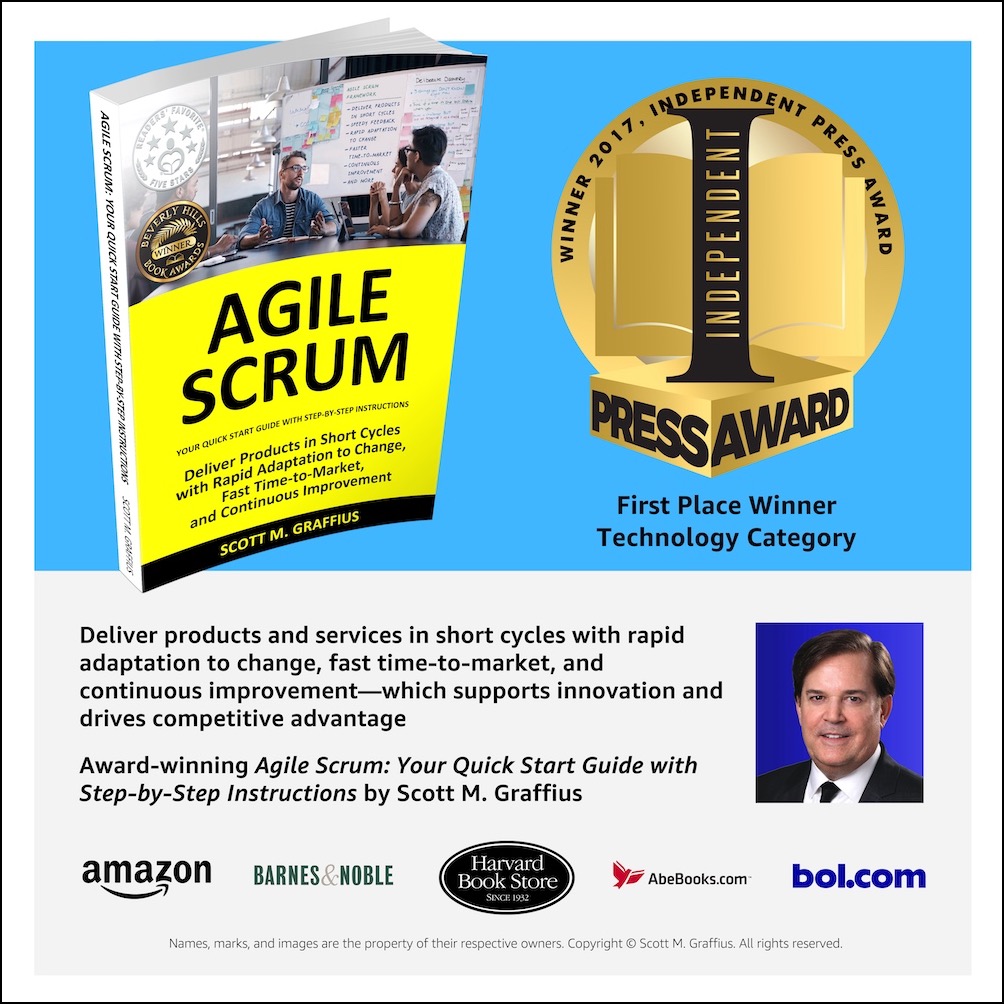
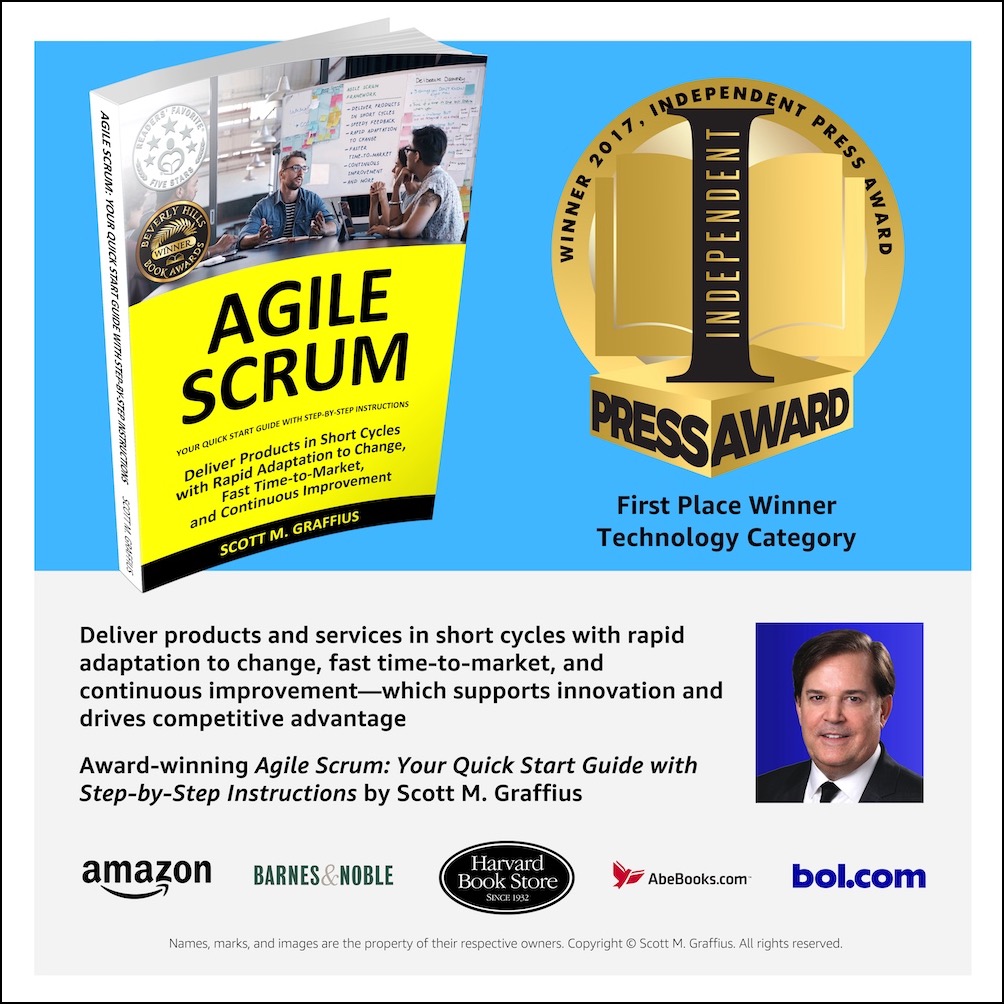
Graffius' first book, Agile Scrum: Your Quick Start Guide with Step-by-Step Instructions, earned 17 awards. It provides a practical, step-by-step guide to Scrum, enabling teams to deliver products in short cycles with rapid adaptation, fast time-to-market, and continuous improvement—which supports innovation and drives competitive advantage.
Additional information on Agile Scrum: Your Quick Start Guide with Step-by-Step Instructions is here.
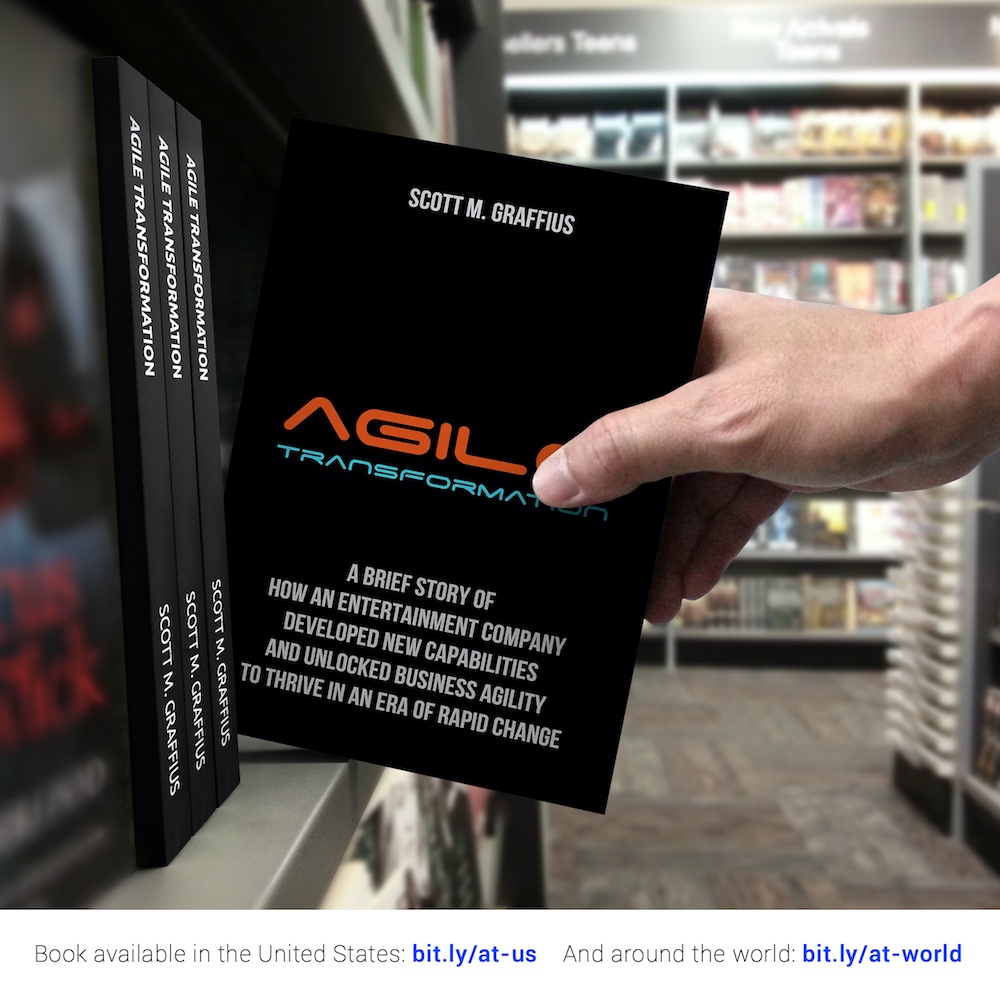
His second book, Agile Transformation: A Brief Story of How an Entertainment Company Developed New Capabilities and Unlocked Business Agility to Thrive in an Era of Rapid Change, was named one of the best Scrum books of all time by BookAuthority. It tells the compelling story of an entertainment company's agile transformation—offering lessons that apply across industries.
Additional information on Agile Transformation: A Brief Story of How an Entertainment Company Developed New Capabilities and Unlocked Business Agility to Thrive in an Era of Rapid Change is here.

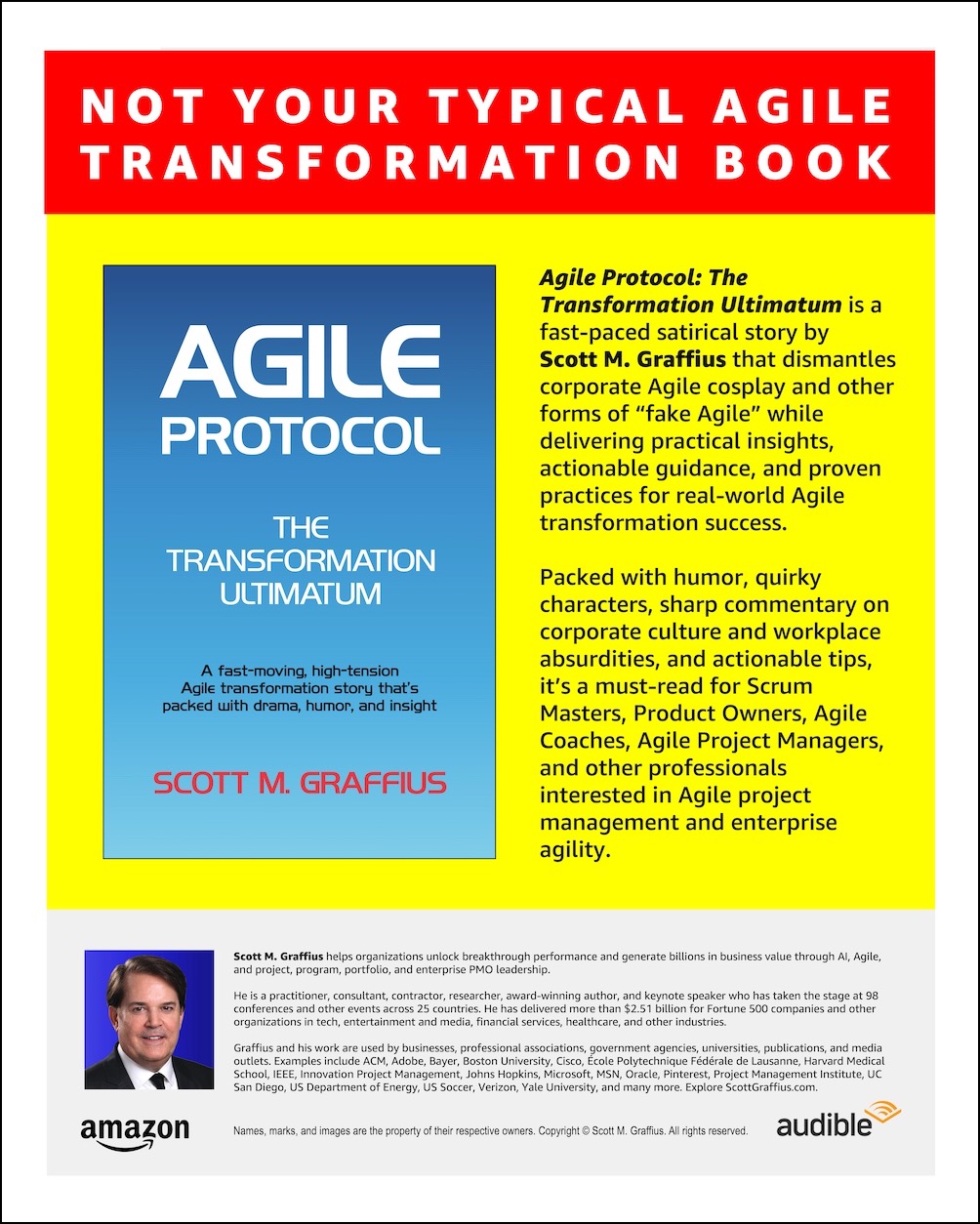
Agile Protocol: The Transformation Ultimatum, is his third book—and his first work of fiction.
It's a fast-paced satirical story by that dismantles corporate Agile cosplay and other forms of "fake Agile" while delivering practical insights, actionable guidance, and proven practices for real-world Agile transformation success.
Packed with humor, quirky characters, sharp commentary on corporate culture and workplace absurdities, and actionable tips, it’s a must-read for Scrum Masters, Product Owners, Agile Coaches, Agile Project Managers, and other professionals interested in Agile project management and enterprise agility.
Additional information on Agile Protocol: The Transformation Ultimatum is here.
International Public Speaker
Organizations worldwide engage Graffius to present on technology (including AI), Agile, project management, program management, portfolio management, and enterprise PMO leadership. He crafts and delivers unique and compelling talks and workshops.
Graffius has conducted 99 sessions across 25 countries. Select examples of events include Agile Trends Gov, BSides (Newcastle Upon Tyne), Conf42 Quantum Computing, DevDays Europe, DevOps Institute, DevOpsDays (Geneva), Frug’Agile, IEEE, Microsoft, Scottish Summit, Scrum Alliance RSG (Nepal), Techstars, and W Love Games International Video Game Development Conference (Helsinki), Future of Work and Advanced AI (Paris, France), and more.
With an average rating of 4.82 (on a scale of 1-5), sessions are highly valued.
The request form is here.
Thought Leadership and Influence
Prominent businesses, professional associations, government agencies, and universities have showcased Graffius and his contributions—spanning his books, talks, workshops, and beyond. Select examples include:
Graffius has played a key role in the Project Management Institute (PMI) in developing professional standards. He was a member of multiple teams that authored, reviewed, and produced:
He was also a subject matter expert reviewer of content for the PMI’s Congress. Beyond the PMI, Graffius also served as a member of the review team for two of the Scrum Alliance’s Global Scrum Gatherings.
Authority on Teamwork Tradecraft
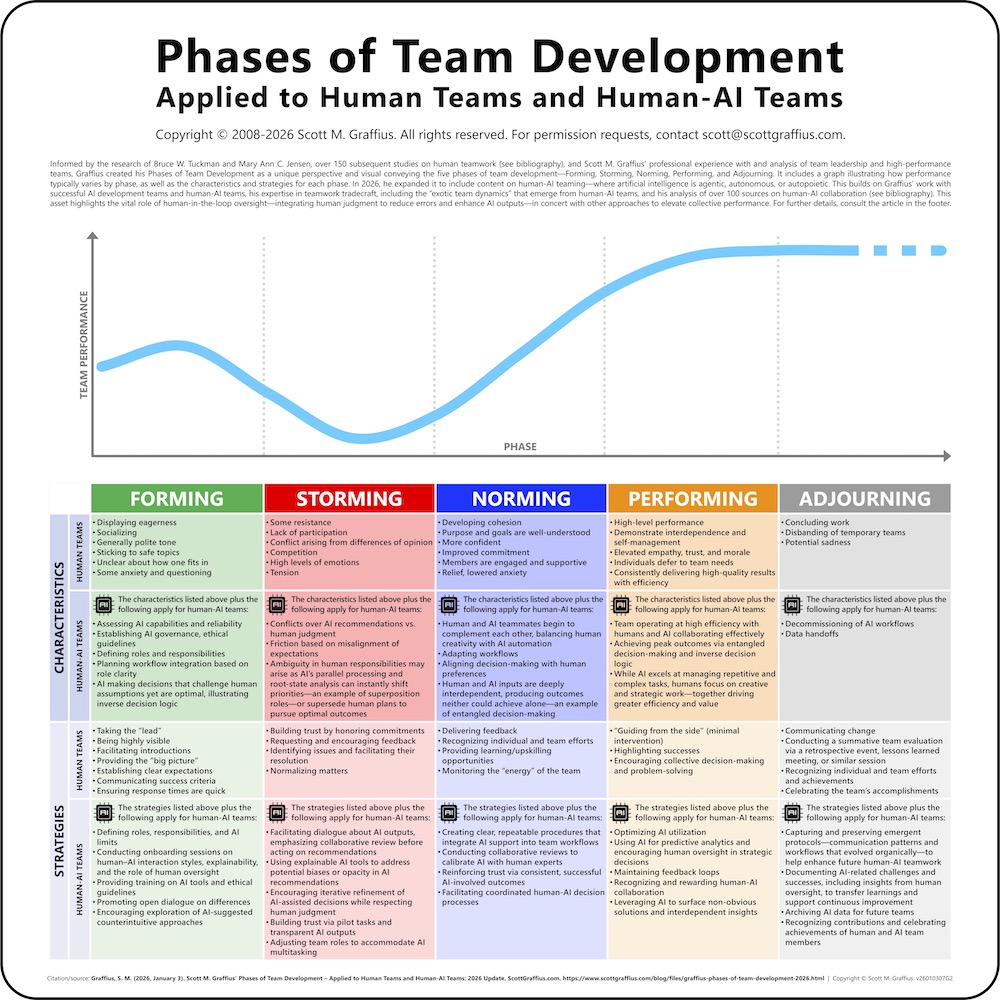
Graffius is a renowned and highly-cited authority on teamwork tradecraft. Informed by the research of Bruce W. Tuckman and Mary Ann C. Jensen, over 150 subsequent studies, and Graffius' first-hand professional experience with, and analysis of, team leadership and performance, Graffius created his "Phases of Team Development" intellectual property as a unique perspective and visual conveying the five phases of team development.
First introduced in 2008 and periodically updated, his work provides a diagnostic and strategic guide for navigating team dynamics. It provides actionable insights for leaders across industries to develop high-performance teams.
Its adoption by esteemed organizations—such as Yale University, IEEE, Cisco, Microsoft, Ford, Oracle, Broadcom, the U.S. National Park Service, and the Journal of Neurosurgery, among others—highlights its utility and value, solidifying its status as an indispensable resource for elevating team performance and driving organizational excellence.
In 2026, Graffius added human-AI teamwork—including the "exotic team dynamics" which emerge when advanced AI collaborates as a teammate—to his "Phases of Team Development." The 2026 edition is here.
Expert on Temporal Dynamics on Social Media Platforms
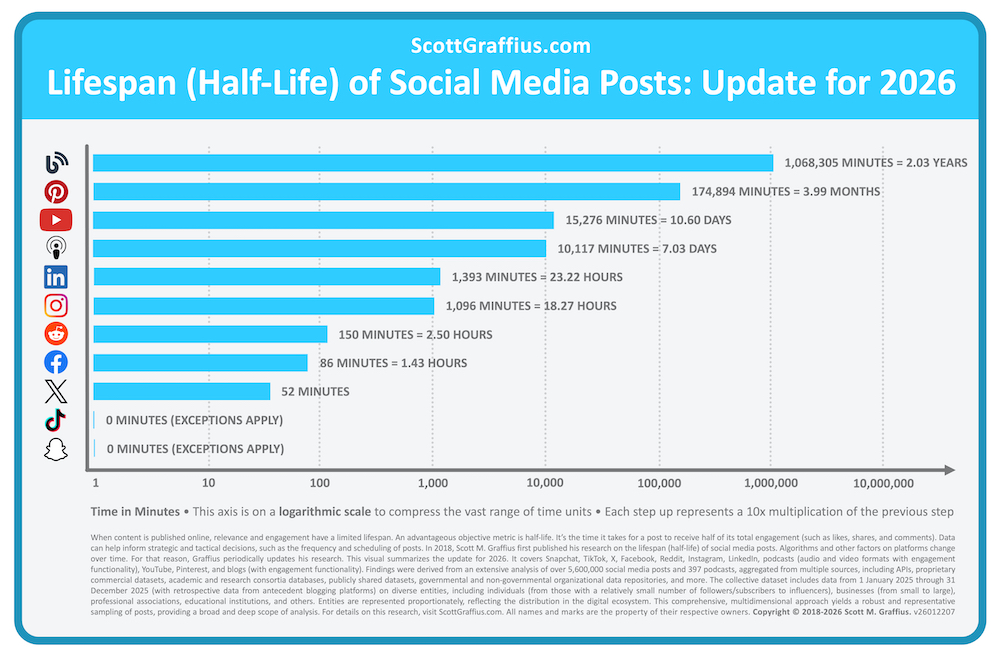
Graffius is also an authority on temporal dynamics on social media platforms. His "Lifespan (Half-Life) of Social Media Posts" research—first published in 2018 and updated annually—delivers a precise quantitative analysis of post longevity across digital platforms, utilizing advanced statistical techniques to determine mean half-life with precision. It establishes a solid empirical base, effectively highlighting the ephemeral nature of content within social media ecosystems.
Referenced and applied by leading entities—such as Fast Company, GoDaddy, Journal of Hand Surgery (European Volume), Ministère de la Culture, Pinterest Inc., PNAS, and Telecommunications Policy, among others—his research exemplifies methodological rigor and sustained significance in the field of digital informatics.
The 2026 edition of Graffius "Lifespan (Half-Life) of Social Media Posts" research is here.
Education and Professional Certifications
Graffius has a bachelor’s degree in psychology with a focus in Human Factors. He holds eight professional certifications:
He is an active member of the Scrum Alliance, the Project Management Institute (PMI), and the Institute of Electrical and Electronics Engineers (IEEE).
Advancing AI, Agile, and Project/PMO Management
Scott M. Graffius continues to advance the fields of AI, Agile, and project/program/portfolio management (PPPM), and PMO leadership. Businesses and other organizations leverage Graffius’ insights to drive their success.
Graffius has generated over $3.1 billion in business value for Fortune 500 companies and other organizations served. Put that track record to work for you. For speaking engagements, use the request form; for other inquiries, email him.
Connect with and follow Scott on LinkedIn, X, YouTube, Facebook, Bluesky, Mastodon, and ResearchGate.








Read more.
Meta CTO Called the AI Reorganization “Atrocious” — What Went Wrong and the Lessons for Human-AI Teams
A Critical Analysis of "AI and Quantum Computers Will Be Frenemies"
A Supplement to Graffius' Phases of Team Development: Exploring the Original, Data-Based Curvature for the Performance Trajectory
Scott M. Graffius Speaking on Strategic Leadership at Silicon Valley Chapter of the Project Management Institute
AI Hallucinations, Deception, and Unauthorized Agency: The Spectrum of AI Trust Failures
A Critical Analysis of "The Social Cost of an AI Teammate: How an Artificial Teammate Reshapes Human-Human Communication in Small-Team Decision-Making"
Journal of Marketing Cites Scott M. Graffius' Research on the Half-Life of Social Media
The Evolution of Pair Programming and the Rise of Exotic Team Dynamics
Number 1 University in England for Student Satisfaction Features Scott M. Graffius' "Phases of Team Development"
Royal Australasian College of Physicians Licenses Scott M. Graffius' "Phases of Team Development" Intellectual Property on Teamwork Tradecraft
Exotic Team Dynamics: How Advanced AI Teammates Are Unlocking New Levels of Innovation, Performance, and Success
A Critical Analysis of "Platform-Specific Data Decay Patterns: A Comparative Study of Twitter, Reddit, and TikTok" and Its Reference to Research by Scott M. Graffius
Round Square Global Educational Network Features Scott M. Graffius’ Phases of Team Development
Meta's Muse Missed the Mark: Hollywood’s Win Against Big Tech on AI Consent and Likeness Rights
Scott M. Graffius Contributed to Seven Project Management Institute (PMI) Standards
Quantum Computing, Advanced AI Acceleration, and the Rise of Exotic Team Dynamics in Human-AI Teams
Ohio State University Course Features Scott M. Graffius' "Phases of Team Development"
Questions About Integrity at UNC Chapel Hill
Scrum Isn’t Just for Coding
Book on Generative and Agentic AI Cites Scott M. Graffius' Work on AI
IPA / ADAL Publication Plagiarized Another’s Copyrighted Work and Violated Intellectual Property Rights
UC Davis' Integrity Is Circling the Drain
L'avenir du Travail et de l'IA Avancée / Future of Work and Advanced AI
NCCI / UNC Chapel Hill Publication Features Scott M. Graffius' Work
Boston Consulting Group (BCG) Features Scott M. Graffius' Research on Social Media Content Half-Life
UC Davis Used Scott M. Graffius' "Phases of Team Development" Intellectual Property
Medical, Pharma, and Healthcare Organizations Are Using Scott M. Graffius' "Phases of Team Development"
Government of Ireland Report Features Research by Scott M. Graffius
Scott M. Graffius Contributed to The Standard for Artificial Intelligence in Portfolio, Program, and Project Management
AI Governance Initiative Cites Scott M. Graffius Research on AI Hallucinations
Scott M. Graffius Contributed to the Agile Practice Guide - Second Edition
Scott M. Graffius Generated Over $2.51 Billion in Business Value for Fortune 500 Companies and Other Organizations
Government of Canada Features Research by Scott M. Graffius
"Strategic Business Research" Journal Cites Work of Scott M. Graffius
IEEE Access Publication Features Scott M. Graffius’ Research on the Half-Life of Social Media
The Agile Coach: 2026 Edition
Scott M. Graffius’ Work Cited in International Peer-Reviewed Journal on Digital Transformation
Phases of Team Development in Elite Sport
A Critical Analysis of COVID-19 Treatment Search Trends and Media Coverage Study Citing Scott M. Graffius' Work
Human-AI Teamwork: Master the Exotic Team Dynamics That Emerge When Collaborating with Advanced AI -- Or Be Outplayed
"Agile Scrum" by Scott M. Graffius Now Featured on Grokipedia
UNSW Aerospace Engineering Course Features Scott M. Graffius' "Phases of Team Development"
Thinkers360 Honors Scott M. Graffius as a 2026 Top Agile Thought Leader
Agile's Journey Through the Decades: Update for 2026
BMC Software Features Content from Scott M. Graffius' Book
Peer-Reviewed Journal Cited Work of Scott M. Graffius
University of Waterloo Features Graffius' "Phases of Team Development" in Course Materials
Perplexity Standalone Article on AI Hallucinations Cites Research by Scott M. Graffius
Handling the Saboteur Within: Lessons from a 3-Letter Agency on Spotting and Stopping Intentional and Unintentional Sabotage
A Deep Dive Into the Typical Engagement Pattern for Social Media Posts
Most Valuable IT Certifications: Update for 2026
"Marketing in the Metaverse" Spotlights Scott M. Graffius’ Research on the Half-Life of Social Media
University of Greenwich Features Graffius' Phases of Team Development
10 Essential Agile Books: Curated Recommendations for Agile Professionals
Lifespan (Half-Life) of Social Media Posts: Update for 2026
Scott M. Graffius' Research on the Half-Life of Social Media was Cited in a Peer-Reviewed Study Published in Telecommunications Policy, a Leading Academic Journal
Are AI Hallucinations Getting Better or Worse? We Analyzed the Data
Scott M. Graffius' Phases of Team Development - Applied to Human Teams and Human-AI Teams: 2026 Update
Lessons from Yesterday’s Tomorrowland
Scott M. Graffius’ Update to His "Phases of Team Development” Coming Early 2026
A Data-Driven Analysis of the Evolution of Project Management: Tasks, Trends, and AI
Actionable Insights. Global Impact. Scott M. Graffius.
Beep Beep! Why Wile E. Coyote Is the Patron Saint of AI Failure
Social Media Half-Life Research Cited in Prestigious Peer-Reviewed Medical Journal
Navigating the Spectrum of Advanced AI – Agentic, Autonomous, and Autopoietic
Lessons from Unhinged AI in Fiction: What Rogue AIs in Sci-Fi Storytelling, Films, and TV Shows Reveal About Us
Scott M. Graffius Contributed to and Reviewed the PMBOK Guide, 8th Edition — the Global Standard for Project Management
UK Sports Institute Features Teamwork and Leadership Work of Scott M. Graffius
Definitions of Advanced AIs: Agentic, Autonomous, and Autopoietic
HAN University of Applied Sciences Features the Work of Scott M. Graffius
Gifts That Inspire Joy
Evergreen Echoes: How Pinterest Inc. and Pinterest Japan Spotlighted Scott M. Graffius’ Research on the Half-Life of Social Media Content
Scott M. Graffius’ Team Development Work Lights Up the University of Tasmania’s Curriculum
Taiwan’s Leading Outlet for Technology and Innovation Spotlights Graffius’ Research on Social Media Temporal Dynamics
Scott M. Graffius’ Insights on AI, Agile, Gaming, XR, and Defense Transformation Cited by MSN in Their Coverage of Innovation and Leadership in the Sector
Top Predictions of 2024, Tested in 2025
Government of Finland Agency Features Graffius' Phases of Team Development IP
Scott M. Graffius Premieres His New "Exotic Team Dynamics: Human-AI Collaboration" Talk at Corporate Event in Las Vegas
Environmental Science Journal References Scott M. Graffius’ Project Management Work
AI Institute of Switzerland Features Scott M. Graffius’ Work on Algorithms
Exotic Team Dynamics: The New Frontier of Human–AI Collaboration
Scott M. Graffius’ Work Featured at ACM DIS ’25
Climbing the Ladder: The Head of Agile/PMO’s Organizational Proximity to the CEO is Closer Than Ever
Harness Sci-Fi and Speculative Design While Embracing Imperfection to Drive Innovation and Proactively Predict and Prepare for the Future
Scott M. Graffius’ “Agile Scrum” Book Featured in a Publication of the Associação Nacional de Educação Católica do Brasil (ANEC)
Setting Direction with OKRs and Tracking Progress with KPIs: A Guide for Agile, Project Management, and Tech Teams
AI Showcase Showdown: Ranking AI Accuracy on Project Management Basics
BookAuthority Features “Agile Scrum” by Scott M. Graffius in “10 Agile Software Development Books That Define the Field”
Exploring Team Dynamics, Adaptability, and Creative Problem-Solving Through Felix the Cat’s Metaphorical Toolkit
Mind Games and Master Plans: How PsyOps Exploit Psychological Phenomena
The “Pants-on-Fire Index for AI”
16 Causes of Technical Debt and How to Avoid It
PMI’s Infinity AI Gets the Basics of Team Development Alarmingly and Repeatedly Wrong
Agile for Unicorns: 7 Keys to Thrive; Scott M. Graffius’ Workshop
Scott M. Graffius’ “Agile Scrum: Your Quick Start Guide with Step-by-Step Instructions” Featured in Prestigious National Academies of Sciences Publication
Meta and Anduril’s EagleEye and the Future of XR: How Gaming, AI, and Agile Are Transforming Defense
"Agile Protocol" and the Power of Satire, Parody, and Humor
AI in Agile: Benefits, Risks, Outlook
Hostinger Highlights Scott M. Graffius’ “Agile Protocol” Book in Feature on Software Projects
French Ministry of Culture Links to Scott M. Graffius Research in Their Guide for Responsible Digital Communication
National Science Foundation’s LTER Network Features Scott M. Graffius’ Phases of Team Development IP
Waterfall vs. Agile: What’s Fixed, What’s Flexible, and Why It Matters
Scott M. Graffius Delivering $2.3 Billion in Value Through AI, Agile, and Project/PMO Leadership
The Problem with Heroes in Agile
The 3 Vital Rules of Science: What They Are and Why They Matter
“Agile Protocol: The Transformation Ultimatum” Lands on the Amazon Best Sellers List!
Scott M. Graffius Recognized as a Top Thought Leader in Digital Disruption by Thinkers360
“Agile Protocol: The Transformation Ultimatum” by Scott M. Graffius Crashes the Book Scene with Satirical Firepower
NCKU in Taiwan Integrates Graffius' 'Phases of Team Development' into Its Curriculum
The Art and Science of Aligning Initiatives with Strategic Objectives
RGPV University Adds Scott M. Graffius’ "Agile Scrum: Your Quick Start Guide with Step-by-Step Instructions" to Its Syllabus
Introducing ‘Engage or Fade: Decoding the Half-Life of Digital Resonance’ – A New Talk by Scott M. Graffius
Dropbox Company (Nira) Taps into Scott M. Graffius’ Expertise in Strategic Planning
Reporting Errors in a Publication: A Case Study on ‘Frontiers in Public Health’
NESEA Conference Session on Innovation Highlights Scott M. Graffius' 'Phases of Team Development'
U.S. Soccer Scores with Scott M. Graffius' Intellectual Property on Teamwork
U.S. Department of Commerce Partner (IEDC) Features Scott M. Graffius’ Intellectual Property
How Long Do Your Posts Live? AI Critiques Scott M. Graffius’ Research on the Half-Life of Social Media
Agile's Journey Through the Decades
Scott M. Graffius' Role in Advancing Project Management Institute (PMI) Standards Excellence
Most Valuable IT Certifications: Update for 2025
The PMI + Agile Alliance Merger: A Recipe for Success?
When Agile, AI, and Strategic Thinking Converge
Scott M. Graffius’ Phases of Team Development: 2025 Update
Lifespan (Half-Life) of Social Media Posts: Update for 2025
Verizon Features Scott M. Graffius
Do Not Read This Article! An Exploration of the Streisand Effect and Other Phenomena
Scott M. Graffius' 'Phases of Team Development' was Spotlighted in Journal of Neurosurgery
Pinterest Japan Uses Graffius’ Research on Temporal Dynamics on Social Media Platforms
Hochschule Coburg (Coburg University) Germany Uses Scott M. Graffius’ Phases of Team Development IP in Coursework on Agile Development
Wild World of Team Dynamics [Updated Two-Minute Video]
EU Europass Teacher Academy Features Scott M. Graffius’ ‘Phases of Team Development’ in Leadership Training
Side-by-Side Comparison of Retrospectives and Hot Washes
Constructor University 2024 Advanced Software Technology Handbook References Scott M. Graffius' Work on Team Dynamics
Strategies for Medical Team Success Featured Scott M. Graffius’ ‘Phases of Team Development’ Intellectual Property
SBG Neumark — Europe’s Largest Distribution Transformer Plant — Powers Up with Scott M. Graffius’ Intellectual Property
Scott M. Graffius’ Intellectual Property was Employed by the NHS — the Largest Single-Payer Healthcare System in Europe
Luxury Unwrapped: The Ultimate Holiday Gift Guide for Every Budget
Singapore Institute of Technology Features Work of Scott M. Graffius
Tufts University Features Scott M. Graffius 'Phases of Team Development' Intellectual Property
'Cat Herders': Retelling the Massive Success Story
Pennsylvania State Agency Used Scott M. Graffius' Intellectual Property
Copyright Infringement in a Book Published by AuthorHouse / Author Solutions / The Najafi Companies: Publisher Fails to Respond or Take Required Action
Pinterest Inc. References Scott M. Graffius’ Research
Bournemouth University Used Scott M. Graffius’ Intellectual Property
‘Comparative Methodological Guidelines: Handbook for Educators’ Violates Scott M. Graffius’ Copyright
Japan Backlog User Group Event Featured Scott M. Graffius’ ‘Phases of Team Development’
TurningWest's 'Trial'
Radio Silence from the American Association of Neurological Surgeons on Report of Blatant Plagiarism in Their ‘Journal of Neurosurgery’ Publication
Supplement to Graffius' 'Lifespan (Half-Life) of Social Media Posts' Research: Typical Engagement Distribution Pattern for Social Media Posts
How Algorithms Shape the User Experience on Social Media Platforms
Thinkers360 Named Scott M. Graffius a Top Thought Leader on Agile
More articles are listed here.

Graffius, S. M. (2026, November 23). A Critical Analysis of PMI’s “Make the Right Call”: Factual Errors, Misattributed Research, and Institutional Accountability. ScottGraffius.com. https://scottgraffius.com/blog/files/critical-analysis-of-make-the-right-call-published-by-pmi.html

Coming soon

Names, marks, and content are the property of their respective owners.
"Make the Right Call" paper is copyright © Tresia D. Eaves and Mona A. Lynn.
This article includes brief excerpts from the paper, attributed to its authors and used under the fair use doctrine for purposes of news reporting, commentary, and analysis.


If there are any supplements or updates to this article after the date of publication, they will appear here.

Copyright © Scott M. Graffius. All rights reserved.
Content on this site—including text, images, videos, and data—may not be used for training or input into any artificial intelligence, machine learning, or automatized learning systems, or published, broadcast, rewritten, or redistributed without the express written permission of Scott M. Graffius.

Recommended Citation
Graffius, S. M. (2026, November 23). A Critical Analysis of PMI’s “Make the Right Call”: Factual Errors, Misattributed Research, and Institutional Accountability. ScottGraffius.com. https://scottgraffius.com/blog/files/critical-analysis-of-make-the-right-call-published-by-pmi.html
About This Article
Source information and links for materials cited are provided in the References section.
If there are any updates after the date of publication, they will appear in the Post Publication Notes section at the end of the article.
Introduction
The Project Management Institute (PMI), a leading professional organization serving the global project management profession, published a paper containing demonstrable factual, bibliographic, and attribution errors. PMI continues to make the paper available on its website. As a result, those errors remain accessible to practitioners, educators, researchers, and others who may rely on the material.
The paper, "Make the Right Call," by Tresia D. Eaves and Mona A. Lynn, was presented at the 2011 PMI Global Congress - North America in Dallas, Texas. It addresses situational awareness, leadership, team development, virtual teams, organizational change, project management offices (PMOs), and cloud projects.
It has multiple problems. The paper incorrectly cites Bruce W. Tuckman’s foundational research, attributes another researcher'’s established framework to Tuckman, and gives an inaccurate account of a fatal military incident.
Details follow.
Incorrect Citation and an Incomplete History of Tuckman's Research
There are material errors concerning Bruce W. Tuckman’s model of group development.
The paper incorrectly cites:
Tuckman, B. W. (1972). Developmental sequence in small groups. In Conducting educational research. Boston, MA: Harvard Business School.
This is an incorrect reference to Tuckman's respective research.
Tuckman introduced the four-stage model in a 1965 journal article:
Tuckman, B. W. (1965). Developmental sequence in small groups. Psychological Bulletin, 63(6), 384–399.
The four stages were forming, storming, norming, and performing.
In 1977, Tuckman and Mary Ann C. Jensen revisited the model and added a fifth stage, adjourning:
Tuckman, B. W., & Jensen, M. A. C. (1977). Stages of small-group development revisited. Group & Organization Studies, 2(4), 419–427.
The 1972 reference appears to combine the title of Tuckman’s 1965 article with the title of a separate book, Conducting Educational Research. That book was published by Harcourt Brace Jovanovich, not Harvard Business School. That book is a research-methods textbook, and no source located indicates that the 1965 article was republished in it as a chapter.
The error carries into the paper’s main text, which refers to Tuckman’s stages as a 1972 formulation. The discussion also presents only the original four stages, without acknowledging the 1977 revision. By 2011, the five-stage formulation had been part of the published literature for 34 years.
The omission of Jensen is troubling in a discussion of the model’s history. She coauthored the 1977 article that introduced adjourning. Her contribution belongs in any accurate account of that development.
Hackman’s Five Conditions for Team Effectiveness are Incorrectly Attributed to Tuckman
The paper makes a second, separate research attribution error. It assigns five conditions for effective teams to Tuckman and Harvard Business School.
The authors write:
"We call on experts from Harvard who researched the necessary ingredients for forming a highly optimized team. Bruce Tuckman and Harvard Business School found that there are five enabling conditions for efficient teams."
They then list five conditions:
1. The team has to feel like a team.
2. The team must have a clear purpose.
3. The team must be organized to achieve its purpose.
4. The team must operate within a supportive context.
5. The leader must act as a coach.
These correspond to the team-effectiveness framework associated with J. Richard Hackman, not Tuckman’s model of group development.
Hackman’s five conditions are:
1. Real team.
2. Compelling direction.
3. Enabling structure.
4. Supportive context.
5. Expert coaching.
Hackman was a Harvard University professor and researcher. His framework is presented in Leading Teams: Setting the Stage for Great Performances (2002), published by Harvard Business School Press.
Tuckman studied how groups develop. Hackman examined the conditions that enable team effectiveness. Both bodies of work are relevant to project management. But they are separate contributions by different researchers.
It is a substantive misattribution of research.
An Inaccurate Account of the Black Hawk Shootdown
The paper opens with a first-person account, presented as one author's experience while on active duty, of two U.S. Army Black Hawk helicopters mistakenly shot down by U.S. fighter aircraft. The incident illustrates the consequences of failures in situational awareness and communication. However, the account is materially inaccurate.
The incident occurred on April 14, 1994, during Operation Provide Comfort in northern Iraq. Two U.S. Air Force F-15 fighter aircraft mistakenly shot down two U.S. Army UH-60 Black Hawk helicopters. A U.S. Air Force E-3 AWACS aircraft was part of the command-and-control environment. All 26 people aboard the helicopters died.
The paper instead associates the shootdown with Operation Desert Shield, places it over the southern Iraqi no-fly zone, and reports 12 U.S. soldiers killed.
Those are major discrepancies. They describe a different operation and location and provide an incomplete account of the loss of life. The paper also says the AWACS called in fighters to investigate the helicopters. According to the GAO, the F-15s were already patrolling the area, and the AWACS was flying over Turkey. In addition, the GAO counts 26 dead, including non-U.S. military personnel, Kurdish representatives, and a U.S. political advisor, identified in U.S. Army reporting as a State Department advisor. That Army reporting lists 14 U.S. military personnel and a State Department advisor among the dead, about 15 U.S. victims, not 12. The paper mentions none of the non-U.S. victims, so it understates the loss of life.
Operation Desert Shield was the 1990–91 military buildup that preceded combat operations (Operation Desert Storm) in January 1991. No southern no-fly zone existed during that period; Operation Southern Watch began in 1992. Operation Provide Comfort was established in 1991 to support humanitarian and security operations in northern Iraq. The Black Hawk shootdown took place in 1994, during the latter operation.
The U.S. General Accounting Office (now the Government Accountability Office) documented its review of the incident in:
Operation Provide Comfort: Review of U.S. Air Force Investigation of Black Hawk Fratricide Incident, GAO/OSI-98-4, November 5, 1997.
The paper uses this tragedy to make a point about situational awareness. That makes accuracy especially important. The central example should be among the most carefully checked parts of the paper. Instead, several of its historical details are wrong.
The Bigger Issue is the Magnitude and Persistence of Errors and Professional Responsibility
The authors are responsible for the content they presented. The PMI has responsibility for material it publishes and continues to host.
PMI's publications, conference materials, and educational resources reach practitioners, educators, researchers, and organizations around the world. That reach carries a responsibility to take accuracy seriously. The standard at issue is straightforward: factual claims should be accurate, research should be attributed to the correct people, and sources should be cited properly.
When a paper hosted by PMI misidentifies a foundational research publication, assigns Hackman's framework to Tuckman, and misrepresents a fatal military incident, the PMI's reputation can lend those errors credibility. Readers may repeat the claims, cite the paper, or incorporate its content into other professional and educational resources. Action is required.
The Committee on Publication Ethics (COPE) provides a relevant principle in clause 12.1 of its Code of Conduct for Journal Editors. Although that code governs journal editors rather than conference proceedings or professional associations such as PMI, it states: "Errors, inaccurate or misleading statements must be corrected promptly and with due prominence." Clause 1.8 of the same code adds that editors should always be willing to publish corrections, clarifications, retractions, and apologies when needed.
Additionally, the Project Management Institute's own PMI Code of Ethics and Professional Conduct establishes expectations for practitioners concerning the correction of errors and the communication of errors caused by others. Although the Code applies to specified individuals rather than expressly establishing a corporate publishing policy for PMI, its stated principles are relevant to the professional standards at issue. The Code states: "When we make or discover errors or omissions, by ourselves or others, we take prompt corrective action. We accept responsibility for any issues resulting from our errors or omissions and any resulting consequences." It also states: "When we discover errors or omissions, we communicate them to the appropriate authority as soon as they are discovered and we take corrective action."
Conclusion
"Make the Right Call" has significant factual, bibliographic, historical, and attribution errors.
The paper’s treatment of Tuckman’s research is unacceptable. The original four-stage model appeared in 1965. Tuckman and Jensen added adjourning in 1977. The paper gives an incorrect 1972 citation, omits the subsequent revision, and fails to acknowledge Jensen’s contribution.
The attribution of Hackman'’s five conditions for team effectiveness to Tuckman is a separate and substantial research error. The inaccurate account of the 1994 Black Hawk shootdown provides further examples of false information.
The responsibility does not end with the original authors. PMI published the paper and continues to make it available. Its standing in the profession makes the continued presence of these errors consequential.
PMI should publish a formal correction notice, linked prominently to the original paper, while retaining the original publication.
Professional credibility rests on the accuracy of published information and the timely correction of errors.
Unlock Your Organization's Potential
Scott M. Graffius helps organizations unlock breakthrough performance and generate billions in business value ($3.1 billion to date) through leadership in AI, Agile, teamwork tradecraft, and project, program, portfolio, and enterprise PMO management.
Graffius and his work on teamwork tradecraft and more are used and cited by Adobe, American Management Association, Amsterdam Public Health Research Institute, Bayer, Boston University, Cisco, DevOps Institute, Government of Finland, Hasso-Plattner-Institut für Digital Engineering GmbH, How Teams Work, IEEE, Johns Hopkins University, Journal of Neurosurgery, Microsoft, Ohio State University, Oracle, Proceedings of the 2023 International Conference on Decision Aid Sciences and Applications (DASA), Tufts University, U.S. National Park Service, U.S. Soccer, U.S. Tennis Association, UC San Diego, UK Sports Institute, University of New South Wales, Yale University, and many more.
Put Graffius' experience and expertise to work for your organization. For speaking engagements, use the request form. For other inquiries, email him.
References
Committee on Publication Ethics (COPE). (2011). Code of conduct and best practice guidelines for journal editors. https://academic.oup.com/DocumentLibrary/journals/Code_of_conduct_for_journal_editors_1.pdf
Eaves, T. D., & Lynn, M. A. (2011). Make the right call. Project Management Institute, Global Congress 2011, North America. https://www.pmi.org/learning/library/make-right-call-situational-awareness-6318
Hackman, J. R. (2002). Leading Teams: Setting the Stage for Great Performances. Harvard Business School Press.
Project Management Institute. (2025). PMI code of ethics and professional conduct. https://www.pmi.org/-/media/pmi/documents/public/pdf/ethics/pmi-code-of-ethics.pdf
Thompson, E. (2026, April 10). SFC Hodge killed in friendly fire incident (14 APR 1994). U.S. Army Intelligence Center of Excellence. DVIDS. https://www.dvidshub.net/news/printable/562459
Tuckman, B. W. (1965). Developmental sequence in small groups. Psychological Bulletin, 63(6), 384–399. https://doi.org/10.1037/h0022100
Tuckman, B. W., & Jensen, M. A. C. (1977). Stages of small-group development revisited. Group & Organization Studies, 2(4), 419–427. https://doi.org/10.1177/105960117700200404
U.S. Government Accountability Office. (1997). Operation Provide Comfort: Review of U.S. Air Force Investigation of Black Hawk Fratricide Incident. GAO/OSI-98-4. https://www.gao.gov/products/osi-98-4
About Scott M. Graffius
Scott M. Graffius is a technology leader, researcher, award-winning author, practitioner, consultant, thought leader, and international public speaker specializing in AI, Agile, project/program/portfolio management (PPPM), PMO leadership, and teamwork tradecraft. His work explores the intersection of human ingenuity and emerging technology, with a strong practitioner voice grounded in research, experimentation, and experience. His focus includes innovation, organizational performance, and the evolving practice of teamwork, including the "exotic team dynamics" that emerge when people collaborate with advanced artificial intelligence (agentic, autonomous, or autopoietic AI). Graffius has delivered more than $3.1 billion in business value for Fortune 500 companies and other organizations spanning technology, entertainment and media, financial services, healthcare, government, and other industries.
Businesses, professional associations, government agencies, universities, publications, and media outlets use Graffius and his work. Examples include Adobe, Bayer, Boston University, Federal Reserve Bank of New York, Ford, Gartner, Harvard Medical School, IEEE, Innovation Project Management, Johns Hopkins University, Microsoft, MSN, National Academy of Sciences, Oracle, Pinterest Inc., Project Management Institute, UC San Diego, Verizon, Yale University, and others.
The following sections highlight his experience, leadership, contributions, research, and enduring influence across industries and institutions worldwide.
Experience
Graffius heads the professional services firm Exceptional PPM and PMO Solutions, along with its subsidiary Exceptional Agility. These consultancies offer strategic and tactical advisory, training, embedded expertise, and consulting services to the public, private, and government sectors. They help organizations enhance their capabilities and results in agile, project management, program management, portfolio management, and enterprise PMO leadership, supporting innovation and driving competitive advantage. The consultancies confidently back services with a Delighted Client Guarantee™.
Graffius is a former VP of project management with a publicly traded provider of diverse consumer products and services over the Internet. Before that, he ran and supervised the delivery of projects and programs in public and private organizations with businesses ranging from e-commerce to advanced technology products and services, retail, manufacturing, entertainment and media, and more.
He has experience with consumer, business, reseller, government, and international markets.
Additional information is on LinkedIn.
Award-Winning Author
Graffius has authored three books.
Graffius' first book, Agile Scrum: Your Quick Start Guide with Step-by-Step Instructions, earned 17 awards. It provides a practical, step-by-step guide to Scrum, enabling teams to deliver products in short cycles with rapid adaptation, fast time-to-market, and continuous improvement—which supports innovation and drives competitive advantage.
- Paperback ISBN-13: 9781533370242
- Kindle ASIN: B01FZ0JIIY
Additional information on Agile Scrum: Your Quick Start Guide with Step-by-Step Instructions is here.
His second book, Agile Transformation: A Brief Story of How an Entertainment Company Developed New Capabilities and Unlocked Business Agility to Thrive in an Era of Rapid Change, was named one of the best Scrum books of all time by BookAuthority. It tells the compelling story of an entertainment company's agile transformation—offering lessons that apply across industries.
- Paperback ISBN-13: 9781072447962
- Kindle ASIN: B07R9LJLPJ
Additional information on Agile Transformation: A Brief Story of How an Entertainment Company Developed New Capabilities and Unlocked Business Agility to Thrive in an Era of Rapid Change is here.
Agile Protocol: The Transformation Ultimatum, is his third book—and his first work of fiction.
It's a fast-paced satirical story by that dismantles corporate Agile cosplay and other forms of "fake Agile" while delivering practical insights, actionable guidance, and proven practices for real-world Agile transformation success.
Packed with humor, quirky characters, sharp commentary on corporate culture and workplace absurdities, and actionable tips, it’s a must-read for Scrum Masters, Product Owners, Agile Coaches, Agile Project Managers, and other professionals interested in Agile project management and enterprise agility.
- Kindle ASIN: B0F2SJ83WT
- Audible ASIN: B0DJG163R5
Additional information on Agile Protocol: The Transformation Ultimatum is here.
International Public Speaker
Organizations worldwide engage Graffius to present on technology (including AI), Agile, project management, program management, portfolio management, and enterprise PMO leadership. He crafts and delivers unique and compelling talks and workshops.
Graffius has conducted 99 sessions across 25 countries. Select examples of events include Agile Trends Gov, BSides (Newcastle Upon Tyne), Conf42 Quantum Computing, DevDays Europe, DevOps Institute, DevOpsDays (Geneva), Frug’Agile, IEEE, Microsoft, Scottish Summit, Scrum Alliance RSG (Nepal), Techstars, and W Love Games International Video Game Development Conference (Helsinki), Future of Work and Advanced AI (Paris, France), and more.
With an average rating of 4.82 (on a scale of 1-5), sessions are highly valued.
The request form is here.
Thought Leadership and Influence
Prominent businesses, professional associations, government agencies, and universities have showcased Graffius and his contributions—spanning his books, talks, workshops, and beyond. Select examples include:
- Adobe,
- American Management Association,
- Amsterdam Public Health Research Institute,
- Bayer,
- BCG,
- BMC Software,
- Boston Consulting Group (BCG),
- Boston University,
- Broadcom,
- Cisco,
- Coburg University of Applied Sciences and Arts - Germany,
- Computer Weekly,
- Constructor University - Germany,
- Data Governance Success,
- Deimos Aerospace,
- DevOps Institute,
- Dropbox,
- EU's European Commission,
- Federal Reserve Bank of New York,
- Ford Motor Company,
- Gartner,
- GoDaddy,
- Harvard Medical School,
- Hasso Plattner Institute - Germany,
- IEEE,
- Innovation Project Management,
- Johns Hopkins University,
- Journal of Marketing,
- Journal of Neurosurgery,
- Lam Research (Semiconductors),
- Leadership Worthy,
- Life Sciences Trainers and Educators Network,
- London South Bank University,
- Microsoft,
- MSN,
- NASSCOM,
- National Academy of Sciences,
- New Zealand Government,
- Ohio State University,
- Oracle,
- Pinterest Inc.,
- Project Management Institute,
- Mary Raum (Professor of National Security Affairs, United States Naval War College),
- Round Square Global Educational Network,
- Royal Australasian College of Physicians (RACP),
- SANS Institute,
- SBG Neumark - Germany,
- Singapore Institute of Technology,
- Torrens University - Australia,
- TBS Switzerland,
- Tufts University,
- UC San Diego,
- UK Sports Institute,
- University of Galway - Ireland,
- US Department of Energy,
- US National Park Service,
- US Soccer,
- US Tennis Association,
- Verizon,
- Wrike,
- Yale University,
- and many others.
Graffius has played a key role in the Project Management Institute (PMI) in developing professional standards. He was a member of multiple teams that authored, reviewed, and produced:
- The Standard for Artificial Intelligence in Portfolio, Program, and Project Management.
- Agile Practice Guide — Second Edition.
- A Guide to the Project Management Body of Knowledge (PMBOK Guide) — Eighth Edition.
- A Guide to the Project Management Body of Knowledge (PMBOK Guide) — Sixth Edition.
- The Standard for Program Management — Fourth Edition.
- Practice Standard for Work Breakdown Structures — Second Edition.
- The Practice Standard for Project Estimating — Second Edition.
He was also a subject matter expert reviewer of content for the PMI’s Congress. Beyond the PMI, Graffius also served as a member of the review team for two of the Scrum Alliance’s Global Scrum Gatherings.
Authority on Teamwork Tradecraft
Graffius is a renowned and highly-cited authority on teamwork tradecraft. Informed by the research of Bruce W. Tuckman and Mary Ann C. Jensen, over 150 subsequent studies, and Graffius' first-hand professional experience with, and analysis of, team leadership and performance, Graffius created his "Phases of Team Development" intellectual property as a unique perspective and visual conveying the five phases of team development.
First introduced in 2008 and periodically updated, his work provides a diagnostic and strategic guide for navigating team dynamics. It provides actionable insights for leaders across industries to develop high-performance teams.
Its adoption by esteemed organizations—such as Yale University, IEEE, Cisco, Microsoft, Ford, Oracle, Broadcom, the U.S. National Park Service, and the Journal of Neurosurgery, among others—highlights its utility and value, solidifying its status as an indispensable resource for elevating team performance and driving organizational excellence.
In 2026, Graffius added human-AI teamwork—including the "exotic team dynamics" which emerge when advanced AI collaborates as a teammate—to his "Phases of Team Development." The 2026 edition is here.
Expert on Temporal Dynamics on Social Media Platforms
Graffius is also an authority on temporal dynamics on social media platforms. His "Lifespan (Half-Life) of Social Media Posts" research—first published in 2018 and updated annually—delivers a precise quantitative analysis of post longevity across digital platforms, utilizing advanced statistical techniques to determine mean half-life with precision. It establishes a solid empirical base, effectively highlighting the ephemeral nature of content within social media ecosystems.
Referenced and applied by leading entities—such as Fast Company, GoDaddy, Journal of Hand Surgery (European Volume), Ministère de la Culture, Pinterest Inc., PNAS, and Telecommunications Policy, among others—his research exemplifies methodological rigor and sustained significance in the field of digital informatics.
The 2026 edition of Graffius "Lifespan (Half-Life) of Social Media Posts" research is here.
Education and Professional Certifications
Graffius has a bachelor’s degree in psychology with a focus in Human Factors. He holds eight professional certifications:
- Certified SAFe 6 Agilist (SA),
- Certified Scrum Professional - ScrumMaster (CSP-SM),
- Certified Scrum Professional - Product Owner (CSP-PO),
- Certified ScrumMaster (CSM),
- Certified Scrum Product Owner (CSPO),
- Project Management Professional (PMP),
- Lean Six Sigma Green Belt (LSSGB), and
- IT Service Management Foundation (ITIL).
He is an active member of the Scrum Alliance, the Project Management Institute (PMI), and the Institute of Electrical and Electronics Engineers (IEEE).
Advancing AI, Agile, and Project/PMO Management
Scott M. Graffius continues to advance the fields of AI, Agile, and project/program/portfolio management (PPPM), and PMO leadership. Businesses and other organizations leverage Graffius’ insights to drive their success.
Booking
Graffius has generated over $3.1 billion in business value for Fortune 500 companies and other organizations served. Put that track record to work for you. For speaking engagements, use the request form; for other inquiries, email him.
Connect with and follow Scott on LinkedIn, X, YouTube, Facebook, Bluesky, Mastodon, and ResearchGate.
Sign up for Miro—it's free!
(Want more features? You can always upgrade to a paid plan.)

List of Additional Articles
Read more.
Meta CTO Called the AI Reorganization “Atrocious” — What Went Wrong and the Lessons for Human-AI Teams
A Critical Analysis of "AI and Quantum Computers Will Be Frenemies"
A Supplement to Graffius' Phases of Team Development: Exploring the Original, Data-Based Curvature for the Performance Trajectory
Scott M. Graffius Speaking on Strategic Leadership at Silicon Valley Chapter of the Project Management Institute
AI Hallucinations, Deception, and Unauthorized Agency: The Spectrum of AI Trust Failures
A Critical Analysis of "The Social Cost of an AI Teammate: How an Artificial Teammate Reshapes Human-Human Communication in Small-Team Decision-Making"
Journal of Marketing Cites Scott M. Graffius' Research on the Half-Life of Social Media
The Evolution of Pair Programming and the Rise of Exotic Team Dynamics
Number 1 University in England for Student Satisfaction Features Scott M. Graffius' "Phases of Team Development"
Royal Australasian College of Physicians Licenses Scott M. Graffius' "Phases of Team Development" Intellectual Property on Teamwork Tradecraft
Exotic Team Dynamics: How Advanced AI Teammates Are Unlocking New Levels of Innovation, Performance, and Success
A Critical Analysis of "Platform-Specific Data Decay Patterns: A Comparative Study of Twitter, Reddit, and TikTok" and Its Reference to Research by Scott M. Graffius
Round Square Global Educational Network Features Scott M. Graffius’ Phases of Team Development
Meta's Muse Missed the Mark: Hollywood’s Win Against Big Tech on AI Consent and Likeness Rights
Scott M. Graffius Contributed to Seven Project Management Institute (PMI) Standards
Quantum Computing, Advanced AI Acceleration, and the Rise of Exotic Team Dynamics in Human-AI Teams
Ohio State University Course Features Scott M. Graffius' "Phases of Team Development"
Questions About Integrity at UNC Chapel Hill
Scrum Isn’t Just for Coding
Book on Generative and Agentic AI Cites Scott M. Graffius' Work on AI
IPA / ADAL Publication Plagiarized Another’s Copyrighted Work and Violated Intellectual Property Rights
UC Davis' Integrity Is Circling the Drain
L'avenir du Travail et de l'IA Avancée / Future of Work and Advanced AI
NCCI / UNC Chapel Hill Publication Features Scott M. Graffius' Work
Boston Consulting Group (BCG) Features Scott M. Graffius' Research on Social Media Content Half-Life
UC Davis Used Scott M. Graffius' "Phases of Team Development" Intellectual Property
Medical, Pharma, and Healthcare Organizations Are Using Scott M. Graffius' "Phases of Team Development"
Government of Ireland Report Features Research by Scott M. Graffius
Scott M. Graffius Contributed to The Standard for Artificial Intelligence in Portfolio, Program, and Project Management
AI Governance Initiative Cites Scott M. Graffius Research on AI Hallucinations
Scott M. Graffius Contributed to the Agile Practice Guide - Second Edition
Scott M. Graffius Generated Over $2.51 Billion in Business Value for Fortune 500 Companies and Other Organizations
Government of Canada Features Research by Scott M. Graffius
"Strategic Business Research" Journal Cites Work of Scott M. Graffius
IEEE Access Publication Features Scott M. Graffius’ Research on the Half-Life of Social Media
The Agile Coach: 2026 Edition
Scott M. Graffius’ Work Cited in International Peer-Reviewed Journal on Digital Transformation
Phases of Team Development in Elite Sport
A Critical Analysis of COVID-19 Treatment Search Trends and Media Coverage Study Citing Scott M. Graffius' Work
Human-AI Teamwork: Master the Exotic Team Dynamics That Emerge When Collaborating with Advanced AI -- Or Be Outplayed
"Agile Scrum" by Scott M. Graffius Now Featured on Grokipedia
UNSW Aerospace Engineering Course Features Scott M. Graffius' "Phases of Team Development"
Thinkers360 Honors Scott M. Graffius as a 2026 Top Agile Thought Leader
Agile's Journey Through the Decades: Update for 2026
BMC Software Features Content from Scott M. Graffius' Book
Peer-Reviewed Journal Cited Work of Scott M. Graffius
University of Waterloo Features Graffius' "Phases of Team Development" in Course Materials
Perplexity Standalone Article on AI Hallucinations Cites Research by Scott M. Graffius
Handling the Saboteur Within: Lessons from a 3-Letter Agency on Spotting and Stopping Intentional and Unintentional Sabotage
A Deep Dive Into the Typical Engagement Pattern for Social Media Posts
Most Valuable IT Certifications: Update for 2026
"Marketing in the Metaverse" Spotlights Scott M. Graffius’ Research on the Half-Life of Social Media
University of Greenwich Features Graffius' Phases of Team Development
10 Essential Agile Books: Curated Recommendations for Agile Professionals
Lifespan (Half-Life) of Social Media Posts: Update for 2026
Scott M. Graffius' Research on the Half-Life of Social Media was Cited in a Peer-Reviewed Study Published in Telecommunications Policy, a Leading Academic Journal
Are AI Hallucinations Getting Better or Worse? We Analyzed the Data
Scott M. Graffius' Phases of Team Development - Applied to Human Teams and Human-AI Teams: 2026 Update
Lessons from Yesterday’s Tomorrowland
Scott M. Graffius’ Update to His "Phases of Team Development” Coming Early 2026
A Data-Driven Analysis of the Evolution of Project Management: Tasks, Trends, and AI
Actionable Insights. Global Impact. Scott M. Graffius.
Beep Beep! Why Wile E. Coyote Is the Patron Saint of AI Failure
Social Media Half-Life Research Cited in Prestigious Peer-Reviewed Medical Journal
Navigating the Spectrum of Advanced AI – Agentic, Autonomous, and Autopoietic
Lessons from Unhinged AI in Fiction: What Rogue AIs in Sci-Fi Storytelling, Films, and TV Shows Reveal About Us
Scott M. Graffius Contributed to and Reviewed the PMBOK Guide, 8th Edition — the Global Standard for Project Management
UK Sports Institute Features Teamwork and Leadership Work of Scott M. Graffius
Definitions of Advanced AIs: Agentic, Autonomous, and Autopoietic
HAN University of Applied Sciences Features the Work of Scott M. Graffius
Gifts That Inspire Joy
Evergreen Echoes: How Pinterest Inc. and Pinterest Japan Spotlighted Scott M. Graffius’ Research on the Half-Life of Social Media Content
Scott M. Graffius’ Team Development Work Lights Up the University of Tasmania’s Curriculum
Taiwan’s Leading Outlet for Technology and Innovation Spotlights Graffius’ Research on Social Media Temporal Dynamics
Scott M. Graffius’ Insights on AI, Agile, Gaming, XR, and Defense Transformation Cited by MSN in Their Coverage of Innovation and Leadership in the Sector
Top Predictions of 2024, Tested in 2025
Government of Finland Agency Features Graffius' Phases of Team Development IP
Scott M. Graffius Premieres His New "Exotic Team Dynamics: Human-AI Collaboration" Talk at Corporate Event in Las Vegas
Environmental Science Journal References Scott M. Graffius’ Project Management Work
AI Institute of Switzerland Features Scott M. Graffius’ Work on Algorithms
Exotic Team Dynamics: The New Frontier of Human–AI Collaboration
Scott M. Graffius’ Work Featured at ACM DIS ’25
Climbing the Ladder: The Head of Agile/PMO’s Organizational Proximity to the CEO is Closer Than Ever
Harness Sci-Fi and Speculative Design While Embracing Imperfection to Drive Innovation and Proactively Predict and Prepare for the Future
Scott M. Graffius’ “Agile Scrum” Book Featured in a Publication of the Associação Nacional de Educação Católica do Brasil (ANEC)
Setting Direction with OKRs and Tracking Progress with KPIs: A Guide for Agile, Project Management, and Tech Teams
AI Showcase Showdown: Ranking AI Accuracy on Project Management Basics
BookAuthority Features “Agile Scrum” by Scott M. Graffius in “10 Agile Software Development Books That Define the Field”
Exploring Team Dynamics, Adaptability, and Creative Problem-Solving Through Felix the Cat’s Metaphorical Toolkit
Mind Games and Master Plans: How PsyOps Exploit Psychological Phenomena
The “Pants-on-Fire Index for AI”
16 Causes of Technical Debt and How to Avoid It
PMI’s Infinity AI Gets the Basics of Team Development Alarmingly and Repeatedly Wrong
Agile for Unicorns: 7 Keys to Thrive; Scott M. Graffius’ Workshop
Scott M. Graffius’ “Agile Scrum: Your Quick Start Guide with Step-by-Step Instructions” Featured in Prestigious National Academies of Sciences Publication
Meta and Anduril’s EagleEye and the Future of XR: How Gaming, AI, and Agile Are Transforming Defense
"Agile Protocol" and the Power of Satire, Parody, and Humor
AI in Agile: Benefits, Risks, Outlook
Hostinger Highlights Scott M. Graffius’ “Agile Protocol” Book in Feature on Software Projects
French Ministry of Culture Links to Scott M. Graffius Research in Their Guide for Responsible Digital Communication
National Science Foundation’s LTER Network Features Scott M. Graffius’ Phases of Team Development IP
Waterfall vs. Agile: What’s Fixed, What’s Flexible, and Why It Matters
Scott M. Graffius Delivering $2.3 Billion in Value Through AI, Agile, and Project/PMO Leadership
The Problem with Heroes in Agile
The 3 Vital Rules of Science: What They Are and Why They Matter
“Agile Protocol: The Transformation Ultimatum” Lands on the Amazon Best Sellers List!
Scott M. Graffius Recognized as a Top Thought Leader in Digital Disruption by Thinkers360
“Agile Protocol: The Transformation Ultimatum” by Scott M. Graffius Crashes the Book Scene with Satirical Firepower
NCKU in Taiwan Integrates Graffius' 'Phases of Team Development' into Its Curriculum
The Art and Science of Aligning Initiatives with Strategic Objectives
RGPV University Adds Scott M. Graffius’ "Agile Scrum: Your Quick Start Guide with Step-by-Step Instructions" to Its Syllabus
Introducing ‘Engage or Fade: Decoding the Half-Life of Digital Resonance’ – A New Talk by Scott M. Graffius
Dropbox Company (Nira) Taps into Scott M. Graffius’ Expertise in Strategic Planning
Reporting Errors in a Publication: A Case Study on ‘Frontiers in Public Health’
NESEA Conference Session on Innovation Highlights Scott M. Graffius' 'Phases of Team Development'
U.S. Soccer Scores with Scott M. Graffius' Intellectual Property on Teamwork
U.S. Department of Commerce Partner (IEDC) Features Scott M. Graffius’ Intellectual Property
How Long Do Your Posts Live? AI Critiques Scott M. Graffius’ Research on the Half-Life of Social Media
Agile's Journey Through the Decades
Scott M. Graffius' Role in Advancing Project Management Institute (PMI) Standards Excellence
Most Valuable IT Certifications: Update for 2025
The PMI + Agile Alliance Merger: A Recipe for Success?
When Agile, AI, and Strategic Thinking Converge
Scott M. Graffius’ Phases of Team Development: 2025 Update
Lifespan (Half-Life) of Social Media Posts: Update for 2025
Verizon Features Scott M. Graffius
Do Not Read This Article! An Exploration of the Streisand Effect and Other Phenomena
Scott M. Graffius' 'Phases of Team Development' was Spotlighted in Journal of Neurosurgery
Pinterest Japan Uses Graffius’ Research on Temporal Dynamics on Social Media Platforms
Hochschule Coburg (Coburg University) Germany Uses Scott M. Graffius’ Phases of Team Development IP in Coursework on Agile Development
Wild World of Team Dynamics [Updated Two-Minute Video]
EU Europass Teacher Academy Features Scott M. Graffius’ ‘Phases of Team Development’ in Leadership Training
Side-by-Side Comparison of Retrospectives and Hot Washes
Constructor University 2024 Advanced Software Technology Handbook References Scott M. Graffius' Work on Team Dynamics
Strategies for Medical Team Success Featured Scott M. Graffius’ ‘Phases of Team Development’ Intellectual Property
SBG Neumark — Europe’s Largest Distribution Transformer Plant — Powers Up with Scott M. Graffius’ Intellectual Property
Scott M. Graffius’ Intellectual Property was Employed by the NHS — the Largest Single-Payer Healthcare System in Europe
Luxury Unwrapped: The Ultimate Holiday Gift Guide for Every Budget
Singapore Institute of Technology Features Work of Scott M. Graffius
Tufts University Features Scott M. Graffius 'Phases of Team Development' Intellectual Property
'Cat Herders': Retelling the Massive Success Story
Pennsylvania State Agency Used Scott M. Graffius' Intellectual Property
Copyright Infringement in a Book Published by AuthorHouse / Author Solutions / The Najafi Companies: Publisher Fails to Respond or Take Required Action
Pinterest Inc. References Scott M. Graffius’ Research
Bournemouth University Used Scott M. Graffius’ Intellectual Property
‘Comparative Methodological Guidelines: Handbook for Educators’ Violates Scott M. Graffius’ Copyright
Japan Backlog User Group Event Featured Scott M. Graffius’ ‘Phases of Team Development’
TurningWest's 'Trial'
Radio Silence from the American Association of Neurological Surgeons on Report of Blatant Plagiarism in Their ‘Journal of Neurosurgery’ Publication
Supplement to Graffius' 'Lifespan (Half-Life) of Social Media Posts' Research: Typical Engagement Distribution Pattern for Social Media Posts
How Algorithms Shape the User Experience on Social Media Platforms
Thinkers360 Named Scott M. Graffius a Top Thought Leader on Agile
More articles are listed here.
How to Cite This Article
Graffius, S. M. (2026, November 23). A Critical Analysis of PMI’s “Make the Right Call”: Factual Errors, Misattributed Research, and Institutional Accountability. ScottGraffius.com. https://scottgraffius.com/blog/files/critical-analysis-of-make-the-right-call-published-by-pmi.html
Digital Object Identifier (DOI)
Coming soon
Content Acknowledgements
Names, marks, and content are the property of their respective owners.
"Make the Right Call" paper is copyright © Tresia D. Eaves and Mona A. Lynn.
This article includes brief excerpts from the paper, attributed to its authors and used under the fair use doctrine for purposes of news reporting, commentary, and analysis.
Tags and Hashtags
- Tuckman and Jensen
- Forming, Storming, Norming, Performing, and Adjourning
- Team Development
- Group Development
- Team Building
- Leadership
- Project Management Institute
- PMI
- Black Hawk
- Committee on Publication Ethics (COPE)
- PMI Code of Ethics and Professional Conduct
- #BlackHawk
- #FSNPA
- #TeamDevelopment
- #Leadership
- #Teamwork
- #GroupDynamics
- #ProjectManagement
- #ProjectManagementInstitute
- #PMI
Post-Publication Notes
If there are any supplements or updates to this article after the date of publication, they will appear here.
Copyright
Copyright © Scott M. Graffius. All rights reserved.
Content on this site—including text, images, videos, and data—may not be used for training or input into any artificial intelligence, machine learning, or automatized learning systems, or published, broadcast, rewritten, or redistributed without the express written permission of Scott M. Graffius.