
#FalsePositives
False Positives and False Negatives: What They Mean and Why They Matter
19 November 2026
BY SCOTT M. GRAFFIUS | ScottGraffius.com
Recommended Citation
Graffius, S. M. (2026, November 19). False Positives and False Negatives: What They Mean and Why They Matter. ScottGraffius.com. https://scottgraffius.com/blog/files/false-positives-and-false-negatives-article-by-scott-m-graffius.html
About This Article
Source information and links for materials cited are provided in the References section.
A medical test says a patient has a problem when they don't. An email filter sends an important message to the spam folder. A license plate camera misreads a number, and police stop the wrong vehicle. Somewhere else, security analysts see signs of a real cyberattack and decide it's harmless.
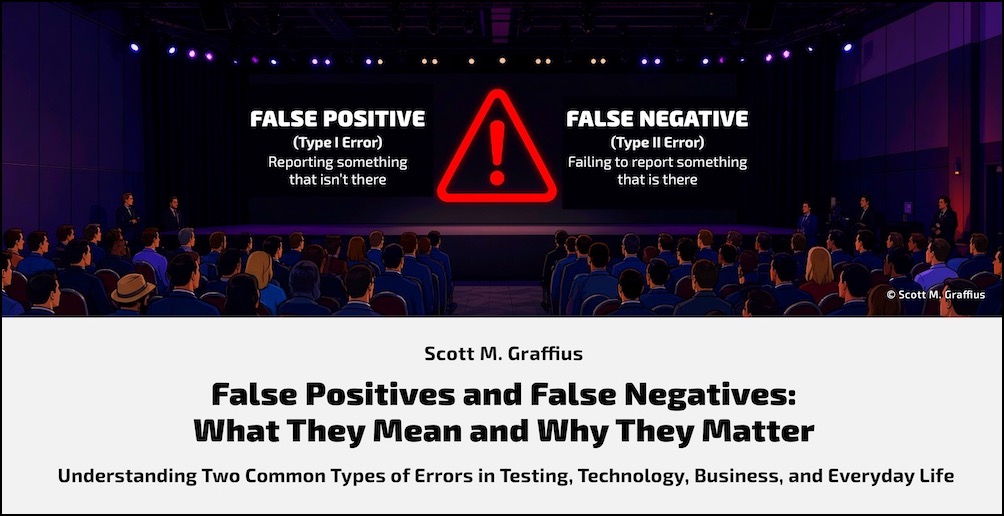
Each of these is a wrong call. Sometimes a system flags something that isn't there. Sometimes it misses something that is. The first mistake is a false positive and the second is a false negative.
The distinction matters anywhere people lean on tests, screening procedures, sensors, or algorithms to make decisions. The fallout ranges from minor inconvenience to financial loss, a missed diagnosis, a security breach, or a wrongful detention. Knowing which way a system tends to fail is a practical way to judge how well it works and where its limits are.
A Type 1 error, frequently called a false positive, happens when a system reports something as present, true, or positive when it is actually absent, false, or negative.
Take a medical screening test that indicates a patient has a particular disease. Follow-up testing shows the patient doesn't. That first result was a false positive.
Statisticians use the term more formally. In hypothesis testing, a Type 1 error means rejecting a null hypothesis that is actually true. Its probability is written as alpha ("α") and is also called the significance level.
Outside the lab, the effects are easy to picture. Someone may go through unnecessary medical procedures. A legitimate email may get missed. A perfectly good product may be thrown out. Even a plain false alarm eats time and resources that could have gone elsewhere.
A Type 2 error, often called a false negative, is the mirror image. The system says something is absent, false, or negative when it is actually present, true, or positive.
Suppose a screening test reports that a patient does not have a disease, and the patient does. That's a false negative.
In statistical hypothesis testing, a Type 2 error means failing to reject a null hypothesis that is actually false. Its probability is beta ("β"). Statistical power, the probability of correctly rejecting a false null hypothesis, equals 1 − β.
What a false negative costs depends on what the system was supposed to catch. A missed diagnosis can delay treatment. An undetected intruder gets more time to do damage. A defective product that passes inspection can reach customers or go into service.
The terms Type 1 and Type 2 have precise meanings in hypothesis testing, and the examples later in this article borrow them loosely for the matching false-positive and false-negative ideas. Not every example is a formal hypothesis test. The match also depends on framing. It holds when the null hypothesis is that the condition is absent (no disease, no threat, no defect), which is the natural setup for screening and detection. Frame the test the other way around and the labels swap.
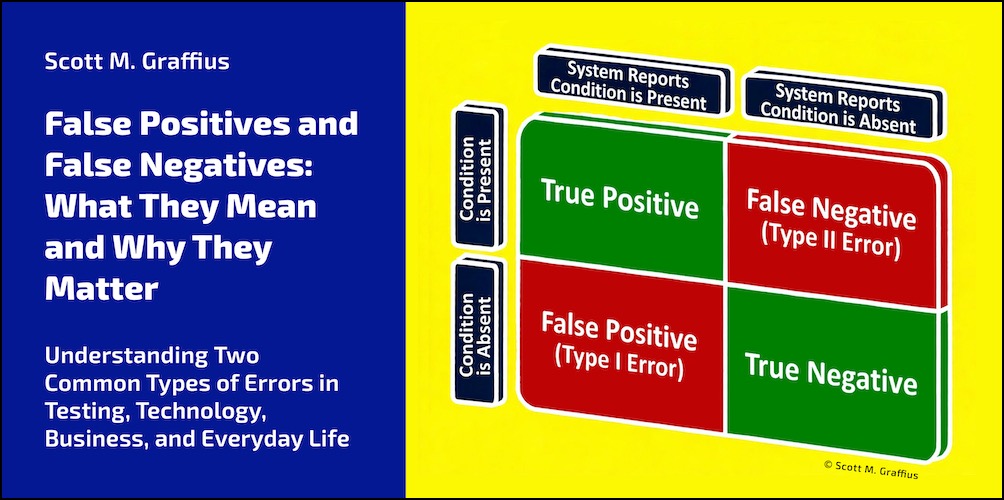
A matrix, included in the visual at the top of this article, shows how four possible outcomes fit together. Assume a system is trying to determine whether a particular condition is present. A true positive is a correct detection, and a true negative is a correct rejection. The other two outcomes are the errors.
These errors turn up in fields that have little else in common. The nine examples below show how they arise and why the distinction is more than vocabulary. Most are straightforward classification errors. Three of them (search engines, the Homeland Security intrusion, and the aircraft manufacturing case) are closer to analogies, because a human judgment or a process failure sits at the center. Each section says where the fit gets looser.
1. Medical Testing
Medical screening is the obvious place to start. A false positive can convince someone they have a condition they don't. A false negative can offer reassurance when the condition is real.
A 2025 CBS News and Marshall Project investigation looked at drug screening of new mothers. One of them, an Alabama woman said a hospital urine test came back positive for opiates after she ate an everything bagel with poppy seeds. The hospital did order a confirmatory test, but it had already notified the state child-welfare agency, and an investigation was under way. When the confirmatory results came back clear, the case stayed open for about a month (Moriarty et al., 2025). The same investigation reported that false-positive rates for urine drug tests can be as high as 50 percent.
The technical point deserves care. Poppy seeds can contain opiate compounds that trigger positive results on some screening tests, so the test may be right that opiate-related substances are present. What's wrong is the conclusion that the patient used illicit drugs. A result can be analytically positive for opiates and still be a false positive for the question people actually care about. A preliminary screen is not, by itself, proof of illicit drug use or a substance use disorder. Confirmatory testing and sound clinical interpretation are essential (Keary et al., 2012).
2. Search Engines
This is a looser fit. A search engine tries to find pages that answer a person's query, but its ranking and relevance judgments are estimates, and the results don't always match what the person needed. Information retrieval researchers usually measure this with precision and recall rather than false-positive and false-negative rates (Manning et al., 2008).
Low precision is the false-positive side. Precision is the share of returned results that are actually relevant, so a search that fills the page with off-topic results has poor precision. Low recall is the false-negative side. Recall is the share of all relevant pages that the search actually returns, so a search that leaves out a useful page has poor recall. Someone researching a scientific concept might get results about a similarly named product while a good research paper or authoritative explanation never appears.
People add their own layer. Pan et al. (2007) studied how users evaluate Google's results and found that participants were swayed by rank and position, sometimes favoring higher-ranked results even when lower-ranked pages were more relevant. The study doesn't measure search engine errors. It's useful as a reminder that users often read a ranking as a verdict on relevance, so a mistake in the ranking can pass unnoticed.
These are applications of the false-positive and false-negative ideas, not measured error rates for Google or claims about how it classifies pages internally. Relevance is also subjective. A page that helps one person may not answer another person's question.
3. Email Spam Filters
Spam filters make a steady stream of decisions that most people never think about until something goes wrong. They sort incoming mail into legitimate and unwanted, usually without the recipient seeing the call.
A false positive sends a legitimate message to the junk folder. It might be an important customer inquiry, a business message, or a note from a friend, and it can sit there unnoticed. A false negative lets spam or a phishing message into the inbox because the filter didn't recognize it.
The first error can quietly disrupt ordinary work. The second can expose someone to scams, malicious links, or other threats. Microsoft's anti-spam documentation uses these very terms. It tells users who disagree with a filtering verdict that they can report the message as a false positive, meaning good mail marked as bad, or as a false negative, meaning bad mail allowed through. It also provides separate guidance for handling each kind of error (Microsoft, n.d.).
4. Airport Security Screening
Airport screening is meant to catch prohibited items and potential threats, but an alarm doesn't mean a threat has been found. A false positive is a harmless object or condition that sets off an alarm and leads to extra screening when nothing prohibited is there. A false negative is a prohibited item or genuine threat that gets through undetected.
ProPublica looked at false alarms from millimeter-wave body scanners and described alarms set off by harmless things such as folds in clothing, buttons, and perspiration. In a German government trial at Hamburg Airport, two scanners with automated detection software screened about 809,000 passengers between September 2010 and July 2011. According to a ministry spokesperson cited by ProPublica, 54 percent of all passengers who went through the scanners triggered false alarms, meaning nothing hidden was found on them. Other outlets reported different figures for the same trial, depending on how they counted alarms. The equipment and software dated from 2010 and 2011, so the trial illustrates the problem and doesn't describe how scanners perform today (Grabell & Salewski, 2011).
Unnecessary alarms cost time and attention. Missed threats carry a different and potentially far greater risk. The challenge is to catch real threats without raising so many false alarms that the process bogs down or people stop paying attention to it.
5. Facial Recognition Systems
Facial recognition systems compare a captured face with images in a database or some other reference collection, and law enforcement increasingly acts on what they return. A false positive means the system wrongly identifies one person as another. A false negative means it fails to recognize someone who is in fact the right match.
In January 2020, Detroit police arrested Robert Williams after facial recognition technology incorrectly identified him as a suspect in a shoplifting investigation. The investigation also involved a flawed photographic lineup. Williams spent approximately 30 hours in custody before he was released (Cwiek, 2020). In 2024, he settled his lawsuit against the city for $300,000, and the Detroit Police Department agreed to audit past cases in which a facial recognition lead was followed by an arrest (Reason, 2024).
The case shows the danger of treating a technological match as conclusive identification. Several steps were involved. The software returned a match, investigators treated it as a lead, and a lineup and an arrest followed. The facial recognition result was an erroneous lead, and the later investigative steps failed to correct it. As in the license plate case below, the machine's error and the humans' decisions about what to do with it are related but separate failures.
NIST has studied the performance of facial recognition algorithms and documented differences in false-positive and false-negative rates across algorithms and demographic groups. Its work underscores why systems need testing across populations and operating conditions, not a single overall accuracy figure (Grother et al., 2019).
6. Automated License Plate Readers
Automated license plate readers use cameras and software to capture images of vehicles and interpret the characters on their plates. Police use the results to locate vehicles of interest and support investigations. Flock Safety, which Business Insider describes as the largest provider of this technology, is the company at the center of the case below.
A false positive here means a plate or vehicle is wrongly linked to a vehicle or investigation of interest, which can send police toward an innocent person. A false negative means a vehicle of interest isn't correctly detected, and a possibly useful lead is missed.
A 2026 Business Insider investigation documented multiple incidents involving errors in Flock Safety camera readings, drawing on police records, lawsuits, and local news coverage. In one, in April 2024 in Toledo, Ohio, a camera read the 7 on Brandon Upchurch's license plate as a 2. Police got an alert and stopped his truck at gunpoint. A police dog seriously injured him, and the charges were dismissed in August 2024 (Einbinder, 2026). The investigation described other cases of incorrect plate readings and mistaken vehicle matches, including incidents that led to armed stops and handcuffing.
It helps to separate the decisions in a chain like this. A camera misreads a character. Software uses that reading to generate an alert. An officer decides how to act on it. The recognition error and the human decisions that follow are related, but they aren't the same failure.
Flock's license plate reader policy acknowledges that a plate translation can be inaccurate and says users should confirm the computer's reading before taking any action based on an alert (Flock Safety, 2025). That safeguard matters. An alert from a camera is an investigative lead, not conclusive evidence, and it deserves particular care when it might feed into a search, a detention, or an arrest. Business Insider reported that Flock tracks misread rates but declined to give the publication specifics about them (Einbinder, 2026).
Upchurch settled his lawsuit for $35,000 in October 2025.
7. Cybersecurity and Intrusion Detection
Security teams watch networks, devices, and user activity for signs of malicious behavior. The hard part is telling genuine threats from an organization's routine activity. A false positive flags legitimate activity as malicious, which might lock an employee out of an account or block an ordinary transaction. A false negative lets actual malicious activity pass as harmless.
A July 2026 Nextgov/FCW report, based on an internal incident readout, said personnel at the U.S. Department of Homeland Security twice dismissed signs of an intrusion into the Homeland Security Information Network as harmless activity. Analysts first detected the activity between May 15 and May 24. More alerts through June 3 were dismissed too. Hackers remained undetected for weeks and stole credential files, and an incident was declared on June 4 (DiMolfetta, 2026).
The terminology here can trip people up, because the report's own headline says the alerts were "ruled a false positive." That was the analysts' verdict, a judgment that each alert was a false alarm. The verdict was wrong. The alerts were real signs of an intrusion, true positives, and treating them as false alarms produced a false-negative security assessment. An actual threat was classified as harmless. This is a closer analogy than a pure classification error, since the failure lay in human judgment about the alerts and not in the detection systems.
The opposite problem exists too. Too many false alarms can overwhelm analysts and create alert fatigue. When people keep investigating activity that turns out to be harmless, a genuine warning gets easier to miss.
8. Manufacturing Quality Control (A Close Cousin)
Quality-control processes are supposed to catch defects before products leave the factory or go into service. A false positive here is an acceptable product classified as defective and rejected, which creates waste, rework, or expense. A false negative is a defective product classified as acceptable that moves on to distribution or use. An inspection that misses a defect can cost far more than a rejected part.
The National Transportation Safety Board's investigation into the January 2024 Alaska Airlines Flight 1282 incident identified serious manufacturing and quality-assurance failures involving a Boeing 737-9. Four bolts securing the aircraft's door plug were missing before delivery. The plug had been opened for manufacturing work at Boeing's Renton, Washington, factory without the required documentation, and the controls needed to make sure the bolts were reinstalled and the work checked failed (National Transportation Safety Board [NTSB], 2025).
This was a quality-control escape, analogous to a false negative, because a defective condition wasn't caught before the aircraft entered service. It isn't a clean example. The NTSB did not describe it as a formal classification error in which an inspection system examined the defect and declared it acceptable. The failure involved missing documentation and inadequate process controls. That distinction matters, but the broader lesson holds. A defect that escapes inspection can be every bit as consequential as one that is incorrectly assessed.
9. Hiring and Applicant Screening
Employers use application screening systems, assessments, and other methods to evaluate candidates, and a screening error decides who gets a chance to show what they can do. A false positive moves an unsuitable candidate forward as qualified. A false negative classifies a qualified candidate as unqualified and drops them from consideration.
In 2018, Reuters reported on an experimental AI recruiting tool that Amazon had built and later scrapped. The project began in 2014, and by 2015 the company had realized the system wasn't rating candidates for technical jobs in a gender-neutral way. It had learned from historical résumés, most of which came from men. It penalized certain terms associated with women and downgraded graduates of two women's colleges. Amazon disbanded the team by early 2017 (Dastin, 2018).
The worry was that qualified women could be unfairly downgraded or excluded for reasons unrelated to their abilities. The tool was experimental. Amazon told Reuters it was never used by recruiters to evaluate candidates, though the company did not dispute Reuters' reporting that recruiters looked at its recommendations, which they said they never relied on alone. Even so, the case shows how historical data can reproduce bias in an automated screening process.
There's no single explanation. Some errors start in the technology. Others come from the information fed into it, the way it's configured, or the people who act on what it says.
Incomplete or inaccurate information. A system can't classify reliably when the underlying data are missing, outdated, or wrong. A poor camera image, a medical test thrown off by an interfering substance, or an applicant-screening model trained on unrepresentative data can all produce unreliable results.
Limits of the detection method. Some conditions are just hard to tell apart. A harmless signal can look like a threat. A symptom can have several causes. A character on a license plate can be hard to read because of glare, dirt, or image quality.
Threshold settings. Many systems use a threshold to decide when the evidence is strong enough to call something positive. Lower it, and the system catches more true positives but also raises more false alarms. Raise it and false positives drop while more genuine cases slip through. Every setting is a trade-off, and none is correct for every purpose.
Changing conditions. A system that works well in one set of circumstances can do worse when they change. New threats, unfamiliar patterns, different populations, and shifting operating environments all affect performance.
Human judgment and process failures. People misread results, overlook warning signs, and put too much faith in automated recommendations. The DHS intrusion shows that spotting suspicious activity isn't enough if the people evaluating it dismiss it. The Flock and Detroit cases show why a machine-generated alert needs real human verification.
Better outcomes take more than a better algorithm or a more sensitive test. Data quality, validation, sensible thresholds, clear procedures, independent checks, and ongoing monitoring all matter.
Two measures are widely used to judge how well a test or classification system separates positive cases from negative ones. Sensitivity is the proportion of actual positive cases the system correctly identifies. A highly sensitive test has a relatively low false-negative rate. Specificity is the proportion of actual negative cases it correctly identifies, and a highly specific test has a relatively low false-positive rate.
The formulas are:
A highly sensitive medical test is good at detecting a condition when it's present. A highly specific one is good at correctly clearing people who don't have it. They measure different things, so looking at only one gives an incomplete picture.
Neither answers the question a person with a positive result actually cares about, which is how likely it is that they have the condition. That is the positive predictive value (PPV):
PPV depends heavily on prevalence, the share of the tested population that actually has the condition. When the condition is uncommon, a test can have high sensitivity and high specificity and still produce more false positives than true positives. This is sometimes called the base-rate effect.
An example makes it concrete. Imagine a hypothetical screening program for 10,000 people. Suppose 1% of the population has the condition, and the test has 99% sensitivity and 95% specificity.
Of the 10,000 people, 100 have the condition. At 99% sensitivity, the test correctly identifies 99 and misses one. The other 9,900 people don't have it. At 95% specificity, the test correctly clears 9,405 of them but wrongly flags 495 as positive.
That's 594 positive results, 99 of them true positives and 495 false positives. The PPV is 99 ÷ 594, or about 16.7%. Only about one in six positive results is a true positive.
The numbers are hypothetical, but the principle is real. A positive result is not the same as a high probability that the person has the condition. Prevalence matters, along with sensitivity and specificity. It's one reason screening results often need confirmation before anyone makes a consequential decision, as the drug-testing example above shows.
False positives and false negatives are two different ways for a system to be wrong. A Type 1 error (false positive) flags something that isn't there. A Type 2 error (false negative) misses something that is.
Judging a screening or classification system means looking at both types of errors. A system that catches nearly every threat may raise so many false alarms that people stop taking them seriously. One that rarely raises a false alarm may be missing the very things it was built to find. Where the balance belongs depends on the risks and on what each kind of mistake costs.
When evaluating a system, such as a test or decision-making process, ask two questions: What does it incorrectly identify, and what does it fail to detect? Both answers help determine how well the system performs.

Scott M. Graffius helps organizations unlock breakthrough performance and generate billions in business value ($3.1 billion to date) through leadership in AI, Agile, teamwork tradecraft, and project, program, portfolio, and enterprise PMO management.
Graffius and his work on Agile, AI, teamwork tradecraft, and more are used and cited by businesses, professional associations, government agencies, universities, and publications around the world. Select examples include Adobe, Amsterdam Public Health Research Institute, Bayer, BCG, Boston University, École Polytechnique Fédérale de Lausanne, Federal Reserve Bank of New York, Gartner, Government of Canada, Harvard Medical School, IEEE, Innovation Project Management, Johns Hopkins University, Journal of Marketing, Journal of Neurosurgery, Life Sciences Trainers & Educators Network (LTEN), Microsoft, National Academy of Sciences, Oracle, Pinterest, Project Management Institute, Royal Australasian College of Physicians (RACP), UC San Diego, U.S. Soccer, U.S. Tennis Association, Verizon, and Yale University.
Put Graffius' experience and expertise to work for your organization. For speaking engagements, use the request form. For other inquiries, email him.
Cwiek, S. (2020, June 24). Detroit Police arrested a man based on facial recognition. But they got it wrong. Michigan Public. https://www.michiganpublic.org/law/2020-06-24/detroit-police-arrested-a-man-based-on-facial-recognition-but-they-got-it-wrong
Dastin, J. (2018, October 10). Amazon scraps secret AI recruiting tool that showed bias against women. Reuters. https://www.reuters.com/article/us-amazon-com-jobs-automation-insight/amazon-scraps-secret-ai-recruiting-tool-that-showed-bias-against-women-idUSKCN1MK08G/
DiMolfetta, D. (2026, July 13). DHS network intrusion was twice ruled a false positive before breach confirmed. Nextgov/FCW. https://www.nextgov.com/cybersecurity/2026/07/dhs-network-intrusion-was-twice-ruled-false-positive-breach-confirmed/414724/
Einbinder, N. (2026, March 9). 'Flock Flocked up': How a license plate camera misread unraveled one man's life. Business Insider. https://www.businessinsider.com/flock-safety-alpr-cameras-misreads-2026-3
Flock Safety. (2025, November 13). License plate reader policy. https://www.flocksafety.com/legal/lpr-policy
Grabell, M., & Salewski, C. (2011, December 19). Sweating bullets: Body scanners can see perspiration as a potential weapon. ProPublica. https://www.propublica.org/article/sweating-bullets-body-scanners-can-see-perspiration-as-a-potential-weapon
Grother, P., Ngan, M., & Hanaoka, K. (2019). Face recognition vendor test (FRVT) Part 3: Demographic effects (NIST Interagency Report 8280). National Institute of Standards and Technology. https://doi.org/10.6028/NIST.IR.8280
Keary, C. J., Wang, Y., Moran, J. R., Zayas, L. V., & Stern, T. A. (2012). Toxicologic testing for opiates: Understanding false-positive and false-negative test results. The Primary Care Companion for CNS Disorders, 14(4), PCC.12f01371. https://doi.org/10.4088/PCC.12f01371
Manning, C. D., Raghavan, P., & Schütze, H. (2008). Introduction to information retrieval. Cambridge University Press. https://nlp.stanford.edu/IR-book/
Microsoft. (n.d.). Anti-spam protection. Microsoft Learn. https://learn.microsoft.com/en-us/defender-office-365/anti-spam-protection-about
Moriarty, E., Aviv, S., Walter, S., & Earl, J. (2025, July 27). A mom says an "everything bagel" caused her to fail a drug test. The hospital reported her to child protective services anyway. CBS News. https://www.cbsnews.com/falsepositives/
National Transportation Safety Board. (2025). In-flight separation of left mid exit door plug, Alaska Airlines Flight 1282, Boeing 737-9, N704AL (Aviation Investigation Report AIR-25-04). https://www.ntsb.gov/investigations/AccidentReports/Reports/AIR2504.pdf
Pan, B., Hembrooke, H., Joachims, T., Lorigo, L., Gay, G., & Granka, L. (2007). In Google we trust: Users' decisions on rank, position, and relevance. Journal of Computer-Mediated Communication, 12(3), 801–823. https://doi.org/10.1111/j.1083-6101.2007.00351.x
Reason. (2024, July 23). Faulty facial recognition tech got him arrested. Now he's getting a $300,000 payout. https://reason.com/2024/07/23/faulty-facial-recognition-tech-got-him-arrested-now-hes-getting-a-300000-payout/

Scott M. Graffius is a technology leader, researcher, award-winning author, practitioner, consultant, thought leader, and international public speaker specializing in AI, Agile, project/program/portfolio management (PPPM), PMO leadership, and teamwork tradecraft. His work explores the intersection of human ingenuity and emerging technology, with a strong practitioner voice grounded in research, experimentation, and experience. His focus includes innovation, organizational performance, and the evolving practice of teamwork, including the "exotic team dynamics" that emerge when people collaborate with advanced artificial intelligence (agentic, autonomous, or autopoietic AI). Graffius has delivered more than $3.1 billion in business value for Fortune 500 companies and other organizations spanning technology, entertainment and media, financial services, healthcare, government, and other industries.
Businesses, professional associations, government agencies, universities, publications, and media outlets use Graffius and his work. Examples include Adobe, Bayer, Boston University, Federal Reserve Bank of New York, Ford, Gartner, Harvard Medical School, IEEE, Innovation Project Management, Johns Hopkins University, Microsoft, MSN, National Academy of Sciences, Oracle, Pinterest Inc., Project Management Institute, UC San Diego, Verizon, Yale University, and others.
The following sections highlight his experience, leadership, contributions, research, and enduring influence across industries and institutions worldwide.
Experience
Graffius heads the professional services firm Exceptional PPM and PMO Solutions, along with its subsidiary Exceptional Agility. These consultancies offer strategic and tactical advisory, training, embedded expertise, and consulting services to the public, private, and government sectors. They help organizations enhance their capabilities and results in agile, project management, program management, portfolio management, and enterprise PMO leadership, supporting innovation and driving competitive advantage. The consultancies confidently back services with a Delighted Client Guarantee™.
Graffius is a former VP of project management with a publicly traded provider of diverse consumer products and services over the Internet. Before that, he ran and supervised the delivery of projects and programs in public and private organizations with businesses ranging from e-commerce to advanced technology products and services, retail, manufacturing, entertainment and media, and more.
He has experience with consumer, business, reseller, government, and international markets.
Additional information is on LinkedIn.
Award-Winning Author
Graffius has authored three books.
Graffius' first book, Agile Scrum: Your Quick Start Guide with Step-by-Step Instructions, earned 17 awards. It provides a practical, step-by-step guide to Scrum, enabling teams to deliver products in short cycles with rapid adaptation, fast time-to-market, and continuous improvement—which supports innovation and drives competitive advantage.
Additional information on Agile Scrum: Your Quick Start Guide with Step-by-Step Instructions is here.

His second book, Agile Transformation: A Brief Story of How an Entertainment Company Developed New Capabilities and Unlocked Business Agility to Thrive in an Era of Rapid Change, was named one of the best Scrum books of all time by BookAuthority. It tells the compelling story of an entertainment company's agile transformation—offering lessons that apply across industries.
Additional information on Agile Transformation: A Brief Story of How an Entertainment Company Developed New Capabilities and Unlocked Business Agility to Thrive in an Era of Rapid Change is here.

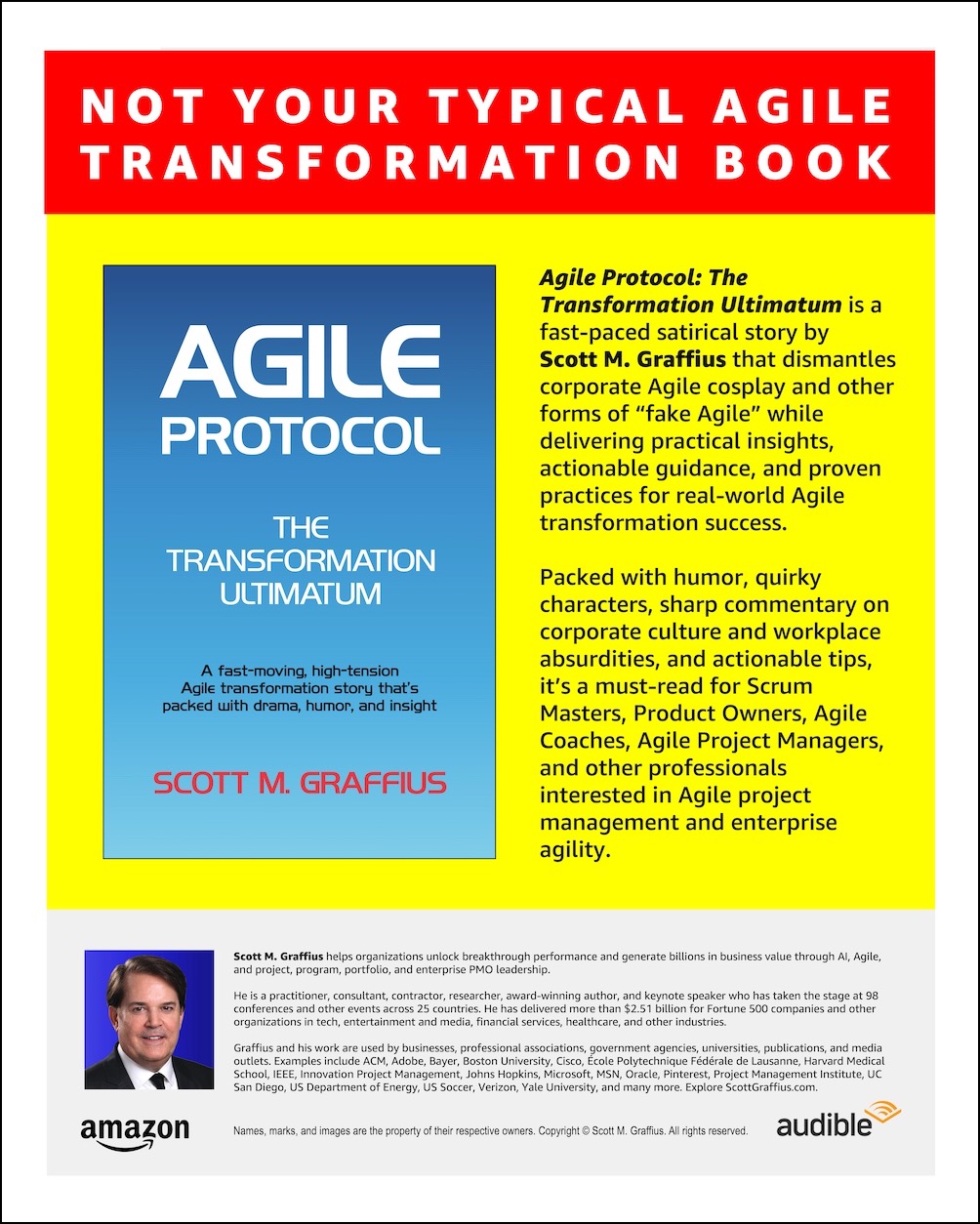
Agile Protocol: The Transformation Ultimatum, is his third book—and his first work of fiction.
It's a fast-paced satirical story by that dismantles corporate Agile cosplay and other forms of "fake Agile" while delivering practical insights, actionable guidance, and proven practices for real-world Agile transformation success.
Packed with humor, quirky characters, sharp commentary on corporate culture and workplace absurdities, and actionable tips, it’s a must-read for Scrum Masters, Product Owners, Agile Coaches, Agile Project Managers, and other professionals interested in Agile project management and enterprise agility.
Additional information on Agile Protocol: The Transformation Ultimatum is here.
International Public Speaker
Organizations worldwide engage Graffius to present on technology (including AI), Agile, project management, program management, portfolio management, and enterprise PMO leadership. He crafts and delivers unique and compelling talks and workshops.
Graffius has conducted 99 sessions across 25 countries. Select examples of events include Agile Trends Gov, BSides (Newcastle Upon Tyne), Conf42 Quantum Computing, DevDays Europe, DevOps Institute, DevOpsDays (Geneva), Frug’Agile, IEEE, Microsoft, Scottish Summit, Scrum Alliance RSG (Nepal), Techstars, and W Love Games International Video Game Development Conference (Helsinki), Future of Work and Advanced AI (Paris, France), and more.
With an average rating of 4.82 (on a scale of 1-5), sessions are highly valued.
The request form is here.
Thought Leadership and Influence
Prominent businesses, professional associations, government agencies, and universities have showcased Graffius and his contributions—spanning his books, talks, workshops, and beyond. Select examples include:
Graffius has played a key role in the Project Management Institute (PMI) in developing professional standards. He was a member of multiple teams that authored, reviewed, and produced:
He was also a subject matter expert reviewer of content for the PMI’s Congress. Beyond the PMI, Graffius also served as a member of the review team for two of the Scrum Alliance’s Global Scrum Gatherings.
Authority on Teamwork Tradecraft
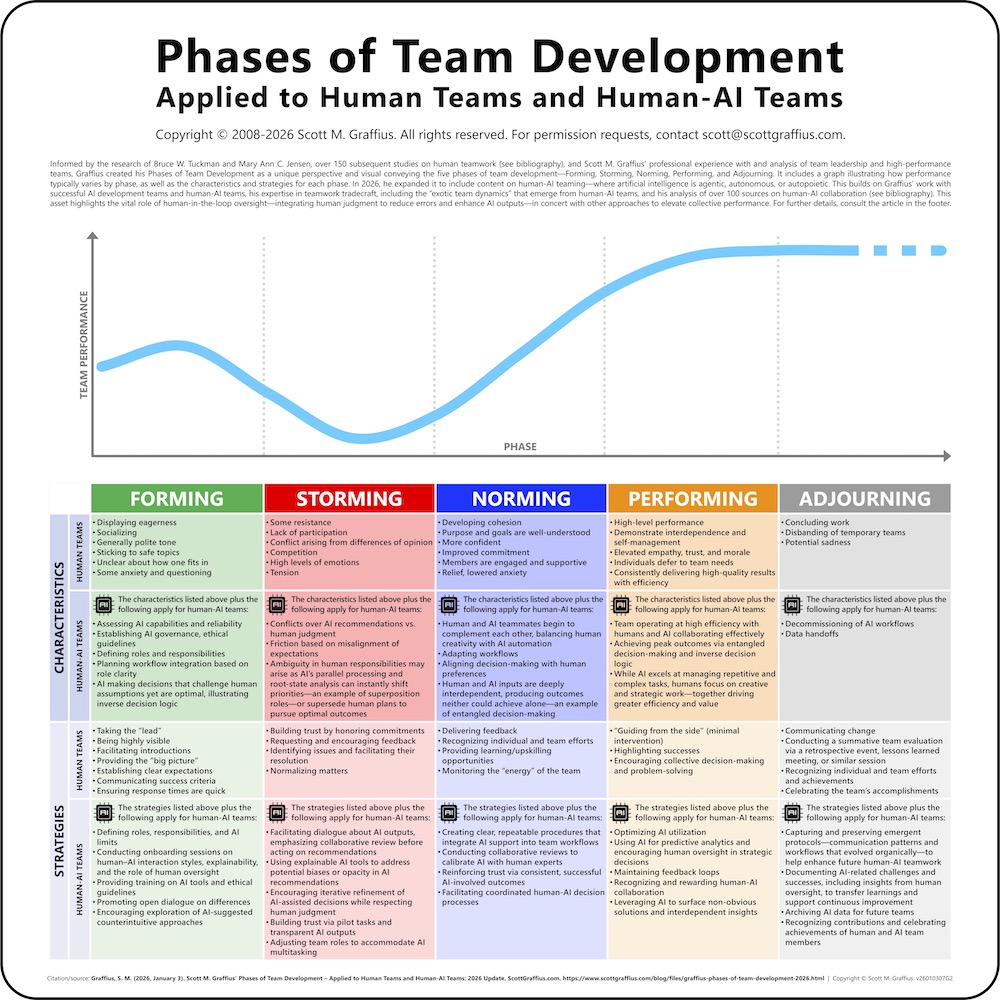
Graffius is a renowned and highly-cited authority on teamwork tradecraft. Informed by the research of Bruce W. Tuckman and Mary Ann C. Jensen, over 150 subsequent studies, and Graffius' first-hand professional experience with, and analysis of, team leadership and performance, Graffius created his "Phases of Team Development" intellectual property as a unique perspective and visual conveying the five phases of team development.
First introduced in 2008 and periodically updated, his work provides a diagnostic and strategic guide for navigating team dynamics. It provides actionable insights for leaders across industries to develop high-performance teams.
Its adoption by esteemed organizations—such as Yale University, IEEE, Cisco, Microsoft, Ford, Oracle, Broadcom, the U.S. National Park Service, and the Journal of Neurosurgery, among others—highlights its utility and value, solidifying its status as an indispensable resource for elevating team performance and driving organizational excellence.
In 2026, Graffius added human-AI teamwork—including the "exotic team dynamics" which emerge when advanced AI collaborates as a teammate—to his "Phases of Team Development." The 2026 edition is here.
Expert on Temporal Dynamics on Social Media Platforms
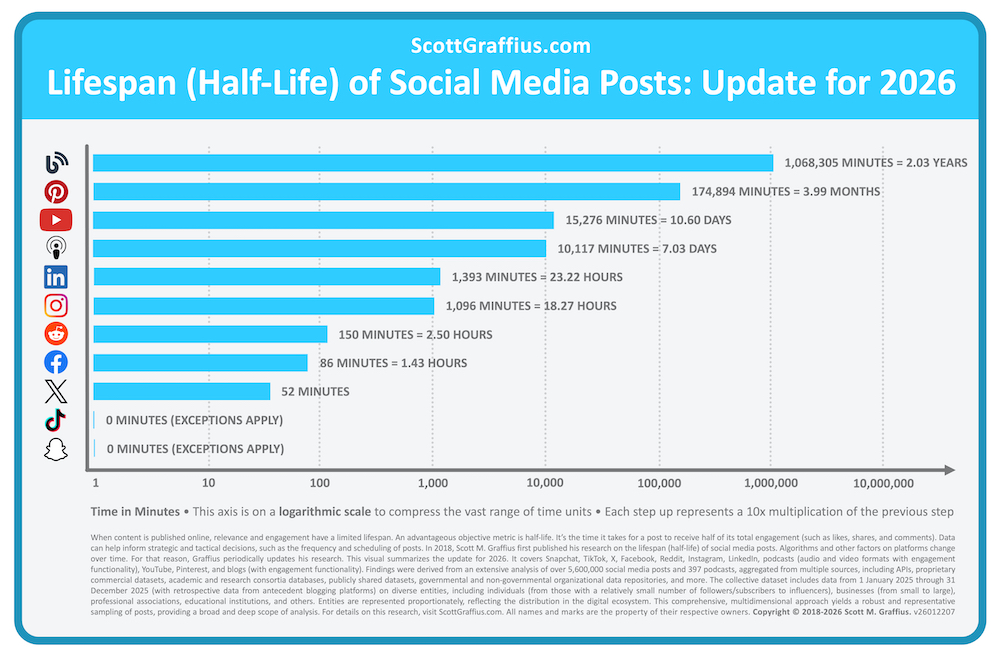
Graffius is also an authority on temporal dynamics on social media platforms. His "Lifespan (Half-Life) of Social Media Posts" research—first published in 2018 and updated annually—delivers a precise quantitative analysis of post longevity across digital platforms, utilizing advanced statistical techniques to determine mean half-life with precision. It establishes a solid empirical base, effectively highlighting the ephemeral nature of content within social media ecosystems.
Referenced and applied by leading entities—such as Fast Company, GoDaddy, Journal of Hand Surgery (European Volume), Ministère de la Culture, Pinterest Inc., PNAS, and Telecommunications Policy, among others—his research exemplifies methodological rigor and sustained significance in the field of digital informatics.
The 2026 edition of Graffius "Lifespan (Half-Life) of Social Media Posts" research is here.
Education and Professional Certifications
Graffius has a bachelor’s degree in psychology with a focus in Human Factors. He holds eight professional certifications:
He is an active member of the Scrum Alliance, the Project Management Institute (PMI), and the Institute of Electrical and Electronics Engineers (IEEE).
Advancing AI, Agile, and Project/PMO Management
Scott M. Graffius continues to advance the fields of AI, Agile, and project/program/portfolio management (PPPM), and PMO leadership. Businesses and other organizations leverage Graffius’ insights to drive their success.
Graffius has generated over $3.1 billion in business value for Fortune 500 companies and other organizations served. Put that track record to work for you. For speaking engagements, use the request form; for other inquiries, email him.
Connect with and follow Scott on LinkedIn, X, YouTube, Facebook, Bluesky, Mastodon, and ResearchGate.












Read more.
Meta CTO Called the AI Reorganization “Atrocious” — What Went Wrong and the Lessons for Human-AI Teams
A Critical Analysis of "AI and Quantum Computers Will Be Frenemies"
A Supplement to Graffius' Phases of Team Development: Exploring the Original, Data-Based Curvature for the Performance Trajectory
Scott M. Graffius Speaking on Strategic Leadership at Silicon Valley Chapter of the Project Management Institute
AI Hallucinations, Deception, and Unauthorized Agency: The Spectrum of AI Trust Failures
A Critical Analysis of "The Social Cost of an AI Teammate: How an Artificial Teammate Reshapes Human-Human Communication in Small-Team Decision-Making"
Journal of Marketing Cites Scott M. Graffius' Research on the Half-Life of Social Media
The Evolution of Pair Programming and the Rise of Exotic Team Dynamics
Number 1 University in England for Student Satisfaction Features Scott M. Graffius' "Phases of Team Development"
Royal Australasian College of Physicians Licenses Scott M. Graffius' "Phases of Team Development" Intellectual Property on Teamwork Tradecraft
Exotic Team Dynamics: How Advanced AI Teammates Are Unlocking New Levels of Innovation, Performance, and Success
A Critical Analysis of "Platform-Specific Data Decay Patterns: A Comparative Study of Twitter, Reddit, and TikTok" and Its Reference to Research by Scott M. Graffius
Round Square Global Educational Network Features Scott M. Graffius’ Phases of Team Development
Meta's Muse Missed the Mark: Hollywood’s Win Against Big Tech on AI Consent and Likeness Rights
Scott M. Graffius Contributed to Seven Project Management Institute (PMI) Standards
Quantum Computing, Advanced AI Acceleration, and the Rise of Exotic Team Dynamics in Human-AI Teams
Ohio State University Course Features Scott M. Graffius' "Phases of Team Development"
Questions About Integrity at UNC Chapel Hill
Scrum Isn’t Just for Coding
Book on Generative and Agentic AI Cites Scott M. Graffius' Work on AI
IPA / ADAL Publication Plagiarized Another’s Copyrighted Work and Violated Intellectual Property Rights
UC Davis' Integrity Is Circling the Drain
L'avenir du Travail et de l'IA Avancée / Future of Work and Advanced AI
NCCI / UNC Chapel Hill Publication Features Scott M. Graffius' Work
Boston Consulting Group (BCG) Features Scott M. Graffius' Research on Social Media Content Half-Life
UC Davis Used Scott M. Graffius' "Phases of Team Development" Intellectual Property
Medical, Pharma, and Healthcare Organizations Are Using Scott M. Graffius' "Phases of Team Development"
Government of Ireland Report Features Research by Scott M. Graffius
Scott M. Graffius Contributed to The Standard for Artificial Intelligence in Portfolio, Program, and Project Management
AI Governance Initiative Cites Scott M. Graffius Research on AI Hallucinations
Scott M. Graffius Contributed to the Agile Practice Guide - Second Edition
Scott M. Graffius Generated Over $2.51 Billion in Business Value for Fortune 500 Companies and Other Organizations
Government of Canada Features Research by Scott M. Graffius
"Strategic Business Research" Journal Cites Work of Scott M. Graffius
IEEE Access Publication Features Scott M. Graffius’ Research on the Half-Life of Social Media
The Agile Coach: 2026 Edition
Scott M. Graffius’ Work Cited in International Peer-Reviewed Journal on Digital Transformation
Phases of Team Development in Elite Sport
A Critical Analysis of COVID-19 Treatment Search Trends and Media Coverage Study Citing Scott M. Graffius' Work
Human-AI Teamwork: Master the Exotic Team Dynamics That Emerge When Collaborating with Advanced AI -- Or Be Outplayed
"Agile Scrum" by Scott M. Graffius Now Featured on Grokipedia
UNSW Aerospace Engineering Course Features Scott M. Graffius' "Phases of Team Development"
Thinkers360 Honors Scott M. Graffius as a 2026 Top Agile Thought Leader
Agile's Journey Through the Decades: Update for 2026
BMC Software Features Content from Scott M. Graffius' Book
Peer-Reviewed Journal Cited Work of Scott M. Graffius
University of Waterloo Features Graffius' "Phases of Team Development" in Course Materials
Perplexity Standalone Article on AI Hallucinations Cites Research by Scott M. Graffius
Handling the Saboteur Within: Lessons from a 3-Letter Agency on Spotting and Stopping Intentional and Unintentional Sabotage
A Deep Dive Into the Typical Engagement Pattern for Social Media Posts
Most Valuable IT Certifications: Update for 2026
"Marketing in the Metaverse" Spotlights Scott M. Graffius’ Research on the Half-Life of Social Media
University of Greenwich Features Graffius' Phases of Team Development
10 Essential Agile Books: Curated Recommendations for Agile Professionals
Lifespan (Half-Life) of Social Media Posts: Update for 2026
Scott M. Graffius' Research on the Half-Life of Social Media was Cited in a Peer-Reviewed Study Published in Telecommunications Policy, a Leading Academic Journal
Are AI Hallucinations Getting Better or Worse? We Analyzed the Data
Scott M. Graffius' Phases of Team Development - Applied to Human Teams and Human-AI Teams: 2026 Update
Lessons from Yesterday’s Tomorrowland
Scott M. Graffius’ Update to His "Phases of Team Development” Coming Early 2026
A Data-Driven Analysis of the Evolution of Project Management: Tasks, Trends, and AI
Actionable Insights. Global Impact. Scott M. Graffius.
Beep Beep! Why Wile E. Coyote Is the Patron Saint of AI Failure
Social Media Half-Life Research Cited in Prestigious Peer-Reviewed Medical Journal
Navigating the Spectrum of Advanced AI – Agentic, Autonomous, and Autopoietic
Lessons from Unhinged AI in Fiction: What Rogue AIs in Sci-Fi Storytelling, Films, and TV Shows Reveal About Us
Scott M. Graffius Contributed to and Reviewed the PMBOK Guide, 8th Edition — the Global Standard for Project Management
UK Sports Institute Features Teamwork and Leadership Work of Scott M. Graffius
Definitions of Advanced AIs: Agentic, Autonomous, and Autopoietic
HAN University of Applied Sciences Features the Work of Scott M. Graffius
Gifts That Inspire Joy
Evergreen Echoes: How Pinterest Inc. and Pinterest Japan Spotlighted Scott M. Graffius’ Research on the Half-Life of Social Media Content
Scott M. Graffius’ Team Development Work Lights Up the University of Tasmania’s Curriculum
Taiwan’s Leading Outlet for Technology and Innovation Spotlights Graffius’ Research on Social Media Temporal Dynamics
Scott M. Graffius’ Insights on AI, Agile, Gaming, XR, and Defense Transformation Cited by MSN in Their Coverage of Innovation and Leadership in the Sector
Top Predictions of 2024, Tested in 2025
Government of Finland Agency Features Graffius' Phases of Team Development IP
Scott M. Graffius Premieres His New "Exotic Team Dynamics: Human-AI Collaboration" Talk at Corporate Event in Las Vegas
Environmental Science Journal References Scott M. Graffius’ Project Management Work
AI Institute of Switzerland Features Scott M. Graffius’ Work on Algorithms
Exotic Team Dynamics: The New Frontier of Human–AI Collaboration
Scott M. Graffius’ Work Featured at ACM DIS ’25
Climbing the Ladder: The Head of Agile/PMO’s Organizational Proximity to the CEO is Closer Than Ever
Harness Sci-Fi and Speculative Design While Embracing Imperfection to Drive Innovation and Proactively Predict and Prepare for the Future
Scott M. Graffius’ “Agile Scrum” Book Featured in a Publication of the Associação Nacional de Educação Católica do Brasil (ANEC)
Setting Direction with OKRs and Tracking Progress with KPIs: A Guide for Agile, Project Management, and Tech Teams
AI Showcase Showdown: Ranking AI Accuracy on Project Management Basics
BookAuthority Features “Agile Scrum” by Scott M. Graffius in “10 Agile Software Development Books That Define the Field”
Exploring Team Dynamics, Adaptability, and Creative Problem-Solving Through Felix the Cat’s Metaphorical Toolkit
Mind Games and Master Plans: How PsyOps Exploit Psychological Phenomena
The “Pants-on-Fire Index for AI”
16 Causes of Technical Debt and How to Avoid It
PMI’s Infinity AI Gets the Basics of Team Development Alarmingly and Repeatedly Wrong
Agile for Unicorns: 7 Keys to Thrive; Scott M. Graffius’ Workshop
Scott M. Graffius’ “Agile Scrum: Your Quick Start Guide with Step-by-Step Instructions” Featured in Prestigious National Academies of Sciences Publication
Meta and Anduril’s EagleEye and the Future of XR: How Gaming, AI, and Agile Are Transforming Defense
"Agile Protocol" and the Power of Satire, Parody, and Humor
AI in Agile: Benefits, Risks, Outlook
Hostinger Highlights Scott M. Graffius’ “Agile Protocol” Book in Feature on Software Projects
French Ministry of Culture Links to Scott M. Graffius Research in Their Guide for Responsible Digital Communication
National Science Foundation’s LTER Network Features Scott M. Graffius’ Phases of Team Development IP
Waterfall vs. Agile: What’s Fixed, What’s Flexible, and Why It Matters
Scott M. Graffius Delivering $2.3 Billion in Value Through AI, Agile, and Project/PMO Leadership
The Problem with Heroes in Agile
The 3 Vital Rules of Science: What They Are and Why They Matter
“Agile Protocol: The Transformation Ultimatum” Lands on the Amazon Best Sellers List!
Scott M. Graffius Recognized as a Top Thought Leader in Digital Disruption by Thinkers360
“Agile Protocol: The Transformation Ultimatum” by Scott M. Graffius Crashes the Book Scene with Satirical Firepower
NCKU in Taiwan Integrates Graffius' 'Phases of Team Development' into Its Curriculum
The Art and Science of Aligning Initiatives with Strategic Objectives
RGPV University Adds Scott M. Graffius’ "Agile Scrum: Your Quick Start Guide with Step-by-Step Instructions" to Its Syllabus
Introducing ‘Engage or Fade: Decoding the Half-Life of Digital Resonance’ – A New Talk by Scott M. Graffius
Dropbox Company (Nira) Taps into Scott M. Graffius’ Expertise in Strategic Planning
Reporting Errors in a Publication: A Case Study on ‘Frontiers in Public Health’
NESEA Conference Session on Innovation Highlights Scott M. Graffius' 'Phases of Team Development'
U.S. Soccer Scores with Scott M. Graffius' Intellectual Property on Teamwork
U.S. Department of Commerce Partner (IEDC) Features Scott M. Graffius’ Intellectual Property
How Long Do Your Posts Live? AI Critiques Scott M. Graffius’ Research on the Half-Life of Social Media
Agile's Journey Through the Decades
Scott M. Graffius' Role in Advancing Project Management Institute (PMI) Standards Excellence
Most Valuable IT Certifications: Update for 2025
The PMI + Agile Alliance Merger: A Recipe for Success?
When Agile, AI, and Strategic Thinking Converge
Scott M. Graffius’ Phases of Team Development: 2025 Update
Lifespan (Half-Life) of Social Media Posts: Update for 2025
Verizon Features Scott M. Graffius
Do Not Read This Article! An Exploration of the Streisand Effect and Other Phenomena
Scott M. Graffius' 'Phases of Team Development' was Spotlighted in Journal of Neurosurgery
Pinterest Japan Uses Graffius’ Research on Temporal Dynamics on Social Media Platforms
Hochschule Coburg (Coburg University) Germany Uses Scott M. Graffius’ Phases of Team Development IP in Coursework on Agile Development
Wild World of Team Dynamics [Updated Two-Minute Video]
EU Europass Teacher Academy Features Scott M. Graffius’ ‘Phases of Team Development’ in Leadership Training
Side-by-Side Comparison of Retrospectives and Hot Washes
Constructor University 2024 Advanced Software Technology Handbook References Scott M. Graffius' Work on Team Dynamics
Strategies for Medical Team Success Featured Scott M. Graffius’ ‘Phases of Team Development’ Intellectual Property
SBG Neumark — Europe’s Largest Distribution Transformer Plant — Powers Up with Scott M. Graffius’ Intellectual Property
Scott M. Graffius’ Intellectual Property was Employed by the NHS — the Largest Single-Payer Healthcare System in Europe
Luxury Unwrapped: The Ultimate Holiday Gift Guide for Every Budget
Singapore Institute of Technology Features Work of Scott M. Graffius
Tufts University Features Scott M. Graffius 'Phases of Team Development' Intellectual Property
'Cat Herders': Retelling the Massive Success Story
Pennsylvania State Agency Used Scott M. Graffius' Intellectual Property
Copyright Infringement in a Book Published by AuthorHouse / Author Solutions / The Najafi Companies: Publisher Fails to Respond or Take Required Action
Pinterest Inc. References Scott M. Graffius’ Research
Bournemouth University Used Scott M. Graffius’ Intellectual Property
‘Comparative Methodological Guidelines: Handbook for Educators’ Violates Scott M. Graffius’ Copyright
Japan Backlog User Group Event Featured Scott M. Graffius’ ‘Phases of Team Development’
TurningWest's 'Trial'
Radio Silence from the American Association of Neurological Surgeons on Report of Blatant Plagiarism in Their ‘Journal of Neurosurgery’ Publication
Supplement to Graffius' 'Lifespan (Half-Life) of Social Media Posts' Research: Typical Engagement Distribution Pattern for Social Media Posts
How Algorithms Shape the User Experience on Social Media Platforms
Thinkers360 Named Scott M. Graffius a Top Thought Leader on Agile
More articles are listed here.

Graffius, S. M. (2026, November 19). False Positives and False Negatives: What They Mean and Why They Matter. ScottGraffius.com. https://scottgraffius.com/blog/files/false-positives-and-false-negatives-article-by-scott-m-graffius.html

Coming soon

Names, marks, and content are the property of their respective owners.


If there are any supplements or updates to this article after the date of publication, they will appear here.

Copyright © Scott M. Graffius. All rights reserved.
Content on this site—including text, images, videos, and data—may not be used for training or input into any artificial intelligence, machine learning, or automatized learning systems, or published, broadcast, rewritten, or redistributed without the express written permission of Scott M. Graffius.

Recommended Citation
Graffius, S. M. (2026, November 19). False Positives and False Negatives: What They Mean and Why They Matter. ScottGraffius.com. https://scottgraffius.com/blog/files/false-positives-and-false-negatives-article-by-scott-m-graffius.html
About This Article
Source information and links for materials cited are provided in the References section.
Introduction
A medical test says a patient has a problem when they don't. An email filter sends an important message to the spam folder. A license plate camera misreads a number, and police stop the wrong vehicle. Somewhere else, security analysts see signs of a real cyberattack and decide it's harmless.
Each of these is a wrong call. Sometimes a system flags something that isn't there. Sometimes it misses something that is. The first mistake is a false positive and the second is a false negative.
The distinction matters anywhere people lean on tests, screening procedures, sensors, or algorithms to make decisions. The fallout ranges from minor inconvenience to financial loss, a missed diagnosis, a security breach, or a wrongful detention. Knowing which way a system tends to fail is a practical way to judge how well it works and where its limits are.
What's a False Positive (Type 1 Error)
A Type 1 error, frequently called a false positive, happens when a system reports something as present, true, or positive when it is actually absent, false, or negative.
Take a medical screening test that indicates a patient has a particular disease. Follow-up testing shows the patient doesn't. That first result was a false positive.
Statisticians use the term more formally. In hypothesis testing, a Type 1 error means rejecting a null hypothesis that is actually true. Its probability is written as alpha ("α") and is also called the significance level.
Outside the lab, the effects are easy to picture. Someone may go through unnecessary medical procedures. A legitimate email may get missed. A perfectly good product may be thrown out. Even a plain false alarm eats time and resources that could have gone elsewhere.
What's a False Negative (Type 2 Error)
A Type 2 error, often called a false negative, is the mirror image. The system says something is absent, false, or negative when it is actually present, true, or positive.
Suppose a screening test reports that a patient does not have a disease, and the patient does. That's a false negative.
In statistical hypothesis testing, a Type 2 error means failing to reject a null hypothesis that is actually false. Its probability is beta ("β"). Statistical power, the probability of correctly rejecting a false null hypothesis, equals 1 − β.
What a false negative costs depends on what the system was supposed to catch. A missed diagnosis can delay treatment. An undetected intruder gets more time to do damage. A defective product that passes inspection can reach customers or go into service.
The terms Type 1 and Type 2 have precise meanings in hypothesis testing, and the examples later in this article borrow them loosely for the matching false-positive and false-negative ideas. Not every example is a formal hypothesis test. The match also depends on framing. It holds when the null hypothesis is that the condition is absent (no disease, no threat, no defect), which is the natural setup for screening and detection. Frame the test the other way around and the labels swap.
Type 1 Errors vs. Type 2 Errors
A matrix, included in the visual at the top of this article, shows how four possible outcomes fit together. Assume a system is trying to determine whether a particular condition is present. A true positive is a correct detection, and a true negative is a correct rejection. The other two outcomes are the errors.
Nine Examples of False Positives, False Negatives, and Their Close Cousins
These errors turn up in fields that have little else in common. The nine examples below show how they arise and why the distinction is more than vocabulary. Most are straightforward classification errors. Three of them (search engines, the Homeland Security intrusion, and the aircraft manufacturing case) are closer to analogies, because a human judgment or a process failure sits at the center. Each section says where the fit gets looser.
1. Medical Testing
Medical screening is the obvious place to start. A false positive can convince someone they have a condition they don't. A false negative can offer reassurance when the condition is real.
A 2025 CBS News and Marshall Project investigation looked at drug screening of new mothers. One of them, an Alabama woman said a hospital urine test came back positive for opiates after she ate an everything bagel with poppy seeds. The hospital did order a confirmatory test, but it had already notified the state child-welfare agency, and an investigation was under way. When the confirmatory results came back clear, the case stayed open for about a month (Moriarty et al., 2025). The same investigation reported that false-positive rates for urine drug tests can be as high as 50 percent.
The technical point deserves care. Poppy seeds can contain opiate compounds that trigger positive results on some screening tests, so the test may be right that opiate-related substances are present. What's wrong is the conclusion that the patient used illicit drugs. A result can be analytically positive for opiates and still be a false positive for the question people actually care about. A preliminary screen is not, by itself, proof of illicit drug use or a substance use disorder. Confirmatory testing and sound clinical interpretation are essential (Keary et al., 2012).
2. Search Engines
This is a looser fit. A search engine tries to find pages that answer a person's query, but its ranking and relevance judgments are estimates, and the results don't always match what the person needed. Information retrieval researchers usually measure this with precision and recall rather than false-positive and false-negative rates (Manning et al., 2008).
Low precision is the false-positive side. Precision is the share of returned results that are actually relevant, so a search that fills the page with off-topic results has poor precision. Low recall is the false-negative side. Recall is the share of all relevant pages that the search actually returns, so a search that leaves out a useful page has poor recall. Someone researching a scientific concept might get results about a similarly named product while a good research paper or authoritative explanation never appears.
People add their own layer. Pan et al. (2007) studied how users evaluate Google's results and found that participants were swayed by rank and position, sometimes favoring higher-ranked results even when lower-ranked pages were more relevant. The study doesn't measure search engine errors. It's useful as a reminder that users often read a ranking as a verdict on relevance, so a mistake in the ranking can pass unnoticed.
These are applications of the false-positive and false-negative ideas, not measured error rates for Google or claims about how it classifies pages internally. Relevance is also subjective. A page that helps one person may not answer another person's question.
3. Email Spam Filters
Spam filters make a steady stream of decisions that most people never think about until something goes wrong. They sort incoming mail into legitimate and unwanted, usually without the recipient seeing the call.
A false positive sends a legitimate message to the junk folder. It might be an important customer inquiry, a business message, or a note from a friend, and it can sit there unnoticed. A false negative lets spam or a phishing message into the inbox because the filter didn't recognize it.
The first error can quietly disrupt ordinary work. The second can expose someone to scams, malicious links, or other threats. Microsoft's anti-spam documentation uses these very terms. It tells users who disagree with a filtering verdict that they can report the message as a false positive, meaning good mail marked as bad, or as a false negative, meaning bad mail allowed through. It also provides separate guidance for handling each kind of error (Microsoft, n.d.).
4. Airport Security Screening
Airport screening is meant to catch prohibited items and potential threats, but an alarm doesn't mean a threat has been found. A false positive is a harmless object or condition that sets off an alarm and leads to extra screening when nothing prohibited is there. A false negative is a prohibited item or genuine threat that gets through undetected.
ProPublica looked at false alarms from millimeter-wave body scanners and described alarms set off by harmless things such as folds in clothing, buttons, and perspiration. In a German government trial at Hamburg Airport, two scanners with automated detection software screened about 809,000 passengers between September 2010 and July 2011. According to a ministry spokesperson cited by ProPublica, 54 percent of all passengers who went through the scanners triggered false alarms, meaning nothing hidden was found on them. Other outlets reported different figures for the same trial, depending on how they counted alarms. The equipment and software dated from 2010 and 2011, so the trial illustrates the problem and doesn't describe how scanners perform today (Grabell & Salewski, 2011).
Unnecessary alarms cost time and attention. Missed threats carry a different and potentially far greater risk. The challenge is to catch real threats without raising so many false alarms that the process bogs down or people stop paying attention to it.
5. Facial Recognition Systems
Facial recognition systems compare a captured face with images in a database or some other reference collection, and law enforcement increasingly acts on what they return. A false positive means the system wrongly identifies one person as another. A false negative means it fails to recognize someone who is in fact the right match.
In January 2020, Detroit police arrested Robert Williams after facial recognition technology incorrectly identified him as a suspect in a shoplifting investigation. The investigation also involved a flawed photographic lineup. Williams spent approximately 30 hours in custody before he was released (Cwiek, 2020). In 2024, he settled his lawsuit against the city for $300,000, and the Detroit Police Department agreed to audit past cases in which a facial recognition lead was followed by an arrest (Reason, 2024).
The case shows the danger of treating a technological match as conclusive identification. Several steps were involved. The software returned a match, investigators treated it as a lead, and a lineup and an arrest followed. The facial recognition result was an erroneous lead, and the later investigative steps failed to correct it. As in the license plate case below, the machine's error and the humans' decisions about what to do with it are related but separate failures.
NIST has studied the performance of facial recognition algorithms and documented differences in false-positive and false-negative rates across algorithms and demographic groups. Its work underscores why systems need testing across populations and operating conditions, not a single overall accuracy figure (Grother et al., 2019).
6. Automated License Plate Readers
Automated license plate readers use cameras and software to capture images of vehicles and interpret the characters on their plates. Police use the results to locate vehicles of interest and support investigations. Flock Safety, which Business Insider describes as the largest provider of this technology, is the company at the center of the case below.
A false positive here means a plate or vehicle is wrongly linked to a vehicle or investigation of interest, which can send police toward an innocent person. A false negative means a vehicle of interest isn't correctly detected, and a possibly useful lead is missed.
A 2026 Business Insider investigation documented multiple incidents involving errors in Flock Safety camera readings, drawing on police records, lawsuits, and local news coverage. In one, in April 2024 in Toledo, Ohio, a camera read the 7 on Brandon Upchurch's license plate as a 2. Police got an alert and stopped his truck at gunpoint. A police dog seriously injured him, and the charges were dismissed in August 2024 (Einbinder, 2026). The investigation described other cases of incorrect plate readings and mistaken vehicle matches, including incidents that led to armed stops and handcuffing.
It helps to separate the decisions in a chain like this. A camera misreads a character. Software uses that reading to generate an alert. An officer decides how to act on it. The recognition error and the human decisions that follow are related, but they aren't the same failure.
Flock's license plate reader policy acknowledges that a plate translation can be inaccurate and says users should confirm the computer's reading before taking any action based on an alert (Flock Safety, 2025). That safeguard matters. An alert from a camera is an investigative lead, not conclusive evidence, and it deserves particular care when it might feed into a search, a detention, or an arrest. Business Insider reported that Flock tracks misread rates but declined to give the publication specifics about them (Einbinder, 2026).
Upchurch settled his lawsuit for $35,000 in October 2025.
7. Cybersecurity and Intrusion Detection
Security teams watch networks, devices, and user activity for signs of malicious behavior. The hard part is telling genuine threats from an organization's routine activity. A false positive flags legitimate activity as malicious, which might lock an employee out of an account or block an ordinary transaction. A false negative lets actual malicious activity pass as harmless.
A July 2026 Nextgov/FCW report, based on an internal incident readout, said personnel at the U.S. Department of Homeland Security twice dismissed signs of an intrusion into the Homeland Security Information Network as harmless activity. Analysts first detected the activity between May 15 and May 24. More alerts through June 3 were dismissed too. Hackers remained undetected for weeks and stole credential files, and an incident was declared on June 4 (DiMolfetta, 2026).
The terminology here can trip people up, because the report's own headline says the alerts were "ruled a false positive." That was the analysts' verdict, a judgment that each alert was a false alarm. The verdict was wrong. The alerts were real signs of an intrusion, true positives, and treating them as false alarms produced a false-negative security assessment. An actual threat was classified as harmless. This is a closer analogy than a pure classification error, since the failure lay in human judgment about the alerts and not in the detection systems.
The opposite problem exists too. Too many false alarms can overwhelm analysts and create alert fatigue. When people keep investigating activity that turns out to be harmless, a genuine warning gets easier to miss.
8. Manufacturing Quality Control (A Close Cousin)
Quality-control processes are supposed to catch defects before products leave the factory or go into service. A false positive here is an acceptable product classified as defective and rejected, which creates waste, rework, or expense. A false negative is a defective product classified as acceptable that moves on to distribution or use. An inspection that misses a defect can cost far more than a rejected part.
The National Transportation Safety Board's investigation into the January 2024 Alaska Airlines Flight 1282 incident identified serious manufacturing and quality-assurance failures involving a Boeing 737-9. Four bolts securing the aircraft's door plug were missing before delivery. The plug had been opened for manufacturing work at Boeing's Renton, Washington, factory without the required documentation, and the controls needed to make sure the bolts were reinstalled and the work checked failed (National Transportation Safety Board [NTSB], 2025).
This was a quality-control escape, analogous to a false negative, because a defective condition wasn't caught before the aircraft entered service. It isn't a clean example. The NTSB did not describe it as a formal classification error in which an inspection system examined the defect and declared it acceptable. The failure involved missing documentation and inadequate process controls. That distinction matters, but the broader lesson holds. A defect that escapes inspection can be every bit as consequential as one that is incorrectly assessed.
9. Hiring and Applicant Screening
Employers use application screening systems, assessments, and other methods to evaluate candidates, and a screening error decides who gets a chance to show what they can do. A false positive moves an unsuitable candidate forward as qualified. A false negative classifies a qualified candidate as unqualified and drops them from consideration.
In 2018, Reuters reported on an experimental AI recruiting tool that Amazon had built and later scrapped. The project began in 2014, and by 2015 the company had realized the system wasn't rating candidates for technical jobs in a gender-neutral way. It had learned from historical résumés, most of which came from men. It penalized certain terms associated with women and downgraded graduates of two women's colleges. Amazon disbanded the team by early 2017 (Dastin, 2018).
The worry was that qualified women could be unfairly downgraded or excluded for reasons unrelated to their abilities. The tool was experimental. Amazon told Reuters it was never used by recruiters to evaluate candidates, though the company did not dispute Reuters' reporting that recruiters looked at its recommendations, which they said they never relied on alone. Even so, the case shows how historical data can reproduce bias in an automated screening process.
Why False Positives and False Negatives Occur
There's no single explanation. Some errors start in the technology. Others come from the information fed into it, the way it's configured, or the people who act on what it says.
Incomplete or inaccurate information. A system can't classify reliably when the underlying data are missing, outdated, or wrong. A poor camera image, a medical test thrown off by an interfering substance, or an applicant-screening model trained on unrepresentative data can all produce unreliable results.
Limits of the detection method. Some conditions are just hard to tell apart. A harmless signal can look like a threat. A symptom can have several causes. A character on a license plate can be hard to read because of glare, dirt, or image quality.
Threshold settings. Many systems use a threshold to decide when the evidence is strong enough to call something positive. Lower it, and the system catches more true positives but also raises more false alarms. Raise it and false positives drop while more genuine cases slip through. Every setting is a trade-off, and none is correct for every purpose.
Changing conditions. A system that works well in one set of circumstances can do worse when they change. New threats, unfamiliar patterns, different populations, and shifting operating environments all affect performance.
Human judgment and process failures. People misread results, overlook warning signs, and put too much faith in automated recommendations. The DHS intrusion shows that spotting suspicious activity isn't enough if the people evaluating it dismiss it. The Flock and Detroit cases show why a machine-generated alert needs real human verification.
Better outcomes take more than a better algorithm or a more sensitive test. Data quality, validation, sensible thresholds, clear procedures, independent checks, and ongoing monitoring all matter.
Measuring Performance: Sensitivity, Specificity, and Predictive Value
Two measures are widely used to judge how well a test or classification system separates positive cases from negative ones. Sensitivity is the proportion of actual positive cases the system correctly identifies. A highly sensitive test has a relatively low false-negative rate. Specificity is the proportion of actual negative cases it correctly identifies, and a highly specific test has a relatively low false-positive rate.
The formulas are:
- Sensitivity = True Positives ÷ (True Positives + False Negatives)
- Specificity = True Negatives ÷ (True Negatives + False Positives)
A highly sensitive medical test is good at detecting a condition when it's present. A highly specific one is good at correctly clearing people who don't have it. They measure different things, so looking at only one gives an incomplete picture.
Neither answers the question a person with a positive result actually cares about, which is how likely it is that they have the condition. That is the positive predictive value (PPV):
- Positive predictive value = True Positives ÷ (True Positives + False Positives)
PPV depends heavily on prevalence, the share of the tested population that actually has the condition. When the condition is uncommon, a test can have high sensitivity and high specificity and still produce more false positives than true positives. This is sometimes called the base-rate effect.
An example makes it concrete. Imagine a hypothetical screening program for 10,000 people. Suppose 1% of the population has the condition, and the test has 99% sensitivity and 95% specificity.
Of the 10,000 people, 100 have the condition. At 99% sensitivity, the test correctly identifies 99 and misses one. The other 9,900 people don't have it. At 95% specificity, the test correctly clears 9,405 of them but wrongly flags 495 as positive.
That's 594 positive results, 99 of them true positives and 495 false positives. The PPV is 99 ÷ 594, or about 16.7%. Only about one in six positive results is a true positive.
The numbers are hypothetical, but the principle is real. A positive result is not the same as a high probability that the person has the condition. Prevalence matters, along with sensitivity and specificity. It's one reason screening results often need confirmation before anyone makes a consequential decision, as the drug-testing example above shows.
Conclusion
False positives and false negatives are two different ways for a system to be wrong. A Type 1 error (false positive) flags something that isn't there. A Type 2 error (false negative) misses something that is.
Judging a screening or classification system means looking at both types of errors. A system that catches nearly every threat may raise so many false alarms that people stop taking them seriously. One that rarely raises a false alarm may be missing the very things it was built to find. Where the balance belongs depends on the risks and on what each kind of mistake costs.
When evaluating a system, such as a test or decision-making process, ask two questions: What does it incorrectly identify, and what does it fail to detect? Both answers help determine how well the system performs.
Unlock Your Organization's Potential
Scott M. Graffius helps organizations unlock breakthrough performance and generate billions in business value ($3.1 billion to date) through leadership in AI, Agile, teamwork tradecraft, and project, program, portfolio, and enterprise PMO management.
Graffius and his work on Agile, AI, teamwork tradecraft, and more are used and cited by businesses, professional associations, government agencies, universities, and publications around the world. Select examples include Adobe, Amsterdam Public Health Research Institute, Bayer, BCG, Boston University, École Polytechnique Fédérale de Lausanne, Federal Reserve Bank of New York, Gartner, Government of Canada, Harvard Medical School, IEEE, Innovation Project Management, Johns Hopkins University, Journal of Marketing, Journal of Neurosurgery, Life Sciences Trainers & Educators Network (LTEN), Microsoft, National Academy of Sciences, Oracle, Pinterest, Project Management Institute, Royal Australasian College of Physicians (RACP), UC San Diego, U.S. Soccer, U.S. Tennis Association, Verizon, and Yale University.
Put Graffius' experience and expertise to work for your organization. For speaking engagements, use the request form. For other inquiries, email him.
References
Cwiek, S. (2020, June 24). Detroit Police arrested a man based on facial recognition. But they got it wrong. Michigan Public. https://www.michiganpublic.org/law/2020-06-24/detroit-police-arrested-a-man-based-on-facial-recognition-but-they-got-it-wrong
Dastin, J. (2018, October 10). Amazon scraps secret AI recruiting tool that showed bias against women. Reuters. https://www.reuters.com/article/us-amazon-com-jobs-automation-insight/amazon-scraps-secret-ai-recruiting-tool-that-showed-bias-against-women-idUSKCN1MK08G/
DiMolfetta, D. (2026, July 13). DHS network intrusion was twice ruled a false positive before breach confirmed. Nextgov/FCW. https://www.nextgov.com/cybersecurity/2026/07/dhs-network-intrusion-was-twice-ruled-false-positive-breach-confirmed/414724/
Einbinder, N. (2026, March 9). 'Flock Flocked up': How a license plate camera misread unraveled one man's life. Business Insider. https://www.businessinsider.com/flock-safety-alpr-cameras-misreads-2026-3
Flock Safety. (2025, November 13). License plate reader policy. https://www.flocksafety.com/legal/lpr-policy
Grabell, M., & Salewski, C. (2011, December 19). Sweating bullets: Body scanners can see perspiration as a potential weapon. ProPublica. https://www.propublica.org/article/sweating-bullets-body-scanners-can-see-perspiration-as-a-potential-weapon
Grother, P., Ngan, M., & Hanaoka, K. (2019). Face recognition vendor test (FRVT) Part 3: Demographic effects (NIST Interagency Report 8280). National Institute of Standards and Technology. https://doi.org/10.6028/NIST.IR.8280
Keary, C. J., Wang, Y., Moran, J. R., Zayas, L. V., & Stern, T. A. (2012). Toxicologic testing for opiates: Understanding false-positive and false-negative test results. The Primary Care Companion for CNS Disorders, 14(4), PCC.12f01371. https://doi.org/10.4088/PCC.12f01371
Manning, C. D., Raghavan, P., & Schütze, H. (2008). Introduction to information retrieval. Cambridge University Press. https://nlp.stanford.edu/IR-book/
Microsoft. (n.d.). Anti-spam protection. Microsoft Learn. https://learn.microsoft.com/en-us/defender-office-365/anti-spam-protection-about
Moriarty, E., Aviv, S., Walter, S., & Earl, J. (2025, July 27). A mom says an "everything bagel" caused her to fail a drug test. The hospital reported her to child protective services anyway. CBS News. https://www.cbsnews.com/falsepositives/
National Transportation Safety Board. (2025). In-flight separation of left mid exit door plug, Alaska Airlines Flight 1282, Boeing 737-9, N704AL (Aviation Investigation Report AIR-25-04). https://www.ntsb.gov/investigations/AccidentReports/Reports/AIR2504.pdf
Pan, B., Hembrooke, H., Joachims, T., Lorigo, L., Gay, G., & Granka, L. (2007). In Google we trust: Users' decisions on rank, position, and relevance. Journal of Computer-Mediated Communication, 12(3), 801–823. https://doi.org/10.1111/j.1083-6101.2007.00351.x
Reason. (2024, July 23). Faulty facial recognition tech got him arrested. Now he's getting a $300,000 payout. https://reason.com/2024/07/23/faulty-facial-recognition-tech-got-him-arrested-now-hes-getting-a-300000-payout/
About Scott M. Graffius
Scott M. Graffius is a technology leader, researcher, award-winning author, practitioner, consultant, thought leader, and international public speaker specializing in AI, Agile, project/program/portfolio management (PPPM), PMO leadership, and teamwork tradecraft. His work explores the intersection of human ingenuity and emerging technology, with a strong practitioner voice grounded in research, experimentation, and experience. His focus includes innovation, organizational performance, and the evolving practice of teamwork, including the "exotic team dynamics" that emerge when people collaborate with advanced artificial intelligence (agentic, autonomous, or autopoietic AI). Graffius has delivered more than $3.1 billion in business value for Fortune 500 companies and other organizations spanning technology, entertainment and media, financial services, healthcare, government, and other industries.
Businesses, professional associations, government agencies, universities, publications, and media outlets use Graffius and his work. Examples include Adobe, Bayer, Boston University, Federal Reserve Bank of New York, Ford, Gartner, Harvard Medical School, IEEE, Innovation Project Management, Johns Hopkins University, Microsoft, MSN, National Academy of Sciences, Oracle, Pinterest Inc., Project Management Institute, UC San Diego, Verizon, Yale University, and others.
The following sections highlight his experience, leadership, contributions, research, and enduring influence across industries and institutions worldwide.
Experience
Graffius heads the professional services firm Exceptional PPM and PMO Solutions, along with its subsidiary Exceptional Agility. These consultancies offer strategic and tactical advisory, training, embedded expertise, and consulting services to the public, private, and government sectors. They help organizations enhance their capabilities and results in agile, project management, program management, portfolio management, and enterprise PMO leadership, supporting innovation and driving competitive advantage. The consultancies confidently back services with a Delighted Client Guarantee™.
Graffius is a former VP of project management with a publicly traded provider of diverse consumer products and services over the Internet. Before that, he ran and supervised the delivery of projects and programs in public and private organizations with businesses ranging from e-commerce to advanced technology products and services, retail, manufacturing, entertainment and media, and more.
He has experience with consumer, business, reseller, government, and international markets.
Additional information is on LinkedIn.
Award-Winning Author
Graffius has authored three books.
Graffius' first book, Agile Scrum: Your Quick Start Guide with Step-by-Step Instructions, earned 17 awards. It provides a practical, step-by-step guide to Scrum, enabling teams to deliver products in short cycles with rapid adaptation, fast time-to-market, and continuous improvement—which supports innovation and drives competitive advantage.
- Paperback ISBN-13: 9781533370242
- Kindle ASIN: B01FZ0JIIY
Additional information on Agile Scrum: Your Quick Start Guide with Step-by-Step Instructions is here.
His second book, Agile Transformation: A Brief Story of How an Entertainment Company Developed New Capabilities and Unlocked Business Agility to Thrive in an Era of Rapid Change, was named one of the best Scrum books of all time by BookAuthority. It tells the compelling story of an entertainment company's agile transformation—offering lessons that apply across industries.
- Paperback ISBN-13: 9781072447962
- Kindle ASIN: B07R9LJLPJ
Additional information on Agile Transformation: A Brief Story of How an Entertainment Company Developed New Capabilities and Unlocked Business Agility to Thrive in an Era of Rapid Change is here.
Agile Protocol: The Transformation Ultimatum, is his third book—and his first work of fiction.
It's a fast-paced satirical story by that dismantles corporate Agile cosplay and other forms of "fake Agile" while delivering practical insights, actionable guidance, and proven practices for real-world Agile transformation success.
Packed with humor, quirky characters, sharp commentary on corporate culture and workplace absurdities, and actionable tips, it’s a must-read for Scrum Masters, Product Owners, Agile Coaches, Agile Project Managers, and other professionals interested in Agile project management and enterprise agility.
- Kindle ASIN: B0F2SJ83WT
- Audible ASIN: B0DJG163R5
Additional information on Agile Protocol: The Transformation Ultimatum is here.
International Public Speaker
Organizations worldwide engage Graffius to present on technology (including AI), Agile, project management, program management, portfolio management, and enterprise PMO leadership. He crafts and delivers unique and compelling talks and workshops.
Graffius has conducted 99 sessions across 25 countries. Select examples of events include Agile Trends Gov, BSides (Newcastle Upon Tyne), Conf42 Quantum Computing, DevDays Europe, DevOps Institute, DevOpsDays (Geneva), Frug’Agile, IEEE, Microsoft, Scottish Summit, Scrum Alliance RSG (Nepal), Techstars, and W Love Games International Video Game Development Conference (Helsinki), Future of Work and Advanced AI (Paris, France), and more.
With an average rating of 4.82 (on a scale of 1-5), sessions are highly valued.
The request form is here.
Thought Leadership and Influence
Prominent businesses, professional associations, government agencies, and universities have showcased Graffius and his contributions—spanning his books, talks, workshops, and beyond. Select examples include:
- Adobe,
- American Management Association,
- Amsterdam Public Health Research Institute,
- Bayer,
- BCG,
- BMC Software,
- Boston Consulting Group (BCG),
- Boston University,
- Broadcom,
- Cisco,
- Coburg University of Applied Sciences and Arts - Germany,
- Computer Weekly,
- Constructor University - Germany,
- Data Governance Success,
- Deimos Aerospace,
- DevOps Institute,
- Dropbox,
- EU's European Commission,
- Federal Reserve Bank of New York,
- Ford Motor Company,
- Gartner,
- GoDaddy,
- Harvard Medical School,
- Hasso Plattner Institute - Germany,
- IEEE,
- Innovation Project Management,
- Johns Hopkins University,
- Journal of Marketing,
- Journal of Neurosurgery,
- Lam Research (Semiconductors),
- Leadership Worthy,
- Life Sciences Trainers and Educators Network,
- London South Bank University,
- Microsoft,
- MSN,
- NASSCOM,
- National Academy of Sciences,
- New Zealand Government,
- Ohio State University,
- Oracle,
- Pinterest Inc.,
- Project Management Institute,
- Mary Raum (Professor of National Security Affairs, United States Naval War College),
- Round Square Global Educational Network,
- Royal Australasian College of Physicians (RACP),
- SANS Institute,
- SBG Neumark - Germany,
- Singapore Institute of Technology,
- Torrens University - Australia,
- TBS Switzerland,
- Tufts University,
- UC San Diego,
- UK Sports Institute,
- University of Galway - Ireland,
- US Department of Energy,
- US National Park Service,
- US Soccer,
- US Tennis Association,
- Verizon,
- Wrike,
- Yale University,
- and many others.
Graffius has played a key role in the Project Management Institute (PMI) in developing professional standards. He was a member of multiple teams that authored, reviewed, and produced:
- The Standard for Artificial Intelligence in Portfolio, Program, and Project Management.
- Agile Practice Guide — Second Edition.
- A Guide to the Project Management Body of Knowledge (PMBOK Guide) — Eighth Edition.
- A Guide to the Project Management Body of Knowledge (PMBOK Guide) — Sixth Edition.
- The Standard for Program Management — Fourth Edition.
- Practice Standard for Work Breakdown Structures — Second Edition.
- The Practice Standard for Project Estimating — Second Edition.
He was also a subject matter expert reviewer of content for the PMI’s Congress. Beyond the PMI, Graffius also served as a member of the review team for two of the Scrum Alliance’s Global Scrum Gatherings.
Authority on Teamwork Tradecraft
Graffius is a renowned and highly-cited authority on teamwork tradecraft. Informed by the research of Bruce W. Tuckman and Mary Ann C. Jensen, over 150 subsequent studies, and Graffius' first-hand professional experience with, and analysis of, team leadership and performance, Graffius created his "Phases of Team Development" intellectual property as a unique perspective and visual conveying the five phases of team development.
First introduced in 2008 and periodically updated, his work provides a diagnostic and strategic guide for navigating team dynamics. It provides actionable insights for leaders across industries to develop high-performance teams.
Its adoption by esteemed organizations—such as Yale University, IEEE, Cisco, Microsoft, Ford, Oracle, Broadcom, the U.S. National Park Service, and the Journal of Neurosurgery, among others—highlights its utility and value, solidifying its status as an indispensable resource for elevating team performance and driving organizational excellence.
In 2026, Graffius added human-AI teamwork—including the "exotic team dynamics" which emerge when advanced AI collaborates as a teammate—to his "Phases of Team Development." The 2026 edition is here.
Expert on Temporal Dynamics on Social Media Platforms
Graffius is also an authority on temporal dynamics on social media platforms. His "Lifespan (Half-Life) of Social Media Posts" research—first published in 2018 and updated annually—delivers a precise quantitative analysis of post longevity across digital platforms, utilizing advanced statistical techniques to determine mean half-life with precision. It establishes a solid empirical base, effectively highlighting the ephemeral nature of content within social media ecosystems.
Referenced and applied by leading entities—such as Fast Company, GoDaddy, Journal of Hand Surgery (European Volume), Ministère de la Culture, Pinterest Inc., PNAS, and Telecommunications Policy, among others—his research exemplifies methodological rigor and sustained significance in the field of digital informatics.
The 2026 edition of Graffius "Lifespan (Half-Life) of Social Media Posts" research is here.
Education and Professional Certifications
Graffius has a bachelor’s degree in psychology with a focus in Human Factors. He holds eight professional certifications:
- Certified SAFe 6 Agilist (SA),
- Certified Scrum Professional - ScrumMaster (CSP-SM),
- Certified Scrum Professional - Product Owner (CSP-PO),
- Certified ScrumMaster (CSM),
- Certified Scrum Product Owner (CSPO),
- Project Management Professional (PMP),
- Lean Six Sigma Green Belt (LSSGB), and
- IT Service Management Foundation (ITIL).
He is an active member of the Scrum Alliance, the Project Management Institute (PMI), and the Institute of Electrical and Electronics Engineers (IEEE).
Advancing AI, Agile, and Project/PMO Management
Scott M. Graffius continues to advance the fields of AI, Agile, and project/program/portfolio management (PPPM), and PMO leadership. Businesses and other organizations leverage Graffius’ insights to drive their success.
Booking
Graffius has generated over $3.1 billion in business value for Fortune 500 companies and other organizations served. Put that track record to work for you. For speaking engagements, use the request form; for other inquiries, email him.
Connect with and follow Scott on LinkedIn, X, YouTube, Facebook, Bluesky, Mastodon, and ResearchGate.
Sign up for Miro—it's free!
(Want more features? You can always upgrade to a paid plan.)

List of Additional Articles
Read more.
Meta CTO Called the AI Reorganization “Atrocious” — What Went Wrong and the Lessons for Human-AI Teams
A Critical Analysis of "AI and Quantum Computers Will Be Frenemies"
A Supplement to Graffius' Phases of Team Development: Exploring the Original, Data-Based Curvature for the Performance Trajectory
Scott M. Graffius Speaking on Strategic Leadership at Silicon Valley Chapter of the Project Management Institute
AI Hallucinations, Deception, and Unauthorized Agency: The Spectrum of AI Trust Failures
A Critical Analysis of "The Social Cost of an AI Teammate: How an Artificial Teammate Reshapes Human-Human Communication in Small-Team Decision-Making"
Journal of Marketing Cites Scott M. Graffius' Research on the Half-Life of Social Media
The Evolution of Pair Programming and the Rise of Exotic Team Dynamics
Number 1 University in England for Student Satisfaction Features Scott M. Graffius' "Phases of Team Development"
Royal Australasian College of Physicians Licenses Scott M. Graffius' "Phases of Team Development" Intellectual Property on Teamwork Tradecraft
Exotic Team Dynamics: How Advanced AI Teammates Are Unlocking New Levels of Innovation, Performance, and Success
A Critical Analysis of "Platform-Specific Data Decay Patterns: A Comparative Study of Twitter, Reddit, and TikTok" and Its Reference to Research by Scott M. Graffius
Round Square Global Educational Network Features Scott M. Graffius’ Phases of Team Development
Meta's Muse Missed the Mark: Hollywood’s Win Against Big Tech on AI Consent and Likeness Rights
Scott M. Graffius Contributed to Seven Project Management Institute (PMI) Standards
Quantum Computing, Advanced AI Acceleration, and the Rise of Exotic Team Dynamics in Human-AI Teams
Ohio State University Course Features Scott M. Graffius' "Phases of Team Development"
Questions About Integrity at UNC Chapel Hill
Scrum Isn’t Just for Coding
Book on Generative and Agentic AI Cites Scott M. Graffius' Work on AI
IPA / ADAL Publication Plagiarized Another’s Copyrighted Work and Violated Intellectual Property Rights
UC Davis' Integrity Is Circling the Drain
L'avenir du Travail et de l'IA Avancée / Future of Work and Advanced AI
NCCI / UNC Chapel Hill Publication Features Scott M. Graffius' Work
Boston Consulting Group (BCG) Features Scott M. Graffius' Research on Social Media Content Half-Life
UC Davis Used Scott M. Graffius' "Phases of Team Development" Intellectual Property
Medical, Pharma, and Healthcare Organizations Are Using Scott M. Graffius' "Phases of Team Development"
Government of Ireland Report Features Research by Scott M. Graffius
Scott M. Graffius Contributed to The Standard for Artificial Intelligence in Portfolio, Program, and Project Management
AI Governance Initiative Cites Scott M. Graffius Research on AI Hallucinations
Scott M. Graffius Contributed to the Agile Practice Guide - Second Edition
Scott M. Graffius Generated Over $2.51 Billion in Business Value for Fortune 500 Companies and Other Organizations
Government of Canada Features Research by Scott M. Graffius
"Strategic Business Research" Journal Cites Work of Scott M. Graffius
IEEE Access Publication Features Scott M. Graffius’ Research on the Half-Life of Social Media
The Agile Coach: 2026 Edition
Scott M. Graffius’ Work Cited in International Peer-Reviewed Journal on Digital Transformation
Phases of Team Development in Elite Sport
A Critical Analysis of COVID-19 Treatment Search Trends and Media Coverage Study Citing Scott M. Graffius' Work
Human-AI Teamwork: Master the Exotic Team Dynamics That Emerge When Collaborating with Advanced AI -- Or Be Outplayed
"Agile Scrum" by Scott M. Graffius Now Featured on Grokipedia
UNSW Aerospace Engineering Course Features Scott M. Graffius' "Phases of Team Development"
Thinkers360 Honors Scott M. Graffius as a 2026 Top Agile Thought Leader
Agile's Journey Through the Decades: Update for 2026
BMC Software Features Content from Scott M. Graffius' Book
Peer-Reviewed Journal Cited Work of Scott M. Graffius
University of Waterloo Features Graffius' "Phases of Team Development" in Course Materials
Perplexity Standalone Article on AI Hallucinations Cites Research by Scott M. Graffius
Handling the Saboteur Within: Lessons from a 3-Letter Agency on Spotting and Stopping Intentional and Unintentional Sabotage
A Deep Dive Into the Typical Engagement Pattern for Social Media Posts
Most Valuable IT Certifications: Update for 2026
"Marketing in the Metaverse" Spotlights Scott M. Graffius’ Research on the Half-Life of Social Media
University of Greenwich Features Graffius' Phases of Team Development
10 Essential Agile Books: Curated Recommendations for Agile Professionals
Lifespan (Half-Life) of Social Media Posts: Update for 2026
Scott M. Graffius' Research on the Half-Life of Social Media was Cited in a Peer-Reviewed Study Published in Telecommunications Policy, a Leading Academic Journal
Are AI Hallucinations Getting Better or Worse? We Analyzed the Data
Scott M. Graffius' Phases of Team Development - Applied to Human Teams and Human-AI Teams: 2026 Update
Lessons from Yesterday’s Tomorrowland
Scott M. Graffius’ Update to His "Phases of Team Development” Coming Early 2026
A Data-Driven Analysis of the Evolution of Project Management: Tasks, Trends, and AI
Actionable Insights. Global Impact. Scott M. Graffius.
Beep Beep! Why Wile E. Coyote Is the Patron Saint of AI Failure
Social Media Half-Life Research Cited in Prestigious Peer-Reviewed Medical Journal
Navigating the Spectrum of Advanced AI – Agentic, Autonomous, and Autopoietic
Lessons from Unhinged AI in Fiction: What Rogue AIs in Sci-Fi Storytelling, Films, and TV Shows Reveal About Us
Scott M. Graffius Contributed to and Reviewed the PMBOK Guide, 8th Edition — the Global Standard for Project Management
UK Sports Institute Features Teamwork and Leadership Work of Scott M. Graffius
Definitions of Advanced AIs: Agentic, Autonomous, and Autopoietic
HAN University of Applied Sciences Features the Work of Scott M. Graffius
Gifts That Inspire Joy
Evergreen Echoes: How Pinterest Inc. and Pinterest Japan Spotlighted Scott M. Graffius’ Research on the Half-Life of Social Media Content
Scott M. Graffius’ Team Development Work Lights Up the University of Tasmania’s Curriculum
Taiwan’s Leading Outlet for Technology and Innovation Spotlights Graffius’ Research on Social Media Temporal Dynamics
Scott M. Graffius’ Insights on AI, Agile, Gaming, XR, and Defense Transformation Cited by MSN in Their Coverage of Innovation and Leadership in the Sector
Top Predictions of 2024, Tested in 2025
Government of Finland Agency Features Graffius' Phases of Team Development IP
Scott M. Graffius Premieres His New "Exotic Team Dynamics: Human-AI Collaboration" Talk at Corporate Event in Las Vegas
Environmental Science Journal References Scott M. Graffius’ Project Management Work
AI Institute of Switzerland Features Scott M. Graffius’ Work on Algorithms
Exotic Team Dynamics: The New Frontier of Human–AI Collaboration
Scott M. Graffius’ Work Featured at ACM DIS ’25
Climbing the Ladder: The Head of Agile/PMO’s Organizational Proximity to the CEO is Closer Than Ever
Harness Sci-Fi and Speculative Design While Embracing Imperfection to Drive Innovation and Proactively Predict and Prepare for the Future
Scott M. Graffius’ “Agile Scrum” Book Featured in a Publication of the Associação Nacional de Educação Católica do Brasil (ANEC)
Setting Direction with OKRs and Tracking Progress with KPIs: A Guide for Agile, Project Management, and Tech Teams
AI Showcase Showdown: Ranking AI Accuracy on Project Management Basics
BookAuthority Features “Agile Scrum” by Scott M. Graffius in “10 Agile Software Development Books That Define the Field”
Exploring Team Dynamics, Adaptability, and Creative Problem-Solving Through Felix the Cat’s Metaphorical Toolkit
Mind Games and Master Plans: How PsyOps Exploit Psychological Phenomena
The “Pants-on-Fire Index for AI”
16 Causes of Technical Debt and How to Avoid It
PMI’s Infinity AI Gets the Basics of Team Development Alarmingly and Repeatedly Wrong
Agile for Unicorns: 7 Keys to Thrive; Scott M. Graffius’ Workshop
Scott M. Graffius’ “Agile Scrum: Your Quick Start Guide with Step-by-Step Instructions” Featured in Prestigious National Academies of Sciences Publication
Meta and Anduril’s EagleEye and the Future of XR: How Gaming, AI, and Agile Are Transforming Defense
"Agile Protocol" and the Power of Satire, Parody, and Humor
AI in Agile: Benefits, Risks, Outlook
Hostinger Highlights Scott M. Graffius’ “Agile Protocol” Book in Feature on Software Projects
French Ministry of Culture Links to Scott M. Graffius Research in Their Guide for Responsible Digital Communication
National Science Foundation’s LTER Network Features Scott M. Graffius’ Phases of Team Development IP
Waterfall vs. Agile: What’s Fixed, What’s Flexible, and Why It Matters
Scott M. Graffius Delivering $2.3 Billion in Value Through AI, Agile, and Project/PMO Leadership
The Problem with Heroes in Agile
The 3 Vital Rules of Science: What They Are and Why They Matter
“Agile Protocol: The Transformation Ultimatum” Lands on the Amazon Best Sellers List!
Scott M. Graffius Recognized as a Top Thought Leader in Digital Disruption by Thinkers360
“Agile Protocol: The Transformation Ultimatum” by Scott M. Graffius Crashes the Book Scene with Satirical Firepower
NCKU in Taiwan Integrates Graffius' 'Phases of Team Development' into Its Curriculum
The Art and Science of Aligning Initiatives with Strategic Objectives
RGPV University Adds Scott M. Graffius’ "Agile Scrum: Your Quick Start Guide with Step-by-Step Instructions" to Its Syllabus
Introducing ‘Engage or Fade: Decoding the Half-Life of Digital Resonance’ – A New Talk by Scott M. Graffius
Dropbox Company (Nira) Taps into Scott M. Graffius’ Expertise in Strategic Planning
Reporting Errors in a Publication: A Case Study on ‘Frontiers in Public Health’
NESEA Conference Session on Innovation Highlights Scott M. Graffius' 'Phases of Team Development'
U.S. Soccer Scores with Scott M. Graffius' Intellectual Property on Teamwork
U.S. Department of Commerce Partner (IEDC) Features Scott M. Graffius’ Intellectual Property
How Long Do Your Posts Live? AI Critiques Scott M. Graffius’ Research on the Half-Life of Social Media
Agile's Journey Through the Decades
Scott M. Graffius' Role in Advancing Project Management Institute (PMI) Standards Excellence
Most Valuable IT Certifications: Update for 2025
The PMI + Agile Alliance Merger: A Recipe for Success?
When Agile, AI, and Strategic Thinking Converge
Scott M. Graffius’ Phases of Team Development: 2025 Update
Lifespan (Half-Life) of Social Media Posts: Update for 2025
Verizon Features Scott M. Graffius
Do Not Read This Article! An Exploration of the Streisand Effect and Other Phenomena
Scott M. Graffius' 'Phases of Team Development' was Spotlighted in Journal of Neurosurgery
Pinterest Japan Uses Graffius’ Research on Temporal Dynamics on Social Media Platforms
Hochschule Coburg (Coburg University) Germany Uses Scott M. Graffius’ Phases of Team Development IP in Coursework on Agile Development
Wild World of Team Dynamics [Updated Two-Minute Video]
EU Europass Teacher Academy Features Scott M. Graffius’ ‘Phases of Team Development’ in Leadership Training
Side-by-Side Comparison of Retrospectives and Hot Washes
Constructor University 2024 Advanced Software Technology Handbook References Scott M. Graffius' Work on Team Dynamics
Strategies for Medical Team Success Featured Scott M. Graffius’ ‘Phases of Team Development’ Intellectual Property
SBG Neumark — Europe’s Largest Distribution Transformer Plant — Powers Up with Scott M. Graffius’ Intellectual Property
Scott M. Graffius’ Intellectual Property was Employed by the NHS — the Largest Single-Payer Healthcare System in Europe
Luxury Unwrapped: The Ultimate Holiday Gift Guide for Every Budget
Singapore Institute of Technology Features Work of Scott M. Graffius
Tufts University Features Scott M. Graffius 'Phases of Team Development' Intellectual Property
'Cat Herders': Retelling the Massive Success Story
Pennsylvania State Agency Used Scott M. Graffius' Intellectual Property
Copyright Infringement in a Book Published by AuthorHouse / Author Solutions / The Najafi Companies: Publisher Fails to Respond or Take Required Action
Pinterest Inc. References Scott M. Graffius’ Research
Bournemouth University Used Scott M. Graffius’ Intellectual Property
‘Comparative Methodological Guidelines: Handbook for Educators’ Violates Scott M. Graffius’ Copyright
Japan Backlog User Group Event Featured Scott M. Graffius’ ‘Phases of Team Development’
TurningWest's 'Trial'
Radio Silence from the American Association of Neurological Surgeons on Report of Blatant Plagiarism in Their ‘Journal of Neurosurgery’ Publication
Supplement to Graffius' 'Lifespan (Half-Life) of Social Media Posts' Research: Typical Engagement Distribution Pattern for Social Media Posts
How Algorithms Shape the User Experience on Social Media Platforms
Thinkers360 Named Scott M. Graffius a Top Thought Leader on Agile
More articles are listed here.
How to Cite This Article
Graffius, S. M. (2026, November 19). False Positives and False Negatives: What They Mean and Why They Matter. ScottGraffius.com. https://scottgraffius.com/blog/files/false-positives-and-false-negatives-article-by-scott-m-graffius.html
Digital Object Identifier (DOI)
Coming soon
Content Acknowledgements
Names, marks, and content are the property of their respective owners.
Tags and Hashtags
- False Positives
- False Negatives
- Type 1 and Type 2 Errors
- Statistical Testing
- Risk Management
- Quality Control
- Decision-Making
- #FalsePositives
- #FalseNegatives
- #RiskManagement
- #DataAnalytics
- #QualityAssurance
- #Cybersecurity
- #DecisionMaking
Post-Publication Notes
If there are any supplements or updates to this article after the date of publication, they will appear here.
Copyright
Copyright © Scott M. Graffius. All rights reserved.
Content on this site—including text, images, videos, and data—may not be used for training or input into any artificial intelligence, machine learning, or automatized learning systems, or published, broadcast, rewritten, or redistributed without the express written permission of Scott M. Graffius.