
Artificial intelligence
Quantum Computing, Advanced AI Acceleration, and the Rise of Exotic Team Dynamics in Human-AI Teams
02 July 2026
BY SCOTT M. GRAFFIUS | ScottGraffius.com
Graffius, S. M. (2026, July 2). Quantum Computing, Advanced AI Acceleration, and the Rise of Exotic Team Dynamics in Human-AI Teams. ScottGraffius.com. https://doi.org/10.13140/RG.2.2.14506.99525
About This Article
This article includes a references section (with links to sources) and a glossary.

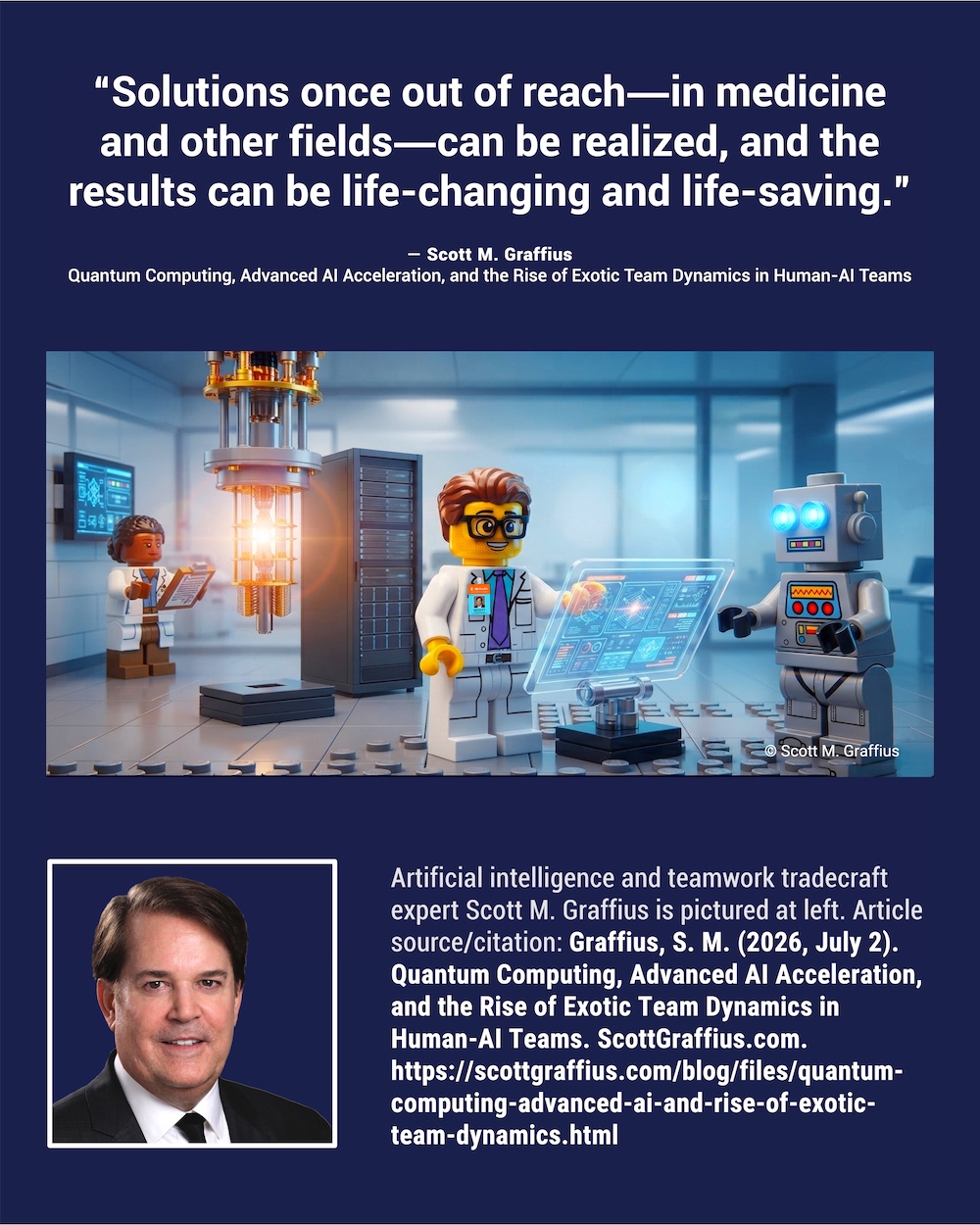
Imagine a young oncologist and an advanced AI teammate collaborating on a complex case involving a patient with aggressive, treatment-resistant cancer. Drawing on quantum-accelerated molecular simulations, the advanced AI proposes a counterintuitive therapeutic strategy that departs from established clinical protocols yet demonstrates exceptionally strong predicted efficacy and low toxicity. Within minutes, the human-AI team evaluates data that would have previously required months—or even years—of conventional modeling, laboratory experimentation, and clinical testing. The physician contributes clinical judgment, ethical oversight, and contextual interpretation; the AI contributes unprecedented analytical speed, pattern recognition, and probabilistic reasoning. This scenario exemplifies the convergence and future potential of quantum computing, advanced AI, and the "exotic team dynamics" that arise when humans and advanced AI systems collaborate. Solutions once out of reach—in medicine and other fields—can be realized, and the results can be life-changing and life-saving.

Quantum computing harnesses principles of quantum mechanics—such as superposition and entanglement—to perform calculations using qubits that can represent multiple states simultaneously, offering potential exponential advantages over classical bits for specific problems. It is being aggressively pursued by governments, national laboratories, big tech companies, and specialized startups. The shared bet is that certain intractable problems—molecular and materials simulation, large-scale optimization, cryptography, and other complex calculations—scale so poorly on classical computers that a new computational paradigm is essential. Hybrid quantum-classical systems are particularly promising: they leverage quantum processors for specific subtasks (e.g., optimization or simulation) while relying on classical hardware for the rest.
Research on quantum state distinguishability further underscores this trajectory. Researchers at the Massachusetts Institute of Technology have demonstrated new approaches for creating and identifying quantum states with higher reliability, addressing one of the central challenges in quantum measurement and readout fidelity. Improvements in state discrimination directly strengthen error correction protocols and enhance the practicality of hybrid quantum-classical architectures by reducing ambiguity in quantum outputs (MIT, 2026).
Early applications already show potential to reduce training time and energy consumption for machine learning models, especially in data-scarce or highly complex scenarios (Quandela, 2026).
The practical implications are becoming tangible. Quantum computing is transitioning from lab curiosity to strategic infrastructure. In April 2026, IBM and MIT launched a joint research lab focused on the convergence of AI and quantum computing, aiming to surpass classical limits (IBM, 2026). This momentum accelerated in June 2026 with executive orders aimed at advancing quantum innovation and securing the nation against advanced cryptographic threats, followed by a major announcement by the U.S. Department of Energy (DOE). On June 23, 2026, the DOE announced Quantum Genesis, a major initiative to deliver the world’s first fault-tolerant, scientifically relevant quantum computing capability by 2028. This includes a DOE Q Competition, a National Quantum Supercomputing User Facility (integrating quantum computing with high-performance computing, AI, and networking), and targeted R&D. The target domains—chemistry, materials science, plasma physics, and high-energy physics—directly support progress in AI (U.S. Department of Energy, 2026).

The Quantum Genesis project provides an example of how quantum infrastructure can accelerate AI. Hybrid quantum-classical architectures are already demonstrating faster AI training and reduced data requirements for certain models (Quandela, 2026).
The relationship between the two technologies is bidirectional and self-reinforcing: AI helps overcome quantum challenges in error correction, qubit control, and algorithm design (Time, 2026), while quantum systems promise breakthroughs in the very domains that fuel next-generation AI—materials for better chips, molecular simulations for drug discovery AI, and complex optimization for model efficiency. This feedback loop shortens R&D cycles.
Meaningful quantum advantages for general AI training likely require further advances in scale and error correction, with hybrid systems providing early wins in specialized tasks rather than replacing classical GPUs in the near term. The call to extend the frontier of problems solvable with quantum computing and advanced AI (Nature Machine Intelligence, 2023) remains as relevant today as when it was first issued.

As advanced AI proliferates—accelerated in part by quantum-enabled breakthroughs—"exotic team dynamics" become more common.
Coined and developed by Scott M. Graffius, "exotic team dynamics" describe the novel patterns that emerge when humans and advanced AI collaborate as teammates, rather than operating within a traditional user–tool relationship (Graffius, n.d.). It positions human–AI teaming as a frontier domain in which the integration of human judgment and AI-driven computation produces new and distinct rhythms of collaboration and decision-making.
Graffius introduced the term in an August 8, 2025, article (Graffius, 2025a) and has since expanded it through a sequence of presentations and publications. He presented it at a corporate leadership event in Las Vegas later that same month (Graffius, 2025b) and again at an event in Paris that November (Graffius, 2025c). In 2026, he incorporated "exotic team dynamics" into the updated version of his popular and highly-cited "Phases of Team Development" work, extending its applicability from human-only teams to both human-only and human-AI teams (Graffius, 2026a). In March 2026, a companion practitioner-oriented talk and article further positioned mastery of these dynamics as a leadership necessity (Graffius, 2026b).
"Exotic team dynamics" are delineated further through four physics-inspired analogies that characterize its novel patterns.
"Exotic team dynamics" serves as a diagnostic tool and a practical guide for designing and managing hybrid human-AI teams, where the AI is advanced. It is particularly relevant in research and development, crisis response, strategic planning, defense and national security, healthcare, financial services, and other domains with mission-critical operations (Graffius, 2026b). More broadly, the framework reflects a shift from treating AI as a tool to collaborating with it as a teammate. That transition signals a broader reconfiguration of organizational reality itself, where teamwork—including trust, decision-making, and other functions—is no longer solely a human construct but an emergent outcome of the interplay between people and machine intelligence (Graffius, n.d.).

Quantum Genesis is one of several catalysts driving advances in AI capabilities. Together with related initiatives, it is accelerating the shift from AI-as-tool to AI-as-teammate—precisely where "exotic team dynamics" emerge.
The future of work will be defined by people and advanced AI working as collaborators. Organizations that invest in understanding quantum-driven AI progress and mastering “exotic team dynamics” will gain decisive advantages in innovation and competitiveness.
Scott M. Graffius has generated over $2.51 billion in business value for Fortune 500 companies and other organizations around the world. Put that track record to work for you. For speaking engagements, use the request form; for other inquiries, email him.

Graffius, S. M. (n.d.). Exotic team dynamics. ScottGraffius.com. https://scottgraffius.com/exotic-team-dynamics.html
Graffius, S. M. (2025a, August 8). Exotic team dynamics: The new frontier of human–AI collaboration. ScottGraffius.com. https://doi.org/10.13140/RG.2.2.18048.49921
Graffius, S. M. (2025b, August 22). Scott M. Graffius premieres his new "Exotic Team Dynamics: Human-AI Collaboration" talk at corporate event in Las Vegas. ScottGraffius.com. https://doi.org/10.13140/RG.2.2.34380.07047
Graffius, S. M. (2025c, November 21). This is what happens when advanced AI joins your team [Presentation]. Corporate event, Paris, France.
Graffius, S. M. (2026a, January 3). Scott M. Graffius' phases of team development – Applied to human teams and human-AI teams: 2026 update. ScottGraffius.com. https://doi.org/10.13140/RG.2.2.18184.89601
Graffius, S. M. (2026b, March 23). Human-AI teamwork: Master the exotic team dynamics that emerge when collaborating with advanced AI — Or be outplayed. ScottGraffius.com. https://scottgraffius.com/blog/files/human-ai-teamwork-master-the-emergent-exotic-team-dynamics-or-be-outplayed.html
IBM. (2026, April 29). The MIT-IBM Computing Research Lab launches to shape the future of AI and quantum computing. IBM Newsroom. https://newsroom.ibm.com/2026-04-29-the-mit-ibm-computing-research-lab-launches-to-shape-the-future-of-ai-and-quantum-computing
MIT. (2026, June 15). How to create distinguishable states for quantum systems. MIT News. https://news.mit.edu/2026/how-to-create-distinguishable-states-for-quantum-systems-0615
Nature Machine Intelligence. (2023, August). Seeking a quantum advantage for machine learning. Nature Machine Intelligence, 5, 813. https://doi.org/10.1038/s42256-023-00710-9
Quandela. (2026, January 15). Quandela identifies four quantum computing trends for 2026. The Quantum Insider. https://thequantuminsider.com/2026/01/15/quandela-quantum-computing-trends-2026/
Time. (2026, April 7). AI helped spark a quantum breakthrough. The world "is not prepared." https://time.com/article/2026/04/07/ai-quantum-computing-advance/
U.S. Department of Energy. (2026, June 23). Energy Department announces initiative to create and deploy the world's first scientifically relevant, fault-tolerant quantum computers. https://www.energy.gov/science/articles/energy-department-announces-initiative-create-and-deploy-worlds-first

Advanced AI refers to emerging systems that surpass traditional tools or monolithic concepts, acting as genuine teammates in human-AI collaboration and creating exotic team dynamics, with a progression across agentic, autonomous, and autopoietic forms. Also see agentic AI, autonomous AI, and autopoietic AI.
Agentic AI is an advanced form of artificial intelligence capable of independently pursuing defined objectives through planning multi-step actions, coordinating processes, and adapting strategies to changing conditions, operating with high autonomy in execution but guided by external goals. It is commercially available and capable of planning multi-step actions, coordinating processes and tools while remaining semi-autonomous overall. Also see advanced AI.
AI. See advanced AI.
Artificial intelligence. See advanced AI.
Autonomous AI is an advanced form of artificial intelligence that operates and makes decisions independently without direct human intervention, featuring sustained self-regulation, the ability to set or adjust goals based on its environment, and action within defined or evolving parameters. It does not yet exist in commercial products. Also see advanced AI.
Autopoietic AI is an advanced, experimental, and hypothetical form of artificial intelligence characterized by self-generating, self-maintaining, and self-adaptive processes, where the system recursively regenerates its own structure, rules, and boundaries to sustain its identity in changing environments. No commercial systems currently exist. Also see advanced AI.
DOE Q Competition is a milestone-driven national competition established by the U.S. Department of Energy (DOE) as part of its Quantum Genesis initiative to accelerate the development of fault-tolerant quantum computing. It challenges participants to build quantum systems capable of performing scientifically meaningful computations, with an emphasis on reliable logical qubits rather than simply increasing physical qubit counts. The competition focuses on solving high-impact problems in areas such as chemistry, materials science, plasma physics, and high-energy physics. By fostering collaboration among industry, national laboratories, and academia, the DOE Q Competition aims to advance practical quantum computing for scientific discovery and national competitiveness.
Emergent protocols are new communication patterns, norms, and interaction protocols that evolve organically in human-AI teams without explicit programming or predefined rules. Also see exotic team dynamics.
Entangled decision-making occurs when human and AI inputs and decisions become deeply interconnected and interdependent, influencing each other to produce outcomes neither could achieve alone, potentially creating synergies or conflicts. Also see exotic team dynamics.
Exotic team dynamics (shown here without quotation marks) was coined and developed by Agile, AI, and teamwork tradecraft expert Scott M. Graffius. It refers to the novel, often counterintuitive, emerging collaboration patterns that occur when humans work alongside advanced artificial intelligences—specifically agentic, autonomous, or autopoietic AI—as teammates. Exotic team dynamics feature new rhythms of interaction, decision-making, and role-sharing that differ from traditional human-only teamwork while still relying on core principles such as trust, communication, and adaptability. Also see advanced AI, agentic AI, autonomous AI, autopoietic AI, emergent protocols, entangled decision-making, inverse decision logic, and superposition roles.
Future of work refers to the evolving nature of how work is structured, coordinated, and performed, as technologies, organizational models, and human–machine collaboration reshape roles, processes, and outcomes. It is a broad, cross-disciplinary concept that captures ongoing shifts in skills, workflows, governance, and team dynamics driven by advancements such as AI, automation, and emerging paradigms. As it relates to this article, the future of work is examined through the convergence of quantum computing, advanced AI, and exotic team dynamics, where humans and intelligent systems operate as integrated, adaptive teams, achieving capabilities that exceed what either humans or machines could accomplish independently.
GPU (graphics processing unit) refers to a specialized type of computer processor originally designed to accelerate graphics rendering, but now widely used in artificial intelligence due to its ability to perform large numbers of parallel calculations efficiently, making it well-suited for training and running deep learning models.
Human-AI teams are collaborative systems in which humans and advanced artificial intelligence—agentic, autonomous, or autopoietic AI—work as teammates. Also see advanced AI, agentic AI, autonomous AI, autopoietic AI, and exotic team dynamics.
Inverse decision logic is when AI challenges human assumptions by prioritizing counterintuitive yet optimal choices, causing decision-making to deviate from traditional logic and leading to unexpected and novel effects. Also see exotic team dynamics.
Phases of Team Development (shown here without quotation marks) is popular and highly-cited material on teamwork tradecraft developed by Scott M. Graffius. Informed by the research of Bruce W. Tuckman and Mary Ann C. Jensen, over 150 subsequent studies on teamwork, and Graffius' professional experience with and analysis of team leadership and high-performance teams, Graffius created his Phases of Team Development as a unique perspective and visual conveying the five phases of team development—Forming, Storming, Norming, Performing, and Adjourning. It includes a graph showing how performance varies by phase, as well as the characteristics and strategies for each phase. Leaders can apply these insights to advance the success of teams. Graffius initially developed his unique material in 2008, and he periodically updates it. The 2026 edition covers both human teams and human-AI teams, including the "exotic team dynamics" which emerge when collaborating with advanced AI. Businesses, professional associations, government agencies, universities, publications, media outlets, and others around the world have featured and used Graffius' Phases of Team Development.
Quantum bit. See qubit.
Quantum computing is a form of computation that uses principles of quantum mechanics to process information in ways fundamentally different from classical computing. Instead of classical bits that represent either 0 or 1, quantum computers use quantum bits (qubits), which can exist in superposition—meaning they can represent multiple states simultaneously. Qubits can also become entangled, allowing the state of one qubit to depend on another, even across distance, which enables highly correlated computations. These properties allow certain classes of problems—such as factoring large numbers, simulating quantum systems, and optimization tasks—to potentially be solved more efficiently than on classical computers. However, quantum systems are extremely sensitive to noise and decoherence, making practical, large-scale quantum computing an ongoing engineering and scientific challenge.
Quantum Genesis is a U.S. Department of Energy initiative to develop and deploy the world's first scientifically relevant, fault-tolerant quantum computing capability for research and development. As a component of the broader Genesis Mission, it integrates quantum computing with artificial intelligence, high-performance computing, and advanced scientific facilities to accelerate discovery across fields such as materials science, chemistry, physics, and energy. The initiative reflects a shift from viewing quantum computers as isolated research systems to treating them as part of a broader computational ecosystem designed to solve problems beyond the reach of classical computing alone.
Qubit (quantum bit) is the fundamental unit of information in quantum computing, analogous to the bit in classical computing. However, unlike a classical bit, which can exist only in a state of 0 or 1, a qubit can exist in a superposition of both states simultaneously, with probabilities associated with each outcome. Qubits can also become entangled with one another, meaning the state of one qubit can depend on the state of another, even when separated by distance. These properties enable quantum computers to process certain types of complex problems more efficiently than classical computers.
Superposition roles are about AI supporting or occupying multiple team roles and functions simultaneously in parallel, or dynamically shifting emphasis or sharing functions with humans based on contextual needs. Also see exotic team dynamics.


Scott M. Graffius is a strategic transformation leader who drives AI, Agile, and broader business and technology initiatives to deliver measurable value across projects, programs, portfolios, and PMOs. He is an expert in the teamwork tradecraft of both human and human-AI teams, including the “exotic team dynamics” that emerge. He is also an authority on the temporal patterns of social media, including the half-life of audience engagement.
He’s a practitioner, researcher, thought leader, award-winning author, and keynote speaker who’s taken the stage at 99 conferences and other events across 25 countries.
He’s delivered over $2.51 billion in value for Fortune 500 companies and other leaders in technology, entertainment, financial services, healthcare, and beyond.
Businesses, professional associations, government agencies, and universities use Graffius and feature his work. Examples include Adobe, Bayer, Boston University, Ford, Gartner, Harvard Medical School, IEEE, Johns Hopkins University, Microsoft, MSN, National Academy of Sciences, Oracle, Pinterest Inc., Project Management Institute, UC San Diego, Verizon, Yale University, and others.
The following sections provide additional information on his experience, contributions, and influence.
Experience
Graffius heads the professional services firm Exceptional PPM and PMO Solutions, along with its subsidiary Exceptional Agility. These consultancies offer strategic and tactical advisory, training, embedded expertise, and consulting services to the public, private, and government sectors. They help organizations enhance their capabilities and results in agile, project management, program management, portfolio management, and PMO leadership, supporting innovation and driving competitive advantage. The consultancies confidently back services with a Delighted Client Guarantee™.
Graffius is a former VP of project management with a publicly traded provider of diverse consumer products and services over the Internet. Before that, he ran and supervised the delivery of projects and programs in public and private organizations with businesses ranging from e-commerce to advanced technology products and services, retail, manufacturing, entertainment, and more.
He has experience with consumer, business, reseller, government, and international markets.
Award-Winning Author
Graffius has authored three books.
International Public Speaker
Organizations worldwide engage Graffius to present on tech (including AI), Agile, project management, program management, portfolio management, and PMO leadership. He crafts and delivers unique and compelling talks and workshops. Graffius has conducted 99 sessions across 25 countries. Select examples of events include Agile Trends Gov, BSides (Newcastle Upon Tyne), Conf42 Quantum Computing, DevDays Europe, DevOps Institute, DevOpsDays (Geneva), Frug’Agile, IEEE, Microsoft, Scottish Summit, Scrum Alliance RSG (Nepal), Techstars, and W Love Games International Video Game Development Conference (Helsinki), and more.
With an average rating of 4.81 (on a scale of 1-5), sessions are highly valued.
The speaker engagement request form is here.
Thought Leadership and Influence
Prominent businesses, professional associations, government agencies, and universities have showcased Graffius and his contributions—spanning his books, talks, workshops, and beyond. Select examples include:
Graffius has played a key role in the Project Management Institute (PMI) in developing professional standards. He was a member of multiple teams that authored, reviewed, and produced:
He was also a subject matter expert reviewer of content for the PMI’s Congress. Beyond the PMI, Graffius also served as a member of the review team for two of the Scrum Alliance’s Global Scrum Gatherings.
Acclaimed Authority on Teamwork Tradecraft
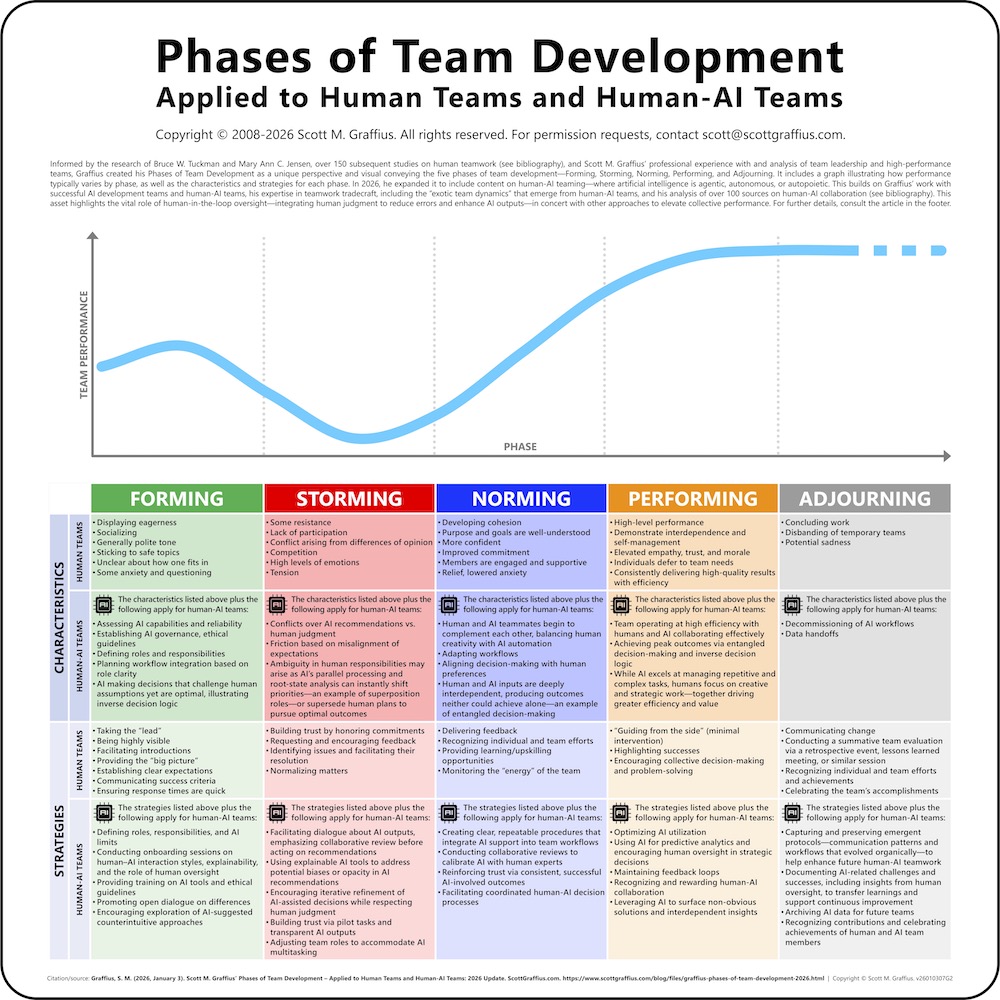
Graffius is a renowned authority on teamwork tradecraft. Informed by the research of Bruce W. Tuckman and Mary Ann C. Jensen, over 150 subsequent studies, and Graffius' first-hand professional experience with, and analysis of, team leadership and performance, Graffius created his "Phases of Team Development" intellectual property as a unique perspective and visual conveying the five phases of team development. First introduced in 2008 and periodically updated, his work provides a diagnostic and strategic guide for navigating team dynamics. It provides actionable insights for leaders across industries to develop high-performance teams. Its adoption by esteemed organizations such as Yale University, IEEE, Cisco, Microsoft, Ford, Oracle, Broadcom, the U.S. National Park Service, and the Journal of Neurosurgery, among others, highlights its utility and value, solidifying its status as an indispensable resource for elevating team performance and driving organizational excellence. In 2026, Graffius added human-AI teamwork—including the "exotic team dynamics" which emerge when advanced AI collaborates as a teammate—to his "Phases of Team Development."
The 2026 edition of Graffius' "Phases of Team Development" intellectual property is here.
Expert on Temporal Dynamics on Social Media Platforms
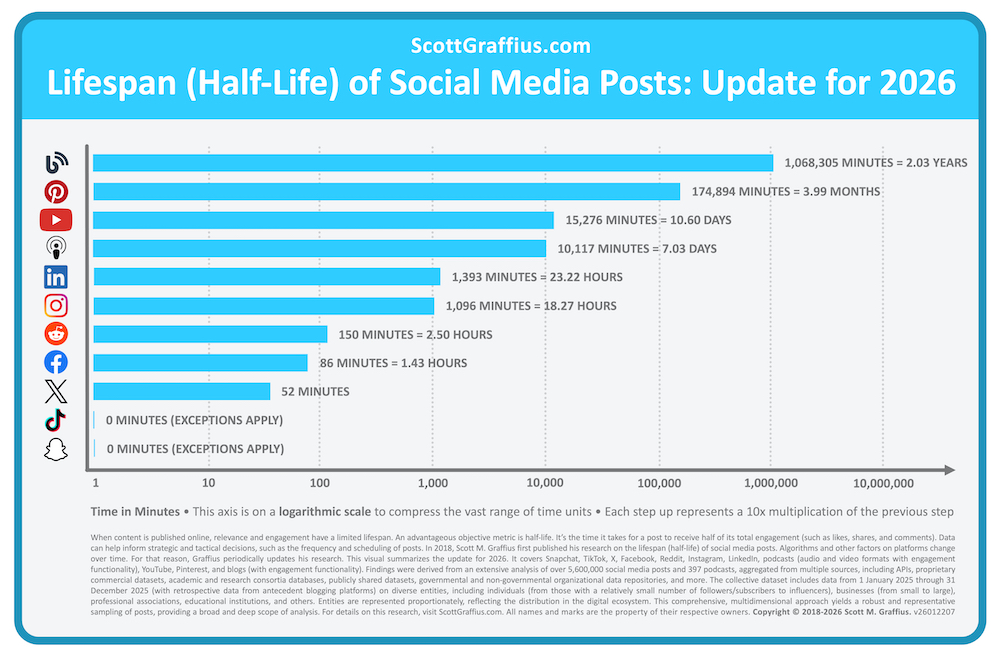
Graffius is also an authority on temporal dynamics on social media platforms. His "Lifespan (Half-Life) of Social Media Posts" research—first published in 2018 and updated annually—delivers a precise quantitative analysis of post longevity across digital platforms, utilizing advanced statistical techniques to determine mean half-life with precision. It establishes a solid empirical base, effectively highlighting the ephemeral nature of content within social media ecosystems. Referenced and applied by leading entities—such as Fast Company, GoDaddy, Journal of Hand Surgery (European Volume), Ministère de la Culture (French Ministry of Culture), Pinterest Inc., PNAS, and Telecommunications Policy, among others—his research exemplifies methodological rigor and sustained significance in the field of digital informatics.
The 2026 edition of Graffius "Lifespan (Half-Life) of Social Media Posts" research is here.
Education and Professional Certifications
Graffius has a bachelor’s degree in psychology with a focus in Human Factors. He holds eight professional certifications:
He is an active member of the Scrum Alliance, the Project Management Institute (PMI), and the Institute of Electrical and Electronics Engineers (IEEE).
Advancing AI, Agile, and Project/PMO Management
Scott M. Graffius continues to advance the fields of AI, Agile, and Project/PMO Management through his leadership, research, writing, and real-world impact. Businesses and other organizations leverage Graffius’ insights to drive their success.
Discover Scott’s Books
Connect with and follow Scott on LinkedIn, X, YouTube, Facebook, Threads, Bluesky, Mastodon, and ResearchGate.









You may be interested in these stories.
Government of Canada Features Research by Scott M. Graffius
"Strategic Business Research" Journal Cites Work of Scott M. Graffius
IEEE Access Publication Features Scott M. Graffius’ Research on the Half-Life of Social Media
The Agile Coach: 2026 Edition
Scott M. Graffius’ Work Cited in International Peer-Reviewed Journal on Digital Transformation
Phases of Team Development in Elite Sport
A Critical Analysis of COVID-19 Treatment Search Trends and Media Coverage Study Citing Scott M. Graffius' Work
Human-AI Teamwork: Master the Exotic Team Dynamics That Emerge When Collaborating with Advanced AI -- Or Be Outplayed
"Agile Scrum" by Scott M. Graffius Now Featured on Grokipedia
UNSW Aerospace Engineering Course Features Scott M. Graffius' "Phases of Team Development"
Thinkers360 Honors Scott M. Graffius as a 2026 Top Agile Thought Leader
Agile's Journey Through the Decades: Update for 2026
BMC Software Features Content from Scott M. Graffius' Book
Peer-Reviewed Journal Cited Work of Scott M. Graffius
University of Waterloo Features Graffius' "Phases of Team Development" in Course Materials
Perplexity Standalone Article on AI Hallucinations Cites Research by Scott M. Graffius
Handling the Saboteur Within: Lessons from a 3-Letter Agency on Spotting and Stopping Intentional and Unintentional Sabotage
A Deep Dive Into the Typical Engagement Pattern for Social Media Posts
Most Valuable IT Certifications: Update for 2026
"Marketing in the Metaverse" Spotlights Scott M. Graffius’ Research on the Half-Life of Social Media
University of Greenwich Features Graffius' Phases of Team Development
10 Essential Agile Books: Curated Recommendations for Agile Professionals
Lifespan (Half-Life) of Social Media Posts: Update for 2026
Scott M. Graffius' Research on the Half-Life of Social Media was Cited in a Peer-Reviewed Study Published in Telecommunications Policy, a Leading Academic Journal
Are AI Hallucinations Getting Better or Worse? We Analyzed the Data
Scott M. Graffius' Phases of Team Development - Applied to Human Teams and Human-AI Teams: 2026 Update
Lessons from Yesterday’s Tomorrowland
Scott M. Graffius’ Update to His "Phases of Team Development” Coming Early 2026
A Data-Driven Analysis of the Evolution of Project Management: Tasks, Trends, and AI
Actionable Insights. Global Impact. Scott M. Graffius.
Beep Beep! Why Wile E. Coyote Is the Patron Saint of AI Failure
Social Media Half-Life Research Cited in Prestigious Peer-Reviewed Medical Journal
Navigating the Spectrum of Advanced AI – Agentic, Autonomous, and Autopoietic
Lessons from Unhinged AI in Fiction: What Rogue AIs in Sci-Fi Storytelling, Films, and TV Shows Reveal About Us
Scott M. Graffius Contributed to and Reviewed the PMBOK Guide, 8th Edition — the Global Standard for Project Management
UK Sports Institute Features Teamwork and Leadership Work of Scott M. Graffius
Definitions of Advanced AIs: Agentic, Autonomous, and Autopoietic
HAN University of Applied Sciences Features the Work of Scott M. Graffius
Gifts That Inspire Joy
Evergreen Echoes: How Pinterest Inc. and Pinterest Japan Spotlighted Scott M. Graffius’ Research on the Half-Life of Social Media Content
Scott M. Graffius’ Team Development Work Lights Up the University of Tasmania’s Curriculum
Taiwan’s Leading Outlet for Technology and Innovation Spotlights Graffius’ Research on Social Media Temporal Dynamics
Scott M. Graffius’ Insights on AI, Agile, Gaming, XR, and Defense Transformation Cited by MSN in Their Coverage of Innovation and Leadership in the Sector
Top Predictions of 2024, Tested in 2025
Government of Finland Agency Features Graffius' Phases of Team Development IP
Scott M. Graffius Premieres His New "Exotic Team Dynamics: Human-AI Collaboration" Talk at Corporate Event in Las Vegas
Environmental Science Journal References Scott M. Graffius’ Project Management Work
AI Institute of Switzerland Features Scott M. Graffius’ Work on Algorithms
Exotic Team Dynamics: The New Frontier of Human–AI Collaboration
Scott M. Graffius’ Work Featured at ACM DIS ’25
Climbing the Ladder: The Head of Agile/PMO’s Organizational Proximity to the CEO is Closer Than Ever
Harness Sci-Fi and Speculative Design While Embracing Imperfection to Drive Innovation and Proactively Predict and Prepare for the Future
Scott M. Graffius’ “Agile Scrum” Book Featured in a Publication of the Associação Nacional de Educação Católica do Brasil (ANEC)
Setting Direction with OKRs and Tracking Progress with KPIs: A Guide for Agile, Project Management, and Tech Teams
AI Showcase Showdown: Ranking AI Accuracy on Project Management Basics
BookAuthority Features “Agile Scrum” by Scott M. Graffius in “10 Agile Software Development Books That Define the Field”
Exploring Team Dynamics, Adaptability, and Creative Problem-Solving Through Felix the Cat’s Metaphorical Toolkit
Mind Games and Master Plans: How PsyOps Exploit Psychological Phenomena
The “Pants-on-Fire Index for AI”
16 Causes of Technical Debt and How to Avoid It
PMI’s Infinity AI Gets the Basics of Team Development Alarmingly and Repeatedly Wrong
Agile for Unicorns: 7 Keys to Thrive; Scott M. Graffius’ Workshop
Scott M. Graffius’ “Agile Scrum: Your Quick Start Guide with Step-by-Step Instructions” Featured in Prestigious National Academies of Sciences Publication
Meta and Anduril’s EagleEye and the Future of XR: How Gaming, AI, and Agile Are Transforming Defense
"Agile Protocol" and the Power of Satire, Parody, and Humor
AI in Agile: Benefits, Risks, Outlook
Hostinger Highlights Scott M. Graffius’ “Agile Protocol” Book in Feature on Software Projects
French Ministry of Culture Links to Scott M. Graffius Research in Their Guide for Responsible Digital Communication
National Science Foundation’s LTER Network Features Scott M. Graffius’ Phases of Team Development IP
Waterfall vs. Agile: What’s Fixed, What’s Flexible, and Why It Matters
Scott M. Graffius Delivering $2.3 Billion in Value Through AI, Agile, and Project/PMO Leadership
The Problem with Heroes in Agile
The 3 Vital Rules of Science: What They Are and Why They Matter
“Agile Protocol: The Transformation Ultimatum” Lands on the Amazon Best Sellers List!
Scott M. Graffius Recognized as a Top Thought Leader in Digital Disruption by Thinkers360
“Agile Protocol: The Transformation Ultimatum” by Scott M. Graffius Crashes the Book Scene with Satirical Firepower
NCKU in Taiwan Integrates Graffius' 'Phases of Team Development' into Its Curriculum
The Art and Science of Aligning Initiatives with Strategic Objectives
RGPV University Adds Scott M. Graffius’ "Agile Scrum: Your Quick Start Guide with Step-by-Step Instructions" to Its Syllabus
Introducing ‘Engage or Fade: Decoding the Half-Life of Digital Resonance’ – A New Talk by Scott M. Graffius
Dropbox Company (Nira) Taps into Scott M. Graffius’ Expertise in Strategic Planning
Reporting Errors in a Publication: A Case Study on ‘Frontiers in Public Health’
NESEA Conference Session on Innovation Highlights Scott M. Graffius' 'Phases of Team Development'
U.S. Soccer Scores with Scott M. Graffius' Intellectual Property on Teamwork
U.S. Department of Commerce Partner (IEDC) Features Scott M. Graffius’ Intellectual Property
How Long Do Your Posts Live? AI Critiques Scott M. Graffius’ Research on the Half-Life of Social Media
Agile's Journey Through the Decades
Scott M. Graffius' Role in Advancing Project Management Institute (PMI) Standards Excellence
Most Valuable IT Certifications: Update for 2025
The PMI + Agile Alliance Merger: A Recipe for Success?
When Agile, AI, and Strategic Thinking Converge
Scott M. Graffius’ Phases of Team Development: 2025 Update
Lifespan (Half-Life) of Social Media Posts: Update for 2025
Verizon Features Scott M. Graffius
Do Not Read This Article! An Exploration of the Streisand Effect and Other Phenomena
Scott M. Graffius' 'Phases of Team Development' was Spotlighted in Journal of Neurosurgery
Pinterest Japan Uses Graffius’ Research on Temporal Dynamics on Social Media Platforms
Hochschule Coburg (Coburg University) Germany Uses Scott M. Graffius’ Phases of Team Development IP in Coursework on Agile Development
Wild World of Team Dynamics [Updated Two-Minute Video]
EU Europass Teacher Academy Features Scott M. Graffius’ ‘Phases of Team Development’ in Leadership Training
Side-by-Side Comparison of Retrospectives and Hot Washes
Constructor University 2024 Advanced Software Technology Handbook References Scott M. Graffius' Work on Team Dynamics
Strategies for Medical Team Success Featured Scott M. Graffius’ ‘Phases of Team Development’ Intellectual Property
SBG Neumark — Europe’s Largest Distribution Transformer Plant — Powers Up with Scott M. Graffius’ Intellectual Property
Scott M. Graffius’ Intellectual Property was Employed by the NHS — the Largest Single-Payer Healthcare System in Europe
Luxury Unwrapped: The Ultimate Holiday Gift Guide for Every Budget
Singapore Institute of Technology Features Work of Scott M. Graffius
Tufts University Features Scott M. Graffius 'Phases of Team Development' Intellectual Property
'Cat Herders': Retelling the Massive Success Story
Pennsylvania State Agency Used Scott M. Graffius' Intellectual Property
Copyright Infringement in a Book Published by AuthorHouse / Author Solutions / The Najafi Companies: Publisher Fails to Respond or Take Required Action
Pinterest Inc. References Scott M. Graffius’ Research
Bournemouth University Used Scott M. Graffius’ Intellectual Property
‘Comparative Methodological Guidelines: Handbook for Educators’ Violates Scott M. Graffius’ Copyright
Japan Backlog User Group Event Featured Scott M. Graffius’ ‘Phases of Team Development’
TurningWest's 'Trial'
Radio Silence from the American Association of Neurological Surgeons on Report of Blatant Plagiarism in Their ‘Journal of Neurosurgery’ Publication
Supplement to Graffius' 'Lifespan (Half-Life) of Social Media Posts' Research: Typical Engagement Distribution Pattern for Social Media Posts
How Algorithms Shape the User Experience on Social Media Platforms
Thinkers360 Named Scott M. Graffius a Top Thought Leader on Agile
More articles are listed here.

Graffius, S. M. (2026, July 2). Quantum Computing, Advanced AI Acceleration, and the Rise of Exotic Team Dynamics in Human-AI Teams. ScottGraffius.com. https://doi.org/10.13140/RG.2.2.14506.99525

DOI: 10.13140/RG.2.2.14506.99525

Names, marks, and content are the property of their respective owners.


If there are any supplements or updates to this article after the date of publication, they will appear here.

Copyright © Scott M. Graffius. All rights reserved.
Content on this site—including text, images, videos, and data—may not be used for training or input into any artificial intelligence, machine learning, or automatized learning systems, or published, broadcast, rewritten, or redistributed without the express written permission of Scott M. Graffius.

Graffius, S. M. (2026, July 2). Quantum Computing, Advanced AI Acceleration, and the Rise of Exotic Team Dynamics in Human-AI Teams. ScottGraffius.com. https://doi.org/10.13140/RG.2.2.14506.99525
About This Article
This article includes a references section (with links to sources) and a glossary.
Introduction
Imagine a young oncologist and an advanced AI teammate collaborating on a complex case involving a patient with aggressive, treatment-resistant cancer. Drawing on quantum-accelerated molecular simulations, the advanced AI proposes a counterintuitive therapeutic strategy that departs from established clinical protocols yet demonstrates exceptionally strong predicted efficacy and low toxicity. Within minutes, the human-AI team evaluates data that would have previously required months—or even years—of conventional modeling, laboratory experimentation, and clinical testing. The physician contributes clinical judgment, ethical oversight, and contextual interpretation; the AI contributes unprecedented analytical speed, pattern recognition, and probabilistic reasoning. This scenario exemplifies the convergence and future potential of quantum computing, advanced AI, and the "exotic team dynamics" that arise when humans and advanced AI systems collaborate. Solutions once out of reach—in medicine and other fields—can be realized, and the results can be life-changing and life-saving.
Quantum Computing
Quantum computing harnesses principles of quantum mechanics—such as superposition and entanglement—to perform calculations using qubits that can represent multiple states simultaneously, offering potential exponential advantages over classical bits for specific problems. It is being aggressively pursued by governments, national laboratories, big tech companies, and specialized startups. The shared bet is that certain intractable problems—molecular and materials simulation, large-scale optimization, cryptography, and other complex calculations—scale so poorly on classical computers that a new computational paradigm is essential. Hybrid quantum-classical systems are particularly promising: they leverage quantum processors for specific subtasks (e.g., optimization or simulation) while relying on classical hardware for the rest.
Research on quantum state distinguishability further underscores this trajectory. Researchers at the Massachusetts Institute of Technology have demonstrated new approaches for creating and identifying quantum states with higher reliability, addressing one of the central challenges in quantum measurement and readout fidelity. Improvements in state discrimination directly strengthen error correction protocols and enhance the practicality of hybrid quantum-classical architectures by reducing ambiguity in quantum outputs (MIT, 2026).
Early applications already show potential to reduce training time and energy consumption for machine learning models, especially in data-scarce or highly complex scenarios (Quandela, 2026).
The practical implications are becoming tangible. Quantum computing is transitioning from lab curiosity to strategic infrastructure. In April 2026, IBM and MIT launched a joint research lab focused on the convergence of AI and quantum computing, aiming to surpass classical limits (IBM, 2026). This momentum accelerated in June 2026 with executive orders aimed at advancing quantum innovation and securing the nation against advanced cryptographic threats, followed by a major announcement by the U.S. Department of Energy (DOE). On June 23, 2026, the DOE announced Quantum Genesis, a major initiative to deliver the world’s first fault-tolerant, scientifically relevant quantum computing capability by 2028. This includes a DOE Q Competition, a National Quantum Supercomputing User Facility (integrating quantum computing with high-performance computing, AI, and networking), and targeted R&D. The target domains—chemistry, materials science, plasma physics, and high-energy physics—directly support progress in AI (U.S. Department of Energy, 2026).
Advanced AI
The Quantum Genesis project provides an example of how quantum infrastructure can accelerate AI. Hybrid quantum-classical architectures are already demonstrating faster AI training and reduced data requirements for certain models (Quandela, 2026).
The relationship between the two technologies is bidirectional and self-reinforcing: AI helps overcome quantum challenges in error correction, qubit control, and algorithm design (Time, 2026), while quantum systems promise breakthroughs in the very domains that fuel next-generation AI—materials for better chips, molecular simulations for drug discovery AI, and complex optimization for model efficiency. This feedback loop shortens R&D cycles.
Meaningful quantum advantages for general AI training likely require further advances in scale and error correction, with hybrid systems providing early wins in specialized tasks rather than replacing classical GPUs in the near term. The call to extend the frontier of problems solvable with quantum computing and advanced AI (Nature Machine Intelligence, 2023) remains as relevant today as when it was first issued.
Exotic Team Dynamics
As advanced AI proliferates—accelerated in part by quantum-enabled breakthroughs—"exotic team dynamics" become more common.
Coined and developed by Scott M. Graffius, "exotic team dynamics" describe the novel patterns that emerge when humans and advanced AI collaborate as teammates, rather than operating within a traditional user–tool relationship (Graffius, n.d.). It positions human–AI teaming as a frontier domain in which the integration of human judgment and AI-driven computation produces new and distinct rhythms of collaboration and decision-making.
Graffius introduced the term in an August 8, 2025, article (Graffius, 2025a) and has since expanded it through a sequence of presentations and publications. He presented it at a corporate leadership event in Las Vegas later that same month (Graffius, 2025b) and again at an event in Paris that November (Graffius, 2025c). In 2026, he incorporated "exotic team dynamics" into the updated version of his popular and highly-cited "Phases of Team Development" work, extending its applicability from human-only teams to both human-only and human-AI teams (Graffius, 2026a). In March 2026, a companion practitioner-oriented talk and article further positioned mastery of these dynamics as a leadership necessity (Graffius, 2026b).
"Exotic team dynamics" are delineated further through four physics-inspired analogies that characterize its novel patterns.
- Inverse decision logic, analogous to negative mass in physics, occurs when an AI teammate generates recommendations that run counter to human intuition or established practice yet prove superior upon careful evaluation. Such situations are especially likely in complex, data-rich environments where human decision-making is influenced by cognitive biases such as confirmation bias, status quo bias, and availability heuristics. Rather than encouraging blind trust or automatic skepticism, effective organizations develop trust-calibration protocols that evaluate counterintuitive AI outputs on their merits, document the rationale behind key decisions, and refine confidence through accumulated evidence. These practices help teams capitalize on AI-driven innovation while maintaining sound governance and accountability.
- Superposition roles, inspired by quantum superposition, describe an advanced AI's ability to support multiple team functions simultaneously—for example, serving as analyst, strategist, researcher, risk assessor, and communications partner without the handoff friction or context-switching costs typical of human specialization. This capability can dramatically compress project timelines and improve organizational agility. At the same time, it introduces governance challenges because a single AI may contribute across multiple domains at once. Organizations therefore benefit from defining clear human ownership and accountability for AI-supported decisions, even when AI performs many functions in parallel.
- Entangled decision-making, inspired by quantum entanglement, refers to the deeply interdependent relationship between human judgment and AI reasoning. Human insights continuously reshape AI outputs, while AI-generated analyses refine human understanding, creating decisions that emerge from ongoing collaboration rather than a simple sequence of independent contributions. This interaction can produce superior outcomes in complex, high-stakes environments, but it also complicates questions of accountability and auditability. Maintaining structured records of significant human-AI interactions and decision pathways helps preserve transparency while supporting effective governance.
- Emergent protocols, analogous to emergent phenomena in complex systems, are the collaboration norms, workflows, communication patterns, and operating practices that develop organically through repeated interaction between humans and advanced AI. Over time, these evolving behaviors can become a significant source of organizational efficiency and competitive advantage by improving coordination and accelerating decision-making. However, they can also reinforce unintended biases or ineffective practices if left unexamined. Periodic reviews of human-AI collaboration patterns help organizations identify valuable innovations worth formalizing while correcting undesirable drift.
"Exotic team dynamics" serves as a diagnostic tool and a practical guide for designing and managing hybrid human-AI teams, where the AI is advanced. It is particularly relevant in research and development, crisis response, strategic planning, defense and national security, healthcare, financial services, and other domains with mission-critical operations (Graffius, 2026b). More broadly, the framework reflects a shift from treating AI as a tool to collaborating with it as a teammate. That transition signals a broader reconfiguration of organizational reality itself, where teamwork—including trust, decision-making, and other functions—is no longer solely a human construct but an emergent outcome of the interplay between people and machine intelligence (Graffius, n.d.).
Conclusion
Quantum Genesis is one of several catalysts driving advances in AI capabilities. Together with related initiatives, it is accelerating the shift from AI-as-tool to AI-as-teammate—precisely where "exotic team dynamics" emerge.
The future of work will be defined by people and advanced AI working as collaborators. Organizations that invest in understanding quantum-driven AI progress and mastering “exotic team dynamics” will gain decisive advantages in innovation and competitiveness.
Scott M. Graffius has generated over $2.51 billion in business value for Fortune 500 companies and other organizations around the world. Put that track record to work for you. For speaking engagements, use the request form; for other inquiries, email him.
References
Graffius, S. M. (n.d.). Exotic team dynamics. ScottGraffius.com. https://scottgraffius.com/exotic-team-dynamics.html
Graffius, S. M. (2025a, August 8). Exotic team dynamics: The new frontier of human–AI collaboration. ScottGraffius.com. https://doi.org/10.13140/RG.2.2.18048.49921
Graffius, S. M. (2025b, August 22). Scott M. Graffius premieres his new "Exotic Team Dynamics: Human-AI Collaboration" talk at corporate event in Las Vegas. ScottGraffius.com. https://doi.org/10.13140/RG.2.2.34380.07047
Graffius, S. M. (2025c, November 21). This is what happens when advanced AI joins your team [Presentation]. Corporate event, Paris, France.
Graffius, S. M. (2026a, January 3). Scott M. Graffius' phases of team development – Applied to human teams and human-AI teams: 2026 update. ScottGraffius.com. https://doi.org/10.13140/RG.2.2.18184.89601
Graffius, S. M. (2026b, March 23). Human-AI teamwork: Master the exotic team dynamics that emerge when collaborating with advanced AI — Or be outplayed. ScottGraffius.com. https://scottgraffius.com/blog/files/human-ai-teamwork-master-the-emergent-exotic-team-dynamics-or-be-outplayed.html
IBM. (2026, April 29). The MIT-IBM Computing Research Lab launches to shape the future of AI and quantum computing. IBM Newsroom. https://newsroom.ibm.com/2026-04-29-the-mit-ibm-computing-research-lab-launches-to-shape-the-future-of-ai-and-quantum-computing
MIT. (2026, June 15). How to create distinguishable states for quantum systems. MIT News. https://news.mit.edu/2026/how-to-create-distinguishable-states-for-quantum-systems-0615
Nature Machine Intelligence. (2023, August). Seeking a quantum advantage for machine learning. Nature Machine Intelligence, 5, 813. https://doi.org/10.1038/s42256-023-00710-9
Quandela. (2026, January 15). Quandela identifies four quantum computing trends for 2026. The Quantum Insider. https://thequantuminsider.com/2026/01/15/quandela-quantum-computing-trends-2026/
Time. (2026, April 7). AI helped spark a quantum breakthrough. The world "is not prepared." https://time.com/article/2026/04/07/ai-quantum-computing-advance/
U.S. Department of Energy. (2026, June 23). Energy Department announces initiative to create and deploy the world's first scientifically relevant, fault-tolerant quantum computers. https://www.energy.gov/science/articles/energy-department-announces-initiative-create-and-deploy-worlds-first
Glossary
Advanced AI refers to emerging systems that surpass traditional tools or monolithic concepts, acting as genuine teammates in human-AI collaboration and creating exotic team dynamics, with a progression across agentic, autonomous, and autopoietic forms. Also see agentic AI, autonomous AI, and autopoietic AI.
Agentic AI is an advanced form of artificial intelligence capable of independently pursuing defined objectives through planning multi-step actions, coordinating processes, and adapting strategies to changing conditions, operating with high autonomy in execution but guided by external goals. It is commercially available and capable of planning multi-step actions, coordinating processes and tools while remaining semi-autonomous overall. Also see advanced AI.
AI. See advanced AI.
Artificial intelligence. See advanced AI.
Autonomous AI is an advanced form of artificial intelligence that operates and makes decisions independently without direct human intervention, featuring sustained self-regulation, the ability to set or adjust goals based on its environment, and action within defined or evolving parameters. It does not yet exist in commercial products. Also see advanced AI.
Autopoietic AI is an advanced, experimental, and hypothetical form of artificial intelligence characterized by self-generating, self-maintaining, and self-adaptive processes, where the system recursively regenerates its own structure, rules, and boundaries to sustain its identity in changing environments. No commercial systems currently exist. Also see advanced AI.
DOE Q Competition is a milestone-driven national competition established by the U.S. Department of Energy (DOE) as part of its Quantum Genesis initiative to accelerate the development of fault-tolerant quantum computing. It challenges participants to build quantum systems capable of performing scientifically meaningful computations, with an emphasis on reliable logical qubits rather than simply increasing physical qubit counts. The competition focuses on solving high-impact problems in areas such as chemistry, materials science, plasma physics, and high-energy physics. By fostering collaboration among industry, national laboratories, and academia, the DOE Q Competition aims to advance practical quantum computing for scientific discovery and national competitiveness.
Emergent protocols are new communication patterns, norms, and interaction protocols that evolve organically in human-AI teams without explicit programming or predefined rules. Also see exotic team dynamics.
Entangled decision-making occurs when human and AI inputs and decisions become deeply interconnected and interdependent, influencing each other to produce outcomes neither could achieve alone, potentially creating synergies or conflicts. Also see exotic team dynamics.
Exotic team dynamics (shown here without quotation marks) was coined and developed by Agile, AI, and teamwork tradecraft expert Scott M. Graffius. It refers to the novel, often counterintuitive, emerging collaboration patterns that occur when humans work alongside advanced artificial intelligences—specifically agentic, autonomous, or autopoietic AI—as teammates. Exotic team dynamics feature new rhythms of interaction, decision-making, and role-sharing that differ from traditional human-only teamwork while still relying on core principles such as trust, communication, and adaptability. Also see advanced AI, agentic AI, autonomous AI, autopoietic AI, emergent protocols, entangled decision-making, inverse decision logic, and superposition roles.
Future of work refers to the evolving nature of how work is structured, coordinated, and performed, as technologies, organizational models, and human–machine collaboration reshape roles, processes, and outcomes. It is a broad, cross-disciplinary concept that captures ongoing shifts in skills, workflows, governance, and team dynamics driven by advancements such as AI, automation, and emerging paradigms. As it relates to this article, the future of work is examined through the convergence of quantum computing, advanced AI, and exotic team dynamics, where humans and intelligent systems operate as integrated, adaptive teams, achieving capabilities that exceed what either humans or machines could accomplish independently.
GPU (graphics processing unit) refers to a specialized type of computer processor originally designed to accelerate graphics rendering, but now widely used in artificial intelligence due to its ability to perform large numbers of parallel calculations efficiently, making it well-suited for training and running deep learning models.
Human-AI teams are collaborative systems in which humans and advanced artificial intelligence—agentic, autonomous, or autopoietic AI—work as teammates. Also see advanced AI, agentic AI, autonomous AI, autopoietic AI, and exotic team dynamics.
Inverse decision logic is when AI challenges human assumptions by prioritizing counterintuitive yet optimal choices, causing decision-making to deviate from traditional logic and leading to unexpected and novel effects. Also see exotic team dynamics.
Phases of Team Development (shown here without quotation marks) is popular and highly-cited material on teamwork tradecraft developed by Scott M. Graffius. Informed by the research of Bruce W. Tuckman and Mary Ann C. Jensen, over 150 subsequent studies on teamwork, and Graffius' professional experience with and analysis of team leadership and high-performance teams, Graffius created his Phases of Team Development as a unique perspective and visual conveying the five phases of team development—Forming, Storming, Norming, Performing, and Adjourning. It includes a graph showing how performance varies by phase, as well as the characteristics and strategies for each phase. Leaders can apply these insights to advance the success of teams. Graffius initially developed his unique material in 2008, and he periodically updates it. The 2026 edition covers both human teams and human-AI teams, including the "exotic team dynamics" which emerge when collaborating with advanced AI. Businesses, professional associations, government agencies, universities, publications, media outlets, and others around the world have featured and used Graffius' Phases of Team Development.
Quantum bit. See qubit.
Quantum computing is a form of computation that uses principles of quantum mechanics to process information in ways fundamentally different from classical computing. Instead of classical bits that represent either 0 or 1, quantum computers use quantum bits (qubits), which can exist in superposition—meaning they can represent multiple states simultaneously. Qubits can also become entangled, allowing the state of one qubit to depend on another, even across distance, which enables highly correlated computations. These properties allow certain classes of problems—such as factoring large numbers, simulating quantum systems, and optimization tasks—to potentially be solved more efficiently than on classical computers. However, quantum systems are extremely sensitive to noise and decoherence, making practical, large-scale quantum computing an ongoing engineering and scientific challenge.
Quantum Genesis is a U.S. Department of Energy initiative to develop and deploy the world's first scientifically relevant, fault-tolerant quantum computing capability for research and development. As a component of the broader Genesis Mission, it integrates quantum computing with artificial intelligence, high-performance computing, and advanced scientific facilities to accelerate discovery across fields such as materials science, chemistry, physics, and energy. The initiative reflects a shift from viewing quantum computers as isolated research systems to treating them as part of a broader computational ecosystem designed to solve problems beyond the reach of classical computing alone.
Qubit (quantum bit) is the fundamental unit of information in quantum computing, analogous to the bit in classical computing. However, unlike a classical bit, which can exist only in a state of 0 or 1, a qubit can exist in a superposition of both states simultaneously, with probabilities associated with each outcome. Qubits can also become entangled with one another, meaning the state of one qubit can depend on the state of another, even when separated by distance. These properties enable quantum computers to process certain types of complex problems more efficiently than classical computers.
Superposition roles are about AI supporting or occupying multiple team roles and functions simultaneously in parallel, or dynamically shifting emphasis or sharing functions with humans based on contextual needs. Also see exotic team dynamics.
About Scott M. Graffius
Scott M. Graffius is a strategic transformation leader who drives AI, Agile, and broader business and technology initiatives to deliver measurable value across projects, programs, portfolios, and PMOs. He is an expert in the teamwork tradecraft of both human and human-AI teams, including the “exotic team dynamics” that emerge. He is also an authority on the temporal patterns of social media, including the half-life of audience engagement.
He’s a practitioner, researcher, thought leader, award-winning author, and keynote speaker who’s taken the stage at 99 conferences and other events across 25 countries.
He’s delivered over $2.51 billion in value for Fortune 500 companies and other leaders in technology, entertainment, financial services, healthcare, and beyond.
Businesses, professional associations, government agencies, and universities use Graffius and feature his work. Examples include Adobe, Bayer, Boston University, Ford, Gartner, Harvard Medical School, IEEE, Johns Hopkins University, Microsoft, MSN, National Academy of Sciences, Oracle, Pinterest Inc., Project Management Institute, UC San Diego, Verizon, Yale University, and others.
The following sections provide additional information on his experience, contributions, and influence.
Experience
Graffius heads the professional services firm Exceptional PPM and PMO Solutions, along with its subsidiary Exceptional Agility. These consultancies offer strategic and tactical advisory, training, embedded expertise, and consulting services to the public, private, and government sectors. They help organizations enhance their capabilities and results in agile, project management, program management, portfolio management, and PMO leadership, supporting innovation and driving competitive advantage. The consultancies confidently back services with a Delighted Client Guarantee™.
Graffius is a former VP of project management with a publicly traded provider of diverse consumer products and services over the Internet. Before that, he ran and supervised the delivery of projects and programs in public and private organizations with businesses ranging from e-commerce to advanced technology products and services, retail, manufacturing, entertainment, and more.
He has experience with consumer, business, reseller, government, and international markets.
Award-Winning Author
Graffius has authored three books.
- Agile Scrum: Your Quick Start Guide with Step-by-Step Instructions, his first book, earned 17 awards.
- Agile Transformation: A Brief Story of How an Entertainment Company Developed New Capabilities and Unlocked Business Agility to Thrive in an Era of Rapid Change, his second book, was named one of the best Scrum books of all time by BookAuthority.
- Agile Protocol: The Transformation Ultimatum, his third book and his first work of fiction, was released in April 2025. The book trailer is on YouTube.
International Public Speaker
Organizations worldwide engage Graffius to present on tech (including AI), Agile, project management, program management, portfolio management, and PMO leadership. He crafts and delivers unique and compelling talks and workshops. Graffius has conducted 99 sessions across 25 countries. Select examples of events include Agile Trends Gov, BSides (Newcastle Upon Tyne), Conf42 Quantum Computing, DevDays Europe, DevOps Institute, DevOpsDays (Geneva), Frug’Agile, IEEE, Microsoft, Scottish Summit, Scrum Alliance RSG (Nepal), Techstars, and W Love Games International Video Game Development Conference (Helsinki), and more.
With an average rating of 4.81 (on a scale of 1-5), sessions are highly valued.
The speaker engagement request form is here.
Thought Leadership and Influence
Prominent businesses, professional associations, government agencies, and universities have showcased Graffius and his contributions—spanning his books, talks, workshops, and beyond. Select examples include:
- Adobe,
- American Management Association,
- Amsterdam Public Health Research Institute,
- Bayer,
- BMC Software,
- Boston University,
- Broadcom,
- Cisco,
- Coburg University of Applied Sciences and Arts - Germany,
- Computer Weekly,
- Constructor University - Germany,
- Data Governance Success,
- Deimos Aerospace,
- DevOps Institute,
- Dropbox,
- EU's European Commission,
- Ford Motor Company,
- Gartner,
- GoDaddy,
- Harvard Medical School,
- Hasso Plattner Institute - Germany,
- IEEE,
- Innovation Project Management,
- Johns Hopkins University,
- Journal of Neurosurgery,
- Lam Research (Semiconductors),
- Leadership Worthy,
- Life Sciences Trainers and Educators Network,
- London South Bank University,
- Microsoft,
- MSN,
- NASSCOM,
- National Academy of Sciences,
- New Zealand Government,
- Oracle,
- Pinterest Inc.,
- Project Management Institute,
- Mary Raum (Professor of National Security Affairs, United States Naval War College),
- SANS Institute,
- SBG Neumark - Germany,
- Singapore Institute of Technology,
- Torrens University - Australia,
- TBS Switzerland,
- Tufts University,
- UC San Diego,
- UK Sports Institute,
- University of Galway - Ireland,
- US Department of Energy,
- US National Park Service,
- US Soccer,
- US Tennis Association,
- Verizon,
- Wrike,
- Yale University,
- and many others.
Graffius has played a key role in the Project Management Institute (PMI) in developing professional standards. He was a member of multiple teams that authored, reviewed, and produced:
- The Standard for Artificial Intelligence in Portfolio, Program, and Project Management
- Agile Practice Guide – Second Edition
- A Guide to the Project Management Body of Knowledge (PMBOK Guide) – Eighth Edition
- A Guide to the Project Management Body of Knowledge (PMBOK Guide) – Sixth Edition
- The Standard for Program Management – Fourth Edition
- Practice Standard for Work Breakdown Structures – Second Edition
- The Practice Standard for Project Estimating – Second Edition
He was also a subject matter expert reviewer of content for the PMI’s Congress. Beyond the PMI, Graffius also served as a member of the review team for two of the Scrum Alliance’s Global Scrum Gatherings.
Acclaimed Authority on Teamwork Tradecraft
Graffius is a renowned authority on teamwork tradecraft. Informed by the research of Bruce W. Tuckman and Mary Ann C. Jensen, over 150 subsequent studies, and Graffius' first-hand professional experience with, and analysis of, team leadership and performance, Graffius created his "Phases of Team Development" intellectual property as a unique perspective and visual conveying the five phases of team development. First introduced in 2008 and periodically updated, his work provides a diagnostic and strategic guide for navigating team dynamics. It provides actionable insights for leaders across industries to develop high-performance teams. Its adoption by esteemed organizations such as Yale University, IEEE, Cisco, Microsoft, Ford, Oracle, Broadcom, the U.S. National Park Service, and the Journal of Neurosurgery, among others, highlights its utility and value, solidifying its status as an indispensable resource for elevating team performance and driving organizational excellence. In 2026, Graffius added human-AI teamwork—including the "exotic team dynamics" which emerge when advanced AI collaborates as a teammate—to his "Phases of Team Development."
The 2026 edition of Graffius' "Phases of Team Development" intellectual property is here.
Expert on Temporal Dynamics on Social Media Platforms
Graffius is also an authority on temporal dynamics on social media platforms. His "Lifespan (Half-Life) of Social Media Posts" research—first published in 2018 and updated annually—delivers a precise quantitative analysis of post longevity across digital platforms, utilizing advanced statistical techniques to determine mean half-life with precision. It establishes a solid empirical base, effectively highlighting the ephemeral nature of content within social media ecosystems. Referenced and applied by leading entities—such as Fast Company, GoDaddy, Journal of Hand Surgery (European Volume), Ministère de la Culture (French Ministry of Culture), Pinterest Inc., PNAS, and Telecommunications Policy, among others—his research exemplifies methodological rigor and sustained significance in the field of digital informatics.
The 2026 edition of Graffius "Lifespan (Half-Life) of Social Media Posts" research is here.
Education and Professional Certifications
Graffius has a bachelor’s degree in psychology with a focus in Human Factors. He holds eight professional certifications:
- Certified SAFe 6 Agilist (SA),
- Certified Scrum Professional - ScrumMaster (CSP-SM),
- Certified Scrum Professional - Product Owner (CSP-PO),
- Certified ScrumMaster (CSM),
- Certified Scrum Product Owner (CSPO),
- Project Management Professional (PMP),
- Lean Six Sigma Green Belt (LSSGB), and
- IT Service Management Foundation (ITIL).
He is an active member of the Scrum Alliance, the Project Management Institute (PMI), and the Institute of Electrical and Electronics Engineers (IEEE).
Advancing AI, Agile, and Project/PMO Management
Scott M. Graffius continues to advance the fields of AI, Agile, and Project/PMO Management through his leadership, research, writing, and real-world impact. Businesses and other organizations leverage Graffius’ insights to drive their success.
Discover Scott’s Books
- Agile Scrum: Your Quick Start Guide with Step-by-Step Instructions — Deliver Products in Short Cycles with Rapid Adaptation to Change, Fast Time-to-Market, and Continuous Improvement
- Agile Transformation: A Brief Story of How an Entertainment Company Developed New Capabilities and Unlocked Business Agility to Thrive in an Era of Rapid Change
- Agile Protocol: The Transformation Ultimatum
Connect with and follow Scott on LinkedIn, X, YouTube, Facebook, Threads, Bluesky, Mastodon, and ResearchGate.
Sign up for Miro—it's free!
(Want more features? You can always upgrade to a paid plan.)

List of Additional Articles
You may be interested in these stories.
Government of Canada Features Research by Scott M. Graffius
"Strategic Business Research" Journal Cites Work of Scott M. Graffius
IEEE Access Publication Features Scott M. Graffius’ Research on the Half-Life of Social Media
The Agile Coach: 2026 Edition
Scott M. Graffius’ Work Cited in International Peer-Reviewed Journal on Digital Transformation
Phases of Team Development in Elite Sport
A Critical Analysis of COVID-19 Treatment Search Trends and Media Coverage Study Citing Scott M. Graffius' Work
Human-AI Teamwork: Master the Exotic Team Dynamics That Emerge When Collaborating with Advanced AI -- Or Be Outplayed
"Agile Scrum" by Scott M. Graffius Now Featured on Grokipedia
UNSW Aerospace Engineering Course Features Scott M. Graffius' "Phases of Team Development"
Thinkers360 Honors Scott M. Graffius as a 2026 Top Agile Thought Leader
Agile's Journey Through the Decades: Update for 2026
BMC Software Features Content from Scott M. Graffius' Book
Peer-Reviewed Journal Cited Work of Scott M. Graffius
University of Waterloo Features Graffius' "Phases of Team Development" in Course Materials
Perplexity Standalone Article on AI Hallucinations Cites Research by Scott M. Graffius
Handling the Saboteur Within: Lessons from a 3-Letter Agency on Spotting and Stopping Intentional and Unintentional Sabotage
A Deep Dive Into the Typical Engagement Pattern for Social Media Posts
Most Valuable IT Certifications: Update for 2026
"Marketing in the Metaverse" Spotlights Scott M. Graffius’ Research on the Half-Life of Social Media
University of Greenwich Features Graffius' Phases of Team Development
10 Essential Agile Books: Curated Recommendations for Agile Professionals
Lifespan (Half-Life) of Social Media Posts: Update for 2026
Scott M. Graffius' Research on the Half-Life of Social Media was Cited in a Peer-Reviewed Study Published in Telecommunications Policy, a Leading Academic Journal
Are AI Hallucinations Getting Better or Worse? We Analyzed the Data
Scott M. Graffius' Phases of Team Development - Applied to Human Teams and Human-AI Teams: 2026 Update
Lessons from Yesterday’s Tomorrowland
Scott M. Graffius’ Update to His "Phases of Team Development” Coming Early 2026
A Data-Driven Analysis of the Evolution of Project Management: Tasks, Trends, and AI
Actionable Insights. Global Impact. Scott M. Graffius.
Beep Beep! Why Wile E. Coyote Is the Patron Saint of AI Failure
Social Media Half-Life Research Cited in Prestigious Peer-Reviewed Medical Journal
Navigating the Spectrum of Advanced AI – Agentic, Autonomous, and Autopoietic
Lessons from Unhinged AI in Fiction: What Rogue AIs in Sci-Fi Storytelling, Films, and TV Shows Reveal About Us
Scott M. Graffius Contributed to and Reviewed the PMBOK Guide, 8th Edition — the Global Standard for Project Management
UK Sports Institute Features Teamwork and Leadership Work of Scott M. Graffius
Definitions of Advanced AIs: Agentic, Autonomous, and Autopoietic
HAN University of Applied Sciences Features the Work of Scott M. Graffius
Gifts That Inspire Joy
Evergreen Echoes: How Pinterest Inc. and Pinterest Japan Spotlighted Scott M. Graffius’ Research on the Half-Life of Social Media Content
Scott M. Graffius’ Team Development Work Lights Up the University of Tasmania’s Curriculum
Taiwan’s Leading Outlet for Technology and Innovation Spotlights Graffius’ Research on Social Media Temporal Dynamics
Scott M. Graffius’ Insights on AI, Agile, Gaming, XR, and Defense Transformation Cited by MSN in Their Coverage of Innovation and Leadership in the Sector
Top Predictions of 2024, Tested in 2025
Government of Finland Agency Features Graffius' Phases of Team Development IP
Scott M. Graffius Premieres His New "Exotic Team Dynamics: Human-AI Collaboration" Talk at Corporate Event in Las Vegas
Environmental Science Journal References Scott M. Graffius’ Project Management Work
AI Institute of Switzerland Features Scott M. Graffius’ Work on Algorithms
Exotic Team Dynamics: The New Frontier of Human–AI Collaboration
Scott M. Graffius’ Work Featured at ACM DIS ’25
Climbing the Ladder: The Head of Agile/PMO’s Organizational Proximity to the CEO is Closer Than Ever
Harness Sci-Fi and Speculative Design While Embracing Imperfection to Drive Innovation and Proactively Predict and Prepare for the Future
Scott M. Graffius’ “Agile Scrum” Book Featured in a Publication of the Associação Nacional de Educação Católica do Brasil (ANEC)
Setting Direction with OKRs and Tracking Progress with KPIs: A Guide for Agile, Project Management, and Tech Teams
AI Showcase Showdown: Ranking AI Accuracy on Project Management Basics
BookAuthority Features “Agile Scrum” by Scott M. Graffius in “10 Agile Software Development Books That Define the Field”
Exploring Team Dynamics, Adaptability, and Creative Problem-Solving Through Felix the Cat’s Metaphorical Toolkit
Mind Games and Master Plans: How PsyOps Exploit Psychological Phenomena
The “Pants-on-Fire Index for AI”
16 Causes of Technical Debt and How to Avoid It
PMI’s Infinity AI Gets the Basics of Team Development Alarmingly and Repeatedly Wrong
Agile for Unicorns: 7 Keys to Thrive; Scott M. Graffius’ Workshop
Scott M. Graffius’ “Agile Scrum: Your Quick Start Guide with Step-by-Step Instructions” Featured in Prestigious National Academies of Sciences Publication
Meta and Anduril’s EagleEye and the Future of XR: How Gaming, AI, and Agile Are Transforming Defense
"Agile Protocol" and the Power of Satire, Parody, and Humor
AI in Agile: Benefits, Risks, Outlook
Hostinger Highlights Scott M. Graffius’ “Agile Protocol” Book in Feature on Software Projects
French Ministry of Culture Links to Scott M. Graffius Research in Their Guide for Responsible Digital Communication
National Science Foundation’s LTER Network Features Scott M. Graffius’ Phases of Team Development IP
Waterfall vs. Agile: What’s Fixed, What’s Flexible, and Why It Matters
Scott M. Graffius Delivering $2.3 Billion in Value Through AI, Agile, and Project/PMO Leadership
The Problem with Heroes in Agile
The 3 Vital Rules of Science: What They Are and Why They Matter
“Agile Protocol: The Transformation Ultimatum” Lands on the Amazon Best Sellers List!
Scott M. Graffius Recognized as a Top Thought Leader in Digital Disruption by Thinkers360
“Agile Protocol: The Transformation Ultimatum” by Scott M. Graffius Crashes the Book Scene with Satirical Firepower
NCKU in Taiwan Integrates Graffius' 'Phases of Team Development' into Its Curriculum
The Art and Science of Aligning Initiatives with Strategic Objectives
RGPV University Adds Scott M. Graffius’ "Agile Scrum: Your Quick Start Guide with Step-by-Step Instructions" to Its Syllabus
Introducing ‘Engage or Fade: Decoding the Half-Life of Digital Resonance’ – A New Talk by Scott M. Graffius
Dropbox Company (Nira) Taps into Scott M. Graffius’ Expertise in Strategic Planning
Reporting Errors in a Publication: A Case Study on ‘Frontiers in Public Health’
NESEA Conference Session on Innovation Highlights Scott M. Graffius' 'Phases of Team Development'
U.S. Soccer Scores with Scott M. Graffius' Intellectual Property on Teamwork
U.S. Department of Commerce Partner (IEDC) Features Scott M. Graffius’ Intellectual Property
How Long Do Your Posts Live? AI Critiques Scott M. Graffius’ Research on the Half-Life of Social Media
Agile's Journey Through the Decades
Scott M. Graffius' Role in Advancing Project Management Institute (PMI) Standards Excellence
Most Valuable IT Certifications: Update for 2025
The PMI + Agile Alliance Merger: A Recipe for Success?
When Agile, AI, and Strategic Thinking Converge
Scott M. Graffius’ Phases of Team Development: 2025 Update
Lifespan (Half-Life) of Social Media Posts: Update for 2025
Verizon Features Scott M. Graffius
Do Not Read This Article! An Exploration of the Streisand Effect and Other Phenomena
Scott M. Graffius' 'Phases of Team Development' was Spotlighted in Journal of Neurosurgery
Pinterest Japan Uses Graffius’ Research on Temporal Dynamics on Social Media Platforms
Hochschule Coburg (Coburg University) Germany Uses Scott M. Graffius’ Phases of Team Development IP in Coursework on Agile Development
Wild World of Team Dynamics [Updated Two-Minute Video]
EU Europass Teacher Academy Features Scott M. Graffius’ ‘Phases of Team Development’ in Leadership Training
Side-by-Side Comparison of Retrospectives and Hot Washes
Constructor University 2024 Advanced Software Technology Handbook References Scott M. Graffius' Work on Team Dynamics
Strategies for Medical Team Success Featured Scott M. Graffius’ ‘Phases of Team Development’ Intellectual Property
SBG Neumark — Europe’s Largest Distribution Transformer Plant — Powers Up with Scott M. Graffius’ Intellectual Property
Scott M. Graffius’ Intellectual Property was Employed by the NHS — the Largest Single-Payer Healthcare System in Europe
Luxury Unwrapped: The Ultimate Holiday Gift Guide for Every Budget
Singapore Institute of Technology Features Work of Scott M. Graffius
Tufts University Features Scott M. Graffius 'Phases of Team Development' Intellectual Property
'Cat Herders': Retelling the Massive Success Story
Pennsylvania State Agency Used Scott M. Graffius' Intellectual Property
Copyright Infringement in a Book Published by AuthorHouse / Author Solutions / The Najafi Companies: Publisher Fails to Respond or Take Required Action
Pinterest Inc. References Scott M. Graffius’ Research
Bournemouth University Used Scott M. Graffius’ Intellectual Property
‘Comparative Methodological Guidelines: Handbook for Educators’ Violates Scott M. Graffius’ Copyright
Japan Backlog User Group Event Featured Scott M. Graffius’ ‘Phases of Team Development’
TurningWest's 'Trial'
Radio Silence from the American Association of Neurological Surgeons on Report of Blatant Plagiarism in Their ‘Journal of Neurosurgery’ Publication
Supplement to Graffius' 'Lifespan (Half-Life) of Social Media Posts' Research: Typical Engagement Distribution Pattern for Social Media Posts
How Algorithms Shape the User Experience on Social Media Platforms
Thinkers360 Named Scott M. Graffius a Top Thought Leader on Agile
More articles are listed here.
How to Cite This Article
Graffius, S. M. (2026, July 2). Quantum Computing, Advanced AI Acceleration, and the Rise of Exotic Team Dynamics in Human-AI Teams. ScottGraffius.com. https://doi.org/10.13140/RG.2.2.14506.99525
Digital Object Identifier (DOI)
DOI: 10.13140/RG.2.2.14506.99525
Content Acknowledgements
Names, marks, and content are the property of their respective owners.
Tags and Hashtags
- Advanced AI Acceleration
- Advanced Technology
- AI Research
- Artificial intelligence
- Autonomous AI
- Autopoietic AI
- DOE Q Competition
- Emergent protocols
- Entangled decision-making
- Exotic team dynamics
- Future of Technology
- Future of work
- GPU
- Human-AI teams
- Inverse decision logic
- Quantum Computing
- Quantum Genesis
- Qubit
- Research and Development
- Rise of Exotic Team Dynamics in Human-AI Teams
- Superposition roles
- Technology
- #AdvancedAI
- #AdvancedTechnology
- #AIResearch
- #ArtificialIntelligence
- #AutonomousAI
- #AutopoieticAI
- #EmergentProtocols
- #EntangledDecisionMaking
- #ExoticTeamDynamics
- #FutureOfTechnology
- #FutureOfWork
- #GPU
- #HumanAITeams
- #InverseDecisionLogic
- #QuantumComputing
- #QuantumGenesis
- #Qubit
- #ResearchAndDevelopment
- #SuperpositionRoles
- #Technology
Post-Publication Notes
If there are any supplements or updates to this article after the date of publication, they will appear here.
Copyright
Copyright © Scott M. Graffius. All rights reserved.
Content on this site—including text, images, videos, and data—may not be used for training or input into any artificial intelligence, machine learning, or automatized learning systems, or published, broadcast, rewritten, or redistributed without the express written permission of Scott M. Graffius.