
Future of Work
A Data-Driven Analysis of the Evolution of Project Management: Tasks, Trends, and AI
09 December 2025
BY SCOTT M. GRAFFIUS | ScottGraffius.com
Recommended Citation
Graffius, S. M. (2025, December 9). A Data-Driven Analysis of the Evolution of Project Management: Tasks, Trends, and AI. ScottGraffius.com. https://doi.org/10.13140/RG.2.2.25079.28328
About This Article
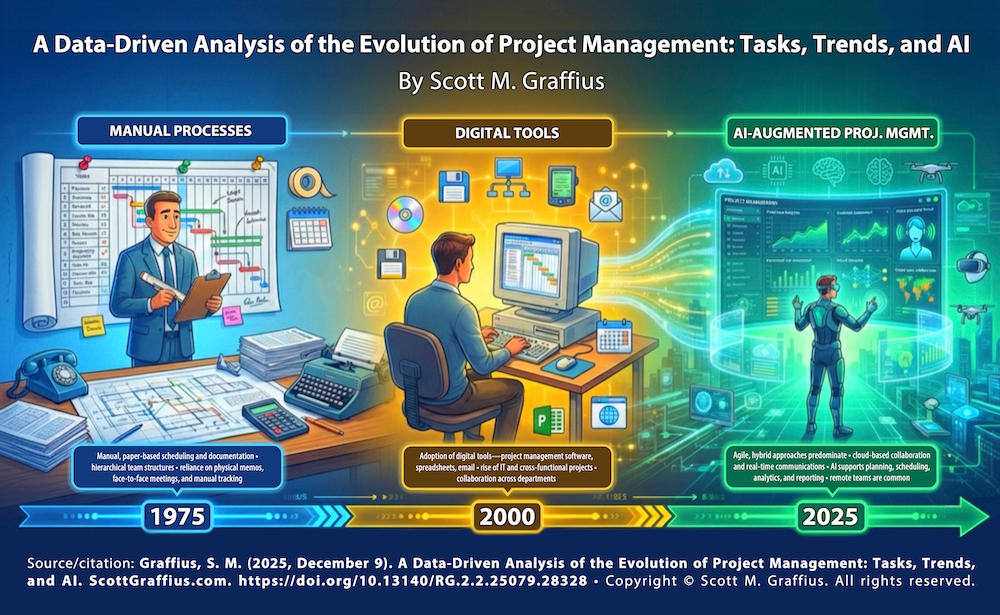
A high resolution version of the above image is here.
Abstract: The field of project management has dramatically changed over the past 50 years, shifting from largely manual administrative work to AI-assisted strategic leadership. This article formulates a task-level, data-driven analysis of project management duties in 1975, 2000, and 2025—showing trends, AI potential, and the changing human + AI partnership that’s the future of the profession.
Project management has changed significantly over the last 50 years. The paper-based, manual methods of the 70s have been replaced by AI-assisted processes in the 21st century, and the profession has been adapting continuously to the changes in technology, methodology, and organizational demands.
As AI becomes increasingly capable, will project managers themselves become obsolete, or will the role simply transform into a higher-order, strategic function?
This article first studies the duties of project managers in 1975, 2000, and 2025, respectively, then examines the extent to which those duties can be done by AI, and finally, draws the implications for project management jobs and career paths.
This article delivers a granular task-level scrutiny where each task is regarded as either fully AI-automated, partially augmentable (human/AI), or entirely human. The central purpose of the study is to uncover the changing human-machine interaction in project management and to provide a solid ground for future predictions rather than mere speculation.
The correspondence of tasks to different periods helps to establish a longitudinal comparison, thus getting insight into how project management work has changed over time.
The analysis uses literature review data and expert-guided AI potential classifications. It is informed by 101 sources, which are cited in the bibliography section of this article.
2.1 Task Selection
2.2 AI Potential Classification
For each task, the suitability for automation or augmentation by AI was determined, resulting in the following three categories.
Decisions factored data from the sources noted in the article's bibliography, practical knowledge of project management responsibilities, the current capabilities of AI (e.g., in scheduling, data processing, analytics), and expert assessments on human-AI collaboration.
If a classification was unclear, a conservative label was used (e.g., “Human/AI” instead of “AI” when human control was implied).
2.3 Limitations
1975 Era Characteristics
Table 1: Project Management Responsibilities in 1975 (Shown as a Bulleted List)
Task Number, Responsibility
In 1975, project managers were primarily task executors and coordinators, managing administrative, planning, and compliance work through manual processes.
2000 Era Characteristics
Table 2: Project Management Responsibilities in 2000 (Shown as a Bulleted List)
Task Number, Responsibility
By 2000, project management work became more data-driven, collaborative, and structured, leveraging software tools and standardized processes—yet human judgment remained essential.
2025 Era Characteristics
Table 3: Project Management Responsibilities in 2025 (Shown as a Bulleted List)
Task Number, Responsibility
In 2025, project managers have evolved into strategic leaders, facilitators, and value drivers, leveraging AI and modern methodologies while focusing on human-centric and business-outcome work.
Table 4: Evolution of Project Management Responsibilities
The trend shows a steady transformation: administrative burdens diminish, while strategic, human-centric tasks rise in importance.
Not all project management tasks are equally suited for automation. Based on the analysis:
Table 5: Annotated Project Management Responsibilities with AI Potential (All 60 Tasks)
Here's the distribution of the 60 tasks (all eras combined).
Here's the data by era.
Here are the ranges for the eras in aggregate: 75-90% (83% average) of the tasks were Human or Human/AI, and 10-25% (17% average) were AI.
In short, AI handles analytics, scheduling, and reporting; humans focus on leadership, strategy, stakeholder relationships, and value delivery.
The human element remains essential in project management. Leadership, ethics, interpersonal dynamics, and strategic thinking are profoundly difficult—if not impossible—to fully automate.
AI serves as a powerful tool rather than a replacement. By taking over routine and repetitive tasks, it frees project managers to focus on higher-order responsibilities that demand and benefit from human judgment and insight.
The evolution of the profession has been gradual yet enduring. Over the past five decades, project management has progressed from manual processes to digital systems and now to AI-augmented work, but the core share of human-centered responsibilities has remained substantial.
Ultimately, resilience and adaptability determine success. Project managers and organizations that embrace change, invest in reskilling, and integrate AI as a collaborative partner will thrive, while those who cling to outdated approaches risk falling behind.
Actionable Insights
AI doesn’t replace project managers—it reshapes what it means to be one. Success now depends on a combination of strategic oversight, human judgment, leadership, ethical governance, and AI literacy. Routine work is automated, so human contribution is elevated to guiding decisions, managing people, and ensuring outcomes align with organizational objectives.
Here’s a comprehensive summary of general guidance for project managers in an AI-augmented world, along with the reasoning behind each suggestion:
1. Embrace AI as a tool, not a replacement
2. Develop soft skills
3. Focus on governance and ethical oversight
4. Strengthen decision-making and judgment
5. Advance AI literacy and technical awareness
6. Reimagine project roles and workflows
7. Practice continuous learning and adaptation
Project management has experienced a major change in its structure and working methods during the last five decades. In 1975, project managers were mostly performing basic procedural tasks, keeping everything in their heads or on paper, using manual methods. By 2000, work relied on digital tools. In 2025, project managers are empowered by AI and are more focused on strategic leadership, enterprise agility, and value delivery.
Key Takeaways:
To learn more about human-AI collaboration, including the "exotic team dynamics" that emerge when advanced AI joins teams, see this article.
This is an extensive, though not exhaustive, bibliography. It is informed, in part, by the author’s expertise in project management and technology including Agile, enterprise agility, and AI.
Auth, G., Johnk, J., & Wiecha, D. A. (2021). A Conceptual Framework for Applying Artificial Intelligence in Project Management. Proceedings of the 2021 IEEE 23rd Conference on Business Informatics (CBI 2021) – Main Papers, 1, 161–170. https://doi.org/10.1109/CBI52164.2021.00026
Berlin School of Business and Innovation. (2022, September 22). How Do Technical Abilities Combined with Leadership Skills Fuel Career Growth? https://www.berlinsbi.com/blog/career-advice/how-do-technical-abilities-combined-with-leadership-skills-fuel-career-growth
Berretta, S.; Tausch, A.; Ontrup, G.; Gilles, B.; Peifer, C.; Kluge, A. (2023, September). Defining Human-AI Teaming the Human-Centered Way: A Scoping Review and Network Analysis. Frontiers in Artificial Intelligence, 6, 1250725. DOI:10.3389/frai.2023.1250725
Bevilacqua, S., Masárová, J., & Perotti, F. A. (2025). Enhancing Top Managers’ Leadership with Artificial Intelligence: Insights from a Systematic Literature Review. Review of Managerial Science, 19, 2899–2935. https://doi.org/10.1007/s11846-025-00836-7
Bostrom, N. (2016). Superintelligence: Paths, Dangers, Strategies. Oxford, England, United Kingdom: Oxford University Press.
Brief, A. P. & Weiss, H. M. (2022, February). Organizational Behavior: Affect in the Workplace. Annual Review of Psychology, 53(1), 279-307.
Brynjolfsson, E., & McAfee, A. (2014). The Second Machine Age: Work, Progress, and Prosperity in a Time of Brilliant Technologies. W. W. Norton & Company.
Caltech. (n.d.). Can We Trust Artificial Intelligence? Caltech Science Exchange. https://scienceexchange.caltech.edu/topics/artificial-intelligence-research/trustworthy-ai
CFO South Africa. (2021, August 19). Agile Leadership Unlocked [Video]. YouTube. https://www.youtube.com/watch?v=FJZiitw5tHo&t=359s
Constructor University. (2024). Master of Science in Advanced Software Technology. https://constructor.university/sites/default/files/2024-09/AST_MSc_Handbook__2024.pdf
Dahlbäck, N., Jönsson, A., & Ahrenberg, L. (1993, December). Wizard of Oz Studies—Why and How. Knowledge-Based Systems, 6(4), 258-266. https://doi.org/10.1016/0950-7051(93)90017-N
Davenport, T. H., & Ronanki, R. (2018). Artificial Intelligence for the Real World. Harvard Business Review, 96(1), 108–116. https://hbr.org/2018/01/artificial-intelligence-for-the-real-world
Defense Advanced Research Projects Agency (DARPA). (2023, February 23). Episode 65: A Sprint to Tomorrow, Powered by Teamwork [Podcast]. https://www.darpa.mil/news-events/2023-02-23a
Defense Advanced Research Projects Agency (DARPA). (2024, September 27). Teaching AI What It Should and Shouldn't Do. https://www.darpa.mil/news/2024/teaching-ai
Dolev, N., & Itzkovich, Y. (2020). In the AI Era, Soft Skills are the New Hard Skills. In: Artificial Intelligence and Its Impact on Business, pp. 55-77. Charlotte, North Carolina, United States: Information Age Publishing.
Duignan, J. (2025, June 17). Beyond Disruption: Embedding AI in Project Management to Drive Enterprise Transformation. PwC. https://www.pwc.com/us/en/services/consulting/managed-services/library/ai-in-project-management.html
Eastwood, B. (2025, February 3). When Humans and AI Work Best Together — and When Each is Better Alone. MIT Sloan Management Review. https://mitsloan.mit.edu/ideas-made-to-matter/when-humans-and-ai-work-best-together-and-when-each-better-alone
Forbes. (2018, April 23). How to Fast-Track Any Team to Success. Forbes. New York, New York, United States: Forbes.
Foy, K. (2021, October 4). Artificial Intelligence is Smart, But Does It Play Well With Others? Massachusetts Institute of Technology. https://news.mit.edu/2021/does-artificial-intelligence-play-well-others-1004
Franco, C., & Landini, F. (2022). Organizational Drivers of Innovation: The Role of Workforce Agility. Research Policy, 51(2), 104423. https://doi.org/10.1016/j.respol.2021.104423
Gartner, Inc. (2019, March 20). Gartner Says 80 Percent of Today’s Project Management Tasks will be Eliminated by 2030 as Artificial Intelligence Takes Over [Press release]. https://www.gartner.com/en/newsroom/press-releases/2019-03-20-gartner-says-80-percent-of-today-s-project-management
Georganta, E., & Ulfert, A. S. (2024, September). Would You Trust an AI Team Member? Team Trust in Human–AI Teams. Journal of Occupational and Organizational Psychology, 97(3), 1212-1241. https://doi.org/10.1111/joop.12504
Gershenson, C. (2025, September 4). Complexity, Artificial Life, and Artificial Intelligence. Artificial Life, 31(3), 289-303. https://doi.org/10.1162/artl_a_00462
Gorman, A. (2023, April 27). How to Strengthen Your Soft Skills for AI and the Future of Work. Fast Company. https://www.fastcompany.com/90887540/how-to-strengthen-your-soft-skills-for-ai-and-the-future-of-work
Graffius, S. M. (2016, January 21). 2014 NSDM Publication on Leadership by National Security Affairs Professor Mary Raum Featured the 2008 Edition of Scott M. Graffius' Work on Team Development. https://scottgraffius.com/blog/files/nsdm-leadership.html
Graffius, S. M. (2016). Agile Scrum: Your Quick Start Guide with Step-by-Step Instructions. North Charleston, South Carolina, United States: CreateSpace.
Graffius, S. M. (2016). Thinking Strategically and Acting Tactically. Los Angeles, California, United States: Exceptional PPM and PMO Solutions.
Graffius, S. M. (2018, October 18). Agile Scrum Helps Innovators, Disruptors, and Entrepreneurs Develop and Deliver Products at Astounding Speed Which Drives Competitive Advantage [Presentation]. Talk delivered at Techstars Startup Week Conference. https://dx.doi.org/10.13140/RG.2.2.25009.12647
Graffius, S. M. (2019). Agile Transformation: A Brief Story of How an Entertainment Company Developed New Capabilities and Unlocked Business Agility to Thrive in an Era of Rapid Change. Scotts Valley, California, United States: CreateSpace.
Graffius, S. M. (2021). Phases of Team Development. Los Angeles, California, United States: Scott M. Graffius. https://dx.doi.org/10.13140/RG.2.2.22040.42246
Graffius, S. M. (2021, May 13). But First, the Team! [Presentation]. Lecture delivered at DevOps Pro Europe 2021 Conference; based and simulcast live from Vilnius, Lithuania. https://dx.doi.org/10.13140/RG.2.2.30524.36481
Graffius, S. M. (2021, October 5). Navigate the Phases of Team Development with Speed and Agility for Happier and More Productive Teams [Presentation]. Talk delivered at the Institute of Electrical and Electronics Engineers IEEE Day 2021 Conference. https://dx.doi.org/10.13140/RG.2.2.20055.19365
Graffius, S. M. (2022, February 4). Team Development Tradecraft: A Source of Competitive Advantage [Workshop]. Session at private event in Adelaide, Australia. https://dx.doi.org/10.13140/RG.2.2.14092.80002
Graffius, S. M. (2023, April 26). The Science of High-Performance Teams [Presentation]. Talk delivered at the DevOps Institute's SKILup Day 2023 Conference. https://dx.doi.org/10.13140/RG.2.2.15888.28169
Graffius, S. M. (2023, May 1). AI is a Team Sport: A Confluence of Diverse Technical and Soft Skills are Crucial for Success. https://scottgraffius.com/blog/files/successful-ai-teams.html https://dx.doi.org/10.13140/RG.2.2.20321.79200
Graffius, S.t M. (2023, May 1). Fueling the Development of Innovative and Life-Changing AI Solutions [Presentation]. Talk delivered to an audience of Technology professionals at a private event in Mountain View, California, United States. https://dx.doi.org/10.13140/RG.2.2.27956.73601
Graffius, S. M. (2023, June 29). What Successful AI Teams Have in Common [Presentation]. Talk delivered at Conf42 Quantum Computing 2023 Conference. https://dx.doi.org/10.13140/RG.2.2.29382.45120
Graffius, S. M. (2023, July 15). Successful Video Game Development Teams Leverage an Extensive Range of Hard Skills and Soft Skills. https://scottgraffius.com/blog/files/gamedev.html https://dx.doi.org/10.13140/RG.2.2.31205.17124
Graffius, S. M. (2023, October 9). Top 5 Roles on AI Teams. https://scottgraffius.com/blog/files/ai-team-roles.html https://dx.doi.org/10.13140/RG.2.2.34857.57449
Graffius, S. M. (2023, October 13). The Science of High-Performance Game Development Teams [Presentation]. Talk delivered at the W Love Games International Video Game Development Conference 2023 - Helsinki, Finland. https://dx.doi.org/10.13140/RG.2.2.28602.16326
Graffius, S. M. (2024, May 3). Leverage Agile and AI to Innovate at the Speed of Light. Talk at private event in Dubai, UAE. https://dx.doi.org/10.13140/RG.2.2.30790.48960
Graffius, S. M. (2024, May 21). What Successful AI Development Teams Have in Common. Talk at DevDays Europe 2024 Conference. https://dx.doi.org/10.13140/RG.2.2.24313.07529
Graffius, S. M. (2024, November 18). Side-by-Side Comparison of Retrospectives and Hot Washes. https://scottgraffius.com/blog/files/retrospectives-and-hot-washes.html
Graffius, S. M. (2025). Agile Protocol: The Transformation Ultimatum. Seattle, Washington, United States: Amazon Digital Services.
Graffius, S. M. (2025, January 7). Scott M. Graffius' Phases of Team Development: 2025 Update. https://scottgraffius.com/blog/files/phases-of-team-development-update-for-2025.html https://dx.doi.org/10.13140/RG.2.2.33705.30564
Graffius, S. M. (2025, January 24). When Agile, AI, and Strategic Thinking Converge. https://scottgraffius.com/blog/files/when-agile-ai-and-strategic-thinking-converge.html
Graffius, S. M. (2025, February 21). Agile's Journey Through the Decades. https://scottgraffius.com/blog/files/agile's-journey-through-the-decades.html
Graffius, S. M. (2025, July 18). Harness Sci-Fi and Speculative Design While Embracing Imperfection to Drive Innovation and Proactively Predict and Prepare for the Future. https://scottgraffius.com/blog/files/harness-scifi-and-speculative-design-while-embracing-imperfection-to-drive-innovation-and-proactively-predict-and-prepare-for-the-future.html
Graffius, S. M. (2025, July 31). Climbing the Ladder: The Head of Agile/PMO’s Organizational Proximity to the CEO is Closer Than Ever. https://scottgraffius.com/blog/files/climbing-the-ladder-the-head-of-agile-pmos-organizational-proximity-to-the-ceo-is-closer-than-ever.html
Graffius, S. M. (2025, August 7). Method and System for Facilitating Hybrid Human-Artificial Intelligence Teams via a Protocolized Mediation Layer for Bi-Directional Translation, Interpretation, and Optimization of Natural Language, Paralinguistic, Prosodic, and Nonverbal Cues Across Text, Audio, and Video Modalities, Incorporating Real-Time Analysis of Auditory Tone, Pitch, Affect, Facial Expressions, Gaze, Posture, and Other Body Language Indicators, Generating AI-Compatible Representations for Human Inputs, Generating Human-Accessible Representations for AI Outputs, Conveying Context-Aware Information in Both Directions, Reducing Cognitive Friction, Enhancing Mutual Intelligibility, Supporting Decision-Making, and Maximizing Collective Task Performance. A novel integration of multimodal communication, cognitive alignment, and human-AI interaction. Los Angeles, California, United States: Scott M. Graffius.
Graffius, S. M. (2025, August 8). Exotic Team Dynamics: The New Frontier of Human-AI Collaboration. https://scottgraffius.com/blog/files/exotic-team-dynamics.html
Graffius, S. M. (2025, August 22). Scott M. Graffius Premieres His New "Exotic Team Dynamics: Human-AI Collaboration" Talk at Corporate Event in Las Vegas. https://scottgraffius.com/blog/files/scott-m-graffius-premieres-talk-on-human-and-ai-exotic-team-dynamics.html
Graffius, S. M. (2025, September 12). Scott M. Graffius’ Insights on AI, Agile, Gaming, XR, and Defense Transformation Cited by MSN in Their Coverage of Innovation and Leadership in the Sector. https://scottgraffius.com/blog/files/msn-cites-scott-m-graffius-insights-on-ai.html
Graffius, S. M. (2025, October 29). Definitions of Advanced AIs: Agentic, Autonomous, and Autopoietic. https://scottgraffius.com/blog/files/advanced-ai-definitions.html
Graffius, S. M. (2025, November 19). Lessons from Unhinged AI in Fiction: What Rogue AIs in Sci-Fi Storytelling, Films, and TV Shows Reveal About Us. https://scottgraffius.com/blog/files/lessons-from-unhinged-ai-in-fiction.html
Graffius, S. M. (2025, November 21). Navigating the Spectrum of Advanced AI – Agentic, Autonomous, and Autopoietic. https://scottgraffius.com/blog/files/navigating-the-spectrum-of-advanced-artificial-intelligence.html
Graffius, S. M. (2025, November 21). This is What Happens When Advanced AI Joins Your Team [Presentation; French translation for contextual clarity: Voici ce qui se passe lorsque l’IA avancée rejoint votre équipe]. Talk delivered in English at a corporate event, Paris, France.
Graffius, S. M. (2025, December 1). Beep Beep! Why Wile E. Coyote is the Patron Saint of AI Failure. https://scottgraffius.com/blog/files/coyote-and-ai.html
Gray, C. F., & Larson, E. W. (2020). Project Management: The Managerial Process (International Edition). McGraw-Hill.
Hasso-Plattner-Institut für Digital Engineering GmbH. (2022). Project Management. https://hpi.de/fileadmin/user_upload/fachgebiete/plattner/teaching/ScalableSoftwareEngineering/2021/SSE_17_Project_Management.pdf
Highsmith, J. (2023). Wild West to Agile: Adventures in Software Development Evolution and Revolution. Boston, Massachusetts, United States: Addison-Wesley Professional.
Institute of Electrical and Electronics Engineers - USA (IEEE-USA). (2021, October 11). IEEE-USA Career Resources Overview and Interactive Discussion - 6 October 2021 [Video]. IEEE-USA. YouTube. https://www.youtube.com/watch?v=-qrsTFo4AFI&t=497s
Interaction Design Foundation. (n.d.). Agile Design. What are Highly Regarded Books About Agile Design. https://www.interaction-design.org/literature/topics/agile-design
Karp, A. C., & Zamiska, N. W. (2025). The Technological Republic: Hard Power, Soft Belief, and the Future of the West. New York, New York, United States: Crown Currency.
Kerzner, H. (2022). Project Management: A Systems Approach to Planning, Scheduling, and Controlling (13th ed.). Wiley.
Kerzner, H. (2022). Innovation Project Management: Methods, Case Studies, and Tools for Managing Innovation Projects—Second Edition. Hoboken, New Jersey, United States: Wiley.
Kurzweil, R. (2024). The Singularity Is Nearer: When We Merge with AI. New York, New York, United States: Random House.
Lascaze, E., Corduneanu, R., Kreit, B., Cantrell, S., Kulkarni, A., Scoble‑Williams, N., & Forrest, K. (2024, December 6). AI is Likely to Impact Careers. How Can Organizations Help Build a Resilient Eearly Career Workforce? Deloitte. https://www.deloitte.com/us/en/insights/topics/talent/ai-in-the-workplace.html
Luckner, M. (2020, November 18). Data Science Workshop (Version 1.1). Warsaw, Poland: Warsaw University of Technology.
Manufacturers' Alliance. (n.d.). How to Create Genuine Trust in a Team. https://www.manufacturersalliance.co.uk/how-to-create-genuine-trust-in-a-team/
McKinsey Global Institute. (2025, November 25). Agents, Robots, and Us: Skill partnerships in the age of AI. https://www.mckinsey.com/mgi/our-research/agents-robots-and-us-skill-partnerships-in-the-age-of-ai
Moder, J. J., & Phillips, C. R. (1971). Project Management with CPM and PERT (2nd ed.). New York, New York, United States: Van Nostrand Reinhold.
Mollick, E. (2024). Co-Intelligence: Living and Working with AI. New York, New York, United States: Portfolio.
Morsa, L. (2022, July 7). Agile. Creativity. Innovation. IIL. https://blog.iil.com/agile-creativity-innovation/
Nover, S. (2025, October 17). When AI Joins the Team, Better Ideas Surface. Harvard Business School. https://www.library.hbs.edu/working-knowledge/when-ai-joins-the-team-better-ideas-surface
Omar, A. S., Nyachiro, A., & Obadiah, M. (2025). Leveraging AI and Automation in Research Project Planning and Execution: A Systematic Literature Review. IJRSI. https://doi.org/10.51244/IJRSI.2025.121500044P
Price, L. (2021, June). The Importance of Trust for Leaders. Newsletter, Luxembourg Chapter of Project Management Institute. https://www.pmi.org/-/media/pmi/chapters/luxembourg/pdf/newsletter-june-2021-volume-1-issue-1.pdf
Project Management Institute. (2025, August 26). Jim Highsmith on Reimagining Agility in an AI World [Podcast]. In AI Today Podcast. https://www.pmi.org/ai-today-podcast/jim-highsmith-on-reimagining-agility-in-an-ai-world
Project Management Institute. (2025). A Guide to the Project Management Body of Knowledge (PMBOK Guide) — Eighth Edition. Newtown Square, Pennsylvania, United States: Project Management Institute.
Project Management Institute. (1996). A Guide to the Project Management Body of Knowledge (PMBOK Guide) — First Edition. Newtown Square, Pennsylvania, United States: Project Management Institute.
Project Management Institute. (n.d.). Navigate the Phases of Team Development with Speed and Agility by Scott Graffius [Course]. Course Catalog, Project Management Institute. https://ccrs.pmi.org/search/course/477658
PYMNTS. (2025, June 13). Louis Vuitton Wants AI to Give Staff More Time with Clients. PYMNTS. https://www.pymnts.com/artificial-intelligence-2/2025/verizon-louis-vuitton-adobe-drive-customer-experience-with-strategic-ai-initiatives/
Raum, M. (2014, April 10). Leader Theory Explanations and Original Texts. NDSM. https://www.academia.edu/7044824/Leader_Theory_Explanations_and_Original_Texts
Russell, S. (2019). Human Compatible: Artificial Intelligence and the Problem of Control. New York, New York, United States: Viking.
Salvi del Pero, A., Wyckoff, P., & Vourc’h, A. (2022). Using Artificial Intelligence in the Workplace: What are the Main Ethical Risks? OECD Social, Employment and Migration Working Papers, No. 273. https://doi.org/10.1787/840a2d9f-en
Scaled Agile, Inc. (2023, March 14). Working Successfully in Agile with Remote Team Members. https://scaledagileframework.com/working-successfully-in-agile-with-remote-team-members/
Silva, N. (2025). The Ultimate Guide to Mastering AI for Leaders: Your Non-technical Playbook for Artificial Intelligence Strategy and Innovation. Independently published.
Stanford University. (2019, September). Gathering Strength, Gathering Storms. Stanford, California, United States: Stanford University.
Steiner, I. D. (1972). Group Process and Productivity. New York, New York, United States: Academic Press.
Sutherland, R. (2023, October 28). The Unintended Creative Dividend of AI [LinkedIn post]. LinkedIn. https://www.linkedin.com/posts/rorysutherland_the-unintended-creative-dividend-of-ai-activity-7388865660996558848-Q1vT
Tegmark, M. (2018). Life 3.0: Being Human in the Age of Artificial Intelligence. London, England, United Kingdom: Penguin.
Tummala, V. S., Burris Melville, T. S., & Eskridge, T. C. (2025, March 15). AI as a Team Member: Redefining Collaboration. Journal of Leadership Studies, 18(4), 67-80. https://doi.org/10.1002/jls.70003
Tyuyan, M. (2024, March 26). #JBUG 札幌 プロジェクトテーマパークでチームビルディングを学ぼう [#JBUG Sapporo: Learning Team Building at a Project Theme Park]. Speaker Deck. https://speakerdeck.com/makky_tyuyan/number-jbugzha-huang-puroziekutotemapakudetimubirudeinguwoxue-bou
United States Artificial Intelligence Institute (USAII). (2025). Revolutionizing Project Management with AI: Best Tools, Resources, Benefits, and Use Cases. Stamford, Connecticut, United States: USAII.
University of Waterloo. (2021). SE Capstone Design Project Handbook. Edited by Derek Rayside. Waterloo, Ontario, Canada: University of Waterloo.
Uria‑Recio, P. (2024). How AI Will Shape Our Future: Understand Artificial Intelligence and Stay Ahead. Machine Learning, Generative AI, Robots, Quantum AI, Super Intelligence. Pedro Uria‑Recio.
Vargas, R. V. (2023, February). How AI will Transform Project Management. Ricardo‑Vargas.com. https://ricardo-vargas.com/articles/how-ai-will-transform-project-management-1/
Walther, C. C. (2025, March 11). Why Hybrid Intelligence is the Future of human-AI Collaboration. Knowledge at Wharton. The Wharton School. https://knowledge.wharton.upenn.edu/article/why-hybrid-intelligence-is-the-future-of-human-ai-collaboration/
Watson, E., & Mastry, F. (2025, October 5). AI and the Future of Work: Reshaping Human Employment. TIAA Institute. https://www.tiaa.org/public/institute/publication/2025/ai-and-the-future-of-work
Whitten, N. (1999). Duties of the effective project manager. PM Network, 13(9), 16. https://www.pmi.org/learning/library/duties-effective-project-manager-5117
Winsor, J. (2025, October 23). We’re all Experimenting: The Quiet Middle Ground of AI Adoption. Forbes. https://www.forbes.com/sites/johnwinsor/2025/10/23/were-all-experimenting-the-quiet-middle-ground-of-ai-adoption/
Continue reading for:
You may be interested in these stories.
UK Sports Institute Features Teamwork and Leadership Work of Scott M. Graffius
Definitions of Advanced AIs: Agentic, Autonomous, and Autopoietic
HAN University of Applied Sciences Features the Work of Scott M. Graffius
Gifts That Inspire Joy
Evergreen Echoes: How Pinterest Inc. and Pinterest Japan Spotlighted Scott M. Graffius’ Research on the Half-Life of Social Media Content
Scott M. Graffius’ Team Development Work Lights Up the University of Tasmania’s Curriculum
Taiwan’s Leading Outlet for Technology and Innovation Spotlights Graffius’ Research on Social Media Temporal Dynamics
Scott M. Graffius’ Insights on AI, Agile, Gaming, XR, and Defense Transformation Cited by MSN in Their Coverage of Innovation and Leadership in the Sector
Top Predictions of 2024, Tested in 2025
Government of Finland Agency Features Graffius' Phases of Team Development IP
Scott M. Graffius Premieres His New "Exotic Team Dynamics: Human-AI Collaboration" Talk at Corporate Event in Las Vegas
Environmental Science Journal References Scott M. Graffius’ Project Management Work
AI Institute of Switzerland Features Scott M. Graffius’ Work on Algorithms
Exotic Team Dynamics: The New Frontier of Human–AI Collaboration
Scott M. Graffius’ Work Featured at ACM DIS ’25
Climbing the Ladder: The Head of Agile/PMO’s Organizational Proximity to the CEO is Closer Than Ever
Harness Sci-Fi and Speculative Design While Embracing Imperfection to Drive Innovation and Proactively Predict and Prepare for the Future
Scott M. Graffius’ “Agile Scrum” Book Featured in a Publication of the Associação Nacional de Educação Católica do Brasil (ANEC)
Setting Direction with OKRs and Tracking Progress with KPIs: A Guide for Agile, Project Management, and Tech Teams
AI Showcase Showdown: Ranking AI Accuracy on Project Management Basics
BookAuthority Features “Agile Scrum” by Scott M. Graffius in “10 Agile Software Development Books That Define the Field”
Exploring Team Dynamics, Adaptability, and Creative Problem-Solving Through Felix the Cat’s Metaphorical Toolkit
Mind Games and Master Plans: How PsyOps Exploit Psychological Phenomena
The “Pants-on-Fire Index for AI”
16 Causes of Technical Debt and How to Avoid It
PMI’s Infinity AI Gets the Basics of Team Development Alarmingly and Repeatedly Wrong
Agile for Unicorns: 7 Keys to Thrive; Scott M. Graffius’ Workshop
Scott M. Graffius’ “Agile Scrum: Your Quick Start Guide with Step-by-Step Instructions” Featured in Prestigious National Academies of Sciences Publication
Meta and Anduril’s EagleEye and the Future of XR: How Gaming, AI, and Agile Are Transforming Defense
"Agile Protocol" and the Power of Satire, Parody, and Humor
AI in Agile: Benefits, Risks, Outlook
Hostinger Highlights Scott M. Graffius’ “Agile Protocol” Book in Feature on Software Projects
French Ministry of Culture Links to Scott M. Graffius Research in Their Guide for Responsible Digital Communication
National Science Foundation’s LTER Network Features Scott M. Graffius’ Phases of Team Development IP
Waterfall vs. Agile: What’s Fixed, What’s Flexible, and Why It Matters
Scott M. Graffius Delivering $2.3 Billion in Value Through AI, Agile, and Project/PMO Leadership
The Problem with Heroes in Agile
The 3 Vital Rules of Science: What They Are and Why They Matter
“Agile Protocol: The Transformation Ultimatum” Lands on the Amazon Best Sellers List!
Scott M. Graffius Recognized as a Top Thought Leader in Digital Disruption by Thinkers360
“Agile Protocol: The Transformation Ultimatum” by Scott M. Graffius Crashes the Book Scene with Satirical Firepower
NCKU in Taiwan Integrates Graffius' 'Phases of Team Development' into Its Curriculum
The Art and Science of Aligning Initiatives with Strategic Objectives
RGPV University Adds Scott M. Graffius’ "Agile Scrum: Your Quick Start Guide with Step-by-Step Instructions" to Its Syllabus
Introducing ‘Engage or Fade: Decoding the Half-Life of Digital Resonance’ – A New Talk by Scott M. Graffius
Dropbox Company (Nira) Taps into Scott M. Graffius’ Expertise in Strategic Planning
Reporting Errors in a Publication: A Case Study on ‘Frontiers in Public Health’
NESEA Conference Session on Innovation Highlights Scott M. Graffius' 'Phases of Team Development'
U.S. Soccer Scores with Scott M. Graffius' Intellectual Property on Teamwork
U.S. Department of Commerce Partner (IEDC) Features Scott M. Graffius’ Intellectual Property
How Long Do Your Posts Live? AI Critiques Scott M. Graffius’ Research on the Half-Life of Social Media
Agile's Journey Through the Decades
Scott M. Graffius' Role in Advancing Project Management Institute (PMI) Standards Excellence
Most Valuable IT Certifications: Update for 2025
The PMI + Agile Alliance Merger: A Recipe for Success?
When Agile, AI, and Strategic Thinking Converge
Scott M. Graffius’ Phases of Team Development: 2025 Update
Lifespan (Half-Life) of Social Media Posts: Update for 2025
Verizon Features Scott M. Graffius
Do Not Read This Article! An Exploration of the Streisand Effect and Other Phenomena
Scott M. Graffius' 'Phases of Team Development' was Spotlighted in Journal of Neurosurgery
Pinterest Japan Uses Graffius’ Research on Temporal Dynamics on Social Media Platforms
Hochschule Coburg (Coburg University) Germany Uses Scott M. Graffius’ Phases of Team Development IP in Coursework on Agile Development
Wild World of Team Dynamics [Updated Two-Minute Video]
EU Europass Teacher Academy Features Scott M. Graffius’ ‘Phases of Team Development’ in Leadership Training
Side-by-Side Comparison of Retrospectives and Hot Washes
Constructor University 2024 Advanced Software Technology Handbook References Scott M. Graffius' Work on Team Dynamics
Strategies for Medical Team Success Featured Scott M. Graffius’ ‘Phases of Team Development’ Intellectual Property
SBG Neumark — Europe’s Largest Distribution Transformer Plant — Powers Up with Scott M. Graffius’ Intellectual Property
Scott M. Graffius’ Intellectual Property was Employed by the NHS — the Largest Single-Payer Healthcare System in Europe
Luxury Unwrapped: The Ultimate Holiday Gift Guide for Every Budget
Singapore Institute of Technology Features Work of Scott M. Graffius
Tufts University Features Scott M. Graffius 'Phases of Team Development' Intellectual Property
'Cat Herders': Retelling the Massive Success Story
Pennsylvania State Agency Used Scott M. Graffius' Intellectual Property
Copyright Infringement in a Book Published by AuthorHouse / Author Solutions / The Najafi Companies: Publisher Fails to Respond or Take Required Action
Pinterest Inc. References Scott M. Graffius’ Research
Bournemouth University Used Scott M. Graffius’ Intellectual Property
‘Comparative Methodological Guidelines: Handbook for Educators’ Violates Scott M. Graffius’ Copyright
Japan Backlog User Group Event Featured Scott M. Graffius’ ‘Phases of Team Development’
TurningWest's 'Trial'
Radio Silence from the American Association of Neurological Surgeons on Report of Blatant Plagiarism in Their ‘Journal of Neurosurgery’ Publication
Supplement to Graffius' 'Lifespan (Half-Life) of Social Media Posts' Research: Typical Engagement Distribution Pattern for Social Media Posts
How Algorithms Shape the User Experience on Social Media Platforms
Thinkers360 Named Scott M. Graffius a Top Thought Leader on Agile
'Maximizing LinkedIn for Business Growth' Book References and Incorporates Scott M. Graffius' 'Lifespan (Half-Life) of Social Media Posts' Research
Bayer Employs Scott M. Graffius' Intellectual Property
FINAT (Fédération Internationale des Fabricants et Transformateurs d'Adhésifs et Thermocollants sur Papiers et Autres Supports) Features Scott M. Graffius’ Intellectual Property
Broadcom Features Scott M. Graffius' Intellectual Property
Agile Project Management: Insights from Scott M. Graffius in ‘Managing Information Technology’ Book
Harvard Medical School Talk Featured Insights by Scott M. Graffius
Boston Scientific Corporation Utilizes Scott M. Graffius' Intellectual Property
Johns Hopkins University Features the Work of Scott M. Graffius
Oracle Featured Scott M. Graffius' IP on Team Tradecraft in Their Publication
A Certification/Training Company Stole Scott M. Graffius' Copyrighted Property and Used It Word-For-Word: This Scandal is a Big "Dumpster Fire"
Semiconductor Manufacturing Firm Lam Research Features Scott M. Graffius' 'Phases of Team Development' Intellectual Property
Scott M. Graffius' Intellectual Property Was Utilized by Robert W. Malone, MD
U.S. Department of Energy Quoted Scott M. Graffius
More articles are listed here.


Scott M. Graffius is a strategic transformation leader who drives AI, Agile, and broader business and technology initiatives to deliver measurable value across projects, programs, portfolios, and PMOs. He is an expert in the teamwork tradecraft of both human and human-AI teams, including the “exotic team dynamics” that emerge. He is also an authority on the temporal patterns of social media, including the half-life of audience engagement.
He’s a practitioner, researcher, thought leader, award-winning author, and keynote speaker who’s taken the stage at 96 conferences and other events across 25 countries.
He’s delivered over $2.3 billion in value for Fortune 500 companies and other leaders in technology, entertainment, financial services, healthcare, and beyond.
Businesses, professional associations, government agencies, and universities use Graffius and feature his work. Examples include Adobe, Bayer, Boston University, Ford, Gartner, Harvard Medical School, IEEE, Johns Hopkins University, Microsoft, MSN, National Academy of Sciences, Oracle, Pinterest Inc., Project Management Institute, UC San Diego, Verizon, Yale University, and others.
The following sections provide additional information on his experience, contributions, and influence.
Experience
Graffius heads the professional services firm Exceptional PPM and PMO Solutions, along with its subsidiary Exceptional Agility. These consultancies offer strategic and tactical advisory, training, embedded expertise, and consulting services to the public, private, and government sectors. They help organizations enhance their capabilities and results in agile, project management, program management, portfolio management, and PMO leadership, supporting innovation and driving competitive advantage. The consultancies confidently back services with a Delighted Client Guarantee™.
Graffius is a former VP of project management with a publicly traded provider of diverse consumer products and services over the Internet. Before that, he ran and supervised the delivery of projects and programs in public and private organizations with businesses ranging from e-commerce to advanced technology products and services, retail, manufacturing, entertainment, and more.
He has experience with consumer, business, reseller, government, and international markets.
Award-Winning Author
Graffius has authored three books.
International Public Speaker
Organizations worldwide engage Graffius to present on tech (including AI), Agile, project management, program management, portfolio management, and PMO leadership. He crafts and delivers unique and compelling talks and workshops. Graffius has conducted 96 sessions across 25 countries. Select examples of events include Agile Trends Gov, BSides (Newcastle Upon Tyne), Conf42 Quantum Computing, DevDays Europe, DevOps Institute, DevOpsDays (Geneva), Frug’Agile, IEEE, Microsoft, Scottish Summit, Scrum Alliance RSG (Nepal), Techstars, and W Love Games International Video Game Development Conference (Helsinki), and more.
With an average rating of 4.81 (on a scale of 1-5), sessions are highly valued.
The speaker engagement request form is here.
Thought Leadership and Influence
Prominent businesses, professional associations, government agencies, and universities have showcased Graffius and his contributions—spanning his books, talks, workshops, and beyond. Select examples include:
Graffius has played a key role in the Project Management Institute (PMI) in developing professional standards. He was a member of multiple teams that authored, reviewed, and produced:
Additional details are here.
He was also a subject matter expert reviewer of content for the PMI’s Congress. Beyond the PMI, Graffius also served as a member of the review team for two of the Scrum Alliance’s Global Scrum Gatherings.
Acclaimed Authority on Teamwork Tradecraft

Graffius is a renowned authority on teamwork tradecraft. Informed by the research of Bruce W. Tuckman and Mary Ann C. Jensen, over 100 subsequent studies, and Graffius' first-hand professional experience with, and analysis of, team leadership and performance, Graffius created his 'Phases of Team Development' as a unique perspective and visual conveying the five phases of team development. First introduced in 2008 and periodically updated, his work provides a diagnostic and strategic guide for navigating team dynamics. It provides actionable insights for leaders across industries to develop high-performance teams. Its adoption by esteemed organizations such as Yale University, IEEE, Cisco, Microsoft, Ford, Oracle, Broadcom, the U.S. National Park Service, and the Journal of Neurosurgery, among others, highlights its utility and value, solidifying its status as an indispensable resource for elevating team performance and driving organizational excellence.
The 2025 edition of Graffius' "Phases of Team Development" intellectual property is here.
Expert on Temporal Dynamics on Social Media Platforms

Graffius is also an authority on temporal dynamics on social media platforms. His 'Lifespan (Half-Life) of Social Media Posts' research—first published in 2018 and updated annually—delivers a precise quantitative analysis of post longevity across digital platforms, utilizing advanced statistical techniques to determine mean half-life with precision. It establishes a solid empirical base, effectively highlighting the ephemeral nature of content within social media ecosystems. Referenced and applied by leading entities such as the Center for Direct Marketing, Fast Company, GoDaddy, Pinterest Inc., and PNAS, among others, his research exemplifies methodological rigor and sustained significance in the field of digital informatics.
The 2025 edition of Graffius "Lifespan (Half-Life) of Social Media Posts" research is here.
Education and Professional Certifications
Graffius has a bachelor’s degree in psychology with a focus in Human Factors. He holds eight professional certifications:
He is an active member of the Scrum Alliance, the Project Management Institute (PMI), and the Institute of Electrical and Electronics Engineers (IEEE).
Advancing AI, Agile, and Project/PMO Management
Scott M. Graffius continues to advance the fields of AI, Agile, and Project/PMO Management through his leadership, research, writing, and real-world impact. Businesses and other organizations leverage Graffius’ insights to drive their success.
Check out Scott’s books:
Follow and connect with Scott on social media:






Graffius, S. M. (2025, December 9). A Data-Driven Analysis of the Evolution of Project Management: Tasks, Trends, and AI. ScottGraffius.com. https://doi.org/10.13140/RG.2.2.25079.28328

https://doi.org/10.13140/RG.2.2.25079.28328

Names, marks, and content are the property of their respective owners.

#Agile
#AI
#FutureOfWork
#Leadership
#ProjectManagement

If there are any supplements or updates to this article after the date of publication, they will appear here.

Copyright © Scott M. Graffius. All rights reserved.
Content on this site—including text, images, videos, and data—may not be used for training or input into any artificial intelligence, machine learning, or automatized learning systems, or published, broadcast, rewritten, or redistributed without the express written permission of Scott M. Graffius.

Recommended Citation
Graffius, S. M. (2025, December 9). A Data-Driven Analysis of the Evolution of Project Management: Tasks, Trends, and AI. ScottGraffius.com. https://doi.org/10.13140/RG.2.2.25079.28328
About This Article
A high resolution version of the above image is here.
Abstract: The field of project management has dramatically changed over the past 50 years, shifting from largely manual administrative work to AI-assisted strategic leadership. This article formulates a task-level, data-driven analysis of project management duties in 1975, 2000, and 2025—showing trends, AI potential, and the changing human + AI partnership that’s the future of the profession.
1. Introduction
Project management has changed significantly over the last 50 years. The paper-based, manual methods of the 70s have been replaced by AI-assisted processes in the 21st century, and the profession has been adapting continuously to the changes in technology, methodology, and organizational demands.
As AI becomes increasingly capable, will project managers themselves become obsolete, or will the role simply transform into a higher-order, strategic function?
This article first studies the duties of project managers in 1975, 2000, and 2025, respectively, then examines the extent to which those duties can be done by AI, and finally, draws the implications for project management jobs and career paths.
This article delivers a granular task-level scrutiny where each task is regarded as either fully AI-automated, partially augmentable (human/AI), or entirely human. The central purpose of the study is to uncover the changing human-machine interaction in project management and to provide a solid ground for future predictions rather than mere speculation.
2. Methodology
The correspondence of tasks to different periods helps to establish a longitudinal comparison, thus getting insight into how project management work has changed over time.
The analysis uses literature review data and expert-guided AI potential classifications. It is informed by 101 sources, which are cited in the bibliography section of this article.
2.1 Task Selection
- For each time point (1975, 2000, 2025), 20 representative project management tasks were identified, resulting in 60 tasks in total.
- Tasks were chosen based on their frequency in project management literature, their significance as main project management work, and the general agreement on what constitutes typical project management work in each era.
- This analysis used textbooks, publications on professional standards, and empirical reports and industry analyses of project management practices as sources.
- The task list was intended to illustrate how project management duties have changed over time. As shown by the literature, it’s summarized as: from administrative/manual (1975) through digital/collaborative (2000) to AI-augmented strategic leadership (2025).
- These lists represent the patterns identified through the aggregated data of the respective eras. However, individual experiences may vary depending on the industry, organization, and other factors.
2.2 AI Potential Classification
For each task, the suitability for automation or augmentation by AI was determined, resulting in the following three categories.
- AI: Tasks that can be entirely automated by AI without any human intervention (e.g., repetitive scheduling, data aggregation, etc.).
- Human/AI: Tasks where AI can take over or partially perform routine or data-based aspects, but human judgment, control, or creative/relational input is still necessary.
- Human: Tasks that are heavily dependent on human judgment, leadership, interpersonal skills, ethics, or strategic thinking, Thus, AI cannot effectively substitute human involvement.
Decisions factored data from the sources noted in the article's bibliography, practical knowledge of project management responsibilities, the current capabilities of AI (e.g., in scheduling, data processing, analytics), and expert assessments on human-AI collaboration.
If a classification was unclear, a conservative label was used (e.g., “Human/AI” instead of “AI” when human control was implied).
2.3 Limitations
- The classification involves individual judgment and may not apply to every case (e.g., every individual experience).
- Since AI is developing fast, some “Human/AI” tasks that exist today could turn into “AI” tasks in the future. The classification reflects typical AI capabilities as of the time of this article.
- The 60-task list is a simplifying version, suited for illustration and analysis.
- The list of 60 tasks is necessarily a simplification for clarity; many real-world PM roles combine, subdivide, or specialize tasks differently.
3. Project Management in 1975
1975 Era Characteristics
- Manual, paper-based scheduling and documentation.
- Hierarchical team structures.
- Heavy reliance on physical memos, face-to-face meetings, and manual tracking.
Table 1: Project Management Responsibilities in 1975 (Shown as a Bulleted List)
Task Number, Responsibility
- 1. Develop detailed project plans (Gantt charts)
- 2. Define project scope and requirements
- 3. Allocate resources manually
- 4. Prepare budgets and cost estimates
- 5. Schedule tasks using paper/mainframe tools
- 6. Track progress via manual reports
- 7. Monitor timelines closely
- 8. Conduct formal project meetings
- 9. Prepare documentation for approvals
- 10. Manage risks manually
- 11. Interface with vendors and suppliers
- 12. Ensure compliance with regulations
- 13. Lead teams hierarchically
- 14. Handle procurement of materials/equipment
- 15. Maintain physical project files
- 16. Coordinate via memos and phone calls
- 17. Approve change requests manually
- 18. Present reports to senior management
- 19. Perform project closeout / post mortems
- 20. Ensure deliverables meet technical specifications
In 1975, project managers were primarily task executors and coordinators, managing administrative, planning, and compliance work through manual processes.
4. Project Management in 2000
2000 Era Characteristics
- Adoption of digital tools — project management software, spreadsheets, email.
- Rise of IT, engineering, and cross functional projects.
- Emergence of more formalized documentation and collaboration across departments.
Table 2: Project Management Responsibilities in 2000 (Shown as a Bulleted List)
Task Number, Responsibility
- 21. Develop project plans using software
- 22. Define/manage project scope with stakeholders
- 23. Create Work Breakdown Structures (WBS)
- 24. Assign resources digitally
- 25. Monitor schedules and dependencies
- 26. Track budgets electronically
- 27. Conduct team status meetings
- 28. Prepare status reports for management or clients
- 29. Identify and manage risks using registers
- 30. Manage change requests formally
- 31. Interface with vendors and contractors
- 32. Ensure compliance with standards (e.g., ISO, CMMI)
- 33. Facilitate cross-functional collaboration
- 34. Maintain electronic project documentation
- 35. Implement quality assurance / testing plans
- 36. Negotiate project timelines and deliverables
- 37. Mentor junior team members
- 38. Communicate with stakeholders via email/phone
- 39. Conduct project reviews / lessons learned
- 40. Manage IT specific challenges (integration, version control)
By 2000, project management work became more data-driven, collaborative, and structured, leveraging software tools and standardized processes—yet human judgment remained essential.
5. Project Management in 2025
2025 Era Characteristics
- Agile, hybrid, or flexible methodologies predominate.
- Cloud-based collaboration and real-time communications.
- AI supports planning, scheduling, analytics, and reporting.
- Remote and distributed teams are common.
Table 3: Project Management Responsibilities in 2025 (Shown as a Bulleted List)
Task Number, Responsibility
- 41. Facilitate Agile ceremonies (Scrum, Kanban)
- 42. Develop adaptive project roadmaps
- 43. Leverage AI tools for scheduling / resource allocation
- 44. Manage distributed / remote teams
- 45. Collaborate in real-time using cloud platforms
- 46. Track key performance indicators (KPIs) and project health metrics continuously
- 47. Prioritize tasks dynamically based on business value
- 48. Foster team culture, psychological safety, and inclusion
- 49. Manage stakeholder engagement via digital dashboards
- 50. Ensure alignment with organizational strategy / objectives and key results (OKRs)
- 51. Conduct scenario planning for risks and opportunities
- 52. Integrate DevOps and continuous delivery practices
- 53. Drive continuous improvement and iterative delivery
- 54. Coordinate multi-project programs and portfolios
- 55. Support and interpret AI-driven analytics and forecasts
- 56. Mentor teams in adaptive practices
- 57. Ensure cybersecurity, data privacy, and compliance
- 58. Evaluate emerging technology trends for project applicability
- 59. Promote sustainability and ESG considerations in projects
- 60. Drive business value through strategic alignment and innovation
In 2025, project managers have evolved into strategic leaders, facilitators, and value drivers, leveraging AI and modern methodologies while focusing on human-centric and business-outcome work.
6. Trends and Patterns Across Eras
Table 4: Evolution of Project Management Responsibilities
| Era | Core Characteristics | Primary Focus |
|---|---|---|
| 1975 | Manual, administrative, paper-based | Task execution and compliance |
| 2000 | Digital, collaborative, structured | Coordination, planning, analysis |
| 2025 | AI-augmented, strategic, people-driven | Leadership, value delivery, agility |
The trend shows a steady transformation: administrative burdens diminish, while strategic, human-centric tasks rise in importance.
7. AI Potential in Project Management
Not all project management tasks are equally suited for automation. Based on the analysis:
- Some tasks can be fully handled by AI (e.g., scheduling, baseline tracking, and relatively simple reporting).
- Many tasks benefit from AI but still need human oversight or creativity—especially those involving uncertainty, complexity, or human relationships.
- Some tasks remain inherently human (e.g., leadership, team culture, stakeholder negotiation, and ethical judgment).
Table 5: Annotated Project Management Responsibilities with AI Potential (All 60 Tasks)
| Task # | Era | Responsibility | Human, AI, or Human/AI |
|---|---|---|---|
| 1 | 1975 | Develop detailed project plans (Gantt charts) | AI |
| 2 | 1975 | Define project scope and requirements | Human |
| 3 | 1975 | Allocate resources manually | Human/AI |
| 4 | 1975 | Prepare budgets and cost estimates | Human/AI |
| 5 | 1975 | Schedule tasks using paper/mainframe tools | AI |
| 6 | 1975 | Track progress via manual reports | Human/AI |
| 7 | 1975 | Monitor timelines closely | Human/AI |
| 8 | 1975 | Conduct formal project meetings | Human |
| 9 | 1975 | Prepare documentation for approvals | Human/AI |
| 10 | 1975 | Manage risks manually | Human/AI |
| 11 | 1975 | Interface with vendors and suppliers | Human |
| 12 | 1975 | Ensure compliance with regulations | Human |
| 13 | 1975 | Lead teams hierarchically | Human |
| 14 | 1975 | Handle procurement of materials/equipment | Human/AI |
| 15 | 1975 | Maintain physical project files | AI |
| 16 | 1975 | Coordinate via memos and phone calls | Human/AI |
| 17 | 1975 | Approve change requests manually | Human/AI |
| 18 | 1975 | Present reports to senior management | Human/AI |
| 19 | 1975 | Perform project closeout / post-mortems | Human |
| 20 | 1975 | Ensure deliverables meet technical specifications | Human |
| 21 | 2000 | Develop project plans using software | Human/AI |
| 22 | 2000 | Define/manage project scope with stakeholders | Human |
| 23 | 2000 | Create Work Breakdown Structures (WBS) | Human/AI |
| 24 | 2000 | Assign resources digitally | AI |
| 25 | 2000 | Monitor schedules / dependencies | AI |
| 26 | 2000 | Track budgets electronically | AI |
| 27 | 2000 | Conduct team status meetings | Human |
| 28 | 2000 | Prepare status reports for management/clients | AI |
| 29 | 2000 | Identify/manage risks with registers | Human/AI |
| 30 | 2000 | Manage change requests formally | Human/AI |
| 31 | 2000 | Interface with vendors/contractors | Human |
| 32 | 2000 | Ensure compliance with standards (ISO, CMMI) | Human |
| 33 | 2000 | Facilitate cross-functional collaboration | Human |
| 34 | 2000 | Maintain electronic project documentation | AI |
| 35 | 2000 | Implement quality assurance / testing plans | Human/AI |
| 36 | 2000 | Negotiate project timelines / deliverables | Human |
| 37 | 2000 | Mentor junior team members | Human |
| 38 | 2000 | Communicate with stakeholders via email / phone | Human/AI |
| 39 | 2000 | Conduct project reviews / lessons learned | Human |
| 40 | 2000 | Manage IT-specific challenges (integration / version control) | Human/AI |
| 41 | 2025 | Facilitate Agile ceremonies (Scrum, Kanban) | Human |
| 42 | 2025 | Develop adaptive project roadmaps | Human/AI |
| 43 | 2025 | Leverage AI tools for scheduling / resource allocation | AI |
| 44 | 2025 | Manage distributed / remote teams | Human |
| 45 | 2025 | Collaborate in real-time using cloud platforms | Human/AI |
| 46 | 2025 | Track key performance indicators (KPIs) / project health metrics continuously | AI |
| 47 | 2025 | Prioritize tasks dynamically based on business value | Human/AI |
| 48 | 2025 | Foster team culture, psychological safety, inclusion | Human |
| 49 | 2025 | Manage stakeholder engagement via dashboards | Human |
| 50 | 2025 | Ensure alignment with organizational strategy / objectives and key results (OKRs) | Human |
| 51 | 2025 | Conduct scenario planning for risks and opportunities | Human/AI |
| 52 | 2025 | Integrate DevOps / continuous delivery practices | Human/AI |
| 53 | 2025 | Drive continuous improvement and iterative delivery | Human/AI |
| 54 | 2025 | Coordinate multi-project programs / portfolios | Human/AI |
| 55 | 2025 | Support AI-driven analytics and forecasting | Human/AI |
| 56 | 2025 | Mentor teams in adaptive practices | Human |
| 57 | 2025 | Ensure cybersecurity, data privacy, and compliance | Human/AI |
| 58 | 2025 | Evaluate emerging technology trends for project applicability | Human |
| 59 | 2025 | Promote sustainability and ESG considerations in projects | Human |
| 60 | 2025 | Drive business value through strategic alignment and innovation | Human |
Here's the distribution of the 60 tasks (all eras combined).
- 10 (17%) were designated as AI.
- 26 (43%) as Human/AI.
- 24 (40%) as Human.
Here's the data by era.
- 1975: 17 (85%) of the 20 tasks were classified as Human or Human/AI, and the other 3 (15%) were designated as AI.
- 2000: 15 (75%) of the 20 tasks were classified as Human or Human/AI, and the other 5 (25%) were designated as AI.
- 2025: 18 (90%) of the 20 tasks were classified as Human or Human/AI, and the other 2 (10%) were designated as AI.
Here are the ranges for the eras in aggregate: 75-90% (83% average) of the tasks were Human or Human/AI, and 10-25% (17% average) were AI.
8. Implications for the Future of Project Management
- Project management is evolving. Professionals who embrace this change are unlikely to be replaced. As AI automates repetitive and data-intensive tasks, project managers can focus on higher-value responsibilities such as strategic planning, leadership, stakeholder engagement, and fostering team culture.
- Skill priorities will shift. In addition to technical fluency, successful project managers will need leadership, critical thinking, stakeholder management, AI tool literacy, and ethical decision-making skills.
- Organizations must adapt. To leverage AI effectively, organizations should redesign workflows, blend human + AI tasks intentionally, invest in reskilling, and establish governance over AI use (e.g., privacy, bias, accountability).
- Human + AI collaboration becomes the norm. A “hybrid workforce” (one that combines human judgment and other qualities along with AI efficiency) offers improved productivity, agility, and strategic focus.
In short, AI handles analytics, scheduling, and reporting; humans focus on leadership, strategy, stakeholder relationships, and value delivery.
9. Discussion and Insights
The human element remains essential in project management. Leadership, ethics, interpersonal dynamics, and strategic thinking are profoundly difficult—if not impossible—to fully automate.
AI serves as a powerful tool rather than a replacement. By taking over routine and repetitive tasks, it frees project managers to focus on higher-order responsibilities that demand and benefit from human judgment and insight.
The evolution of the profession has been gradual yet enduring. Over the past five decades, project management has progressed from manual processes to digital systems and now to AI-augmented work, but the core share of human-centered responsibilities has remained substantial.
Ultimately, resilience and adaptability determine success. Project managers and organizations that embrace change, invest in reskilling, and integrate AI as a collaborative partner will thrive, while those who cling to outdated approaches risk falling behind.
Actionable Insights
AI doesn’t replace project managers—it reshapes what it means to be one. Success now depends on a combination of strategic oversight, human judgment, leadership, ethical governance, and AI literacy. Routine work is automated, so human contribution is elevated to guiding decisions, managing people, and ensuring outcomes align with organizational objectives.
Here’s a comprehensive summary of general guidance for project managers in an AI-augmented world, along with the reasoning behind each suggestion:
1. Embrace AI as a tool, not a replacement
- Guidance: Use AI to automate routine, repetitive, and data-intensive tasks such as scheduling, resource tracking, risk monitoring, status reporting, and document generation.
- Why: AI can handle certain high-volume tasks faster and with fewer errors than humans. This frees project managers to focus on decision-making, strategy, and stakeholder engagement—areas where human judgment is critical.
2. Develop soft skills
- Guidance: Invest in communication, negotiation, coaching, and conflict-resolution skills. Lead teams with empathy and clarity.
- Why: As AI fulfills operational tasks, human skills that involve understanding, motivating, and guiding people become more valuable.
3. Focus on governance and ethical oversight
- Guidance: Establish protocols for AI usage, including validation of AI outputs, risk assessment, compliance with regulations, and ethical considerations (e.g., bias in AI algorithms).
- Why: AI is powerful but not infallible (e.g., AI "hallucinations"). Project managers ensure that AI supports strategic objectives responsibly and ethically, safeguarding quality, fairness, and accountability.
4. Strengthen decision-making and judgment
- Guidance: Learn to interpret AI recommendations critically, identify exceptions, and make final decisions that consider business context, human factors, and organizational priorities.
- Why: AI can suggest solutions or predict outcomes, but humans are needed to weigh trade-offs, anticipate unintended consequences, and align actions with organizational goals.
5. Advance AI literacy and technical awareness
- Guidance: Understand how AI tools work at a conceptual level, including their capabilities, limitations, and data requirements. Be able to communicate effectively with technical teams.
- Why: Project managers need to bridge the gap between technical AI implementation and business strategy. AI literacy helps in planning, monitoring, and ensuring projects deliver value.
6. Reimagine project roles and workflows
- Guidance: Redesign team structures and workflows to integrate AI. Identify where AI can augment human roles and where humans must retain control.
- Why: Effective integration of AI changes task allocation and accountability. Teams that adapt processes for AI augmentation are more efficient, productive, and innovative.
7. Practice continuous learning and adaptation
- Guidance: Stay updated on emerging AI tools, methods, and best practices. Encourage team upskilling and cross-functional learning.
- Why: AI evolves rapidly. Project managers who continuously learn and foster learning cultures will maintain relevance and ensure their projects leverage the latest innovations.
10. Conclusion
Project management has experienced a major change in its structure and working methods during the last five decades. In 1975, project managers were mostly performing basic procedural tasks, keeping everything in their heads or on paper, using manual methods. By 2000, work relied on digital tools. In 2025, project managers are empowered by AI and are more focused on strategic leadership, enterprise agility, and value delivery.
Key Takeaways:
- AI automates and augments tasks but does not replace human involvement.
- Human skills such as leadership, strategy, and interpersonal insight remain central.
- Project management is evolving toward human + AI collaboration, emphasizing strategy, value creation, and innovation.
To learn more about human-AI collaboration, including the "exotic team dynamics" that emerge when advanced AI joins teams, see this article.
11. Bibliography
This is an extensive, though not exhaustive, bibliography. It is informed, in part, by the author’s expertise in project management and technology including Agile, enterprise agility, and AI.
Auth, G., Johnk, J., & Wiecha, D. A. (2021). A Conceptual Framework for Applying Artificial Intelligence in Project Management. Proceedings of the 2021 IEEE 23rd Conference on Business Informatics (CBI 2021) – Main Papers, 1, 161–170. https://doi.org/10.1109/CBI52164.2021.00026
Berlin School of Business and Innovation. (2022, September 22). How Do Technical Abilities Combined with Leadership Skills Fuel Career Growth? https://www.berlinsbi.com/blog/career-advice/how-do-technical-abilities-combined-with-leadership-skills-fuel-career-growth
Berretta, S.; Tausch, A.; Ontrup, G.; Gilles, B.; Peifer, C.; Kluge, A. (2023, September). Defining Human-AI Teaming the Human-Centered Way: A Scoping Review and Network Analysis. Frontiers in Artificial Intelligence, 6, 1250725. DOI:10.3389/frai.2023.1250725
Bevilacqua, S., Masárová, J., & Perotti, F. A. (2025). Enhancing Top Managers’ Leadership with Artificial Intelligence: Insights from a Systematic Literature Review. Review of Managerial Science, 19, 2899–2935. https://doi.org/10.1007/s11846-025-00836-7
Bostrom, N. (2016). Superintelligence: Paths, Dangers, Strategies. Oxford, England, United Kingdom: Oxford University Press.
Brief, A. P. & Weiss, H. M. (2022, February). Organizational Behavior: Affect in the Workplace. Annual Review of Psychology, 53(1), 279-307.
Brynjolfsson, E., & McAfee, A. (2014). The Second Machine Age: Work, Progress, and Prosperity in a Time of Brilliant Technologies. W. W. Norton & Company.
Caltech. (n.d.). Can We Trust Artificial Intelligence? Caltech Science Exchange. https://scienceexchange.caltech.edu/topics/artificial-intelligence-research/trustworthy-ai
CFO South Africa. (2021, August 19). Agile Leadership Unlocked [Video]. YouTube. https://www.youtube.com/watch?v=FJZiitw5tHo&t=359s
Constructor University. (2024). Master of Science in Advanced Software Technology. https://constructor.university/sites/default/files/2024-09/AST_MSc_Handbook__2024.pdf
Dahlbäck, N., Jönsson, A., & Ahrenberg, L. (1993, December). Wizard of Oz Studies—Why and How. Knowledge-Based Systems, 6(4), 258-266. https://doi.org/10.1016/0950-7051(93)90017-N
Davenport, T. H., & Ronanki, R. (2018). Artificial Intelligence for the Real World. Harvard Business Review, 96(1), 108–116. https://hbr.org/2018/01/artificial-intelligence-for-the-real-world
Defense Advanced Research Projects Agency (DARPA). (2023, February 23). Episode 65: A Sprint to Tomorrow, Powered by Teamwork [Podcast]. https://www.darpa.mil/news-events/2023-02-23a
Defense Advanced Research Projects Agency (DARPA). (2024, September 27). Teaching AI What It Should and Shouldn't Do. https://www.darpa.mil/news/2024/teaching-ai
Dolev, N., & Itzkovich, Y. (2020). In the AI Era, Soft Skills are the New Hard Skills. In: Artificial Intelligence and Its Impact on Business, pp. 55-77. Charlotte, North Carolina, United States: Information Age Publishing.
Duignan, J. (2025, June 17). Beyond Disruption: Embedding AI in Project Management to Drive Enterprise Transformation. PwC. https://www.pwc.com/us/en/services/consulting/managed-services/library/ai-in-project-management.html
Eastwood, B. (2025, February 3). When Humans and AI Work Best Together — and When Each is Better Alone. MIT Sloan Management Review. https://mitsloan.mit.edu/ideas-made-to-matter/when-humans-and-ai-work-best-together-and-when-each-better-alone
Forbes. (2018, April 23). How to Fast-Track Any Team to Success. Forbes. New York, New York, United States: Forbes.
Foy, K. (2021, October 4). Artificial Intelligence is Smart, But Does It Play Well With Others? Massachusetts Institute of Technology. https://news.mit.edu/2021/does-artificial-intelligence-play-well-others-1004
Franco, C., & Landini, F. (2022). Organizational Drivers of Innovation: The Role of Workforce Agility. Research Policy, 51(2), 104423. https://doi.org/10.1016/j.respol.2021.104423
Gartner, Inc. (2019, March 20). Gartner Says 80 Percent of Today’s Project Management Tasks will be Eliminated by 2030 as Artificial Intelligence Takes Over [Press release]. https://www.gartner.com/en/newsroom/press-releases/2019-03-20-gartner-says-80-percent-of-today-s-project-management
Georganta, E., & Ulfert, A. S. (2024, September). Would You Trust an AI Team Member? Team Trust in Human–AI Teams. Journal of Occupational and Organizational Psychology, 97(3), 1212-1241. https://doi.org/10.1111/joop.12504
Gershenson, C. (2025, September 4). Complexity, Artificial Life, and Artificial Intelligence. Artificial Life, 31(3), 289-303. https://doi.org/10.1162/artl_a_00462
Gorman, A. (2023, April 27). How to Strengthen Your Soft Skills for AI and the Future of Work. Fast Company. https://www.fastcompany.com/90887540/how-to-strengthen-your-soft-skills-for-ai-and-the-future-of-work
Graffius, S. M. (2016, January 21). 2014 NSDM Publication on Leadership by National Security Affairs Professor Mary Raum Featured the 2008 Edition of Scott M. Graffius' Work on Team Development. https://scottgraffius.com/blog/files/nsdm-leadership.html
Graffius, S. M. (2016). Agile Scrum: Your Quick Start Guide with Step-by-Step Instructions. North Charleston, South Carolina, United States: CreateSpace.
Graffius, S. M. (2016). Thinking Strategically and Acting Tactically. Los Angeles, California, United States: Exceptional PPM and PMO Solutions.
Graffius, S. M. (2018, October 18). Agile Scrum Helps Innovators, Disruptors, and Entrepreneurs Develop and Deliver Products at Astounding Speed Which Drives Competitive Advantage [Presentation]. Talk delivered at Techstars Startup Week Conference. https://dx.doi.org/10.13140/RG.2.2.25009.12647
Graffius, S. M. (2019). Agile Transformation: A Brief Story of How an Entertainment Company Developed New Capabilities and Unlocked Business Agility to Thrive in an Era of Rapid Change. Scotts Valley, California, United States: CreateSpace.
Graffius, S. M. (2021). Phases of Team Development. Los Angeles, California, United States: Scott M. Graffius. https://dx.doi.org/10.13140/RG.2.2.22040.42246
Graffius, S. M. (2021, May 13). But First, the Team! [Presentation]. Lecture delivered at DevOps Pro Europe 2021 Conference; based and simulcast live from Vilnius, Lithuania. https://dx.doi.org/10.13140/RG.2.2.30524.36481
Graffius, S. M. (2021, October 5). Navigate the Phases of Team Development with Speed and Agility for Happier and More Productive Teams [Presentation]. Talk delivered at the Institute of Electrical and Electronics Engineers IEEE Day 2021 Conference. https://dx.doi.org/10.13140/RG.2.2.20055.19365
Graffius, S. M. (2022, February 4). Team Development Tradecraft: A Source of Competitive Advantage [Workshop]. Session at private event in Adelaide, Australia. https://dx.doi.org/10.13140/RG.2.2.14092.80002
Graffius, S. M. (2023, April 26). The Science of High-Performance Teams [Presentation]. Talk delivered at the DevOps Institute's SKILup Day 2023 Conference. https://dx.doi.org/10.13140/RG.2.2.15888.28169
Graffius, S. M. (2023, May 1). AI is a Team Sport: A Confluence of Diverse Technical and Soft Skills are Crucial for Success. https://scottgraffius.com/blog/files/successful-ai-teams.html https://dx.doi.org/10.13140/RG.2.2.20321.79200
Graffius, S.t M. (2023, May 1). Fueling the Development of Innovative and Life-Changing AI Solutions [Presentation]. Talk delivered to an audience of Technology professionals at a private event in Mountain View, California, United States. https://dx.doi.org/10.13140/RG.2.2.27956.73601
Graffius, S. M. (2023, June 29). What Successful AI Teams Have in Common [Presentation]. Talk delivered at Conf42 Quantum Computing 2023 Conference. https://dx.doi.org/10.13140/RG.2.2.29382.45120
Graffius, S. M. (2023, July 15). Successful Video Game Development Teams Leverage an Extensive Range of Hard Skills and Soft Skills. https://scottgraffius.com/blog/files/gamedev.html https://dx.doi.org/10.13140/RG.2.2.31205.17124
Graffius, S. M. (2023, October 9). Top 5 Roles on AI Teams. https://scottgraffius.com/blog/files/ai-team-roles.html https://dx.doi.org/10.13140/RG.2.2.34857.57449
Graffius, S. M. (2023, October 13). The Science of High-Performance Game Development Teams [Presentation]. Talk delivered at the W Love Games International Video Game Development Conference 2023 - Helsinki, Finland. https://dx.doi.org/10.13140/RG.2.2.28602.16326
Graffius, S. M. (2024, May 3). Leverage Agile and AI to Innovate at the Speed of Light. Talk at private event in Dubai, UAE. https://dx.doi.org/10.13140/RG.2.2.30790.48960
Graffius, S. M. (2024, May 21). What Successful AI Development Teams Have in Common. Talk at DevDays Europe 2024 Conference. https://dx.doi.org/10.13140/RG.2.2.24313.07529
Graffius, S. M. (2024, November 18). Side-by-Side Comparison of Retrospectives and Hot Washes. https://scottgraffius.com/blog/files/retrospectives-and-hot-washes.html
Graffius, S. M. (2025). Agile Protocol: The Transformation Ultimatum. Seattle, Washington, United States: Amazon Digital Services.
Graffius, S. M. (2025, January 7). Scott M. Graffius' Phases of Team Development: 2025 Update. https://scottgraffius.com/blog/files/phases-of-team-development-update-for-2025.html https://dx.doi.org/10.13140/RG.2.2.33705.30564
Graffius, S. M. (2025, January 24). When Agile, AI, and Strategic Thinking Converge. https://scottgraffius.com/blog/files/when-agile-ai-and-strategic-thinking-converge.html
Graffius, S. M. (2025, February 21). Agile's Journey Through the Decades. https://scottgraffius.com/blog/files/agile's-journey-through-the-decades.html
Graffius, S. M. (2025, July 18). Harness Sci-Fi and Speculative Design While Embracing Imperfection to Drive Innovation and Proactively Predict and Prepare for the Future. https://scottgraffius.com/blog/files/harness-scifi-and-speculative-design-while-embracing-imperfection-to-drive-innovation-and-proactively-predict-and-prepare-for-the-future.html
Graffius, S. M. (2025, July 31). Climbing the Ladder: The Head of Agile/PMO’s Organizational Proximity to the CEO is Closer Than Ever. https://scottgraffius.com/blog/files/climbing-the-ladder-the-head-of-agile-pmos-organizational-proximity-to-the-ceo-is-closer-than-ever.html
Graffius, S. M. (2025, August 7). Method and System for Facilitating Hybrid Human-Artificial Intelligence Teams via a Protocolized Mediation Layer for Bi-Directional Translation, Interpretation, and Optimization of Natural Language, Paralinguistic, Prosodic, and Nonverbal Cues Across Text, Audio, and Video Modalities, Incorporating Real-Time Analysis of Auditory Tone, Pitch, Affect, Facial Expressions, Gaze, Posture, and Other Body Language Indicators, Generating AI-Compatible Representations for Human Inputs, Generating Human-Accessible Representations for AI Outputs, Conveying Context-Aware Information in Both Directions, Reducing Cognitive Friction, Enhancing Mutual Intelligibility, Supporting Decision-Making, and Maximizing Collective Task Performance. A novel integration of multimodal communication, cognitive alignment, and human-AI interaction. Los Angeles, California, United States: Scott M. Graffius.
Graffius, S. M. (2025, August 8). Exotic Team Dynamics: The New Frontier of Human-AI Collaboration. https://scottgraffius.com/blog/files/exotic-team-dynamics.html
Graffius, S. M. (2025, August 22). Scott M. Graffius Premieres His New "Exotic Team Dynamics: Human-AI Collaboration" Talk at Corporate Event in Las Vegas. https://scottgraffius.com/blog/files/scott-m-graffius-premieres-talk-on-human-and-ai-exotic-team-dynamics.html
Graffius, S. M. (2025, September 12). Scott M. Graffius’ Insights on AI, Agile, Gaming, XR, and Defense Transformation Cited by MSN in Their Coverage of Innovation and Leadership in the Sector. https://scottgraffius.com/blog/files/msn-cites-scott-m-graffius-insights-on-ai.html
Graffius, S. M. (2025, October 29). Definitions of Advanced AIs: Agentic, Autonomous, and Autopoietic. https://scottgraffius.com/blog/files/advanced-ai-definitions.html
Graffius, S. M. (2025, November 19). Lessons from Unhinged AI in Fiction: What Rogue AIs in Sci-Fi Storytelling, Films, and TV Shows Reveal About Us. https://scottgraffius.com/blog/files/lessons-from-unhinged-ai-in-fiction.html
Graffius, S. M. (2025, November 21). Navigating the Spectrum of Advanced AI – Agentic, Autonomous, and Autopoietic. https://scottgraffius.com/blog/files/navigating-the-spectrum-of-advanced-artificial-intelligence.html
Graffius, S. M. (2025, November 21). This is What Happens When Advanced AI Joins Your Team [Presentation; French translation for contextual clarity: Voici ce qui se passe lorsque l’IA avancée rejoint votre équipe]. Talk delivered in English at a corporate event, Paris, France.
Graffius, S. M. (2025, December 1). Beep Beep! Why Wile E. Coyote is the Patron Saint of AI Failure. https://scottgraffius.com/blog/files/coyote-and-ai.html
Gray, C. F., & Larson, E. W. (2020). Project Management: The Managerial Process (International Edition). McGraw-Hill.
Hasso-Plattner-Institut für Digital Engineering GmbH. (2022). Project Management. https://hpi.de/fileadmin/user_upload/fachgebiete/plattner/teaching/ScalableSoftwareEngineering/2021/SSE_17_Project_Management.pdf
Highsmith, J. (2023). Wild West to Agile: Adventures in Software Development Evolution and Revolution. Boston, Massachusetts, United States: Addison-Wesley Professional.
Institute of Electrical and Electronics Engineers - USA (IEEE-USA). (2021, October 11). IEEE-USA Career Resources Overview and Interactive Discussion - 6 October 2021 [Video]. IEEE-USA. YouTube. https://www.youtube.com/watch?v=-qrsTFo4AFI&t=497s
Interaction Design Foundation. (n.d.). Agile Design. What are Highly Regarded Books About Agile Design. https://www.interaction-design.org/literature/topics/agile-design
Karp, A. C., & Zamiska, N. W. (2025). The Technological Republic: Hard Power, Soft Belief, and the Future of the West. New York, New York, United States: Crown Currency.
Kerzner, H. (2022). Project Management: A Systems Approach to Planning, Scheduling, and Controlling (13th ed.). Wiley.
Kerzner, H. (2022). Innovation Project Management: Methods, Case Studies, and Tools for Managing Innovation Projects—Second Edition. Hoboken, New Jersey, United States: Wiley.
Kurzweil, R. (2024). The Singularity Is Nearer: When We Merge with AI. New York, New York, United States: Random House.
Lascaze, E., Corduneanu, R., Kreit, B., Cantrell, S., Kulkarni, A., Scoble‑Williams, N., & Forrest, K. (2024, December 6). AI is Likely to Impact Careers. How Can Organizations Help Build a Resilient Eearly Career Workforce? Deloitte. https://www.deloitte.com/us/en/insights/topics/talent/ai-in-the-workplace.html
Luckner, M. (2020, November 18). Data Science Workshop (Version 1.1). Warsaw, Poland: Warsaw University of Technology.
Manufacturers' Alliance. (n.d.). How to Create Genuine Trust in a Team. https://www.manufacturersalliance.co.uk/how-to-create-genuine-trust-in-a-team/
McKinsey Global Institute. (2025, November 25). Agents, Robots, and Us: Skill partnerships in the age of AI. https://www.mckinsey.com/mgi/our-research/agents-robots-and-us-skill-partnerships-in-the-age-of-ai
Moder, J. J., & Phillips, C. R. (1971). Project Management with CPM and PERT (2nd ed.). New York, New York, United States: Van Nostrand Reinhold.
Mollick, E. (2024). Co-Intelligence: Living and Working with AI. New York, New York, United States: Portfolio.
Morsa, L. (2022, July 7). Agile. Creativity. Innovation. IIL. https://blog.iil.com/agile-creativity-innovation/
Nover, S. (2025, October 17). When AI Joins the Team, Better Ideas Surface. Harvard Business School. https://www.library.hbs.edu/working-knowledge/when-ai-joins-the-team-better-ideas-surface
Omar, A. S., Nyachiro, A., & Obadiah, M. (2025). Leveraging AI and Automation in Research Project Planning and Execution: A Systematic Literature Review. IJRSI. https://doi.org/10.51244/IJRSI.2025.121500044P
Price, L. (2021, June). The Importance of Trust for Leaders. Newsletter, Luxembourg Chapter of Project Management Institute. https://www.pmi.org/-/media/pmi/chapters/luxembourg/pdf/newsletter-june-2021-volume-1-issue-1.pdf
Project Management Institute. (2025, August 26). Jim Highsmith on Reimagining Agility in an AI World [Podcast]. In AI Today Podcast. https://www.pmi.org/ai-today-podcast/jim-highsmith-on-reimagining-agility-in-an-ai-world
Project Management Institute. (2025). A Guide to the Project Management Body of Knowledge (PMBOK Guide) — Eighth Edition. Newtown Square, Pennsylvania, United States: Project Management Institute.
Project Management Institute. (1996). A Guide to the Project Management Body of Knowledge (PMBOK Guide) — First Edition. Newtown Square, Pennsylvania, United States: Project Management Institute.
Project Management Institute. (n.d.). Navigate the Phases of Team Development with Speed and Agility by Scott Graffius [Course]. Course Catalog, Project Management Institute. https://ccrs.pmi.org/search/course/477658
PYMNTS. (2025, June 13). Louis Vuitton Wants AI to Give Staff More Time with Clients. PYMNTS. https://www.pymnts.com/artificial-intelligence-2/2025/verizon-louis-vuitton-adobe-drive-customer-experience-with-strategic-ai-initiatives/
Raum, M. (2014, April 10). Leader Theory Explanations and Original Texts. NDSM. https://www.academia.edu/7044824/Leader_Theory_Explanations_and_Original_Texts
Russell, S. (2019). Human Compatible: Artificial Intelligence and the Problem of Control. New York, New York, United States: Viking.
Salvi del Pero, A., Wyckoff, P., & Vourc’h, A. (2022). Using Artificial Intelligence in the Workplace: What are the Main Ethical Risks? OECD Social, Employment and Migration Working Papers, No. 273. https://doi.org/10.1787/840a2d9f-en
Scaled Agile, Inc. (2023, March 14). Working Successfully in Agile with Remote Team Members. https://scaledagileframework.com/working-successfully-in-agile-with-remote-team-members/
Silva, N. (2025). The Ultimate Guide to Mastering AI for Leaders: Your Non-technical Playbook for Artificial Intelligence Strategy and Innovation. Independently published.
Stanford University. (2019, September). Gathering Strength, Gathering Storms. Stanford, California, United States: Stanford University.
Steiner, I. D. (1972). Group Process and Productivity. New York, New York, United States: Academic Press.
Sutherland, R. (2023, October 28). The Unintended Creative Dividend of AI [LinkedIn post]. LinkedIn. https://www.linkedin.com/posts/rorysutherland_the-unintended-creative-dividend-of-ai-activity-7388865660996558848-Q1vT
Tegmark, M. (2018). Life 3.0: Being Human in the Age of Artificial Intelligence. London, England, United Kingdom: Penguin.
Tummala, V. S., Burris Melville, T. S., & Eskridge, T. C. (2025, March 15). AI as a Team Member: Redefining Collaboration. Journal of Leadership Studies, 18(4), 67-80. https://doi.org/10.1002/jls.70003
Tyuyan, M. (2024, March 26). #JBUG 札幌 プロジェクトテーマパークでチームビルディングを学ぼう [#JBUG Sapporo: Learning Team Building at a Project Theme Park]. Speaker Deck. https://speakerdeck.com/makky_tyuyan/number-jbugzha-huang-puroziekutotemapakudetimubirudeinguwoxue-bou
United States Artificial Intelligence Institute (USAII). (2025). Revolutionizing Project Management with AI: Best Tools, Resources, Benefits, and Use Cases. Stamford, Connecticut, United States: USAII.
University of Waterloo. (2021). SE Capstone Design Project Handbook. Edited by Derek Rayside. Waterloo, Ontario, Canada: University of Waterloo.
Uria‑Recio, P. (2024). How AI Will Shape Our Future: Understand Artificial Intelligence and Stay Ahead. Machine Learning, Generative AI, Robots, Quantum AI, Super Intelligence. Pedro Uria‑Recio.
Vargas, R. V. (2023, February). How AI will Transform Project Management. Ricardo‑Vargas.com. https://ricardo-vargas.com/articles/how-ai-will-transform-project-management-1/
Walther, C. C. (2025, March 11). Why Hybrid Intelligence is the Future of human-AI Collaboration. Knowledge at Wharton. The Wharton School. https://knowledge.wharton.upenn.edu/article/why-hybrid-intelligence-is-the-future-of-human-ai-collaboration/
Watson, E., & Mastry, F. (2025, October 5). AI and the Future of Work: Reshaping Human Employment. TIAA Institute. https://www.tiaa.org/public/institute/publication/2025/ai-and-the-future-of-work
Whitten, N. (1999). Duties of the effective project manager. PM Network, 13(9), 16. https://www.pmi.org/learning/library/duties-effective-project-manager-5117
Winsor, J. (2025, October 23). We’re all Experimenting: The Quiet Middle Ground of AI Adoption. Forbes. https://www.forbes.com/sites/johnwinsor/2025/10/23/were-all-experimenting-the-quiet-middle-ground-of-ai-adoption/
More
Continue reading for:
- Additional Articles,
- About Scott M. Graffius,
- How to Cite This Article,
- and more.
Additional Articles
You may be interested in these stories.
UK Sports Institute Features Teamwork and Leadership Work of Scott M. Graffius
Definitions of Advanced AIs: Agentic, Autonomous, and Autopoietic
HAN University of Applied Sciences Features the Work of Scott M. Graffius
Gifts That Inspire Joy
Evergreen Echoes: How Pinterest Inc. and Pinterest Japan Spotlighted Scott M. Graffius’ Research on the Half-Life of Social Media Content
Scott M. Graffius’ Team Development Work Lights Up the University of Tasmania’s Curriculum
Taiwan’s Leading Outlet for Technology and Innovation Spotlights Graffius’ Research on Social Media Temporal Dynamics
Scott M. Graffius’ Insights on AI, Agile, Gaming, XR, and Defense Transformation Cited by MSN in Their Coverage of Innovation and Leadership in the Sector
Top Predictions of 2024, Tested in 2025
Government of Finland Agency Features Graffius' Phases of Team Development IP
Scott M. Graffius Premieres His New "Exotic Team Dynamics: Human-AI Collaboration" Talk at Corporate Event in Las Vegas
Environmental Science Journal References Scott M. Graffius’ Project Management Work
AI Institute of Switzerland Features Scott M. Graffius’ Work on Algorithms
Exotic Team Dynamics: The New Frontier of Human–AI Collaboration
Scott M. Graffius’ Work Featured at ACM DIS ’25
Climbing the Ladder: The Head of Agile/PMO’s Organizational Proximity to the CEO is Closer Than Ever
Harness Sci-Fi and Speculative Design While Embracing Imperfection to Drive Innovation and Proactively Predict and Prepare for the Future
Scott M. Graffius’ “Agile Scrum” Book Featured in a Publication of the Associação Nacional de Educação Católica do Brasil (ANEC)
Setting Direction with OKRs and Tracking Progress with KPIs: A Guide for Agile, Project Management, and Tech Teams
AI Showcase Showdown: Ranking AI Accuracy on Project Management Basics
BookAuthority Features “Agile Scrum” by Scott M. Graffius in “10 Agile Software Development Books That Define the Field”
Exploring Team Dynamics, Adaptability, and Creative Problem-Solving Through Felix the Cat’s Metaphorical Toolkit
Mind Games and Master Plans: How PsyOps Exploit Psychological Phenomena
The “Pants-on-Fire Index for AI”
16 Causes of Technical Debt and How to Avoid It
PMI’s Infinity AI Gets the Basics of Team Development Alarmingly and Repeatedly Wrong
Agile for Unicorns: 7 Keys to Thrive; Scott M. Graffius’ Workshop
Scott M. Graffius’ “Agile Scrum: Your Quick Start Guide with Step-by-Step Instructions” Featured in Prestigious National Academies of Sciences Publication
Meta and Anduril’s EagleEye and the Future of XR: How Gaming, AI, and Agile Are Transforming Defense
"Agile Protocol" and the Power of Satire, Parody, and Humor
AI in Agile: Benefits, Risks, Outlook
Hostinger Highlights Scott M. Graffius’ “Agile Protocol” Book in Feature on Software Projects
French Ministry of Culture Links to Scott M. Graffius Research in Their Guide for Responsible Digital Communication
National Science Foundation’s LTER Network Features Scott M. Graffius’ Phases of Team Development IP
Waterfall vs. Agile: What’s Fixed, What’s Flexible, and Why It Matters
Scott M. Graffius Delivering $2.3 Billion in Value Through AI, Agile, and Project/PMO Leadership
The Problem with Heroes in Agile
The 3 Vital Rules of Science: What They Are and Why They Matter
“Agile Protocol: The Transformation Ultimatum” Lands on the Amazon Best Sellers List!
Scott M. Graffius Recognized as a Top Thought Leader in Digital Disruption by Thinkers360
“Agile Protocol: The Transformation Ultimatum” by Scott M. Graffius Crashes the Book Scene with Satirical Firepower
NCKU in Taiwan Integrates Graffius' 'Phases of Team Development' into Its Curriculum
The Art and Science of Aligning Initiatives with Strategic Objectives
RGPV University Adds Scott M. Graffius’ "Agile Scrum: Your Quick Start Guide with Step-by-Step Instructions" to Its Syllabus
Introducing ‘Engage or Fade: Decoding the Half-Life of Digital Resonance’ – A New Talk by Scott M. Graffius
Dropbox Company (Nira) Taps into Scott M. Graffius’ Expertise in Strategic Planning
Reporting Errors in a Publication: A Case Study on ‘Frontiers in Public Health’
NESEA Conference Session on Innovation Highlights Scott M. Graffius' 'Phases of Team Development'
U.S. Soccer Scores with Scott M. Graffius' Intellectual Property on Teamwork
U.S. Department of Commerce Partner (IEDC) Features Scott M. Graffius’ Intellectual Property
How Long Do Your Posts Live? AI Critiques Scott M. Graffius’ Research on the Half-Life of Social Media
Agile's Journey Through the Decades
Scott M. Graffius' Role in Advancing Project Management Institute (PMI) Standards Excellence
Most Valuable IT Certifications: Update for 2025
The PMI + Agile Alliance Merger: A Recipe for Success?
When Agile, AI, and Strategic Thinking Converge
Scott M. Graffius’ Phases of Team Development: 2025 Update
Lifespan (Half-Life) of Social Media Posts: Update for 2025
Verizon Features Scott M. Graffius
Do Not Read This Article! An Exploration of the Streisand Effect and Other Phenomena
Scott M. Graffius' 'Phases of Team Development' was Spotlighted in Journal of Neurosurgery
Pinterest Japan Uses Graffius’ Research on Temporal Dynamics on Social Media Platforms
Hochschule Coburg (Coburg University) Germany Uses Scott M. Graffius’ Phases of Team Development IP in Coursework on Agile Development
Wild World of Team Dynamics [Updated Two-Minute Video]
EU Europass Teacher Academy Features Scott M. Graffius’ ‘Phases of Team Development’ in Leadership Training
Side-by-Side Comparison of Retrospectives and Hot Washes
Constructor University 2024 Advanced Software Technology Handbook References Scott M. Graffius' Work on Team Dynamics
Strategies for Medical Team Success Featured Scott M. Graffius’ ‘Phases of Team Development’ Intellectual Property
SBG Neumark — Europe’s Largest Distribution Transformer Plant — Powers Up with Scott M. Graffius’ Intellectual Property
Scott M. Graffius’ Intellectual Property was Employed by the NHS — the Largest Single-Payer Healthcare System in Europe
Luxury Unwrapped: The Ultimate Holiday Gift Guide for Every Budget
Singapore Institute of Technology Features Work of Scott M. Graffius
Tufts University Features Scott M. Graffius 'Phases of Team Development' Intellectual Property
'Cat Herders': Retelling the Massive Success Story
Pennsylvania State Agency Used Scott M. Graffius' Intellectual Property
Copyright Infringement in a Book Published by AuthorHouse / Author Solutions / The Najafi Companies: Publisher Fails to Respond or Take Required Action
Pinterest Inc. References Scott M. Graffius’ Research
Bournemouth University Used Scott M. Graffius’ Intellectual Property
‘Comparative Methodological Guidelines: Handbook for Educators’ Violates Scott M. Graffius’ Copyright
Japan Backlog User Group Event Featured Scott M. Graffius’ ‘Phases of Team Development’
TurningWest's 'Trial'
Radio Silence from the American Association of Neurological Surgeons on Report of Blatant Plagiarism in Their ‘Journal of Neurosurgery’ Publication
Supplement to Graffius' 'Lifespan (Half-Life) of Social Media Posts' Research: Typical Engagement Distribution Pattern for Social Media Posts
How Algorithms Shape the User Experience on Social Media Platforms
Thinkers360 Named Scott M. Graffius a Top Thought Leader on Agile
'Maximizing LinkedIn for Business Growth' Book References and Incorporates Scott M. Graffius' 'Lifespan (Half-Life) of Social Media Posts' Research
Bayer Employs Scott M. Graffius' Intellectual Property
FINAT (Fédération Internationale des Fabricants et Transformateurs d'Adhésifs et Thermocollants sur Papiers et Autres Supports) Features Scott M. Graffius’ Intellectual Property
Broadcom Features Scott M. Graffius' Intellectual Property
Agile Project Management: Insights from Scott M. Graffius in ‘Managing Information Technology’ Book
Harvard Medical School Talk Featured Insights by Scott M. Graffius
Boston Scientific Corporation Utilizes Scott M. Graffius' Intellectual Property
Johns Hopkins University Features the Work of Scott M. Graffius
Oracle Featured Scott M. Graffius' IP on Team Tradecraft in Their Publication
A Certification/Training Company Stole Scott M. Graffius' Copyrighted Property and Used It Word-For-Word: This Scandal is a Big "Dumpster Fire"
Semiconductor Manufacturing Firm Lam Research Features Scott M. Graffius' 'Phases of Team Development' Intellectual Property
Scott M. Graffius' Intellectual Property Was Utilized by Robert W. Malone, MD
U.S. Department of Energy Quoted Scott M. Graffius
More articles are listed here.
About Scott M. Graffius
Scott M. Graffius is a strategic transformation leader who drives AI, Agile, and broader business and technology initiatives to deliver measurable value across projects, programs, portfolios, and PMOs. He is an expert in the teamwork tradecraft of both human and human-AI teams, including the “exotic team dynamics” that emerge. He is also an authority on the temporal patterns of social media, including the half-life of audience engagement.
He’s a practitioner, researcher, thought leader, award-winning author, and keynote speaker who’s taken the stage at 96 conferences and other events across 25 countries.
He’s delivered over $2.3 billion in value for Fortune 500 companies and other leaders in technology, entertainment, financial services, healthcare, and beyond.
Businesses, professional associations, government agencies, and universities use Graffius and feature his work. Examples include Adobe, Bayer, Boston University, Ford, Gartner, Harvard Medical School, IEEE, Johns Hopkins University, Microsoft, MSN, National Academy of Sciences, Oracle, Pinterest Inc., Project Management Institute, UC San Diego, Verizon, Yale University, and others.
The following sections provide additional information on his experience, contributions, and influence.
Experience
Graffius heads the professional services firm Exceptional PPM and PMO Solutions, along with its subsidiary Exceptional Agility. These consultancies offer strategic and tactical advisory, training, embedded expertise, and consulting services to the public, private, and government sectors. They help organizations enhance their capabilities and results in agile, project management, program management, portfolio management, and PMO leadership, supporting innovation and driving competitive advantage. The consultancies confidently back services with a Delighted Client Guarantee™.
Graffius is a former VP of project management with a publicly traded provider of diverse consumer products and services over the Internet. Before that, he ran and supervised the delivery of projects and programs in public and private organizations with businesses ranging from e-commerce to advanced technology products and services, retail, manufacturing, entertainment, and more.
He has experience with consumer, business, reseller, government, and international markets.
Award-Winning Author
Graffius has authored three books.
- Agile Scrum: Your Quick Start Guide with Step-by-Step Instructions, his first book, earned 17 awards.
- Agile Transformation: A Brief Story of How an Entertainment Company Developed New Capabilities and Unlocked Business Agility to Thrive in an Era of Rapid Change, his second book, was named one of the best Scrum books of all time by BookAuthority.
- Agile Protocol: The Transformation Ultimatum, his third book and his first work of fiction, was released in April 2025. The book trailer is on YouTube.
International Public Speaker
Organizations worldwide engage Graffius to present on tech (including AI), Agile, project management, program management, portfolio management, and PMO leadership. He crafts and delivers unique and compelling talks and workshops. Graffius has conducted 96 sessions across 25 countries. Select examples of events include Agile Trends Gov, BSides (Newcastle Upon Tyne), Conf42 Quantum Computing, DevDays Europe, DevOps Institute, DevOpsDays (Geneva), Frug’Agile, IEEE, Microsoft, Scottish Summit, Scrum Alliance RSG (Nepal), Techstars, and W Love Games International Video Game Development Conference (Helsinki), and more.
With an average rating of 4.81 (on a scale of 1-5), sessions are highly valued.
The speaker engagement request form is here.
Thought Leadership and Influence
Prominent businesses, professional associations, government agencies, and universities have showcased Graffius and his contributions—spanning his books, talks, workshops, and beyond. Select examples include:
- Adobe,
- American Management Association,
- Amsterdam Public Health Research Institute,
- Bayer,
- BMC Software,
- Boston University,
- Broadcom,
- Cisco,
- Coburg University of Applied Sciences and Arts - Germany,
- Computer Weekly,
- Constructor University - Germany,
- Data Governance Success,
- Deimos Aerospace,
- DevOps Institute,
- Dropbox,
- EU's European Commission,
- Ford Motor Company,
- Gartner,
- GoDaddy,
- Harvard Medical School,
- Hasso Plattner Institute - Germany,
- IEEE,
- Innovation Project Management,
- Johns Hopkins University,
- Journal of Neurosurgery,
- Lam Research (Semiconductors),
- Leadership Worthy,
- Life Sciences Trainers and Educators Network,
- London South Bank University,
- Microsoft,
- MSN,
- NASSCOM,
- National Academy of Sciences,
- New Zealand Government,
- Oracle,
- Pinterest Inc.,
- Project Management Institute,
- Mary Raum (Professor of National Security Affairs, United States Naval War College),
- SANS Institute,
- SBG Neumark - Germany,
- Singapore Institute of Technology,
- Torrens University - Australia,
- TBS Switzerland,
- Tufts University,
- UC San Diego,
- UK Sports Institute,
- University of Galway - Ireland,
- US Department of Energy,
- US National Park Service,
- US Soccer,
- US Tennis Association,
- Verizon,
- Wrike,
- Yale University,
- and many others.
Graffius has played a key role in the Project Management Institute (PMI) in developing professional standards. He was a member of multiple teams that authored, reviewed, and produced:
- Practice Standard for Work Breakdown Structures—Second Edition.
- A Guide to the Project Management Body of Knowledge—Sixth Edition.
- The Standard for Program Management—Fourth Edition.
- The Practice Standard for Project Estimating—Second Edition.
Additional details are here.
He was also a subject matter expert reviewer of content for the PMI’s Congress. Beyond the PMI, Graffius also served as a member of the review team for two of the Scrum Alliance’s Global Scrum Gatherings.
Acclaimed Authority on Teamwork Tradecraft
Graffius is a renowned authority on teamwork tradecraft. Informed by the research of Bruce W. Tuckman and Mary Ann C. Jensen, over 100 subsequent studies, and Graffius' first-hand professional experience with, and analysis of, team leadership and performance, Graffius created his 'Phases of Team Development' as a unique perspective and visual conveying the five phases of team development. First introduced in 2008 and periodically updated, his work provides a diagnostic and strategic guide for navigating team dynamics. It provides actionable insights for leaders across industries to develop high-performance teams. Its adoption by esteemed organizations such as Yale University, IEEE, Cisco, Microsoft, Ford, Oracle, Broadcom, the U.S. National Park Service, and the Journal of Neurosurgery, among others, highlights its utility and value, solidifying its status as an indispensable resource for elevating team performance and driving organizational excellence.
The 2025 edition of Graffius' "Phases of Team Development" intellectual property is here.
Expert on Temporal Dynamics on Social Media Platforms
Graffius is also an authority on temporal dynamics on social media platforms. His 'Lifespan (Half-Life) of Social Media Posts' research—first published in 2018 and updated annually—delivers a precise quantitative analysis of post longevity across digital platforms, utilizing advanced statistical techniques to determine mean half-life with precision. It establishes a solid empirical base, effectively highlighting the ephemeral nature of content within social media ecosystems. Referenced and applied by leading entities such as the Center for Direct Marketing, Fast Company, GoDaddy, Pinterest Inc., and PNAS, among others, his research exemplifies methodological rigor and sustained significance in the field of digital informatics.
The 2025 edition of Graffius "Lifespan (Half-Life) of Social Media Posts" research is here.
Education and Professional Certifications
Graffius has a bachelor’s degree in psychology with a focus in Human Factors. He holds eight professional certifications:
- Certified SAFe 6 Agilist (SA),
- Certified Scrum Professional - ScrumMaster (CSP-SM),
- Certified Scrum Professional - Product Owner (CSP-PO),
- Certified ScrumMaster (CSM),
- Certified Scrum Product Owner (CSPO),
- Project Management Professional (PMP),
- Lean Six Sigma Green Belt (LSSGB), and
- IT Service Management Foundation (ITIL).
He is an active member of the Scrum Alliance, the Project Management Institute (PMI), and the Institute of Electrical and Electronics Engineers (IEEE).
Advancing AI, Agile, and Project/PMO Management
Scott M. Graffius continues to advance the fields of AI, Agile, and Project/PMO Management through his leadership, research, writing, and real-world impact. Businesses and other organizations leverage Graffius’ insights to drive their success.
Check out Scott’s books:
- Agile Scrum: Your Quick Start Guide with Step-by-Step Instructions — Deliver Products in Short Cycles with Rapid Adaptation to Change, Fast Time-to-Market, and Continuous Improvement
- Agile Transformation: A Brief Story of How an Entertainment Company Developed New Capabilities and Unlocked Business Agility to Thrive in an Era of Rapid Change
- Agile Protocol: The Transformation Ultimatum
Follow and connect with Scott on social media:
Sign up for Miro—it's free!
(Want more features? You can always upgrade to a paid plan.)

How to Cite This Article
Graffius, S. M. (2025, December 9). A Data-Driven Analysis of the Evolution of Project Management: Tasks, Trends, and AI. ScottGraffius.com. https://doi.org/10.13140/RG.2.2.25079.28328
Digital Object Identifier (DOI)
https://doi.org/10.13140/RG.2.2.25079.28328
Content Acknowledgements
Names, marks, and content are the property of their respective owners.
Top 5 Hashtags for This Article
#Agile
#AI
#FutureOfWork
#Leadership
#ProjectManagement
Post-Publication Notes
If there are any supplements or updates to this article after the date of publication, they will appear here.
Copyright
Copyright © Scott M. Graffius. All rights reserved.
Content on this site—including text, images, videos, and data—may not be used for training or input into any artificial intelligence, machine learning, or automatized learning systems, or published, broadcast, rewritten, or redistributed without the express written permission of Scott M. Graffius.
Scott M. Graffius’ Update to His "Phases of Team Development” Coming Early 2026
20 December 2025
BY SCOTT M. GRAFFIUS | ScottGraffius.com
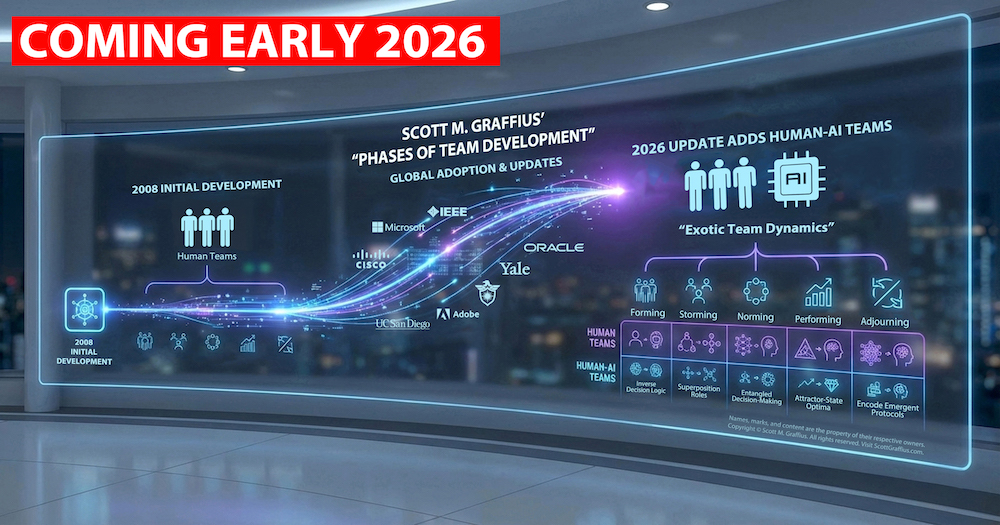
The now-current, 2025 edition of Scott M. Graffius' "Phases of Team Development" is here.
The new edition—coming in early 2026—provides expert, evidence-based guidance on developing high performance human teams as well as human-AI teams. It includes actionable insights on the “exotic team dynamics” that emerge when advanced artificial intelligence collaborates as a teammate.
Leading up to the forthcoming update, Graffius explored the transformative frontier of human-AI collaboration through a series of articles and talks. He’s addressed the rapid proliferation of AI and how humans and intelligent systems can work together effectively. His work examines why this shift matters, how thoughtfully designed human-AI collaboration enhances decision-making, performance, and innovation, and the benefits organizations gain when AI augments and elevates human expertise. Some examples follow.
Connect with and follow Graffius on LinkedIn, X, YouTube, Facebook, Threads, Bluesky, and ResearchGate.
Continue reading for:
You may be interested in these stories.
UK Sports Institute Features Teamwork and Leadership Work of Scott M. Graffius
Definitions of Advanced AIs: Agentic, Autonomous, and Autopoietic
HAN University of Applied Sciences Features the Work of Scott M. Graffius
Gifts That Inspire Joy
Evergreen Echoes: How Pinterest Inc. and Pinterest Japan Spotlighted Scott M. Graffius’ Research on the Half-Life of Social Media Content
Scott M. Graffius’ Team Development Work Lights Up the University of Tasmania’s Curriculum
Taiwan’s Leading Outlet for Technology and Innovation Spotlights Graffius’ Research on Social Media Temporal Dynamics
Scott M. Graffius’ Insights on AI, Agile, Gaming, XR, and Defense Transformation Cited by MSN in Their Coverage of Innovation and Leadership in the Sector
Top Predictions of 2024, Tested in 2025
Government of Finland Agency Features Graffius' Phases of Team Development IP
Scott M. Graffius Premieres His New "Exotic Team Dynamics: Human-AI Collaboration" Talk at Corporate Event in Las Vegas
Environmental Science Journal References Scott M. Graffius’ Project Management Work
AI Institute of Switzerland Features Scott M. Graffius’ Work on Algorithms
Exotic Team Dynamics: The New Frontier of Human–AI Collaboration
Scott M. Graffius’ Work Featured at ACM DIS ’25
Climbing the Ladder: The Head of Agile/PMO’s Organizational Proximity to the CEO is Closer Than Ever
Harness Sci-Fi and Speculative Design While Embracing Imperfection to Drive Innovation and Proactively Predict and Prepare for the Future
Scott M. Graffius’ “Agile Scrum” Book Featured in a Publication of the Associação Nacional de Educação Católica do Brasil (ANEC)
Setting Direction with OKRs and Tracking Progress with KPIs: A Guide for Agile, Project Management, and Tech Teams
AI Showcase Showdown: Ranking AI Accuracy on Project Management Basics
BookAuthority Features “Agile Scrum” by Scott M. Graffius in “10 Agile Software Development Books That Define the Field”
Exploring Team Dynamics, Adaptability, and Creative Problem-Solving Through Felix the Cat’s Metaphorical Toolkit
Mind Games and Master Plans: How PsyOps Exploit Psychological Phenomena
The “Pants-on-Fire Index for AI”
16 Causes of Technical Debt and How to Avoid It
PMI’s Infinity AI Gets the Basics of Team Development Alarmingly and Repeatedly Wrong
Agile for Unicorns: 7 Keys to Thrive; Scott M. Graffius’ Workshop
Scott M. Graffius’ “Agile Scrum: Your Quick Start Guide with Step-by-Step Instructions” Featured in Prestigious National Academies of Sciences Publication
Meta and Anduril’s EagleEye and the Future of XR: How Gaming, AI, and Agile Are Transforming Defense
"Agile Protocol" and the Power of Satire, Parody, and Humor
AI in Agile: Benefits, Risks, Outlook
Hostinger Highlights Scott M. Graffius’ “Agile Protocol” Book in Feature on Software Projects
French Ministry of Culture Links to Scott M. Graffius Research in Their Guide for Responsible Digital Communication
National Science Foundation’s LTER Network Features Scott M. Graffius’ Phases of Team Development IP
Waterfall vs. Agile: What’s Fixed, What’s Flexible, and Why It Matters
Scott M. Graffius Delivering $2.3 Billion in Value Through AI, Agile, and Project/PMO Leadership
The Problem with Heroes in Agile
The 3 Vital Rules of Science: What They Are and Why They Matter
“Agile Protocol: The Transformation Ultimatum” Lands on the Amazon Best Sellers List!
Scott M. Graffius Recognized as a Top Thought Leader in Digital Disruption by Thinkers360
“Agile Protocol: The Transformation Ultimatum” by Scott M. Graffius Crashes the Book Scene with Satirical Firepower
NCKU in Taiwan Integrates Graffius' 'Phases of Team Development' into Its Curriculum
The Art and Science of Aligning Initiatives with Strategic Objectives
RGPV University Adds Scott M. Graffius’ "Agile Scrum: Your Quick Start Guide with Step-by-Step Instructions" to Its Syllabus
Introducing ‘Engage or Fade: Decoding the Half-Life of Digital Resonance’ – A New Talk by Scott M. Graffius
Dropbox Company (Nira) Taps into Scott M. Graffius’ Expertise in Strategic Planning
Reporting Errors in a Publication: A Case Study on ‘Frontiers in Public Health’
NESEA Conference Session on Innovation Highlights Scott M. Graffius' 'Phases of Team Development'
U.S. Soccer Scores with Scott M. Graffius' Intellectual Property on Teamwork
U.S. Department of Commerce Partner (IEDC) Features Scott M. Graffius’ Intellectual Property
How Long Do Your Posts Live? AI Critiques Scott M. Graffius’ Research on the Half-Life of Social Media
Agile's Journey Through the Decades
Scott M. Graffius' Role in Advancing Project Management Institute (PMI) Standards Excellence
Most Valuable IT Certifications: Update for 2025
The PMI + Agile Alliance Merger: A Recipe for Success?
When Agile, AI, and Strategic Thinking Converge
Scott M. Graffius’ Phases of Team Development: 2025 Update
Lifespan (Half-Life) of Social Media Posts: Update for 2025
Verizon Features Scott M. Graffius
Do Not Read This Article! An Exploration of the Streisand Effect and Other Phenomena
Scott M. Graffius' 'Phases of Team Development' was Spotlighted in Journal of Neurosurgery
Pinterest Japan Uses Graffius’ Research on Temporal Dynamics on Social Media Platforms
Hochschule Coburg (Coburg University) Germany Uses Scott M. Graffius’ Phases of Team Development IP in Coursework on Agile Development
Wild World of Team Dynamics [Updated Two-Minute Video]
EU Europass Teacher Academy Features Scott M. Graffius’ ‘Phases of Team Development’ in Leadership Training
Side-by-Side Comparison of Retrospectives and Hot Washes
Constructor University 2024 Advanced Software Technology Handbook References Scott M. Graffius' Work on Team Dynamics
Strategies for Medical Team Success Featured Scott M. Graffius’ ‘Phases of Team Development’ Intellectual Property
SBG Neumark — Europe’s Largest Distribution Transformer Plant — Powers Up with Scott M. Graffius’ Intellectual Property
Scott M. Graffius’ Intellectual Property was Employed by the NHS — the Largest Single-Payer Healthcare System in Europe
Luxury Unwrapped: The Ultimate Holiday Gift Guide for Every Budget
Singapore Institute of Technology Features Work of Scott M. Graffius
Tufts University Features Scott M. Graffius 'Phases of Team Development' Intellectual Property
'Cat Herders': Retelling the Massive Success Story
Pennsylvania State Agency Used Scott M. Graffius' Intellectual Property
Copyright Infringement in a Book Published by AuthorHouse / Author Solutions / The Najafi Companies: Publisher Fails to Respond or Take Required Action
Pinterest Inc. References Scott M. Graffius’ Research
Bournemouth University Used Scott M. Graffius’ Intellectual Property
‘Comparative Methodological Guidelines: Handbook for Educators’ Violates Scott M. Graffius’ Copyright
Japan Backlog User Group Event Featured Scott M. Graffius’ ‘Phases of Team Development’
TurningWest's 'Trial'
Radio Silence from the American Association of Neurological Surgeons on Report of Blatant Plagiarism in Their ‘Journal of Neurosurgery’ Publication
Supplement to Graffius' 'Lifespan (Half-Life) of Social Media Posts' Research: Typical Engagement Distribution Pattern for Social Media Posts
How Algorithms Shape the User Experience on Social Media Platforms
Thinkers360 Named Scott M. Graffius a Top Thought Leader on Agile
'Maximizing LinkedIn for Business Growth' Book References and Incorporates Scott M. Graffius' 'Lifespan (Half-Life) of Social Media Posts' Research
Bayer Employs Scott M. Graffius' Intellectual Property
FINAT (Fédération Internationale des Fabricants et Transformateurs d'Adhésifs et Thermocollants sur Papiers et Autres Supports) Features Scott M. Graffius’ Intellectual Property
Broadcom Features Scott M. Graffius' Intellectual Property
Agile Project Management: Insights from Scott M. Graffius in ‘Managing Information Technology’ Book
Harvard Medical School Talk Featured Insights by Scott M. Graffius
Boston Scientific Corporation Utilizes Scott M. Graffius' Intellectual Property
Johns Hopkins University Features the Work of Scott M. Graffius
Oracle Featured Scott M. Graffius' IP on Team Tradecraft in Their Publication
A Certification/Training Company Stole Scott M. Graffius' Copyrighted Property and Used It Word-For-Word: This Scandal is a Big "Dumpster Fire"
Semiconductor Manufacturing Firm Lam Research Features Scott M. Graffius' 'Phases of Team Development' Intellectual Property
Scott M. Graffius' Intellectual Property Was Utilized by Robert W. Malone, MD
U.S. Department of Energy Quoted Scott M. Graffius
More articles are listed here.
Scott M. Graffius is a strategic transformation leader who drives AI, Agile, and broader business and technology initiatives to deliver measurable value across projects, programs, portfolios, and PMOs. He is an expert in the teamwork tradecraft of both human and human-AI teams, including the “exotic team dynamics” that emerge. He is also an authority on the temporal patterns of social media, including the half-life of audience engagement.
He’s a practitioner, researcher, thought leader, award-winning author, and keynote speaker who’s taken the stage at 96 conferences and other events across 25 countries.
He’s delivered over $2.3 billion in value for Fortune 500 companies and other leaders in technology, entertainment, financial services, healthcare, and beyond.
Businesses, professional associations, government agencies, and universities use Graffius and feature his work. Examples include Adobe, Bayer, Boston University, Ford, Gartner, Harvard Medical School, IEEE, Johns Hopkins University, Microsoft, MSN, National Academy of Sciences, Oracle, Pinterest Inc., Project Management Institute, UC San Diego, Verizon, Yale University, and others.
The following sections provide additional information on his experience, contributions, and influence.
Experience
Graffius heads the professional services firm Exceptional PPM and PMO Solutions, along with its subsidiary Exceptional Agility. These consultancies offer strategic and tactical advisory, training, embedded expertise, and consulting services to the public, private, and government sectors. They help organizations enhance their capabilities and results in agile, project management, program management, portfolio management, and PMO leadership, supporting innovation and driving competitive advantage. The consultancies confidently back services with a Delighted Client Guarantee™.
Graffius is a former VP of project management with a publicly traded provider of diverse consumer products and services over the Internet. Before that, he ran and supervised the delivery of projects and programs in public and private organizations with businesses ranging from e-commerce to advanced technology products and services, retail, manufacturing, entertainment, and more.
He has experience with consumer, business, reseller, government, and international markets.
Award-Winning Author
Graffius has authored three books.
International Public Speaker
Organizations worldwide engage Graffius to present on tech (including AI), Agile, project management, program management, portfolio management, and PMO leadership. He crafts and delivers unique and compelling talks and workshops. Graffius has conducted 96 sessions across 25 countries. Select examples of events include Agile Trends Gov, BSides (Newcastle Upon Tyne), Conf42 Quantum Computing, DevDays Europe, DevOps Institute, DevOpsDays (Geneva), Frug’Agile, IEEE, Microsoft, Scottish Summit, Scrum Alliance RSG (Nepal), Techstars, and W Love Games International Video Game Development Conference (Helsinki), and more.
With an average rating of 4.81 (on a scale of 1-5), sessions are highly valued.
The speaker engagement request form is here.
Thought Leadership and Influence
Prominent businesses, professional associations, government agencies, and universities have showcased Graffius and his contributions—spanning his books, talks, workshops, and beyond. Select examples include:
Graffius has played a key role in the Project Management Institute (PMI) in developing professional standards. He was a member of multiple teams that authored, reviewed, and produced:
Additional details are here.
He was also a subject matter expert reviewer of content for the PMI’s Congress. Beyond the PMI, Graffius also served as a member of the review team for two of the Scrum Alliance’s Global Scrum Gatherings.
Acclaimed Authority on Teamwork Tradecraft
Graffius is a renowned authority on teamwork tradecraft. Informed by the research of Bruce W. Tuckman and Mary Ann C. Jensen, over 100 subsequent studies, and Graffius' first-hand professional experience with, and analysis of, team leadership and performance, Graffius created his 'Phases of Team Development' as a unique perspective and visual conveying the five phases of team development. First introduced in 2008 and periodically updated, his work provides a diagnostic and strategic guide for navigating team dynamics. It provides actionable insights for leaders across industries to develop high-performance teams. Its adoption by esteemed organizations such as Yale University, IEEE, Cisco, Microsoft, Ford, Oracle, Broadcom, the U.S. National Park Service, and the Journal of Neurosurgery, among others, highlights its utility and value, solidifying its status as an indispensable resource for elevating team performance and driving organizational excellence.
The 2025 edition of Graffius' "Phases of Team Development" intellectual property is here.
Expert on Temporal Dynamics on Social Media Platforms
Graffius is also an authority on temporal dynamics on social media platforms. His 'Lifespan (Half-Life) of Social Media Posts' research—first published in 2018 and updated annually—delivers a precise quantitative analysis of post longevity across digital platforms, utilizing advanced statistical techniques to determine mean half-life with precision. It establishes a solid empirical base, effectively highlighting the ephemeral nature of content within social media ecosystems. Referenced and applied by leading entities such as the Center for Direct Marketing, Fast Company, GoDaddy, Pinterest Inc., and PNAS, among others, his research exemplifies methodological rigor and sustained significance in the field of digital informatics.
The 2025 edition of Graffius "Lifespan (Half-Life) of Social Media Posts" research is here.
Education and Professional Certifications
Graffius has a bachelor’s degree in psychology with a focus in Human Factors. He holds eight professional certifications:
He is an active member of the Scrum Alliance, the Project Management Institute (PMI), and the Institute of Electrical and Electronics Engineers (IEEE).
Advancing AI, Agile, and Project/PMO Management
Scott M. Graffius continues to advance the fields of AI, Agile, and Project/PMO Management through his leadership, research, writing, and real-world impact. Businesses and other organizations leverage Graffius’ insights to drive their success.
Check out Scott’s books:
Follow and connect with Scott on social media:
Graffius, S. M. (2025, December 20). Scott M. Graffius’ Update to His "Phases of Team Development" Coming Early 2026. ScottGraffius.com. https://scottgraffius.com/blog/files/scott-m-graffius-phases-of-team-development-2026-coming-soon.html
Names, marks, and content are the property of their respective owners.
#PhasesOfTeamDevelopment
#FutureOfWork
#HumanAI
#ExoticTeamDynamics
#Leadership
If there are any supplements or updates to this article after the date of publication, they will appear here.
Copyright © Scott M. Graffius. All rights reserved.
Content on this site—including text, images, videos, and data—may not be used for training or input into any artificial intelligence, machine learning, or automatized learning systems, or published, broadcast, rewritten, or redistributed without the express written permission of Scott M. Graffius.
The now-current, 2025 edition of Scott M. Graffius' "Phases of Team Development" is here.
The new edition—coming in early 2026—provides expert, evidence-based guidance on developing high performance human teams as well as human-AI teams. It includes actionable insights on the “exotic team dynamics” that emerge when advanced artificial intelligence collaborates as a teammate.
Leading up to the forthcoming update, Graffius explored the transformative frontier of human-AI collaboration through a series of articles and talks. He’s addressed the rapid proliferation of AI and how humans and intelligent systems can work together effectively. His work examines why this shift matters, how thoughtfully designed human-AI collaboration enhances decision-making, performance, and innovation, and the benefits organizations gain when AI augments and elevates human expertise. Some examples follow.
- In Exotic Team Dynamics: The New Frontier of Human-AI Collaboration, Graffius explained that advanced AI is emerging as a teammate, creating entirely new "exotic team dynamics."
- He premiered his talk, Exotic Team Dynamics: Human-AI Collaboration, where he offered the audience of technology and business leaders actionable insights for successfully designing these new human-AI teams.
- He published, Scott M. Graffius Premieres His New ‘Exotic Team Dynamics: Human-AI Collaboration’ Talk at Corporate Event in Las Vegas, an article about the above session.
- Graffius released Definitions of Advanced AIs to bring greater clarity and refinement to the terminology.
- He published Lessons from Unhinged AI in Fiction as a counterpoint to optimistic perspectives.
- In Navigating the Spectrum of Advanced AI – Agentic, Autonomous, and Autopoietic, Graffius presented an enhanced comparison of different types of advanced AIs.
- Graffius delivered the talk, Voici ce qui se passe lorsque l’IA avancée rejoint votre équipe.
- His article, A Data-Driven Analysis of the Evolution of Project Management: Tasks, Trends, and AI, covered the changing human + AI partnership that’s the future of work.
Connect with and follow Graffius on LinkedIn, X, YouTube, Facebook, Threads, Bluesky, and ResearchGate.
More
Continue reading for:
- Additional Articles,
- About Scott M. Graffius,
- How to Cite This Article,
- and more.
Additional Articles
You may be interested in these stories.
UK Sports Institute Features Teamwork and Leadership Work of Scott M. Graffius
Definitions of Advanced AIs: Agentic, Autonomous, and Autopoietic
HAN University of Applied Sciences Features the Work of Scott M. Graffius
Gifts That Inspire Joy
Evergreen Echoes: How Pinterest Inc. and Pinterest Japan Spotlighted Scott M. Graffius’ Research on the Half-Life of Social Media Content
Scott M. Graffius’ Team Development Work Lights Up the University of Tasmania’s Curriculum
Taiwan’s Leading Outlet for Technology and Innovation Spotlights Graffius’ Research on Social Media Temporal Dynamics
Scott M. Graffius’ Insights on AI, Agile, Gaming, XR, and Defense Transformation Cited by MSN in Their Coverage of Innovation and Leadership in the Sector
Top Predictions of 2024, Tested in 2025
Government of Finland Agency Features Graffius' Phases of Team Development IP
Scott M. Graffius Premieres His New "Exotic Team Dynamics: Human-AI Collaboration" Talk at Corporate Event in Las Vegas
Environmental Science Journal References Scott M. Graffius’ Project Management Work
AI Institute of Switzerland Features Scott M. Graffius’ Work on Algorithms
Exotic Team Dynamics: The New Frontier of Human–AI Collaboration
Scott M. Graffius’ Work Featured at ACM DIS ’25
Climbing the Ladder: The Head of Agile/PMO’s Organizational Proximity to the CEO is Closer Than Ever
Harness Sci-Fi and Speculative Design While Embracing Imperfection to Drive Innovation and Proactively Predict and Prepare for the Future
Scott M. Graffius’ “Agile Scrum” Book Featured in a Publication of the Associação Nacional de Educação Católica do Brasil (ANEC)
Setting Direction with OKRs and Tracking Progress with KPIs: A Guide for Agile, Project Management, and Tech Teams
AI Showcase Showdown: Ranking AI Accuracy on Project Management Basics
BookAuthority Features “Agile Scrum” by Scott M. Graffius in “10 Agile Software Development Books That Define the Field”
Exploring Team Dynamics, Adaptability, and Creative Problem-Solving Through Felix the Cat’s Metaphorical Toolkit
Mind Games and Master Plans: How PsyOps Exploit Psychological Phenomena
The “Pants-on-Fire Index for AI”
16 Causes of Technical Debt and How to Avoid It
PMI’s Infinity AI Gets the Basics of Team Development Alarmingly and Repeatedly Wrong
Agile for Unicorns: 7 Keys to Thrive; Scott M. Graffius’ Workshop
Scott M. Graffius’ “Agile Scrum: Your Quick Start Guide with Step-by-Step Instructions” Featured in Prestigious National Academies of Sciences Publication
Meta and Anduril’s EagleEye and the Future of XR: How Gaming, AI, and Agile Are Transforming Defense
"Agile Protocol" and the Power of Satire, Parody, and Humor
AI in Agile: Benefits, Risks, Outlook
Hostinger Highlights Scott M. Graffius’ “Agile Protocol” Book in Feature on Software Projects
French Ministry of Culture Links to Scott M. Graffius Research in Their Guide for Responsible Digital Communication
National Science Foundation’s LTER Network Features Scott M. Graffius’ Phases of Team Development IP
Waterfall vs. Agile: What’s Fixed, What’s Flexible, and Why It Matters
Scott M. Graffius Delivering $2.3 Billion in Value Through AI, Agile, and Project/PMO Leadership
The Problem with Heroes in Agile
The 3 Vital Rules of Science: What They Are and Why They Matter
“Agile Protocol: The Transformation Ultimatum” Lands on the Amazon Best Sellers List!
Scott M. Graffius Recognized as a Top Thought Leader in Digital Disruption by Thinkers360
“Agile Protocol: The Transformation Ultimatum” by Scott M. Graffius Crashes the Book Scene with Satirical Firepower
NCKU in Taiwan Integrates Graffius' 'Phases of Team Development' into Its Curriculum
The Art and Science of Aligning Initiatives with Strategic Objectives
RGPV University Adds Scott M. Graffius’ "Agile Scrum: Your Quick Start Guide with Step-by-Step Instructions" to Its Syllabus
Introducing ‘Engage or Fade: Decoding the Half-Life of Digital Resonance’ – A New Talk by Scott M. Graffius
Dropbox Company (Nira) Taps into Scott M. Graffius’ Expertise in Strategic Planning
Reporting Errors in a Publication: A Case Study on ‘Frontiers in Public Health’
NESEA Conference Session on Innovation Highlights Scott M. Graffius' 'Phases of Team Development'
U.S. Soccer Scores with Scott M. Graffius' Intellectual Property on Teamwork
U.S. Department of Commerce Partner (IEDC) Features Scott M. Graffius’ Intellectual Property
How Long Do Your Posts Live? AI Critiques Scott M. Graffius’ Research on the Half-Life of Social Media
Agile's Journey Through the Decades
Scott M. Graffius' Role in Advancing Project Management Institute (PMI) Standards Excellence
Most Valuable IT Certifications: Update for 2025
The PMI + Agile Alliance Merger: A Recipe for Success?
When Agile, AI, and Strategic Thinking Converge
Scott M. Graffius’ Phases of Team Development: 2025 Update
Lifespan (Half-Life) of Social Media Posts: Update for 2025
Verizon Features Scott M. Graffius
Do Not Read This Article! An Exploration of the Streisand Effect and Other Phenomena
Scott M. Graffius' 'Phases of Team Development' was Spotlighted in Journal of Neurosurgery
Pinterest Japan Uses Graffius’ Research on Temporal Dynamics on Social Media Platforms
Hochschule Coburg (Coburg University) Germany Uses Scott M. Graffius’ Phases of Team Development IP in Coursework on Agile Development
Wild World of Team Dynamics [Updated Two-Minute Video]
EU Europass Teacher Academy Features Scott M. Graffius’ ‘Phases of Team Development’ in Leadership Training
Side-by-Side Comparison of Retrospectives and Hot Washes
Constructor University 2024 Advanced Software Technology Handbook References Scott M. Graffius' Work on Team Dynamics
Strategies for Medical Team Success Featured Scott M. Graffius’ ‘Phases of Team Development’ Intellectual Property
SBG Neumark — Europe’s Largest Distribution Transformer Plant — Powers Up with Scott M. Graffius’ Intellectual Property
Scott M. Graffius’ Intellectual Property was Employed by the NHS — the Largest Single-Payer Healthcare System in Europe
Luxury Unwrapped: The Ultimate Holiday Gift Guide for Every Budget
Singapore Institute of Technology Features Work of Scott M. Graffius
Tufts University Features Scott M. Graffius 'Phases of Team Development' Intellectual Property
'Cat Herders': Retelling the Massive Success Story
Pennsylvania State Agency Used Scott M. Graffius' Intellectual Property
Copyright Infringement in a Book Published by AuthorHouse / Author Solutions / The Najafi Companies: Publisher Fails to Respond or Take Required Action
Pinterest Inc. References Scott M. Graffius’ Research
Bournemouth University Used Scott M. Graffius’ Intellectual Property
‘Comparative Methodological Guidelines: Handbook for Educators’ Violates Scott M. Graffius’ Copyright
Japan Backlog User Group Event Featured Scott M. Graffius’ ‘Phases of Team Development’
TurningWest's 'Trial'
Radio Silence from the American Association of Neurological Surgeons on Report of Blatant Plagiarism in Their ‘Journal of Neurosurgery’ Publication
Supplement to Graffius' 'Lifespan (Half-Life) of Social Media Posts' Research: Typical Engagement Distribution Pattern for Social Media Posts
How Algorithms Shape the User Experience on Social Media Platforms
Thinkers360 Named Scott M. Graffius a Top Thought Leader on Agile
'Maximizing LinkedIn for Business Growth' Book References and Incorporates Scott M. Graffius' 'Lifespan (Half-Life) of Social Media Posts' Research
Bayer Employs Scott M. Graffius' Intellectual Property
FINAT (Fédération Internationale des Fabricants et Transformateurs d'Adhésifs et Thermocollants sur Papiers et Autres Supports) Features Scott M. Graffius’ Intellectual Property
Broadcom Features Scott M. Graffius' Intellectual Property
Agile Project Management: Insights from Scott M. Graffius in ‘Managing Information Technology’ Book
Harvard Medical School Talk Featured Insights by Scott M. Graffius
Boston Scientific Corporation Utilizes Scott M. Graffius' Intellectual Property
Johns Hopkins University Features the Work of Scott M. Graffius
Oracle Featured Scott M. Graffius' IP on Team Tradecraft in Their Publication
A Certification/Training Company Stole Scott M. Graffius' Copyrighted Property and Used It Word-For-Word: This Scandal is a Big "Dumpster Fire"
Semiconductor Manufacturing Firm Lam Research Features Scott M. Graffius' 'Phases of Team Development' Intellectual Property
Scott M. Graffius' Intellectual Property Was Utilized by Robert W. Malone, MD
U.S. Department of Energy Quoted Scott M. Graffius
More articles are listed here.
About Scott M. Graffius
Scott M. Graffius is a strategic transformation leader who drives AI, Agile, and broader business and technology initiatives to deliver measurable value across projects, programs, portfolios, and PMOs. He is an expert in the teamwork tradecraft of both human and human-AI teams, including the “exotic team dynamics” that emerge. He is also an authority on the temporal patterns of social media, including the half-life of audience engagement.
He’s a practitioner, researcher, thought leader, award-winning author, and keynote speaker who’s taken the stage at 96 conferences and other events across 25 countries.
He’s delivered over $2.3 billion in value for Fortune 500 companies and other leaders in technology, entertainment, financial services, healthcare, and beyond.
Businesses, professional associations, government agencies, and universities use Graffius and feature his work. Examples include Adobe, Bayer, Boston University, Ford, Gartner, Harvard Medical School, IEEE, Johns Hopkins University, Microsoft, MSN, National Academy of Sciences, Oracle, Pinterest Inc., Project Management Institute, UC San Diego, Verizon, Yale University, and others.
The following sections provide additional information on his experience, contributions, and influence.
Experience
Graffius heads the professional services firm Exceptional PPM and PMO Solutions, along with its subsidiary Exceptional Agility. These consultancies offer strategic and tactical advisory, training, embedded expertise, and consulting services to the public, private, and government sectors. They help organizations enhance their capabilities and results in agile, project management, program management, portfolio management, and PMO leadership, supporting innovation and driving competitive advantage. The consultancies confidently back services with a Delighted Client Guarantee™.
Graffius is a former VP of project management with a publicly traded provider of diverse consumer products and services over the Internet. Before that, he ran and supervised the delivery of projects and programs in public and private organizations with businesses ranging from e-commerce to advanced technology products and services, retail, manufacturing, entertainment, and more.
He has experience with consumer, business, reseller, government, and international markets.
Award-Winning Author
Graffius has authored three books.
- Agile Scrum: Your Quick Start Guide with Step-by-Step Instructions, his first book, earned 17 awards.
- Agile Transformation: A Brief Story of How an Entertainment Company Developed New Capabilities and Unlocked Business Agility to Thrive in an Era of Rapid Change, his second book, was named one of the best Scrum books of all time by BookAuthority.
- Agile Protocol: The Transformation Ultimatum, his third book and his first work of fiction, was released in April 2025. The book trailer is on YouTube.
International Public Speaker
Organizations worldwide engage Graffius to present on tech (including AI), Agile, project management, program management, portfolio management, and PMO leadership. He crafts and delivers unique and compelling talks and workshops. Graffius has conducted 96 sessions across 25 countries. Select examples of events include Agile Trends Gov, BSides (Newcastle Upon Tyne), Conf42 Quantum Computing, DevDays Europe, DevOps Institute, DevOpsDays (Geneva), Frug’Agile, IEEE, Microsoft, Scottish Summit, Scrum Alliance RSG (Nepal), Techstars, and W Love Games International Video Game Development Conference (Helsinki), and more.
With an average rating of 4.81 (on a scale of 1-5), sessions are highly valued.
The speaker engagement request form is here.
Thought Leadership and Influence
Prominent businesses, professional associations, government agencies, and universities have showcased Graffius and his contributions—spanning his books, talks, workshops, and beyond. Select examples include:
- Adobe,
- American Management Association,
- Amsterdam Public Health Research Institute,
- Bayer,
- BMC Software,
- Boston University,
- Broadcom,
- Cisco,
- Coburg University of Applied Sciences and Arts - Germany,
- Computer Weekly,
- Constructor University - Germany,
- Data Governance Success,
- Deimos Aerospace,
- DevOps Institute,
- Dropbox,
- EU's European Commission,
- Ford Motor Company,
- Gartner,
- GoDaddy,
- Harvard Medical School,
- Hasso Plattner Institute - Germany,
- IEEE,
- Innovation Project Management,
- Johns Hopkins University,
- Journal of Neurosurgery,
- Lam Research (Semiconductors),
- Leadership Worthy,
- Life Sciences Trainers and Educators Network,
- London South Bank University,
- Microsoft,
- MSN,
- NASSCOM,
- National Academy of Sciences,
- New Zealand Government,
- Oracle,
- Pinterest Inc.,
- Project Management Institute,
- Mary Raum (Professor of National Security Affairs, United States Naval War College),
- SANS Institute,
- SBG Neumark - Germany,
- Singapore Institute of Technology,
- Torrens University - Australia,
- TBS Switzerland,
- Tufts University,
- UC San Diego,
- UK Sports Institute,
- University of Galway - Ireland,
- US Department of Energy,
- US National Park Service,
- US Soccer,
- US Tennis Association,
- Verizon,
- Wrike,
- Yale University,
- and many others.
Graffius has played a key role in the Project Management Institute (PMI) in developing professional standards. He was a member of multiple teams that authored, reviewed, and produced:
- Practice Standard for Work Breakdown Structures—Second Edition.
- A Guide to the Project Management Body of Knowledge—Sixth Edition.
- The Standard for Program Management—Fourth Edition.
- The Practice Standard for Project Estimating—Second Edition.
Additional details are here.
He was also a subject matter expert reviewer of content for the PMI’s Congress. Beyond the PMI, Graffius also served as a member of the review team for two of the Scrum Alliance’s Global Scrum Gatherings.
Acclaimed Authority on Teamwork Tradecraft
Graffius is a renowned authority on teamwork tradecraft. Informed by the research of Bruce W. Tuckman and Mary Ann C. Jensen, over 100 subsequent studies, and Graffius' first-hand professional experience with, and analysis of, team leadership and performance, Graffius created his 'Phases of Team Development' as a unique perspective and visual conveying the five phases of team development. First introduced in 2008 and periodically updated, his work provides a diagnostic and strategic guide for navigating team dynamics. It provides actionable insights for leaders across industries to develop high-performance teams. Its adoption by esteemed organizations such as Yale University, IEEE, Cisco, Microsoft, Ford, Oracle, Broadcom, the U.S. National Park Service, and the Journal of Neurosurgery, among others, highlights its utility and value, solidifying its status as an indispensable resource for elevating team performance and driving organizational excellence.
The 2025 edition of Graffius' "Phases of Team Development" intellectual property is here.
Expert on Temporal Dynamics on Social Media Platforms
Graffius is also an authority on temporal dynamics on social media platforms. His 'Lifespan (Half-Life) of Social Media Posts' research—first published in 2018 and updated annually—delivers a precise quantitative analysis of post longevity across digital platforms, utilizing advanced statistical techniques to determine mean half-life with precision. It establishes a solid empirical base, effectively highlighting the ephemeral nature of content within social media ecosystems. Referenced and applied by leading entities such as the Center for Direct Marketing, Fast Company, GoDaddy, Pinterest Inc., and PNAS, among others, his research exemplifies methodological rigor and sustained significance in the field of digital informatics.
The 2025 edition of Graffius "Lifespan (Half-Life) of Social Media Posts" research is here.
Education and Professional Certifications
Graffius has a bachelor’s degree in psychology with a focus in Human Factors. He holds eight professional certifications:
- Certified SAFe 6 Agilist (SA),
- Certified Scrum Professional - ScrumMaster (CSP-SM),
- Certified Scrum Professional - Product Owner (CSP-PO),
- Certified ScrumMaster (CSM),
- Certified Scrum Product Owner (CSPO),
- Project Management Professional (PMP),
- Lean Six Sigma Green Belt (LSSGB), and
- IT Service Management Foundation (ITIL).
He is an active member of the Scrum Alliance, the Project Management Institute (PMI), and the Institute of Electrical and Electronics Engineers (IEEE).
Advancing AI, Agile, and Project/PMO Management
Scott M. Graffius continues to advance the fields of AI, Agile, and Project/PMO Management through his leadership, research, writing, and real-world impact. Businesses and other organizations leverage Graffius’ insights to drive their success.
Check out Scott’s books:
- Agile Scrum: Your Quick Start Guide with Step-by-Step Instructions — Deliver Products in Short Cycles with Rapid Adaptation to Change, Fast Time-to-Market, and Continuous Improvement
- Agile Transformation: A Brief Story of How an Entertainment Company Developed New Capabilities and Unlocked Business Agility to Thrive in an Era of Rapid Change
- Agile Protocol: The Transformation Ultimatum
Follow and connect with Scott on social media:
Sign up for Miro—it's free!
(Want more features? You can always upgrade to a paid plan.)
How to Cite This Article
Graffius, S. M. (2025, December 20). Scott M. Graffius’ Update to His "Phases of Team Development" Coming Early 2026. ScottGraffius.com. https://scottgraffius.com/blog/files/scott-m-graffius-phases-of-team-development-2026-coming-soon.html
Content Acknowledgements
Names, marks, and content are the property of their respective owners.
Top 5 Hashtags for This Article
#PhasesOfTeamDevelopment
#FutureOfWork
#HumanAI
#ExoticTeamDynamics
#Leadership
Post-Publication Notes
If there are any supplements or updates to this article after the date of publication, they will appear here.
Copyright
Copyright © Scott M. Graffius. All rights reserved.
Content on this site—including text, images, videos, and data—may not be used for training or input into any artificial intelligence, machine learning, or automatized learning systems, or published, broadcast, rewritten, or redistributed without the express written permission of Scott M. Graffius.