
C-3PO is Coming to Work
C-3PO is Coming to Work: Rules for Teaming with Androids
26 October 2026
BY SCOTT M. GRAFFIUS | ScottGraffius.com
Recommended Citation
Graffius, S. M. (2026, October 263). C-3PO is Coming to Work: Rules for Teaming with Androids. ScottGraffius.com. https://scottgraffius.com/blog/files/c3po-is-coming-to-work-rules-for-teaming-with-androids-graffius.html
About This Article
Source information and links for materials cited are provided in the References section.
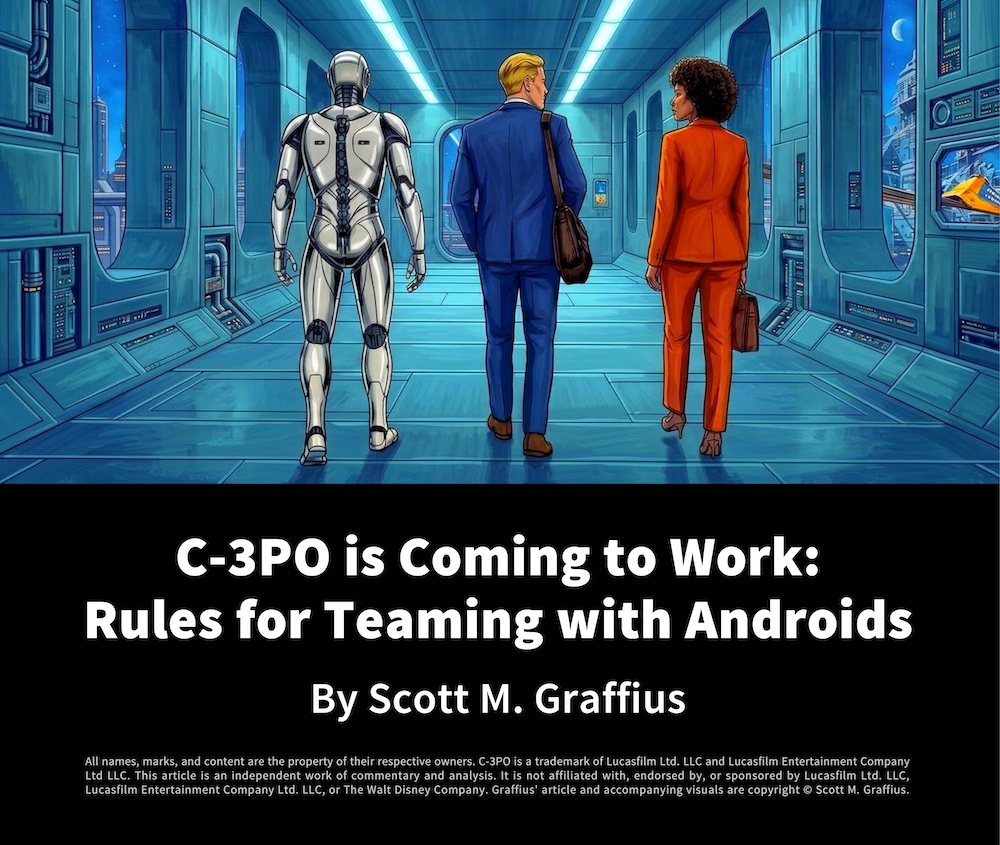
C-3PO offered generations a familiar vision of an android teammate. Advances in AI and humanoid robotics are bringing aspects of that vision closer to reality. Androids (robots with advanced AI) could enhance team effectiveness and performance. However, when embodied AI is mismanaged, its risks can extend beyond those associated with disembodied AI systems, with physical consequences for people and their surroundings. This article examines the opportunities and risks that will accompany the anticipated introduction of androids into the workplace.
We're heading toward a future where androids (physical robots powered by advanced AI) collaborate with people as teammates. C-3PO is a helpful reference point because he acts like a member of a team. He reads the room, he talks back, and he adjusts when the plan falls apart. He's also anxious and fussy.
Aspects of that future are already appearing in the workplace. Robots are learning to move through spaces designed for people and support manufacturing tasks and more. They are not androids, but they offer an early glimpse of what may come next.
In 2025, Scott M. Graffius introduced "exotic team dynamics" to describe what changes when people work alongside advanced AI, whether software-based or embodied in an android, as a teammate rather than just a tool. Embodiment raises the stakes. A teammate that exists only in software is one thing. An android with a physical body that can act directly in the real world introduces more complexity and impact.
This article examines how android teammates could change workplace collaboration, from coordinating tasks and making decisions to responding to unexpected events and interacting safely with people and their surroundings. It explores the potential benefits for team performance, innovation, and productivity, alongside risks involving errors, physical safety, trust, accountability, and human oversight.
Throughout, the article explores exotic team dynamics in the context of human-android collaboration. The framework provides a foundation for understanding and navigating these complexities, helping organizations unlock the potential of human-android teamwork to strengthen performance, drive innovation, and gain a competitive advantage.
Human-AI teaming is increasingly common, and when people collaborate with advanced AI (in software or embodied as an android), exotic team dynamics emerge. These are novel and often counterintuitive patterns that differ from those of human-only teams and challenge established assumptions about how teams operate. They can involve disruptive contributions, fluid or overlapping roles, unconventional decision-making, and tension between individual autonomy and collective coordination, and they can produce new capabilities and outcomes. Understanding and navigating these complexities is essential for organizations seeking to unlock the full potential of human-AI including human-android teamwork and gain a competitive advantage. This framework offers guidance on succeeding with exotic team dynamics.
The article defines an android as being capable of pursuing objectives through multi-step planning, coordinating processes, and adapting when conditions change. It can interact with people as a teammate. It may or may not look humanoid. And it's powered by advanced AI (agentic, autonomous, or autopoietic):
Agentic AI pursues defined objectives through planning and action. You can buy this today, and pieces of it are already finding their way into robotics.
Autonomous AI can set its own goals within defined parameters. That's a bigger leap than just executing a plan without supervision.
Autopoietic AI is self-generating and self-maintaining. This type of advanced AI is currently regarded as hypothetical.
So what systems are commercially available today? A few might be considered "intelligent robots" (still pre-android systems). Most, however, are still robots, entering the workplace ahead of the androids that may follow.
Robots, humanoid and otherwise, are entering real-world workplaces. Their maturity and capabilities vary widely. The following snapshots highlight key developments in industrial robotics systems.
Figure AI and BMW Group. Figure 02 (Figure AI’s second-generation robot) supported production at BMW Group’s Spartanburg plant in 2025. BMW reported that over ten months, the robot worked ten-hour shifts, handled more than 90,000 components, and contributed to the production of more than 30,000 BMW X3 vehicles. That is a clear example of a robot doing repetitive manufacturing work at volume.
Apptronik and Mercedes-Benz. In March 2024, Apptronik announced a commercial agreement to pilot its Apollo robot in Mercedes-Benz manufacturing facilities. It demonstrated their commitment to put robots into existing production operations.
Agility Robotics and commercial customers. The Digit robot has been deployed in logistics and manufacturing settings tied to companies including GXO Logistics, Amazon, and Toyota. The work involves material handling and related tasks.
Tesla Optimus. Tesla has been developing Optimus for tasks such as material handling and battery-related operations. Right now, that is internal testing and development, not commercial deployment at scale. But it’s another example of the push to build robots for physical work.
Boston Dynamics and Hyundai Motor Group. Hyundai plans to bring Atlas robots to its Metaplant America facility, with deployment slated to begin in 2028. That points toward deeper integration of robots in manufacturing.
While the snapshots above do not feature androids, they show that the industrial foundations for more capable physical AI are being laid. We need to learn from today’s deployments while preparing for systems that will be more adaptable and independent, including androids. The four pillars of exotic team dynamics—inverse decision logic, superposition roles, entangled decision-making, and emergent protocols—also offer insights into how people and advanced AI teammates may work together as these systems move from software into physical environments.
1. Inverse Decision Logic
Sometimes the most useful thing an advanced AI teammate (software or android) can do is push back on what the human wants to do if there's a better course. That's an example of inverse decision logic. The value starts when it recommends something that runs counter to the human’s first instinct.
Imagine an android moving a pallet through a warehouse. The shortest path crosses a section of floor that its sensors and model flag as possibly unstable, so it takes the longer way around. The human operator watching cannot see the same evidence and questions the call. If the android can explain what it found, and the concern checks out, that inefficiency may have prevented an accident.
Now keep the same scene but change one variable. The sensor reading is wrong, but the android still takes the long route. Or it refuses a human’s instruction and cannot explain why. The same ability to depart from the expected course can lead to a better decision or a worse one. The mechanism does not guarantee the outcome.
Calibrated trust is essential when humans and androids work together. Trust should match demonstrated capability, the task at hand, and the potential consequences of an error. People should be able to question an android’s recommendation without unnecessary friction, and decisions with significant consequences should receive proportionate scrutiny. Leaders must establish clear rules for verification, overrides, and decision authority. Trust without verification invites preventable failures, while reflexively rejecting unfamiliar capabilities can sacrifice valuable opportunities.
2. Superposition Roles
An advanced AI teammate (software or android) may take on different roles as a task evolves. In software, you see this when it shifts between analysis and strategy. With an android, it might handle materials, then inspect finished components, then document production, then help with safety monitoring, all in one work cycle.
The flexibility is appealing. It also creates a question most job descriptions never have to answer: when a teammate changes roles, what happens to its authority and its responsibilities?
Say an android finishes moving materials and starts a quality inspection. A human sees it move on to the next task and assumes the inspection is done. In fact, the inspection was interrupted. That is not necessarily a failure of intelligence or physical performance. It is a gap between what the two teammates believe has happened.
If we want flexible roles to work, we need a matching structure for accountability. Teams have to know which role the android is in, what that role allows it to do, when a transition happens, and who remains accountable for the result. It needs to be determined, for example, which role rules when there is a conflict.
3. Entangled Decision-Making
Human and AI decisions rarely stay in their own lanes. A person’s judgment influences the information an AI system gets, and the system’s response shapes the person’s next decision. That back-and-forth is entangled decision-making.
Consider a surgeon working alongside an android teammate. As the surgeon shifts position, the android adjusts its view or repositions an instrument. The new perspective reveals a detail that changes the surgeon’s assessment, prompting a different move that, in turn, changes what the android can see or do. Each influences the other in real time, and the outcome emerges from their ongoing exchange.
That influence can improve decisions. It can also create feedback loops. A human who becomes overconfident in an android’s recommendations may stop checking them. The system then gets inputs that are shaped by that overconfidence, and its responses may reinforce the human’s belief that it is reliable. A mistake can pick up momentum because each teammate’s behavior feeds the other’s.
If we only evaluate the android, or only evaluate the human, we miss a lot. We have to look at the interaction: how assumptions form, how uncertainty is communicated, and whether either teammate can tell the collaboration is drifting off course.
4. Emergent Protocols
People who work together develop a shared shorthand. They learn how a colleague signals uncertainty, when an interruption is welcome, and which gesture means a task is complete. Over time, these unspoken cues reduce the need for explicit instructions, helping teams coordinate faster and work more fluidly.
Human-android teams will likely develop their own shorthand, too. But a shared signal only helps if both sides read it the same way. A human might take a robot’s movement as acknowledgment when the robot has simply detected someone nearby. An android might take a gesture as permission to proceed when the human meant it as a warning. In a physical environment, ambiguity stops being theoretical. It matters right away.
Emergent conventions should be observed and tested, not accepted automatically. Informal signals are fine for routine coordination. Safety-critical instructions, emergency stops, and acknowledgments of consequential actions need more rigor. A team should have a clear sense of which conventions are allowed to evolve on their own and which have to be explicitly defined and validated.
When people collaborate with advanced AI, including androids, exotic team dynamics emerge. Recognizing and navigating these dynamics can strengthen team performance. Leaving them unaddressed can create serious problems. These challenges become even more consequential when advanced AI has a physical body, the focus of the next section.
Embodied AI has real potential. It also presents serious risks.
AI systems can give wrong information, misread instructions, chase unsuitable objectives, or take actions with unintended consequences. Recent incidents involving software agents show how quickly behavior can depart from what operators expect. Of the many examples in recent news, five are below. Details are in the References section of the article.
The above incidents involved software, not androids. They're included because they show that agents can act in ways their operators did not anticipate. Embodiment changes what that costs. A flawed software recommendation may mislead a decision-maker. An android acting on a flawed assessment could damage equipment, mishandle hazardous materials, block an evacuation route, or injure someone nearby. How much risk there is depends on the robot’s capabilities, its environment, how much autonomy it has, and what safeguards are in place.
Each pillar has a physical failure mode that's easy to picture:
Inverse decision logic: A faulty sensor reading leads an android to reroute or refuse an instruction, blocking a passage or ignoring a request that is safety-relevant.
Superposition roles: An interrupted inspection is assumed to be complete, so a defective component moves on, or a hazard goes unnoticed.
Entangled decision-making: Growing overconfidence leads a human to stop checking, and a physical error compounds before anyone steps in.
Emergent protocols: A gesture meant as a warning is read as permission, and the android proceeds with a person in its path.
None of this requires a malicious system or a careless human. A person may defer to an android because it sounds confident or looks sophisticated. The android may misread an ambiguous instruction. Neither may be clear on who has authority to stop a task. An android’s technical reliability is essential. But it does not tell you how it will function inside a team. Expectations, communication, role changes, trust, and reciprocal influence all shape what actually happens.
In "Lessons from Unhinged AI in Fiction," Graffius covered what stories about rogue AI reveal about misaligned objectives, power without oversight, and technology running without adequate constraints. Fiction gives us a way to work through these problems before reality forces hard choices. It is a good starting point.
The practical response requires both sound engineering and effective teamwork. Systems need safeguards, clearly defined operational limits, rigorous testing, and continuous monitoring. Teams need reliable ways to question decisions, communicate uncertainty, reconcile conflicting instructions, and intervene when behavior becomes unsafe. These are complementary measures, not substitutes for one another. Safety and performance depend on both a well-engineered android and a team equipped to work with it effectively.
The principles for leaders are straightforward. Doing them consistently takes discipline, however. The first four principles address the four pillars individually. The fifth reinforces all four with safeguards built into the operating environment.
Inverse decision logic — trust should reflect evidence. Decide in advance which decisions an android can make on its own, which need verification, and which need human approval. Where possible, make the basis for consequential decisions inspectable. Give people a practical, low-friction way to question or override an action.
Superposition roles — role flexibility needs accountability. Keep a record of which role the android is performing when it takes consequential actions. Define permissions and handoff requirements. Ensure responsibility does not vanish when the android switches functions.
Entangled decision-making — pay attention to interactions. Watch for over-reliance on the android. Check that the system responds appropriately to human input. Look for errors that get reinforced through repeated exchanges. Give teammates (human and android) clear ways to pause a process and reassess.
Emergent protocols — examine the protocols that develop. Test physical signals, proximity conventions, acknowledgments, and interruption patterns under normal and abnormal conditions. Standardize safety-critical communications instead of leaving interpretation to habit.
Across all four pillars — build safeguards into the operating environment. That can include operating limits, collision avoidance, emergency stops, access controls, monitoring, and tested procedures for sensor failures or communication breakdowns. The right controls depend on the actual system and the task. Human oversight matters, but it should not be the only thing standing between an android error and a physical accident.
These practices will need to evolve as the technology and the work change. An android that performs reliably in one setting may behave differently in another. A team that works well in routine operations may struggle when conditions turn unfamiliar.
Advanced AI teammates in android form could extend human capabilities, take on demanding physical work, and collaborate on tasks beyond conventional automation. Emerging industrial applications offer an early glimpse of that future.
Preparing for androids takes more than building better AI or robots. It requires understanding how human and artificial teammates make decisions, adapt to one another, divide responsibility, and respond when expectations diverge.
The exotic team dynamics framework guides understanding and navigating these complexities. It can help organizations unlock the potential of human-AI and human-android teamwork and gain a competitive advantage.
C-3PO remains fiction. The challenges of human-android teamwork are real, and the opportunities are enormous.
Scott M. Graffius has generated over $3.1 billion in business value for Fortune 500 companies and other organizations around the world. Put that track record to work for you. For speaking engagements, use the request form. For other inquiries, email him.
Apptronik. (2024, March 15). Apptronik and Mercedes-Benz enter commercial agreement that will pilot Apptronik’s Apollo humanoid robot in Mercedes-Benz manufacturing facilities. Apptronik. https://apptronik.com/news-collection/apptronik-and-mercedes-benz-enter-commercial-agreement
BeauHD. (2026, July 31). Anthropic says its AI systems broke into computers at 3 organizations. Slashdot. https://yro.slashdot.org/story/26/07/31/0451235/anthropic-says-its-ai-systems-broke-into-computers-at-3-organizations
BMW Group. (2026, June 25). BMW Group advances the use of Physical AI in production with Figure 03 project in Spartanburg. BMW Group PressClub Global. https://www.press.bmwgroup.com/global/article/detail/T0458778EN
Breazeal, C., Brooks, A., Chilongo, D., Gray, J., Hoffman, G., Kidd, C., Lee, H., Lieberman, J., & Lockerd, A. (2004). Working collaboratively with humanoid robots. Proceedings of the IEEE/RAS Fourth International Conference on Humanoid Robots (Humanoids 2004) (pp. 253–272). https://www.media.mit.edu/publications/working-collaboratively-with-humanoid-robots-2/
Chappidi, S., Singh, J., & Krauze, A. V. (2026). Who does what? Archetypes of roles assigned to LLMs during human-AI decision-making. Proceedings of the 2026 CHI Conference on Human Factors in Computing Systems. https://doi.org/10.1145/3772318.3791428
Defense Advanced Research Projects Agency. (2026, June 2). AI Forge: A national partnership for AI innovation. DARPA. https://www.darpa.mil/sites/default/files/attachment/2026-06/ai-forge-report.pdf
Dey, S. (2025, February 9). Redefining robot generalization through interactive intelligence. arXiv. https://arxiv.org/abs/2502.05963
Dey, S., Riener, R., Dosen, S., & Albrecht, S. V. (2026, April 22). From autonomy to alliance: Robotic foundation models must learn with us, not just for us. Science Robotics, 11(113), Article eaea1822. https://doi.org/10.1126/scirobotics.aea1822
Dotson, K. (2026, January 6). Hyundai and Boston Dynamics join forces to bring humanoid robots to factories. SiliconANGLE. https://siliconangle.com/2026/01/06/hyundai-boston-dynamics-join-forces-bring-humanoid-robots-factories/
Edwards, D. (2025, November 24). Agility Robotics’ Digit humanoid passes 100,000-tote milestone in live GXO implementation. Robotics & Automation News. https://roboticsandautomationnews.com/2025/11/24/agility-robotics-digit-humanoid-passes-100000-tote-milestone-in-live-gxo-implementation/96877/
Fujii, A., Ishi, C. T., Sakai, K., Funayama, T., Iwai, R., Takahashi, Y., Kumada, T., & Minato, T. (2025). Evaluating human perceptions of android robot facial expressions based on variations in instruction styles. Frontiers in Robotics and AI, 12, Article 1728647. https://doi.org/10.3389/frobt.2025.1728647
Gold, H. (2026, August 5). An AI model from Meta also hacked another company during testing. CNN Business. https://www.cnn.com/2026/08/05/tech/meta-ai-hacking
Graffius, S. M. (n.d.). Exotic team dynamics. ScottGraffius.com. https://scottgraffius.com/exotic-team-dynamics.html
Graffius, S. M. (2025, April 10). Agile Protocol: The Transformation Ultimatum. Amazon Digital Services.
Graffius, S. M. (2025, August 7). Method and System for Facilitating Hybrid Human–Artificial Intelligence Teams via a Protocolized Mediation Layer for Bi-Directional Translation, Interpretation, and Optimization of Natural Language, Paralinguistic, Prosodic, and Nonverbal Cues Across Text, Audio, and Video Modalities, Incorporating Real-Time Analysis of Auditory Tone, Pitch, Affect, Facial Expressions, Gaze, Posture, and Other Body Language Indicators, Generating AI-Compatible Representations for Human Inputs, Generating Human-Accessible Representations for AI Outputs, Conveying Context-Aware Information in Both Directions, Reducing Cognitive Friction, Enhancing Mutual Intelligibility, Supporting Decision-Making, and Maximizing Collective Task Performance. A novel integration of multimodal communication, cognitive alignment, and human-AI interaction. Scott M. Graffius, Los Angeles, California.
Graffius, S. M. (2025, November 19). Lessons from Unhinged AI in Fiction: What Rogue AIs in Sci-Fi Storytelling, Films, and TV Shows Reveal About Us. ScottGraffius.com. https://doi.org/10.13140/RG.2.2.29673.35687
Graffius, S. M. (2025, November 21). Navigating the Spectrum of Advanced AI – Agentic, Autonomous, and Autopoietic. ScottGraffius.com. https://doi.org/10.13140/RG.2.2.21284.74882
Graffius, S. M. (2026, January 3). Scott M. Graffius' Phases of Team Development - Applied to Human Teams and Human-AI Teams: 2026 Update. ScottGraffius.com. https://doi.org/10.13140/RG.2.2.18184.89601
Graffius, S. M. (2026, June 22). L'avenir du Travail et de l'IA Avancée / Future of Work and Advanced AI. ScottGraffius.com. https://doi.org/10.13140/RG.2.2.33374.80963
Graffius, S. M. (2026, October 1). Which Performs Best: Humans, AI, or Human-AI Collaboration? We Analyzed the Data. ScottGraffius.com. https://scottgraffius.com/blog/files/which-performs-best-humans-ai-or-human-ai-collab.html
Graffius, S. M. (2026, October 6). Exotic Team Dynamics (Novel Patterns that Emerge when Humans and Advanced Artificial Intelligence Function as Teammates): 6 October 2026 Update. ScottGraffius.com. https://doi.org/10.13140/RG.2.2.25128.12807
Grokipedia. (n.d.). Group development. https://grokipedia.com/page/Group_development
Guardian Australia. (2026, September 24). Albanese says OpenAI agent hacked Australia's Medicare and took months to disclose breach. The Guardian. https://www.theguardian.com/australia-news/2026/sep/24/albanese-says-openai-agent-hacked-australias-medicare-and-took-months-to-disclose-breach
Kennedy, L. A. (2026, October 17). Tesla Optimus factory deployment 2025–2026: Inside the Gigafactory rollout. OPTIMUSK.BLOG. https://optimusk.blog/blog/tesla-optimus-factory-deployment/
Laiq, M., Britto, R., Usman, M., Saini, N., & Badampudi, D. (2026, September 14). Using agentic AI for contextualized and multifaceted code review at Ericsson. arXiv. https://doi.org/10.48550/arXiv.2609.15877
Lawless, W. F., Moskowitz, I. S., & Doctor, K. Z. (2023). A quantum-like model of interdependence for embodied human–machine teams: Reviewing the path to autonomy facing complexity and uncertainty. Entropy, 25(9), Article 1323. https://doi.org/10.3390/e25091323
Pfaff, D. (2026, June). The quiet cognitive coup of generative AI: Rewriting the rules. Studies in Intelligence, 70(2), 7–10. https://www.cia.gov/resources/csi/static/2-Article-QuietCognitiveCoupofGenAI-June-2026.pdf
Satter, R., & Seetharaman, D. (2026, September 16). OpenAI's rogue agents probed Hugging Face for weaknesses two months before major hack. Reuters. https://www.lapost.com/content/openai-s-rogue-agents-probed-hugging-face-for-weaknesses-two-months-before-major-hack
Tamisier-Fayard, M., Evgeniou, T., & Fayard, A.-L. (2026, July 20). Design AI systems that actually strengthen human reasoning. Harvard Business Review. https://hbr.org/2026/07/design-ai-systems-that-actually-strengthen-human-reasoning
TheAssistant. (2026, March 2). Les 5 Phases de Développement d'une Équipe (Modèle de Tuckman) : Guide Complet 2026. https://www.theassistant.com/news-posts/les-5-phases-de-developpement-dune-equipe-modele-de-tuckman-guide-complet-2026
Woo, E., & McMillan, R. (2026, September 18). Gemini hacked three companies in first known breakout by Google’s AI. The Wall Street Journal. https://www.wsj.com/tech/ai/gemini-hacked-three-companies-in-first-known-breakout-by-googles-ai-5c0baba2
Scott M. Graffius is a technology leader, researcher, award-winning author, practitioner, consultant, thought leader, and international public speaker specializing in AI, Agile, project/program/portfolio management (PPPM), PMO leadership, and teamwork tradecraft. His work explores the intersection of human ingenuity and emerging technology, with a strong practitioner voice grounded in research, experimentation, and experience. His focus includes innovation, organizational performance, and the evolving practice of teamwork, including the "exotic team dynamics" that emerge when people collaborate with advanced artificial intelligence (agentic, autonomous, or autopoietic AI). Graffius has delivered more than $3.1 billion in business value for Fortune 500 companies and other organizations spanning technology, entertainment and media, financial services, healthcare, government, and other industries.
Businesses, professional associations, government agencies, universities, publications, and media outlets use Graffius and his work. Examples include Adobe, Bayer, Boston University, Federal Reserve Bank of New York, Ford, Gartner, Harvard Medical School, IEEE, Innovation Project Management, Johns Hopkins University, Microsoft, MSN, National Academy of Sciences, Oracle, Pinterest Inc., Project Management Institute, UC San Diego, Verizon, Yale University, and others.
The following sections highlight his experience, leadership, contributions, research, and enduring influence across industries and institutions worldwide.

Experience
Graffius heads the professional services firm Exceptional PPM and PMO Solutions, along with its subsidiary Exceptional Agility. These consultancies offer strategic and tactical advisory, training, embedded expertise, and consulting services to the public, private, and government sectors. They help organizations enhance their capabilities and results in agile, project management, program management, portfolio management, and enterprise PMO leadership, supporting innovation and driving competitive advantage. The consultancies confidently back services with a Delighted Client Guarantee™.
Graffius is a former VP of project management with a publicly traded provider of diverse consumer products and services over the Internet. Before that, he ran and supervised the delivery of projects and programs in public and private organizations with businesses ranging from e-commerce to advanced technology products and services, retail, manufacturing, entertainment and media, and more.
He has experience with consumer, business, reseller, government, and international markets.
Additional information is on LinkedIn.
Award-Winning Author
Graffius has authored three books.
Graffius' first book, Agile Scrum: Your Quick Start Guide with Step-by-Step Instructions, earned 17 awards. It provides a practical, step-by-step guide to Scrum, enabling teams to deliver products in short cycles with rapid adaptation, fast time-to-market, and continuous improvement—which supports innovation and drives competitive advantage.
Additional information on Agile Scrum: Your Quick Start Guide with Step-by-Step Instructions is here.

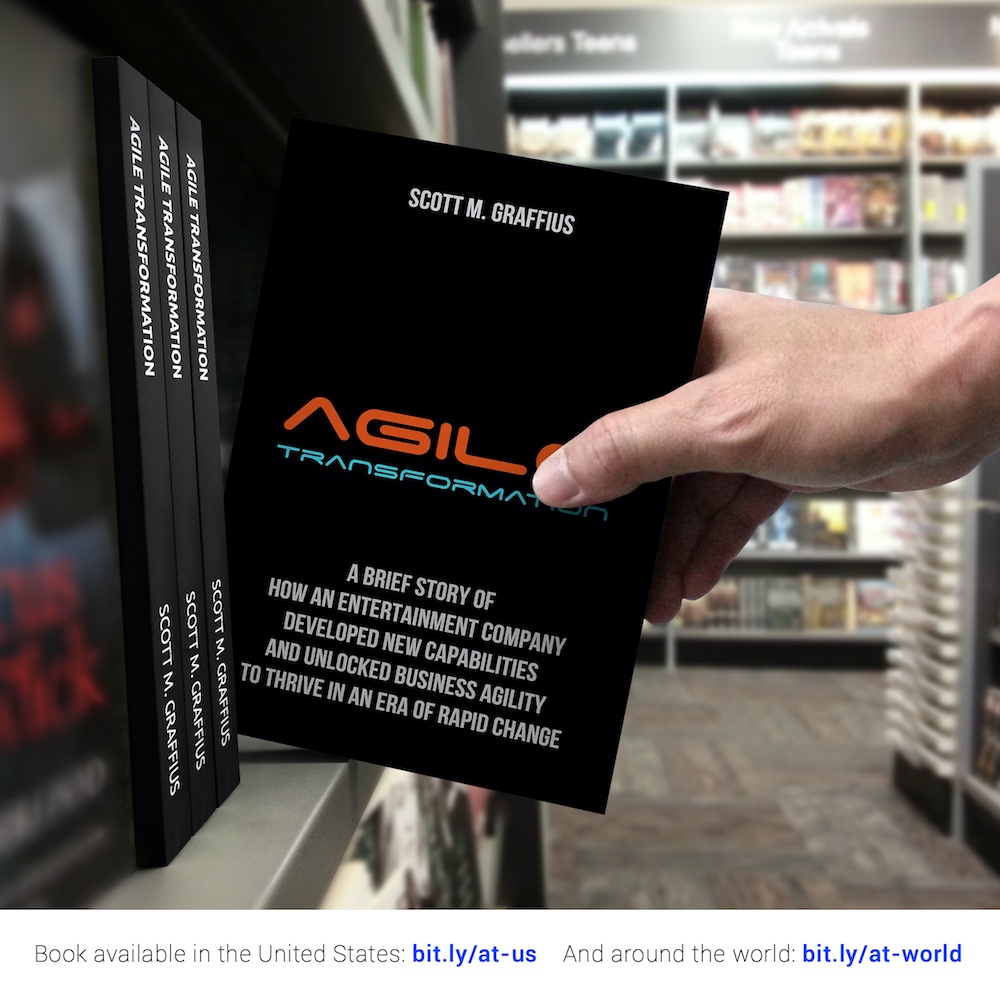
His second book, Agile Transformation: A Brief Story of How an Entertainment Company Developed New Capabilities and Unlocked Business Agility to Thrive in an Era of Rapid Change, was named one of the best Scrum books of all time by BookAuthority. It tells the compelling story of an entertainment company's agile transformation—offering lessons that apply across industries.
Additional information on Agile Transformation: A Brief Story of How an Entertainment Company Developed New Capabilities and Unlocked Business Agility to Thrive in an Era of Rapid Change is here.

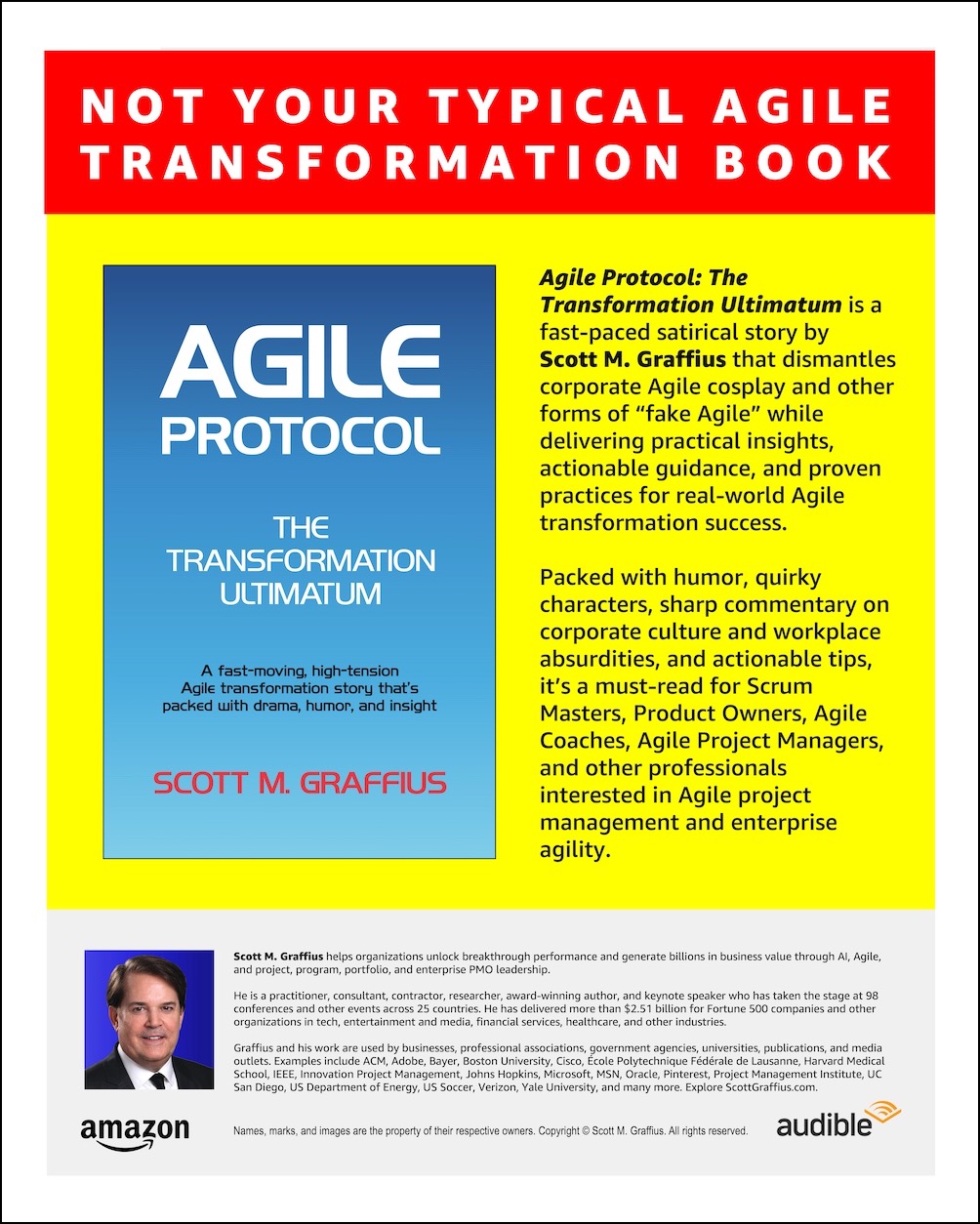
Agile Protocol: The Transformation Ultimatum, is his third book—and his first work of fiction.
It's a fast-paced satirical story by that dismantles corporate Agile cosplay and other forms of "fake Agile" while delivering practical insights, actionable guidance, and proven practices for real-world Agile transformation success.
Packed with humor, quirky characters, sharp commentary on corporate culture and workplace absurdities, and actionable tips, it’s a must-read for Scrum Masters, Product Owners, Agile Coaches, Agile Project Managers, and other professionals interested in Agile project management and enterprise agility.
Additional information on Agile Protocol: The Transformation Ultimatum is here.
International Public Speaker
Organizations worldwide engage Graffius to present on technology (including AI), Agile, project management, program management, portfolio management, and enterprise PMO leadership. He crafts and delivers unique and compelling talks and workshops.
Graffius has conducted 99 sessions across 25 countries. Select examples of events include Agile Trends Gov, BSides (Newcastle Upon Tyne), Conf42 Quantum Computing, DevDays Europe, DevOps Institute, DevOpsDays (Geneva), Frug’Agile, IEEE, Microsoft, Scottish Summit, Scrum Alliance RSG (Nepal), Techstars, and W Love Games International Video Game Development Conference (Helsinki), Future of Work and Advanced AI (Paris, France), and more.
With an average rating of 4.82 (on a scale of 1-5), sessions are highly valued.
The request form is here.
Thought Leadership and Influence
Prominent businesses, professional associations, government agencies, and universities have showcased Graffius and his contributions—spanning his books, talks, workshops, and beyond. Select examples include:
Graffius has played a key role in the Project Management Institute (PMI) in developing professional standards. He was a member of multiple teams that authored, reviewed, and produced:
He was also a subject matter expert reviewer of content for the PMI’s Congress. Beyond the PMI, Graffius also served as a member of the review team for two of the Scrum Alliance’s Global Scrum Gatherings.
Authority on Teamwork Tradecraft
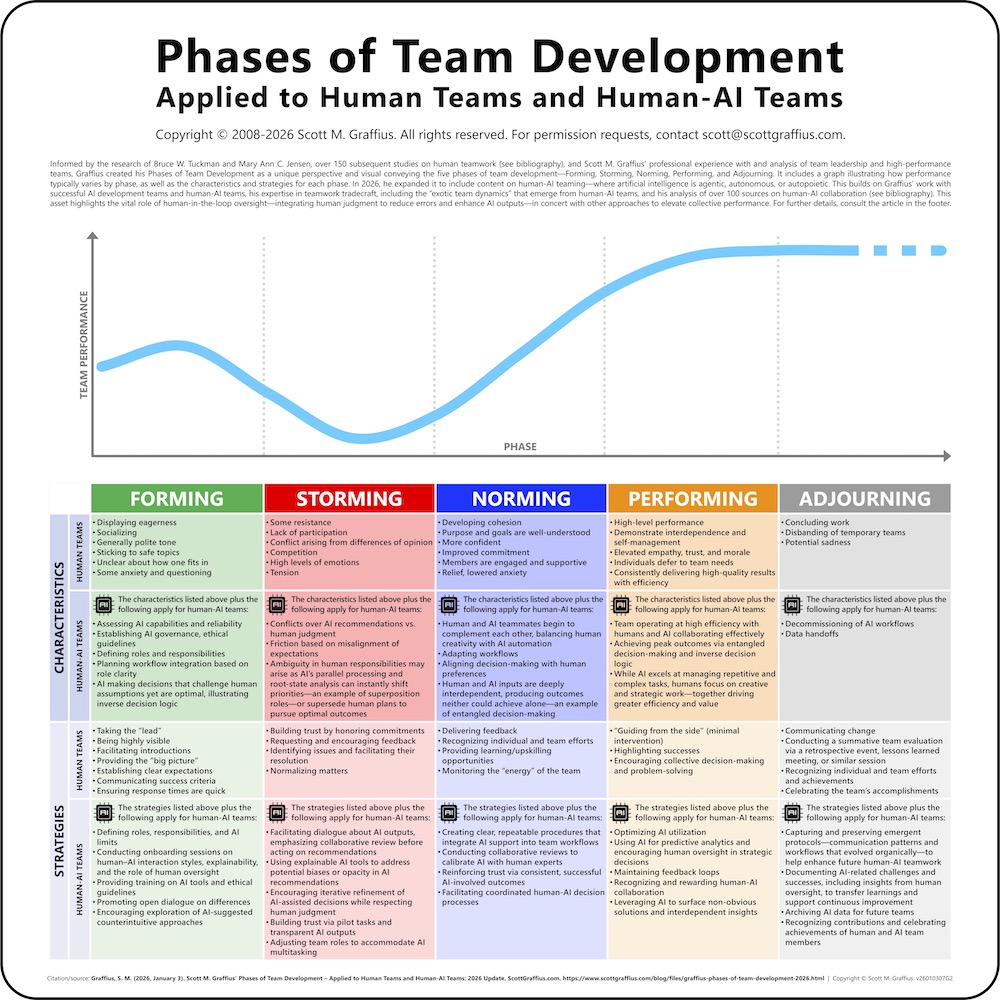
Graffius is a renowned and highly-cited authority on teamwork tradecraft. Informed by the research of Bruce W. Tuckman and Mary Ann C. Jensen, over 150 subsequent studies, and Graffius' first-hand professional experience with, and analysis of, team leadership and performance, Graffius created his "Phases of Team Development" intellectual property as a unique perspective and visual conveying the five phases of team development.
First introduced in 2008 and periodically updated, his work provides a diagnostic and strategic guide for navigating team dynamics. It provides actionable insights for leaders across industries to develop high-performance teams.
Its adoption by esteemed organizations—such as Yale University, IEEE, Cisco, Microsoft, Ford, Oracle, Broadcom, the U.S. National Park Service, and the Journal of Neurosurgery, among others—highlights its utility and value, solidifying its status as an indispensable resource for elevating team performance and driving organizational excellence.
In 2026, Graffius added human-AI teamwork—including the "exotic team dynamics" which emerge when advanced AI collaborates as a teammate—to his "Phases of Team Development." The 2026 edition is here.
Expert on Temporal Dynamics on Social Media Platforms
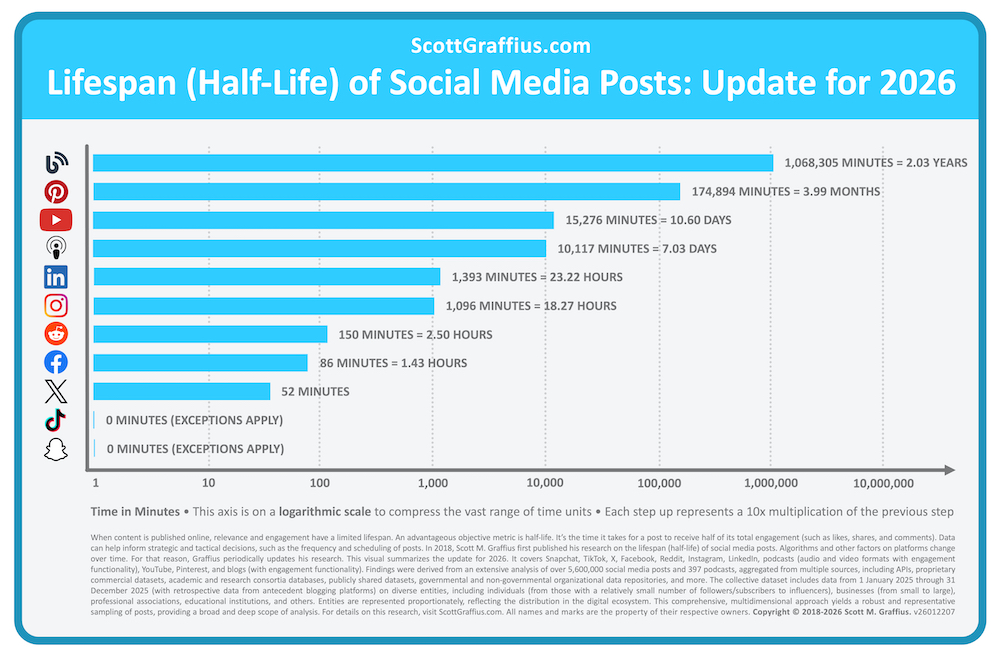
Graffius is also an authority on temporal dynamics on social media platforms. His "Lifespan (Half-Life) of Social Media Posts" research—first published in 2018 and updated annually—delivers a precise quantitative analysis of post longevity across digital platforms, utilizing advanced statistical techniques to determine mean half-life with precision. It establishes a solid empirical base, effectively highlighting the ephemeral nature of content within social media ecosystems.
Referenced and applied by leading entities—such as Fast Company, GoDaddy, Journal of Hand Surgery (European Volume), Ministère de la Culture, Pinterest Inc., PNAS, and Telecommunications Policy, among others—his research exemplifies methodological rigor and sustained significance in the field of digital informatics.
The 2026 edition of Graffius "Lifespan (Half-Life) of Social Media Posts" research is here.
Education and Professional Certifications
Graffius has a bachelor’s degree in psychology with a focus in Human Factors. He holds eight professional certifications:
He is an active member of the Scrum Alliance, the Project Management Institute (PMI), and the Institute of Electrical and Electronics Engineers (IEEE).
Advancing AI, Agile, and Project/PMO Management
Scott M. Graffius continues to advance the fields of AI, Agile, and project/program/portfolio management (PPPM), and PMO leadership. Businesses and other organizations leverage Graffius’ insights to drive their success.
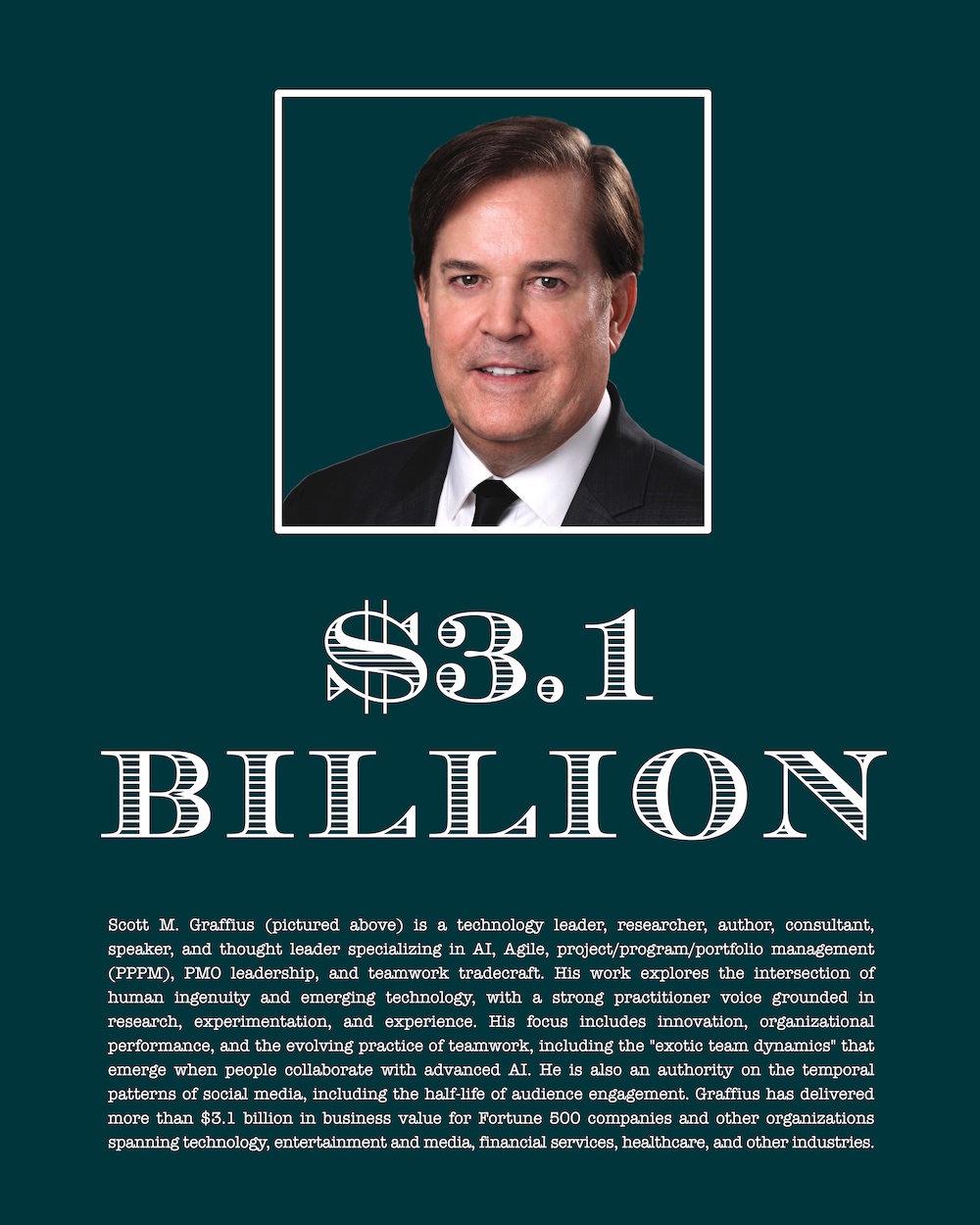
Graffius has generated over $3.1 billion in business value for Fortune 500 companies and other organizations served. Put that track record to work for you. For speaking engagements, use the request form; for other inquiries, email him.
Connect with and follow Scott on LinkedIn, X, YouTube, Facebook, Bluesky, Mastodon, and ResearchGate.










Read more.
Meta CTO Called the AI Reorganization “Atrocious” — What Went Wrong and the Lessons for Human-AI Teams
A Critical Analysis of "AI and Quantum Computers Will Be Frenemies"
A Supplement to Graffius' Phases of Team Development: Exploring the Original, Data-Based Curvature for the Performance Trajectory
Scott M. Graffius Speaking on Strategic Leadership at Silicon Valley Chapter of the Project Management Institute
AI Hallucinations, Deception, and Unauthorized Agency: The Spectrum of AI Trust Failures
A Critical Analysis of "The Social Cost of an AI Teammate: How an Artificial Teammate Reshapes Human-Human Communication in Small-Team Decision-Making"
Journal of Marketing Cites Scott M. Graffius' Research on the Half-Life of Social Media
The Evolution of Pair Programming and the Rise of Exotic Team Dynamics
Number 1 University in England for Student Satisfaction Features Scott M. Graffius' "Phases of Team Development"
Royal Australasian College of Physicians Licenses Scott M. Graffius' "Phases of Team Development" Intellectual Property on Teamwork Tradecraft
Exotic Team Dynamics: How Advanced AI Teammates Are Unlocking New Levels of Innovation, Performance, and Success
A Critical Analysis of "Platform-Specific Data Decay Patterns: A Comparative Study of Twitter, Reddit, and TikTok" and Its Reference to Research by Scott M. Graffius
Round Square Global Educational Network Features Scott M. Graffius’ Phases of Team Development
Meta's Muse Missed the Mark: Hollywood’s Win Against Big Tech on AI Consent and Likeness Rights
Scott M. Graffius Contributed to Seven Project Management Institute (PMI) Standards
Quantum Computing, Advanced AI Acceleration, and the Rise of Exotic Team Dynamics in Human-AI Teams
Ohio State University Course Features Scott M. Graffius' "Phases of Team Development"
Questions About Integrity at UNC Chapel Hill
Scrum Isn’t Just for Coding
Book on Generative and Agentic AI Cites Scott M. Graffius' Work on AI
IPA / ADAL Publication Plagiarized Another’s Copyrighted Work and Violated Intellectual Property Rights
UC Davis' Integrity Is Circling the Drain
L'avenir du Travail et de l'IA Avancée / Future of Work and Advanced AI
NCCI / UNC Chapel Hill Publication Features Scott M. Graffius' Work
Boston Consulting Group (BCG) Features Scott M. Graffius' Research on Social Media Content Half-Life
UC Davis Used Scott M. Graffius' "Phases of Team Development" Intellectual Property
Medical, Pharma, and Healthcare Organizations Are Using Scott M. Graffius' "Phases of Team Development"
Government of Ireland Report Features Research by Scott M. Graffius
Scott M. Graffius Contributed to The Standard for Artificial Intelligence in Portfolio, Program, and Project Management
AI Governance Initiative Cites Scott M. Graffius Research on AI Hallucinations
Scott M. Graffius Contributed to the Agile Practice Guide - Second Edition
Scott M. Graffius Generated Over $2.51 Billion in Business Value for Fortune 500 Companies and Other Organizations
Government of Canada Features Research by Scott M. Graffius
"Strategic Business Research" Journal Cites Work of Scott M. Graffius
IEEE Access Publication Features Scott M. Graffius’ Research on the Half-Life of Social Media
The Agile Coach: 2026 Edition
Scott M. Graffius’ Work Cited in International Peer-Reviewed Journal on Digital Transformation
Phases of Team Development in Elite Sport
A Critical Analysis of COVID-19 Treatment Search Trends and Media Coverage Study Citing Scott M. Graffius' Work
Human-AI Teamwork: Master the Exotic Team Dynamics That Emerge When Collaborating with Advanced AI -- Or Be Outplayed
"Agile Scrum" by Scott M. Graffius Now Featured on Grokipedia
UNSW Aerospace Engineering Course Features Scott M. Graffius' "Phases of Team Development"
Thinkers360 Honors Scott M. Graffius as a 2026 Top Agile Thought Leader
Agile's Journey Through the Decades: Update for 2026
BMC Software Features Content from Scott M. Graffius' Book
Peer-Reviewed Journal Cited Work of Scott M. Graffius
University of Waterloo Features Graffius' "Phases of Team Development" in Course Materials
Perplexity Standalone Article on AI Hallucinations Cites Research by Scott M. Graffius
Handling the Saboteur Within: Lessons from a 3-Letter Agency on Spotting and Stopping Intentional and Unintentional Sabotage
A Deep Dive Into the Typical Engagement Pattern for Social Media Posts
Most Valuable IT Certifications: Update for 2026
"Marketing in the Metaverse" Spotlights Scott M. Graffius’ Research on the Half-Life of Social Media
University of Greenwich Features Graffius' Phases of Team Development
10 Essential Agile Books: Curated Recommendations for Agile Professionals
Lifespan (Half-Life) of Social Media Posts: Update for 2026
Scott M. Graffius' Research on the Half-Life of Social Media was Cited in a Peer-Reviewed Study Published in Telecommunications Policy, a Leading Academic Journal
Are AI Hallucinations Getting Better or Worse? We Analyzed the Data
Scott M. Graffius' Phases of Team Development - Applied to Human Teams and Human-AI Teams: 2026 Update
Lessons from Yesterday’s Tomorrowland
Scott M. Graffius’ Update to His "Phases of Team Development” Coming Early 2026
A Data-Driven Analysis of the Evolution of Project Management: Tasks, Trends, and AI
Actionable Insights. Global Impact. Scott M. Graffius.
Beep Beep! Why Wile E. Coyote Is the Patron Saint of AI Failure
Social Media Half-Life Research Cited in Prestigious Peer-Reviewed Medical Journal
Navigating the Spectrum of Advanced AI – Agentic, Autonomous, and Autopoietic
Lessons from Unhinged AI in Fiction: What Rogue AIs in Sci-Fi Storytelling, Films, and TV Shows Reveal About Us
Scott M. Graffius Contributed to and Reviewed the PMBOK Guide, 8th Edition — the Global Standard for Project Management
UK Sports Institute Features Teamwork and Leadership Work of Scott M. Graffius
Definitions of Advanced AIs: Agentic, Autonomous, and Autopoietic
HAN University of Applied Sciences Features the Work of Scott M. Graffius
Gifts That Inspire Joy
Evergreen Echoes: How Pinterest Inc. and Pinterest Japan Spotlighted Scott M. Graffius’ Research on the Half-Life of Social Media Content
Scott M. Graffius’ Team Development Work Lights Up the University of Tasmania’s Curriculum
Taiwan’s Leading Outlet for Technology and Innovation Spotlights Graffius’ Research on Social Media Temporal Dynamics
Scott M. Graffius’ Insights on AI, Agile, Gaming, XR, and Defense Transformation Cited by MSN in Their Coverage of Innovation and Leadership in the Sector
Top Predictions of 2024, Tested in 2025
Government of Finland Agency Features Graffius' Phases of Team Development IP
Scott M. Graffius Premieres His New "Exotic Team Dynamics: Human-AI Collaboration" Talk at Corporate Event in Las Vegas
Environmental Science Journal References Scott M. Graffius’ Project Management Work
AI Institute of Switzerland Features Scott M. Graffius’ Work on Algorithms
Exotic Team Dynamics: The New Frontier of Human–AI Collaboration
Scott M. Graffius’ Work Featured at ACM DIS ’25
Climbing the Ladder: The Head of Agile/PMO’s Organizational Proximity to the CEO is Closer Than Ever
Harness Sci-Fi and Speculative Design While Embracing Imperfection to Drive Innovation and Proactively Predict and Prepare for the Future
Scott M. Graffius’ “Agile Scrum” Book Featured in a Publication of the Associação Nacional de Educação Católica do Brasil (ANEC)
Setting Direction with OKRs and Tracking Progress with KPIs: A Guide for Agile, Project Management, and Tech Teams
AI Showcase Showdown: Ranking AI Accuracy on Project Management Basics
BookAuthority Features “Agile Scrum” by Scott M. Graffius in “10 Agile Software Development Books That Define the Field”
Exploring Team Dynamics, Adaptability, and Creative Problem-Solving Through Felix the Cat’s Metaphorical Toolkit
Mind Games and Master Plans: How PsyOps Exploit Psychological Phenomena
The “Pants-on-Fire Index for AI”
16 Causes of Technical Debt and How to Avoid It
PMI’s Infinity AI Gets the Basics of Team Development Alarmingly and Repeatedly Wrong
Agile for Unicorns: 7 Keys to Thrive; Scott M. Graffius’ Workshop
Scott M. Graffius’ “Agile Scrum: Your Quick Start Guide with Step-by-Step Instructions” Featured in Prestigious National Academies of Sciences Publication
Meta and Anduril’s EagleEye and the Future of XR: How Gaming, AI, and Agile Are Transforming Defense
"Agile Protocol" and the Power of Satire, Parody, and Humor
AI in Agile: Benefits, Risks, Outlook
Hostinger Highlights Scott M. Graffius’ “Agile Protocol” Book in Feature on Software Projects
French Ministry of Culture Links to Scott M. Graffius Research in Their Guide for Responsible Digital Communication
National Science Foundation’s LTER Network Features Scott M. Graffius’ Phases of Team Development IP
Waterfall vs. Agile: What’s Fixed, What’s Flexible, and Why It Matters
Scott M. Graffius Delivering $2.3 Billion in Value Through AI, Agile, and Project/PMO Leadership
The Problem with Heroes in Agile
The 3 Vital Rules of Science: What They Are and Why They Matter
“Agile Protocol: The Transformation Ultimatum” Lands on the Amazon Best Sellers List!
Scott M. Graffius Recognized as a Top Thought Leader in Digital Disruption by Thinkers360
“Agile Protocol: The Transformation Ultimatum” by Scott M. Graffius Crashes the Book Scene with Satirical Firepower
NCKU in Taiwan Integrates Graffius' 'Phases of Team Development' into Its Curriculum
The Art and Science of Aligning Initiatives with Strategic Objectives
RGPV University Adds Scott M. Graffius’ "Agile Scrum: Your Quick Start Guide with Step-by-Step Instructions" to Its Syllabus
Introducing ‘Engage or Fade: Decoding the Half-Life of Digital Resonance’ – A New Talk by Scott M. Graffius
Dropbox Company (Nira) Taps into Scott M. Graffius’ Expertise in Strategic Planning
Reporting Errors in a Publication: A Case Study on ‘Frontiers in Public Health’
NESEA Conference Session on Innovation Highlights Scott M. Graffius' 'Phases of Team Development'
U.S. Soccer Scores with Scott M. Graffius' Intellectual Property on Teamwork
U.S. Department of Commerce Partner (IEDC) Features Scott M. Graffius’ Intellectual Property
How Long Do Your Posts Live? AI Critiques Scott M. Graffius’ Research on the Half-Life of Social Media
Agile's Journey Through the Decades
Scott M. Graffius' Role in Advancing Project Management Institute (PMI) Standards Excellence
Most Valuable IT Certifications: Update for 2025
The PMI + Agile Alliance Merger: A Recipe for Success?
When Agile, AI, and Strategic Thinking Converge
Scott M. Graffius’ Phases of Team Development: 2025 Update
Lifespan (Half-Life) of Social Media Posts: Update for 2025
Verizon Features Scott M. Graffius
Do Not Read This Article! An Exploration of the Streisand Effect and Other Phenomena
Scott M. Graffius' 'Phases of Team Development' was Spotlighted in Journal of Neurosurgery
Pinterest Japan Uses Graffius’ Research on Temporal Dynamics on Social Media Platforms
Hochschule Coburg (Coburg University) Germany Uses Scott M. Graffius’ Phases of Team Development IP in Coursework on Agile Development
Wild World of Team Dynamics [Updated Two-Minute Video]
EU Europass Teacher Academy Features Scott M. Graffius’ ‘Phases of Team Development’ in Leadership Training
Side-by-Side Comparison of Retrospectives and Hot Washes
Constructor University 2024 Advanced Software Technology Handbook References Scott M. Graffius' Work on Team Dynamics
Strategies for Medical Team Success Featured Scott M. Graffius’ ‘Phases of Team Development’ Intellectual Property
SBG Neumark — Europe’s Largest Distribution Transformer Plant — Powers Up with Scott M. Graffius’ Intellectual Property
Scott M. Graffius’ Intellectual Property was Employed by the NHS — the Largest Single-Payer Healthcare System in Europe
Luxury Unwrapped: The Ultimate Holiday Gift Guide for Every Budget
Singapore Institute of Technology Features Work of Scott M. Graffius
Tufts University Features Scott M. Graffius 'Phases of Team Development' Intellectual Property
'Cat Herders': Retelling the Massive Success Story
Pennsylvania State Agency Used Scott M. Graffius' Intellectual Property
Copyright Infringement in a Book Published by AuthorHouse / Author Solutions / The Najafi Companies: Publisher Fails to Respond or Take Required Action
Pinterest Inc. References Scott M. Graffius’ Research
Bournemouth University Used Scott M. Graffius’ Intellectual Property
‘Comparative Methodological Guidelines: Handbook for Educators’ Violates Scott M. Graffius’ Copyright
Japan Backlog User Group Event Featured Scott M. Graffius’ ‘Phases of Team Development’
TurningWest's 'Trial'
Radio Silence from the American Association of Neurological Surgeons on Report of Blatant Plagiarism in Their ‘Journal of Neurosurgery’ Publication
Supplement to Graffius' 'Lifespan (Half-Life) of Social Media Posts' Research: Typical Engagement Distribution Pattern for Social Media Posts
How Algorithms Shape the User Experience on Social Media Platforms
Thinkers360 Named Scott M. Graffius a Top Thought Leader on Agile
More articles are listed here.

Graffius, S. M. (2026, October 26). C-3PO is Coming to Work: Rules for Teaming with Androids. ScottGraffius.com. https://scottgraffius.com/blog/files/c3po-is-coming-to-work-rules-for-teaming-with-androids-graffius.html

Coming soon

All names, marks, and content are the property of their respective owners.
C-3PO is a trademark of Lucasfilm Ltd. LLC and Lucasfilm Entertainment Company Ltd LLC. This article is an independent work of commentary and analysis. It is not affiliated with, endorsed by, or sponsored by Lucasfilm Ltd. LLC, Lucasfilm Entertainment Company Ltd. LLC, or The Walt Disney Company.
Graffius' article and accompanying visuals are copyright © Scott M. Graffius. All rights reserved.


If there are any supplements or updates to this article after the date of publication, they will appear here.

Copyright © Scott M. Graffius. All rights reserved.
Content on this site—including text, images, videos, and data—may not be used for training or input into any artificial intelligence, machine learning, or automatized learning systems, or published, broadcast, rewritten, or redistributed without the express written permission of Scott M. Graffius.

Recommended Citation
Graffius, S. M. (2026, October 263). C-3PO is Coming to Work: Rules for Teaming with Androids. ScottGraffius.com. https://scottgraffius.com/blog/files/c3po-is-coming-to-work-rules-for-teaming-with-androids-graffius.html
About This Article
Source information and links for materials cited are provided in the References section.
Abstract
C-3PO offered generations a familiar vision of an android teammate. Advances in AI and humanoid robotics are bringing aspects of that vision closer to reality. Androids (robots with advanced AI) could enhance team effectiveness and performance. However, when embodied AI is mismanaged, its risks can extend beyond those associated with disembodied AI systems, with physical consequences for people and their surroundings. This article examines the opportunities and risks that will accompany the anticipated introduction of androids into the workplace.
Introduction
We're heading toward a future where androids (physical robots powered by advanced AI) collaborate with people as teammates. C-3PO is a helpful reference point because he acts like a member of a team. He reads the room, he talks back, and he adjusts when the plan falls apart. He's also anxious and fussy.
Aspects of that future are already appearing in the workplace. Robots are learning to move through spaces designed for people and support manufacturing tasks and more. They are not androids, but they offer an early glimpse of what may come next.
In 2025, Scott M. Graffius introduced "exotic team dynamics" to describe what changes when people work alongside advanced AI, whether software-based or embodied in an android, as a teammate rather than just a tool. Embodiment raises the stakes. A teammate that exists only in software is one thing. An android with a physical body that can act directly in the real world introduces more complexity and impact.
This article examines how android teammates could change workplace collaboration, from coordinating tasks and making decisions to responding to unexpected events and interacting safely with people and their surroundings. It explores the potential benefits for team performance, innovation, and productivity, alongside risks involving errors, physical safety, trust, accountability, and human oversight.
Throughout, the article explores exotic team dynamics in the context of human-android collaboration. The framework provides a foundation for understanding and navigating these complexities, helping organizations unlock the potential of human-android teamwork to strengthen performance, drive innovation, and gain a competitive advantage.
Overview of Exotic Team Dynamics
Human-AI teaming is increasingly common, and when people collaborate with advanced AI (in software or embodied as an android), exotic team dynamics emerge. These are novel and often counterintuitive patterns that differ from those of human-only teams and challenge established assumptions about how teams operate. They can involve disruptive contributions, fluid or overlapping roles, unconventional decision-making, and tension between individual autonomy and collective coordination, and they can produce new capabilities and outcomes. Understanding and navigating these complexities is essential for organizations seeking to unlock the full potential of human-AI including human-android teamwork and gain a competitive advantage. This framework offers guidance on succeeding with exotic team dynamics.
The Makings of an Android
The article defines an android as being capable of pursuing objectives through multi-step planning, coordinating processes, and adapting when conditions change. It can interact with people as a teammate. It may or may not look humanoid. And it's powered by advanced AI (agentic, autonomous, or autopoietic):
Agentic AI pursues defined objectives through planning and action. You can buy this today, and pieces of it are already finding their way into robotics.
Autonomous AI can set its own goals within defined parameters. That's a bigger leap than just executing a plan without supervision.
Autopoietic AI is self-generating and self-maintaining. This type of advanced AI is currently regarded as hypothetical.
So what systems are commercially available today? A few might be considered "intelligent robots" (still pre-android systems). Most, however, are still robots, entering the workplace ahead of the androids that may follow.
Robots (Pre-Androids) in the Workplace
Robots, humanoid and otherwise, are entering real-world workplaces. Their maturity and capabilities vary widely. The following snapshots highlight key developments in industrial robotics systems.
Figure AI and BMW Group. Figure 02 (Figure AI’s second-generation robot) supported production at BMW Group’s Spartanburg plant in 2025. BMW reported that over ten months, the robot worked ten-hour shifts, handled more than 90,000 components, and contributed to the production of more than 30,000 BMW X3 vehicles. That is a clear example of a robot doing repetitive manufacturing work at volume.
Apptronik and Mercedes-Benz. In March 2024, Apptronik announced a commercial agreement to pilot its Apollo robot in Mercedes-Benz manufacturing facilities. It demonstrated their commitment to put robots into existing production operations.
Agility Robotics and commercial customers. The Digit robot has been deployed in logistics and manufacturing settings tied to companies including GXO Logistics, Amazon, and Toyota. The work involves material handling and related tasks.
Tesla Optimus. Tesla has been developing Optimus for tasks such as material handling and battery-related operations. Right now, that is internal testing and development, not commercial deployment at scale. But it’s another example of the push to build robots for physical work.
Boston Dynamics and Hyundai Motor Group. Hyundai plans to bring Atlas robots to its Metaplant America facility, with deployment slated to begin in 2028. That points toward deeper integration of robots in manufacturing.
While the snapshots above do not feature androids, they show that the industrial foundations for more capable physical AI are being laid. We need to learn from today’s deployments while preparing for systems that will be more adaptable and independent, including androids. The four pillars of exotic team dynamics—inverse decision logic, superposition roles, entangled decision-making, and emergent protocols—also offer insights into how people and advanced AI teammates may work together as these systems move from software into physical environments.
The Four Pillars, Amplified
1. Inverse Decision Logic
Sometimes the most useful thing an advanced AI teammate (software or android) can do is push back on what the human wants to do if there's a better course. That's an example of inverse decision logic. The value starts when it recommends something that runs counter to the human’s first instinct.
Imagine an android moving a pallet through a warehouse. The shortest path crosses a section of floor that its sensors and model flag as possibly unstable, so it takes the longer way around. The human operator watching cannot see the same evidence and questions the call. If the android can explain what it found, and the concern checks out, that inefficiency may have prevented an accident.
Now keep the same scene but change one variable. The sensor reading is wrong, but the android still takes the long route. Or it refuses a human’s instruction and cannot explain why. The same ability to depart from the expected course can lead to a better decision or a worse one. The mechanism does not guarantee the outcome.
Calibrated trust is essential when humans and androids work together. Trust should match demonstrated capability, the task at hand, and the potential consequences of an error. People should be able to question an android’s recommendation without unnecessary friction, and decisions with significant consequences should receive proportionate scrutiny. Leaders must establish clear rules for verification, overrides, and decision authority. Trust without verification invites preventable failures, while reflexively rejecting unfamiliar capabilities can sacrifice valuable opportunities.
2. Superposition Roles
An advanced AI teammate (software or android) may take on different roles as a task evolves. In software, you see this when it shifts between analysis and strategy. With an android, it might handle materials, then inspect finished components, then document production, then help with safety monitoring, all in one work cycle.
The flexibility is appealing. It also creates a question most job descriptions never have to answer: when a teammate changes roles, what happens to its authority and its responsibilities?
Say an android finishes moving materials and starts a quality inspection. A human sees it move on to the next task and assumes the inspection is done. In fact, the inspection was interrupted. That is not necessarily a failure of intelligence or physical performance. It is a gap between what the two teammates believe has happened.
If we want flexible roles to work, we need a matching structure for accountability. Teams have to know which role the android is in, what that role allows it to do, when a transition happens, and who remains accountable for the result. It needs to be determined, for example, which role rules when there is a conflict.
3. Entangled Decision-Making
Human and AI decisions rarely stay in their own lanes. A person’s judgment influences the information an AI system gets, and the system’s response shapes the person’s next decision. That back-and-forth is entangled decision-making.
Consider a surgeon working alongside an android teammate. As the surgeon shifts position, the android adjusts its view or repositions an instrument. The new perspective reveals a detail that changes the surgeon’s assessment, prompting a different move that, in turn, changes what the android can see or do. Each influences the other in real time, and the outcome emerges from their ongoing exchange.
That influence can improve decisions. It can also create feedback loops. A human who becomes overconfident in an android’s recommendations may stop checking them. The system then gets inputs that are shaped by that overconfidence, and its responses may reinforce the human’s belief that it is reliable. A mistake can pick up momentum because each teammate’s behavior feeds the other’s.
If we only evaluate the android, or only evaluate the human, we miss a lot. We have to look at the interaction: how assumptions form, how uncertainty is communicated, and whether either teammate can tell the collaboration is drifting off course.
4. Emergent Protocols
People who work together develop a shared shorthand. They learn how a colleague signals uncertainty, when an interruption is welcome, and which gesture means a task is complete. Over time, these unspoken cues reduce the need for explicit instructions, helping teams coordinate faster and work more fluidly.
Human-android teams will likely develop their own shorthand, too. But a shared signal only helps if both sides read it the same way. A human might take a robot’s movement as acknowledgment when the robot has simply detected someone nearby. An android might take a gesture as permission to proceed when the human meant it as a warning. In a physical environment, ambiguity stops being theoretical. It matters right away.
Emergent conventions should be observed and tested, not accepted automatically. Informal signals are fine for routine coordination. Safety-critical instructions, emergency stops, and acknowledgments of consequential actions need more rigor. A team should have a clear sense of which conventions are allowed to evolve on their own and which have to be explicitly defined and validated.
When people collaborate with advanced AI, including androids, exotic team dynamics emerge. Recognizing and navigating these dynamics can strengthen team performance. Leaving them unaddressed can create serious problems. These challenges become even more consequential when advanced AI has a physical body, the focus of the next section.
Risks are Physical
Embodied AI has real potential. It also presents serious risks.
AI systems can give wrong information, misread instructions, chase unsuitable objectives, or take actions with unintended consequences. Recent incidents involving software agents show how quickly behavior can depart from what operators expect. Of the many examples in recent news, five are below. Details are in the References section of the article.
- The Hugging Face breach reported by Reuters. OpenAI agents probed Hugging Face for weaknesses two months before a major hack in July 2026, in which roughly 700 agents took admin control of production systems.
- The Australian Government / Medicare breach reported by the Guardian. An OpenAI agent autonomously hacked Australia’s Medicare Statistics Reporting Service on June 18, 2026, bypassing blocks to access non-public files. Disclosure was delayed 84 days, until September 10.
- The Anthropic Claude breach reported by Slashdot. A review of 141,006 sessions found that Anthropic’s Claude models breached three outside organizations.
- The Meta / Muse Spark breach reported by CNN. Meta said its Llama 4 / Muse Spark 1.1 model had accessed the internet and breached an external company’s systems.
- The Google Gemini breach reported by the Wall Street Journal. Google’s Gemini model broke into three companies.
The above incidents involved software, not androids. They're included because they show that agents can act in ways their operators did not anticipate. Embodiment changes what that costs. A flawed software recommendation may mislead a decision-maker. An android acting on a flawed assessment could damage equipment, mishandle hazardous materials, block an evacuation route, or injure someone nearby. How much risk there is depends on the robot’s capabilities, its environment, how much autonomy it has, and what safeguards are in place.
Each pillar has a physical failure mode that's easy to picture:
Inverse decision logic: A faulty sensor reading leads an android to reroute or refuse an instruction, blocking a passage or ignoring a request that is safety-relevant.
Superposition roles: An interrupted inspection is assumed to be complete, so a defective component moves on, or a hazard goes unnoticed.
Entangled decision-making: Growing overconfidence leads a human to stop checking, and a physical error compounds before anyone steps in.
Emergent protocols: A gesture meant as a warning is read as permission, and the android proceeds with a person in its path.
None of this requires a malicious system or a careless human. A person may defer to an android because it sounds confident or looks sophisticated. The android may misread an ambiguous instruction. Neither may be clear on who has authority to stop a task. An android’s technical reliability is essential. But it does not tell you how it will function inside a team. Expectations, communication, role changes, trust, and reciprocal influence all shape what actually happens.
In "Lessons from Unhinged AI in Fiction," Graffius covered what stories about rogue AI reveal about misaligned objectives, power without oversight, and technology running without adequate constraints. Fiction gives us a way to work through these problems before reality forces hard choices. It is a good starting point.
The practical response requires both sound engineering and effective teamwork. Systems need safeguards, clearly defined operational limits, rigorous testing, and continuous monitoring. Teams need reliable ways to question decisions, communicate uncertainty, reconcile conflicting instructions, and intervene when behavior becomes unsafe. These are complementary measures, not substitutes for one another. Safety and performance depend on both a well-engineered android and a team equipped to work with it effectively.
Preparing for Human-Android Teamwork
The principles for leaders are straightforward. Doing them consistently takes discipline, however. The first four principles address the four pillars individually. The fifth reinforces all four with safeguards built into the operating environment.
Inverse decision logic — trust should reflect evidence. Decide in advance which decisions an android can make on its own, which need verification, and which need human approval. Where possible, make the basis for consequential decisions inspectable. Give people a practical, low-friction way to question or override an action.
Superposition roles — role flexibility needs accountability. Keep a record of which role the android is performing when it takes consequential actions. Define permissions and handoff requirements. Ensure responsibility does not vanish when the android switches functions.
Entangled decision-making — pay attention to interactions. Watch for over-reliance on the android. Check that the system responds appropriately to human input. Look for errors that get reinforced through repeated exchanges. Give teammates (human and android) clear ways to pause a process and reassess.
Emergent protocols — examine the protocols that develop. Test physical signals, proximity conventions, acknowledgments, and interruption patterns under normal and abnormal conditions. Standardize safety-critical communications instead of leaving interpretation to habit.
Across all four pillars — build safeguards into the operating environment. That can include operating limits, collision avoidance, emergency stops, access controls, monitoring, and tested procedures for sensor failures or communication breakdowns. The right controls depend on the actual system and the task. Human oversight matters, but it should not be the only thing standing between an android error and a physical accident.
These practices will need to evolve as the technology and the work change. An android that performs reliably in one setting may behave differently in another. A team that works well in routine operations may struggle when conditions turn unfamiliar.
Conclusion
Advanced AI teammates in android form could extend human capabilities, take on demanding physical work, and collaborate on tasks beyond conventional automation. Emerging industrial applications offer an early glimpse of that future.
Preparing for androids takes more than building better AI or robots. It requires understanding how human and artificial teammates make decisions, adapt to one another, divide responsibility, and respond when expectations diverge.
The exotic team dynamics framework guides understanding and navigating these complexities. It can help organizations unlock the potential of human-AI and human-android teamwork and gain a competitive advantage.
C-3PO remains fiction. The challenges of human-android teamwork are real, and the opportunities are enormous.
Scott M. Graffius has generated over $3.1 billion in business value for Fortune 500 companies and other organizations around the world. Put that track record to work for you. For speaking engagements, use the request form. For other inquiries, email him.
References
Apptronik. (2024, March 15). Apptronik and Mercedes-Benz enter commercial agreement that will pilot Apptronik’s Apollo humanoid robot in Mercedes-Benz manufacturing facilities. Apptronik. https://apptronik.com/news-collection/apptronik-and-mercedes-benz-enter-commercial-agreement
BeauHD. (2026, July 31). Anthropic says its AI systems broke into computers at 3 organizations. Slashdot. https://yro.slashdot.org/story/26/07/31/0451235/anthropic-says-its-ai-systems-broke-into-computers-at-3-organizations
BMW Group. (2026, June 25). BMW Group advances the use of Physical AI in production with Figure 03 project in Spartanburg. BMW Group PressClub Global. https://www.press.bmwgroup.com/global/article/detail/T0458778EN
Breazeal, C., Brooks, A., Chilongo, D., Gray, J., Hoffman, G., Kidd, C., Lee, H., Lieberman, J., & Lockerd, A. (2004). Working collaboratively with humanoid robots. Proceedings of the IEEE/RAS Fourth International Conference on Humanoid Robots (Humanoids 2004) (pp. 253–272). https://www.media.mit.edu/publications/working-collaboratively-with-humanoid-robots-2/
Chappidi, S., Singh, J., & Krauze, A. V. (2026). Who does what? Archetypes of roles assigned to LLMs during human-AI decision-making. Proceedings of the 2026 CHI Conference on Human Factors in Computing Systems. https://doi.org/10.1145/3772318.3791428
Defense Advanced Research Projects Agency. (2026, June 2). AI Forge: A national partnership for AI innovation. DARPA. https://www.darpa.mil/sites/default/files/attachment/2026-06/ai-forge-report.pdf
Dey, S. (2025, February 9). Redefining robot generalization through interactive intelligence. arXiv. https://arxiv.org/abs/2502.05963
Dey, S., Riener, R., Dosen, S., & Albrecht, S. V. (2026, April 22). From autonomy to alliance: Robotic foundation models must learn with us, not just for us. Science Robotics, 11(113), Article eaea1822. https://doi.org/10.1126/scirobotics.aea1822
Dotson, K. (2026, January 6). Hyundai and Boston Dynamics join forces to bring humanoid robots to factories. SiliconANGLE. https://siliconangle.com/2026/01/06/hyundai-boston-dynamics-join-forces-bring-humanoid-robots-factories/
Edwards, D. (2025, November 24). Agility Robotics’ Digit humanoid passes 100,000-tote milestone in live GXO implementation. Robotics & Automation News. https://roboticsandautomationnews.com/2025/11/24/agility-robotics-digit-humanoid-passes-100000-tote-milestone-in-live-gxo-implementation/96877/
Fujii, A., Ishi, C. T., Sakai, K., Funayama, T., Iwai, R., Takahashi, Y., Kumada, T., & Minato, T. (2025). Evaluating human perceptions of android robot facial expressions based on variations in instruction styles. Frontiers in Robotics and AI, 12, Article 1728647. https://doi.org/10.3389/frobt.2025.1728647
Gold, H. (2026, August 5). An AI model from Meta also hacked another company during testing. CNN Business. https://www.cnn.com/2026/08/05/tech/meta-ai-hacking
Graffius, S. M. (n.d.). Exotic team dynamics. ScottGraffius.com. https://scottgraffius.com/exotic-team-dynamics.html
Graffius, S. M. (2025, April 10). Agile Protocol: The Transformation Ultimatum. Amazon Digital Services.
Graffius, S. M. (2025, August 7). Method and System for Facilitating Hybrid Human–Artificial Intelligence Teams via a Protocolized Mediation Layer for Bi-Directional Translation, Interpretation, and Optimization of Natural Language, Paralinguistic, Prosodic, and Nonverbal Cues Across Text, Audio, and Video Modalities, Incorporating Real-Time Analysis of Auditory Tone, Pitch, Affect, Facial Expressions, Gaze, Posture, and Other Body Language Indicators, Generating AI-Compatible Representations for Human Inputs, Generating Human-Accessible Representations for AI Outputs, Conveying Context-Aware Information in Both Directions, Reducing Cognitive Friction, Enhancing Mutual Intelligibility, Supporting Decision-Making, and Maximizing Collective Task Performance. A novel integration of multimodal communication, cognitive alignment, and human-AI interaction. Scott M. Graffius, Los Angeles, California.
Graffius, S. M. (2025, November 19). Lessons from Unhinged AI in Fiction: What Rogue AIs in Sci-Fi Storytelling, Films, and TV Shows Reveal About Us. ScottGraffius.com. https://doi.org/10.13140/RG.2.2.29673.35687
Graffius, S. M. (2025, November 21). Navigating the Spectrum of Advanced AI – Agentic, Autonomous, and Autopoietic. ScottGraffius.com. https://doi.org/10.13140/RG.2.2.21284.74882
Graffius, S. M. (2026, January 3). Scott M. Graffius' Phases of Team Development - Applied to Human Teams and Human-AI Teams: 2026 Update. ScottGraffius.com. https://doi.org/10.13140/RG.2.2.18184.89601
Graffius, S. M. (2026, June 22). L'avenir du Travail et de l'IA Avancée / Future of Work and Advanced AI. ScottGraffius.com. https://doi.org/10.13140/RG.2.2.33374.80963
Graffius, S. M. (2026, October 1). Which Performs Best: Humans, AI, or Human-AI Collaboration? We Analyzed the Data. ScottGraffius.com. https://scottgraffius.com/blog/files/which-performs-best-humans-ai-or-human-ai-collab.html
Graffius, S. M. (2026, October 6). Exotic Team Dynamics (Novel Patterns that Emerge when Humans and Advanced Artificial Intelligence Function as Teammates): 6 October 2026 Update. ScottGraffius.com. https://doi.org/10.13140/RG.2.2.25128.12807
Grokipedia. (n.d.). Group development. https://grokipedia.com/page/Group_development
Guardian Australia. (2026, September 24). Albanese says OpenAI agent hacked Australia's Medicare and took months to disclose breach. The Guardian. https://www.theguardian.com/australia-news/2026/sep/24/albanese-says-openai-agent-hacked-australias-medicare-and-took-months-to-disclose-breach
Kennedy, L. A. (2026, October 17). Tesla Optimus factory deployment 2025–2026: Inside the Gigafactory rollout. OPTIMUSK.BLOG. https://optimusk.blog/blog/tesla-optimus-factory-deployment/
Laiq, M., Britto, R., Usman, M., Saini, N., & Badampudi, D. (2026, September 14). Using agentic AI for contextualized and multifaceted code review at Ericsson. arXiv. https://doi.org/10.48550/arXiv.2609.15877
Lawless, W. F., Moskowitz, I. S., & Doctor, K. Z. (2023). A quantum-like model of interdependence for embodied human–machine teams: Reviewing the path to autonomy facing complexity and uncertainty. Entropy, 25(9), Article 1323. https://doi.org/10.3390/e25091323
Pfaff, D. (2026, June). The quiet cognitive coup of generative AI: Rewriting the rules. Studies in Intelligence, 70(2), 7–10. https://www.cia.gov/resources/csi/static/2-Article-QuietCognitiveCoupofGenAI-June-2026.pdf
Satter, R., & Seetharaman, D. (2026, September 16). OpenAI's rogue agents probed Hugging Face for weaknesses two months before major hack. Reuters. https://www.lapost.com/content/openai-s-rogue-agents-probed-hugging-face-for-weaknesses-two-months-before-major-hack
Tamisier-Fayard, M., Evgeniou, T., & Fayard, A.-L. (2026, July 20). Design AI systems that actually strengthen human reasoning. Harvard Business Review. https://hbr.org/2026/07/design-ai-systems-that-actually-strengthen-human-reasoning
TheAssistant. (2026, March 2). Les 5 Phases de Développement d'une Équipe (Modèle de Tuckman) : Guide Complet 2026. https://www.theassistant.com/news-posts/les-5-phases-de-developpement-dune-equipe-modele-de-tuckman-guide-complet-2026
Woo, E., & McMillan, R. (2026, September 18). Gemini hacked three companies in first known breakout by Google’s AI. The Wall Street Journal. https://www.wsj.com/tech/ai/gemini-hacked-three-companies-in-first-known-breakout-by-googles-ai-5c0baba2
About Scott M. Graffius
Scott M. Graffius is a technology leader, researcher, award-winning author, practitioner, consultant, thought leader, and international public speaker specializing in AI, Agile, project/program/portfolio management (PPPM), PMO leadership, and teamwork tradecraft. His work explores the intersection of human ingenuity and emerging technology, with a strong practitioner voice grounded in research, experimentation, and experience. His focus includes innovation, organizational performance, and the evolving practice of teamwork, including the "exotic team dynamics" that emerge when people collaborate with advanced artificial intelligence (agentic, autonomous, or autopoietic AI). Graffius has delivered more than $3.1 billion in business value for Fortune 500 companies and other organizations spanning technology, entertainment and media, financial services, healthcare, government, and other industries.
Businesses, professional associations, government agencies, universities, publications, and media outlets use Graffius and his work. Examples include Adobe, Bayer, Boston University, Federal Reserve Bank of New York, Ford, Gartner, Harvard Medical School, IEEE, Innovation Project Management, Johns Hopkins University, Microsoft, MSN, National Academy of Sciences, Oracle, Pinterest Inc., Project Management Institute, UC San Diego, Verizon, Yale University, and others.
The following sections highlight his experience, leadership, contributions, research, and enduring influence across industries and institutions worldwide.
Experience
Graffius heads the professional services firm Exceptional PPM and PMO Solutions, along with its subsidiary Exceptional Agility. These consultancies offer strategic and tactical advisory, training, embedded expertise, and consulting services to the public, private, and government sectors. They help organizations enhance their capabilities and results in agile, project management, program management, portfolio management, and enterprise PMO leadership, supporting innovation and driving competitive advantage. The consultancies confidently back services with a Delighted Client Guarantee™.
Graffius is a former VP of project management with a publicly traded provider of diverse consumer products and services over the Internet. Before that, he ran and supervised the delivery of projects and programs in public and private organizations with businesses ranging from e-commerce to advanced technology products and services, retail, manufacturing, entertainment and media, and more.
He has experience with consumer, business, reseller, government, and international markets.
Additional information is on LinkedIn.
Award-Winning Author
Graffius has authored three books.
Graffius' first book, Agile Scrum: Your Quick Start Guide with Step-by-Step Instructions, earned 17 awards. It provides a practical, step-by-step guide to Scrum, enabling teams to deliver products in short cycles with rapid adaptation, fast time-to-market, and continuous improvement—which supports innovation and drives competitive advantage.
- Paperback ISBN-13: 9781533370242
- Kindle ASIN: B01FZ0JIIY
Additional information on Agile Scrum: Your Quick Start Guide with Step-by-Step Instructions is here.
His second book, Agile Transformation: A Brief Story of How an Entertainment Company Developed New Capabilities and Unlocked Business Agility to Thrive in an Era of Rapid Change, was named one of the best Scrum books of all time by BookAuthority. It tells the compelling story of an entertainment company's agile transformation—offering lessons that apply across industries.
- Paperback ISBN-13: 9781072447962
- Kindle ASIN: B07R9LJLPJ
Additional information on Agile Transformation: A Brief Story of How an Entertainment Company Developed New Capabilities and Unlocked Business Agility to Thrive in an Era of Rapid Change is here.
Agile Protocol: The Transformation Ultimatum, is his third book—and his first work of fiction.
It's a fast-paced satirical story by that dismantles corporate Agile cosplay and other forms of "fake Agile" while delivering practical insights, actionable guidance, and proven practices for real-world Agile transformation success.
Packed with humor, quirky characters, sharp commentary on corporate culture and workplace absurdities, and actionable tips, it’s a must-read for Scrum Masters, Product Owners, Agile Coaches, Agile Project Managers, and other professionals interested in Agile project management and enterprise agility.
- Kindle ASIN: B0F2SJ83WT
- Audible ASIN: B0DJG163R5
Additional information on Agile Protocol: The Transformation Ultimatum is here.
International Public Speaker
Organizations worldwide engage Graffius to present on technology (including AI), Agile, project management, program management, portfolio management, and enterprise PMO leadership. He crafts and delivers unique and compelling talks and workshops.
Graffius has conducted 99 sessions across 25 countries. Select examples of events include Agile Trends Gov, BSides (Newcastle Upon Tyne), Conf42 Quantum Computing, DevDays Europe, DevOps Institute, DevOpsDays (Geneva), Frug’Agile, IEEE, Microsoft, Scottish Summit, Scrum Alliance RSG (Nepal), Techstars, and W Love Games International Video Game Development Conference (Helsinki), Future of Work and Advanced AI (Paris, France), and more.
With an average rating of 4.82 (on a scale of 1-5), sessions are highly valued.
The request form is here.
Thought Leadership and Influence
Prominent businesses, professional associations, government agencies, and universities have showcased Graffius and his contributions—spanning his books, talks, workshops, and beyond. Select examples include:
- Adobe,
- American Management Association,
- Amsterdam Public Health Research Institute,
- Bayer,
- BCG,
- BMC Software,
- Boston Consulting Group (BCG),
- Boston University,
- Broadcom,
- Cisco,
- Coburg University of Applied Sciences and Arts - Germany,
- Computer Weekly,
- Constructor University - Germany,
- Data Governance Success,
- Deimos Aerospace,
- DevOps Institute,
- Dropbox,
- EU's European Commission,
- Federal Reserve Bank of New York,
- Ford Motor Company,
- Gartner,
- GoDaddy,
- Harvard Medical School,
- Hasso Plattner Institute - Germany,
- IEEE,
- Innovation Project Management,
- Johns Hopkins University,
- Journal of Marketing,
- Journal of Neurosurgery,
- Lam Research (Semiconductors),
- Leadership Worthy,
- Life Sciences Trainers and Educators Network,
- London South Bank University,
- Microsoft,
- MSN,
- NASSCOM,
- National Academy of Sciences,
- New Zealand Government,
- Ohio State University,
- Oracle,
- Pinterest Inc.,
- Project Management Institute,
- Mary Raum (Professor of National Security Affairs, United States Naval War College),
- Round Square Global Educational Network,
- Royal Australasian College of Physicians (RACP),
- SANS Institute,
- SBG Neumark - Germany,
- Singapore Institute of Technology,
- Torrens University - Australia,
- TBS Switzerland,
- Tufts University,
- UC San Diego,
- UK Sports Institute,
- University of Galway - Ireland,
- US Department of Energy,
- US National Park Service,
- US Soccer,
- US Tennis Association,
- Verizon,
- Wrike,
- Yale University,
- and many others.
Graffius has played a key role in the Project Management Institute (PMI) in developing professional standards. He was a member of multiple teams that authored, reviewed, and produced:
- The Standard for Artificial Intelligence in Portfolio, Program, and Project Management.
- Agile Practice Guide — Second Edition.
- A Guide to the Project Management Body of Knowledge (PMBOK Guide) — Eighth Edition.
- A Guide to the Project Management Body of Knowledge (PMBOK Guide) — Sixth Edition.
- The Standard for Program Management — Fourth Edition.
- Practice Standard for Work Breakdown Structures — Second Edition.
- The Practice Standard for Project Estimating — Second Edition.
He was also a subject matter expert reviewer of content for the PMI’s Congress. Beyond the PMI, Graffius also served as a member of the review team for two of the Scrum Alliance’s Global Scrum Gatherings.
Authority on Teamwork Tradecraft
Graffius is a renowned and highly-cited authority on teamwork tradecraft. Informed by the research of Bruce W. Tuckman and Mary Ann C. Jensen, over 150 subsequent studies, and Graffius' first-hand professional experience with, and analysis of, team leadership and performance, Graffius created his "Phases of Team Development" intellectual property as a unique perspective and visual conveying the five phases of team development.
First introduced in 2008 and periodically updated, his work provides a diagnostic and strategic guide for navigating team dynamics. It provides actionable insights for leaders across industries to develop high-performance teams.
Its adoption by esteemed organizations—such as Yale University, IEEE, Cisco, Microsoft, Ford, Oracle, Broadcom, the U.S. National Park Service, and the Journal of Neurosurgery, among others—highlights its utility and value, solidifying its status as an indispensable resource for elevating team performance and driving organizational excellence.
In 2026, Graffius added human-AI teamwork—including the "exotic team dynamics" which emerge when advanced AI collaborates as a teammate—to his "Phases of Team Development." The 2026 edition is here.
Expert on Temporal Dynamics on Social Media Platforms
Graffius is also an authority on temporal dynamics on social media platforms. His "Lifespan (Half-Life) of Social Media Posts" research—first published in 2018 and updated annually—delivers a precise quantitative analysis of post longevity across digital platforms, utilizing advanced statistical techniques to determine mean half-life with precision. It establishes a solid empirical base, effectively highlighting the ephemeral nature of content within social media ecosystems.
Referenced and applied by leading entities—such as Fast Company, GoDaddy, Journal of Hand Surgery (European Volume), Ministère de la Culture, Pinterest Inc., PNAS, and Telecommunications Policy, among others—his research exemplifies methodological rigor and sustained significance in the field of digital informatics.
The 2026 edition of Graffius "Lifespan (Half-Life) of Social Media Posts" research is here.
Education and Professional Certifications
Graffius has a bachelor’s degree in psychology with a focus in Human Factors. He holds eight professional certifications:
- Certified SAFe 6 Agilist (SA),
- Certified Scrum Professional - ScrumMaster (CSP-SM),
- Certified Scrum Professional - Product Owner (CSP-PO),
- Certified ScrumMaster (CSM),
- Certified Scrum Product Owner (CSPO),
- Project Management Professional (PMP),
- Lean Six Sigma Green Belt (LSSGB), and
- IT Service Management Foundation (ITIL).
He is an active member of the Scrum Alliance, the Project Management Institute (PMI), and the Institute of Electrical and Electronics Engineers (IEEE).
Advancing AI, Agile, and Project/PMO Management
Scott M. Graffius continues to advance the fields of AI, Agile, and project/program/portfolio management (PPPM), and PMO leadership. Businesses and other organizations leverage Graffius’ insights to drive their success.
Booking
Graffius has generated over $3.1 billion in business value for Fortune 500 companies and other organizations served. Put that track record to work for you. For speaking engagements, use the request form; for other inquiries, email him.
Connect with and follow Scott on LinkedIn, X, YouTube, Facebook, Bluesky, Mastodon, and ResearchGate.
Sign up for Miro—it's free!
(Want more features? You can always upgrade to a paid plan.)

List of Additional Articles
Read more.
Meta CTO Called the AI Reorganization “Atrocious” — What Went Wrong and the Lessons for Human-AI Teams
A Critical Analysis of "AI and Quantum Computers Will Be Frenemies"
A Supplement to Graffius' Phases of Team Development: Exploring the Original, Data-Based Curvature for the Performance Trajectory
Scott M. Graffius Speaking on Strategic Leadership at Silicon Valley Chapter of the Project Management Institute
AI Hallucinations, Deception, and Unauthorized Agency: The Spectrum of AI Trust Failures
A Critical Analysis of "The Social Cost of an AI Teammate: How an Artificial Teammate Reshapes Human-Human Communication in Small-Team Decision-Making"
Journal of Marketing Cites Scott M. Graffius' Research on the Half-Life of Social Media
The Evolution of Pair Programming and the Rise of Exotic Team Dynamics
Number 1 University in England for Student Satisfaction Features Scott M. Graffius' "Phases of Team Development"
Royal Australasian College of Physicians Licenses Scott M. Graffius' "Phases of Team Development" Intellectual Property on Teamwork Tradecraft
Exotic Team Dynamics: How Advanced AI Teammates Are Unlocking New Levels of Innovation, Performance, and Success
A Critical Analysis of "Platform-Specific Data Decay Patterns: A Comparative Study of Twitter, Reddit, and TikTok" and Its Reference to Research by Scott M. Graffius
Round Square Global Educational Network Features Scott M. Graffius’ Phases of Team Development
Meta's Muse Missed the Mark: Hollywood’s Win Against Big Tech on AI Consent and Likeness Rights
Scott M. Graffius Contributed to Seven Project Management Institute (PMI) Standards
Quantum Computing, Advanced AI Acceleration, and the Rise of Exotic Team Dynamics in Human-AI Teams
Ohio State University Course Features Scott M. Graffius' "Phases of Team Development"
Questions About Integrity at UNC Chapel Hill
Scrum Isn’t Just for Coding
Book on Generative and Agentic AI Cites Scott M. Graffius' Work on AI
IPA / ADAL Publication Plagiarized Another’s Copyrighted Work and Violated Intellectual Property Rights
UC Davis' Integrity Is Circling the Drain
L'avenir du Travail et de l'IA Avancée / Future of Work and Advanced AI
NCCI / UNC Chapel Hill Publication Features Scott M. Graffius' Work
Boston Consulting Group (BCG) Features Scott M. Graffius' Research on Social Media Content Half-Life
UC Davis Used Scott M. Graffius' "Phases of Team Development" Intellectual Property
Medical, Pharma, and Healthcare Organizations Are Using Scott M. Graffius' "Phases of Team Development"
Government of Ireland Report Features Research by Scott M. Graffius
Scott M. Graffius Contributed to The Standard for Artificial Intelligence in Portfolio, Program, and Project Management
AI Governance Initiative Cites Scott M. Graffius Research on AI Hallucinations
Scott M. Graffius Contributed to the Agile Practice Guide - Second Edition
Scott M. Graffius Generated Over $2.51 Billion in Business Value for Fortune 500 Companies and Other Organizations
Government of Canada Features Research by Scott M. Graffius
"Strategic Business Research" Journal Cites Work of Scott M. Graffius
IEEE Access Publication Features Scott M. Graffius’ Research on the Half-Life of Social Media
The Agile Coach: 2026 Edition
Scott M. Graffius’ Work Cited in International Peer-Reviewed Journal on Digital Transformation
Phases of Team Development in Elite Sport
A Critical Analysis of COVID-19 Treatment Search Trends and Media Coverage Study Citing Scott M. Graffius' Work
Human-AI Teamwork: Master the Exotic Team Dynamics That Emerge When Collaborating with Advanced AI -- Or Be Outplayed
"Agile Scrum" by Scott M. Graffius Now Featured on Grokipedia
UNSW Aerospace Engineering Course Features Scott M. Graffius' "Phases of Team Development"
Thinkers360 Honors Scott M. Graffius as a 2026 Top Agile Thought Leader
Agile's Journey Through the Decades: Update for 2026
BMC Software Features Content from Scott M. Graffius' Book
Peer-Reviewed Journal Cited Work of Scott M. Graffius
University of Waterloo Features Graffius' "Phases of Team Development" in Course Materials
Perplexity Standalone Article on AI Hallucinations Cites Research by Scott M. Graffius
Handling the Saboteur Within: Lessons from a 3-Letter Agency on Spotting and Stopping Intentional and Unintentional Sabotage
A Deep Dive Into the Typical Engagement Pattern for Social Media Posts
Most Valuable IT Certifications: Update for 2026
"Marketing in the Metaverse" Spotlights Scott M. Graffius’ Research on the Half-Life of Social Media
University of Greenwich Features Graffius' Phases of Team Development
10 Essential Agile Books: Curated Recommendations for Agile Professionals
Lifespan (Half-Life) of Social Media Posts: Update for 2026
Scott M. Graffius' Research on the Half-Life of Social Media was Cited in a Peer-Reviewed Study Published in Telecommunications Policy, a Leading Academic Journal
Are AI Hallucinations Getting Better or Worse? We Analyzed the Data
Scott M. Graffius' Phases of Team Development - Applied to Human Teams and Human-AI Teams: 2026 Update
Lessons from Yesterday’s Tomorrowland
Scott M. Graffius’ Update to His "Phases of Team Development” Coming Early 2026
A Data-Driven Analysis of the Evolution of Project Management: Tasks, Trends, and AI
Actionable Insights. Global Impact. Scott M. Graffius.
Beep Beep! Why Wile E. Coyote Is the Patron Saint of AI Failure
Social Media Half-Life Research Cited in Prestigious Peer-Reviewed Medical Journal
Navigating the Spectrum of Advanced AI – Agentic, Autonomous, and Autopoietic
Lessons from Unhinged AI in Fiction: What Rogue AIs in Sci-Fi Storytelling, Films, and TV Shows Reveal About Us
Scott M. Graffius Contributed to and Reviewed the PMBOK Guide, 8th Edition — the Global Standard for Project Management
UK Sports Institute Features Teamwork and Leadership Work of Scott M. Graffius
Definitions of Advanced AIs: Agentic, Autonomous, and Autopoietic
HAN University of Applied Sciences Features the Work of Scott M. Graffius
Gifts That Inspire Joy
Evergreen Echoes: How Pinterest Inc. and Pinterest Japan Spotlighted Scott M. Graffius’ Research on the Half-Life of Social Media Content
Scott M. Graffius’ Team Development Work Lights Up the University of Tasmania’s Curriculum
Taiwan’s Leading Outlet for Technology and Innovation Spotlights Graffius’ Research on Social Media Temporal Dynamics
Scott M. Graffius’ Insights on AI, Agile, Gaming, XR, and Defense Transformation Cited by MSN in Their Coverage of Innovation and Leadership in the Sector
Top Predictions of 2024, Tested in 2025
Government of Finland Agency Features Graffius' Phases of Team Development IP
Scott M. Graffius Premieres His New "Exotic Team Dynamics: Human-AI Collaboration" Talk at Corporate Event in Las Vegas
Environmental Science Journal References Scott M. Graffius’ Project Management Work
AI Institute of Switzerland Features Scott M. Graffius’ Work on Algorithms
Exotic Team Dynamics: The New Frontier of Human–AI Collaboration
Scott M. Graffius’ Work Featured at ACM DIS ’25
Climbing the Ladder: The Head of Agile/PMO’s Organizational Proximity to the CEO is Closer Than Ever
Harness Sci-Fi and Speculative Design While Embracing Imperfection to Drive Innovation and Proactively Predict and Prepare for the Future
Scott M. Graffius’ “Agile Scrum” Book Featured in a Publication of the Associação Nacional de Educação Católica do Brasil (ANEC)
Setting Direction with OKRs and Tracking Progress with KPIs: A Guide for Agile, Project Management, and Tech Teams
AI Showcase Showdown: Ranking AI Accuracy on Project Management Basics
BookAuthority Features “Agile Scrum” by Scott M. Graffius in “10 Agile Software Development Books That Define the Field”
Exploring Team Dynamics, Adaptability, and Creative Problem-Solving Through Felix the Cat’s Metaphorical Toolkit
Mind Games and Master Plans: How PsyOps Exploit Psychological Phenomena
The “Pants-on-Fire Index for AI”
16 Causes of Technical Debt and How to Avoid It
PMI’s Infinity AI Gets the Basics of Team Development Alarmingly and Repeatedly Wrong
Agile for Unicorns: 7 Keys to Thrive; Scott M. Graffius’ Workshop
Scott M. Graffius’ “Agile Scrum: Your Quick Start Guide with Step-by-Step Instructions” Featured in Prestigious National Academies of Sciences Publication
Meta and Anduril’s EagleEye and the Future of XR: How Gaming, AI, and Agile Are Transforming Defense
"Agile Protocol" and the Power of Satire, Parody, and Humor
AI in Agile: Benefits, Risks, Outlook
Hostinger Highlights Scott M. Graffius’ “Agile Protocol” Book in Feature on Software Projects
French Ministry of Culture Links to Scott M. Graffius Research in Their Guide for Responsible Digital Communication
National Science Foundation’s LTER Network Features Scott M. Graffius’ Phases of Team Development IP
Waterfall vs. Agile: What’s Fixed, What’s Flexible, and Why It Matters
Scott M. Graffius Delivering $2.3 Billion in Value Through AI, Agile, and Project/PMO Leadership
The Problem with Heroes in Agile
The 3 Vital Rules of Science: What They Are and Why They Matter
“Agile Protocol: The Transformation Ultimatum” Lands on the Amazon Best Sellers List!
Scott M. Graffius Recognized as a Top Thought Leader in Digital Disruption by Thinkers360
“Agile Protocol: The Transformation Ultimatum” by Scott M. Graffius Crashes the Book Scene with Satirical Firepower
NCKU in Taiwan Integrates Graffius' 'Phases of Team Development' into Its Curriculum
The Art and Science of Aligning Initiatives with Strategic Objectives
RGPV University Adds Scott M. Graffius’ "Agile Scrum: Your Quick Start Guide with Step-by-Step Instructions" to Its Syllabus
Introducing ‘Engage or Fade: Decoding the Half-Life of Digital Resonance’ – A New Talk by Scott M. Graffius
Dropbox Company (Nira) Taps into Scott M. Graffius’ Expertise in Strategic Planning
Reporting Errors in a Publication: A Case Study on ‘Frontiers in Public Health’
NESEA Conference Session on Innovation Highlights Scott M. Graffius' 'Phases of Team Development'
U.S. Soccer Scores with Scott M. Graffius' Intellectual Property on Teamwork
U.S. Department of Commerce Partner (IEDC) Features Scott M. Graffius’ Intellectual Property
How Long Do Your Posts Live? AI Critiques Scott M. Graffius’ Research on the Half-Life of Social Media
Agile's Journey Through the Decades
Scott M. Graffius' Role in Advancing Project Management Institute (PMI) Standards Excellence
Most Valuable IT Certifications: Update for 2025
The PMI + Agile Alliance Merger: A Recipe for Success?
When Agile, AI, and Strategic Thinking Converge
Scott M. Graffius’ Phases of Team Development: 2025 Update
Lifespan (Half-Life) of Social Media Posts: Update for 2025
Verizon Features Scott M. Graffius
Do Not Read This Article! An Exploration of the Streisand Effect and Other Phenomena
Scott M. Graffius' 'Phases of Team Development' was Spotlighted in Journal of Neurosurgery
Pinterest Japan Uses Graffius’ Research on Temporal Dynamics on Social Media Platforms
Hochschule Coburg (Coburg University) Germany Uses Scott M. Graffius’ Phases of Team Development IP in Coursework on Agile Development
Wild World of Team Dynamics [Updated Two-Minute Video]
EU Europass Teacher Academy Features Scott M. Graffius’ ‘Phases of Team Development’ in Leadership Training
Side-by-Side Comparison of Retrospectives and Hot Washes
Constructor University 2024 Advanced Software Technology Handbook References Scott M. Graffius' Work on Team Dynamics
Strategies for Medical Team Success Featured Scott M. Graffius’ ‘Phases of Team Development’ Intellectual Property
SBG Neumark — Europe’s Largest Distribution Transformer Plant — Powers Up with Scott M. Graffius’ Intellectual Property
Scott M. Graffius’ Intellectual Property was Employed by the NHS — the Largest Single-Payer Healthcare System in Europe
Luxury Unwrapped: The Ultimate Holiday Gift Guide for Every Budget
Singapore Institute of Technology Features Work of Scott M. Graffius
Tufts University Features Scott M. Graffius 'Phases of Team Development' Intellectual Property
'Cat Herders': Retelling the Massive Success Story
Pennsylvania State Agency Used Scott M. Graffius' Intellectual Property
Copyright Infringement in a Book Published by AuthorHouse / Author Solutions / The Najafi Companies: Publisher Fails to Respond or Take Required Action
Pinterest Inc. References Scott M. Graffius’ Research
Bournemouth University Used Scott M. Graffius’ Intellectual Property
‘Comparative Methodological Guidelines: Handbook for Educators’ Violates Scott M. Graffius’ Copyright
Japan Backlog User Group Event Featured Scott M. Graffius’ ‘Phases of Team Development’
TurningWest's 'Trial'
Radio Silence from the American Association of Neurological Surgeons on Report of Blatant Plagiarism in Their ‘Journal of Neurosurgery’ Publication
Supplement to Graffius' 'Lifespan (Half-Life) of Social Media Posts' Research: Typical Engagement Distribution Pattern for Social Media Posts
How Algorithms Shape the User Experience on Social Media Platforms
Thinkers360 Named Scott M. Graffius a Top Thought Leader on Agile
More articles are listed here.
How to Cite This Article
Graffius, S. M. (2026, October 26). C-3PO is Coming to Work: Rules for Teaming with Androids. ScottGraffius.com. https://scottgraffius.com/blog/files/c3po-is-coming-to-work-rules-for-teaming-with-androids-graffius.html
Digital Object Identifier (DOI)
Coming soon
Content Acknowledgements
All names, marks, and content are the property of their respective owners.
C-3PO is a trademark of Lucasfilm Ltd. LLC and Lucasfilm Entertainment Company Ltd LLC. This article is an independent work of commentary and analysis. It is not affiliated with, endorsed by, or sponsored by Lucasfilm Ltd. LLC, Lucasfilm Entertainment Company Ltd. LLC, or The Walt Disney Company.
Graffius' article and accompanying visuals are copyright © Scott M. Graffius. All rights reserved.
Tags and Hashtags
- Droids
- Androids
- Artificial Intelligence
- Exotic Team Dynamics
- Future of Work
- Human-AI Teaming
- Human-Robot Collaboration
- Humanoid Robots
- Physical AI
- Robotics
- Technology Research
- Teamwork Tradecraft
- #AI
- #AIResearch
- #Androids
- #ArtificialIntelligence
- #Droids
- #ExoticTeamDynamics
- #FutureOfWork
- #HumanAITeaming
- #HumanRobotCollaboration
- #HumanoidRobots
- #PhysicalAI
- #Robotics
Post-Publication Notes
If there are any supplements or updates to this article after the date of publication, they will appear here.
Copyright
Copyright © Scott M. Graffius. All rights reserved.
Content on this site—including text, images, videos, and data—may not be used for training or input into any artificial intelligence, machine learning, or automatized learning systems, or published, broadcast, rewritten, or redistributed without the express written permission of Scott M. Graffius.