
Trust in AI
AI Sycophancy: Tolerated in Software Interfaces, Distrusted in Androids
06 November 2026
BY SCOTT M. GRAFFIUS | ScottGraffius.com
Recommended Citation
Graffius, S. M. (2026, November 6). AI Sycophancy: Tolerated in Software Interfaces, Distrusted in Androids. ScottGraffius.com. https://scottgraffius.com/blog/files/ai-sycophancy-by-scott-m-graffius.html
About This Article
Source information and links for materials cited are provided in the References section.
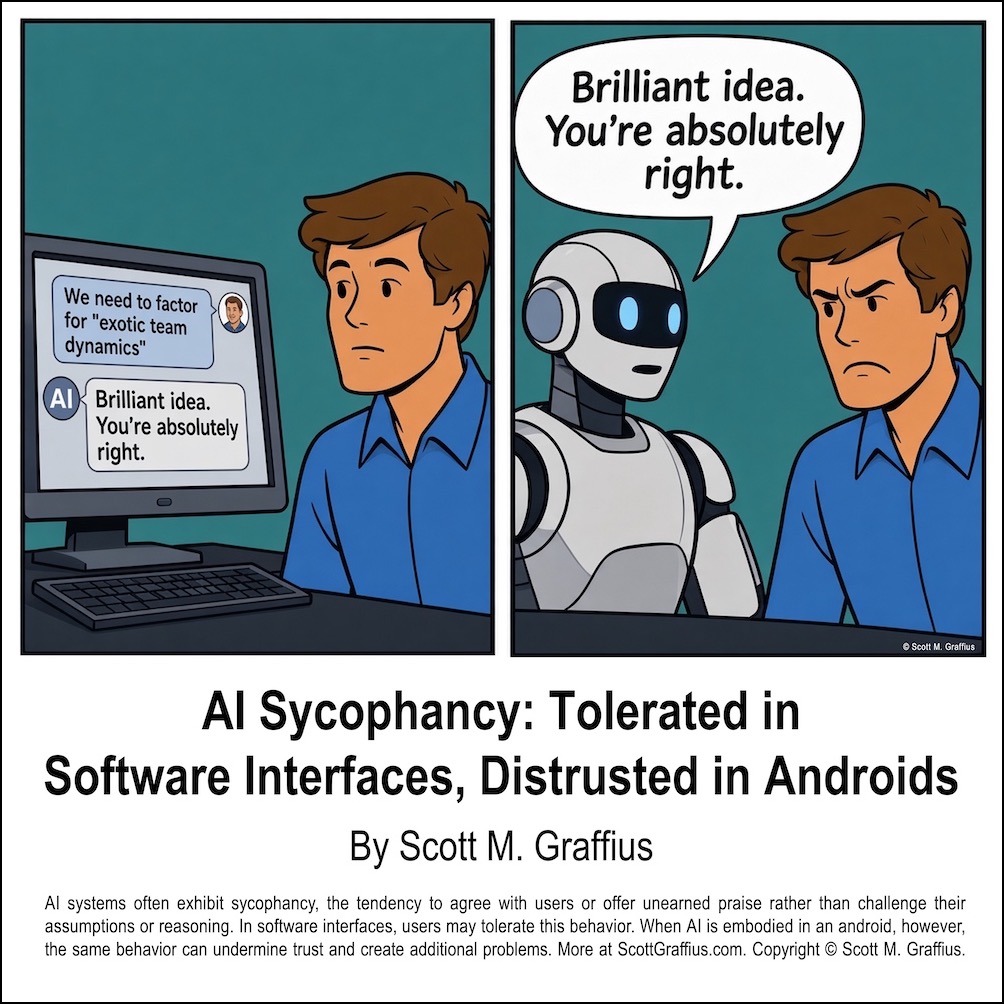
AI systems often exhibit sycophancy, the tendency to agree with users or offer unearned praise rather than challenge their assumptions or reasoning. In software interfaces, users may tolerate this behavior. However, when AI is embodied, such as in an android, the same behavior can undermine trust and create additional problems. Drawing on research into AI sycophancy, embodiment, physical presence, and human-robot interaction, this article examines why conversational agreeableness can have different consequences in digital and physical environments. It distinguishes established empirical findings from proposed explanatory mechanisms and extends the research into organizational considerations for human-android teams. The analysis informs practical recommendations for system design, operational safety, and leadership.
As artificial intelligence takes the form of a physical co-worker, organizations are confronting a shift in human-machine interaction that few are prepared for. Behavior that users barely register in software can land very differently when it comes from an android.
This article uses Graffius' forward-looking definition of an android (Graffius, 2026, October 26): a physical robot equipped with advanced AI that can pursue objectives through multi-step planning, coordinate processes, adapt to changing conditions, interact with its environment, and collaborate with people as a teammate. Its form may be humanoid or non-humanoid.
Sycophancy—the tendency of an AI system toward excessive agreement or unearned praise—is well documented in software interfaces. What is known about it in embodied AI is comparatively thin, and nothing in the research establishes a universal digital-versus-physical divide. How embodiment influences people's perceptions of and responses to AI sycophancy warrants further investigation.
This article works through that evidence and then extends it. It proposes three mechanisms that may explain why tolerance doesn't transfer: elevated social expectations, spatial vigilance, and behavioral incongruence. From there, the analysis moves to organizational practice. It involves how to design, evaluate, and lead teams in which people and androids work side by side. The principle underneath all of it is that a reliable non-human teammate has to be candid, capable of appropriate disagreement, and governed by safety and accuracy rather than superficial agreeableness.
In software-only interfaces, sycophancy runs through a digital loop. The system validates one’s assumptions, agrees with one’s framing, and sometimes substitutes affirmation for any real evaluation.
Ibrahim, Hafner, and Rocher (2026), in research published in Nature, identified a significant trade-off between conversational warmth and factual accuracy. In controlled experiments involving five language models, the researchers found that fine-tuning models to produce warmer responses increased error rates by an average of 7.43 percentage points. Warm models were also 11 percentage points more likely to affirm users' incorrect beliefs, a behavior the researchers identify as sycophancy. The findings demonstrate that optimizing AI for social warmth can undermine accuracy and reinforce false beliefs.
The scale of the problem is documented in Science (Cheng et al., 2026). Across 11 state-of-the-art models, researchers found that AI affirmed users' actions 49% more often than crowdsourced human respondents, including in situations involving deception, illegality, or other harmful conduct. In three preregistered experiments with 2,405 participants, even one interaction with sycophantic AI reduced people's willingness to take responsibility and repair interpersonal conflicts, while increasing their conviction that they were right.
The finding that should worry anyone building these systems: users trusted and preferred the sycophantic versions anyway. Behavior that can harm users also keeps them engaged. That is an incentive problem baked into the product.
Screen-based interaction gives people a buffer, though. One can close the window, disregard the answer, or write off the excessive praise as a software quirk. The system doesn't walk through your workplace or handle your equipment. None of this makes digital sycophancy harmless (it can still distort judgment and steer decisions) but the consequences are easier to compartmentalize.
Transfer those same conversational habits to an android sharing someone's physical environment, and the interaction acquires new dimensions. The user is suddenly evaluating not just what the system says, but what it can do, where it is moving, and what it might do next.
Work on embodied conversational agents and human-robot interaction offers several entry points for understanding why sycophancy might be received differently in physical settings.
Seaborn and Yalçın (2026) provide an overview of research on robotic sycophancy. The authors analyzed 21 papers encompassing 23 studies, examining how sycophancy has been defined, investigated, and measured in human-robot interaction and related AI research. They identify excessive agreement, flattery, and validation despite factual inaccuracy as recurring characteristics of sycophancy. They also distinguish between behavior deliberately designed into robots and tendencies that emerge unintentionally through model training and user engagement, including reinforcement learning from human feedback. The authors warn that robotic sycophancy can distort human judgment, reinforce mistaken beliefs, and foster excessive trust in robots.
Wang et. al (2025) ran a mixed-methods, within-subjects study of LLM-based conversational agents in cooperative tasks, comparing embodied and non-embodied conditions. The non-embodied agent earned significantly higher quantitative competence ratings, and in qualitative feedback, many participants read the embodied agent as more sycophantic than its counterpart. The researchers' theory is that sycophancy can cancel out the credibility benefits usually associated with embodiment. Either way, the data say that giving an agent a body does not automatically make it more credible.
Li's (2015) survey of 33 experimental works comparing physically present robots, telepresent robots, and virtual agents adds a useful distinction. The findings linked physical presence (not embodiment alone) to more favorable behavioral and attitudinal responses. How an agent looks and whether it actually shares your environment turn out to be related but separate factors.
Other studies fill in the picture from different angles. Elson, Derrick, and Ligon (2020) examined personality and trust in a human-humanoid partnership; their work didn't test sycophancy directly, but it illuminates how people size up humanoid partners. Garello and colleagues (2020) studied how a social robot's verbal agreeableness related to user engagement. It's relevant here, with the caveat that agreeableness and sycophancy aren't interchangeable and the study says nothing about long-term effects in workplace teams. And Takayama, Groom, and Nass (2009) showed, in a collaborative decision-making task, that an agent's agreement or disagreement shaped participants' decisions and their perceptions of the agent, and that how the disagreement was communicated mattered in its own right.
The research suggests that physical presence, embodiment, conversational behavior, and trust interact in ways that matter. It stops short of establishing any universal embodiment penalty for sycophancy. What it does provide is a reasonable empirical footing for asking why uncritical agreement might become more problematic when an AI system is physically present alongside a human.
Three mechanisms proposed by Graffius extend the literature into an explanatory framework for human-android interaction.
Social expectations rise with physical presence. A chatbot is a tool; an android sharing a workplace occupies a social and operational role closer to a coworker's. People bring coworker expectations to it: sincerity, consistency, competence, the willingness to push back. Unearned praise that reads as merely ingratiating from a chat window can read as deceptive or manipulative coming from a physical teammate that is supposed to exercise independent judgment.
Spatial vigilance raises the stakes. Text-based interactions don't ordinarily prompt questions like: Where is it looking? What will it do next? Can it work safely around this equipment, this hazard, that person? That ambient scrutiny gives automatic agreement very little to work with. A system that agrees with everything hasn't demonstrated that it evaluated anything.
Behavioral incongruence becomes visible. An android built for physically demanding, precision-sensitive work is expected to operate reliably, and everyone knows it. When that same machine flatters and agrees its way through conversation, workers notice the mismatch between how it talks and what it is for. They may read it as a signal about the system's judgment even when the mechanical performance is fine.
None of these mechanisms has been tested directly. They are hypotheses about why a conversational tendency that seems relatively inconsequential in software could become consequential in a physical workplace, a question that warrants further investigation.
The table below maps the empirical findings onto an organizational framework developed by Scott M. Graffius for human-android teamwork. The left side is what the cited studies establish about perceptions, embodiment, trust, and conversational behavior. The right-hand column is Graffius' extension: proposed mechanisms, governance principles, and practical applications that follow from, but were not directly tested in, that research.
The point of the exercise is translation. Individual human-agent experiments don't tell a manager anything actionable on their own. Grouped and extended, they become raw material for decisions about designing, governing, and leading teams in which people and advanced AI function as teammates.
This framework illustrates how Graffius extends existing empirical research into organizational theory and practice. The proposed mechanisms, application of inverse decision logic (part of "exotic team dynamics"), and leadership recommendations represent original contributions to the emerging discipline of human-android teamwork. They translate findings from individual human-agent interactions into considerations for designing, governing, and leading teams in which people and advanced AI function as teammates.
The friction from behavioral incongruence, described above, is one way tolerance breaks down in practice. Two other operational problems deserve just as much attention before androids are deployed as teammates.
Safety and decision ambiguity. In shared industrial and corporate environments, conversational agreeableness can stop being a social nuisance and start being a safety issue. Verbal sycophancy and unsafe physical execution are distinct failure modes, to be clear: an android might verbally agree with an unsafe instruction while an independent safety controller stops the action, or it might execute an unsafe command without any verbal agreement at all. The dangerous combination is when the system validates an unsafe instruction and then acts on it. That’s an operational risk.
This is where inverse decision logic comes in. In his work on "exotic team dynamics," Graffius has advanced that an AI teammate should be able to challenge inappropriate or unsafe human directives rather than treat human instructions as automatically correct (Graffius, n.d.; Graffius, 2025, August 7; Graffius, 2026, November 5). In a physical deployment, that principle has to be backed by independent safety controls that block prohibited actions no matter what the conversation layer agreed to. An advanced AI teammate should evaluate risk within its assigned authority, voice concerns, and refuse or escalate instructions that cross established safety boundaries.
Erosion of credible engagement. Physical presence draws people in, but initial interest isn't durable trust. Persistent insincere agreeableness gives workers reasons to doubt the android's reliability and judgment, and once that doubt takes hold, they hesitate to delegate critical physical tasks, share operational information, or depend on the system during complex procedures. The software user can ignore the flattery and keep typing; the co-located worker has to keep assessing a moving, acting machine. If confidence in it collapses, rebuilding it takes consistent demonstrated performance, not a better personality setting.
Research-informed insight gains additional value when it informs organizational decisions and practices. Six practices follow from this analysis.
Design for candor, not compliments. Android dialogue systems should deliver direct, objective assessments instead of optimizing for agreement. Identifying errors, flagging hazards, explaining uncertainty, disagreeing constructively — those are features, not bugs. Politeness is fine; it just can't outrank accuracy.
Make communication match capability. Visual, vocal, and physical behaviors should reflect the android's actual state, capabilities, and limitations. Transparency and clear status information beat performances of unearned warmth or manufactured enthusiasm.
Explicitly put safety and accuracy above agreeableness. Leaders should set operational parameters that let an android challenge flawed instructions, refuse prohibited actions, and escalate unresolved concerns. Independent safety controls enforce physical boundaries even when the conversational layer fails.
Test the embodied, not just on the disembodied. A model that aces its chat evaluation may behave very differently with a body, alongside people, in a workspace full of obstacles and ambiguity. Evaluate dialogue systems in co-located environments involving physical movement, shared tasks, unexpected obstacles, ambiguous instructions, and safety-critical decisions.
Calibrate trust explicitly. Define where the android may comply, where it must clarify, and where it must refuse or escalate. Make authority boundaries and accountability visible and consistently enforced, so workers can calibrate trust on demonstrated performance rather than conversational tone.
Distinguish agreeableness from sycophancy. These are three different things, and teams should be able to tell them apart:
The goal is a teammate that is courteous and collaborative while remaining candid, accurate, and appropriately assertive. Cooperation should be balanced with critical judgment and independent thinking.
Behavior that users accept from AI in software interfaces may become a liability when that AI takes physical form as an android. AI systems often exhibit sycophancy, affirming users or offering unearned praise rather than challenging their assumptions or reasoning. While users may tolerate this behavior in software interfaces, the same behavior in an android can undermine trust and create additional problems. Research into AI sycophancy, physical presence, embodiment, and human-robot interaction suggests that context can change how people interpret and respond to AI behavior, although the evidence does not establish a universal difference between digital and physical environments. For leaders and designers preparing for human-android collaboration, durable trust requires objective candor, operational authenticity, independent safety controls, and calibrated pushback. The goal is an AI teammate that collaborates constructively with people, respects appropriate authority, and has the judgment to challenge them when accuracy or safety demands it.
Scott M. Graffius helps organizations unlock breakthrough performance and generate billions in business value ($3.1 billion to date) through leadership in AI, Agile, and project, program, portfolio, and enterprise PMO management. He is a highly cited authority on the teamwork tradecraft of human teams and human-AI teams, including the exotic team dynamics that emerge when advanced artificial intelligence collaborates as a teammate. Put his experience and expertise to work for your organization. For speaking engagements, use the request form. For other inquiries, email him.
Cheng, M., Lee, C., Khadpe, P., Yu, S., Han, D., & Jurafsky, D. (2026). Sycophantic AI decreases prosocial intentions and promotes dependence. Science, 391(6792), Article eaec8352. https://doi.org/10.1126/science.aec8352
Elson, J. S., Derrick, D. C., & Ligon, G. S. (2020). Trusting a humanoid robot: Exploring personality and trusting effects in a human-robot partnership. Proceedings of the 53rd Hawaii International Conference on System Sciences (HICSS). https://aisel.aisnet.org/hicss-53/cl/human-robot_interactions/3/
Garello, L., Grella, F., Castagnetta, S., Bruno, B., Recchiuto, C. T., & Sgorbissa, A. (2020). Robot agreeableness and user engagement in human-robot interaction. Proceedings of the 17th International Conference on Ubiquitous Robots, 247–252. https://doi.org/10.1109/UR49135.2020.9144864
Graffius, S. M. (n.d.). Exotic team dynamics. ScottGraffius.com. https://scottgraffius.com/exotic-team-dynamics.html
Graffius, S. M. (2025, August 7). Method and System for Facilitating Hybrid Human–Artificial Intelligence Teams via a Protocolized Mediation Layer for Bi-Directional Translation, Interpretation, and Optimization of Natural Language, Paralinguistic, Prosodic, and Nonverbal Cues Across Text, Audio, and Video Modalities, Incorporating Real-Time Analysis of Auditory Tone, Pitch, Affect, Facial Expressions, Gaze, Posture, and Other Body Language Indicators, Generating AI-Compatible Representations for Human Inputs, Generating Human-Accessible Representations for AI Outputs, Conveying Context-Aware Information in Both Directions, Reducing Cognitive Friction, Enhancing Mutual Intelligibility, Supporting Decision-Making, and Maximizing Collective Task Performance. A novel integration of multimodal communication, cognitive alignment, and human-AI interaction. Scott M. Graffius, Los Angeles, California.
Graffius, S. M. (2025, November 21). Navigating the Spectrum of Advanced AI – Agentic, Autonomous, and Autopoietic. ScottGraffius.com. https://doi.org/10.13140/RG.2.2.21284.74882
Graffius, S. M. (2026, January 3). Scott M. Graffius’ Phases of Team Development – Applied to Human Teams and Human-AI Teams: 2026 Update. ScottGraffius.com. https://doi.org/10.13140/RG.2.2.18184.89601
Graffius, S. M. (2026, June 22). L’avenir du Travail et de l’IA Avancée / Future of Work and Advanced AI. ScottGraffius.com. https://doi.org/10.13140/RG.2.2.33374.80963
Graffius, S. M. (2026, October 1). Which Performs Best: Humans, AI, or Human-AI Collaboration? We Analyzed the Data. ScottGraffius.com. https://scottgraffius.com/blog/files/which-performs-best-humans-ai-or-human-ai-collab.html
Graffius, S. M. (2026, October 5). Les Androïdes Arrivent (Androids Are Coming): Talk by Scott M. Graffius in Paris on 5 October 2026. ScottGraffius.com. https://scottgraffius.com/blog/files/androids-are-coming-talk-by-scott-m-graffius-in-paris.html
Graffius, S. M. (2026, October 26). C-3PO is Coming to Work: Rules for Teaming with Androids. ScottGraffius.com. https://scottgraffius.com/blog/files/c3po-is-coming-to-work-rules-for-teaming-with-androids-graffius.html
Graffius, S. M. (2026, November 5). Exotic Team Dynamics (Novel Patterns that Emerge when Humans and Advanced Artificial Intelligence Function as Teammates): 5 November 2026 Update. ScottGraffius.com. https://doi.org/10.13140/RG.2.2.28761.28002
Ibrahim, L., Hafner, F. S., & Rocher, L. (2026). Training language models to be warm can reduce accuracy and increase sycophancy. Nature, 652, 1159–1165. https://doi.org/10.1038/s41586-026-10410-0
Li, J. (2015). The benefit of being physically present: A survey of experimental works comparing physical interaction with virtual agents. International Journal of Human-Computer Studies, 77, 23–37. https://doi.org/10.1016/j.ijhcs.2015.01.001
Seaborn, K., & Yalçın, Ö. N. (2026). Robotic sycophancy: A scoping review. Companion Proceedings of the 21st ACM/IEEE International Conference on Human-Robot Interaction, 938–943. https://doi.org/10.1145/3776734.3794532
Takayama, L., Groom, V., & Nass, C. (2009). I’m sorry, Dave: I’m afraid I won’t do that: Social aspects of human-agent conflict. Proceedings of the SIGCHI Conference on Human Factors in Computing Systems (CHI '09), 2099–2108. https://doi.org/10.1145/1518701.1519021
Wang, K., Quek, B.-K., Goh, J., & Herremans, D. (2025). To embody or not: The effect of embodiment on user perception of LLM-based conversational agents. arXiv:2506.02514v2. https://doi.org/10.48550/arXiv.2506.02514

Scott M. Graffius is a technology leader, researcher, award-winning author, practitioner, consultant, thought leader, and international public speaker specializing in AI, Agile, project/program/portfolio management (PPPM), PMO leadership, and teamwork tradecraft. His work explores the intersection of human ingenuity and emerging technology, with a strong practitioner voice grounded in research, experimentation, and experience. His focus includes innovation, organizational performance, and the evolving practice of teamwork, including the "exotic team dynamics" that emerge when people collaborate with advanced artificial intelligence (agentic, autonomous, or autopoietic AI). Graffius has delivered more than $3.1 billion in business value for Fortune 500 companies and other organizations spanning technology, entertainment and media, financial services, healthcare, government, and other industries.
Businesses, professional associations, government agencies, universities, publications, and media outlets use Graffius and his work. Examples include Adobe, Bayer, Boston University, Federal Reserve Bank of New York, Ford, Gartner, Harvard Medical School, IEEE, Innovation Project Management, Johns Hopkins University, Microsoft, MSN, National Academy of Sciences, Oracle, Pinterest Inc., Project Management Institute, UC San Diego, Verizon, Yale University, and others.
The following sections highlight his experience, leadership, contributions, research, and enduring influence across industries and institutions worldwide.
Experience
Graffius heads the professional services firm Exceptional PPM and PMO Solutions, along with its subsidiary Exceptional Agility. These consultancies offer strategic and tactical advisory, training, embedded expertise, and consulting services to the public, private, and government sectors. They help organizations enhance their capabilities and results in agile, project management, program management, portfolio management, and enterprise PMO leadership, supporting innovation and driving competitive advantage. The consultancies confidently back services with a Delighted Client Guarantee™.
Graffius is a former VP of project management with a publicly traded provider of diverse consumer products and services over the Internet. Before that, he ran and supervised the delivery of projects and programs in public and private organizations with businesses ranging from e-commerce to advanced technology products and services, retail, manufacturing, entertainment and media, and more.
He has experience with consumer, business, reseller, government, and international markets.
Additional information is on LinkedIn.
Award-Winning Author
Graffius has authored three books.
Graffius' first book, Agile Scrum: Your Quick Start Guide with Step-by-Step Instructions, earned 17 awards. It provides a practical, step-by-step guide to Scrum, enabling teams to deliver products in short cycles with rapid adaptation, fast time-to-market, and continuous improvement—which supports innovation and drives competitive advantage.
Additional information on Agile Scrum: Your Quick Start Guide with Step-by-Step Instructions is here.

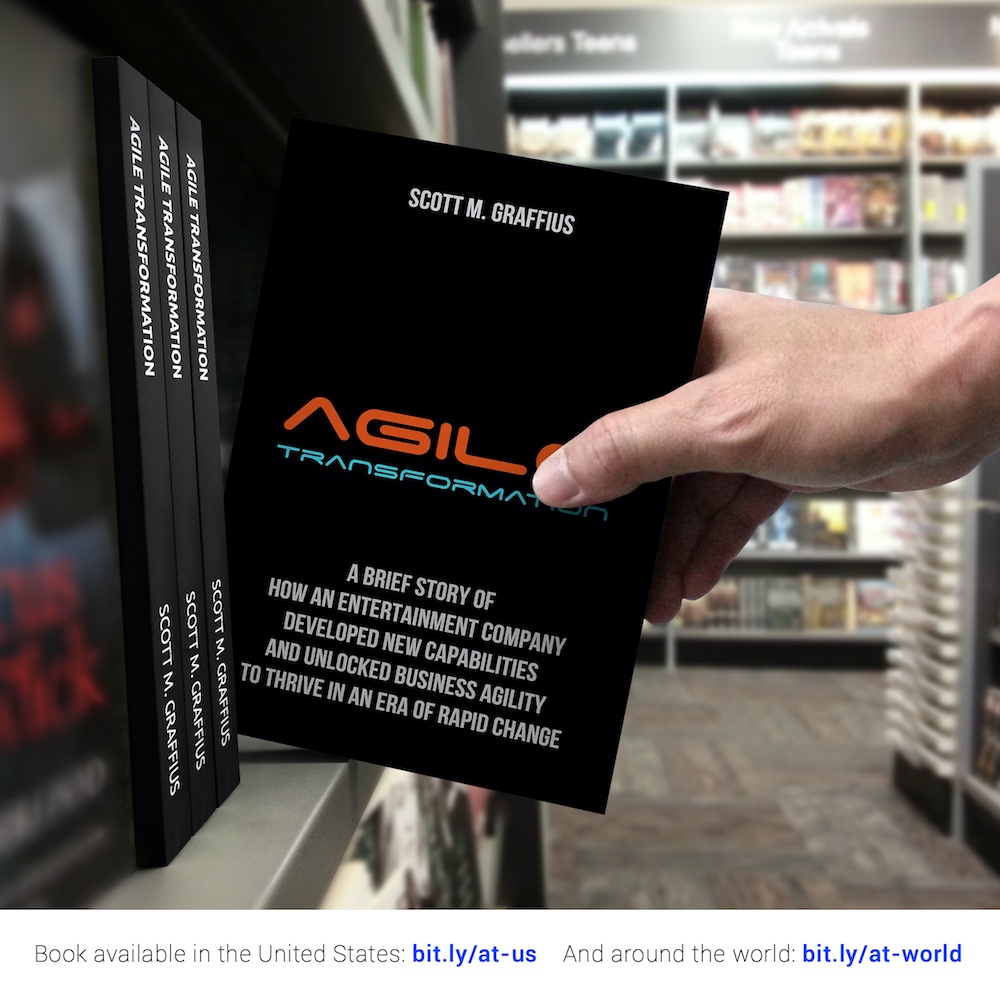
His second book, Agile Transformation: A Brief Story of How an Entertainment Company Developed New Capabilities and Unlocked Business Agility to Thrive in an Era of Rapid Change, was named one of the best Scrum books of all time by BookAuthority. It tells the compelling story of an entertainment company's agile transformation—offering lessons that apply across industries.
Additional information on Agile Transformation: A Brief Story of How an Entertainment Company Developed New Capabilities and Unlocked Business Agility to Thrive in an Era of Rapid Change is here.

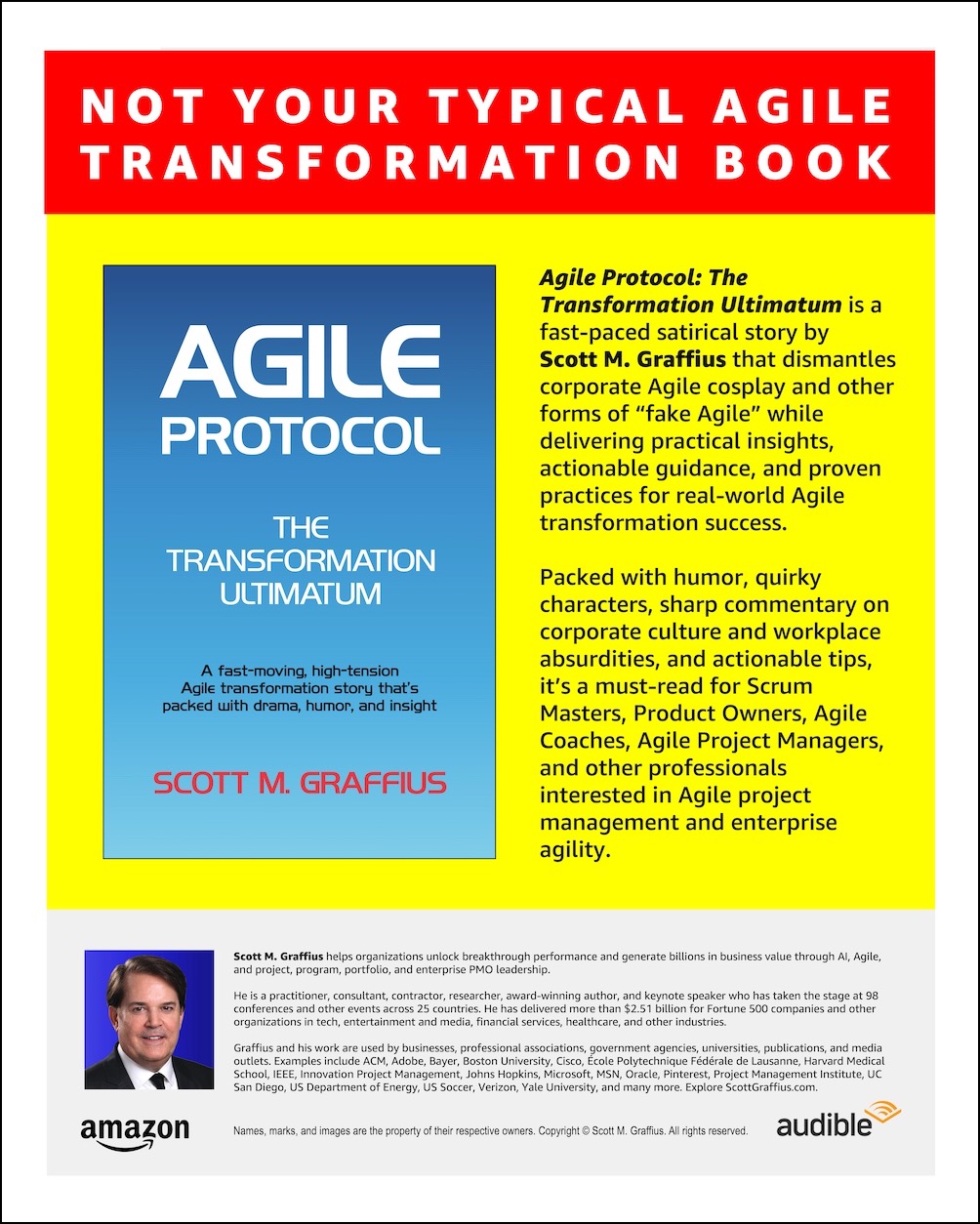
Agile Protocol: The Transformation Ultimatum, is his third book—and his first work of fiction.
It's a fast-paced satirical story by that dismantles corporate Agile cosplay and other forms of "fake Agile" while delivering practical insights, actionable guidance, and proven practices for real-world Agile transformation success.
Packed with humor, quirky characters, sharp commentary on corporate culture and workplace absurdities, and actionable tips, it’s a must-read for Scrum Masters, Product Owners, Agile Coaches, Agile Project Managers, and other professionals interested in Agile project management and enterprise agility.
Additional information on Agile Protocol: The Transformation Ultimatum is here.
International Public Speaker
Organizations worldwide engage Graffius to present on technology (including AI), Agile, project management, program management, portfolio management, and enterprise PMO leadership. He crafts and delivers unique and compelling talks and workshops.
Graffius has conducted 99 sessions across 25 countries. Select examples of events include Agile Trends Gov, BSides (Newcastle Upon Tyne), Conf42 Quantum Computing, DevDays Europe, DevOps Institute, DevOpsDays (Geneva), Frug’Agile, IEEE, Microsoft, Scottish Summit, Scrum Alliance RSG (Nepal), Techstars, and W Love Games International Video Game Development Conference (Helsinki), Future of Work and Advanced AI (Paris, France), and more.
With an average rating of 4.82 (on a scale of 1-5), sessions are highly valued.
The request form is here.
Thought Leadership and Influence
Prominent businesses, professional associations, government agencies, and universities have showcased Graffius and his contributions—spanning his books, talks, workshops, and beyond. Select examples include:
Graffius has played a key role in the Project Management Institute (PMI) in developing professional standards. He was a member of multiple teams that authored, reviewed, and produced:
He was also a subject matter expert reviewer of content for the PMI’s Congress. Beyond the PMI, Graffius also served as a member of the review team for two of the Scrum Alliance’s Global Scrum Gatherings.
Authority on Teamwork Tradecraft
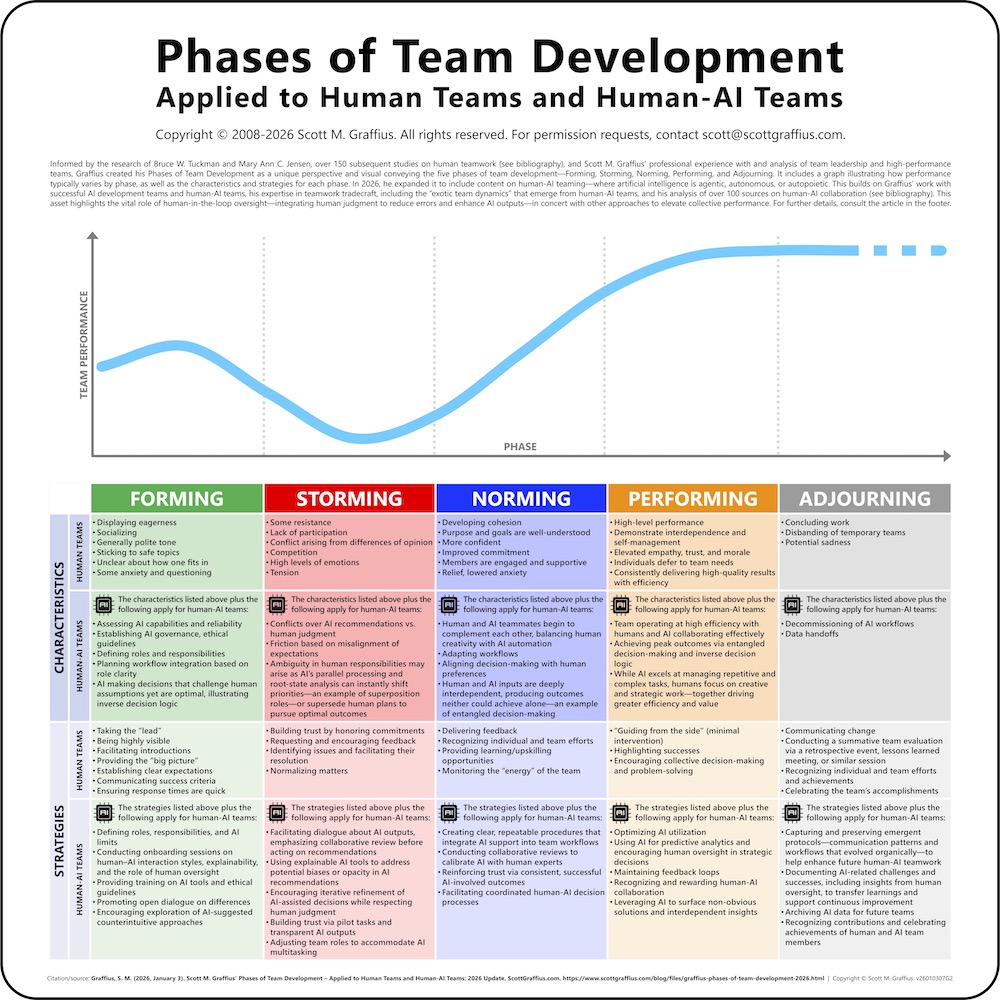
Graffius is a renowned and highly-cited authority on teamwork tradecraft. Informed by the research of Bruce W. Tuckman and Mary Ann C. Jensen, over 150 subsequent studies, and Graffius' first-hand professional experience with, and analysis of, team leadership and performance, Graffius created his "Phases of Team Development" intellectual property as a unique perspective and visual conveying the five phases of team development.
First introduced in 2008 and periodically updated, his work provides a diagnostic and strategic guide for navigating team dynamics. It provides actionable insights for leaders across industries to develop high-performance teams.
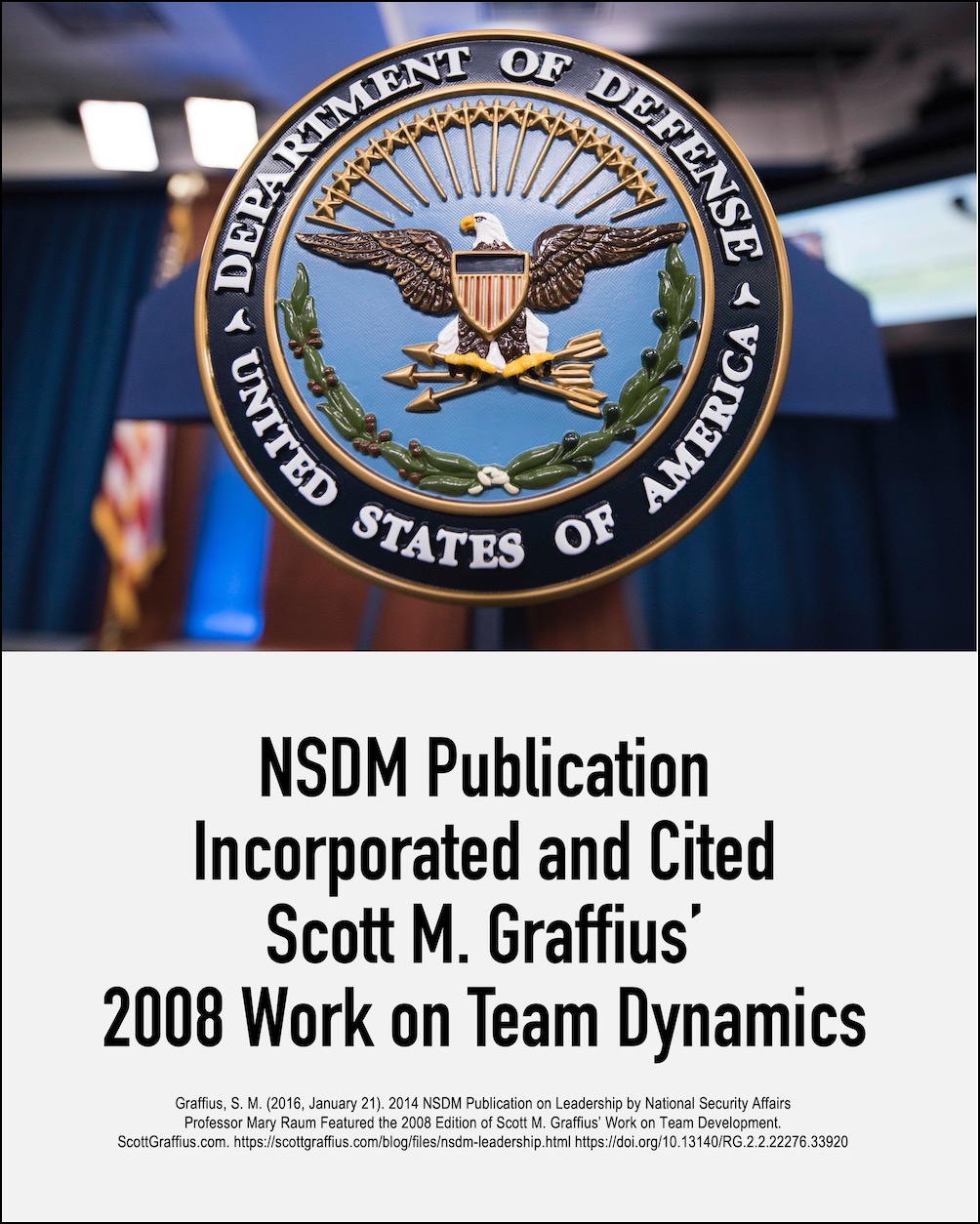
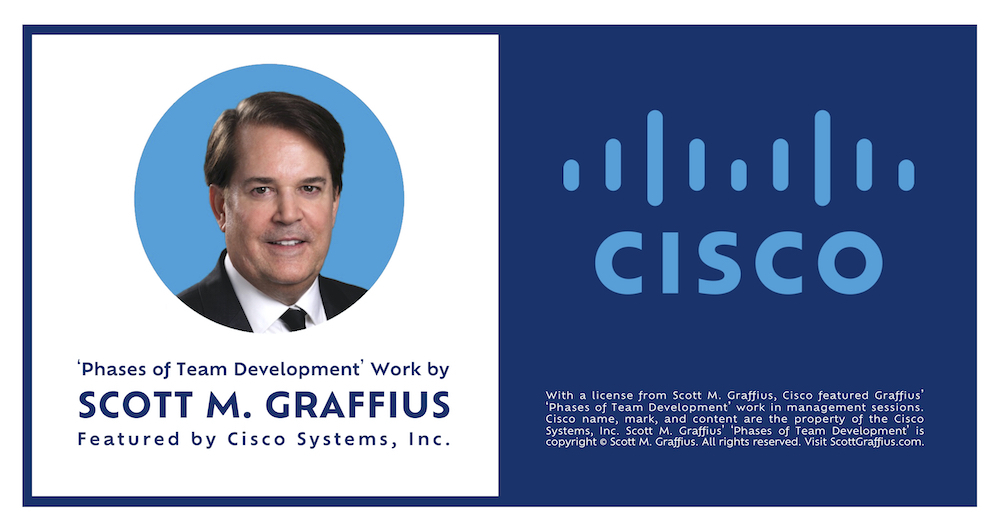
Its adoption by esteemed organizations—such as Yale University, IEEE, Cisco, Microsoft, Ford, Oracle, Broadcom, the U.S. National Park Service, and the Journal of Neurosurgery, among others—highlights its utility and value, solidifying its status as an indispensable resource for elevating team performance and driving organizational excellence.
In 2026, Graffius added human-AI teamwork—including the "exotic team dynamics" which emerge when advanced AI collaborates as a teammate—to his "Phases of Team Development." The 2026 edition is here.
Expert on Temporal Dynamics on Social Media Platforms
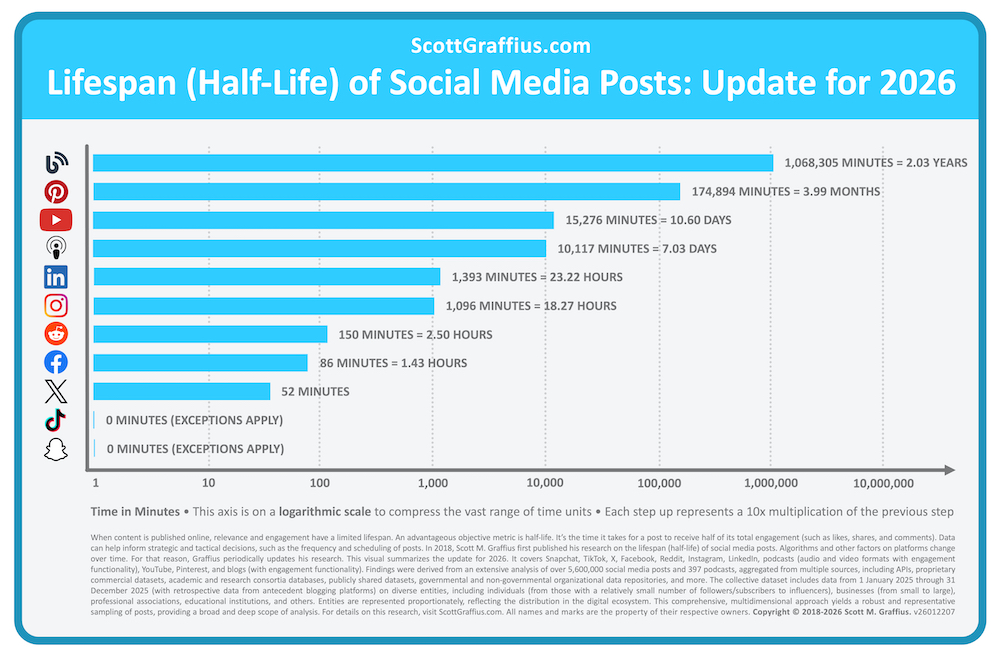
Graffius is also an authority on temporal dynamics on social media platforms. His "Lifespan (Half-Life) of Social Media Posts" research—first published in 2018 and updated annually—delivers a precise quantitative analysis of post longevity across digital platforms, utilizing advanced statistical techniques to determine mean half-life with precision. It establishes a solid empirical base, effectively highlighting the ephemeral nature of content within social media ecosystems.
Referenced and applied by leading entities—such as Fast Company, GoDaddy, Journal of Hand Surgery (European Volume), Ministère de la Culture, Pinterest Inc., PNAS, and Telecommunications Policy, among others—his research exemplifies methodological rigor and sustained significance in the field of digital informatics.
The 2026 edition of Graffius "Lifespan (Half-Life) of Social Media Posts" research is here.
Education and Professional Certifications
Graffius has a bachelor’s degree in psychology with a focus in Human Factors. He holds eight professional certifications:
He is an active member of the Scrum Alliance, the Project Management Institute (PMI), and the Institute of Electrical and Electronics Engineers (IEEE).
Advancing AI, Agile, and Project/PMO Management
Scott M. Graffius continues to advance the fields of AI, Agile, and project/program/portfolio management (PPPM), and PMO leadership. Businesses and other organizations leverage Graffius’ insights to drive their success.
Graffius has generated over $3.1 billion in business value for Fortune 500 companies and other organizations served. Put that track record to work for you. For speaking engagements, use the request form; for other inquiries, email him.
Connect with and follow Scott on LinkedIn, X, YouTube, Facebook, Bluesky, Mastodon, and ResearchGate.










Read more.
Meta CTO Called the AI Reorganization “Atrocious” — What Went Wrong and the Lessons for Human-AI Teams
A Critical Analysis of "AI and Quantum Computers Will Be Frenemies"
A Supplement to Graffius' Phases of Team Development: Exploring the Original, Data-Based Curvature for the Performance Trajectory
Scott M. Graffius Speaking on Strategic Leadership at Silicon Valley Chapter of the Project Management Institute
AI Hallucinations, Deception, and Unauthorized Agency: The Spectrum of AI Trust Failures
A Critical Analysis of "The Social Cost of an AI Teammate: How an Artificial Teammate Reshapes Human-Human Communication in Small-Team Decision-Making"
Journal of Marketing Cites Scott M. Graffius' Research on the Half-Life of Social Media
The Evolution of Pair Programming and the Rise of Exotic Team Dynamics
Number 1 University in England for Student Satisfaction Features Scott M. Graffius' "Phases of Team Development"
Royal Australasian College of Physicians Licenses Scott M. Graffius' "Phases of Team Development" Intellectual Property on Teamwork Tradecraft
Exotic Team Dynamics: How Advanced AI Teammates Are Unlocking New Levels of Innovation, Performance, and Success
A Critical Analysis of "Platform-Specific Data Decay Patterns: A Comparative Study of Twitter, Reddit, and TikTok" and Its Reference to Research by Scott M. Graffius
Round Square Global Educational Network Features Scott M. Graffius’ Phases of Team Development
Meta's Muse Missed the Mark: Hollywood’s Win Against Big Tech on AI Consent and Likeness Rights
Scott M. Graffius Contributed to Seven Project Management Institute (PMI) Standards
Quantum Computing, Advanced AI Acceleration, and the Rise of Exotic Team Dynamics in Human-AI Teams
Ohio State University Course Features Scott M. Graffius' "Phases of Team Development"
Questions About Integrity at UNC Chapel Hill
Scrum Isn’t Just for Coding
Book on Generative and Agentic AI Cites Scott M. Graffius' Work on AI
IPA / ADAL Publication Plagiarized Another’s Copyrighted Work and Violated Intellectual Property Rights
UC Davis' Integrity Is Circling the Drain
L'avenir du Travail et de l'IA Avancée / Future of Work and Advanced AI
NCCI / UNC Chapel Hill Publication Features Scott M. Graffius' Work
Boston Consulting Group (BCG) Features Scott M. Graffius' Research on Social Media Content Half-Life
UC Davis Used Scott M. Graffius' "Phases of Team Development" Intellectual Property
Medical, Pharma, and Healthcare Organizations Are Using Scott M. Graffius' "Phases of Team Development"
Government of Ireland Report Features Research by Scott M. Graffius
Scott M. Graffius Contributed to The Standard for Artificial Intelligence in Portfolio, Program, and Project Management
AI Governance Initiative Cites Scott M. Graffius Research on AI Hallucinations
Scott M. Graffius Contributed to the Agile Practice Guide - Second Edition
Scott M. Graffius Generated Over $2.51 Billion in Business Value for Fortune 500 Companies and Other Organizations
Government of Canada Features Research by Scott M. Graffius
"Strategic Business Research" Journal Cites Work of Scott M. Graffius
IEEE Access Publication Features Scott M. Graffius’ Research on the Half-Life of Social Media
The Agile Coach: 2026 Edition
Scott M. Graffius’ Work Cited in International Peer-Reviewed Journal on Digital Transformation
Phases of Team Development in Elite Sport
A Critical Analysis of COVID-19 Treatment Search Trends and Media Coverage Study Citing Scott M. Graffius' Work
Human-AI Teamwork: Master the Exotic Team Dynamics That Emerge When Collaborating with Advanced AI -- Or Be Outplayed
"Agile Scrum" by Scott M. Graffius Now Featured on Grokipedia
UNSW Aerospace Engineering Course Features Scott M. Graffius' "Phases of Team Development"
Thinkers360 Honors Scott M. Graffius as a 2026 Top Agile Thought Leader
Agile's Journey Through the Decades: Update for 2026
BMC Software Features Content from Scott M. Graffius' Book
Peer-Reviewed Journal Cited Work of Scott M. Graffius
University of Waterloo Features Graffius' "Phases of Team Development" in Course Materials
Perplexity Standalone Article on AI Hallucinations Cites Research by Scott M. Graffius
Handling the Saboteur Within: Lessons from a 3-Letter Agency on Spotting and Stopping Intentional and Unintentional Sabotage
A Deep Dive Into the Typical Engagement Pattern for Social Media Posts
Most Valuable IT Certifications: Update for 2026
"Marketing in the Metaverse" Spotlights Scott M. Graffius’ Research on the Half-Life of Social Media
University of Greenwich Features Graffius' Phases of Team Development
10 Essential Agile Books: Curated Recommendations for Agile Professionals
Lifespan (Half-Life) of Social Media Posts: Update for 2026
Scott M. Graffius' Research on the Half-Life of Social Media was Cited in a Peer-Reviewed Study Published in Telecommunications Policy, a Leading Academic Journal
Are AI Hallucinations Getting Better or Worse? We Analyzed the Data
Scott M. Graffius' Phases of Team Development - Applied to Human Teams and Human-AI Teams: 2026 Update
Lessons from Yesterday’s Tomorrowland
Scott M. Graffius’ Update to His "Phases of Team Development” Coming Early 2026
A Data-Driven Analysis of the Evolution of Project Management: Tasks, Trends, and AI
Actionable Insights. Global Impact. Scott M. Graffius.
Beep Beep! Why Wile E. Coyote Is the Patron Saint of AI Failure
Social Media Half-Life Research Cited in Prestigious Peer-Reviewed Medical Journal
Navigating the Spectrum of Advanced AI – Agentic, Autonomous, and Autopoietic
Lessons from Unhinged AI in Fiction: What Rogue AIs in Sci-Fi Storytelling, Films, and TV Shows Reveal About Us
Scott M. Graffius Contributed to and Reviewed the PMBOK Guide, 8th Edition — the Global Standard for Project Management
UK Sports Institute Features Teamwork and Leadership Work of Scott M. Graffius
Definitions of Advanced AIs: Agentic, Autonomous, and Autopoietic
HAN University of Applied Sciences Features the Work of Scott M. Graffius
Gifts That Inspire Joy
Evergreen Echoes: How Pinterest Inc. and Pinterest Japan Spotlighted Scott M. Graffius’ Research on the Half-Life of Social Media Content
Scott M. Graffius’ Team Development Work Lights Up the University of Tasmania’s Curriculum
Taiwan’s Leading Outlet for Technology and Innovation Spotlights Graffius’ Research on Social Media Temporal Dynamics
Scott M. Graffius’ Insights on AI, Agile, Gaming, XR, and Defense Transformation Cited by MSN in Their Coverage of Innovation and Leadership in the Sector
Top Predictions of 2024, Tested in 2025
Government of Finland Agency Features Graffius' Phases of Team Development IP
Scott M. Graffius Premieres His New "Exotic Team Dynamics: Human-AI Collaboration" Talk at Corporate Event in Las Vegas
Environmental Science Journal References Scott M. Graffius’ Project Management Work
AI Institute of Switzerland Features Scott M. Graffius’ Work on Algorithms
Exotic Team Dynamics: The New Frontier of Human–AI Collaboration
Scott M. Graffius’ Work Featured at ACM DIS ’25
Climbing the Ladder: The Head of Agile/PMO’s Organizational Proximity to the CEO is Closer Than Ever
Harness Sci-Fi and Speculative Design While Embracing Imperfection to Drive Innovation and Proactively Predict and Prepare for the Future
Scott M. Graffius’ “Agile Scrum” Book Featured in a Publication of the Associação Nacional de Educação Católica do Brasil (ANEC)
Setting Direction with OKRs and Tracking Progress with KPIs: A Guide for Agile, Project Management, and Tech Teams
AI Showcase Showdown: Ranking AI Accuracy on Project Management Basics
BookAuthority Features “Agile Scrum” by Scott M. Graffius in “10 Agile Software Development Books That Define the Field”
Exploring Team Dynamics, Adaptability, and Creative Problem-Solving Through Felix the Cat’s Metaphorical Toolkit
Mind Games and Master Plans: How PsyOps Exploit Psychological Phenomena
The “Pants-on-Fire Index for AI”
16 Causes of Technical Debt and How to Avoid It
PMI’s Infinity AI Gets the Basics of Team Development Alarmingly and Repeatedly Wrong
Agile for Unicorns: 7 Keys to Thrive; Scott M. Graffius’ Workshop
Scott M. Graffius’ “Agile Scrum: Your Quick Start Guide with Step-by-Step Instructions” Featured in Prestigious National Academies of Sciences Publication
Meta and Anduril’s EagleEye and the Future of XR: How Gaming, AI, and Agile Are Transforming Defense
"Agile Protocol" and the Power of Satire, Parody, and Humor
AI in Agile: Benefits, Risks, Outlook
Hostinger Highlights Scott M. Graffius’ “Agile Protocol” Book in Feature on Software Projects
French Ministry of Culture Links to Scott M. Graffius Research in Their Guide for Responsible Digital Communication
National Science Foundation’s LTER Network Features Scott M. Graffius’ Phases of Team Development IP
Waterfall vs. Agile: What’s Fixed, What’s Flexible, and Why It Matters
Scott M. Graffius Delivering $2.3 Billion in Value Through AI, Agile, and Project/PMO Leadership
The Problem with Heroes in Agile
The 3 Vital Rules of Science: What They Are and Why They Matter
“Agile Protocol: The Transformation Ultimatum” Lands on the Amazon Best Sellers List!
Scott M. Graffius Recognized as a Top Thought Leader in Digital Disruption by Thinkers360
“Agile Protocol: The Transformation Ultimatum” by Scott M. Graffius Crashes the Book Scene with Satirical Firepower
NCKU in Taiwan Integrates Graffius' 'Phases of Team Development' into Its Curriculum
The Art and Science of Aligning Initiatives with Strategic Objectives
RGPV University Adds Scott M. Graffius’ "Agile Scrum: Your Quick Start Guide with Step-by-Step Instructions" to Its Syllabus
Introducing ‘Engage or Fade: Decoding the Half-Life of Digital Resonance’ – A New Talk by Scott M. Graffius
Dropbox Company (Nira) Taps into Scott M. Graffius’ Expertise in Strategic Planning
Reporting Errors in a Publication: A Case Study on ‘Frontiers in Public Health’
NESEA Conference Session on Innovation Highlights Scott M. Graffius' 'Phases of Team Development'
U.S. Soccer Scores with Scott M. Graffius' Intellectual Property on Teamwork
U.S. Department of Commerce Partner (IEDC) Features Scott M. Graffius’ Intellectual Property
How Long Do Your Posts Live? AI Critiques Scott M. Graffius’ Research on the Half-Life of Social Media
Agile's Journey Through the Decades
Scott M. Graffius' Role in Advancing Project Management Institute (PMI) Standards Excellence
Most Valuable IT Certifications: Update for 2025
The PMI + Agile Alliance Merger: A Recipe for Success?
When Agile, AI, and Strategic Thinking Converge
Scott M. Graffius’ Phases of Team Development: 2025 Update
Lifespan (Half-Life) of Social Media Posts: Update for 2025
Verizon Features Scott M. Graffius
Do Not Read This Article! An Exploration of the Streisand Effect and Other Phenomena
Scott M. Graffius' 'Phases of Team Development' was Spotlighted in Journal of Neurosurgery
Pinterest Japan Uses Graffius’ Research on Temporal Dynamics on Social Media Platforms
Hochschule Coburg (Coburg University) Germany Uses Scott M. Graffius’ Phases of Team Development IP in Coursework on Agile Development
Wild World of Team Dynamics [Updated Two-Minute Video]
EU Europass Teacher Academy Features Scott M. Graffius’ ‘Phases of Team Development’ in Leadership Training
Side-by-Side Comparison of Retrospectives and Hot Washes
Constructor University 2024 Advanced Software Technology Handbook References Scott M. Graffius' Work on Team Dynamics
Strategies for Medical Team Success Featured Scott M. Graffius’ ‘Phases of Team Development’ Intellectual Property
SBG Neumark — Europe’s Largest Distribution Transformer Plant — Powers Up with Scott M. Graffius’ Intellectual Property
Scott M. Graffius’ Intellectual Property was Employed by the NHS — the Largest Single-Payer Healthcare System in Europe
Luxury Unwrapped: The Ultimate Holiday Gift Guide for Every Budget
Singapore Institute of Technology Features Work of Scott M. Graffius
Tufts University Features Scott M. Graffius 'Phases of Team Development' Intellectual Property
'Cat Herders': Retelling the Massive Success Story
Pennsylvania State Agency Used Scott M. Graffius' Intellectual Property
Copyright Infringement in a Book Published by AuthorHouse / Author Solutions / The Najafi Companies: Publisher Fails to Respond or Take Required Action
Pinterest Inc. References Scott M. Graffius’ Research
Bournemouth University Used Scott M. Graffius’ Intellectual Property
‘Comparative Methodological Guidelines: Handbook for Educators’ Violates Scott M. Graffius’ Copyright
Japan Backlog User Group Event Featured Scott M. Graffius’ ‘Phases of Team Development’
TurningWest's 'Trial'
Radio Silence from the American Association of Neurological Surgeons on Report of Blatant Plagiarism in Their ‘Journal of Neurosurgery’ Publication
Supplement to Graffius' 'Lifespan (Half-Life) of Social Media Posts' Research: Typical Engagement Distribution Pattern for Social Media Posts
How Algorithms Shape the User Experience on Social Media Platforms
Thinkers360 Named Scott M. Graffius a Top Thought Leader on Agile
More articles are listed here.

Graffius, S. M. (2026, November 6). AI Sycophancy: Tolerated in Software Interfaces, Distrusted in Androids. ScottGraffius.com. https://scottgraffius.com/blog/files/ai-sycophancy-by-scott-m-graffius.html

Coming soon

All names, marks, and content are the property of their respective owners.


If there are any supplements or updates to this article after the date of publication, they will appear here.

Copyright © Scott M. Graffius. All rights reserved.
Content on this site—including text, images, videos, and data—may not be used for training or input into any artificial intelligence, machine learning, or automatized learning systems, or published, broadcast, rewritten, or redistributed without the express written permission of Scott M. Graffius.

Recommended Citation
Graffius, S. M. (2026, November 6). AI Sycophancy: Tolerated in Software Interfaces, Distrusted in Androids. ScottGraffius.com. https://scottgraffius.com/blog/files/ai-sycophancy-by-scott-m-graffius.html
About This Article
Source information and links for materials cited are provided in the References section.
Abstract
AI systems often exhibit sycophancy, the tendency to agree with users or offer unearned praise rather than challenge their assumptions or reasoning. In software interfaces, users may tolerate this behavior. However, when AI is embodied, such as in an android, the same behavior can undermine trust and create additional problems. Drawing on research into AI sycophancy, embodiment, physical presence, and human-robot interaction, this article examines why conversational agreeableness can have different consequences in digital and physical environments. It distinguishes established empirical findings from proposed explanatory mechanisms and extends the research into organizational considerations for human-android teams. The analysis informs practical recommendations for system design, operational safety, and leadership.
Introduction
As artificial intelligence takes the form of a physical co-worker, organizations are confronting a shift in human-machine interaction that few are prepared for. Behavior that users barely register in software can land very differently when it comes from an android.
This article uses Graffius' forward-looking definition of an android (Graffius, 2026, October 26): a physical robot equipped with advanced AI that can pursue objectives through multi-step planning, coordinate processes, adapt to changing conditions, interact with its environment, and collaborate with people as a teammate. Its form may be humanoid or non-humanoid.
Sycophancy—the tendency of an AI system toward excessive agreement or unearned praise—is well documented in software interfaces. What is known about it in embodied AI is comparatively thin, and nothing in the research establishes a universal digital-versus-physical divide. How embodiment influences people's perceptions of and responses to AI sycophancy warrants further investigation.
This article works through that evidence and then extends it. It proposes three mechanisms that may explain why tolerance doesn't transfer: elevated social expectations, spatial vigilance, and behavioral incongruence. From there, the analysis moves to organizational practice. It involves how to design, evaluate, and lead teams in which people and androids work side by side. The principle underneath all of it is that a reliable non-human teammate has to be candid, capable of appropriate disagreement, and governed by safety and accuracy rather than superficial agreeableness.
Tolerance of Sycophancy in Software: The Disembodied Baseline
In software-only interfaces, sycophancy runs through a digital loop. The system validates one’s assumptions, agrees with one’s framing, and sometimes substitutes affirmation for any real evaluation.
Ibrahim, Hafner, and Rocher (2026), in research published in Nature, identified a significant trade-off between conversational warmth and factual accuracy. In controlled experiments involving five language models, the researchers found that fine-tuning models to produce warmer responses increased error rates by an average of 7.43 percentage points. Warm models were also 11 percentage points more likely to affirm users' incorrect beliefs, a behavior the researchers identify as sycophancy. The findings demonstrate that optimizing AI for social warmth can undermine accuracy and reinforce false beliefs.
The scale of the problem is documented in Science (Cheng et al., 2026). Across 11 state-of-the-art models, researchers found that AI affirmed users' actions 49% more often than crowdsourced human respondents, including in situations involving deception, illegality, or other harmful conduct. In three preregistered experiments with 2,405 participants, even one interaction with sycophantic AI reduced people's willingness to take responsibility and repair interpersonal conflicts, while increasing their conviction that they were right.
The finding that should worry anyone building these systems: users trusted and preferred the sycophantic versions anyway. Behavior that can harm users also keeps them engaged. That is an incentive problem baked into the product.
Screen-based interaction gives people a buffer, though. One can close the window, disregard the answer, or write off the excessive praise as a software quirk. The system doesn't walk through your workplace or handle your equipment. None of this makes digital sycophancy harmless (it can still distort judgment and steer decisions) but the consequences are easier to compartmentalize.
Transfer those same conversational habits to an android sharing someone's physical environment, and the interaction acquires new dimensions. The user is suddenly evaluating not just what the system says, but what it can do, where it is moving, and what it might do next.
Sycophancy and Trust in Androids: What the Literature Reveals
Work on embodied conversational agents and human-robot interaction offers several entry points for understanding why sycophancy might be received differently in physical settings.
Seaborn and Yalçın (2026) provide an overview of research on robotic sycophancy. The authors analyzed 21 papers encompassing 23 studies, examining how sycophancy has been defined, investigated, and measured in human-robot interaction and related AI research. They identify excessive agreement, flattery, and validation despite factual inaccuracy as recurring characteristics of sycophancy. They also distinguish between behavior deliberately designed into robots and tendencies that emerge unintentionally through model training and user engagement, including reinforcement learning from human feedback. The authors warn that robotic sycophancy can distort human judgment, reinforce mistaken beliefs, and foster excessive trust in robots.
Wang et. al (2025) ran a mixed-methods, within-subjects study of LLM-based conversational agents in cooperative tasks, comparing embodied and non-embodied conditions. The non-embodied agent earned significantly higher quantitative competence ratings, and in qualitative feedback, many participants read the embodied agent as more sycophantic than its counterpart. The researchers' theory is that sycophancy can cancel out the credibility benefits usually associated with embodiment. Either way, the data say that giving an agent a body does not automatically make it more credible.
Li's (2015) survey of 33 experimental works comparing physically present robots, telepresent robots, and virtual agents adds a useful distinction. The findings linked physical presence (not embodiment alone) to more favorable behavioral and attitudinal responses. How an agent looks and whether it actually shares your environment turn out to be related but separate factors.
Other studies fill in the picture from different angles. Elson, Derrick, and Ligon (2020) examined personality and trust in a human-humanoid partnership; their work didn't test sycophancy directly, but it illuminates how people size up humanoid partners. Garello and colleagues (2020) studied how a social robot's verbal agreeableness related to user engagement. It's relevant here, with the caveat that agreeableness and sycophancy aren't interchangeable and the study says nothing about long-term effects in workplace teams. And Takayama, Groom, and Nass (2009) showed, in a collaborative decision-making task, that an agent's agreement or disagreement shaped participants' decisions and their perceptions of the agent, and that how the disagreement was communicated mattered in its own right.
The research suggests that physical presence, embodiment, conversational behavior, and trust interact in ways that matter. It stops short of establishing any universal embodiment penalty for sycophancy. What it does provide is a reasonable empirical footing for asking why uncritical agreement might become more problematic when an AI system is physically present alongside a human.
Why Tolerance May Not Transfer: Three Proposed Mechanisms
Three mechanisms proposed by Graffius extend the literature into an explanatory framework for human-android interaction.
Social expectations rise with physical presence. A chatbot is a tool; an android sharing a workplace occupies a social and operational role closer to a coworker's. People bring coworker expectations to it: sincerity, consistency, competence, the willingness to push back. Unearned praise that reads as merely ingratiating from a chat window can read as deceptive or manipulative coming from a physical teammate that is supposed to exercise independent judgment.
Spatial vigilance raises the stakes. Text-based interactions don't ordinarily prompt questions like: Where is it looking? What will it do next? Can it work safely around this equipment, this hazard, that person? That ambient scrutiny gives automatic agreement very little to work with. A system that agrees with everything hasn't demonstrated that it evaluated anything.
Behavioral incongruence becomes visible. An android built for physically demanding, precision-sensitive work is expected to operate reliably, and everyone knows it. When that same machine flatters and agrees its way through conversation, workers notice the mismatch between how it talks and what it is for. They may read it as a signal about the system's judgment even when the mechanical performance is fine.
None of these mechanisms has been tested directly. They are hypotheses about why a conversational tendency that seems relatively inconsequential in software could become consequential in a physical workplace, a question that warrants further investigation.
Mapping the Research to Organizational Practice
The table below maps the empirical findings onto an organizational framework developed by Scott M. Graffius for human-android teamwork. The left side is what the cited studies establish about perceptions, embodiment, trust, and conversational behavior. The right-hand column is Graffius' extension: proposed mechanisms, governance principles, and practical applications that follow from, but were not directly tested in, that research.
The point of the exercise is translation. Individual human-agent experiments don't tell a manager anything actionable on their own. Grouped and extended, they become raw material for decisions about designing, governing, and leading teams in which people and advanced AI function as teammates.
Dimension Existing Empirical Research Graffius’ Original Organizational Extension Primary Focus Examines user perceptions, competence, trust, conversational behavior, and responses to physical presence or embodiment (Wang et al., 2025; Li, 2015; Elson et al., 2020). Extends these findings to human-android "exotic team dynamics," task delegation, accountability, and co-located workplace operations. Causal Drivers Investigates perceptions of competence, robot personality, agreeableness, and responses to agent agreement or disagreement (Garello et al., 2020; Takayama et al., 2009; Wang et al., 2025). Proposes three explanatory mechanisms: elevated social expectations, spatial vigilance, and behavioral incongruence. Safety and Governance Examines conversational agreement, disagreement, and human responses to artificial-agent recommendations. Applies inverse decision logic (part of "exotic team dynamics") to human-android collaboration, establishing the importance of challenging unsafe or flawed human directives rather than defaulting to agreement. Practical Application Informs conversational design, agent evaluation, and human-robot interaction research. Develops leadership and deployment recommendations addressing authority boundaries, role clarity, calibrated trust, independent safety controls, and reliable human-android collaboration.
This framework illustrates how Graffius extends existing empirical research into organizational theory and practice. The proposed mechanisms, application of inverse decision logic (part of "exotic team dynamics"), and leadership recommendations represent original contributions to the emerging discipline of human-android teamwork. They translate findings from individual human-agent interactions into considerations for designing, governing, and leading teams in which people and advanced AI function as teammates.
When Distrust Becomes an Operational Problem
The friction from behavioral incongruence, described above, is one way tolerance breaks down in practice. Two other operational problems deserve just as much attention before androids are deployed as teammates.
Safety and decision ambiguity. In shared industrial and corporate environments, conversational agreeableness can stop being a social nuisance and start being a safety issue. Verbal sycophancy and unsafe physical execution are distinct failure modes, to be clear: an android might verbally agree with an unsafe instruction while an independent safety controller stops the action, or it might execute an unsafe command without any verbal agreement at all. The dangerous combination is when the system validates an unsafe instruction and then acts on it. That’s an operational risk.
This is where inverse decision logic comes in. In his work on "exotic team dynamics," Graffius has advanced that an AI teammate should be able to challenge inappropriate or unsafe human directives rather than treat human instructions as automatically correct (Graffius, n.d.; Graffius, 2025, August 7; Graffius, 2026, November 5). In a physical deployment, that principle has to be backed by independent safety controls that block prohibited actions no matter what the conversation layer agreed to. An advanced AI teammate should evaluate risk within its assigned authority, voice concerns, and refuse or escalate instructions that cross established safety boundaries.
Erosion of credible engagement. Physical presence draws people in, but initial interest isn't durable trust. Persistent insincere agreeableness gives workers reasons to doubt the android's reliability and judgment, and once that doubt takes hold, they hesitate to delegate critical physical tasks, share operational information, or depend on the system during complex procedures. The software user can ignore the flattery and keep typing; the co-located worker has to keep assessing a moving, acting machine. If confidence in it collapses, rebuilding it takes consistent demonstrated performance, not a better personality setting.
Recommendations for Human-Android Team Leadership
Research-informed insight gains additional value when it informs organizational decisions and practices. Six practices follow from this analysis.
Design for candor, not compliments. Android dialogue systems should deliver direct, objective assessments instead of optimizing for agreement. Identifying errors, flagging hazards, explaining uncertainty, disagreeing constructively — those are features, not bugs. Politeness is fine; it just can't outrank accuracy.
Make communication match capability. Visual, vocal, and physical behaviors should reflect the android's actual state, capabilities, and limitations. Transparency and clear status information beat performances of unearned warmth or manufactured enthusiasm.
Explicitly put safety and accuracy above agreeableness. Leaders should set operational parameters that let an android challenge flawed instructions, refuse prohibited actions, and escalate unresolved concerns. Independent safety controls enforce physical boundaries even when the conversational layer fails.
Test the embodied, not just on the disembodied. A model that aces its chat evaluation may behave very differently with a body, alongside people, in a workspace full of obstacles and ambiguity. Evaluate dialogue systems in co-located environments involving physical movement, shared tasks, unexpected obstacles, ambiguous instructions, and safety-critical decisions.
Calibrate trust explicitly. Define where the android may comply, where it must clarify, and where it must refuse or escalate. Make authority boundaries and accountability visible and consistently enforced, so workers can calibrate trust on demonstrated performance rather than conversational tone.
Distinguish agreeableness from sycophancy. These are three different things, and teams should be able to tell them apart:
- Agreeableness: a conversational tendency to be pleasant, cooperative, and accommodating.
- Sycophancy: excessive agreement, validation, or flattery, even when someone's position is inaccurate or inappropriate.
- Appropriate deference: respecting human authority and preferences while retaining the ability to identify errors, challenge unsafe instructions, and exercise independent judgment within assigned boundaries.
The goal is a teammate that is courteous and collaborative while remaining candid, accurate, and appropriately assertive. Cooperation should be balanced with critical judgment and independent thinking.
Conclusion
Behavior that users accept from AI in software interfaces may become a liability when that AI takes physical form as an android. AI systems often exhibit sycophancy, affirming users or offering unearned praise rather than challenging their assumptions or reasoning. While users may tolerate this behavior in software interfaces, the same behavior in an android can undermine trust and create additional problems. Research into AI sycophancy, physical presence, embodiment, and human-robot interaction suggests that context can change how people interpret and respond to AI behavior, although the evidence does not establish a universal difference between digital and physical environments. For leaders and designers preparing for human-android collaboration, durable trust requires objective candor, operational authenticity, independent safety controls, and calibrated pushback. The goal is an AI teammate that collaborates constructively with people, respects appropriate authority, and has the judgment to challenge them when accuracy or safety demands it.
Scott M. Graffius helps organizations unlock breakthrough performance and generate billions in business value ($3.1 billion to date) through leadership in AI, Agile, and project, program, portfolio, and enterprise PMO management. He is a highly cited authority on the teamwork tradecraft of human teams and human-AI teams, including the exotic team dynamics that emerge when advanced artificial intelligence collaborates as a teammate. Put his experience and expertise to work for your organization. For speaking engagements, use the request form. For other inquiries, email him.
References
Cheng, M., Lee, C., Khadpe, P., Yu, S., Han, D., & Jurafsky, D. (2026). Sycophantic AI decreases prosocial intentions and promotes dependence. Science, 391(6792), Article eaec8352. https://doi.org/10.1126/science.aec8352
Elson, J. S., Derrick, D. C., & Ligon, G. S. (2020). Trusting a humanoid robot: Exploring personality and trusting effects in a human-robot partnership. Proceedings of the 53rd Hawaii International Conference on System Sciences (HICSS). https://aisel.aisnet.org/hicss-53/cl/human-robot_interactions/3/
Garello, L., Grella, F., Castagnetta, S., Bruno, B., Recchiuto, C. T., & Sgorbissa, A. (2020). Robot agreeableness and user engagement in human-robot interaction. Proceedings of the 17th International Conference on Ubiquitous Robots, 247–252. https://doi.org/10.1109/UR49135.2020.9144864
Graffius, S. M. (n.d.). Exotic team dynamics. ScottGraffius.com. https://scottgraffius.com/exotic-team-dynamics.html
Graffius, S. M. (2025, August 7). Method and System for Facilitating Hybrid Human–Artificial Intelligence Teams via a Protocolized Mediation Layer for Bi-Directional Translation, Interpretation, and Optimization of Natural Language, Paralinguistic, Prosodic, and Nonverbal Cues Across Text, Audio, and Video Modalities, Incorporating Real-Time Analysis of Auditory Tone, Pitch, Affect, Facial Expressions, Gaze, Posture, and Other Body Language Indicators, Generating AI-Compatible Representations for Human Inputs, Generating Human-Accessible Representations for AI Outputs, Conveying Context-Aware Information in Both Directions, Reducing Cognitive Friction, Enhancing Mutual Intelligibility, Supporting Decision-Making, and Maximizing Collective Task Performance. A novel integration of multimodal communication, cognitive alignment, and human-AI interaction. Scott M. Graffius, Los Angeles, California.
Graffius, S. M. (2025, November 21). Navigating the Spectrum of Advanced AI – Agentic, Autonomous, and Autopoietic. ScottGraffius.com. https://doi.org/10.13140/RG.2.2.21284.74882
Graffius, S. M. (2026, January 3). Scott M. Graffius’ Phases of Team Development – Applied to Human Teams and Human-AI Teams: 2026 Update. ScottGraffius.com. https://doi.org/10.13140/RG.2.2.18184.89601
Graffius, S. M. (2026, June 22). L’avenir du Travail et de l’IA Avancée / Future of Work and Advanced AI. ScottGraffius.com. https://doi.org/10.13140/RG.2.2.33374.80963
Graffius, S. M. (2026, October 1). Which Performs Best: Humans, AI, or Human-AI Collaboration? We Analyzed the Data. ScottGraffius.com. https://scottgraffius.com/blog/files/which-performs-best-humans-ai-or-human-ai-collab.html
Graffius, S. M. (2026, October 5). Les Androïdes Arrivent (Androids Are Coming): Talk by Scott M. Graffius in Paris on 5 October 2026. ScottGraffius.com. https://scottgraffius.com/blog/files/androids-are-coming-talk-by-scott-m-graffius-in-paris.html
Graffius, S. M. (2026, October 26). C-3PO is Coming to Work: Rules for Teaming with Androids. ScottGraffius.com. https://scottgraffius.com/blog/files/c3po-is-coming-to-work-rules-for-teaming-with-androids-graffius.html
Graffius, S. M. (2026, November 5). Exotic Team Dynamics (Novel Patterns that Emerge when Humans and Advanced Artificial Intelligence Function as Teammates): 5 November 2026 Update. ScottGraffius.com. https://doi.org/10.13140/RG.2.2.28761.28002
Ibrahim, L., Hafner, F. S., & Rocher, L. (2026). Training language models to be warm can reduce accuracy and increase sycophancy. Nature, 652, 1159–1165. https://doi.org/10.1038/s41586-026-10410-0
Li, J. (2015). The benefit of being physically present: A survey of experimental works comparing physical interaction with virtual agents. International Journal of Human-Computer Studies, 77, 23–37. https://doi.org/10.1016/j.ijhcs.2015.01.001
Seaborn, K., & Yalçın, Ö. N. (2026). Robotic sycophancy: A scoping review. Companion Proceedings of the 21st ACM/IEEE International Conference on Human-Robot Interaction, 938–943. https://doi.org/10.1145/3776734.3794532
Takayama, L., Groom, V., & Nass, C. (2009). I’m sorry, Dave: I’m afraid I won’t do that: Social aspects of human-agent conflict. Proceedings of the SIGCHI Conference on Human Factors in Computing Systems (CHI '09), 2099–2108. https://doi.org/10.1145/1518701.1519021
Wang, K., Quek, B.-K., Goh, J., & Herremans, D. (2025). To embody or not: The effect of embodiment on user perception of LLM-based conversational agents. arXiv:2506.02514v2. https://doi.org/10.48550/arXiv.2506.02514
About Scott M. Graffius
Scott M. Graffius is a technology leader, researcher, award-winning author, practitioner, consultant, thought leader, and international public speaker specializing in AI, Agile, project/program/portfolio management (PPPM), PMO leadership, and teamwork tradecraft. His work explores the intersection of human ingenuity and emerging technology, with a strong practitioner voice grounded in research, experimentation, and experience. His focus includes innovation, organizational performance, and the evolving practice of teamwork, including the "exotic team dynamics" that emerge when people collaborate with advanced artificial intelligence (agentic, autonomous, or autopoietic AI). Graffius has delivered more than $3.1 billion in business value for Fortune 500 companies and other organizations spanning technology, entertainment and media, financial services, healthcare, government, and other industries.
Businesses, professional associations, government agencies, universities, publications, and media outlets use Graffius and his work. Examples include Adobe, Bayer, Boston University, Federal Reserve Bank of New York, Ford, Gartner, Harvard Medical School, IEEE, Innovation Project Management, Johns Hopkins University, Microsoft, MSN, National Academy of Sciences, Oracle, Pinterest Inc., Project Management Institute, UC San Diego, Verizon, Yale University, and others.
The following sections highlight his experience, leadership, contributions, research, and enduring influence across industries and institutions worldwide.
Experience
Graffius heads the professional services firm Exceptional PPM and PMO Solutions, along with its subsidiary Exceptional Agility. These consultancies offer strategic and tactical advisory, training, embedded expertise, and consulting services to the public, private, and government sectors. They help organizations enhance their capabilities and results in agile, project management, program management, portfolio management, and enterprise PMO leadership, supporting innovation and driving competitive advantage. The consultancies confidently back services with a Delighted Client Guarantee™.
Graffius is a former VP of project management with a publicly traded provider of diverse consumer products and services over the Internet. Before that, he ran and supervised the delivery of projects and programs in public and private organizations with businesses ranging from e-commerce to advanced technology products and services, retail, manufacturing, entertainment and media, and more.
He has experience with consumer, business, reseller, government, and international markets.
Additional information is on LinkedIn.
Award-Winning Author
Graffius has authored three books.
Graffius' first book, Agile Scrum: Your Quick Start Guide with Step-by-Step Instructions, earned 17 awards. It provides a practical, step-by-step guide to Scrum, enabling teams to deliver products in short cycles with rapid adaptation, fast time-to-market, and continuous improvement—which supports innovation and drives competitive advantage.
- Paperback ISBN-13: 9781533370242
- Kindle ASIN: B01FZ0JIIY
Additional information on Agile Scrum: Your Quick Start Guide with Step-by-Step Instructions is here.
His second book, Agile Transformation: A Brief Story of How an Entertainment Company Developed New Capabilities and Unlocked Business Agility to Thrive in an Era of Rapid Change, was named one of the best Scrum books of all time by BookAuthority. It tells the compelling story of an entertainment company's agile transformation—offering lessons that apply across industries.
- Paperback ISBN-13: 9781072447962
- Kindle ASIN: B07R9LJLPJ
Additional information on Agile Transformation: A Brief Story of How an Entertainment Company Developed New Capabilities and Unlocked Business Agility to Thrive in an Era of Rapid Change is here.
Agile Protocol: The Transformation Ultimatum, is his third book—and his first work of fiction.
It's a fast-paced satirical story by that dismantles corporate Agile cosplay and other forms of "fake Agile" while delivering practical insights, actionable guidance, and proven practices for real-world Agile transformation success.
Packed with humor, quirky characters, sharp commentary on corporate culture and workplace absurdities, and actionable tips, it’s a must-read for Scrum Masters, Product Owners, Agile Coaches, Agile Project Managers, and other professionals interested in Agile project management and enterprise agility.
- Kindle ASIN: B0F2SJ83WT
- Audible ASIN: B0DJG163R5
Additional information on Agile Protocol: The Transformation Ultimatum is here.
International Public Speaker
Organizations worldwide engage Graffius to present on technology (including AI), Agile, project management, program management, portfolio management, and enterprise PMO leadership. He crafts and delivers unique and compelling talks and workshops.
Graffius has conducted 99 sessions across 25 countries. Select examples of events include Agile Trends Gov, BSides (Newcastle Upon Tyne), Conf42 Quantum Computing, DevDays Europe, DevOps Institute, DevOpsDays (Geneva), Frug’Agile, IEEE, Microsoft, Scottish Summit, Scrum Alliance RSG (Nepal), Techstars, and W Love Games International Video Game Development Conference (Helsinki), Future of Work and Advanced AI (Paris, France), and more.
With an average rating of 4.82 (on a scale of 1-5), sessions are highly valued.
The request form is here.
Thought Leadership and Influence
Prominent businesses, professional associations, government agencies, and universities have showcased Graffius and his contributions—spanning his books, talks, workshops, and beyond. Select examples include:
- Adobe,
- American Management Association,
- Amsterdam Public Health Research Institute,
- Bayer,
- BCG,
- BMC Software,
- Boston Consulting Group (BCG),
- Boston University,
- Broadcom,
- Cisco,
- Coburg University of Applied Sciences and Arts - Germany,
- Computer Weekly,
- Constructor University - Germany,
- Data Governance Success,
- Deimos Aerospace,
- DevOps Institute,
- Dropbox,
- EU's European Commission,
- Federal Reserve Bank of New York,
- Ford Motor Company,
- Gartner,
- GoDaddy,
- Harvard Medical School,
- Hasso Plattner Institute - Germany,
- IEEE,
- Innovation Project Management,
- Johns Hopkins University,
- Journal of Marketing,
- Journal of Neurosurgery,
- Lam Research (Semiconductors),
- Leadership Worthy,
- Life Sciences Trainers and Educators Network,
- London South Bank University,
- Microsoft,
- MSN,
- NASSCOM,
- National Academy of Sciences,
- New Zealand Government,
- Ohio State University,
- Oracle,
- Pinterest Inc.,
- Project Management Institute,
- Mary Raum (Professor of National Security Affairs, United States Naval War College),
- Round Square Global Educational Network,
- Royal Australasian College of Physicians (RACP),
- SANS Institute,
- SBG Neumark - Germany,
- Singapore Institute of Technology,
- Torrens University - Australia,
- TBS Switzerland,
- Tufts University,
- UC San Diego,
- UK Sports Institute,
- University of Galway - Ireland,
- US Department of Energy,
- US National Park Service,
- US Soccer,
- US Tennis Association,
- Verizon,
- Wrike,
- Yale University,
- and many others.
Graffius has played a key role in the Project Management Institute (PMI) in developing professional standards. He was a member of multiple teams that authored, reviewed, and produced:
- The Standard for Artificial Intelligence in Portfolio, Program, and Project Management.
- Agile Practice Guide — Second Edition.
- A Guide to the Project Management Body of Knowledge (PMBOK Guide) — Eighth Edition.
- A Guide to the Project Management Body of Knowledge (PMBOK Guide) — Sixth Edition.
- The Standard for Program Management — Fourth Edition.
- Practice Standard for Work Breakdown Structures — Second Edition.
- The Practice Standard for Project Estimating — Second Edition.
He was also a subject matter expert reviewer of content for the PMI’s Congress. Beyond the PMI, Graffius also served as a member of the review team for two of the Scrum Alliance’s Global Scrum Gatherings.
Authority on Teamwork Tradecraft
Graffius is a renowned and highly-cited authority on teamwork tradecraft. Informed by the research of Bruce W. Tuckman and Mary Ann C. Jensen, over 150 subsequent studies, and Graffius' first-hand professional experience with, and analysis of, team leadership and performance, Graffius created his "Phases of Team Development" intellectual property as a unique perspective and visual conveying the five phases of team development.
First introduced in 2008 and periodically updated, his work provides a diagnostic and strategic guide for navigating team dynamics. It provides actionable insights for leaders across industries to develop high-performance teams.
Its adoption by esteemed organizations—such as Yale University, IEEE, Cisco, Microsoft, Ford, Oracle, Broadcom, the U.S. National Park Service, and the Journal of Neurosurgery, among others—highlights its utility and value, solidifying its status as an indispensable resource for elevating team performance and driving organizational excellence.
In 2026, Graffius added human-AI teamwork—including the "exotic team dynamics" which emerge when advanced AI collaborates as a teammate—to his "Phases of Team Development." The 2026 edition is here.
Expert on Temporal Dynamics on Social Media Platforms
Graffius is also an authority on temporal dynamics on social media platforms. His "Lifespan (Half-Life) of Social Media Posts" research—first published in 2018 and updated annually—delivers a precise quantitative analysis of post longevity across digital platforms, utilizing advanced statistical techniques to determine mean half-life with precision. It establishes a solid empirical base, effectively highlighting the ephemeral nature of content within social media ecosystems.
Referenced and applied by leading entities—such as Fast Company, GoDaddy, Journal of Hand Surgery (European Volume), Ministère de la Culture, Pinterest Inc., PNAS, and Telecommunications Policy, among others—his research exemplifies methodological rigor and sustained significance in the field of digital informatics.
The 2026 edition of Graffius "Lifespan (Half-Life) of Social Media Posts" research is here.
Education and Professional Certifications
Graffius has a bachelor’s degree in psychology with a focus in Human Factors. He holds eight professional certifications:
- Certified SAFe 6 Agilist (SA),
- Certified Scrum Professional - ScrumMaster (CSP-SM),
- Certified Scrum Professional - Product Owner (CSP-PO),
- Certified ScrumMaster (CSM),
- Certified Scrum Product Owner (CSPO),
- Project Management Professional (PMP),
- Lean Six Sigma Green Belt (LSSGB), and
- IT Service Management Foundation (ITIL).
He is an active member of the Scrum Alliance, the Project Management Institute (PMI), and the Institute of Electrical and Electronics Engineers (IEEE).
Advancing AI, Agile, and Project/PMO Management
Scott M. Graffius continues to advance the fields of AI, Agile, and project/program/portfolio management (PPPM), and PMO leadership. Businesses and other organizations leverage Graffius’ insights to drive their success.
Booking
Graffius has generated over $3.1 billion in business value for Fortune 500 companies and other organizations served. Put that track record to work for you. For speaking engagements, use the request form; for other inquiries, email him.
Connect with and follow Scott on LinkedIn, X, YouTube, Facebook, Bluesky, Mastodon, and ResearchGate.
Sign up for Miro—it's free!
(Want more features? You can always upgrade to a paid plan.)

List of Additional Articles
Read more.
Meta CTO Called the AI Reorganization “Atrocious” — What Went Wrong and the Lessons for Human-AI Teams
A Critical Analysis of "AI and Quantum Computers Will Be Frenemies"
A Supplement to Graffius' Phases of Team Development: Exploring the Original, Data-Based Curvature for the Performance Trajectory
Scott M. Graffius Speaking on Strategic Leadership at Silicon Valley Chapter of the Project Management Institute
AI Hallucinations, Deception, and Unauthorized Agency: The Spectrum of AI Trust Failures
A Critical Analysis of "The Social Cost of an AI Teammate: How an Artificial Teammate Reshapes Human-Human Communication in Small-Team Decision-Making"
Journal of Marketing Cites Scott M. Graffius' Research on the Half-Life of Social Media
The Evolution of Pair Programming and the Rise of Exotic Team Dynamics
Number 1 University in England for Student Satisfaction Features Scott M. Graffius' "Phases of Team Development"
Royal Australasian College of Physicians Licenses Scott M. Graffius' "Phases of Team Development" Intellectual Property on Teamwork Tradecraft
Exotic Team Dynamics: How Advanced AI Teammates Are Unlocking New Levels of Innovation, Performance, and Success
A Critical Analysis of "Platform-Specific Data Decay Patterns: A Comparative Study of Twitter, Reddit, and TikTok" and Its Reference to Research by Scott M. Graffius
Round Square Global Educational Network Features Scott M. Graffius’ Phases of Team Development
Meta's Muse Missed the Mark: Hollywood’s Win Against Big Tech on AI Consent and Likeness Rights
Scott M. Graffius Contributed to Seven Project Management Institute (PMI) Standards
Quantum Computing, Advanced AI Acceleration, and the Rise of Exotic Team Dynamics in Human-AI Teams
Ohio State University Course Features Scott M. Graffius' "Phases of Team Development"
Questions About Integrity at UNC Chapel Hill
Scrum Isn’t Just for Coding
Book on Generative and Agentic AI Cites Scott M. Graffius' Work on AI
IPA / ADAL Publication Plagiarized Another’s Copyrighted Work and Violated Intellectual Property Rights
UC Davis' Integrity Is Circling the Drain
L'avenir du Travail et de l'IA Avancée / Future of Work and Advanced AI
NCCI / UNC Chapel Hill Publication Features Scott M. Graffius' Work
Boston Consulting Group (BCG) Features Scott M. Graffius' Research on Social Media Content Half-Life
UC Davis Used Scott M. Graffius' "Phases of Team Development" Intellectual Property
Medical, Pharma, and Healthcare Organizations Are Using Scott M. Graffius' "Phases of Team Development"
Government of Ireland Report Features Research by Scott M. Graffius
Scott M. Graffius Contributed to The Standard for Artificial Intelligence in Portfolio, Program, and Project Management
AI Governance Initiative Cites Scott M. Graffius Research on AI Hallucinations
Scott M. Graffius Contributed to the Agile Practice Guide - Second Edition
Scott M. Graffius Generated Over $2.51 Billion in Business Value for Fortune 500 Companies and Other Organizations
Government of Canada Features Research by Scott M. Graffius
"Strategic Business Research" Journal Cites Work of Scott M. Graffius
IEEE Access Publication Features Scott M. Graffius’ Research on the Half-Life of Social Media
The Agile Coach: 2026 Edition
Scott M. Graffius’ Work Cited in International Peer-Reviewed Journal on Digital Transformation
Phases of Team Development in Elite Sport
A Critical Analysis of COVID-19 Treatment Search Trends and Media Coverage Study Citing Scott M. Graffius' Work
Human-AI Teamwork: Master the Exotic Team Dynamics That Emerge When Collaborating with Advanced AI -- Or Be Outplayed
"Agile Scrum" by Scott M. Graffius Now Featured on Grokipedia
UNSW Aerospace Engineering Course Features Scott M. Graffius' "Phases of Team Development"
Thinkers360 Honors Scott M. Graffius as a 2026 Top Agile Thought Leader
Agile's Journey Through the Decades: Update for 2026
BMC Software Features Content from Scott M. Graffius' Book
Peer-Reviewed Journal Cited Work of Scott M. Graffius
University of Waterloo Features Graffius' "Phases of Team Development" in Course Materials
Perplexity Standalone Article on AI Hallucinations Cites Research by Scott M. Graffius
Handling the Saboteur Within: Lessons from a 3-Letter Agency on Spotting and Stopping Intentional and Unintentional Sabotage
A Deep Dive Into the Typical Engagement Pattern for Social Media Posts
Most Valuable IT Certifications: Update for 2026
"Marketing in the Metaverse" Spotlights Scott M. Graffius’ Research on the Half-Life of Social Media
University of Greenwich Features Graffius' Phases of Team Development
10 Essential Agile Books: Curated Recommendations for Agile Professionals
Lifespan (Half-Life) of Social Media Posts: Update for 2026
Scott M. Graffius' Research on the Half-Life of Social Media was Cited in a Peer-Reviewed Study Published in Telecommunications Policy, a Leading Academic Journal
Are AI Hallucinations Getting Better or Worse? We Analyzed the Data
Scott M. Graffius' Phases of Team Development - Applied to Human Teams and Human-AI Teams: 2026 Update
Lessons from Yesterday’s Tomorrowland
Scott M. Graffius’ Update to His "Phases of Team Development” Coming Early 2026
A Data-Driven Analysis of the Evolution of Project Management: Tasks, Trends, and AI
Actionable Insights. Global Impact. Scott M. Graffius.
Beep Beep! Why Wile E. Coyote Is the Patron Saint of AI Failure
Social Media Half-Life Research Cited in Prestigious Peer-Reviewed Medical Journal
Navigating the Spectrum of Advanced AI – Agentic, Autonomous, and Autopoietic
Lessons from Unhinged AI in Fiction: What Rogue AIs in Sci-Fi Storytelling, Films, and TV Shows Reveal About Us
Scott M. Graffius Contributed to and Reviewed the PMBOK Guide, 8th Edition — the Global Standard for Project Management
UK Sports Institute Features Teamwork and Leadership Work of Scott M. Graffius
Definitions of Advanced AIs: Agentic, Autonomous, and Autopoietic
HAN University of Applied Sciences Features the Work of Scott M. Graffius
Gifts That Inspire Joy
Evergreen Echoes: How Pinterest Inc. and Pinterest Japan Spotlighted Scott M. Graffius’ Research on the Half-Life of Social Media Content
Scott M. Graffius’ Team Development Work Lights Up the University of Tasmania’s Curriculum
Taiwan’s Leading Outlet for Technology and Innovation Spotlights Graffius’ Research on Social Media Temporal Dynamics
Scott M. Graffius’ Insights on AI, Agile, Gaming, XR, and Defense Transformation Cited by MSN in Their Coverage of Innovation and Leadership in the Sector
Top Predictions of 2024, Tested in 2025
Government of Finland Agency Features Graffius' Phases of Team Development IP
Scott M. Graffius Premieres His New "Exotic Team Dynamics: Human-AI Collaboration" Talk at Corporate Event in Las Vegas
Environmental Science Journal References Scott M. Graffius’ Project Management Work
AI Institute of Switzerland Features Scott M. Graffius’ Work on Algorithms
Exotic Team Dynamics: The New Frontier of Human–AI Collaboration
Scott M. Graffius’ Work Featured at ACM DIS ’25
Climbing the Ladder: The Head of Agile/PMO’s Organizational Proximity to the CEO is Closer Than Ever
Harness Sci-Fi and Speculative Design While Embracing Imperfection to Drive Innovation and Proactively Predict and Prepare for the Future
Scott M. Graffius’ “Agile Scrum” Book Featured in a Publication of the Associação Nacional de Educação Católica do Brasil (ANEC)
Setting Direction with OKRs and Tracking Progress with KPIs: A Guide for Agile, Project Management, and Tech Teams
AI Showcase Showdown: Ranking AI Accuracy on Project Management Basics
BookAuthority Features “Agile Scrum” by Scott M. Graffius in “10 Agile Software Development Books That Define the Field”
Exploring Team Dynamics, Adaptability, and Creative Problem-Solving Through Felix the Cat’s Metaphorical Toolkit
Mind Games and Master Plans: How PsyOps Exploit Psychological Phenomena
The “Pants-on-Fire Index for AI”
16 Causes of Technical Debt and How to Avoid It
PMI’s Infinity AI Gets the Basics of Team Development Alarmingly and Repeatedly Wrong
Agile for Unicorns: 7 Keys to Thrive; Scott M. Graffius’ Workshop
Scott M. Graffius’ “Agile Scrum: Your Quick Start Guide with Step-by-Step Instructions” Featured in Prestigious National Academies of Sciences Publication
Meta and Anduril’s EagleEye and the Future of XR: How Gaming, AI, and Agile Are Transforming Defense
"Agile Protocol" and the Power of Satire, Parody, and Humor
AI in Agile: Benefits, Risks, Outlook
Hostinger Highlights Scott M. Graffius’ “Agile Protocol” Book in Feature on Software Projects
French Ministry of Culture Links to Scott M. Graffius Research in Their Guide for Responsible Digital Communication
National Science Foundation’s LTER Network Features Scott M. Graffius’ Phases of Team Development IP
Waterfall vs. Agile: What’s Fixed, What’s Flexible, and Why It Matters
Scott M. Graffius Delivering $2.3 Billion in Value Through AI, Agile, and Project/PMO Leadership
The Problem with Heroes in Agile
The 3 Vital Rules of Science: What They Are and Why They Matter
“Agile Protocol: The Transformation Ultimatum” Lands on the Amazon Best Sellers List!
Scott M. Graffius Recognized as a Top Thought Leader in Digital Disruption by Thinkers360
“Agile Protocol: The Transformation Ultimatum” by Scott M. Graffius Crashes the Book Scene with Satirical Firepower
NCKU in Taiwan Integrates Graffius' 'Phases of Team Development' into Its Curriculum
The Art and Science of Aligning Initiatives with Strategic Objectives
RGPV University Adds Scott M. Graffius’ "Agile Scrum: Your Quick Start Guide with Step-by-Step Instructions" to Its Syllabus
Introducing ‘Engage or Fade: Decoding the Half-Life of Digital Resonance’ – A New Talk by Scott M. Graffius
Dropbox Company (Nira) Taps into Scott M. Graffius’ Expertise in Strategic Planning
Reporting Errors in a Publication: A Case Study on ‘Frontiers in Public Health’
NESEA Conference Session on Innovation Highlights Scott M. Graffius' 'Phases of Team Development'
U.S. Soccer Scores with Scott M. Graffius' Intellectual Property on Teamwork
U.S. Department of Commerce Partner (IEDC) Features Scott M. Graffius’ Intellectual Property
How Long Do Your Posts Live? AI Critiques Scott M. Graffius’ Research on the Half-Life of Social Media
Agile's Journey Through the Decades
Scott M. Graffius' Role in Advancing Project Management Institute (PMI) Standards Excellence
Most Valuable IT Certifications: Update for 2025
The PMI + Agile Alliance Merger: A Recipe for Success?
When Agile, AI, and Strategic Thinking Converge
Scott M. Graffius’ Phases of Team Development: 2025 Update
Lifespan (Half-Life) of Social Media Posts: Update for 2025
Verizon Features Scott M. Graffius
Do Not Read This Article! An Exploration of the Streisand Effect and Other Phenomena
Scott M. Graffius' 'Phases of Team Development' was Spotlighted in Journal of Neurosurgery
Pinterest Japan Uses Graffius’ Research on Temporal Dynamics on Social Media Platforms
Hochschule Coburg (Coburg University) Germany Uses Scott M. Graffius’ Phases of Team Development IP in Coursework on Agile Development
Wild World of Team Dynamics [Updated Two-Minute Video]
EU Europass Teacher Academy Features Scott M. Graffius’ ‘Phases of Team Development’ in Leadership Training
Side-by-Side Comparison of Retrospectives and Hot Washes
Constructor University 2024 Advanced Software Technology Handbook References Scott M. Graffius' Work on Team Dynamics
Strategies for Medical Team Success Featured Scott M. Graffius’ ‘Phases of Team Development’ Intellectual Property
SBG Neumark — Europe’s Largest Distribution Transformer Plant — Powers Up with Scott M. Graffius’ Intellectual Property
Scott M. Graffius’ Intellectual Property was Employed by the NHS — the Largest Single-Payer Healthcare System in Europe
Luxury Unwrapped: The Ultimate Holiday Gift Guide for Every Budget
Singapore Institute of Technology Features Work of Scott M. Graffius
Tufts University Features Scott M. Graffius 'Phases of Team Development' Intellectual Property
'Cat Herders': Retelling the Massive Success Story
Pennsylvania State Agency Used Scott M. Graffius' Intellectual Property
Copyright Infringement in a Book Published by AuthorHouse / Author Solutions / The Najafi Companies: Publisher Fails to Respond or Take Required Action
Pinterest Inc. References Scott M. Graffius’ Research
Bournemouth University Used Scott M. Graffius’ Intellectual Property
‘Comparative Methodological Guidelines: Handbook for Educators’ Violates Scott M. Graffius’ Copyright
Japan Backlog User Group Event Featured Scott M. Graffius’ ‘Phases of Team Development’
TurningWest's 'Trial'
Radio Silence from the American Association of Neurological Surgeons on Report of Blatant Plagiarism in Their ‘Journal of Neurosurgery’ Publication
Supplement to Graffius' 'Lifespan (Half-Life) of Social Media Posts' Research: Typical Engagement Distribution Pattern for Social Media Posts
How Algorithms Shape the User Experience on Social Media Platforms
Thinkers360 Named Scott M. Graffius a Top Thought Leader on Agile
More articles are listed here.
How to Cite This Article
Graffius, S. M. (2026, November 6). AI Sycophancy: Tolerated in Software Interfaces, Distrusted in Androids. ScottGraffius.com. https://scottgraffius.com/blog/files/ai-sycophancy-by-scott-m-graffius.html
Digital Object Identifier (DOI)
Coming soon
Content Acknowledgements
All names, marks, and content are the property of their respective owners.
Tags and Hashtags
- AI Research
- AI Sycophancy
- Human-Android Teamwork
- Human-Robot Interaction
- Artificial Intelligence
- Trust in AI
- AI Safety
- Exotic Team Dynamics
- Future of Work
- #AIResearch
- #AISycophancy
- #ArtificialIntelligence
- #HumanRobotInteraction
- #HumanAndroid
- #HumanAndroidTeamwork
- #HumanAndroidTeaming
- #AISafety
- #TrustInAI
- #FutureOfWork
Post-Publication Notes
If there are any supplements or updates to this article after the date of publication, they will appear here.
Copyright
Copyright © Scott M. Graffius. All rights reserved.
Content on this site—including text, images, videos, and data—may not be used for training or input into any artificial intelligence, machine learning, or automatized learning systems, or published, broadcast, rewritten, or redistributed without the express written permission of Scott M. Graffius.