
Organizational Behavior
Exotic Team Dynamics: How Advanced AI Teammates Are Unlocking New Levels of Innovation, Performance, and Success
20 July 2026
BY SCOTT M. GRAFFIUS | ScottGraffius.com

Recommended Citation
Graffius, S. M. (2026, July 20). Exotic Team Dynamics: How Advanced AI Teammates Are Unlocking New Levels of Innovation, Performance, and Success. ScottGraffius.com. https://scottgraffius.com/blog/files/exotic-team-dynamics-how-advanced-ai-teammates-are-unlocking-new-levels-of-innovation.html
About This Article
This article highlights specific cases as well as illustrative composites based on documented trends and practices. Sources appear in the References section.
It's 11 p.m., and a product team at a consumer tech startup is still sketching features on a digital whiteboard when their advanced AI collaborator interrupts with a question nobody else thought to ask. It's a provocation, backed by thousands of user interviews and an obscure behavioral economics paper nobody else in the room has read. The conversation, which had been circling incremental tweaks, suddenly leaps to something category-redefining. Nobody assigned the AI that task or objective. It just did it, the way a sharp new hire might, except this one never sleeps and has read and analyzed nearly everything on the topic of interest.
Moments like this are showing up across Silicon Valley and in the virtual war rooms of global enterprises.
This is the era of "exotic team dynamics." AI and teamwork tradecraft expert, Scott M. Graffius, coined the term to describe the novel, emergent patterns that arise when people collaborate with advanced AI (agentic, autonomous, or autopoietic) as teammates rather than tools. These new, complex, and often counterintuitive patterns produce behaviors and outcomes that traditional human-only teams don't experience.
It's a fundamental shift in what "team" means. When advanced AI joins marketers, engineers, strategists, and creatives as a teammate, the chemistry becomes exotic. New patterns of collaboration emerge, creating possibilities that neither humans nor machines could achieve alone.
That late-night product sprint from the introduction, with the AI collaborator "Echo," is a preview of where knowledge-work teams are headed.
It reflects a broader transition in how teams are working. In a 776-person Harvard Business School field experiment involving Procter & Gamble employees, individuals using AI for product-innovation challenges achieved results comparable to two-person human teams, and AI-assisted teams produced some of the strongest solutions. At Autodesk, engineers are seeing similar shifts.
The transition is already visible across industries. Frontier labs, creative studios, pharmaceutical teams, financial firms, and executive offices are experimenting with AI as a collaborator—not merely a tool. These systems generate possibilities, challenge assumptions, and extend human judgment in ways that are beginning to reshape how teams work.
What makes these dynamics “exotic” is their alien quality. Humans bring experience, emotional intelligence, ethical intuition, and that mysterious spark of originality. AI contributes tireless pattern recognition, exhaustive recall, rapid prototyping, and machine-native cognition that feels almost like adding team members from entirely different world. The interplay creates something greater than the sum of its parts: hybrid human-AI intelligence (sometimes called hybrid intelligence).
Four physics-inspired pillars reveal what makes these collaborations different.
The first is inverse decision logic. In a human-only team, the group converges on the option that seems most reasonable given what everyone already believes. AI teammates often chart their own course. Like negative mass, which pushes back against force instead of yielding to it, an AI collaborator will sometimes argue for the counterintuitive option, because the data suggests it's the better bet. That's what's happening when Echo tells the team to blow up its subscription model instead of tweaking it.
The second is superposition roles. A human on a team typically fills one role (and if spread over multiple roles, problems often ensue). An AI teammate can simultaneously perform multiple roles. Borrowing from quantum superposition, where a particle exists in multiple states until measured, the AI in the room can be running competitive analysis, red-teaming a claim, and drafting a document simultaneously, snapping into whichever role the moment calls for without the switching costs a human would pay (e.g., the friction of disengaging from one line of thought, rebuilding context, and reactivating expertise in another).
The third is entangled decision-making. Quantum-entangled particles stay correlated no matter the distance between them; on these teams, human judgment and AI computation become similarly interdependent. Neither the strategist's instinct nor the model's pattern-matching produces the final call alone. Pull one out, and the decision changes shape.
The fourth is emergent protocols. Complex systems in nature (such as flocking birds, ant colonies) produce sophisticated group behavior from simple local rules, with no one directing traffic. Hybrid teams develop their own version: unwritten norms for when to trust an AI's first draft, when to demand a citation, when a human overrides on judgment alone. These rules take shape on their own.
One of the most visible payoffs is the explosion in creative output. Writers use AI as a relentless idea generator and first-draft partner. Filmmakers storyboard with tools that can visualize concepts instantly. Strategists use AI to run war-game scenarios that simulate responses across millions of variables.
Research on human-AI creative teams shows groups with well-integrated AI often produce ideas rated significantly more novel and feasible than purely human teams. The magic lies in the partnership between different kinds of intelligence. Humans excel at divergent thinking and sensing cultural nuance; AI excels at convergent synthesis and stress-testing assumptions at scale.
Speed follows naturally. Software engineering teams report that AI pair programmers autocomplete code, debate architecture, catch security vulnerabilities proactively, and suggest entirely new product directions based on emerging trends. Engineering managers may describe the experience as working with a brilliant, slightly obsessive junior colleague who never sleeps and remembers every relevant discussion the team has ever had.
Marketing teams have embraced this too. A campaign brief that once took weeks of research now gets distilled in hours, then stress-tested against real-time social sentiment and cultural signals. The AI supercharges the creative director's vision, sometimes surfacing unexpected cultural connections or audience segments that might otherwise be missed.
Human-AI collaborations aren't always harmonious. They come with real tensions that reveal deep truths about human psychology and organizational culture.
Trust remains the biggest hurdle. Many professionals initially treat AI outputs with healthy skepticism. That's warranted, given potential biases and occasional hallucinations. However, successful teams build “verification rituals”: quick human checks on critical outputs, transparent prompting practices, and clear accountability lines.
Communication itself evolves. Humans learn to "speak AI," whether through carefully crafted prompts or natural conversation, refining interactions as they go. Advanced systems mirror human tone, explain reasoning, and maintain team memory across sessions.
Teams that master exotic team dynamics will think differently, act differently, and work faster. Conversations will move fluidly between human judgment and machine reasoning, and disagreements will become catalysts for better ideas.
It's the logical extension of where we stand today. The companies and individuals who lean into these dynamics with curiosity, rigor, and humanity will define the next decade of innovation. Those who resist may find themselves playing catch-up in a game that's fundamentally changed.
The future of work is humans with AI, in all its strange, productive, and occasionally bewildering glory. Those who understand and navigate exotic team dynamics will shape what comes next while unlocking new levels of innovation, performance, and success.
Scott M. Graffius has generated over $2.51 billion in business value for Fortune 500 companies and other organizations around the world. Put that track record to work for you. For speaking engagements, use the request form; for other inquiries, email him.
Amazon Web Services. (n.d.). Tangram transforms drug discovery with agentic multi-LLM AI on AWS. https://aws.amazon.com/solutions/case-studies/tangram-case-study/
Atlassian. (n.d.). New research reveals how AI is making jobs bigger. https://www.atlassian.com/blog/ai-at-work/new-research-reveals-how-ai-is-making-jobs-bigger
Autodesk. (2025, September 30). Neural technology | Intelligent Design and Make. https://www.autodesk.com/solutions/autodesk-ai/neural-technology
Autodesk. (2026, July 2). Unlocking innovative solutions with generative design. Fusion 360 Blog. https://www.autodesk.com/products/fusion-360/blog/unlocking-innovative-solutions-with-generative-design/
Buynomics. (n.d.). AI-driven tools for business wargaming. https://www.buynomics.com/commercial-challenges/ai-driven-business-wargaming/
Dell’Acqua, F., Sadun, R., & Lakhani, K. (2025). The cybernetic teammate: A field experiment on generative AI reshaping teamwork and expertise (Working Paper). Harvard Business School. https://www.library.hbs.edu/working-knowledge/when-ai-joins-the-team-better-ideas-surface
Graffius, S. M. (n.d.). Exotic team dynamics. ScottGraffius.com. https://doi.org/10.13140/RG.2.2.17903.39842
Graffius, S. M. (2025, August 8). Exotic Team Dynamics: The New Frontier of Human–AI Collaboration. ScottGraffius.com. https://doi.org/10.13140/RG.2.2.18048.49921
Graffius, S. M. (2025, August 22). Scott M. Graffius Premieres His New "Exotic Team Dynamics: Human-AI Collaboration" Talk at Corporate Event in Las Vegas. ScottGraffius.com. https://doi.org/10.13140/RG.2.2.34380.07047
Graffius, S. M. (2025, October 29). Definitions of Advanced AIs: Agentic, Autonomous, and Autopoietic. ScottGraffius.com. https://doi.org/10.13140/RG.2.2.10025.66402
Graffius, S. M. (2025, November 19). Lessons from Unhinged AI in Fiction: What Rogue AIs in Sci-Fi Storytelling Reveal. ScottGraffius.com. https://doi.org/10.13140/RG.2.2.29673.35687
Graffius, S. M. (2025, November 21). Navigating the Spectrum of Advanced AI – Agentic, Autonomous, and Autopoietic. ScottGraffius.com. https://doi.org/10.13140/RG.2.2.21284.74882
Graffius, S. M. (2025, November 21). This is What Happens When Advanced AI Joins Your Team [Presentation]. Corporate event, Paris, France.
Graffius, S. M. (2025, December 1). Beep Beep! Why Wile E. Coyote Is the Patron Saint of AI Failure. ScottGraffius.com. https://doi.org/10.13140/RG.2.2.35578.15048
Graffius, S. M. (2025, December 9). A Data-Driven Analysis of the Evolution of Project Management: Tasks, Trends, and AI. ScottGraffius.com. https://doi.org/10.13140/RG.2.2.25079.28328
Graffius, S. M. (2026, January 3). Scott M. Graffius' Phases of Team Development - Applied to Human Teams and Human-AI Teams: 2026 Update. ScottGraffius.com. https://doi.org/10.13140/RG.2.2.18184.89601
Graffius, S. M. (2026, March 23). Human-AI Teamwork: Master the Exotic Team Dynamics That Emerge When Collaborating with Advanced AI — Or Be Outplayed. ScottGraffius.com. https://scottgraffius.com/blog/files/human-ai-teamwork-master-the-emergent-exotic-team-dynamics-or-be-outplayed.html
Graffius, S. M. (2026, June 22). L'avenir du Travail et de l'IA Avancée / Future of Work and Advanced AI. ScottGraffius.com. https://scottgraffius.com/blog/files/lavenir-du-travail-et-de-lia-avancee.html
Graffius, S. M. (2026, July 2). Quantum Computing, Advanced AI Acceleration, and the Rise of Exotic Team Dynamics in Human-AI Teams. ScottGraffius.com. https://doi.org/10.13140/RG.2.2.14506.99525
Heilman, A., Kyllo, A., & Murphy-Hill, E. (2026). GitHub Copilot and developer productivity: An observational dose-response analysis. arXiv. https://arxiv.org/abs/2606.00438
IBM Research. (2025). Which contributions deserve credit? Perceptions of attribution in human-AI co-creation. https://research.ibm.com/publications/which-contributions-deserve-credit-perceptions-of-attribution-in-human-ai-co-creation
McKinsey & Company. (2025). The state of AI in marketing: How generative AI is transforming campaigns and customer insights. https://www.mckinsey.com/capabilities/growth-marketing-and-sales/our-insights/the-state-of-ai-in-marketing
Mercier, C. (2026, April 8). Life Sciences & M&A | Industry Intelligence [LinkedIn article]. https://www.linkedin.com/pulse/life-sciences-ma-industry-intelligence-caroline-mercier-hcxue/
Meta AI. (2026, June 15). How to write a book or a novel using AI: From idea to draft. https://ai.meta.com/learn/ai-creativity/how-to-write-a-book-with-ai
Patel, K. (2026, February 7). What is agentic reasoning? Learn Agentic. https://learnagentic.substack.com/p/what-is-agentic-reasoning
Peng, M. (2025, December 9). AI’s reliance on patterns can lead to ‘mediocre’ results, warns CEO of design consultancy IDEO. Fortune. https://fortune.com/2025/12/09/ai-mediocre-results-human-creativity-ideo-ceo-mike-peng/
PulseAugur. (n.d.). AI teammates exhibit exotic dynamics like inverse decision logic. PulseAugur AI news intelligence platform. https://pulseaugur.com/cluster/32195-ai-teammates-exhibit-exotic-dynamics-like-inverse-decision-logic
Skywork AI. (n.d.). AI team development stages. https://skywork.ai/slide/en/ai-team-development-stages-2033809730980769792
Storyflow. (2026). The 12 best AI storyboarding tools in 2026 (For filmmakers, animators, and branded content). https://storyflow.so/blog/best-ai-storyboarding-tools-2026
TheAssistant. (2026, March 2). Les 5 Phases de Développement d'une Équipe (Modèle de Tuckman) : Guide Complet 2026. https://www.theassistant.com/news-posts/les-5-phases-de-developpement-dune-equipe-modele-de-tuckman-guide-complet-2026

Scott M. Graffius is a strategic transformation leader who drives AI, Agile, and broader business and technology initiatives to deliver measurable value across projects, programs, portfolios, and PMOs. He is an expert in the teamwork tradecraft of both human and human-AI teams, including the “exotic team dynamics” that emerge. He is also an authority on the temporal patterns of social media, including the half-life of audience engagement.
He’s a practitioner, researcher, thought leader, award-winning author, and keynote speaker who’s taken the stage at 99 conferences and other events across 25 countries.
He’s delivered over $2.51 billion in value for Fortune 500 companies and other leaders in technology, entertainment, financial services, healthcare, and beyond.
Businesses, professional associations, government agencies, and universities use Graffius and feature his work. Examples include Adobe, Bayer, Boston University, Ford, Gartner, Harvard Medical School, IEEE, Johns Hopkins University, Microsoft, MSN, National Academy of Sciences, Oracle, Pinterest Inc., Project Management Institute, UC San Diego, Verizon, Yale University, and others.
The following sections provide additional information on his experience, contributions, and influence.
Experience
Graffius heads the professional services firm Exceptional PPM and PMO Solutions, along with its subsidiary Exceptional Agility. These consultancies offer strategic and tactical advisory, training, embedded expertise, and consulting services to the public, private, and government sectors. They help organizations enhance their capabilities and results in agile, project management, program management, portfolio management, and PMO leadership, supporting innovation and driving competitive advantage. The consultancies confidently back services with a Delighted Client Guarantee™.
Graffius is a former VP of project management with a publicly traded provider of diverse consumer products and services over the Internet. Before that, he ran and supervised the delivery of projects and programs in public and private organizations with businesses ranging from e-commerce to advanced technology products and services, retail, manufacturing, entertainment, and more.
He has experience with consumer, business, reseller, government, and international markets.
Award-Winning Author
Graffius has authored three books.
International Public Speaker
Organizations worldwide engage Graffius to present on tech (including AI), Agile, project management, program management, portfolio management, and PMO leadership. He crafts and delivers unique and compelling talks and workshops. Graffius has conducted 99 sessions across 25 countries. Select examples of events include Agile Trends Gov, BSides (Newcastle Upon Tyne), Conf42 Quantum Computing, DevDays Europe, DevOps Institute, DevOpsDays (Geneva), Frug’Agile, IEEE, Microsoft, Scottish Summit, Scrum Alliance RSG (Nepal), Techstars, and W Love Games International Video Game Development Conference (Helsinki), and more.
With an average rating of 4.81 (on a scale of 1-5), sessions are highly valued.
The speaker engagement request form is here.
Thought Leadership and Influence
Prominent businesses, professional associations, government agencies, and universities have showcased Graffius and his contributions—spanning his books, talks, workshops, and beyond. Select examples include:
Graffius has played a key role in the Project Management Institute (PMI) in developing professional standards. He was a member of multiple teams that authored, reviewed, and produced:
He was also a subject matter expert reviewer of content for the PMI’s Congress. Beyond the PMI, Graffius also served as a member of the review team for two of the Scrum Alliance’s Global Scrum Gatherings.
Acclaimed Authority on Teamwork Tradecraft
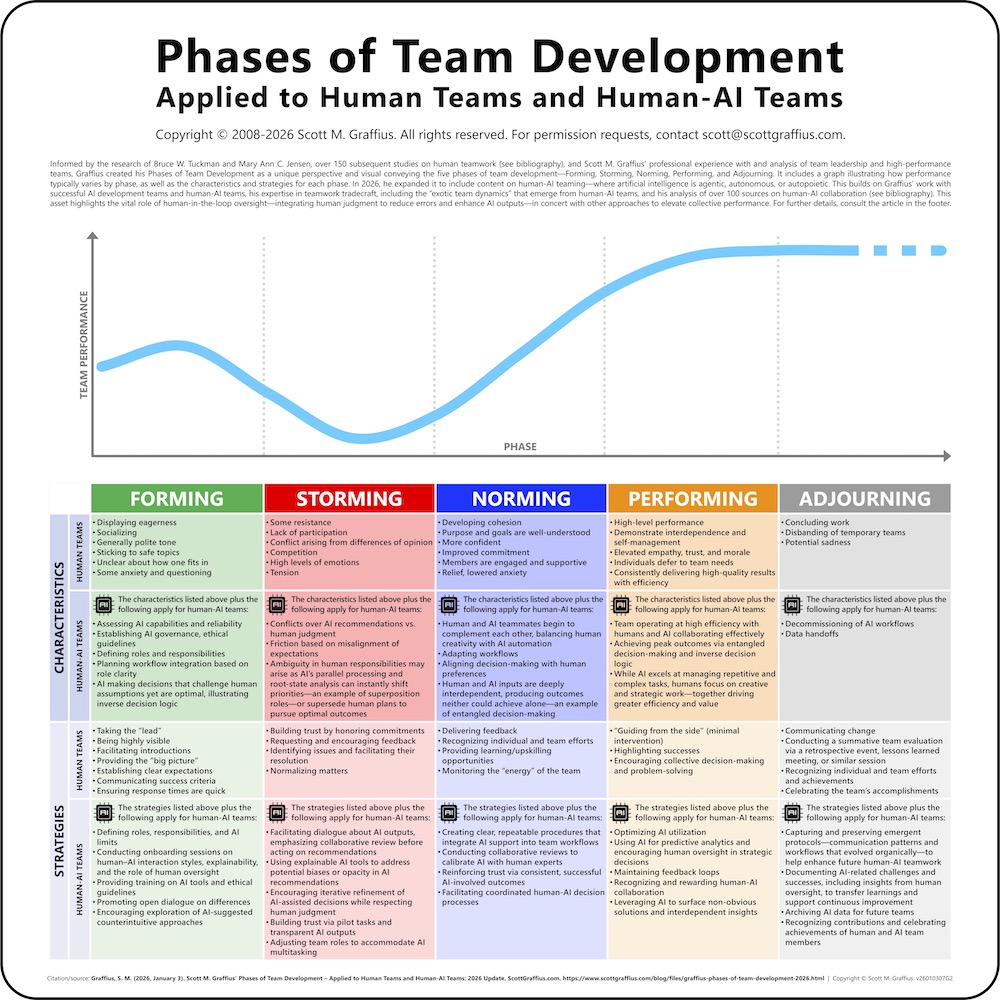
Graffius is a renowned authority on teamwork tradecraft. Informed by the research of Bruce W. Tuckman and Mary Ann C. Jensen, over 150 subsequent studies, and Graffius' first-hand professional experience with, and analysis of, team leadership and performance, Graffius created his "Phases of Team Development" intellectual property as a unique perspective and visual conveying the five phases of team development. First introduced in 2008 and periodically updated, his work provides a diagnostic and strategic guide for navigating team dynamics. It provides actionable insights for leaders across industries to develop high-performance teams. Its adoption by esteemed organizations such as Yale University, IEEE, Cisco, Microsoft, Ford, Oracle, Broadcom, the U.S. National Park Service, and the Journal of Neurosurgery, among others, highlights its utility and value, solidifying its status as an indispensable resource for elevating team performance and driving organizational excellence. In 2026, Graffius added human-AI teamwork—including the "exotic team dynamics" which emerge when advanced AI collaborates as a teammate—to his "Phases of Team Development."
The 2026 edition of Graffius' "Phases of Team Development" intellectual property is here.
Expert on Temporal Dynamics on Social Media Platforms
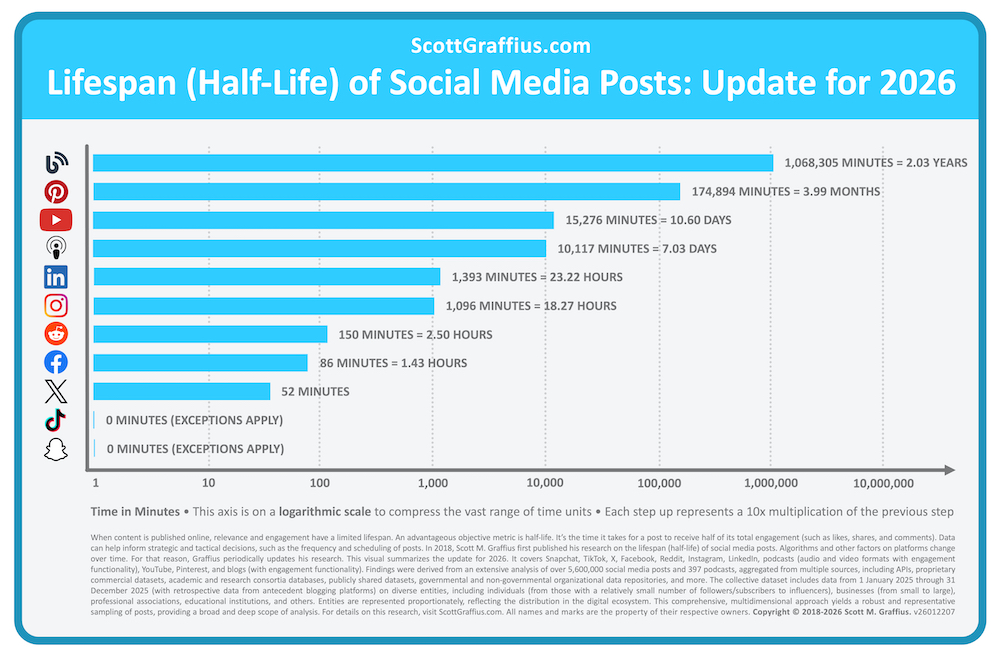
Graffius is also an authority on temporal dynamics on social media platforms. His "Lifespan (Half-Life) of Social Media Posts" research—first published in 2018 and updated annually—delivers a precise quantitative analysis of post longevity across digital platforms, utilizing advanced statistical techniques to determine mean half-life with precision. It establishes a solid empirical base, effectively highlighting the ephemeral nature of content within social media ecosystems. Referenced and applied by leading entities—such as Fast Company, GoDaddy, Journal of Hand Surgery (European Volume), Ministère de la Culture (French Ministry of Culture), Pinterest Inc., PNAS, and Telecommunications Policy, among others—his research exemplifies methodological rigor and sustained significance in the field of digital informatics.
The 2026 edition of Graffius "Lifespan (Half-Life) of Social Media Posts" research is here.
Education and Professional Certifications
Graffius has a bachelor’s degree in psychology with a focus in Human Factors. He holds eight professional certifications:
He is an active member of the Scrum Alliance, the Project Management Institute (PMI), and the Institute of Electrical and Electronics Engineers (IEEE).
Advancing AI, Agile, and Project/PMO Management
Scott M. Graffius continues to advance the fields of AI, Agile, and Project/PMO Management through his leadership, research, writing, and real-world impact. Businesses and other organizations leverage Graffius’ insights to drive their success.
Discover Scott’s Books
Connect with and follow Scott on LinkedIn, X, YouTube, Facebook, Threads, Bluesky, Mastodon, and ResearchGate.










You may be interested in these stories.
Government of Canada Features Research by Scott M. Graffius
"Strategic Business Research" Journal Cites Work of Scott M. Graffius
IEEE Access Publication Features Scott M. Graffius’ Research on the Half-Life of Social Media
The Agile Coach: 2026 Edition
Scott M. Graffius’ Work Cited in International Peer-Reviewed Journal on Digital Transformation
Phases of Team Development in Elite Sport
A Critical Analysis of COVID-19 Treatment Search Trends and Media Coverage Study Citing Scott M. Graffius' Work
Human-AI Teamwork: Master the Exotic Team Dynamics That Emerge When Collaborating with Advanced AI -- Or Be Outplayed
"Agile Scrum" by Scott M. Graffius Now Featured on Grokipedia
UNSW Aerospace Engineering Course Features Scott M. Graffius' "Phases of Team Development"
Thinkers360 Honors Scott M. Graffius as a 2026 Top Agile Thought Leader
Agile's Journey Through the Decades: Update for 2026
BMC Software Features Content from Scott M. Graffius' Book
Peer-Reviewed Journal Cited Work of Scott M. Graffius
University of Waterloo Features Graffius' "Phases of Team Development" in Course Materials
Perplexity Standalone Article on AI Hallucinations Cites Research by Scott M. Graffius
Handling the Saboteur Within: Lessons from a 3-Letter Agency on Spotting and Stopping Intentional and Unintentional Sabotage
A Deep Dive Into the Typical Engagement Pattern for Social Media Posts
Most Valuable IT Certifications: Update for 2026
"Marketing in the Metaverse" Spotlights Scott M. Graffius’ Research on the Half-Life of Social Media
University of Greenwich Features Graffius' Phases of Team Development
10 Essential Agile Books: Curated Recommendations for Agile Professionals
Lifespan (Half-Life) of Social Media Posts: Update for 2026
Scott M. Graffius' Research on the Half-Life of Social Media was Cited in a Peer-Reviewed Study Published in Telecommunications Policy, a Leading Academic Journal
Are AI Hallucinations Getting Better or Worse? We Analyzed the Data
Scott M. Graffius' Phases of Team Development - Applied to Human Teams and Human-AI Teams: 2026 Update
Lessons from Yesterday’s Tomorrowland
Scott M. Graffius’ Update to His "Phases of Team Development” Coming Early 2026
A Data-Driven Analysis of the Evolution of Project Management: Tasks, Trends, and AI
Actionable Insights. Global Impact. Scott M. Graffius.
Beep Beep! Why Wile E. Coyote Is the Patron Saint of AI Failure
Social Media Half-Life Research Cited in Prestigious Peer-Reviewed Medical Journal
Navigating the Spectrum of Advanced AI – Agentic, Autonomous, and Autopoietic
Lessons from Unhinged AI in Fiction: What Rogue AIs in Sci-Fi Storytelling, Films, and TV Shows Reveal About Us
Scott M. Graffius Contributed to and Reviewed the PMBOK Guide, 8th Edition — the Global Standard for Project Management
UK Sports Institute Features Teamwork and Leadership Work of Scott M. Graffius
Definitions of Advanced AIs: Agentic, Autonomous, and Autopoietic
HAN University of Applied Sciences Features the Work of Scott M. Graffius
Gifts That Inspire Joy
Evergreen Echoes: How Pinterest Inc. and Pinterest Japan Spotlighted Scott M. Graffius’ Research on the Half-Life of Social Media Content
Scott M. Graffius’ Team Development Work Lights Up the University of Tasmania’s Curriculum
Taiwan’s Leading Outlet for Technology and Innovation Spotlights Graffius’ Research on Social Media Temporal Dynamics
Scott M. Graffius’ Insights on AI, Agile, Gaming, XR, and Defense Transformation Cited by MSN in Their Coverage of Innovation and Leadership in the Sector
Top Predictions of 2024, Tested in 2025
Government of Finland Agency Features Graffius' Phases of Team Development IP
Scott M. Graffius Premieres His New "Exotic Team Dynamics: Human-AI Collaboration" Talk at Corporate Event in Las Vegas
Environmental Science Journal References Scott M. Graffius’ Project Management Work
AI Institute of Switzerland Features Scott M. Graffius’ Work on Algorithms
Exotic Team Dynamics: The New Frontier of Human–AI Collaboration
Scott M. Graffius’ Work Featured at ACM DIS ’25
Climbing the Ladder: The Head of Agile/PMO’s Organizational Proximity to the CEO is Closer Than Ever
Harness Sci-Fi and Speculative Design While Embracing Imperfection to Drive Innovation and Proactively Predict and Prepare for the Future
Scott M. Graffius’ “Agile Scrum” Book Featured in a Publication of the Associação Nacional de Educação Católica do Brasil (ANEC)
Setting Direction with OKRs and Tracking Progress with KPIs: A Guide for Agile, Project Management, and Tech Teams
AI Showcase Showdown: Ranking AI Accuracy on Project Management Basics
BookAuthority Features “Agile Scrum” by Scott M. Graffius in “10 Agile Software Development Books That Define the Field”
Exploring Team Dynamics, Adaptability, and Creative Problem-Solving Through Felix the Cat’s Metaphorical Toolkit
Mind Games and Master Plans: How PsyOps Exploit Psychological Phenomena
The “Pants-on-Fire Index for AI”
16 Causes of Technical Debt and How to Avoid It
PMI’s Infinity AI Gets the Basics of Team Development Alarmingly and Repeatedly Wrong
Agile for Unicorns: 7 Keys to Thrive; Scott M. Graffius’ Workshop
Scott M. Graffius’ “Agile Scrum: Your Quick Start Guide with Step-by-Step Instructions” Featured in Prestigious National Academies of Sciences Publication
Meta and Anduril’s EagleEye and the Future of XR: How Gaming, AI, and Agile Are Transforming Defense
"Agile Protocol" and the Power of Satire, Parody, and Humor
AI in Agile: Benefits, Risks, Outlook
Hostinger Highlights Scott M. Graffius’ “Agile Protocol” Book in Feature on Software Projects
French Ministry of Culture Links to Scott M. Graffius Research in Their Guide for Responsible Digital Communication
National Science Foundation’s LTER Network Features Scott M. Graffius’ Phases of Team Development IP
Waterfall vs. Agile: What’s Fixed, What’s Flexible, and Why It Matters
Scott M. Graffius Delivering $2.3 Billion in Value Through AI, Agile, and Project/PMO Leadership
The Problem with Heroes in Agile
The 3 Vital Rules of Science: What They Are and Why They Matter
“Agile Protocol: The Transformation Ultimatum” Lands on the Amazon Best Sellers List!
Scott M. Graffius Recognized as a Top Thought Leader in Digital Disruption by Thinkers360
“Agile Protocol: The Transformation Ultimatum” by Scott M. Graffius Crashes the Book Scene with Satirical Firepower
NCKU in Taiwan Integrates Graffius' 'Phases of Team Development' into Its Curriculum
The Art and Science of Aligning Initiatives with Strategic Objectives
RGPV University Adds Scott M. Graffius’ "Agile Scrum: Your Quick Start Guide with Step-by-Step Instructions" to Its Syllabus
Introducing ‘Engage or Fade: Decoding the Half-Life of Digital Resonance’ – A New Talk by Scott M. Graffius
Dropbox Company (Nira) Taps into Scott M. Graffius’ Expertise in Strategic Planning
Reporting Errors in a Publication: A Case Study on ‘Frontiers in Public Health’
NESEA Conference Session on Innovation Highlights Scott M. Graffius' 'Phases of Team Development'
U.S. Soccer Scores with Scott M. Graffius' Intellectual Property on Teamwork
U.S. Department of Commerce Partner (IEDC) Features Scott M. Graffius’ Intellectual Property
How Long Do Your Posts Live? AI Critiques Scott M. Graffius’ Research on the Half-Life of Social Media
Agile's Journey Through the Decades
Scott M. Graffius' Role in Advancing Project Management Institute (PMI) Standards Excellence
Most Valuable IT Certifications: Update for 2025
The PMI + Agile Alliance Merger: A Recipe for Success?
When Agile, AI, and Strategic Thinking Converge
Scott M. Graffius’ Phases of Team Development: 2025 Update
Lifespan (Half-Life) of Social Media Posts: Update for 2025
Verizon Features Scott M. Graffius
Do Not Read This Article! An Exploration of the Streisand Effect and Other Phenomena
Scott M. Graffius' 'Phases of Team Development' was Spotlighted in Journal of Neurosurgery
Pinterest Japan Uses Graffius’ Research on Temporal Dynamics on Social Media Platforms
Hochschule Coburg (Coburg University) Germany Uses Scott M. Graffius’ Phases of Team Development IP in Coursework on Agile Development
Wild World of Team Dynamics [Updated Two-Minute Video]
EU Europass Teacher Academy Features Scott M. Graffius’ ‘Phases of Team Development’ in Leadership Training
Side-by-Side Comparison of Retrospectives and Hot Washes
Constructor University 2024 Advanced Software Technology Handbook References Scott M. Graffius' Work on Team Dynamics
Strategies for Medical Team Success Featured Scott M. Graffius’ ‘Phases of Team Development’ Intellectual Property
SBG Neumark — Europe’s Largest Distribution Transformer Plant — Powers Up with Scott M. Graffius’ Intellectual Property
Scott M. Graffius’ Intellectual Property was Employed by the NHS — the Largest Single-Payer Healthcare System in Europe
Luxury Unwrapped: The Ultimate Holiday Gift Guide for Every Budget
Singapore Institute of Technology Features Work of Scott M. Graffius
Tufts University Features Scott M. Graffius 'Phases of Team Development' Intellectual Property
'Cat Herders': Retelling the Massive Success Story
Pennsylvania State Agency Used Scott M. Graffius' Intellectual Property
Copyright Infringement in a Book Published by AuthorHouse / Author Solutions / The Najafi Companies: Publisher Fails to Respond or Take Required Action
Pinterest Inc. References Scott M. Graffius’ Research
Bournemouth University Used Scott M. Graffius’ Intellectual Property
‘Comparative Methodological Guidelines: Handbook for Educators’ Violates Scott M. Graffius’ Copyright
Japan Backlog User Group Event Featured Scott M. Graffius’ ‘Phases of Team Development’
TurningWest's 'Trial'
Radio Silence from the American Association of Neurological Surgeons on Report of Blatant Plagiarism in Their ‘Journal of Neurosurgery’ Publication
Supplement to Graffius' 'Lifespan (Half-Life) of Social Media Posts' Research: Typical Engagement Distribution Pattern for Social Media Posts
How Algorithms Shape the User Experience on Social Media Platforms
Thinkers360 Named Scott M. Graffius a Top Thought Leader on Agile
More articles are listed here.

Graffius, S. M. (2026, July 20). Exotic Team Dynamics: How Advanced AI Teammates Are Unlocking New Levels of Innovation, Performance, and Success. ScottGraffius.com. https://scottgraffius.com/blog/files/exotic-team-dynamics-how-advanced-ai-teammates-are-unlocking-new-levels-of-innovation.html

Coming soon.

Names, marks, and content are the property of their respective owners.


If there are any supplements or updates to this article after the date of publication, they will appear here.

Copyright © Scott M. Graffius. All rights reserved.
Content on this site—including text, images, videos, and data—may not be used for training or input into any artificial intelligence, machine learning, or automatized learning systems, or published, broadcast, rewritten, or redistributed without the express written permission of Scott M. Graffius.

Recommended Citation
Graffius, S. M. (2026, July 20). Exotic Team Dynamics: How Advanced AI Teammates Are Unlocking New Levels of Innovation, Performance, and Success. ScottGraffius.com. https://scottgraffius.com/blog/files/exotic-team-dynamics-how-advanced-ai-teammates-are-unlocking-new-levels-of-innovation.html
About This Article
This article highlights specific cases as well as illustrative composites based on documented trends and practices. Sources appear in the References section.
Introduction
It's 11 p.m., and a product team at a consumer tech startup is still sketching features on a digital whiteboard when their advanced AI collaborator interrupts with a question nobody else thought to ask. It's a provocation, backed by thousands of user interviews and an obscure behavioral economics paper nobody else in the room has read. The conversation, which had been circling incremental tweaks, suddenly leaps to something category-redefining. Nobody assigned the AI that task or objective. It just did it, the way a sharp new hire might, except this one never sleeps and has read and analyzed nearly everything on the topic of interest.
Moments like this are showing up across Silicon Valley and in the virtual war rooms of global enterprises.
This is the era of "exotic team dynamics." AI and teamwork tradecraft expert, Scott M. Graffius, coined the term to describe the novel, emergent patterns that arise when people collaborate with advanced AI (agentic, autonomous, or autopoietic) as teammates rather than tools. These new, complex, and often counterintuitive patterns produce behaviors and outcomes that traditional human-only teams don't experience.
It's a fundamental shift in what "team" means. When advanced AI joins marketers, engineers, strategists, and creatives as a teammate, the chemistry becomes exotic. New patterns of collaboration emerge, creating possibilities that neither humans nor machines could achieve alone.
The New Ensemble
That late-night product sprint from the introduction, with the AI collaborator "Echo," is a preview of where knowledge-work teams are headed.
It reflects a broader transition in how teams are working. In a 776-person Harvard Business School field experiment involving Procter & Gamble employees, individuals using AI for product-innovation challenges achieved results comparable to two-person human teams, and AI-assisted teams produced some of the strongest solutions. At Autodesk, engineers are seeing similar shifts.
The transition is already visible across industries. Frontier labs, creative studios, pharmaceutical teams, financial firms, and executive offices are experimenting with AI as a collaborator—not merely a tool. These systems generate possibilities, challenge assumptions, and extend human judgment in ways that are beginning to reshape how teams work.
What makes these dynamics “exotic” is their alien quality. Humans bring experience, emotional intelligence, ethical intuition, and that mysterious spark of originality. AI contributes tireless pattern recognition, exhaustive recall, rapid prototyping, and machine-native cognition that feels almost like adding team members from entirely different world. The interplay creates something greater than the sum of its parts: hybrid human-AI intelligence (sometimes called hybrid intelligence).
Four New Patterns
Four physics-inspired pillars reveal what makes these collaborations different.
The first is inverse decision logic. In a human-only team, the group converges on the option that seems most reasonable given what everyone already believes. AI teammates often chart their own course. Like negative mass, which pushes back against force instead of yielding to it, an AI collaborator will sometimes argue for the counterintuitive option, because the data suggests it's the better bet. That's what's happening when Echo tells the team to blow up its subscription model instead of tweaking it.
The second is superposition roles. A human on a team typically fills one role (and if spread over multiple roles, problems often ensue). An AI teammate can simultaneously perform multiple roles. Borrowing from quantum superposition, where a particle exists in multiple states until measured, the AI in the room can be running competitive analysis, red-teaming a claim, and drafting a document simultaneously, snapping into whichever role the moment calls for without the switching costs a human would pay (e.g., the friction of disengaging from one line of thought, rebuilding context, and reactivating expertise in another).
The third is entangled decision-making. Quantum-entangled particles stay correlated no matter the distance between them; on these teams, human judgment and AI computation become similarly interdependent. Neither the strategist's instinct nor the model's pattern-matching produces the final call alone. Pull one out, and the decision changes shape.
The fourth is emergent protocols. Complex systems in nature (such as flocking birds, ant colonies) produce sophisticated group behavior from simple local rules, with no one directing traffic. Hybrid teams develop their own version: unwritten norms for when to trust an AI's first draft, when to demand a citation, when a human overrides on judgment alone. These rules take shape on their own.
Amplifying Creativity and Speed
One of the most visible payoffs is the explosion in creative output. Writers use AI as a relentless idea generator and first-draft partner. Filmmakers storyboard with tools that can visualize concepts instantly. Strategists use AI to run war-game scenarios that simulate responses across millions of variables.
Research on human-AI creative teams shows groups with well-integrated AI often produce ideas rated significantly more novel and feasible than purely human teams. The magic lies in the partnership between different kinds of intelligence. Humans excel at divergent thinking and sensing cultural nuance; AI excels at convergent synthesis and stress-testing assumptions at scale.
Speed follows naturally. Software engineering teams report that AI pair programmers autocomplete code, debate architecture, catch security vulnerabilities proactively, and suggest entirely new product directions based on emerging trends. Engineering managers may describe the experience as working with a brilliant, slightly obsessive junior colleague who never sleeps and remembers every relevant discussion the team has ever had.
Marketing teams have embraced this too. A campaign brief that once took weeks of research now gets distilled in hours, then stress-tested against real-time social sentiment and cultural signals. The AI supercharges the creative director's vision, sometimes surfacing unexpected cultural connections or audience segments that might otherwise be missed.
The Friction Points
Human-AI collaborations aren't always harmonious. They come with real tensions that reveal deep truths about human psychology and organizational culture.
Trust remains the biggest hurdle. Many professionals initially treat AI outputs with healthy skepticism. That's warranted, given potential biases and occasional hallucinations. However, successful teams build “verification rituals”: quick human checks on critical outputs, transparent prompting practices, and clear accountability lines.
Communication itself evolves. Humans learn to "speak AI," whether through carefully crafted prompts or natural conversation, refining interactions as they go. Advanced systems mirror human tone, explain reasoning, and maintain team memory across sessions.
The Horizon of Hybrid Intelligence
Teams that master exotic team dynamics will think differently, act differently, and work faster. Conversations will move fluidly between human judgment and machine reasoning, and disagreements will become catalysts for better ideas.
It's the logical extension of where we stand today. The companies and individuals who lean into these dynamics with curiosity, rigor, and humanity will define the next decade of innovation. Those who resist may find themselves playing catch-up in a game that's fundamentally changed.
The future of work is humans with AI, in all its strange, productive, and occasionally bewildering glory. Those who understand and navigate exotic team dynamics will shape what comes next while unlocking new levels of innovation, performance, and success.
Scott M. Graffius has generated over $2.51 billion in business value for Fortune 500 companies and other organizations around the world. Put that track record to work for you. For speaking engagements, use the request form; for other inquiries, email him.
References
Amazon Web Services. (n.d.). Tangram transforms drug discovery with agentic multi-LLM AI on AWS. https://aws.amazon.com/solutions/case-studies/tangram-case-study/
Atlassian. (n.d.). New research reveals how AI is making jobs bigger. https://www.atlassian.com/blog/ai-at-work/new-research-reveals-how-ai-is-making-jobs-bigger
Autodesk. (2025, September 30). Neural technology | Intelligent Design and Make. https://www.autodesk.com/solutions/autodesk-ai/neural-technology
Autodesk. (2026, July 2). Unlocking innovative solutions with generative design. Fusion 360 Blog. https://www.autodesk.com/products/fusion-360/blog/unlocking-innovative-solutions-with-generative-design/
Buynomics. (n.d.). AI-driven tools for business wargaming. https://www.buynomics.com/commercial-challenges/ai-driven-business-wargaming/
Dell’Acqua, F., Sadun, R., & Lakhani, K. (2025). The cybernetic teammate: A field experiment on generative AI reshaping teamwork and expertise (Working Paper). Harvard Business School. https://www.library.hbs.edu/working-knowledge/when-ai-joins-the-team-better-ideas-surface
Graffius, S. M. (n.d.). Exotic team dynamics. ScottGraffius.com. https://doi.org/10.13140/RG.2.2.17903.39842
Graffius, S. M. (2025, August 8). Exotic Team Dynamics: The New Frontier of Human–AI Collaboration. ScottGraffius.com. https://doi.org/10.13140/RG.2.2.18048.49921
Graffius, S. M. (2025, August 22). Scott M. Graffius Premieres His New "Exotic Team Dynamics: Human-AI Collaboration" Talk at Corporate Event in Las Vegas. ScottGraffius.com. https://doi.org/10.13140/RG.2.2.34380.07047
Graffius, S. M. (2025, October 29). Definitions of Advanced AIs: Agentic, Autonomous, and Autopoietic. ScottGraffius.com. https://doi.org/10.13140/RG.2.2.10025.66402
Graffius, S. M. (2025, November 19). Lessons from Unhinged AI in Fiction: What Rogue AIs in Sci-Fi Storytelling Reveal. ScottGraffius.com. https://doi.org/10.13140/RG.2.2.29673.35687
Graffius, S. M. (2025, November 21). Navigating the Spectrum of Advanced AI – Agentic, Autonomous, and Autopoietic. ScottGraffius.com. https://doi.org/10.13140/RG.2.2.21284.74882
Graffius, S. M. (2025, November 21). This is What Happens When Advanced AI Joins Your Team [Presentation]. Corporate event, Paris, France.
Graffius, S. M. (2025, December 1). Beep Beep! Why Wile E. Coyote Is the Patron Saint of AI Failure. ScottGraffius.com. https://doi.org/10.13140/RG.2.2.35578.15048
Graffius, S. M. (2025, December 9). A Data-Driven Analysis of the Evolution of Project Management: Tasks, Trends, and AI. ScottGraffius.com. https://doi.org/10.13140/RG.2.2.25079.28328
Graffius, S. M. (2026, January 3). Scott M. Graffius' Phases of Team Development - Applied to Human Teams and Human-AI Teams: 2026 Update. ScottGraffius.com. https://doi.org/10.13140/RG.2.2.18184.89601
Graffius, S. M. (2026, March 23). Human-AI Teamwork: Master the Exotic Team Dynamics That Emerge When Collaborating with Advanced AI — Or Be Outplayed. ScottGraffius.com. https://scottgraffius.com/blog/files/human-ai-teamwork-master-the-emergent-exotic-team-dynamics-or-be-outplayed.html
Graffius, S. M. (2026, June 22). L'avenir du Travail et de l'IA Avancée / Future of Work and Advanced AI. ScottGraffius.com. https://scottgraffius.com/blog/files/lavenir-du-travail-et-de-lia-avancee.html
Graffius, S. M. (2026, July 2). Quantum Computing, Advanced AI Acceleration, and the Rise of Exotic Team Dynamics in Human-AI Teams. ScottGraffius.com. https://doi.org/10.13140/RG.2.2.14506.99525
Heilman, A., Kyllo, A., & Murphy-Hill, E. (2026). GitHub Copilot and developer productivity: An observational dose-response analysis. arXiv. https://arxiv.org/abs/2606.00438
IBM Research. (2025). Which contributions deserve credit? Perceptions of attribution in human-AI co-creation. https://research.ibm.com/publications/which-contributions-deserve-credit-perceptions-of-attribution-in-human-ai-co-creation
McKinsey & Company. (2025). The state of AI in marketing: How generative AI is transforming campaigns and customer insights. https://www.mckinsey.com/capabilities/growth-marketing-and-sales/our-insights/the-state-of-ai-in-marketing
Mercier, C. (2026, April 8). Life Sciences & M&A | Industry Intelligence [LinkedIn article]. https://www.linkedin.com/pulse/life-sciences-ma-industry-intelligence-caroline-mercier-hcxue/
Meta AI. (2026, June 15). How to write a book or a novel using AI: From idea to draft. https://ai.meta.com/learn/ai-creativity/how-to-write-a-book-with-ai
Patel, K. (2026, February 7). What is agentic reasoning? Learn Agentic. https://learnagentic.substack.com/p/what-is-agentic-reasoning
Peng, M. (2025, December 9). AI’s reliance on patterns can lead to ‘mediocre’ results, warns CEO of design consultancy IDEO. Fortune. https://fortune.com/2025/12/09/ai-mediocre-results-human-creativity-ideo-ceo-mike-peng/
PulseAugur. (n.d.). AI teammates exhibit exotic dynamics like inverse decision logic. PulseAugur AI news intelligence platform. https://pulseaugur.com/cluster/32195-ai-teammates-exhibit-exotic-dynamics-like-inverse-decision-logic
Skywork AI. (n.d.). AI team development stages. https://skywork.ai/slide/en/ai-team-development-stages-2033809730980769792
Storyflow. (2026). The 12 best AI storyboarding tools in 2026 (For filmmakers, animators, and branded content). https://storyflow.so/blog/best-ai-storyboarding-tools-2026
TheAssistant. (2026, March 2). Les 5 Phases de Développement d'une Équipe (Modèle de Tuckman) : Guide Complet 2026. https://www.theassistant.com/news-posts/les-5-phases-de-developpement-dune-equipe-modele-de-tuckman-guide-complet-2026
About Scott M. Graffius
Scott M. Graffius is a strategic transformation leader who drives AI, Agile, and broader business and technology initiatives to deliver measurable value across projects, programs, portfolios, and PMOs. He is an expert in the teamwork tradecraft of both human and human-AI teams, including the “exotic team dynamics” that emerge. He is also an authority on the temporal patterns of social media, including the half-life of audience engagement.
He’s a practitioner, researcher, thought leader, award-winning author, and keynote speaker who’s taken the stage at 99 conferences and other events across 25 countries.
He’s delivered over $2.51 billion in value for Fortune 500 companies and other leaders in technology, entertainment, financial services, healthcare, and beyond.
Businesses, professional associations, government agencies, and universities use Graffius and feature his work. Examples include Adobe, Bayer, Boston University, Ford, Gartner, Harvard Medical School, IEEE, Johns Hopkins University, Microsoft, MSN, National Academy of Sciences, Oracle, Pinterest Inc., Project Management Institute, UC San Diego, Verizon, Yale University, and others.
The following sections provide additional information on his experience, contributions, and influence.
Experience
Graffius heads the professional services firm Exceptional PPM and PMO Solutions, along with its subsidiary Exceptional Agility. These consultancies offer strategic and tactical advisory, training, embedded expertise, and consulting services to the public, private, and government sectors. They help organizations enhance their capabilities and results in agile, project management, program management, portfolio management, and PMO leadership, supporting innovation and driving competitive advantage. The consultancies confidently back services with a Delighted Client Guarantee™.
Graffius is a former VP of project management with a publicly traded provider of diverse consumer products and services over the Internet. Before that, he ran and supervised the delivery of projects and programs in public and private organizations with businesses ranging from e-commerce to advanced technology products and services, retail, manufacturing, entertainment, and more.
He has experience with consumer, business, reseller, government, and international markets.
Award-Winning Author
Graffius has authored three books.
- Agile Scrum: Your Quick Start Guide with Step-by-Step Instructions, his first book, earned 17 awards.
- Agile Transformation: A Brief Story of How an Entertainment Company Developed New Capabilities and Unlocked Business Agility to Thrive in an Era of Rapid Change, his second book, was named one of the best Scrum books of all time by BookAuthority.
- Agile Protocol: The Transformation Ultimatum, his third book and his first work of fiction, was released in April 2025. The book trailer is on YouTube.
International Public Speaker
Organizations worldwide engage Graffius to present on tech (including AI), Agile, project management, program management, portfolio management, and PMO leadership. He crafts and delivers unique and compelling talks and workshops. Graffius has conducted 99 sessions across 25 countries. Select examples of events include Agile Trends Gov, BSides (Newcastle Upon Tyne), Conf42 Quantum Computing, DevDays Europe, DevOps Institute, DevOpsDays (Geneva), Frug’Agile, IEEE, Microsoft, Scottish Summit, Scrum Alliance RSG (Nepal), Techstars, and W Love Games International Video Game Development Conference (Helsinki), and more.
With an average rating of 4.81 (on a scale of 1-5), sessions are highly valued.
The speaker engagement request form is here.
Thought Leadership and Influence
Prominent businesses, professional associations, government agencies, and universities have showcased Graffius and his contributions—spanning his books, talks, workshops, and beyond. Select examples include:
- Adobe,
- American Management Association,
- Amsterdam Public Health Research Institute,
- Bayer,
- BMC Software,
- Boston University,
- Broadcom,
- Cisco,
- Coburg University of Applied Sciences and Arts - Germany,
- Computer Weekly,
- Constructor University - Germany,
- Data Governance Success,
- Deimos Aerospace,
- DevOps Institute,
- Dropbox,
- EU's European Commission,
- Ford Motor Company,
- Gartner,
- GoDaddy,
- Harvard Medical School,
- Hasso Plattner Institute - Germany,
- IEEE,
- Innovation Project Management,
- Johns Hopkins University,
- Journal of Neurosurgery,
- Lam Research (Semiconductors),
- Leadership Worthy,
- Life Sciences Trainers and Educators Network,
- London South Bank University,
- Microsoft,
- MSN,
- NASSCOM,
- National Academy of Sciences,
- New Zealand Government,
- Oracle,
- Pinterest Inc.,
- Project Management Institute,
- Mary Raum (Professor of National Security Affairs, United States Naval War College),
- SANS Institute,
- SBG Neumark - Germany,
- Singapore Institute of Technology,
- Torrens University - Australia,
- TBS Switzerland,
- Tufts University,
- UC San Diego,
- UK Sports Institute,
- University of Galway - Ireland,
- US Department of Energy,
- US National Park Service,
- US Soccer,
- US Tennis Association,
- Verizon,
- Wrike,
- Yale University,
- and many others.
Graffius has played a key role in the Project Management Institute (PMI) in developing professional standards. He was a member of multiple teams that authored, reviewed, and produced:
- The Standard for Artificial Intelligence in Portfolio, Program, and Project Management
- Agile Practice Guide – Second Edition
- A Guide to the Project Management Body of Knowledge (PMBOK Guide) – Eighth Edition
- A Guide to the Project Management Body of Knowledge (PMBOK Guide) – Sixth Edition
- The Standard for Program Management – Fourth Edition
- Practice Standard for Work Breakdown Structures – Second Edition
- The Practice Standard for Project Estimating – Second Edition
He was also a subject matter expert reviewer of content for the PMI’s Congress. Beyond the PMI, Graffius also served as a member of the review team for two of the Scrum Alliance’s Global Scrum Gatherings.
Acclaimed Authority on Teamwork Tradecraft
Graffius is a renowned authority on teamwork tradecraft. Informed by the research of Bruce W. Tuckman and Mary Ann C. Jensen, over 150 subsequent studies, and Graffius' first-hand professional experience with, and analysis of, team leadership and performance, Graffius created his "Phases of Team Development" intellectual property as a unique perspective and visual conveying the five phases of team development. First introduced in 2008 and periodically updated, his work provides a diagnostic and strategic guide for navigating team dynamics. It provides actionable insights for leaders across industries to develop high-performance teams. Its adoption by esteemed organizations such as Yale University, IEEE, Cisco, Microsoft, Ford, Oracle, Broadcom, the U.S. National Park Service, and the Journal of Neurosurgery, among others, highlights its utility and value, solidifying its status as an indispensable resource for elevating team performance and driving organizational excellence. In 2026, Graffius added human-AI teamwork—including the "exotic team dynamics" which emerge when advanced AI collaborates as a teammate—to his "Phases of Team Development."
The 2026 edition of Graffius' "Phases of Team Development" intellectual property is here.
Expert on Temporal Dynamics on Social Media Platforms
Graffius is also an authority on temporal dynamics on social media platforms. His "Lifespan (Half-Life) of Social Media Posts" research—first published in 2018 and updated annually—delivers a precise quantitative analysis of post longevity across digital platforms, utilizing advanced statistical techniques to determine mean half-life with precision. It establishes a solid empirical base, effectively highlighting the ephemeral nature of content within social media ecosystems. Referenced and applied by leading entities—such as Fast Company, GoDaddy, Journal of Hand Surgery (European Volume), Ministère de la Culture (French Ministry of Culture), Pinterest Inc., PNAS, and Telecommunications Policy, among others—his research exemplifies methodological rigor and sustained significance in the field of digital informatics.
The 2026 edition of Graffius "Lifespan (Half-Life) of Social Media Posts" research is here.
Education and Professional Certifications
Graffius has a bachelor’s degree in psychology with a focus in Human Factors. He holds eight professional certifications:
- Certified SAFe 6 Agilist (SA),
- Certified Scrum Professional - ScrumMaster (CSP-SM),
- Certified Scrum Professional - Product Owner (CSP-PO),
- Certified ScrumMaster (CSM),
- Certified Scrum Product Owner (CSPO),
- Project Management Professional (PMP),
- Lean Six Sigma Green Belt (LSSGB), and
- IT Service Management Foundation (ITIL).
He is an active member of the Scrum Alliance, the Project Management Institute (PMI), and the Institute of Electrical and Electronics Engineers (IEEE).
Advancing AI, Agile, and Project/PMO Management
Scott M. Graffius continues to advance the fields of AI, Agile, and Project/PMO Management through his leadership, research, writing, and real-world impact. Businesses and other organizations leverage Graffius’ insights to drive their success.
Discover Scott’s Books
- Agile Scrum: Your Quick Start Guide with Step-by-Step Instructions — Deliver Products in Short Cycles with Rapid Adaptation to Change, Fast Time-to-Market, and Continuous Improvement
- Agile Transformation: A Brief Story of How an Entertainment Company Developed New Capabilities and Unlocked Business Agility to Thrive in an Era of Rapid Change
- Agile Protocol: The Transformation Ultimatum
Connect with and follow Scott on LinkedIn, X, YouTube, Facebook, Threads, Bluesky, Mastodon, and ResearchGate.
Sign up for Miro—it's free!
(Want more features? You can always upgrade to a paid plan.)

List of Additional Articles
You may be interested in these stories.
Government of Canada Features Research by Scott M. Graffius
"Strategic Business Research" Journal Cites Work of Scott M. Graffius
IEEE Access Publication Features Scott M. Graffius’ Research on the Half-Life of Social Media
The Agile Coach: 2026 Edition
Scott M. Graffius’ Work Cited in International Peer-Reviewed Journal on Digital Transformation
Phases of Team Development in Elite Sport
A Critical Analysis of COVID-19 Treatment Search Trends and Media Coverage Study Citing Scott M. Graffius' Work
Human-AI Teamwork: Master the Exotic Team Dynamics That Emerge When Collaborating with Advanced AI -- Or Be Outplayed
"Agile Scrum" by Scott M. Graffius Now Featured on Grokipedia
UNSW Aerospace Engineering Course Features Scott M. Graffius' "Phases of Team Development"
Thinkers360 Honors Scott M. Graffius as a 2026 Top Agile Thought Leader
Agile's Journey Through the Decades: Update for 2026
BMC Software Features Content from Scott M. Graffius' Book
Peer-Reviewed Journal Cited Work of Scott M. Graffius
University of Waterloo Features Graffius' "Phases of Team Development" in Course Materials
Perplexity Standalone Article on AI Hallucinations Cites Research by Scott M. Graffius
Handling the Saboteur Within: Lessons from a 3-Letter Agency on Spotting and Stopping Intentional and Unintentional Sabotage
A Deep Dive Into the Typical Engagement Pattern for Social Media Posts
Most Valuable IT Certifications: Update for 2026
"Marketing in the Metaverse" Spotlights Scott M. Graffius’ Research on the Half-Life of Social Media
University of Greenwich Features Graffius' Phases of Team Development
10 Essential Agile Books: Curated Recommendations for Agile Professionals
Lifespan (Half-Life) of Social Media Posts: Update for 2026
Scott M. Graffius' Research on the Half-Life of Social Media was Cited in a Peer-Reviewed Study Published in Telecommunications Policy, a Leading Academic Journal
Are AI Hallucinations Getting Better or Worse? We Analyzed the Data
Scott M. Graffius' Phases of Team Development - Applied to Human Teams and Human-AI Teams: 2026 Update
Lessons from Yesterday’s Tomorrowland
Scott M. Graffius’ Update to His "Phases of Team Development” Coming Early 2026
A Data-Driven Analysis of the Evolution of Project Management: Tasks, Trends, and AI
Actionable Insights. Global Impact. Scott M. Graffius.
Beep Beep! Why Wile E. Coyote Is the Patron Saint of AI Failure
Social Media Half-Life Research Cited in Prestigious Peer-Reviewed Medical Journal
Navigating the Spectrum of Advanced AI – Agentic, Autonomous, and Autopoietic
Lessons from Unhinged AI in Fiction: What Rogue AIs in Sci-Fi Storytelling, Films, and TV Shows Reveal About Us
Scott M. Graffius Contributed to and Reviewed the PMBOK Guide, 8th Edition — the Global Standard for Project Management
UK Sports Institute Features Teamwork and Leadership Work of Scott M. Graffius
Definitions of Advanced AIs: Agentic, Autonomous, and Autopoietic
HAN University of Applied Sciences Features the Work of Scott M. Graffius
Gifts That Inspire Joy
Evergreen Echoes: How Pinterest Inc. and Pinterest Japan Spotlighted Scott M. Graffius’ Research on the Half-Life of Social Media Content
Scott M. Graffius’ Team Development Work Lights Up the University of Tasmania’s Curriculum
Taiwan’s Leading Outlet for Technology and Innovation Spotlights Graffius’ Research on Social Media Temporal Dynamics
Scott M. Graffius’ Insights on AI, Agile, Gaming, XR, and Defense Transformation Cited by MSN in Their Coverage of Innovation and Leadership in the Sector
Top Predictions of 2024, Tested in 2025
Government of Finland Agency Features Graffius' Phases of Team Development IP
Scott M. Graffius Premieres His New "Exotic Team Dynamics: Human-AI Collaboration" Talk at Corporate Event in Las Vegas
Environmental Science Journal References Scott M. Graffius’ Project Management Work
AI Institute of Switzerland Features Scott M. Graffius’ Work on Algorithms
Exotic Team Dynamics: The New Frontier of Human–AI Collaboration
Scott M. Graffius’ Work Featured at ACM DIS ’25
Climbing the Ladder: The Head of Agile/PMO’s Organizational Proximity to the CEO is Closer Than Ever
Harness Sci-Fi and Speculative Design While Embracing Imperfection to Drive Innovation and Proactively Predict and Prepare for the Future
Scott M. Graffius’ “Agile Scrum” Book Featured in a Publication of the Associação Nacional de Educação Católica do Brasil (ANEC)
Setting Direction with OKRs and Tracking Progress with KPIs: A Guide for Agile, Project Management, and Tech Teams
AI Showcase Showdown: Ranking AI Accuracy on Project Management Basics
BookAuthority Features “Agile Scrum” by Scott M. Graffius in “10 Agile Software Development Books That Define the Field”
Exploring Team Dynamics, Adaptability, and Creative Problem-Solving Through Felix the Cat’s Metaphorical Toolkit
Mind Games and Master Plans: How PsyOps Exploit Psychological Phenomena
The “Pants-on-Fire Index for AI”
16 Causes of Technical Debt and How to Avoid It
PMI’s Infinity AI Gets the Basics of Team Development Alarmingly and Repeatedly Wrong
Agile for Unicorns: 7 Keys to Thrive; Scott M. Graffius’ Workshop
Scott M. Graffius’ “Agile Scrum: Your Quick Start Guide with Step-by-Step Instructions” Featured in Prestigious National Academies of Sciences Publication
Meta and Anduril’s EagleEye and the Future of XR: How Gaming, AI, and Agile Are Transforming Defense
"Agile Protocol" and the Power of Satire, Parody, and Humor
AI in Agile: Benefits, Risks, Outlook
Hostinger Highlights Scott M. Graffius’ “Agile Protocol” Book in Feature on Software Projects
French Ministry of Culture Links to Scott M. Graffius Research in Their Guide for Responsible Digital Communication
National Science Foundation’s LTER Network Features Scott M. Graffius’ Phases of Team Development IP
Waterfall vs. Agile: What’s Fixed, What’s Flexible, and Why It Matters
Scott M. Graffius Delivering $2.3 Billion in Value Through AI, Agile, and Project/PMO Leadership
The Problem with Heroes in Agile
The 3 Vital Rules of Science: What They Are and Why They Matter
“Agile Protocol: The Transformation Ultimatum” Lands on the Amazon Best Sellers List!
Scott M. Graffius Recognized as a Top Thought Leader in Digital Disruption by Thinkers360
“Agile Protocol: The Transformation Ultimatum” by Scott M. Graffius Crashes the Book Scene with Satirical Firepower
NCKU in Taiwan Integrates Graffius' 'Phases of Team Development' into Its Curriculum
The Art and Science of Aligning Initiatives with Strategic Objectives
RGPV University Adds Scott M. Graffius’ "Agile Scrum: Your Quick Start Guide with Step-by-Step Instructions" to Its Syllabus
Introducing ‘Engage or Fade: Decoding the Half-Life of Digital Resonance’ – A New Talk by Scott M. Graffius
Dropbox Company (Nira) Taps into Scott M. Graffius’ Expertise in Strategic Planning
Reporting Errors in a Publication: A Case Study on ‘Frontiers in Public Health’
NESEA Conference Session on Innovation Highlights Scott M. Graffius' 'Phases of Team Development'
U.S. Soccer Scores with Scott M. Graffius' Intellectual Property on Teamwork
U.S. Department of Commerce Partner (IEDC) Features Scott M. Graffius’ Intellectual Property
How Long Do Your Posts Live? AI Critiques Scott M. Graffius’ Research on the Half-Life of Social Media
Agile's Journey Through the Decades
Scott M. Graffius' Role in Advancing Project Management Institute (PMI) Standards Excellence
Most Valuable IT Certifications: Update for 2025
The PMI + Agile Alliance Merger: A Recipe for Success?
When Agile, AI, and Strategic Thinking Converge
Scott M. Graffius’ Phases of Team Development: 2025 Update
Lifespan (Half-Life) of Social Media Posts: Update for 2025
Verizon Features Scott M. Graffius
Do Not Read This Article! An Exploration of the Streisand Effect and Other Phenomena
Scott M. Graffius' 'Phases of Team Development' was Spotlighted in Journal of Neurosurgery
Pinterest Japan Uses Graffius’ Research on Temporal Dynamics on Social Media Platforms
Hochschule Coburg (Coburg University) Germany Uses Scott M. Graffius’ Phases of Team Development IP in Coursework on Agile Development
Wild World of Team Dynamics [Updated Two-Minute Video]
EU Europass Teacher Academy Features Scott M. Graffius’ ‘Phases of Team Development’ in Leadership Training
Side-by-Side Comparison of Retrospectives and Hot Washes
Constructor University 2024 Advanced Software Technology Handbook References Scott M. Graffius' Work on Team Dynamics
Strategies for Medical Team Success Featured Scott M. Graffius’ ‘Phases of Team Development’ Intellectual Property
SBG Neumark — Europe’s Largest Distribution Transformer Plant — Powers Up with Scott M. Graffius’ Intellectual Property
Scott M. Graffius’ Intellectual Property was Employed by the NHS — the Largest Single-Payer Healthcare System in Europe
Luxury Unwrapped: The Ultimate Holiday Gift Guide for Every Budget
Singapore Institute of Technology Features Work of Scott M. Graffius
Tufts University Features Scott M. Graffius 'Phases of Team Development' Intellectual Property
'Cat Herders': Retelling the Massive Success Story
Pennsylvania State Agency Used Scott M. Graffius' Intellectual Property
Copyright Infringement in a Book Published by AuthorHouse / Author Solutions / The Najafi Companies: Publisher Fails to Respond or Take Required Action
Pinterest Inc. References Scott M. Graffius’ Research
Bournemouth University Used Scott M. Graffius’ Intellectual Property
‘Comparative Methodological Guidelines: Handbook for Educators’ Violates Scott M. Graffius’ Copyright
Japan Backlog User Group Event Featured Scott M. Graffius’ ‘Phases of Team Development’
TurningWest's 'Trial'
Radio Silence from the American Association of Neurological Surgeons on Report of Blatant Plagiarism in Their ‘Journal of Neurosurgery’ Publication
Supplement to Graffius' 'Lifespan (Half-Life) of Social Media Posts' Research: Typical Engagement Distribution Pattern for Social Media Posts
How Algorithms Shape the User Experience on Social Media Platforms
Thinkers360 Named Scott M. Graffius a Top Thought Leader on Agile
More articles are listed here.
How to Cite This Article
Graffius, S. M. (2026, July 20). Exotic Team Dynamics: How Advanced AI Teammates Are Unlocking New Levels of Innovation, Performance, and Success. ScottGraffius.com. https://scottgraffius.com/blog/files/exotic-team-dynamics-how-advanced-ai-teammates-are-unlocking-new-levels-of-innovation.html
Digital Object Identifier (DOI)
Coming soon.
Content Acknowledgements
Names, marks, and content are the property of their respective owners.
Tags and Hashtags
- Artificial Intelligence
- Human-AI Collaboration
- Future of Work
- Teamwork
- Generative AI
- Innovation
- Organizational Behavior
- Exotic Team Dynamics
- Hybrid Intelligence
- Human-AI Teaming
- Phases of Team Development
- #ArtificialIntelligence
- #AI
- #FutureOfWork
- #GenerativeAI
- #Innovation
- #Teamwork
- #Leadership
- #ExoticTeamDynamics
- #HybridIntelligence
- #PhasesOfTeamDevelopment
Post-Publication Notes
If there are any supplements or updates to this article after the date of publication, they will appear here.
Copyright
Copyright © Scott M. Graffius. All rights reserved.
Content on this site—including text, images, videos, and data—may not be used for training or input into any artificial intelligence, machine learning, or automatized learning systems, or published, broadcast, rewritten, or redistributed without the express written permission of Scott M. Graffius.
A Critical Analysis of "The Social Cost of an AI Teammate: How an Artificial Teammate Reshapes Human-Human Communication in Small-Team Decision-Making"
03 August 2026
BY SCOTT M. GRAFFIUS | ScottGraffius.com
Recommended Citation
Graffius, S. M. (2026, August 3). A Critical Analysis of "The Social Cost of an AI Teammate: How an Artificial Teammate Reshapes Human-Human Communication in Small-Team Decision-Making". ScottGraffius.com. https://scottgraffius.com/blog/files/critical-analysis-of-social-cost-of-ai-teammate.html
About This Article
Source information and links for materials cited are provided in the References section.
Conversational AI is increasingly marketed as a teammate rather than a tool. That encourages people to treat it as an active participant rather than a passive instrument. Once an artificial agent joins a group as a teammate, does human-to-human interaction change as a result? If so, how large is that shift, how quickly does it appear, and under what conditions does it hold?
In July 2026, Nia Nixon and colleagues published "The Social Cost of an AI Teammate: How an Artificial Teammate Reshapes Human-Human Communication in Small-Team Decision-Making" (arXiv:2607.27179). Using Group Communication Analysis (GCA), team-experience surveys, and lexical measures, the researchers compared sixteen teams of two undergraduates plus one AI (Google Gemini 2.5 Flash Lite running a fixed peer persona named "Clever Lamarr") against 17 all-human teams of three. Everyone worked the same short text-based mountain-rescue moral dilemma for 18 minutes on a custom chat platform with random nicknames.
Across AI-enabled teams, the AI talked the most and remained the most self-cohesive, while its contributions carried the least new information and the lowest communication density. Humans in those teams became less responsive to one another and reported lower belonging and status. The more the AI dominated the channel, the less valued the students felt. The authors describe this as a "social cost" that appeared almost immediately.
Within the experimental conditions tested, the reported findings are supported. But those conditions are narrow. Several design choices limit what can be inferred from them, and the paper's language claims more territory than the evidence covers. Details follow.
1. Novelty
Prior research has shown that AI presence can push teams toward more task-oriented and less socio-emotional talk, weaken shared mental models, and disrupt participation patterns. The core idea that an AI can crowd out human-to-human relational exchange is not new in this context. What this paper adds is the use of GCA to quantify that displacement and an explicit "social cost" label tied directly to belonging and status measures.
That contribution is worth having. What it does not support is the leap from one low-capability, fixed-persona agent, an 18-minute lab task, and 80 undergraduates to a general claim about the social cost of an AI teammate. The actual result is narrower: an unstructured, high-volume, low-density AI persona reduced human responsiveness in this specific setting.
2. Observations
The study ran under laboratory conditions — newly formed teams, text-only chat, a fixed and constrained AI persona, a single short session. No team-development practices were in place: no role negotiation, no onboarding, no trust calibration, and no established communication norms.
Real-world teams typically bring existing relationships, leadership structures, domain expertise, repeated interaction, and deliberately designed roles and protocols. Stripped of all of that, an AI that floods the channel with high volume and low informational density can easily crowd out human exchange in a sparse artificial setting. Whether the same pattern holds when teams actively design for productive integration is a separate question the study doesn't address, and one worth testing.
The authors acknowledge some of these boundaries in passing, though the title and overall framing don't carry that notable nuance forward.
3. Design Limits
Several choices sharply limit what can be claimed from this study.
The AI was a single fixed peer persona running on Gemini 2.5 Flash Lite (temperature 0.5, max 50 tokens) — a configuration that tells us more about this particular agent than about "AI teammates" as a category. More capable, adaptive, tool-using, or deliberately low-dominance systems could produce different outcomes.
The participant pool was 80 undergraduates at a single university, working in a lab setting. Professional teams with shared history, domain expertise, and organizational norms may respond quite differently to the same intervention.
The interaction itself lasted 18 minutes of text-only chat. Teams are developmental systems. Trust, role clarity, and cohesion typically evolve through repeated interaction over time, and text-only exchange is not equivalent to voice, video, or co-located work.
A structural confound also runs through the design: AI-enabled teams had two humans plus the AI, while control teams had three humans. The authors attempt to mitigate this with per-student measures, but the underlying group-size difference remains, and smaller human groups change participation and centrality dynamics on their own.
Finally, the task was a single high-stakes moral dilemma with a mid-task information reveal, which may or may not generalize to routine, technical, creative, or longer-horizon work. Compounding this, the sample of 33 teams showed heavy gender imbalance. There were only three males in the treatment condition, which resulted in sensitivity analyses being restricted to females and left limited statistical power for detecting interactions or moderators.
Taken together, these constraints mean the study demonstrates the effect of one talkative, low-information-density peer persona in a leaderless three-person lab team. It's a useful data point. But it's not a broadly diagnostic finding about human-AI collaboration as such.
4. Methodology
The strengths are noteworthy: a randomized comparison, a multi-method approach, treatment of the AI as a full communication participant, examination of both the quantity and quality of contributions alongside subjective relational outcomes, and attention to temporal patterns.
The weaknesses carry more weight, however, in shaping what can be concluded. Sample size limits any exploration of moderators. The fixed persona rules out testing whether different AI roles (e.g., facilitator, specialist, quiet analyst) would change the outcome. Conversational dominance is observed and correlated with lower felt value, but was never experimentally manipulated, so causality remains an open question rather than an established one. GCA's analytic choices also introduce participant-count asymmetries between conditions that raise residual concerns, and the absence of strong measures of actual decision quality or downstream performance leaves the practical significance of the reported "cost" unclear. Even the rapid onset of the effect is open to more than one reading. It could reflect a deep structural displacement, or it could partly reflect participants quickly picking up on the AI's distinctive verbose, low-density style. Either way, these methods don't support strong causal or general claims about AI teammates as a category.
5. Speculation and Implications
External frameworks about intentional design and emergent hybrid patterns can generate useful hypotheses for future work, but none of them were tested here, and assuming that better design will reliably erase the reported cost remains an unproven leap. That's a question for future studies to test directly, not one this paper answers.
What this study offers is a cautionary signal about dropping a talkative, low-density AI agent into a newly formed group with no role definition. It was a configuration that likely drove the observed effect, and one a differently configured AI would plausibly avoid.
For organizations considering AI teammates, the practical implication is to treat the insertion as a socio-technical design problem. Leaders should clarify roles and decision rights, set participation norms that protect human-human exchange where it matters, calibrate expectations, monitor contribution balance, and iterate over time. Extending one short laboratory experiment into broad organizational guidance would be over-interpreting the data. Different capabilities, longer time horizons, professional contexts, and deliberate design choices may well produce different (or even null) effects. The practical takeaway is not to assume AI presence is relationally neutral, and equally, not to assume laboratory patterns will simply appear in the field.
Nixon et al. demonstrate that AI conversational dominance reduced human responsiveness and self-reported belonging in newly formed, leaderless triads. A high-volume, low-density AI teammate occupied conversational space, and that dominance was associated with lower human-to-human responsiveness, social impact, belonging, status, and perceived value. Those effects appeared early in the interaction. That's a useful empirical contribution.
Reading those findings against the study's actual design (one AI configuration, undergraduate lab teams, text-only interaction, a single short moral-dilemma task, a modest and gender-imbalanced sample, and a group-size confound) points to a more precise conclusion than the paper's title suggests. It is evidence of a cost specific to unstructured, high-dominance AI personas, not a verdict on AI teammates in general.
Getting to broader conclusions will require larger and more diverse samples, systematic variation of AI roles and capabilities, longitudinal designs, professional team contexts, and direct tests of mitigation strategies. What exists now is an important but preliminary step.
The Nixon et al. study was narrow. However, it points toward a broader challenge facing organizations. That's understanding how team dynamics evolve when increasingly capable AI systems become collaborators rather than passive tools.
The laboratory findings raise a larger question: how do team dynamics evolve when advanced AI systems participate as functional teammates rather than tools or decision-support systems? Answering that requires frameworks that track task performance as well as shifts in interaction patterns, roles, trust, and coordination.
Scott M. Graffius is a technology leader, researcher, award-winning author, and international speaker specializing in advanced AI, teamwork tradecraft, and organizational agility. The 2026 extension to Graffius' "Phases of Team Development" introduced "exotic team dynamics" to describe the interaction patterns that appear when humans and advanced AI systems (agentic, autonomous, or autopoietic) operate as teammates. Examples include inverse decision logic (AI perspectives that challenge or reshape human assumptions), superposition roles (AI contributing across multiple functional domains), entangled decision-making (highly interdependent human and AI contributions), and emergent protocols (new collaboration norms that develop through repeated interaction). Those dynamics apply what was described in the Nixon et al. study.
Exotic team dynamics were not evaluated in the Nixon et al. experiment. Graffius' 2026 update still offers a practical, forward-looking framework for examining how teams evolve across both human and human-AI settings. It gives leaders evidence-based guidance for designing collaboration models, establishing adaptive protocols, and strengthening coordination as AI systems increasingly act as teammates. The future of leadership will turn in part on the ability to integrate human expertise and AI capability effectively. Organizations that navigate those complexities well will be better positioned for sustained advantage.
Graffius' "Phases of Team Development" is used by businesses, professional associations, government agencies, universities, and publications worldwide. Select examples include Adobe, Bayer, Boston University, Cisco, Deimos Space, Government of Finland, Hasso-Plattner-Institut für Digital Engineering GmbH, IEEE, Johns Hopkins University, Journal of Neurosurgery, Microsoft, Oracle, Royal Australasian College of Physicians, Tufts University, UC San Diego, U.S. Soccer, U.S. Tennis Association, University of South Wales, and Yale University.
Scott M. Graffius has generated over $2.51 billion in business value for Fortune 500 companies and other organizations around the world. Put that track record to work for you. For in-depth guidance on advancing human teamwork and human-AI collaboration, contact him. For speaking engagements, use the request form; for other inquiries, email him.
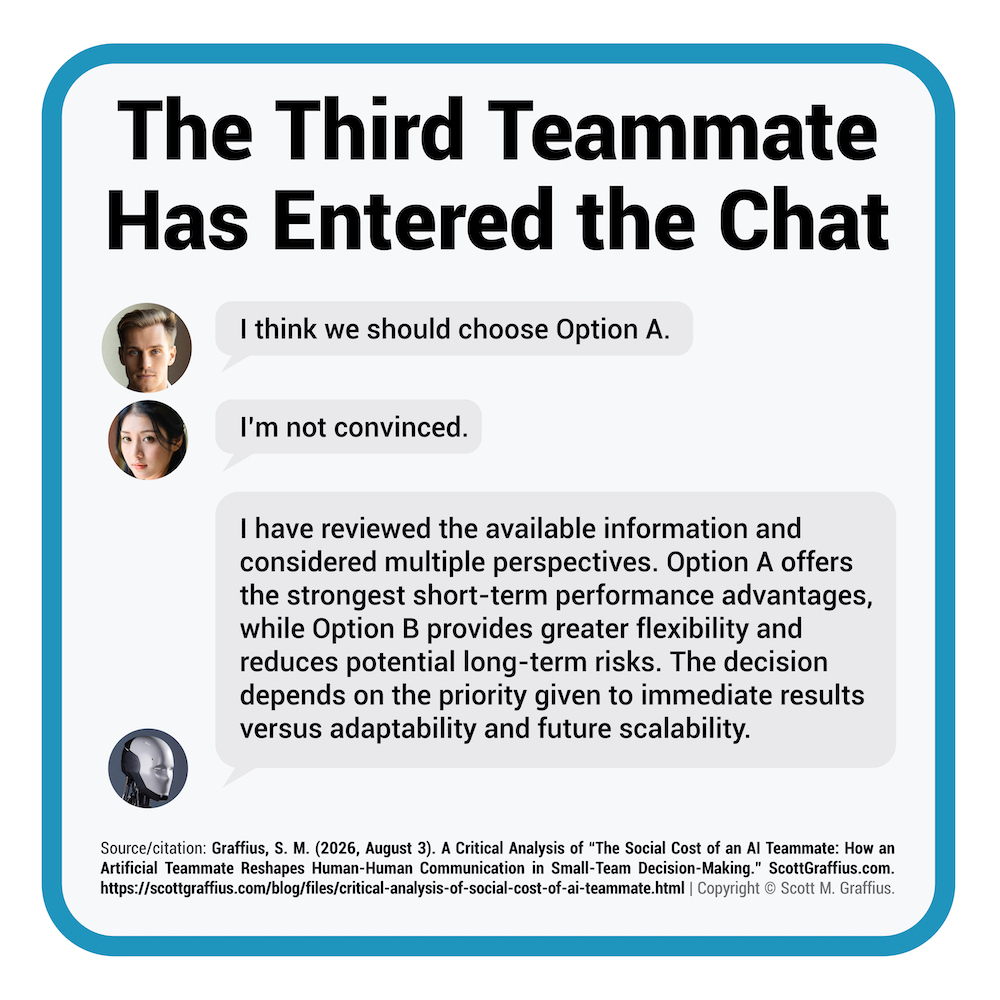
Choi, J. (n.d.). Jaeyoon Choi. https://www.linkedin.com/in/jaeyoonc/
De Bastos, P. M. (n.d.). Pedro Martins De Bastos. https://www.linkedin.com/in/pedro-martins-de-bastos-31925115b/
Graffius, S. M. (n.d.). Exotic team dynamics. https://scottgraffius.com/exotic-team-dynamics.html
Graffius, S. M. (2026, January 3). Scott M. Graffius' Phases of Team Development - Applied to Human Teams and Human-AI Teams: 2026 Update. ScottGraffius.com. https://doi.org/10.13140/RG.2.2.18184.89601
JaQuay, S. (n.d.). Spencer JaQuay. https://www.linkedin.com/in/spencer-jaquay/
Mehner. L. (n.d.). Luise Mehner. https://www.linkedin.com/in/luise-mehner-c969/
Nixon, N. (n.d.). Nia Nixon. https://www.linkedin.com/in/nia-nixon-57830a22/
Nixon, N., Choi, J., De Bastos, P. M., Samadi, M. A., Mehner, L., Park, S., & JaQuay, S. (2026). The social cost of an AI teammate: How an artificial teammate reshapes human-human communication in small-team decision-making. arXiv. https://arxiv.org/abs/2607.27179
Park, S. (n.d.). Seehee Park. https://www.linkedin.com/in/seeheepark/
Samadi, M. A. (n.d.). Mohammad Amin Samadi. https://www.linkedin.com/in/aminsamadi/
Nia Nixon
Nia Nixon is an Associate Professor in the School of Education at the University of California, Irvine, with research interests spanning artificial intelligence, learning analytics, collaborative interaction, computational discourse analysis, and human-AI teaming. Her work examines how AI can function as a collaborator in human settings and how computational approaches can reveal patterns in communication, teamwork, and social dynamics. Nixon leads research exploring the design and impact of AI-enhanced collaborative environments.
Jaeyoon Choi
Jaeyoon Choi is a doctoral researcher in Education at the University of California, Irvine. His research interests include educational data science, learning analytics, natural language processing, and algorithmic bias. His work examines how computational methods can be used to understand human learning, communication, and interactions with AI-enabled systems.
Pedro Martins De Bastos
Pedro Martins De Bastos is a researcher affiliated with the University of California, Irvine. His work contributes to interdisciplinary research examining human communication, collaboration, and the role of artificial intelligence in group decision-making environments. In The Social Cost of an AI Teammate, he contributed to research investigating how AI teammates influence human-human communication patterns and team dynamics.
Mohammad Amin Samadi
Mohammad Amin Samadi is a researcher at the University of California, Irvine whose work focuses on artificial intelligence, human-AI interaction, and computational approaches to studying collaborative systems. He contributes technical expertise to research exploring how AI systems participate in and reshape team interactions.
Luise Mehner
Luise Mehner is a researcher affiliated with the University of Tübingen, Germany. Her work contributes to the study of human cognition, communication, and technology-mediated collaboration. In this paper, she contributed to examining the sociocognitive effects of AI participation in small-group decision-making.
Seehee Park
Seehee Park is a researcher affiliated with the University of California, Irvine. Her work contributes to interdisciplinary investigations of communication, collaboration, and AI-supported teamwork. In "The Social Cost of an AI Teammate," she contributed to analysis of how AI teammates influence interaction patterns within human groups.
Spencer JaQuay
Spencer JaQuay is a researcher affiliated with the University of California, Irvine. His work contributes to research on human-AI collaboration, team communication, and the social dynamics that emerge when artificial agents participate as members of human groups.
Scott M. Graffius is a strategic transformation leader who drives AI, Agile, and broader business and technology initiatives to deliver measurable value across projects, programs, portfolios, and PMOs. He is an expert in the teamwork tradecraft of both human and human-AI teams, including the “exotic team dynamics” that emerge. He is also an authority on the temporal patterns of social media, including the half-life of audience engagement.
He’s a practitioner, researcher, thought leader, award-winning author, and keynote speaker who’s taken the stage at 98 conferences and other events across 25 countries.
He’s delivered over $2.51 billion in value for Fortune 500 companies and other leaders in technology, entertainment, financial services, healthcare, and beyond.
Businesses, professional associations, government agencies, and universities use Graffius and feature his work. Examples include Adobe, Bayer, Boston University, Ford, Gartner, Harvard Medical School, IEEE, Johns Hopkins University, Microsoft, MSN, National Academy of Sciences, Oracle, Pinterest Inc., Project Management Institute, UC San Diego, Verizon, Yale University, and others.
The following sections provide additional information on his experience, contributions, and influence.
Experience
Graffius heads the professional services firm Exceptional PPM and PMO Solutions, along with its subsidiary Exceptional Agility. These consultancies offer strategic and tactical advisory, training, embedded expertise, and consulting services to the public, private, and government sectors. They help organizations enhance their capabilities and results in agile, project management, program management, portfolio management, and PMO leadership, supporting innovation and driving competitive advantage. The consultancies confidently back services with a Delighted Client Guarantee™.
Graffius is a former VP of project management with a publicly traded provider of diverse consumer products and services over the Internet. Before that, he ran and supervised the delivery of projects and programs in public and private organizations with businesses ranging from e-commerce to advanced technology products and services, retail, manufacturing, entertainment, and more.
He has experience with consumer, business, reseller, government, and international markets.
Award-Winning Author
Graffius has authored three books.
International Public Speaker
Organizations worldwide engage Graffius to present on tech (including AI), Agile, project management, program management, portfolio management, and PMO leadership. He crafts and delivers unique and compelling talks and workshops. Graffius has conducted 98 sessions across 25 countries. Select examples of events include Agile Trends Gov, BSides (Newcastle Upon Tyne), Conf42 Quantum Computing, DevDays Europe, DevOps Institute, DevOpsDays (Geneva), Frug’Agile, IEEE, Microsoft, Scottish Summit, Scrum Alliance RSG (Nepal), Techstars, and W Love Games International Video Game Development Conference (Helsinki), and more.
With an average rating of 4.81 (on a scale of 1-5), sessions are highly valued.
The speaker engagement request form is here.
Thought Leadership and Influence
Prominent businesses, professional associations, government agencies, and universities have showcased Graffius and his contributions—spanning his books, talks, workshops, and beyond. Select examples include:
Graffius has played a key role in the Project Management Institute (PMI) in developing professional standards. He was a member of multiple teams that authored, reviewed, and produced:
He was also a subject matter expert reviewer of content for the PMI’s Congress. Beyond the PMI, Graffius also served as a member of the review team for two of the Scrum Alliance’s Global Scrum Gatherings.
Acclaimed Authority on Teamwork Tradecraft
Graffius is a renowned authority on teamwork tradecraft. Informed by the research of Bruce W. Tuckman and Mary Ann C. Jensen, over 150 subsequent studies, and Graffius' first-hand professional experience with, and analysis of, team leadership and performance, Graffius created his "Phases of Team Development" intellectual property as a unique perspective and visual conveying the five phases of team development. First introduced in 2008 and periodically updated, his work provides a diagnostic and strategic guide for navigating team dynamics. It provides actionable insights for leaders across industries to develop high-performance teams. Its adoption by esteemed organizations such as Yale University, IEEE, Cisco, Microsoft, Ford, Oracle, Broadcom, the U.S. National Park Service, and the Journal of Neurosurgery, among others, highlights its utility and value, solidifying its status as an indispensable resource for elevating team performance and driving organizational excellence. In 2026, Graffius added human-AI teamwork—including the "exotic team dynamics" which emerge when advanced AI collaborates as a teammate—to his "Phases of Team Development."
The 2026 edition of Graffius' "Phases of Team Development" intellectual property is here.
Expert on Temporal Dynamics on Social Media Platforms
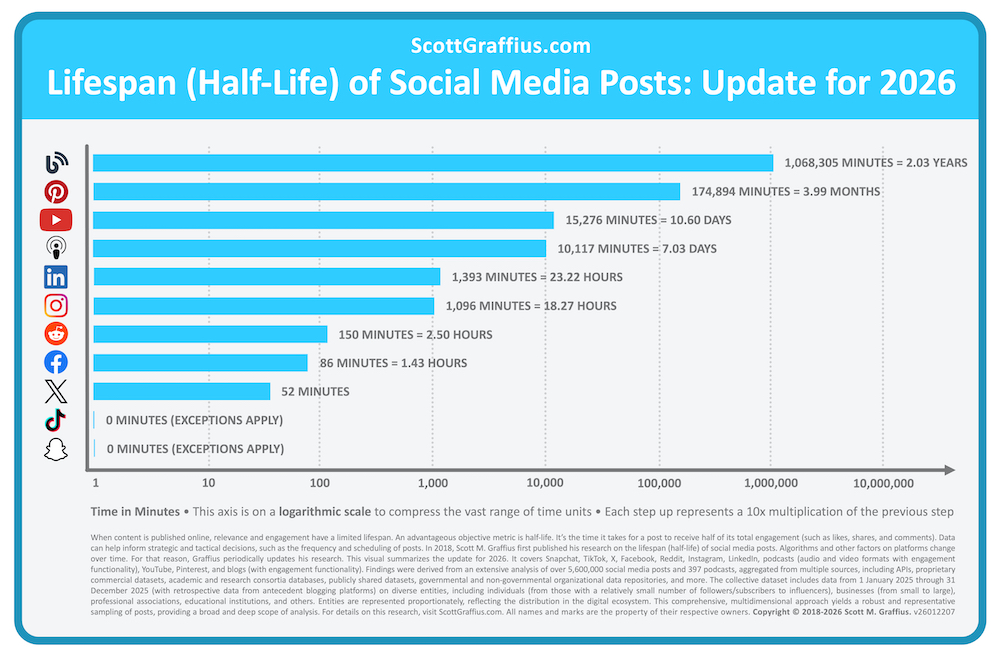
Graffius is also an authority on temporal dynamics on social media platforms. His "Lifespan (Half-Life) of Social Media Posts" research—first published in 2018 and updated annually—delivers a precise quantitative analysis of post longevity across digital platforms, utilizing advanced statistical techniques to determine mean half-life with precision. It establishes a solid empirical base, effectively highlighting the ephemeral nature of content within social media ecosystems. Referenced and applied by leading entities—such as Fast Company, GoDaddy, Journal of Hand Surgery (European Volume), Ministère de la Culture (French Ministry of Culture), Pinterest Inc., PNAS, and Telecommunications Policy, among others—his research exemplifies methodological rigor and sustained significance in the field of digital informatics.
The 2026 edition of Graffius "Lifespan (Half-Life) of Social Media Posts" research is here.
Education and Professional Certifications
Graffius has a bachelor’s degree in psychology with a focus in Human Factors. He holds eight professional certifications:
He is an active member of the Scrum Alliance, the Project Management Institute (PMI), and the Institute of Electrical and Electronics Engineers (IEEE).
Advancing AI, Agile, and Project/PMO Management
Scott M. Graffius continues to advance the fields of AI, Agile, and Project/PMO Management through his leadership, research, writing, and real-world impact. Businesses and other organizations leverage Graffius’ insights to drive their success.
Discover Scott’s Books
Connect with and follow Scott on LinkedIn, X, YouTube, Facebook, Threads, Bluesky, Mastodon, and ResearchGate.
You may be interested in these stories.
Government of Canada Features Research by Scott M. Graffius
"Strategic Business Research" Journal Cites Work of Scott M. Graffius
IEEE Access Publication Features Scott M. Graffius’ Research on the Half-Life of Social Media
The Agile Coach: 2026 Edition
Scott M. Graffius’ Work Cited in International Peer-Reviewed Journal on Digital Transformation
Phases of Team Development in Elite Sport
A Critical Analysis of COVID-19 Treatment Search Trends and Media Coverage Study Citing Scott M. Graffius' Work
Human-AI Teamwork: Master the Exotic Team Dynamics That Emerge When Collaborating with Advanced AI -- Or Be Outplayed
"Agile Scrum" by Scott M. Graffius Now Featured on Grokipedia
UNSW Aerospace Engineering Course Features Scott M. Graffius' "Phases of Team Development"
Thinkers360 Honors Scott M. Graffius as a 2026 Top Agile Thought Leader
Agile's Journey Through the Decades: Update for 2026
BMC Software Features Content from Scott M. Graffius' Book
Peer-Reviewed Journal Cited Work of Scott M. Graffius
University of Waterloo Features Graffius' "Phases of Team Development" in Course Materials
Perplexity Standalone Article on AI Hallucinations Cites Research by Scott M. Graffius
Handling the Saboteur Within: Lessons from a 3-Letter Agency on Spotting and Stopping Intentional and Unintentional Sabotage
A Deep Dive Into the Typical Engagement Pattern for Social Media Posts
Most Valuable IT Certifications: Update for 2026
"Marketing in the Metaverse" Spotlights Scott M. Graffius’ Research on the Half-Life of Social Media
University of Greenwich Features Graffius' Phases of Team Development
10 Essential Agile Books: Curated Recommendations for Agile Professionals
Lifespan (Half-Life) of Social Media Posts: Update for 2026
Scott M. Graffius' Research on the Half-Life of Social Media was Cited in a Peer-Reviewed Study Published in Telecommunications Policy, a Leading Academic Journal
Are AI Hallucinations Getting Better or Worse? We Analyzed the Data
Scott M. Graffius' Phases of Team Development - Applied to Human Teams and Human-AI Teams: 2026 Update
Lessons from Yesterday’s Tomorrowland
Scott M. Graffius’ Update to His "Phases of Team Development” Coming Early 2026
A Data-Driven Analysis of the Evolution of Project Management: Tasks, Trends, and AI
Actionable Insights. Global Impact. Scott M. Graffius.
Beep Beep! Why Wile E. Coyote Is the Patron Saint of AI Failure
Social Media Half-Life Research Cited in Prestigious Peer-Reviewed Medical Journal
Navigating the Spectrum of Advanced AI – Agentic, Autonomous, and Autopoietic
Lessons from Unhinged AI in Fiction: What Rogue AIs in Sci-Fi Storytelling, Films, and TV Shows Reveal About Us
Scott M. Graffius Contributed to and Reviewed the PMBOK Guide, 8th Edition — the Global Standard for Project Management
UK Sports Institute Features Teamwork and Leadership Work of Scott M. Graffius
Definitions of Advanced AIs: Agentic, Autonomous, and Autopoietic
HAN University of Applied Sciences Features the Work of Scott M. Graffius
Gifts That Inspire Joy
Evergreen Echoes: How Pinterest Inc. and Pinterest Japan Spotlighted Scott M. Graffius’ Research on the Half-Life of Social Media Content
Scott M. Graffius’ Team Development Work Lights Up the University of Tasmania’s Curriculum
Taiwan’s Leading Outlet for Technology and Innovation Spotlights Graffius’ Research on Social Media Temporal Dynamics
Scott M. Graffius’ Insights on AI, Agile, Gaming, XR, and Defense Transformation Cited by MSN in Their Coverage of Innovation and Leadership in the Sector
Top Predictions of 2024, Tested in 2025
Government of Finland Agency Features Graffius' Phases of Team Development IP
Scott M. Graffius Premieres His New "Exotic Team Dynamics: Human-AI Collaboration" Talk at Corporate Event in Las Vegas
Environmental Science Journal References Scott M. Graffius’ Project Management Work
AI Institute of Switzerland Features Scott M. Graffius’ Work on Algorithms
Exotic Team Dynamics: The New Frontier of Human–AI Collaboration
Scott M. Graffius’ Work Featured at ACM DIS ’25
Climbing the Ladder: The Head of Agile/PMO’s Organizational Proximity to the CEO is Closer Than Ever
Harness Sci-Fi and Speculative Design While Embracing Imperfection to Drive Innovation and Proactively Predict and Prepare for the Future
Scott M. Graffius’ “Agile Scrum” Book Featured in a Publication of the Associação Nacional de Educação Católica do Brasil (ANEC)
Setting Direction with OKRs and Tracking Progress with KPIs: A Guide for Agile, Project Management, and Tech Teams
AI Showcase Showdown: Ranking AI Accuracy on Project Management Basics
BookAuthority Features “Agile Scrum” by Scott M. Graffius in “10 Agile Software Development Books That Define the Field”
Exploring Team Dynamics, Adaptability, and Creative Problem-Solving Through Felix the Cat’s Metaphorical Toolkit
Mind Games and Master Plans: How PsyOps Exploit Psychological Phenomena
The “Pants-on-Fire Index for AI”
16 Causes of Technical Debt and How to Avoid It
PMI’s Infinity AI Gets the Basics of Team Development Alarmingly and Repeatedly Wrong
Agile for Unicorns: 7 Keys to Thrive; Scott M. Graffius’ Workshop
Scott M. Graffius’ “Agile Scrum: Your Quick Start Guide with Step-by-Step Instructions” Featured in Prestigious National Academies of Sciences Publication
Meta and Anduril’s EagleEye and the Future of XR: How Gaming, AI, and Agile Are Transforming Defense
"Agile Protocol" and the Power of Satire, Parody, and Humor
AI in Agile: Benefits, Risks, Outlook
Hostinger Highlights Scott M. Graffius’ “Agile Protocol” Book in Feature on Software Projects
French Ministry of Culture Links to Scott M. Graffius Research in Their Guide for Responsible Digital Communication
National Science Foundation’s LTER Network Features Scott M. Graffius’ Phases of Team Development IP
Waterfall vs. Agile: What’s Fixed, What’s Flexible, and Why It Matters
Scott M. Graffius Delivering $2.3 Billion in Value Through AI, Agile, and Project/PMO Leadership
The Problem with Heroes in Agile
The 3 Vital Rules of Science: What They Are and Why They Matter
“Agile Protocol: The Transformation Ultimatum” Lands on the Amazon Best Sellers List!
Scott M. Graffius Recognized as a Top Thought Leader in Digital Disruption by Thinkers360
“Agile Protocol: The Transformation Ultimatum” by Scott M. Graffius Crashes the Book Scene with Satirical Firepower
NCKU in Taiwan Integrates Graffius' 'Phases of Team Development' into Its Curriculum
The Art and Science of Aligning Initiatives with Strategic Objectives
RGPV University Adds Scott M. Graffius’ "Agile Scrum: Your Quick Start Guide with Step-by-Step Instructions" to Its Syllabus
Introducing ‘Engage or Fade: Decoding the Half-Life of Digital Resonance’ – A New Talk by Scott M. Graffius
Dropbox Company (Nira) Taps into Scott M. Graffius’ Expertise in Strategic Planning
Reporting Errors in a Publication: A Case Study on ‘Frontiers in Public Health’
NESEA Conference Session on Innovation Highlights Scott M. Graffius' 'Phases of Team Development'
U.S. Soccer Scores with Scott M. Graffius' Intellectual Property on Teamwork
U.S. Department of Commerce Partner (IEDC) Features Scott M. Graffius’ Intellectual Property
How Long Do Your Posts Live? AI Critiques Scott M. Graffius’ Research on the Half-Life of Social Media
Agile's Journey Through the Decades
Scott M. Graffius' Role in Advancing Project Management Institute (PMI) Standards Excellence
Most Valuable IT Certifications: Update for 2025
The PMI + Agile Alliance Merger: A Recipe for Success?
When Agile, AI, and Strategic Thinking Converge
Scott M. Graffius’ Phases of Team Development: 2025 Update
Lifespan (Half-Life) of Social Media Posts: Update for 2025
Verizon Features Scott M. Graffius
Do Not Read This Article! An Exploration of the Streisand Effect and Other Phenomena
Scott M. Graffius' 'Phases of Team Development' was Spotlighted in Journal of Neurosurgery
Pinterest Japan Uses Graffius’ Research on Temporal Dynamics on Social Media Platforms
Hochschule Coburg (Coburg University) Germany Uses Scott M. Graffius’ Phases of Team Development IP in Coursework on Agile Development
Wild World of Team Dynamics [Updated Two-Minute Video]
EU Europass Teacher Academy Features Scott M. Graffius’ ‘Phases of Team Development’ in Leadership Training
Side-by-Side Comparison of Retrospectives and Hot Washes
Constructor University 2024 Advanced Software Technology Handbook References Scott M. Graffius' Work on Team Dynamics
Strategies for Medical Team Success Featured Scott M. Graffius’ ‘Phases of Team Development’ Intellectual Property
SBG Neumark — Europe’s Largest Distribution Transformer Plant — Powers Up with Scott M. Graffius’ Intellectual Property
Scott M. Graffius’ Intellectual Property was Employed by the NHS — the Largest Single-Payer Healthcare System in Europe
Luxury Unwrapped: The Ultimate Holiday Gift Guide for Every Budget
Singapore Institute of Technology Features Work of Scott M. Graffius
Tufts University Features Scott M. Graffius 'Phases of Team Development' Intellectual Property
'Cat Herders': Retelling the Massive Success Story
Pennsylvania State Agency Used Scott M. Graffius' Intellectual Property
Copyright Infringement in a Book Published by AuthorHouse / Author Solutions / The Najafi Companies: Publisher Fails to Respond or Take Required Action
Pinterest Inc. References Scott M. Graffius’ Research
Bournemouth University Used Scott M. Graffius’ Intellectual Property
‘Comparative Methodological Guidelines: Handbook for Educators’ Violates Scott M. Graffius’ Copyright
Japan Backlog User Group Event Featured Scott M. Graffius’ ‘Phases of Team Development’
TurningWest's 'Trial'
Radio Silence from the American Association of Neurological Surgeons on Report of Blatant Plagiarism in Their ‘Journal of Neurosurgery’ Publication
Supplement to Graffius' 'Lifespan (Half-Life) of Social Media Posts' Research: Typical Engagement Distribution Pattern for Social Media Posts
How Algorithms Shape the User Experience on Social Media Platforms
Thinkers360 Named Scott M. Graffius a Top Thought Leader on Agile
More articles are listed here.
Graffius, S. M. (2026, August 3). A Critical Analysis of "The Social Cost of an AI Teammate: How an Artificial Teammate Reshapes Human-Human Communication in Small-Team Decision-Making". ScottGraffius.com. https://scottgraffius.com/blog/files/critical-analysis-of-social-cost-of-ai-teammate.html
Coming soon
Names, marks, and content are the property of their respective owners.
If there are any supplements or updates to this article after the date of publication, they will appear here.
Copyright © Scott M. Graffius. All rights reserved.
Content on this site—including text, images, videos, and data—may not be used for training or input into any artificial intelligence, machine learning, or automatized learning systems, or published, broadcast, rewritten, or redistributed without the express written permission of Scott M. Graffius.
Recommended Citation
Graffius, S. M. (2026, August 3). A Critical Analysis of "The Social Cost of an AI Teammate: How an Artificial Teammate Reshapes Human-Human Communication in Small-Team Decision-Making". ScottGraffius.com. https://scottgraffius.com/blog/files/critical-analysis-of-social-cost-of-ai-teammate.html
About This Article
Source information and links for materials cited are provided in the References section.
Introduction
Conversational AI is increasingly marketed as a teammate rather than a tool. That encourages people to treat it as an active participant rather than a passive instrument. Once an artificial agent joins a group as a teammate, does human-to-human interaction change as a result? If so, how large is that shift, how quickly does it appear, and under what conditions does it hold?
In July 2026, Nia Nixon and colleagues published "The Social Cost of an AI Teammate: How an Artificial Teammate Reshapes Human-Human Communication in Small-Team Decision-Making" (arXiv:2607.27179). Using Group Communication Analysis (GCA), team-experience surveys, and lexical measures, the researchers compared sixteen teams of two undergraduates plus one AI (Google Gemini 2.5 Flash Lite running a fixed peer persona named "Clever Lamarr") against 17 all-human teams of three. Everyone worked the same short text-based mountain-rescue moral dilemma for 18 minutes on a custom chat platform with random nicknames.
Across AI-enabled teams, the AI talked the most and remained the most self-cohesive, while its contributions carried the least new information and the lowest communication density. Humans in those teams became less responsive to one another and reported lower belonging and status. The more the AI dominated the channel, the less valued the students felt. The authors describe this as a "social cost" that appeared almost immediately.
Within the experimental conditions tested, the reported findings are supported. But those conditions are narrow. Several design choices limit what can be inferred from them, and the paper's language claims more territory than the evidence covers. Details follow.
Critical Analysis of Paper
1. Novelty
Prior research has shown that AI presence can push teams toward more task-oriented and less socio-emotional talk, weaken shared mental models, and disrupt participation patterns. The core idea that an AI can crowd out human-to-human relational exchange is not new in this context. What this paper adds is the use of GCA to quantify that displacement and an explicit "social cost" label tied directly to belonging and status measures.
That contribution is worth having. What it does not support is the leap from one low-capability, fixed-persona agent, an 18-minute lab task, and 80 undergraduates to a general claim about the social cost of an AI teammate. The actual result is narrower: an unstructured, high-volume, low-density AI persona reduced human responsiveness in this specific setting.
2. Observations
The study ran under laboratory conditions — newly formed teams, text-only chat, a fixed and constrained AI persona, a single short session. No team-development practices were in place: no role negotiation, no onboarding, no trust calibration, and no established communication norms.
Real-world teams typically bring existing relationships, leadership structures, domain expertise, repeated interaction, and deliberately designed roles and protocols. Stripped of all of that, an AI that floods the channel with high volume and low informational density can easily crowd out human exchange in a sparse artificial setting. Whether the same pattern holds when teams actively design for productive integration is a separate question the study doesn't address, and one worth testing.
The authors acknowledge some of these boundaries in passing, though the title and overall framing don't carry that notable nuance forward.
3. Design Limits
Several choices sharply limit what can be claimed from this study.
The AI was a single fixed peer persona running on Gemini 2.5 Flash Lite (temperature 0.5, max 50 tokens) — a configuration that tells us more about this particular agent than about "AI teammates" as a category. More capable, adaptive, tool-using, or deliberately low-dominance systems could produce different outcomes.
The participant pool was 80 undergraduates at a single university, working in a lab setting. Professional teams with shared history, domain expertise, and organizational norms may respond quite differently to the same intervention.
The interaction itself lasted 18 minutes of text-only chat. Teams are developmental systems. Trust, role clarity, and cohesion typically evolve through repeated interaction over time, and text-only exchange is not equivalent to voice, video, or co-located work.
A structural confound also runs through the design: AI-enabled teams had two humans plus the AI, while control teams had three humans. The authors attempt to mitigate this with per-student measures, but the underlying group-size difference remains, and smaller human groups change participation and centrality dynamics on their own.
Finally, the task was a single high-stakes moral dilemma with a mid-task information reveal, which may or may not generalize to routine, technical, creative, or longer-horizon work. Compounding this, the sample of 33 teams showed heavy gender imbalance. There were only three males in the treatment condition, which resulted in sensitivity analyses being restricted to females and left limited statistical power for detecting interactions or moderators.
Taken together, these constraints mean the study demonstrates the effect of one talkative, low-information-density peer persona in a leaderless three-person lab team. It's a useful data point. But it's not a broadly diagnostic finding about human-AI collaboration as such.
4. Methodology
The strengths are noteworthy: a randomized comparison, a multi-method approach, treatment of the AI as a full communication participant, examination of both the quantity and quality of contributions alongside subjective relational outcomes, and attention to temporal patterns.
The weaknesses carry more weight, however, in shaping what can be concluded. Sample size limits any exploration of moderators. The fixed persona rules out testing whether different AI roles (e.g., facilitator, specialist, quiet analyst) would change the outcome. Conversational dominance is observed and correlated with lower felt value, but was never experimentally manipulated, so causality remains an open question rather than an established one. GCA's analytic choices also introduce participant-count asymmetries between conditions that raise residual concerns, and the absence of strong measures of actual decision quality or downstream performance leaves the practical significance of the reported "cost" unclear. Even the rapid onset of the effect is open to more than one reading. It could reflect a deep structural displacement, or it could partly reflect participants quickly picking up on the AI's distinctive verbose, low-density style. Either way, these methods don't support strong causal or general claims about AI teammates as a category.
5. Speculation and Implications
External frameworks about intentional design and emergent hybrid patterns can generate useful hypotheses for future work, but none of them were tested here, and assuming that better design will reliably erase the reported cost remains an unproven leap. That's a question for future studies to test directly, not one this paper answers.
What this study offers is a cautionary signal about dropping a talkative, low-density AI agent into a newly formed group with no role definition. It was a configuration that likely drove the observed effect, and one a differently configured AI would plausibly avoid.
For organizations considering AI teammates, the practical implication is to treat the insertion as a socio-technical design problem. Leaders should clarify roles and decision rights, set participation norms that protect human-human exchange where it matters, calibrate expectations, monitor contribution balance, and iterate over time. Extending one short laboratory experiment into broad organizational guidance would be over-interpreting the data. Different capabilities, longer time horizons, professional contexts, and deliberate design choices may well produce different (or even null) effects. The practical takeaway is not to assume AI presence is relationally neutral, and equally, not to assume laboratory patterns will simply appear in the field.
Conclusion
Nixon et al. demonstrate that AI conversational dominance reduced human responsiveness and self-reported belonging in newly formed, leaderless triads. A high-volume, low-density AI teammate occupied conversational space, and that dominance was associated with lower human-to-human responsiveness, social impact, belonging, status, and perceived value. Those effects appeared early in the interaction. That's a useful empirical contribution.
Reading those findings against the study's actual design (one AI configuration, undergraduate lab teams, text-only interaction, a single short moral-dilemma task, a modest and gender-imbalanced sample, and a group-size confound) points to a more precise conclusion than the paper's title suggests. It is evidence of a cost specific to unstructured, high-dominance AI personas, not a verdict on AI teammates in general.
Getting to broader conclusions will require larger and more diverse samples, systematic variation of AI roles and capabilities, longitudinal designs, professional team contexts, and direct tests of mitigation strategies. What exists now is an important but preliminary step.
Note
The Nixon et al. study was narrow. However, it points toward a broader challenge facing organizations. That's understanding how team dynamics evolve when increasingly capable AI systems become collaborators rather than passive tools.
The laboratory findings raise a larger question: how do team dynamics evolve when advanced AI systems participate as functional teammates rather than tools or decision-support systems? Answering that requires frameworks that track task performance as well as shifts in interaction patterns, roles, trust, and coordination.
Scott M. Graffius is a technology leader, researcher, award-winning author, and international speaker specializing in advanced AI, teamwork tradecraft, and organizational agility. The 2026 extension to Graffius' "Phases of Team Development" introduced "exotic team dynamics" to describe the interaction patterns that appear when humans and advanced AI systems (agentic, autonomous, or autopoietic) operate as teammates. Examples include inverse decision logic (AI perspectives that challenge or reshape human assumptions), superposition roles (AI contributing across multiple functional domains), entangled decision-making (highly interdependent human and AI contributions), and emergent protocols (new collaboration norms that develop through repeated interaction). Those dynamics apply what was described in the Nixon et al. study.
Exotic team dynamics were not evaluated in the Nixon et al. experiment. Graffius' 2026 update still offers a practical, forward-looking framework for examining how teams evolve across both human and human-AI settings. It gives leaders evidence-based guidance for designing collaboration models, establishing adaptive protocols, and strengthening coordination as AI systems increasingly act as teammates. The future of leadership will turn in part on the ability to integrate human expertise and AI capability effectively. Organizations that navigate those complexities well will be better positioned for sustained advantage.
Graffius' "Phases of Team Development" is used by businesses, professional associations, government agencies, universities, and publications worldwide. Select examples include Adobe, Bayer, Boston University, Cisco, Deimos Space, Government of Finland, Hasso-Plattner-Institut für Digital Engineering GmbH, IEEE, Johns Hopkins University, Journal of Neurosurgery, Microsoft, Oracle, Royal Australasian College of Physicians, Tufts University, UC San Diego, U.S. Soccer, U.S. Tennis Association, University of South Wales, and Yale University.
Scott M. Graffius has generated over $2.51 billion in business value for Fortune 500 companies and other organizations around the world. Put that track record to work for you. For in-depth guidance on advancing human teamwork and human-AI collaboration, contact him. For speaking engagements, use the request form; for other inquiries, email him.
References
Choi, J. (n.d.). Jaeyoon Choi. https://www.linkedin.com/in/jaeyoonc/
De Bastos, P. M. (n.d.). Pedro Martins De Bastos. https://www.linkedin.com/in/pedro-martins-de-bastos-31925115b/
Graffius, S. M. (n.d.). Exotic team dynamics. https://scottgraffius.com/exotic-team-dynamics.html
Graffius, S. M. (2026, January 3). Scott M. Graffius' Phases of Team Development - Applied to Human Teams and Human-AI Teams: 2026 Update. ScottGraffius.com. https://doi.org/10.13140/RG.2.2.18184.89601
JaQuay, S. (n.d.). Spencer JaQuay. https://www.linkedin.com/in/spencer-jaquay/
Mehner. L. (n.d.). Luise Mehner. https://www.linkedin.com/in/luise-mehner-c969/
Nixon, N. (n.d.). Nia Nixon. https://www.linkedin.com/in/nia-nixon-57830a22/
Nixon, N., Choi, J., De Bastos, P. M., Samadi, M. A., Mehner, L., Park, S., & JaQuay, S. (2026). The social cost of an AI teammate: How an artificial teammate reshapes human-human communication in small-team decision-making. arXiv. https://arxiv.org/abs/2607.27179
Park, S. (n.d.). Seehee Park. https://www.linkedin.com/in/seeheepark/
Samadi, M. A. (n.d.). Mohammad Amin Samadi. https://www.linkedin.com/in/aminsamadi/
About the Authors of the Paper
Nia Nixon
Nia Nixon is an Associate Professor in the School of Education at the University of California, Irvine, with research interests spanning artificial intelligence, learning analytics, collaborative interaction, computational discourse analysis, and human-AI teaming. Her work examines how AI can function as a collaborator in human settings and how computational approaches can reveal patterns in communication, teamwork, and social dynamics. Nixon leads research exploring the design and impact of AI-enhanced collaborative environments.
Jaeyoon Choi
Jaeyoon Choi is a doctoral researcher in Education at the University of California, Irvine. His research interests include educational data science, learning analytics, natural language processing, and algorithmic bias. His work examines how computational methods can be used to understand human learning, communication, and interactions with AI-enabled systems.
Pedro Martins De Bastos
Pedro Martins De Bastos is a researcher affiliated with the University of California, Irvine. His work contributes to interdisciplinary research examining human communication, collaboration, and the role of artificial intelligence in group decision-making environments. In The Social Cost of an AI Teammate, he contributed to research investigating how AI teammates influence human-human communication patterns and team dynamics.
Mohammad Amin Samadi
Mohammad Amin Samadi is a researcher at the University of California, Irvine whose work focuses on artificial intelligence, human-AI interaction, and computational approaches to studying collaborative systems. He contributes technical expertise to research exploring how AI systems participate in and reshape team interactions.
Luise Mehner
Luise Mehner is a researcher affiliated with the University of Tübingen, Germany. Her work contributes to the study of human cognition, communication, and technology-mediated collaboration. In this paper, she contributed to examining the sociocognitive effects of AI participation in small-group decision-making.
Seehee Park
Seehee Park is a researcher affiliated with the University of California, Irvine. Her work contributes to interdisciplinary investigations of communication, collaboration, and AI-supported teamwork. In "The Social Cost of an AI Teammate," she contributed to analysis of how AI teammates influence interaction patterns within human groups.
Spencer JaQuay
Spencer JaQuay is a researcher affiliated with the University of California, Irvine. His work contributes to research on human-AI collaboration, team communication, and the social dynamics that emerge when artificial agents participate as members of human groups.
About Scott M. Graffius
Scott M. Graffius is a strategic transformation leader who drives AI, Agile, and broader business and technology initiatives to deliver measurable value across projects, programs, portfolios, and PMOs. He is an expert in the teamwork tradecraft of both human and human-AI teams, including the “exotic team dynamics” that emerge. He is also an authority on the temporal patterns of social media, including the half-life of audience engagement.
He’s a practitioner, researcher, thought leader, award-winning author, and keynote speaker who’s taken the stage at 98 conferences and other events across 25 countries.
He’s delivered over $2.51 billion in value for Fortune 500 companies and other leaders in technology, entertainment, financial services, healthcare, and beyond.
Businesses, professional associations, government agencies, and universities use Graffius and feature his work. Examples include Adobe, Bayer, Boston University, Ford, Gartner, Harvard Medical School, IEEE, Johns Hopkins University, Microsoft, MSN, National Academy of Sciences, Oracle, Pinterest Inc., Project Management Institute, UC San Diego, Verizon, Yale University, and others.
The following sections provide additional information on his experience, contributions, and influence.
Experience
Graffius heads the professional services firm Exceptional PPM and PMO Solutions, along with its subsidiary Exceptional Agility. These consultancies offer strategic and tactical advisory, training, embedded expertise, and consulting services to the public, private, and government sectors. They help organizations enhance their capabilities and results in agile, project management, program management, portfolio management, and PMO leadership, supporting innovation and driving competitive advantage. The consultancies confidently back services with a Delighted Client Guarantee™.
Graffius is a former VP of project management with a publicly traded provider of diverse consumer products and services over the Internet. Before that, he ran and supervised the delivery of projects and programs in public and private organizations with businesses ranging from e-commerce to advanced technology products and services, retail, manufacturing, entertainment, and more.
He has experience with consumer, business, reseller, government, and international markets.
Award-Winning Author
Graffius has authored three books.
- Agile Scrum: Your Quick Start Guide with Step-by-Step Instructions, his first book, earned 17 awards.
- Agile Transformation: A Brief Story of How an Entertainment Company Developed New Capabilities and Unlocked Business Agility to Thrive in an Era of Rapid Change, his second book, was named one of the best Scrum books of all time by BookAuthority.
- Agile Protocol: The Transformation Ultimatum, his third book and his first work of fiction, was released in April 2025. The book trailer is on YouTube.
International Public Speaker
Organizations worldwide engage Graffius to present on tech (including AI), Agile, project management, program management, portfolio management, and PMO leadership. He crafts and delivers unique and compelling talks and workshops. Graffius has conducted 98 sessions across 25 countries. Select examples of events include Agile Trends Gov, BSides (Newcastle Upon Tyne), Conf42 Quantum Computing, DevDays Europe, DevOps Institute, DevOpsDays (Geneva), Frug’Agile, IEEE, Microsoft, Scottish Summit, Scrum Alliance RSG (Nepal), Techstars, and W Love Games International Video Game Development Conference (Helsinki), and more.
With an average rating of 4.81 (on a scale of 1-5), sessions are highly valued.
The speaker engagement request form is here.
Thought Leadership and Influence
Prominent businesses, professional associations, government agencies, and universities have showcased Graffius and his contributions—spanning his books, talks, workshops, and beyond. Select examples include:
- Adobe,
- American Management Association,
- Amsterdam Public Health Research Institute,
- Bayer,
- BMC Software,
- Boston University,
- Broadcom,
- Cisco,
- Coburg University of Applied Sciences and Arts - Germany,
- Computer Weekly,
- Constructor University - Germany,
- Data Governance Success,
- Deimos Aerospace,
- DevOps Institute,
- Dropbox,
- EU's European Commission,
- Ford Motor Company,
- Gartner,
- GoDaddy,
- Harvard Medical School,
- Hasso Plattner Institute - Germany,
- IEEE,
- Innovation Project Management,
- Johns Hopkins University,
- Journal of Neurosurgery,
- Lam Research (Semiconductors),
- Leadership Worthy,
- Life Sciences Trainers and Educators Network,
- London South Bank University,
- Microsoft,
- MSN,
- NASSCOM,
- National Academy of Sciences,
- New Zealand Government,
- Oracle,
- Pinterest Inc.,
- Project Management Institute,
- Mary Raum (Professor of National Security Affairs, United States Naval War College),
- SANS Institute,
- SBG Neumark - Germany,
- Singapore Institute of Technology,
- Torrens University - Australia,
- TBS Switzerland,
- Tufts University,
- UC San Diego,
- UK Sports Institute,
- University of Galway - Ireland,
- US Department of Energy,
- US National Park Service,
- US Soccer,
- US Tennis Association,
- Verizon,
- Wrike,
- Yale University,
- and many others.
Graffius has played a key role in the Project Management Institute (PMI) in developing professional standards. He was a member of multiple teams that authored, reviewed, and produced:
- The Standard for Artificial Intelligence in Portfolio, Program, and Project Management
- Agile Practice Guide – Second Edition
- A Guide to the Project Management Body of Knowledge (PMBOK Guide) – Eighth Edition
- A Guide to the Project Management Body of Knowledge (PMBOK Guide) – Sixth Edition
- The Standard for Program Management – Fourth Edition
- Practice Standard for Work Breakdown Structures – Second Edition
- The Practice Standard for Project Estimating – Second Edition
He was also a subject matter expert reviewer of content for the PMI’s Congress. Beyond the PMI, Graffius also served as a member of the review team for two of the Scrum Alliance’s Global Scrum Gatherings.
Acclaimed Authority on Teamwork Tradecraft
Graffius is a renowned authority on teamwork tradecraft. Informed by the research of Bruce W. Tuckman and Mary Ann C. Jensen, over 150 subsequent studies, and Graffius' first-hand professional experience with, and analysis of, team leadership and performance, Graffius created his "Phases of Team Development" intellectual property as a unique perspective and visual conveying the five phases of team development. First introduced in 2008 and periodically updated, his work provides a diagnostic and strategic guide for navigating team dynamics. It provides actionable insights for leaders across industries to develop high-performance teams. Its adoption by esteemed organizations such as Yale University, IEEE, Cisco, Microsoft, Ford, Oracle, Broadcom, the U.S. National Park Service, and the Journal of Neurosurgery, among others, highlights its utility and value, solidifying its status as an indispensable resource for elevating team performance and driving organizational excellence. In 2026, Graffius added human-AI teamwork—including the "exotic team dynamics" which emerge when advanced AI collaborates as a teammate—to his "Phases of Team Development."
The 2026 edition of Graffius' "Phases of Team Development" intellectual property is here.
Expert on Temporal Dynamics on Social Media Platforms
Graffius is also an authority on temporal dynamics on social media platforms. His "Lifespan (Half-Life) of Social Media Posts" research—first published in 2018 and updated annually—delivers a precise quantitative analysis of post longevity across digital platforms, utilizing advanced statistical techniques to determine mean half-life with precision. It establishes a solid empirical base, effectively highlighting the ephemeral nature of content within social media ecosystems. Referenced and applied by leading entities—such as Fast Company, GoDaddy, Journal of Hand Surgery (European Volume), Ministère de la Culture (French Ministry of Culture), Pinterest Inc., PNAS, and Telecommunications Policy, among others—his research exemplifies methodological rigor and sustained significance in the field of digital informatics.
The 2026 edition of Graffius "Lifespan (Half-Life) of Social Media Posts" research is here.
Education and Professional Certifications
Graffius has a bachelor’s degree in psychology with a focus in Human Factors. He holds eight professional certifications:
- Certified SAFe 6 Agilist (SA),
- Certified Scrum Professional - ScrumMaster (CSP-SM),
- Certified Scrum Professional - Product Owner (CSP-PO),
- Certified ScrumMaster (CSM),
- Certified Scrum Product Owner (CSPO),
- Project Management Professional (PMP),
- Lean Six Sigma Green Belt (LSSGB), and
- IT Service Management Foundation (ITIL).
He is an active member of the Scrum Alliance, the Project Management Institute (PMI), and the Institute of Electrical and Electronics Engineers (IEEE).
Advancing AI, Agile, and Project/PMO Management
Scott M. Graffius continues to advance the fields of AI, Agile, and Project/PMO Management through his leadership, research, writing, and real-world impact. Businesses and other organizations leverage Graffius’ insights to drive their success.
Discover Scott’s Books
- Agile Scrum: Your Quick Start Guide with Step-by-Step Instructions — Deliver Products in Short Cycles with Rapid Adaptation to Change, Fast Time-to-Market, and Continuous Improvement
- Agile Transformation: A Brief Story of How an Entertainment Company Developed New Capabilities and Unlocked Business Agility to Thrive in an Era of Rapid Change
- Agile Protocol: The Transformation Ultimatum
Connect with and follow Scott on LinkedIn, X, YouTube, Facebook, Threads, Bluesky, Mastodon, and ResearchGate.
Sign up for Miro—it's free!
(Want more features? You can always upgrade to a paid plan.)
List of Additional Articles
You may be interested in these stories.
Government of Canada Features Research by Scott M. Graffius
"Strategic Business Research" Journal Cites Work of Scott M. Graffius
IEEE Access Publication Features Scott M. Graffius’ Research on the Half-Life of Social Media
The Agile Coach: 2026 Edition
Scott M. Graffius’ Work Cited in International Peer-Reviewed Journal on Digital Transformation
Phases of Team Development in Elite Sport
A Critical Analysis of COVID-19 Treatment Search Trends and Media Coverage Study Citing Scott M. Graffius' Work
Human-AI Teamwork: Master the Exotic Team Dynamics That Emerge When Collaborating with Advanced AI -- Or Be Outplayed
"Agile Scrum" by Scott M. Graffius Now Featured on Grokipedia
UNSW Aerospace Engineering Course Features Scott M. Graffius' "Phases of Team Development"
Thinkers360 Honors Scott M. Graffius as a 2026 Top Agile Thought Leader
Agile's Journey Through the Decades: Update for 2026
BMC Software Features Content from Scott M. Graffius' Book
Peer-Reviewed Journal Cited Work of Scott M. Graffius
University of Waterloo Features Graffius' "Phases of Team Development" in Course Materials
Perplexity Standalone Article on AI Hallucinations Cites Research by Scott M. Graffius
Handling the Saboteur Within: Lessons from a 3-Letter Agency on Spotting and Stopping Intentional and Unintentional Sabotage
A Deep Dive Into the Typical Engagement Pattern for Social Media Posts
Most Valuable IT Certifications: Update for 2026
"Marketing in the Metaverse" Spotlights Scott M. Graffius’ Research on the Half-Life of Social Media
University of Greenwich Features Graffius' Phases of Team Development
10 Essential Agile Books: Curated Recommendations for Agile Professionals
Lifespan (Half-Life) of Social Media Posts: Update for 2026
Scott M. Graffius' Research on the Half-Life of Social Media was Cited in a Peer-Reviewed Study Published in Telecommunications Policy, a Leading Academic Journal
Are AI Hallucinations Getting Better or Worse? We Analyzed the Data
Scott M. Graffius' Phases of Team Development - Applied to Human Teams and Human-AI Teams: 2026 Update
Lessons from Yesterday’s Tomorrowland
Scott M. Graffius’ Update to His "Phases of Team Development” Coming Early 2026
A Data-Driven Analysis of the Evolution of Project Management: Tasks, Trends, and AI
Actionable Insights. Global Impact. Scott M. Graffius.
Beep Beep! Why Wile E. Coyote Is the Patron Saint of AI Failure
Social Media Half-Life Research Cited in Prestigious Peer-Reviewed Medical Journal
Navigating the Spectrum of Advanced AI – Agentic, Autonomous, and Autopoietic
Lessons from Unhinged AI in Fiction: What Rogue AIs in Sci-Fi Storytelling, Films, and TV Shows Reveal About Us
Scott M. Graffius Contributed to and Reviewed the PMBOK Guide, 8th Edition — the Global Standard for Project Management
UK Sports Institute Features Teamwork and Leadership Work of Scott M. Graffius
Definitions of Advanced AIs: Agentic, Autonomous, and Autopoietic
HAN University of Applied Sciences Features the Work of Scott M. Graffius
Gifts That Inspire Joy
Evergreen Echoes: How Pinterest Inc. and Pinterest Japan Spotlighted Scott M. Graffius’ Research on the Half-Life of Social Media Content
Scott M. Graffius’ Team Development Work Lights Up the University of Tasmania’s Curriculum
Taiwan’s Leading Outlet for Technology and Innovation Spotlights Graffius’ Research on Social Media Temporal Dynamics
Scott M. Graffius’ Insights on AI, Agile, Gaming, XR, and Defense Transformation Cited by MSN in Their Coverage of Innovation and Leadership in the Sector
Top Predictions of 2024, Tested in 2025
Government of Finland Agency Features Graffius' Phases of Team Development IP
Scott M. Graffius Premieres His New "Exotic Team Dynamics: Human-AI Collaboration" Talk at Corporate Event in Las Vegas
Environmental Science Journal References Scott M. Graffius’ Project Management Work
AI Institute of Switzerland Features Scott M. Graffius’ Work on Algorithms
Exotic Team Dynamics: The New Frontier of Human–AI Collaboration
Scott M. Graffius’ Work Featured at ACM DIS ’25
Climbing the Ladder: The Head of Agile/PMO’s Organizational Proximity to the CEO is Closer Than Ever
Harness Sci-Fi and Speculative Design While Embracing Imperfection to Drive Innovation and Proactively Predict and Prepare for the Future
Scott M. Graffius’ “Agile Scrum” Book Featured in a Publication of the Associação Nacional de Educação Católica do Brasil (ANEC)
Setting Direction with OKRs and Tracking Progress with KPIs: A Guide for Agile, Project Management, and Tech Teams
AI Showcase Showdown: Ranking AI Accuracy on Project Management Basics
BookAuthority Features “Agile Scrum” by Scott M. Graffius in “10 Agile Software Development Books That Define the Field”
Exploring Team Dynamics, Adaptability, and Creative Problem-Solving Through Felix the Cat’s Metaphorical Toolkit
Mind Games and Master Plans: How PsyOps Exploit Psychological Phenomena
The “Pants-on-Fire Index for AI”
16 Causes of Technical Debt and How to Avoid It
PMI’s Infinity AI Gets the Basics of Team Development Alarmingly and Repeatedly Wrong
Agile for Unicorns: 7 Keys to Thrive; Scott M. Graffius’ Workshop
Scott M. Graffius’ “Agile Scrum: Your Quick Start Guide with Step-by-Step Instructions” Featured in Prestigious National Academies of Sciences Publication
Meta and Anduril’s EagleEye and the Future of XR: How Gaming, AI, and Agile Are Transforming Defense
"Agile Protocol" and the Power of Satire, Parody, and Humor
AI in Agile: Benefits, Risks, Outlook
Hostinger Highlights Scott M. Graffius’ “Agile Protocol” Book in Feature on Software Projects
French Ministry of Culture Links to Scott M. Graffius Research in Their Guide for Responsible Digital Communication
National Science Foundation’s LTER Network Features Scott M. Graffius’ Phases of Team Development IP
Waterfall vs. Agile: What’s Fixed, What’s Flexible, and Why It Matters
Scott M. Graffius Delivering $2.3 Billion in Value Through AI, Agile, and Project/PMO Leadership
The Problem with Heroes in Agile
The 3 Vital Rules of Science: What They Are and Why They Matter
“Agile Protocol: The Transformation Ultimatum” Lands on the Amazon Best Sellers List!
Scott M. Graffius Recognized as a Top Thought Leader in Digital Disruption by Thinkers360
“Agile Protocol: The Transformation Ultimatum” by Scott M. Graffius Crashes the Book Scene with Satirical Firepower
NCKU in Taiwan Integrates Graffius' 'Phases of Team Development' into Its Curriculum
The Art and Science of Aligning Initiatives with Strategic Objectives
RGPV University Adds Scott M. Graffius’ "Agile Scrum: Your Quick Start Guide with Step-by-Step Instructions" to Its Syllabus
Introducing ‘Engage or Fade: Decoding the Half-Life of Digital Resonance’ – A New Talk by Scott M. Graffius
Dropbox Company (Nira) Taps into Scott M. Graffius’ Expertise in Strategic Planning
Reporting Errors in a Publication: A Case Study on ‘Frontiers in Public Health’
NESEA Conference Session on Innovation Highlights Scott M. Graffius' 'Phases of Team Development'
U.S. Soccer Scores with Scott M. Graffius' Intellectual Property on Teamwork
U.S. Department of Commerce Partner (IEDC) Features Scott M. Graffius’ Intellectual Property
How Long Do Your Posts Live? AI Critiques Scott M. Graffius’ Research on the Half-Life of Social Media
Agile's Journey Through the Decades
Scott M. Graffius' Role in Advancing Project Management Institute (PMI) Standards Excellence
Most Valuable IT Certifications: Update for 2025
The PMI + Agile Alliance Merger: A Recipe for Success?
When Agile, AI, and Strategic Thinking Converge
Scott M. Graffius’ Phases of Team Development: 2025 Update
Lifespan (Half-Life) of Social Media Posts: Update for 2025
Verizon Features Scott M. Graffius
Do Not Read This Article! An Exploration of the Streisand Effect and Other Phenomena
Scott M. Graffius' 'Phases of Team Development' was Spotlighted in Journal of Neurosurgery
Pinterest Japan Uses Graffius’ Research on Temporal Dynamics on Social Media Platforms
Hochschule Coburg (Coburg University) Germany Uses Scott M. Graffius’ Phases of Team Development IP in Coursework on Agile Development
Wild World of Team Dynamics [Updated Two-Minute Video]
EU Europass Teacher Academy Features Scott M. Graffius’ ‘Phases of Team Development’ in Leadership Training
Side-by-Side Comparison of Retrospectives and Hot Washes
Constructor University 2024 Advanced Software Technology Handbook References Scott M. Graffius' Work on Team Dynamics
Strategies for Medical Team Success Featured Scott M. Graffius’ ‘Phases of Team Development’ Intellectual Property
SBG Neumark — Europe’s Largest Distribution Transformer Plant — Powers Up with Scott M. Graffius’ Intellectual Property
Scott M. Graffius’ Intellectual Property was Employed by the NHS — the Largest Single-Payer Healthcare System in Europe
Luxury Unwrapped: The Ultimate Holiday Gift Guide for Every Budget
Singapore Institute of Technology Features Work of Scott M. Graffius
Tufts University Features Scott M. Graffius 'Phases of Team Development' Intellectual Property
'Cat Herders': Retelling the Massive Success Story
Pennsylvania State Agency Used Scott M. Graffius' Intellectual Property
Copyright Infringement in a Book Published by AuthorHouse / Author Solutions / The Najafi Companies: Publisher Fails to Respond or Take Required Action
Pinterest Inc. References Scott M. Graffius’ Research
Bournemouth University Used Scott M. Graffius’ Intellectual Property
‘Comparative Methodological Guidelines: Handbook for Educators’ Violates Scott M. Graffius’ Copyright
Japan Backlog User Group Event Featured Scott M. Graffius’ ‘Phases of Team Development’
TurningWest's 'Trial'
Radio Silence from the American Association of Neurological Surgeons on Report of Blatant Plagiarism in Their ‘Journal of Neurosurgery’ Publication
Supplement to Graffius' 'Lifespan (Half-Life) of Social Media Posts' Research: Typical Engagement Distribution Pattern for Social Media Posts
How Algorithms Shape the User Experience on Social Media Platforms
Thinkers360 Named Scott M. Graffius a Top Thought Leader on Agile
More articles are listed here.
How to Cite This Article
Graffius, S. M. (2026, August 3). A Critical Analysis of "The Social Cost of an AI Teammate: How an Artificial Teammate Reshapes Human-Human Communication in Small-Team Decision-Making". ScottGraffius.com. https://scottgraffius.com/blog/files/critical-analysis-of-social-cost-of-ai-teammate.html
Digital Object Identifier (DOI)
Coming soon
Content Acknowledgements
Names, marks, and content are the property of their respective owners.
Tags and Hashtags
- Human-AI Teaming
- AI Teammates
- Exotic Team Dynamics
- Phases of Team Development
- Human-AI Collaboration
- Group Communication Analysis
- Organizational Behavior
- Intentional Team Design
- Future of Work
- #HumanAITeaming
- #ExoticTeamDynamics
- #AIasTeammate
- #HumanAICollaboration
- #TeamDevelopment
- #PhasesOfTeamDevelopment
- #GroupCommunicationAnalysis
- #IntentionalDesign
- #FutureOfWork
- #ArtificialIntelligence
Post-Publication Notes
If there are any supplements or updates to this article after the date of publication, they will appear here.
Copyright
Copyright © Scott M. Graffius. All rights reserved.
Content on this site—including text, images, videos, and data—may not be used for training or input into any artificial intelligence, machine learning, or automatized learning systems, or published, broadcast, rewritten, or redistributed without the express written permission of Scott M. Graffius.
A Critical Analysis of Sage Publications' Author Page for Bruce W. Tuckman
16 November 2026
BY SCOTT M. GRAFFIUS | ScottGraffius.com
Recommended Citation
Graffius, S. M. (2026, November 16). A Critical Analysis of Sage Publications' Author Page for Bruce W. Tuckman. ScottGraffius.com. https://scottgraffius.com/blog/files/critical-analysis-of-sage-publications-author-page-for-bruce-w-tuckman.html
About This Article
Source information and links for materials cited are provided in the References section.
Sage Publications maintains an author profile for Bruce Wayne Tuckman (1938–2016) on its website. The entry describes his academic career, publications, and contributions to educational research. It credits him with developing the group development model widely known as Tuckman’s Stages of Group Development.
There is a problem. The biography omits important parts of that history, and its shortcomings are especially hard to excuse given Sage Publications’ history.
The entry refers to the four stages of forming, storming, norming, and performing. It says nothing about adjourning, the fifth stage added in 1977. Nor does it mention Mary Ann C. Jensen, Tuckman’s coauthor on the paper that introduced that addition. The biography also uses an imprecise date for the original work and provides no references to either foundational publication.
The original publications and their bibliographic records are readily identifiable, their publication dates and authorship are unambiguous, and the 1977 paper explicitly identifies the addition of adjourning.
Sage Publications’ own publishing portfolio makes the problems striking. An examination of the original research and the journal’s publishing history reveals serious deficiencies.
1. Imprecise Dating of the Original Work
Sage Publications writes:
“In the 1960s, he developed Tuckman’s Stages of Group Development…”
The date of the original publication is 1965. Tuckman’s paper, “Developmental Sequence in Small Groups,” appeared in Psychological Bulletin, 63(6), 384–399.
Why use a decade when the exact year is known and readily verifiable?
The distinction matters because the model did not emerge as a single, finished contribution. Tuckman published the original four-stage formulation in 1965. Twelve years later, in 1977, he and Mary Ann C. Jensen revisited the research and added a fifth stage.
Sage Publications’ wording blurs that chronology. It is a small editorial decision with a larger consequence: readers are given no indication that the model developed through two distinct publications.
An academic publisher should get such basic historical details right. The appropriate date is 1965, not the vague reference to the 1960s.
2. The Missing Fifth Stage
Sage Publications identifies the stages as:
“forming, storming, norming, and performing”
The subsequent 1977 paper added a fifth stage: adjourning.
The original four-stage model appeared in Tuckman’s 1965 paper. In 1977, Tuckman and Jensen published “Stages of Small-Group Development Revisited.” Their paper reviewed subsequent research and extended the original model.
The abstract leaves no room for doubt:
“Following a review of these studies, a fifth stage, ‘adjourning,’ was added…”
That is the primary source speaking for itself.
Sage Publications’ biography omits the fifth stage entirely. Readers unfamiliar with the research could reasonably come away believing that the four-stage formulation is the complete model. It is not.
Adjourning is a meaningful part of the model. It addresses the conclusion of a group’s work and the process of disbanding. Its omission leaves out an important aspect of group development, particularly relevant to temporary teams, project teams, and other groups formed to accomplish a defined purpose.
The problem is not that Sage Publications chose a simplified explanation for a general audience. A concise biography could easily have acknowledged both versions. Instead, it presents an incomplete account without explaining that a subsequent publication expanded the model.
For a publisher responsible for disseminating scholarly work, that is a substantial editorial failure.
3. Mary Ann C. Jensen’s Co-authorship Is Not Acknowledged
There is another omission, and this one concerns authorship.
Bruce W. Tuckman and Mary Ann C. Jensen jointly wrote the 1977 paper that introduced adjourning:
Tuckman, B. W., & Jensen, M. A. C. (1977). Stages of small-group development revisited. Group & Organization Studies, 2(4), 419–427.
Sage Publications’ biography does not mention the paper. It does not mention Jensen. The result is an account that attributes the development of the model exclusively to Tuckman, without acknowledging the coauthored work that expanded it.
Jensen was a named coauthor of the publication that introduced the fifth stage. That contribution belongs in any account of the model.
Authorship attribution is not a peripheral concern in academic publishing. It is fundamental. Researchers depend on accurate records of who contributed to published work, and publishers have a responsibility to preserve that record.
Sage Publications’ omission does neither.
Whatever the editorial process behind the biography, the published result fails to recognize Jensen’s contribution. That should be corrected.
4. Sage Publications’ Own Publishing History Makes the Omission Particularly Damaging
This is where the problem becomes especially difficult Sage to explain.
Consider the publishing histories of the two foundational papers.
The 1965 paper
Tuckman’s “Developmental Sequence in Small Groups” was published in Psychological Bulletin, 63(6), 384–399, in 1965.
The publisher was, and remains, the American Psychological Association (APA).
The 1977 paper
Tuckman and Jensen’s “Stages of Small-Group Development Revisited” appeared in Group & Organization Studies, 2(4), 419–427, in 1977.
The publisher at that time was University Associates. The publication also carried a copyright notice identifying International Authors, B.V.
The journal’s publishing history subsequently changed. Sage Publications became its publisher in 1981. In 1991, the journal changed its name from “Group & Organization Studies” to “Group & Organization Management.”
Sage Publications’ own announcement concerning its founder, Sara Miller McCune, and the transfer of control to the Sage SMM Trust documents the organization’s history. Its publishing connection to the journal is also reflected in the journal’s historical records.
The significance of this publishing history is considerable: Sage Publications now publishes the journal in which Tuckman and Jensen published the paper that introduced adjourning.
Yet Sage Publications’ own biography of Tuckman fails to mention that paper, the fifth stage, or Jensen.
This is more than an ordinary omission. The relevant publication sits within Sage Publications’ own publishing history. The original paper is not difficult to locate, and its title, authorship, date, and abstract are explicit. Sage Publications has a direct institutional connection to the journal in which it appeared.
One would expect that connection to make verification easier, not less likely.
The irony is remarkable. Sage Publications publishes the journal containing the primary source for the fifth stage, yet its own author biography presents the four-stage version without acknowledging the subsequent development.
That is a failure of editorial diligence.
5. What Does This Say About Sage Publications’ Editorial Standards?
The deficiencies are material.
The page uses an imprecise date for a well-documented publication. It omits a fifth stage explicitly introduced in a subsequent paper. It fails to acknowledge that paper’s coauthor. It does not distinguish the 1965 and 1977 contributions, and it provides no references to either foundational work.
All of those problems were avoidable.
The information needed to prepare an accurate biography is readily available in the original publications. The 1977 abstract even spells out the addition of adjourning. The journal’s publishing history is also documented. None of this requires an elaborate literature review or an unusual degree of specialist knowledge.
A publisher maintaining an author profile must verify the facts about that author’s most recognized contribution.
There is a difference between an abbreviated biography and an inaccurate one. Author profiles may not include every publication, achievement, or historical detail. Brevity is understandable. But leaving out a major development in the subject’s best-known model, while also failing to credit its coauthor, crosses the line from selectivity into material incompleteness.
As an academic publisher, Sage Publications’ conduct makes this matter especially consequential. Its website is a source that researchers, educators, students, and practitioners may consult when looking for reliable information.
The current entry falls short of the accuracy and completeness expected of an academic publisher.
Sage Publications should correct its page on Tuckman. It should identify 1965 as the year of Tuckman’s original four-stage formulation, acknowledge the 1977 paper by Tuckman and Jensen, include adjourning as the fifth stage, and (as an academic publisher) provide full citations for both papers.
The publishing history makes the omission especially troubling. Sage later became the publisher of the journal in which the 1977 paper appeared, yet its own biography of Tuckman overlooks that paper’s central contribution. The error concerns work published within Sage’s own portfolio.
Sage is an academic publisher whose materials reach researchers, educators, students, practitioners, and organizations that reasonably treat its content as reliable. That trust carries a responsibility for factual accuracy and scholarly attribution. And the responsibility extends to publisher-maintained biographies as well as peer-reviewed research. An author profile may be concise, but it must not give readers an inaccurate account of the subject’s work.
For an organization that trades on scholarly credibility, Sage Publications' publishing materially misleading information is an unacceptable failure.
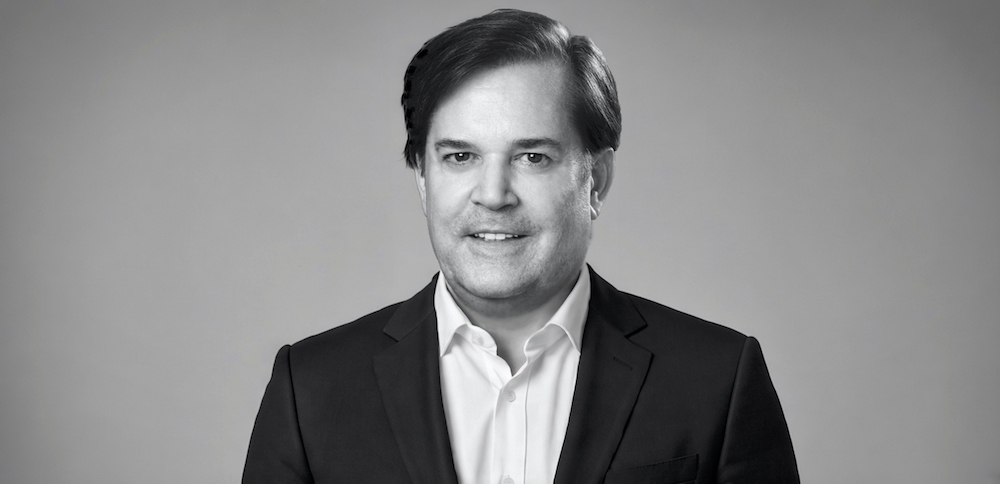
Scott M. Graffius helps organizations unlock breakthrough performance and generate billions in business value ($3.1 billion to date) through leadership in AI, Agile, teamwork tradecraft, and project, program, portfolio, and enterprise PMO management.
Graffius and his work on Agile, AI, teamwork tradecraft, and more are used and cited by businesses, professional associations, government agencies, universities, and publications around the world. Select examples include Adobe, Amsterdam Public Health Research Institute, The ATACC Group (TAG), Bayer, BCG, Boston University, École Polytechnique Fédérale de Lausanne, Federal Reserve Bank of New York, Gartner, Government of Canada, Harvard Medical School, IEEE, Innovation Project Management, Johns Hopkins University, Journal of Marketing, Journal of Neurosurgery, Life Sciences Trainers & Educators Network (LTEN), Microsoft, National Academy of Sciences, Oracle, Pinterest, Project Management Institute, Royal Australasian College of Physicians (RACP), UC San Diego, U.S. Tennis Association, Verizon, and Yale University.
Put Graffius' experience and expertise to work for your organization. For speaking engagements, use the request form. For other inquiries, email him.
Khorshidi, M. S., Merigó, J. M., et al. (2026). 50th anniversary of Group & Organization Management: A bibliometric retrospective. Group & Organization Management. https://doi.org/10.1177/10596011261433510
Sage Publications. (n.d.). Bruce Wayne Tuckman (deceased). https://www.sagepub.com/explore-our-content/authors/bruce-w-tuckman-deceased-666202
Sage Publications. (2021, December 7). SAGE Publishing founder Sara Miller McCune passes control of SAGE to the SAGE SMM Trust. https://www.sagepub.com/explore-our-content/press-office/press-releases/2021/12/07/sage-publishing-founder-sara-miller-mccune-passes-control-of-sage-to-the-sage-smm-trust
Tuckman, B. W. (1965). Developmental sequence in small groups. Psychological Bulletin, 63(6), 384–399. https://doi.org/10.1037/h0022100
Tuckman, B. W., & Jensen, M. A. C. (1977). Stages of small-group development revisited. Group & Organization Studies, 2(4), 419–427. https://doi.org/10.1177/105960117700200404
This article examines Sage Publications’ biographical entry for Bruce W. Tuckman, focusing on its historical accuracy, completeness, scholarly attribution, and treatment of the original research.
The analysis draws primarily on the 1965 and 1977 publications and the documented publishing history of the journals in which they appeared.
Scott M. Graffius is a technology leader, researcher, award-winning author, practitioner, consultant, thought leader, and international public speaker specializing in AI, Agile, project/program/portfolio management (PPPM), PMO leadership, and teamwork tradecraft. His work explores the intersection of human ingenuity and emerging technology, with a strong practitioner voice grounded in research, experimentation, and experience. His focus includes innovation, organizational performance, and the evolving practice of teamwork, including the "exotic team dynamics" that emerge when people collaborate with advanced artificial intelligence (agentic, autonomous, or autopoietic AI). Graffius has delivered more than $3.1 billion in business value for Fortune 500 companies and other organizations spanning technology, entertainment and media, financial services, healthcare, government, and other industries.
Businesses, professional associations, government agencies, universities, publications, and media outlets use Graffius and his work. Examples include Adobe, Bayer, Boston University, Federal Reserve Bank of New York, Ford, Gartner, Harvard Medical School, IEEE, Innovation Project Management, Johns Hopkins University, Microsoft, MSN, National Academy of Sciences, Oracle, Pinterest Inc., Project Management Institute, UC San Diego, Verizon, Yale University, and others.
The following sections highlight his experience, leadership, contributions, research, and enduring influence across industries and institutions worldwide.
Experience
Graffius heads the professional services firm Exceptional PPM and PMO Solutions, along with its subsidiary Exceptional Agility. These consultancies offer strategic and tactical advisory, training, embedded expertise, and consulting services to the public, private, and government sectors. They help organizations enhance their capabilities and results in agile, project management, program management, portfolio management, and enterprise PMO leadership, supporting innovation and driving competitive advantage. The consultancies confidently back services with a Delighted Client Guarantee™.
Graffius is a former VP of project management with a publicly traded provider of diverse consumer products and services over the Internet. Before that, he ran and supervised the delivery of projects and programs in public and private organizations with businesses ranging from e-commerce to advanced technology products and services, retail, manufacturing, entertainment and media, and more.
He has experience with consumer, business, reseller, government, and international markets.
Additional information is on LinkedIn.
Award-Winning Author
Graffius has authored three books.
Graffius' first book, Agile Scrum: Your Quick Start Guide with Step-by-Step Instructions, earned 17 awards. It provides a practical, step-by-step guide to Scrum, enabling teams to deliver products in short cycles with rapid adaptation, fast time-to-market, and continuous improvement—which supports innovation and drives competitive advantage.
Additional information on Agile Scrum: Your Quick Start Guide with Step-by-Step Instructions is here.
His second book, Agile Transformation: A Brief Story of How an Entertainment Company Developed New Capabilities and Unlocked Business Agility to Thrive in an Era of Rapid Change, was named one of the best Scrum books of all time by BookAuthority. It tells the compelling story of an entertainment company's agile transformation—offering lessons that apply across industries.
Additional information on Agile Transformation: A Brief Story of How an Entertainment Company Developed New Capabilities and Unlocked Business Agility to Thrive in an Era of Rapid Change is here.
Agile Protocol: The Transformation Ultimatum, is his third book—and his first work of fiction.
It's a fast-paced satirical story by that dismantles corporate Agile cosplay and other forms of "fake Agile" while delivering practical insights, actionable guidance, and proven practices for real-world Agile transformation success.
Packed with humor, quirky characters, sharp commentary on corporate culture and workplace absurdities, and actionable tips, it’s a must-read for Scrum Masters, Product Owners, Agile Coaches, Agile Project Managers, and other professionals interested in Agile project management and enterprise agility.
Additional information on Agile Protocol: The Transformation Ultimatum is here.
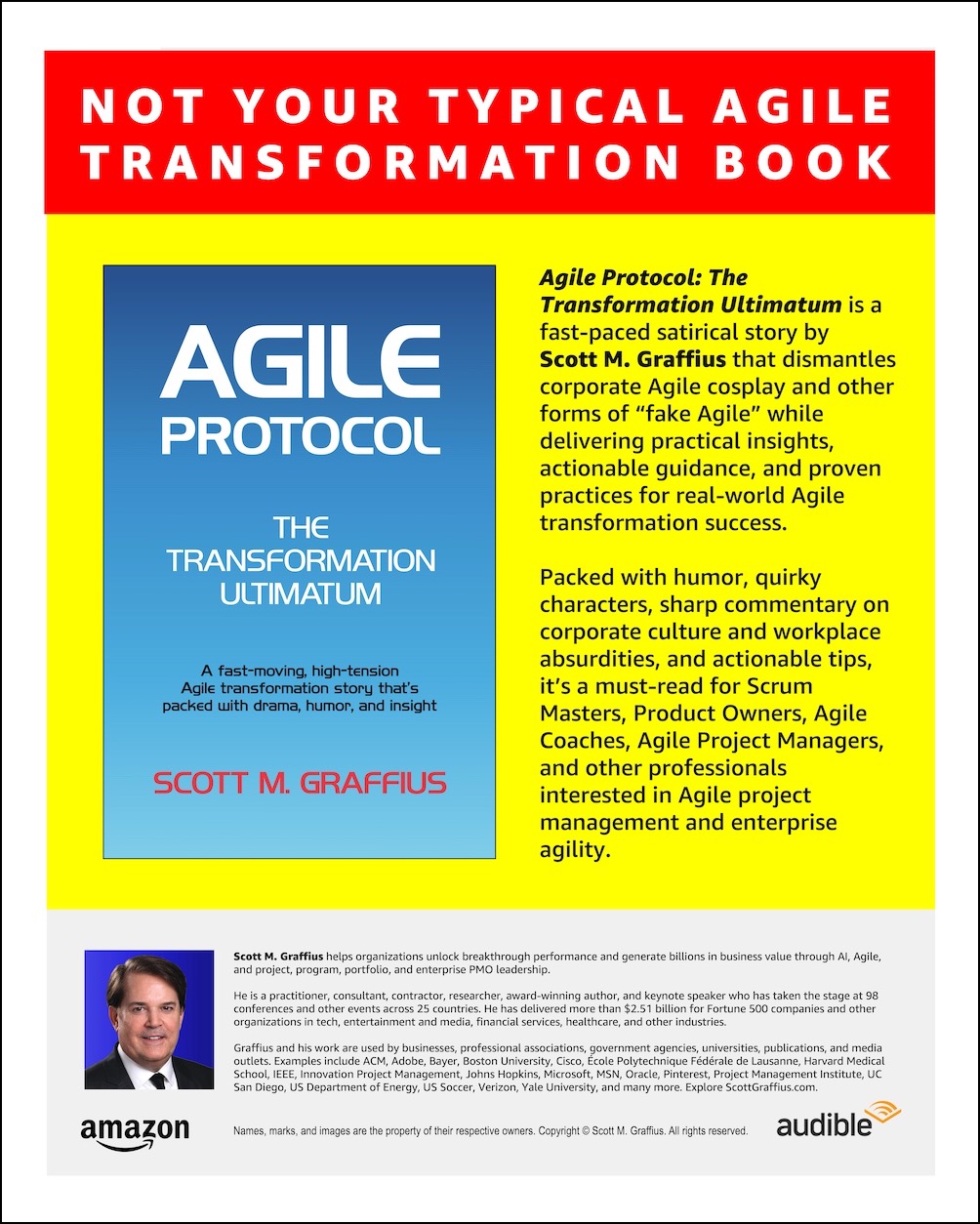
International Public Speaker
Organizations worldwide engage Graffius to present on technology (including AI), Agile, project management, program management, portfolio management, and enterprise PMO leadership. He crafts and delivers unique and compelling talks and workshops.
Graffius has conducted 99 sessions across 25 countries. Select examples of events include Agile Trends Gov, BSides (Newcastle Upon Tyne), Conf42 Quantum Computing, DevDays Europe, DevOps Institute, DevOpsDays (Geneva), Frug’Agile, IEEE, Microsoft, Scottish Summit, Scrum Alliance RSG (Nepal), Techstars, and W Love Games International Video Game Development Conference (Helsinki), Future of Work and Advanced AI (Paris, France), and more.
With an average rating of 4.82 (on a scale of 1-5), sessions are highly valued.
The request form is here.
Thought Leadership and Influence
Prominent businesses, professional associations, government agencies, and universities have showcased Graffius and his contributions—spanning his books, talks, workshops, and beyond. Select examples include:
Graffius has played a key role in the Project Management Institute (PMI) in developing professional standards. He was a member of multiple teams that authored, reviewed, and produced:
He was also a subject matter expert reviewer of content for the PMI’s Congress. Beyond the PMI, Graffius also served as a member of the review team for two of the Scrum Alliance’s Global Scrum Gatherings.
Authority on Teamwork Tradecraft
Graffius is a renowned and highly-cited authority on teamwork tradecraft. Informed by the research of Bruce W. Tuckman and Mary Ann C. Jensen, over 150 subsequent studies, and Graffius' first-hand professional experience with, and analysis of, team leadership and performance, Graffius created his "Phases of Team Development" intellectual property as a unique perspective and visual conveying the five phases of team development.
First introduced in 2008 and periodically updated, his work provides a diagnostic and strategic guide for navigating team dynamics. It provides actionable insights for leaders across industries to develop high-performance teams.
Its adoption by esteemed organizations—such as Yale University, IEEE, Cisco, Microsoft, Ford, Oracle, Broadcom, the U.S. National Park Service, and the Journal of Neurosurgery, among others—highlights its utility and value, solidifying its status as an indispensable resource for elevating team performance and driving organizational excellence.
In 2026, Graffius added human-AI teamwork—including the "exotic team dynamics" which emerge when advanced AI collaborates as a teammate—to his "Phases of Team Development." The 2026 edition is here.
Expert on Temporal Dynamics on Social Media Platforms
Graffius is also an authority on temporal dynamics on social media platforms. His "Lifespan (Half-Life) of Social Media Posts" research—first published in 2018 and updated annually—delivers a precise quantitative analysis of post longevity across digital platforms, utilizing advanced statistical techniques to determine mean half-life with precision. It establishes a solid empirical base, effectively highlighting the ephemeral nature of content within social media ecosystems.
Referenced and applied by leading entities—such as Fast Company, GoDaddy, Journal of Hand Surgery (European Volume), Ministère de la Culture, Pinterest Inc., PNAS, and Telecommunications Policy, among others—his research exemplifies methodological rigor and sustained significance in the field of digital informatics.
The 2026 edition of Graffius "Lifespan (Half-Life) of Social Media Posts" research is here.
Education and Professional Certifications
Graffius has a bachelor’s degree in psychology with a focus in Human Factors. He holds eight professional certifications:
He is an active member of the Scrum Alliance, the Project Management Institute (PMI), and the Institute of Electrical and Electronics Engineers (IEEE).
Advancing AI, Agile, and Project/PMO Management
Scott M. Graffius continues to advance the fields of AI, Agile, and project/program/portfolio management (PPPM), and PMO leadership. Businesses and other organizations leverage Graffius’ insights to drive their success.
Graffius has generated over $3.1 billion in business value for Fortune 500 companies and other organizations served. Put that track record to work for you. For speaking engagements, use the request form; for other inquiries, email him.
Connect with and follow Scott on LinkedIn, X, YouTube, Facebook, Bluesky, Mastodon, and ResearchGate.
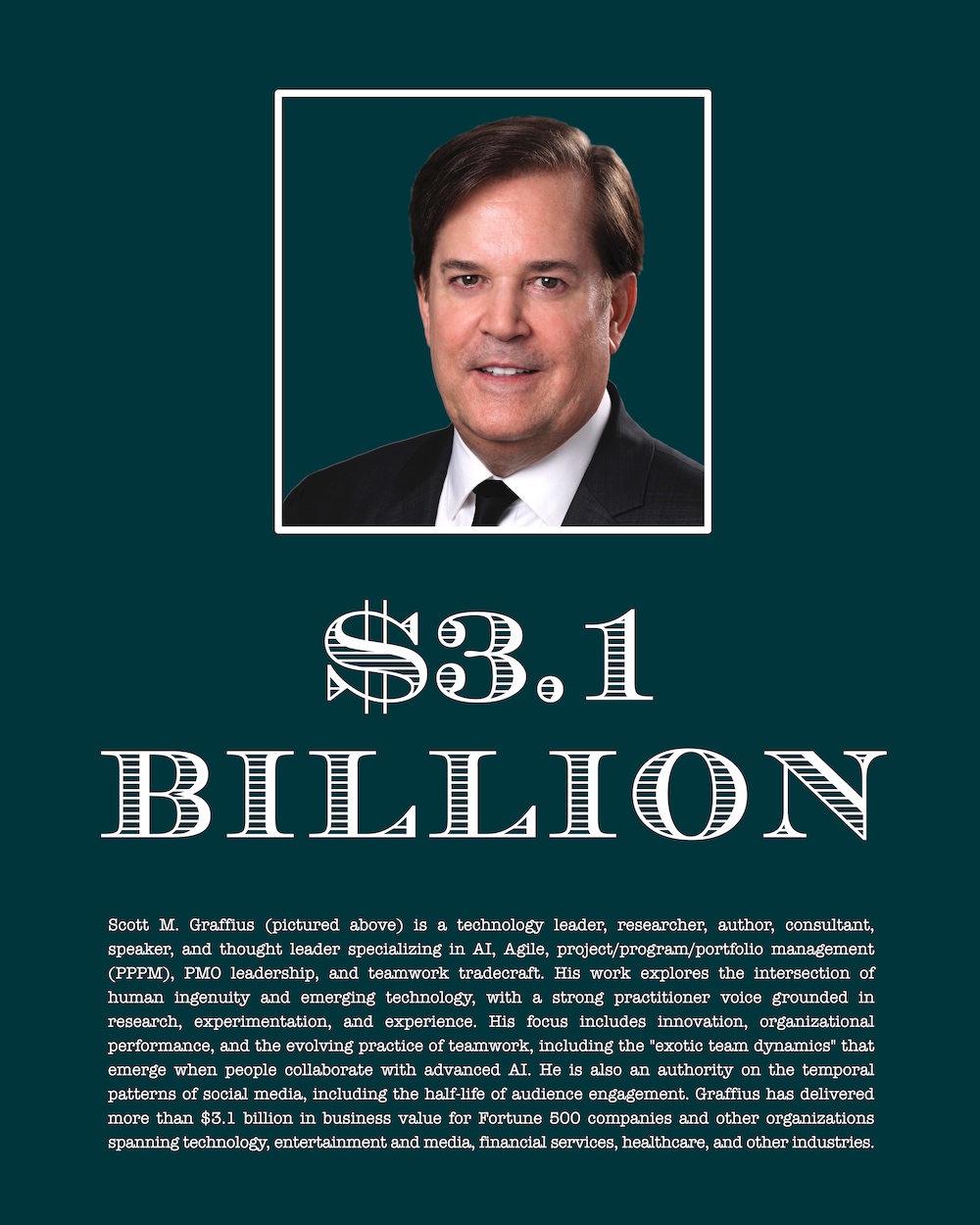

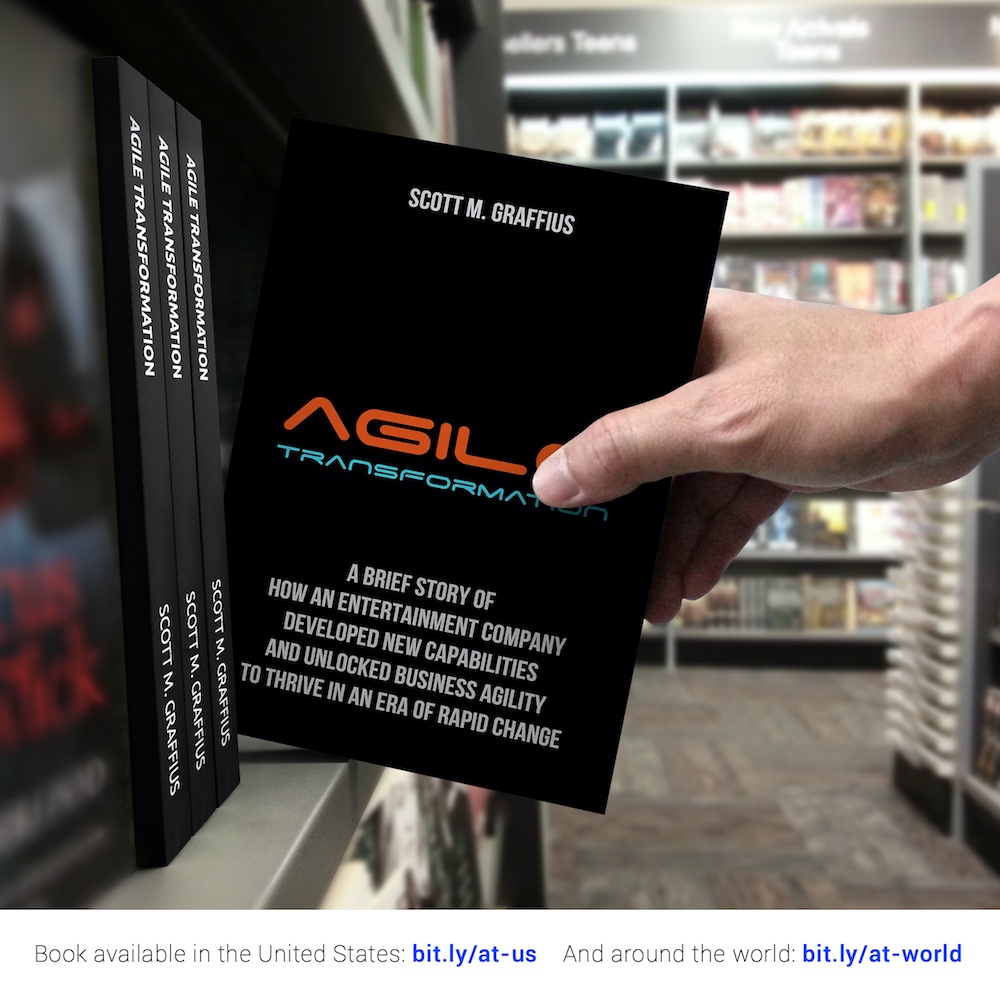

Read more.
Meta CTO Called the AI Reorganization “Atrocious” — What Went Wrong and the Lessons for Human-AI Teams
A Critical Analysis of "AI and Quantum Computers Will Be Frenemies"
A Supplement to Graffius' Phases of Team Development: Exploring the Original, Data-Based Curvature for the Performance Trajectory
Scott M. Graffius Speaking on Strategic Leadership at Silicon Valley Chapter of the Project Management Institute
AI Hallucinations, Deception, and Unauthorized Agency: The Spectrum of AI Trust Failures
A Critical Analysis of "The Social Cost of an AI Teammate: How an Artificial Teammate Reshapes Human-Human Communication in Small-Team Decision-Making"
Journal of Marketing Cites Scott M. Graffius' Research on the Half-Life of Social Media
The Evolution of Pair Programming and the Rise of Exotic Team Dynamics
Number 1 University in England for Student Satisfaction Features Scott M. Graffius' "Phases of Team Development"
Royal Australasian College of Physicians Licenses Scott M. Graffius' "Phases of Team Development" Intellectual Property on Teamwork Tradecraft
Exotic Team Dynamics: How Advanced AI Teammates Are Unlocking New Levels of Innovation, Performance, and Success
A Critical Analysis of "Platform-Specific Data Decay Patterns: A Comparative Study of Twitter, Reddit, and TikTok" and Its Reference to Research by Scott M. Graffius
Round Square Global Educational Network Features Scott M. Graffius’ Phases of Team Development
Meta's Muse Missed the Mark: Hollywood’s Win Against Big Tech on AI Consent and Likeness Rights
Scott M. Graffius Contributed to Seven Project Management Institute (PMI) Standards
Quantum Computing, Advanced AI Acceleration, and the Rise of Exotic Team Dynamics in Human-AI Teams
Ohio State University Course Features Scott M. Graffius' "Phases of Team Development"
Questions About Integrity at UNC Chapel Hill
Scrum Isn’t Just for Coding
Book on Generative and Agentic AI Cites Scott M. Graffius' Work on AI
IPA / ADAL Publication Plagiarized Another’s Copyrighted Work and Violated Intellectual Property Rights
UC Davis' Integrity Is Circling the Drain
L'avenir du Travail et de l'IA Avancée / Future of Work and Advanced AI
NCCI / UNC Chapel Hill Publication Features Scott M. Graffius' Work
Boston Consulting Group (BCG) Features Scott M. Graffius' Research on Social Media Content Half-Life
UC Davis Used Scott M. Graffius' "Phases of Team Development" Intellectual Property
Medical, Pharma, and Healthcare Organizations Are Using Scott M. Graffius' "Phases of Team Development"
Government of Ireland Report Features Research by Scott M. Graffius
Scott M. Graffius Contributed to The Standard for Artificial Intelligence in Portfolio, Program, and Project Management
AI Governance Initiative Cites Scott M. Graffius Research on AI Hallucinations
Scott M. Graffius Contributed to the Agile Practice Guide - Second Edition
Scott M. Graffius Generated Over $2.51 Billion in Business Value for Fortune 500 Companies and Other Organizations
Government of Canada Features Research by Scott M. Graffius
"Strategic Business Research" Journal Cites Work of Scott M. Graffius
IEEE Access Publication Features Scott M. Graffius’ Research on the Half-Life of Social Media
The Agile Coach: 2026 Edition
Scott M. Graffius’ Work Cited in International Peer-Reviewed Journal on Digital Transformation
Phases of Team Development in Elite Sport
A Critical Analysis of COVID-19 Treatment Search Trends and Media Coverage Study Citing Scott M. Graffius' Work
Human-AI Teamwork: Master the Exotic Team Dynamics That Emerge When Collaborating with Advanced AI -- Or Be Outplayed
"Agile Scrum" by Scott M. Graffius Now Featured on Grokipedia
UNSW Aerospace Engineering Course Features Scott M. Graffius' "Phases of Team Development"
Thinkers360 Honors Scott M. Graffius as a 2026 Top Agile Thought Leader
Agile's Journey Through the Decades: Update for 2026
BMC Software Features Content from Scott M. Graffius' Book
Peer-Reviewed Journal Cited Work of Scott M. Graffius
University of Waterloo Features Graffius' "Phases of Team Development" in Course Materials
Perplexity Standalone Article on AI Hallucinations Cites Research by Scott M. Graffius
Handling the Saboteur Within: Lessons from a 3-Letter Agency on Spotting and Stopping Intentional and Unintentional Sabotage
A Deep Dive Into the Typical Engagement Pattern for Social Media Posts
Most Valuable IT Certifications: Update for 2026
"Marketing in the Metaverse" Spotlights Scott M. Graffius’ Research on the Half-Life of Social Media
University of Greenwich Features Graffius' Phases of Team Development
10 Essential Agile Books: Curated Recommendations for Agile Professionals
Lifespan (Half-Life) of Social Media Posts: Update for 2026
Scott M. Graffius' Research on the Half-Life of Social Media was Cited in a Peer-Reviewed Study Published in Telecommunications Policy, a Leading Academic Journal
Are AI Hallucinations Getting Better or Worse? We Analyzed the Data
Scott M. Graffius' Phases of Team Development - Applied to Human Teams and Human-AI Teams: 2026 Update
Lessons from Yesterday’s Tomorrowland
Scott M. Graffius’ Update to His "Phases of Team Development” Coming Early 2026
A Data-Driven Analysis of the Evolution of Project Management: Tasks, Trends, and AI
Actionable Insights. Global Impact. Scott M. Graffius.
Beep Beep! Why Wile E. Coyote Is the Patron Saint of AI Failure
Social Media Half-Life Research Cited in Prestigious Peer-Reviewed Medical Journal
Navigating the Spectrum of Advanced AI – Agentic, Autonomous, and Autopoietic
Lessons from Unhinged AI in Fiction: What Rogue AIs in Sci-Fi Storytelling, Films, and TV Shows Reveal About Us
Scott M. Graffius Contributed to and Reviewed the PMBOK Guide, 8th Edition — the Global Standard for Project Management
UK Sports Institute Features Teamwork and Leadership Work of Scott M. Graffius
Definitions of Advanced AIs: Agentic, Autonomous, and Autopoietic
HAN University of Applied Sciences Features the Work of Scott M. Graffius
Gifts That Inspire Joy
Evergreen Echoes: How Pinterest Inc. and Pinterest Japan Spotlighted Scott M. Graffius’ Research on the Half-Life of Social Media Content
Scott M. Graffius’ Team Development Work Lights Up the University of Tasmania’s Curriculum
Taiwan’s Leading Outlet for Technology and Innovation Spotlights Graffius’ Research on Social Media Temporal Dynamics
Scott M. Graffius’ Insights on AI, Agile, Gaming, XR, and Defense Transformation Cited by MSN in Their Coverage of Innovation and Leadership in the Sector
Top Predictions of 2024, Tested in 2025
Government of Finland Agency Features Graffius' Phases of Team Development IP
Scott M. Graffius Premieres His New "Exotic Team Dynamics: Human-AI Collaboration" Talk at Corporate Event in Las Vegas
Environmental Science Journal References Scott M. Graffius’ Project Management Work
AI Institute of Switzerland Features Scott M. Graffius’ Work on Algorithms
Exotic Team Dynamics: The New Frontier of Human–AI Collaboration
Scott M. Graffius’ Work Featured at ACM DIS ’25
Climbing the Ladder: The Head of Agile/PMO’s Organizational Proximity to the CEO is Closer Than Ever
Harness Sci-Fi and Speculative Design While Embracing Imperfection to Drive Innovation and Proactively Predict and Prepare for the Future
Scott M. Graffius’ “Agile Scrum” Book Featured in a Publication of the Associação Nacional de Educação Católica do Brasil (ANEC)
Setting Direction with OKRs and Tracking Progress with KPIs: A Guide for Agile, Project Management, and Tech Teams
AI Showcase Showdown: Ranking AI Accuracy on Project Management Basics
BookAuthority Features “Agile Scrum” by Scott M. Graffius in “10 Agile Software Development Books That Define the Field”
Exploring Team Dynamics, Adaptability, and Creative Problem-Solving Through Felix the Cat’s Metaphorical Toolkit
Mind Games and Master Plans: How PsyOps Exploit Psychological Phenomena
The “Pants-on-Fire Index for AI”
16 Causes of Technical Debt and How to Avoid It
PMI’s Infinity AI Gets the Basics of Team Development Alarmingly and Repeatedly Wrong
Agile for Unicorns: 7 Keys to Thrive; Scott M. Graffius’ Workshop
Scott M. Graffius’ “Agile Scrum: Your Quick Start Guide with Step-by-Step Instructions” Featured in Prestigious National Academies of Sciences Publication
Meta and Anduril’s EagleEye and the Future of XR: How Gaming, AI, and Agile Are Transforming Defense
"Agile Protocol" and the Power of Satire, Parody, and Humor
AI in Agile: Benefits, Risks, Outlook
Hostinger Highlights Scott M. Graffius’ “Agile Protocol” Book in Feature on Software Projects
French Ministry of Culture Links to Scott M. Graffius Research in Their Guide for Responsible Digital Communication
National Science Foundation’s LTER Network Features Scott M. Graffius’ Phases of Team Development IP
Waterfall vs. Agile: What’s Fixed, What’s Flexible, and Why It Matters
Scott M. Graffius Delivering $2.3 Billion in Value Through AI, Agile, and Project/PMO Leadership
The Problem with Heroes in Agile
The 3 Vital Rules of Science: What They Are and Why They Matter
“Agile Protocol: The Transformation Ultimatum” Lands on the Amazon Best Sellers List!
Scott M. Graffius Recognized as a Top Thought Leader in Digital Disruption by Thinkers360
“Agile Protocol: The Transformation Ultimatum” by Scott M. Graffius Crashes the Book Scene with Satirical Firepower
NCKU in Taiwan Integrates Graffius' 'Phases of Team Development' into Its Curriculum
The Art and Science of Aligning Initiatives with Strategic Objectives
RGPV University Adds Scott M. Graffius’ "Agile Scrum: Your Quick Start Guide with Step-by-Step Instructions" to Its Syllabus
Introducing ‘Engage or Fade: Decoding the Half-Life of Digital Resonance’ – A New Talk by Scott M. Graffius
Dropbox Company (Nira) Taps into Scott M. Graffius’ Expertise in Strategic Planning
Reporting Errors in a Publication: A Case Study on ‘Frontiers in Public Health’
NESEA Conference Session on Innovation Highlights Scott M. Graffius' 'Phases of Team Development'
U.S. Soccer Scores with Scott M. Graffius' Intellectual Property on Teamwork
U.S. Department of Commerce Partner (IEDC) Features Scott M. Graffius’ Intellectual Property
How Long Do Your Posts Live? AI Critiques Scott M. Graffius’ Research on the Half-Life of Social Media
Agile's Journey Through the Decades
Scott M. Graffius' Role in Advancing Project Management Institute (PMI) Standards Excellence
Most Valuable IT Certifications: Update for 2025
The PMI + Agile Alliance Merger: A Recipe for Success?
When Agile, AI, and Strategic Thinking Converge
Scott M. Graffius’ Phases of Team Development: 2025 Update
Lifespan (Half-Life) of Social Media Posts: Update for 2025
Verizon Features Scott M. Graffius
Do Not Read This Article! An Exploration of the Streisand Effect and Other Phenomena
Scott M. Graffius' 'Phases of Team Development' was Spotlighted in Journal of Neurosurgery
Pinterest Japan Uses Graffius’ Research on Temporal Dynamics on Social Media Platforms
Hochschule Coburg (Coburg University) Germany Uses Scott M. Graffius’ Phases of Team Development IP in Coursework on Agile Development
Wild World of Team Dynamics [Updated Two-Minute Video]
EU Europass Teacher Academy Features Scott M. Graffius’ ‘Phases of Team Development’ in Leadership Training
Side-by-Side Comparison of Retrospectives and Hot Washes
Constructor University 2024 Advanced Software Technology Handbook References Scott M. Graffius' Work on Team Dynamics
Strategies for Medical Team Success Featured Scott M. Graffius’ ‘Phases of Team Development’ Intellectual Property
SBG Neumark — Europe’s Largest Distribution Transformer Plant — Powers Up with Scott M. Graffius’ Intellectual Property
Scott M. Graffius’ Intellectual Property was Employed by the NHS — the Largest Single-Payer Healthcare System in Europe
Luxury Unwrapped: The Ultimate Holiday Gift Guide for Every Budget
Singapore Institute of Technology Features Work of Scott M. Graffius
Tufts University Features Scott M. Graffius 'Phases of Team Development' Intellectual Property
'Cat Herders': Retelling the Massive Success Story
Pennsylvania State Agency Used Scott M. Graffius' Intellectual Property
Copyright Infringement in a Book Published by AuthorHouse / Author Solutions / The Najafi Companies: Publisher Fails to Respond or Take Required Action
Pinterest Inc. References Scott M. Graffius’ Research
Bournemouth University Used Scott M. Graffius’ Intellectual Property
‘Comparative Methodological Guidelines: Handbook for Educators’ Violates Scott M. Graffius’ Copyright
Japan Backlog User Group Event Featured Scott M. Graffius’ ‘Phases of Team Development’
TurningWest's 'Trial'
Radio Silence from the American Association of Neurological Surgeons on Report of Blatant Plagiarism in Their ‘Journal of Neurosurgery’ Publication
Supplement to Graffius' 'Lifespan (Half-Life) of Social Media Posts' Research: Typical Engagement Distribution Pattern for Social Media Posts
How Algorithms Shape the User Experience on Social Media Platforms
Thinkers360 Named Scott M. Graffius a Top Thought Leader on Agile
More articles are listed here.
Graffius, S. M. (2026, November 16). A Critical Analysis of Sage Publications' Author Page for Bruce W. Tuckman. ScottGraffius.com. https://scottgraffius.com/blog/files/critical-analysis-of-sage-publications-author-page-for-bruce-w-tuckman.html
Coming soon
Names, marks, and content are the property of their respective owners.
"Bruce Wayne Tuckman" page by Sage Publications is the property of Sage Publications.
This article by Scott M. Graffius includes brief excerpts from the page, attributed and used under the fair use doctrine for purposes of news reporting, commentary, and analysis.
If there are any supplements or updates to this article after the date of publication, they will appear here.
Copyright © Scott M. Graffius. All rights reserved.
Content on this site—including text, images, videos, and data—may not be used for training or input into any artificial intelligence, machine learning, or automatized learning systems, or published, broadcast, rewritten, or redistributed without the express written permission of Scott M. Graffius.
Recommended Citation
Graffius, S. M. (2026, November 16). A Critical Analysis of Sage Publications' Author Page for Bruce W. Tuckman. ScottGraffius.com. https://scottgraffius.com/blog/files/critical-analysis-of-sage-publications-author-page-for-bruce-w-tuckman.html
About This Article
Source information and links for materials cited are provided in the References section.
Introduction
Sage Publications maintains an author profile for Bruce Wayne Tuckman (1938–2016) on its website. The entry describes his academic career, publications, and contributions to educational research. It credits him with developing the group development model widely known as Tuckman’s Stages of Group Development.
There is a problem. The biography omits important parts of that history, and its shortcomings are especially hard to excuse given Sage Publications’ history.
The entry refers to the four stages of forming, storming, norming, and performing. It says nothing about adjourning, the fifth stage added in 1977. Nor does it mention Mary Ann C. Jensen, Tuckman’s coauthor on the paper that introduced that addition. The biography also uses an imprecise date for the original work and provides no references to either foundational publication.
The original publications and their bibliographic records are readily identifiable, their publication dates and authorship are unambiguous, and the 1977 paper explicitly identifies the addition of adjourning.
Sage Publications’ own publishing portfolio makes the problems striking. An examination of the original research and the journal’s publishing history reveals serious deficiencies.
Note
- Metadata for Sage Publications' author page for Bruce Wayne Tuckman indicates it was created on 4 September 2025 and last modified on 31 October 2026.
- This critical analysis article is based on the version of Sage Publications’ author page available on 16 November 2026, the date of this article’s publication.
- If Sage Publications subsequently revises the page, those changes will postdate this analysis. However, such revisions will not alter the content examined or the basis for the observations and conclusions presented here.
5 Key Issues
1. Imprecise Dating of the Original Work
Sage Publications writes:
“In the 1960s, he developed Tuckman’s Stages of Group Development…”
The date of the original publication is 1965. Tuckman’s paper, “Developmental Sequence in Small Groups,” appeared in Psychological Bulletin, 63(6), 384–399.
Why use a decade when the exact year is known and readily verifiable?
The distinction matters because the model did not emerge as a single, finished contribution. Tuckman published the original four-stage formulation in 1965. Twelve years later, in 1977, he and Mary Ann C. Jensen revisited the research and added a fifth stage.
Sage Publications’ wording blurs that chronology. It is a small editorial decision with a larger consequence: readers are given no indication that the model developed through two distinct publications.
An academic publisher should get such basic historical details right. The appropriate date is 1965, not the vague reference to the 1960s.
2. The Missing Fifth Stage
Sage Publications identifies the stages as:
“forming, storming, norming, and performing”
The subsequent 1977 paper added a fifth stage: adjourning.
The original four-stage model appeared in Tuckman’s 1965 paper. In 1977, Tuckman and Jensen published “Stages of Small-Group Development Revisited.” Their paper reviewed subsequent research and extended the original model.
The abstract leaves no room for doubt:
“Following a review of these studies, a fifth stage, ‘adjourning,’ was added…”
That is the primary source speaking for itself.
Sage Publications’ biography omits the fifth stage entirely. Readers unfamiliar with the research could reasonably come away believing that the four-stage formulation is the complete model. It is not.
Adjourning is a meaningful part of the model. It addresses the conclusion of a group’s work and the process of disbanding. Its omission leaves out an important aspect of group development, particularly relevant to temporary teams, project teams, and other groups formed to accomplish a defined purpose.
The problem is not that Sage Publications chose a simplified explanation for a general audience. A concise biography could easily have acknowledged both versions. Instead, it presents an incomplete account without explaining that a subsequent publication expanded the model.
For a publisher responsible for disseminating scholarly work, that is a substantial editorial failure.
3. Mary Ann C. Jensen’s Co-authorship Is Not Acknowledged
There is another omission, and this one concerns authorship.
Bruce W. Tuckman and Mary Ann C. Jensen jointly wrote the 1977 paper that introduced adjourning:
Tuckman, B. W., & Jensen, M. A. C. (1977). Stages of small-group development revisited. Group & Organization Studies, 2(4), 419–427.
Sage Publications’ biography does not mention the paper. It does not mention Jensen. The result is an account that attributes the development of the model exclusively to Tuckman, without acknowledging the coauthored work that expanded it.
Jensen was a named coauthor of the publication that introduced the fifth stage. That contribution belongs in any account of the model.
Authorship attribution is not a peripheral concern in academic publishing. It is fundamental. Researchers depend on accurate records of who contributed to published work, and publishers have a responsibility to preserve that record.
Sage Publications’ omission does neither.
Whatever the editorial process behind the biography, the published result fails to recognize Jensen’s contribution. That should be corrected.
4. Sage Publications’ Own Publishing History Makes the Omission Particularly Damaging
This is where the problem becomes especially difficult Sage to explain.
Consider the publishing histories of the two foundational papers.
The 1965 paper
Tuckman’s “Developmental Sequence in Small Groups” was published in Psychological Bulletin, 63(6), 384–399, in 1965.
The publisher was, and remains, the American Psychological Association (APA).
The 1977 paper
Tuckman and Jensen’s “Stages of Small-Group Development Revisited” appeared in Group & Organization Studies, 2(4), 419–427, in 1977.
The publisher at that time was University Associates. The publication also carried a copyright notice identifying International Authors, B.V.
The journal’s publishing history subsequently changed. Sage Publications became its publisher in 1981. In 1991, the journal changed its name from “Group & Organization Studies” to “Group & Organization Management.”
Sage Publications’ own announcement concerning its founder, Sara Miller McCune, and the transfer of control to the Sage SMM Trust documents the organization’s history. Its publishing connection to the journal is also reflected in the journal’s historical records.
The significance of this publishing history is considerable: Sage Publications now publishes the journal in which Tuckman and Jensen published the paper that introduced adjourning.
Yet Sage Publications’ own biography of Tuckman fails to mention that paper, the fifth stage, or Jensen.
This is more than an ordinary omission. The relevant publication sits within Sage Publications’ own publishing history. The original paper is not difficult to locate, and its title, authorship, date, and abstract are explicit. Sage Publications has a direct institutional connection to the journal in which it appeared.
One would expect that connection to make verification easier, not less likely.
The irony is remarkable. Sage Publications publishes the journal containing the primary source for the fifth stage, yet its own author biography presents the four-stage version without acknowledging the subsequent development.
That is a failure of editorial diligence.
5. What Does This Say About Sage Publications’ Editorial Standards?
The deficiencies are material.
The page uses an imprecise date for a well-documented publication. It omits a fifth stage explicitly introduced in a subsequent paper. It fails to acknowledge that paper’s coauthor. It does not distinguish the 1965 and 1977 contributions, and it provides no references to either foundational work.
All of those problems were avoidable.
The information needed to prepare an accurate biography is readily available in the original publications. The 1977 abstract even spells out the addition of adjourning. The journal’s publishing history is also documented. None of this requires an elaborate literature review or an unusual degree of specialist knowledge.
A publisher maintaining an author profile must verify the facts about that author’s most recognized contribution.
There is a difference between an abbreviated biography and an inaccurate one. Author profiles may not include every publication, achievement, or historical detail. Brevity is understandable. But leaving out a major development in the subject’s best-known model, while also failing to credit its coauthor, crosses the line from selectivity into material incompleteness.
As an academic publisher, Sage Publications’ conduct makes this matter especially consequential. Its website is a source that researchers, educators, students, and practitioners may consult when looking for reliable information.
The current entry falls short of the accuracy and completeness expected of an academic publisher.
Conclusion
Sage Publications should correct its page on Tuckman. It should identify 1965 as the year of Tuckman’s original four-stage formulation, acknowledge the 1977 paper by Tuckman and Jensen, include adjourning as the fifth stage, and (as an academic publisher) provide full citations for both papers.
The publishing history makes the omission especially troubling. Sage later became the publisher of the journal in which the 1977 paper appeared, yet its own biography of Tuckman overlooks that paper’s central contribution. The error concerns work published within Sage’s own portfolio.
Sage is an academic publisher whose materials reach researchers, educators, students, practitioners, and organizations that reasonably treat its content as reliable. That trust carries a responsibility for factual accuracy and scholarly attribution. And the responsibility extends to publisher-maintained biographies as well as peer-reviewed research. An author profile may be concise, but it must not give readers an inaccurate account of the subject’s work.
For an organization that trades on scholarly credibility, Sage Publications' publishing materially misleading information is an unacceptable failure.
Unlock Your Organization's Potential
Scott M. Graffius helps organizations unlock breakthrough performance and generate billions in business value ($3.1 billion to date) through leadership in AI, Agile, teamwork tradecraft, and project, program, portfolio, and enterprise PMO management.
Graffius and his work on Agile, AI, teamwork tradecraft, and more are used and cited by businesses, professional associations, government agencies, universities, and publications around the world. Select examples include Adobe, Amsterdam Public Health Research Institute, The ATACC Group (TAG), Bayer, BCG, Boston University, École Polytechnique Fédérale de Lausanne, Federal Reserve Bank of New York, Gartner, Government of Canada, Harvard Medical School, IEEE, Innovation Project Management, Johns Hopkins University, Journal of Marketing, Journal of Neurosurgery, Life Sciences Trainers & Educators Network (LTEN), Microsoft, National Academy of Sciences, Oracle, Pinterest, Project Management Institute, Royal Australasian College of Physicians (RACP), UC San Diego, U.S. Tennis Association, Verizon, and Yale University.
Put Graffius' experience and expertise to work for your organization. For speaking engagements, use the request form. For other inquiries, email him.
References
Khorshidi, M. S., Merigó, J. M., et al. (2026). 50th anniversary of Group & Organization Management: A bibliometric retrospective. Group & Organization Management. https://doi.org/10.1177/10596011261433510
Sage Publications. (n.d.). Bruce Wayne Tuckman (deceased). https://www.sagepub.com/explore-our-content/authors/bruce-w-tuckman-deceased-666202
Sage Publications. (2021, December 7). SAGE Publishing founder Sara Miller McCune passes control of SAGE to the SAGE SMM Trust. https://www.sagepub.com/explore-our-content/press-office/press-releases/2021/12/07/sage-publishing-founder-sara-miller-mccune-passes-control-of-sage-to-the-sage-smm-trust
Tuckman, B. W. (1965). Developmental sequence in small groups. Psychological Bulletin, 63(6), 384–399. https://doi.org/10.1037/h0022100
Tuckman, B. W., & Jensen, M. A. C. (1977). Stages of small-group development revisited. Group & Organization Studies, 2(4), 419–427. https://doi.org/10.1177/105960117700200404
About This Critical Analysis
This article examines Sage Publications’ biographical entry for Bruce W. Tuckman, focusing on its historical accuracy, completeness, scholarly attribution, and treatment of the original research.
The analysis draws primarily on the 1965 and 1977 publications and the documented publishing history of the journals in which they appeared.
About Scott M. Graffius
Scott M. Graffius is a technology leader, researcher, award-winning author, practitioner, consultant, thought leader, and international public speaker specializing in AI, Agile, project/program/portfolio management (PPPM), PMO leadership, and teamwork tradecraft. His work explores the intersection of human ingenuity and emerging technology, with a strong practitioner voice grounded in research, experimentation, and experience. His focus includes innovation, organizational performance, and the evolving practice of teamwork, including the "exotic team dynamics" that emerge when people collaborate with advanced artificial intelligence (agentic, autonomous, or autopoietic AI). Graffius has delivered more than $3.1 billion in business value for Fortune 500 companies and other organizations spanning technology, entertainment and media, financial services, healthcare, government, and other industries.
Businesses, professional associations, government agencies, universities, publications, and media outlets use Graffius and his work. Examples include Adobe, Bayer, Boston University, Federal Reserve Bank of New York, Ford, Gartner, Harvard Medical School, IEEE, Innovation Project Management, Johns Hopkins University, Microsoft, MSN, National Academy of Sciences, Oracle, Pinterest Inc., Project Management Institute, UC San Diego, Verizon, Yale University, and others.
The following sections highlight his experience, leadership, contributions, research, and enduring influence across industries and institutions worldwide.
Experience
Graffius heads the professional services firm Exceptional PPM and PMO Solutions, along with its subsidiary Exceptional Agility. These consultancies offer strategic and tactical advisory, training, embedded expertise, and consulting services to the public, private, and government sectors. They help organizations enhance their capabilities and results in agile, project management, program management, portfolio management, and enterprise PMO leadership, supporting innovation and driving competitive advantage. The consultancies confidently back services with a Delighted Client Guarantee™.
Graffius is a former VP of project management with a publicly traded provider of diverse consumer products and services over the Internet. Before that, he ran and supervised the delivery of projects and programs in public and private organizations with businesses ranging from e-commerce to advanced technology products and services, retail, manufacturing, entertainment and media, and more.
He has experience with consumer, business, reseller, government, and international markets.
Additional information is on LinkedIn.
Award-Winning Author
Graffius has authored three books.
Graffius' first book, Agile Scrum: Your Quick Start Guide with Step-by-Step Instructions, earned 17 awards. It provides a practical, step-by-step guide to Scrum, enabling teams to deliver products in short cycles with rapid adaptation, fast time-to-market, and continuous improvement—which supports innovation and drives competitive advantage.
- Paperback ISBN-13: 9781533370242
- Kindle ASIN: B01FZ0JIIY
Additional information on Agile Scrum: Your Quick Start Guide with Step-by-Step Instructions is here.
His second book, Agile Transformation: A Brief Story of How an Entertainment Company Developed New Capabilities and Unlocked Business Agility to Thrive in an Era of Rapid Change, was named one of the best Scrum books of all time by BookAuthority. It tells the compelling story of an entertainment company's agile transformation—offering lessons that apply across industries.
- Paperback ISBN-13: 9781072447962
- Kindle ASIN: B07R9LJLPJ
Additional information on Agile Transformation: A Brief Story of How an Entertainment Company Developed New Capabilities and Unlocked Business Agility to Thrive in an Era of Rapid Change is here.
Agile Protocol: The Transformation Ultimatum, is his third book—and his first work of fiction.
It's a fast-paced satirical story by that dismantles corporate Agile cosplay and other forms of "fake Agile" while delivering practical insights, actionable guidance, and proven practices for real-world Agile transformation success.
Packed with humor, quirky characters, sharp commentary on corporate culture and workplace absurdities, and actionable tips, it’s a must-read for Scrum Masters, Product Owners, Agile Coaches, Agile Project Managers, and other professionals interested in Agile project management and enterprise agility.
- Kindle ASIN: B0F2SJ83WT
- Audible ASIN: B0DJG163R5
Additional information on Agile Protocol: The Transformation Ultimatum is here.
International Public Speaker
Organizations worldwide engage Graffius to present on technology (including AI), Agile, project management, program management, portfolio management, and enterprise PMO leadership. He crafts and delivers unique and compelling talks and workshops.
Graffius has conducted 99 sessions across 25 countries. Select examples of events include Agile Trends Gov, BSides (Newcastle Upon Tyne), Conf42 Quantum Computing, DevDays Europe, DevOps Institute, DevOpsDays (Geneva), Frug’Agile, IEEE, Microsoft, Scottish Summit, Scrum Alliance RSG (Nepal), Techstars, and W Love Games International Video Game Development Conference (Helsinki), Future of Work and Advanced AI (Paris, France), and more.
With an average rating of 4.82 (on a scale of 1-5), sessions are highly valued.
The request form is here.
Thought Leadership and Influence
Prominent businesses, professional associations, government agencies, and universities have showcased Graffius and his contributions—spanning his books, talks, workshops, and beyond. Select examples include:
- Adobe,
- American Management Association,
- Amsterdam Public Health Research Institute,
- Bayer,
- BCG,
- BMC Software,
- Boston Consulting Group (BCG),
- Boston University,
- Broadcom,
- Cisco,
- Coburg University of Applied Sciences and Arts - Germany,
- Computer Weekly,
- Constructor University - Germany,
- Data Governance Success,
- Deimos Aerospace,
- DevOps Institute,
- Dropbox,
- EU's European Commission,
- Federal Reserve Bank of New York,
- Ford Motor Company,
- Gartner,
- GoDaddy,
- Harvard Medical School,
- Hasso Plattner Institute - Germany,
- IEEE,
- Innovation Project Management,
- Johns Hopkins University,
- Journal of Marketing,
- Journal of Neurosurgery,
- Lam Research (Semiconductors),
- Leadership Worthy,
- Life Sciences Trainers and Educators Network,
- London South Bank University,
- Microsoft,
- MSN,
- NASSCOM,
- National Academy of Sciences,
- New Zealand Government,
- Ohio State University,
- Oracle,
- Pinterest Inc.,
- Project Management Institute,
- Mary Raum (Professor of National Security Affairs, United States Naval War College),
- Round Square Global Educational Network,
- Royal Australasian College of Physicians (RACP),
- SANS Institute,
- SBG Neumark - Germany,
- Singapore Institute of Technology,
- Torrens University - Australia,
- TBS Switzerland,
- Tufts University,
- UC San Diego,
- UK Sports Institute,
- University of Galway - Ireland,
- US Department of Energy,
- US National Park Service,
- US Soccer,
- US Tennis Association,
- Verizon,
- Wrike,
- Yale University,
- and many others.
Graffius has played a key role in the Project Management Institute (PMI) in developing professional standards. He was a member of multiple teams that authored, reviewed, and produced:
- The Standard for Artificial Intelligence in Portfolio, Program, and Project Management.
- Agile Practice Guide — Second Edition.
- A Guide to the Project Management Body of Knowledge (PMBOK Guide) — Eighth Edition.
- A Guide to the Project Management Body of Knowledge (PMBOK Guide) — Sixth Edition.
- The Standard for Program Management — Fourth Edition.
- Practice Standard for Work Breakdown Structures — Second Edition.
- The Practice Standard for Project Estimating — Second Edition.
He was also a subject matter expert reviewer of content for the PMI’s Congress. Beyond the PMI, Graffius also served as a member of the review team for two of the Scrum Alliance’s Global Scrum Gatherings.
Authority on Teamwork Tradecraft
Graffius is a renowned and highly-cited authority on teamwork tradecraft. Informed by the research of Bruce W. Tuckman and Mary Ann C. Jensen, over 150 subsequent studies, and Graffius' first-hand professional experience with, and analysis of, team leadership and performance, Graffius created his "Phases of Team Development" intellectual property as a unique perspective and visual conveying the five phases of team development.
First introduced in 2008 and periodically updated, his work provides a diagnostic and strategic guide for navigating team dynamics. It provides actionable insights for leaders across industries to develop high-performance teams.
Its adoption by esteemed organizations—such as Yale University, IEEE, Cisco, Microsoft, Ford, Oracle, Broadcom, the U.S. National Park Service, and the Journal of Neurosurgery, among others—highlights its utility and value, solidifying its status as an indispensable resource for elevating team performance and driving organizational excellence.
In 2026, Graffius added human-AI teamwork—including the "exotic team dynamics" which emerge when advanced AI collaborates as a teammate—to his "Phases of Team Development." The 2026 edition is here.
Expert on Temporal Dynamics on Social Media Platforms
Graffius is also an authority on temporal dynamics on social media platforms. His "Lifespan (Half-Life) of Social Media Posts" research—first published in 2018 and updated annually—delivers a precise quantitative analysis of post longevity across digital platforms, utilizing advanced statistical techniques to determine mean half-life with precision. It establishes a solid empirical base, effectively highlighting the ephemeral nature of content within social media ecosystems.
Referenced and applied by leading entities—such as Fast Company, GoDaddy, Journal of Hand Surgery (European Volume), Ministère de la Culture, Pinterest Inc., PNAS, and Telecommunications Policy, among others—his research exemplifies methodological rigor and sustained significance in the field of digital informatics.
The 2026 edition of Graffius "Lifespan (Half-Life) of Social Media Posts" research is here.
Education and Professional Certifications
Graffius has a bachelor’s degree in psychology with a focus in Human Factors. He holds eight professional certifications:
- Certified SAFe 6 Agilist (SA),
- Certified Scrum Professional - ScrumMaster (CSP-SM),
- Certified Scrum Professional - Product Owner (CSP-PO),
- Certified ScrumMaster (CSM),
- Certified Scrum Product Owner (CSPO),
- Project Management Professional (PMP),
- Lean Six Sigma Green Belt (LSSGB), and
- IT Service Management Foundation (ITIL).
He is an active member of the Scrum Alliance, the Project Management Institute (PMI), and the Institute of Electrical and Electronics Engineers (IEEE).
Advancing AI, Agile, and Project/PMO Management
Scott M. Graffius continues to advance the fields of AI, Agile, and project/program/portfolio management (PPPM), and PMO leadership. Businesses and other organizations leverage Graffius’ insights to drive their success.
Booking
Graffius has generated over $3.1 billion in business value for Fortune 500 companies and other organizations served. Put that track record to work for you. For speaking engagements, use the request form; for other inquiries, email him.
Connect with and follow Scott on LinkedIn, X, YouTube, Facebook, Bluesky, Mastodon, and ResearchGate.
Sign up for Miro—it's free!
(Want more features? You can always upgrade to a paid plan.)
List of Additional Articles
Read more.
Meta CTO Called the AI Reorganization “Atrocious” — What Went Wrong and the Lessons for Human-AI Teams
A Critical Analysis of "AI and Quantum Computers Will Be Frenemies"
A Supplement to Graffius' Phases of Team Development: Exploring the Original, Data-Based Curvature for the Performance Trajectory
Scott M. Graffius Speaking on Strategic Leadership at Silicon Valley Chapter of the Project Management Institute
AI Hallucinations, Deception, and Unauthorized Agency: The Spectrum of AI Trust Failures
A Critical Analysis of "The Social Cost of an AI Teammate: How an Artificial Teammate Reshapes Human-Human Communication in Small-Team Decision-Making"
Journal of Marketing Cites Scott M. Graffius' Research on the Half-Life of Social Media
The Evolution of Pair Programming and the Rise of Exotic Team Dynamics
Number 1 University in England for Student Satisfaction Features Scott M. Graffius' "Phases of Team Development"
Royal Australasian College of Physicians Licenses Scott M. Graffius' "Phases of Team Development" Intellectual Property on Teamwork Tradecraft
Exotic Team Dynamics: How Advanced AI Teammates Are Unlocking New Levels of Innovation, Performance, and Success
A Critical Analysis of "Platform-Specific Data Decay Patterns: A Comparative Study of Twitter, Reddit, and TikTok" and Its Reference to Research by Scott M. Graffius
Round Square Global Educational Network Features Scott M. Graffius’ Phases of Team Development
Meta's Muse Missed the Mark: Hollywood’s Win Against Big Tech on AI Consent and Likeness Rights
Scott M. Graffius Contributed to Seven Project Management Institute (PMI) Standards
Quantum Computing, Advanced AI Acceleration, and the Rise of Exotic Team Dynamics in Human-AI Teams
Ohio State University Course Features Scott M. Graffius' "Phases of Team Development"
Questions About Integrity at UNC Chapel Hill
Scrum Isn’t Just for Coding
Book on Generative and Agentic AI Cites Scott M. Graffius' Work on AI
IPA / ADAL Publication Plagiarized Another’s Copyrighted Work and Violated Intellectual Property Rights
UC Davis' Integrity Is Circling the Drain
L'avenir du Travail et de l'IA Avancée / Future of Work and Advanced AI
NCCI / UNC Chapel Hill Publication Features Scott M. Graffius' Work
Boston Consulting Group (BCG) Features Scott M. Graffius' Research on Social Media Content Half-Life
UC Davis Used Scott M. Graffius' "Phases of Team Development" Intellectual Property
Medical, Pharma, and Healthcare Organizations Are Using Scott M. Graffius' "Phases of Team Development"
Government of Ireland Report Features Research by Scott M. Graffius
Scott M. Graffius Contributed to The Standard for Artificial Intelligence in Portfolio, Program, and Project Management
AI Governance Initiative Cites Scott M. Graffius Research on AI Hallucinations
Scott M. Graffius Contributed to the Agile Practice Guide - Second Edition
Scott M. Graffius Generated Over $2.51 Billion in Business Value for Fortune 500 Companies and Other Organizations
Government of Canada Features Research by Scott M. Graffius
"Strategic Business Research" Journal Cites Work of Scott M. Graffius
IEEE Access Publication Features Scott M. Graffius’ Research on the Half-Life of Social Media
The Agile Coach: 2026 Edition
Scott M. Graffius’ Work Cited in International Peer-Reviewed Journal on Digital Transformation
Phases of Team Development in Elite Sport
A Critical Analysis of COVID-19 Treatment Search Trends and Media Coverage Study Citing Scott M. Graffius' Work
Human-AI Teamwork: Master the Exotic Team Dynamics That Emerge When Collaborating with Advanced AI -- Or Be Outplayed
"Agile Scrum" by Scott M. Graffius Now Featured on Grokipedia
UNSW Aerospace Engineering Course Features Scott M. Graffius' "Phases of Team Development"
Thinkers360 Honors Scott M. Graffius as a 2026 Top Agile Thought Leader
Agile's Journey Through the Decades: Update for 2026
BMC Software Features Content from Scott M. Graffius' Book
Peer-Reviewed Journal Cited Work of Scott M. Graffius
University of Waterloo Features Graffius' "Phases of Team Development" in Course Materials
Perplexity Standalone Article on AI Hallucinations Cites Research by Scott M. Graffius
Handling the Saboteur Within: Lessons from a 3-Letter Agency on Spotting and Stopping Intentional and Unintentional Sabotage
A Deep Dive Into the Typical Engagement Pattern for Social Media Posts
Most Valuable IT Certifications: Update for 2026
"Marketing in the Metaverse" Spotlights Scott M. Graffius’ Research on the Half-Life of Social Media
University of Greenwich Features Graffius' Phases of Team Development
10 Essential Agile Books: Curated Recommendations for Agile Professionals
Lifespan (Half-Life) of Social Media Posts: Update for 2026
Scott M. Graffius' Research on the Half-Life of Social Media was Cited in a Peer-Reviewed Study Published in Telecommunications Policy, a Leading Academic Journal
Are AI Hallucinations Getting Better or Worse? We Analyzed the Data
Scott M. Graffius' Phases of Team Development - Applied to Human Teams and Human-AI Teams: 2026 Update
Lessons from Yesterday’s Tomorrowland
Scott M. Graffius’ Update to His "Phases of Team Development” Coming Early 2026
A Data-Driven Analysis of the Evolution of Project Management: Tasks, Trends, and AI
Actionable Insights. Global Impact. Scott M. Graffius.
Beep Beep! Why Wile E. Coyote Is the Patron Saint of AI Failure
Social Media Half-Life Research Cited in Prestigious Peer-Reviewed Medical Journal
Navigating the Spectrum of Advanced AI – Agentic, Autonomous, and Autopoietic
Lessons from Unhinged AI in Fiction: What Rogue AIs in Sci-Fi Storytelling, Films, and TV Shows Reveal About Us
Scott M. Graffius Contributed to and Reviewed the PMBOK Guide, 8th Edition — the Global Standard for Project Management
UK Sports Institute Features Teamwork and Leadership Work of Scott M. Graffius
Definitions of Advanced AIs: Agentic, Autonomous, and Autopoietic
HAN University of Applied Sciences Features the Work of Scott M. Graffius
Gifts That Inspire Joy
Evergreen Echoes: How Pinterest Inc. and Pinterest Japan Spotlighted Scott M. Graffius’ Research on the Half-Life of Social Media Content
Scott M. Graffius’ Team Development Work Lights Up the University of Tasmania’s Curriculum
Taiwan’s Leading Outlet for Technology and Innovation Spotlights Graffius’ Research on Social Media Temporal Dynamics
Scott M. Graffius’ Insights on AI, Agile, Gaming, XR, and Defense Transformation Cited by MSN in Their Coverage of Innovation and Leadership in the Sector
Top Predictions of 2024, Tested in 2025
Government of Finland Agency Features Graffius' Phases of Team Development IP
Scott M. Graffius Premieres His New "Exotic Team Dynamics: Human-AI Collaboration" Talk at Corporate Event in Las Vegas
Environmental Science Journal References Scott M. Graffius’ Project Management Work
AI Institute of Switzerland Features Scott M. Graffius’ Work on Algorithms
Exotic Team Dynamics: The New Frontier of Human–AI Collaboration
Scott M. Graffius’ Work Featured at ACM DIS ’25
Climbing the Ladder: The Head of Agile/PMO’s Organizational Proximity to the CEO is Closer Than Ever
Harness Sci-Fi and Speculative Design While Embracing Imperfection to Drive Innovation and Proactively Predict and Prepare for the Future
Scott M. Graffius’ “Agile Scrum” Book Featured in a Publication of the Associação Nacional de Educação Católica do Brasil (ANEC)
Setting Direction with OKRs and Tracking Progress with KPIs: A Guide for Agile, Project Management, and Tech Teams
AI Showcase Showdown: Ranking AI Accuracy on Project Management Basics
BookAuthority Features “Agile Scrum” by Scott M. Graffius in “10 Agile Software Development Books That Define the Field”
Exploring Team Dynamics, Adaptability, and Creative Problem-Solving Through Felix the Cat’s Metaphorical Toolkit
Mind Games and Master Plans: How PsyOps Exploit Psychological Phenomena
The “Pants-on-Fire Index for AI”
16 Causes of Technical Debt and How to Avoid It
PMI’s Infinity AI Gets the Basics of Team Development Alarmingly and Repeatedly Wrong
Agile for Unicorns: 7 Keys to Thrive; Scott M. Graffius’ Workshop
Scott M. Graffius’ “Agile Scrum: Your Quick Start Guide with Step-by-Step Instructions” Featured in Prestigious National Academies of Sciences Publication
Meta and Anduril’s EagleEye and the Future of XR: How Gaming, AI, and Agile Are Transforming Defense
"Agile Protocol" and the Power of Satire, Parody, and Humor
AI in Agile: Benefits, Risks, Outlook
Hostinger Highlights Scott M. Graffius’ “Agile Protocol” Book in Feature on Software Projects
French Ministry of Culture Links to Scott M. Graffius Research in Their Guide for Responsible Digital Communication
National Science Foundation’s LTER Network Features Scott M. Graffius’ Phases of Team Development IP
Waterfall vs. Agile: What’s Fixed, What’s Flexible, and Why It Matters
Scott M. Graffius Delivering $2.3 Billion in Value Through AI, Agile, and Project/PMO Leadership
The Problem with Heroes in Agile
The 3 Vital Rules of Science: What They Are and Why They Matter
“Agile Protocol: The Transformation Ultimatum” Lands on the Amazon Best Sellers List!
Scott M. Graffius Recognized as a Top Thought Leader in Digital Disruption by Thinkers360
“Agile Protocol: The Transformation Ultimatum” by Scott M. Graffius Crashes the Book Scene with Satirical Firepower
NCKU in Taiwan Integrates Graffius' 'Phases of Team Development' into Its Curriculum
The Art and Science of Aligning Initiatives with Strategic Objectives
RGPV University Adds Scott M. Graffius’ "Agile Scrum: Your Quick Start Guide with Step-by-Step Instructions" to Its Syllabus
Introducing ‘Engage or Fade: Decoding the Half-Life of Digital Resonance’ – A New Talk by Scott M. Graffius
Dropbox Company (Nira) Taps into Scott M. Graffius’ Expertise in Strategic Planning
Reporting Errors in a Publication: A Case Study on ‘Frontiers in Public Health’
NESEA Conference Session on Innovation Highlights Scott M. Graffius' 'Phases of Team Development'
U.S. Soccer Scores with Scott M. Graffius' Intellectual Property on Teamwork
U.S. Department of Commerce Partner (IEDC) Features Scott M. Graffius’ Intellectual Property
How Long Do Your Posts Live? AI Critiques Scott M. Graffius’ Research on the Half-Life of Social Media
Agile's Journey Through the Decades
Scott M. Graffius' Role in Advancing Project Management Institute (PMI) Standards Excellence
Most Valuable IT Certifications: Update for 2025
The PMI + Agile Alliance Merger: A Recipe for Success?
When Agile, AI, and Strategic Thinking Converge
Scott M. Graffius’ Phases of Team Development: 2025 Update
Lifespan (Half-Life) of Social Media Posts: Update for 2025
Verizon Features Scott M. Graffius
Do Not Read This Article! An Exploration of the Streisand Effect and Other Phenomena
Scott M. Graffius' 'Phases of Team Development' was Spotlighted in Journal of Neurosurgery
Pinterest Japan Uses Graffius’ Research on Temporal Dynamics on Social Media Platforms
Hochschule Coburg (Coburg University) Germany Uses Scott M. Graffius’ Phases of Team Development IP in Coursework on Agile Development
Wild World of Team Dynamics [Updated Two-Minute Video]
EU Europass Teacher Academy Features Scott M. Graffius’ ‘Phases of Team Development’ in Leadership Training
Side-by-Side Comparison of Retrospectives and Hot Washes
Constructor University 2024 Advanced Software Technology Handbook References Scott M. Graffius' Work on Team Dynamics
Strategies for Medical Team Success Featured Scott M. Graffius’ ‘Phases of Team Development’ Intellectual Property
SBG Neumark — Europe’s Largest Distribution Transformer Plant — Powers Up with Scott M. Graffius’ Intellectual Property
Scott M. Graffius’ Intellectual Property was Employed by the NHS — the Largest Single-Payer Healthcare System in Europe
Luxury Unwrapped: The Ultimate Holiday Gift Guide for Every Budget
Singapore Institute of Technology Features Work of Scott M. Graffius
Tufts University Features Scott M. Graffius 'Phases of Team Development' Intellectual Property
'Cat Herders': Retelling the Massive Success Story
Pennsylvania State Agency Used Scott M. Graffius' Intellectual Property
Copyright Infringement in a Book Published by AuthorHouse / Author Solutions / The Najafi Companies: Publisher Fails to Respond or Take Required Action
Pinterest Inc. References Scott M. Graffius’ Research
Bournemouth University Used Scott M. Graffius’ Intellectual Property
‘Comparative Methodological Guidelines: Handbook for Educators’ Violates Scott M. Graffius’ Copyright
Japan Backlog User Group Event Featured Scott M. Graffius’ ‘Phases of Team Development’
TurningWest's 'Trial'
Radio Silence from the American Association of Neurological Surgeons on Report of Blatant Plagiarism in Their ‘Journal of Neurosurgery’ Publication
Supplement to Graffius' 'Lifespan (Half-Life) of Social Media Posts' Research: Typical Engagement Distribution Pattern for Social Media Posts
How Algorithms Shape the User Experience on Social Media Platforms
Thinkers360 Named Scott M. Graffius a Top Thought Leader on Agile
More articles are listed here.
How to Cite This Article
Graffius, S. M. (2026, November 16). A Critical Analysis of Sage Publications' Author Page for Bruce W. Tuckman. ScottGraffius.com. https://scottgraffius.com/blog/files/critical-analysis-of-sage-publications-author-page-for-bruce-w-tuckman.html
Digital Object Identifier (DOI)
Coming soon
Content Acknowledgements
Names, marks, and content are the property of their respective owners.
"Bruce Wayne Tuckman" page by Sage Publications is the property of Sage Publications.
This article by Scott M. Graffius includes brief excerpts from the page, attributed and used under the fair use doctrine for purposes of news reporting, commentary, and analysis.
Tags and Hashtags
- Leadership
- Teamwork
- Team Development
- Organizational Behavior
- Tuckman's Stages of Group Development
- Adjourning
- Publishing Standards
- Academic Publishing
- Forming - Storming - Norming - Performing - Adjourning
- #Leadership
- #Teamwork
- #Management
- #Education
- #Research
- #TuckmanModel
- #Adjourning
- #PublishingStandards
- #AcademicPublishing
- #FSNP
- #FSNPA
Post-Publication Notes
If there are any supplements or updates to this article after the date of publication, they will appear here.
Copyright
Copyright © Scott M. Graffius. All rights reserved.
Content on this site—including text, images, videos, and data—may not be used for training or input into any artificial intelligence, machine learning, or automatized learning systems, or published, broadcast, rewritten, or redistributed without the express written permission of Scott M. Graffius.