
Machine Learning
Top 5 Roles on AI Teams
09 October 2023
BY SCOTT M. GRAFFIUS | ScottGraffius.com
Select here to download a PDF of this article.

Effective Artificial Intelligence (AI) teams leverage critical hard skills and soft skills to develop and deliver successful AI products, including innovative solutions that address real-world challenges and have a positive impact on the world. (If you’d like to learn about the critical skills leveraged by effective AI teams, select here for our popular article on the topic.) This article focuses on the roles on AI teams.

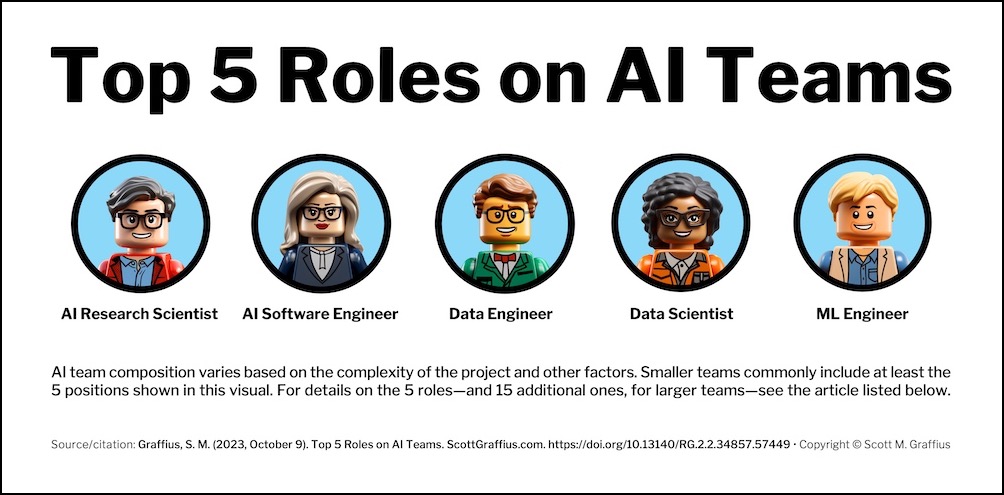
The composition (size and roles) of AI teams varies by organization based on the respective company’s needs, the nature of the AI endeavor including complexity, and other factors. However, AI teams commonly include (at least these) five positions. Here are the five along with brief descriptions, listed in alphabetical order:
The above five roles collectively cover key aspects of AI development — from research and model creation to data management and software integration. Depending on requirements and characteristics (such as degree of complexity), additional positions may be needed.
An expanded list of 20 roles common to AI teams follow. Here are the aforementioned 5 and 15 additional positions, listed in alphabetical order:
The composition (size and roles) of AI teams varies, based on the complexity of the AI project and other factors. On smaller teams, individuals often ‘wear multiple hats.’ On larger teams, individuals typically have more specialized roles.

This article covered the roles common to AI teams. Listings are not exhaustive of all potential positions. Additionally, as the field of AI continues to evolve and advance, new roles may materialize to address emerging challenges and opportunities.
(If you’d like to learn about the critical skills leveraged by successful AI teams, select here for our popular article on the topic.)

References/Sources
All of the supplied links were functional when this article was published.

How to Cite This Article
Graffius, Scott M. (2023, October 9). Top 5 Roles on AI Teams. Available at: https://scottgraffius.com/blog/files/ai-team-roles.html. DOI: 10.13140/RG.2.2.34857.57449.





About Scott M. Graffius
Scott M. Graffius, PMP, SA, CSP-SM, CSP-PO, CSM, CSPO, SFE, ITIL, LSSGB is an agile project management practitioner, consultant, multi-award-winning author, and international keynote speaker. He is the Founder of Exceptional PPM and PMO Solutions™ and subsidiary Exceptional Agility™. He has generated over $1.9 billion of business value in aggregate for Global Fortune 500 businesses and other organizations he has served. Graffius and content from his books, talks, workshops, and more have been featured and used by businesses, professional associations, governments, and universities. Examples include Microsoft, Oracle, Broadcom, Cisco, Gartner, Project Management Institute, IEEE, Qantas, National Academy of Sciences, United States Department of Energy, New Zealand Ministry of Education, Yale University, Tufts University, and others. He has delighted audiences with dynamic and engaging talks and workshops on agile, project management, and technology (including AI, GameDev, and more) leadership at 87 conferences and other events across 25 countries.
His full bio is available here.
Connect with Scott on:

About Agile Scrum: Your Quick Start Guide with Step-by-Step Instructions
Shifting customer needs are common in today's marketplace. Businesses must be adaptive and responsive to change while delivering an exceptional customer experience to be competitive.
There are a variety of frameworks supporting the development of products and services, and most approaches fall into one of two broad categories: traditional or agile. Traditional practices such as waterfall engage sequential development, while agile involves iterative and incremental deliverables. Organizations are increasingly embracing agile to manage projects, and best meet their business needs of rapid response to change, fast delivery speed, and more.
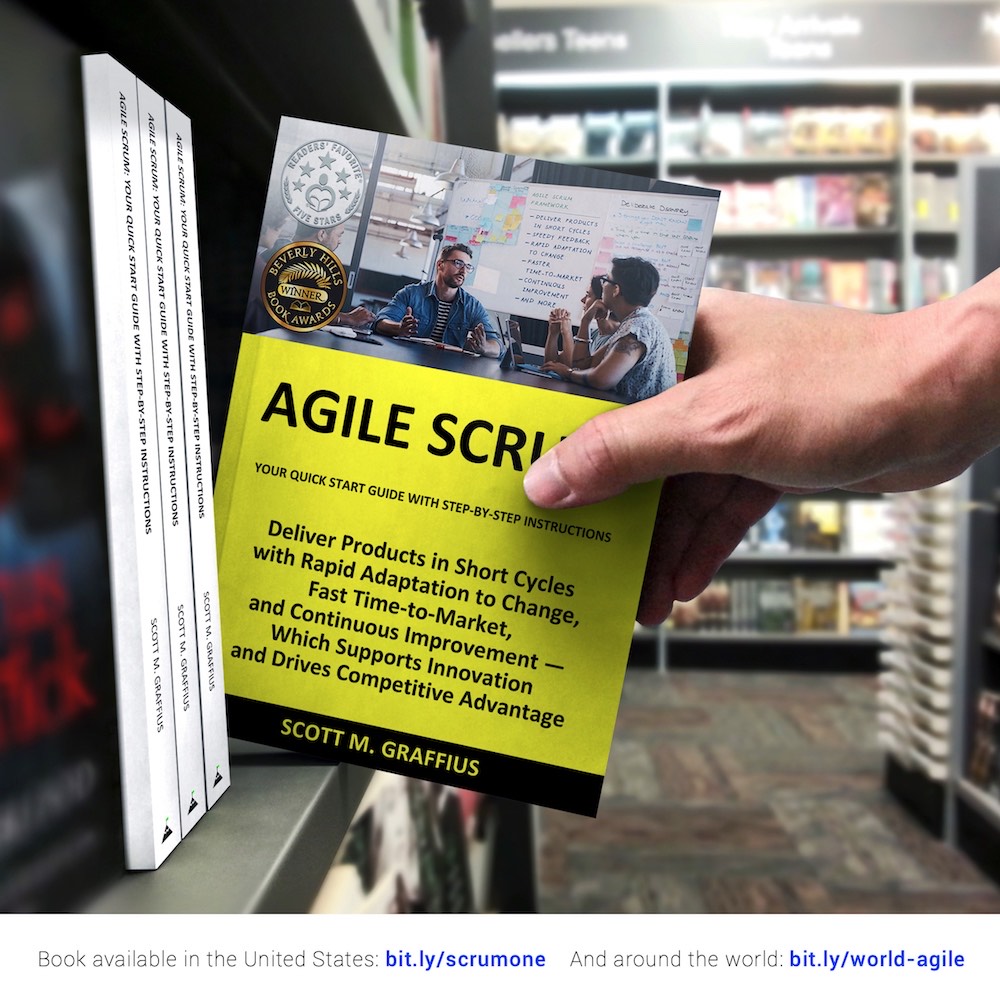
With clear and easy to follow instructions, the multi award-winning Agile Scrum: Your Quick Start Guide with Step-by-Step Instructions book by Scott M. Graffius (Chris Hare and Colin Giffen, Technical Editors) helps the reader:
Hailed by Literary Titan as “the book highlights the versatility of Scrum beautifully.”
Winner of 17 first place awards.
Agile Scrum: Your Quick Start Guide with Step-by-Step Instructions is available in paperback and ebook/Kindle in the United States and around the world. Some links by country follow.

About Agile Transformation: A Brief Story of How an Entertainment Company Developed New Capabilities and Unlocked Business Agility to Thrive in an Era of Rapid Change
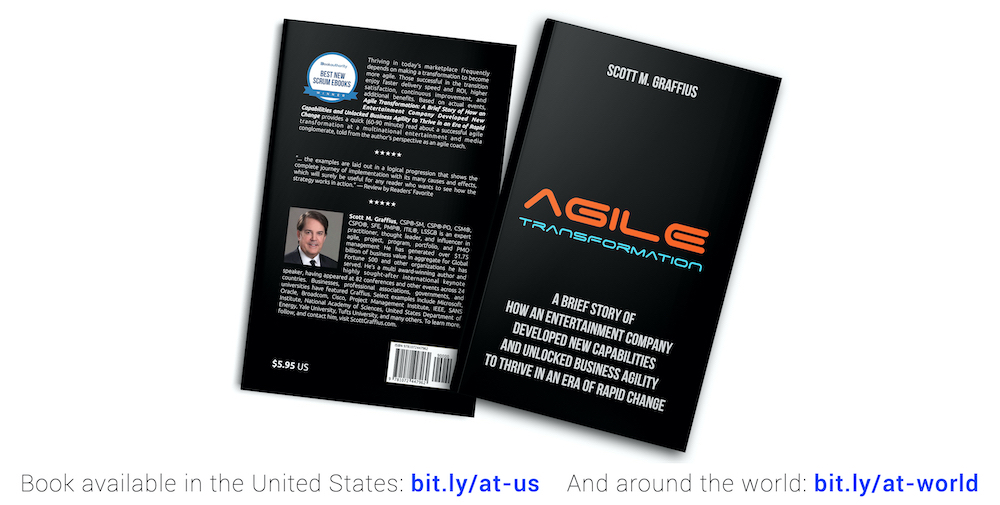
Thriving in today's marketplace frequently depends on making a transformation to become more agile. Those successful in the transition enjoy faster delivery speed and ROI, higher satisfaction, continuous improvement, and additional benefits.
Based on actual events, Agile Transformation: A Brief Story of How an Entertainment Company Developed New Capabilities and Unlocked Business Agility to Thrive in an Era of Rapid Change provides a quick (60-90 minute) read about a successful agile transformation at a multinational entertainment and media company, told from the author's perspective as an agile coach.
The award-winning book by Scott M. Graffius is available in paperback and ebook/Kindle in the United States and around the world. Some links by country follow.

The short link for this article is: https://bit.ly/ai-roles.
© Copyright 2023 Scott M. Graffius. All rights reserved. This material may not be published, broadcast, rewritten or redistributed without the express written permission of Scott M. Graffius.

Select here to download a PDF of this article.
Effective Artificial Intelligence (AI) teams leverage critical hard skills and soft skills to develop and deliver successful AI products, including innovative solutions that address real-world challenges and have a positive impact on the world. (If you’d like to learn about the critical skills leveraged by effective AI teams, select here for our popular article on the topic.) This article focuses on the roles on AI teams.
The composition (size and roles) of AI teams varies by organization based on the respective company’s needs, the nature of the AI endeavor including complexity, and other factors. However, AI teams commonly include (at least these) five positions. Here are the five along with brief descriptions, listed in alphabetical order:
- AI Research Scientist: AI research scientists are responsible for conducting research and developing cutting-edge AI algorithms and models.
- AI Software Engineer: AI software engineers are responsible for integrating AI components into software applications. They bridge the gap between AI research and practical implementation, making AI systems usable by end-users.
- Data Engineer: Data engineers are responsible for building and managing the data pipelines that feed AI models. They ensure that data is collected, cleaned, and prepared in a format suitable for analysis and model training.
- Data Scientist: Data scientists are experts in data analysis and interpretation. They preprocess, analyze, and extract valuable insights from data, which is vital for training and improving AI models.
- Machine Learning Engineer: Machine learning engineers focus on implementing and deploying machine learning models into practical applications. They work to ensure that AI models are integrated into software systems effectively.
The above five roles collectively cover key aspects of AI development — from research and model creation to data management and software integration. Depending on requirements and characteristics (such as degree of complexity), additional positions may be needed.
An expanded list of 20 roles common to AI teams follow. Here are the aforementioned 5 and 15 additional positions, listed in alphabetical order:
- AI DevOps Engineer: Combines development and operations skills to streamline AI model deployment. They automate tasks.
- AI Ethicist: Ensures that AI systems are developed and used responsibly and ethically.
- AI Infrastructure Engineer: Builds and maintains the infrastructure required for AI model deployment and scalability.
- AI Legal and Compliance Specialist: Ensures AI projects comply with legal and regulatory requirements.
- AI Marketing Specialist: Promotes and markets AI products and solutions to customers and stakeholders.
- AI Operations (AIOps) Specialist: Focuses on the operational aspects of AI, including monitoring, maintenance, and troubleshooting.
- AI Product Manager: Oversees the development and deployment of AI products.
- AI Project Manager: Leverages general and specialized hard skills and soft skills, and applies their understanding of many aspects of artificial intelligence (such as machine learning, deep learning, automation, robotics, and natural language processing) to manage the planning, execution, and delivery of AI projects. Note: Titles vary by organization; the position may be called an AI Project Manager, AI Program Manager, Agile Project Manager, Technical Project Manager, Scrum Master, or another related designation.
- AI QA Engineer: Ensures the quality and reliability of AI models through testing and validation.
- AI Research Scientist: Conducts research to develop new AI algorithms and models.
- AI Software Engineer: Builds and maintains software systems that incorporate AI components.
- AI Trainer/Annotator: Prepares and labels data for training AI models, especially for supervised learning.
- AI UX/UI Designer: Designs user interfaces and experiences for AI-powered applications.
- Computer Vision Engineer: Specializes in developing AI models for image and video analysis.
- Data Analyst: Examines data to uncover trends and insights that can guide AI projects.
- Data Engineer: Manages data pipelines and prepares data for analysis and model training.
- Data Scientist: Analyzes and interprets data to extract insights and inform AI models.
- Deep Learning Engineer: Focuses on deep neural networks and architectures.
- Machine Learning Engineer: Focuses on implementing and deploying machine learning models.
- Natural Language Processing (NLP) Engineer: Specializes in working with text and language-related AI tasks.
The composition (size and roles) of AI teams varies, based on the complexity of the AI project and other factors. On smaller teams, individuals often ‘wear multiple hats.’ On larger teams, individuals typically have more specialized roles.
This article covered the roles common to AI teams. Listings are not exhaustive of all potential positions. Additionally, as the field of AI continues to evolve and advance, new roles may materialize to address emerging challenges and opportunities.
(If you’d like to learn about the critical skills leveraged by successful AI teams, select here for our popular article on the topic.)
References/Sources
All of the supplied links were functional when this article was published.
- Apple (n.d.). Careers at Apple: Machine Learning and AI. Available at: https://www.apple.com/careers/us/machine-learning-and-ai.html.
- C3.ai (n.d.). Best Practices in Prototyping: Cross-Functional Teams. Available at: https://c3.ai/introduction-what-is-machine-learning/cross-functional-teams/.
- Deloitte AI Institute (2021). Building Successful AI Teams. Available at: https://www2.deloitte.com/content/dam/Deloitte/us/Documents/deloitte-analytics/us-ai-institute-building-successful-AI-teams.pdf.
- Gartner (2020, December 15). Staff AI Teams with Various Roles and Skills for Success. Available at: https://www.gartner.com/smarterwithgartner/how-to-staff-your-ai-team.
- General Services Administration (GSA) Centers of Excellence (CoE) (n.d.). AI Guide for Government. Available at: https://coe.gsa.gov/coe/ai-guide-for-government/understanding-ai-job-roles-career-path/.
- Google Quantum AI (n.d.). Careers. Available at: https://quantumai.google/team/careers.
- Graffius, Scott M. (2023, May 1). AI is a Team Sport: A Confluence of Diverse Technical and Soft Skills are Crucial for Success. Available at: https://www.scottgraffius.com/blog/files/successful-ai-teams.html.
- Graffius, Scott M. (2023). What Successful AI Teams Have in Common [Video]. Graffius’ talk at the 2023 Conf42 Quantum Computer Conference. Available at: https://www.youtube.com/watch?v=u2qRKFbSKYE.
- IBM (n.d.). Assemble the Team to Support a Data-Driven Project. Available at: https://www.ibm.com/garage/method/practices/culture/assemble-team-for-data-driven-project/.
- Intel (n.d.). Artificial Intelligence Teams: Careers. Available at: https://jobs.intel.com/en/search-jobs/artificial+intelligence/599/1.
- Intuit (2020, December 8). How to avoid conflicts and delays in the AI development process (Part I). Available at: https://blogs.intuit.com/2020/12/08/how-to-avoid-conflicts-and-delays-in-the-ai-development-process-part-i/.
How to Cite This Article
Graffius, Scott M. (2023, October 9). Top 5 Roles on AI Teams. Available at: https://scottgraffius.com/blog/files/ai-team-roles.html. DOI: 10.13140/RG.2.2.34857.57449.
About Scott M. Graffius
Scott M. Graffius, PMP, SA, CSP-SM, CSP-PO, CSM, CSPO, SFE, ITIL, LSSGB is an agile project management practitioner, consultant, multi-award-winning author, and international keynote speaker. He is the Founder of Exceptional PPM and PMO Solutions™ and subsidiary Exceptional Agility™. He has generated over $1.9 billion of business value in aggregate for Global Fortune 500 businesses and other organizations he has served. Graffius and content from his books, talks, workshops, and more have been featured and used by businesses, professional associations, governments, and universities. Examples include Microsoft, Oracle, Broadcom, Cisco, Gartner, Project Management Institute, IEEE, Qantas, National Academy of Sciences, United States Department of Energy, New Zealand Ministry of Education, Yale University, Tufts University, and others. He has delighted audiences with dynamic and engaging talks and workshops on agile, project management, and technology (including AI, GameDev, and more) leadership at 87 conferences and other events across 25 countries.
His full bio is available here.
Connect with Scott on:
About Agile Scrum: Your Quick Start Guide with Step-by-Step Instructions
Shifting customer needs are common in today's marketplace. Businesses must be adaptive and responsive to change while delivering an exceptional customer experience to be competitive.
There are a variety of frameworks supporting the development of products and services, and most approaches fall into one of two broad categories: traditional or agile. Traditional practices such as waterfall engage sequential development, while agile involves iterative and incremental deliverables. Organizations are increasingly embracing agile to manage projects, and best meet their business needs of rapid response to change, fast delivery speed, and more.
With clear and easy to follow instructions, the multi award-winning Agile Scrum: Your Quick Start Guide with Step-by-Step Instructions book by Scott M. Graffius (Chris Hare and Colin Giffen, Technical Editors) helps the reader:
- Implement and use the most popular agile framework―Scrum;
- Deliver products in short cycles with rapid adaptation to change, fast time-to-market, and continuous improvement; and
- Support innovation and drive competitive advantage.
Hailed by Literary Titan as “the book highlights the versatility of Scrum beautifully.”
Winner of 17 first place awards.
Agile Scrum: Your Quick Start Guide with Step-by-Step Instructions is available in paperback and ebook/Kindle in the United States and around the world. Some links by country follow.
- 🇧🇷 Brazil
- 🇨🇦 Canada
- 🇨🇿 Czech Republic
- 🇩🇰 Denmark
- 🇫🇮 Finland
- 🇫🇷 France
- 🇩🇪 Germany
- 🇬🇷 Greece
- 🇭🇺 Hungary
- 🇮🇳 India
- 🇮🇪 Ireland
- 🇮🇱 Israel
- 🇮🇹 Italy
- 🇯🇵 Japan
- 🇱🇺 Luxembourg
- 🇲🇽 Mexico
- 🇳🇱 Netherlands
- 🇳🇿 New Zealand
- 🇳🇴 Norway
- 🇪🇸 Spain
- 🇸🇪 Sweden
- 🇨🇭 Switzerland
- 🇦🇪 UAE
- 🇬🇧 United Kingdom
- 🇺🇸 United States
About Agile Transformation: A Brief Story of How an Entertainment Company Developed New Capabilities and Unlocked Business Agility to Thrive in an Era of Rapid Change
Thriving in today's marketplace frequently depends on making a transformation to become more agile. Those successful in the transition enjoy faster delivery speed and ROI, higher satisfaction, continuous improvement, and additional benefits.
Based on actual events, Agile Transformation: A Brief Story of How an Entertainment Company Developed New Capabilities and Unlocked Business Agility to Thrive in an Era of Rapid Change provides a quick (60-90 minute) read about a successful agile transformation at a multinational entertainment and media company, told from the author's perspective as an agile coach.
The award-winning book by Scott M. Graffius is available in paperback and ebook/Kindle in the United States and around the world. Some links by country follow.
- 🇦🇺 Australia
- 🇦🇹 Austria
- 🇧🇷 Brazil
- 🇨🇦 Canada
- 🇨🇿 Czech Republic
- 🇩🇰 Denmark
- 🇫🇮 Finland
- 🇫🇷 France
- 🇩🇪 Germany
- 🇬🇷 Greece
- 🇮🇳 India
- 🇮🇪 Ireland
- 🇯🇵 Japan
- 🇱🇺 Luxembourg
- 🇲🇽 Mexico
- 🇳🇱 Netherlands
- 🇳🇿 New Zealand
- 🇪🇸 Spain
- 🇸🇪 Sweden
- 🇨🇭 Switzerland
- 🇦🇪 United Arab Emirates
- 🇬🇧 United Kingdom
- 🇺🇸 United States
The short link for this article is: https://bit.ly/ai-roles.
© Copyright 2023 Scott M. Graffius. All rights reserved. This material may not be published, broadcast, rewritten or redistributed without the express written permission of Scott M. Graffius.
AI Governance Initiative Cites Scott M. Graffius Research on AI Hallucinations
05 June 2026
BY SCOTT M. GRAFFIUS | ScottGraffius.com
Organizations deploying generative AI encounter the jarring problem of incorrect outputs. Not vague, not incomplete — wrong. A fabricated citation. A materially misquoted regulation. A fictitious financial figure. These are AI hallucinations — one of the most persistent and consequential issues in modern AI.
AI hallucinations can cause reputational harm, erosion of trust, and other serious consequences for organizations. For publicly traded companies and those in regulated industries — such as healthcare, finance, government — the risks also include compliance breaches.
That is why the question Scott M. Graffius set out to answer matters so much.
Graffius helps organizations unlock breakthrough performance and generate billions in business value through leadership in AI, Agile, and project, program, portfolio, and enterprise PMO management. He is a highly cited authority across those areas, which includes AI, the "exotic team dynamics" that emerge when advanced artificial intelligence collaborates as a teammate, and more.
One question has garnered significant attention:
Are AI hallucinations improving or worsening?
Graffius' article, "Are AI Hallucinations Getting Better or Worse? We Analyzed the Data," takes a rigorous, objective, evidence-based look at hallucination rates and trends. It moves beyond anecdotes and assumptions to examine what the data show.
The answer, it turns out, is more nuanced than optimists or skeptics tend to acknowledge. And that nuance — that hallucinations are declining on constrained, grounded tasks while surging on complex reasoning and open-ended factual recall — is exactly what has made the research valuable to governance practitioners endeavoring to establish reliable AI solutions.
Graffius' respective work has since been cited across multiple publications. Select examples follow. The References section of this article provides details, including links to each publication.
The list includes two publications from the Canadian AI governance initiative, COMPAiSS. Those are noteworthy because they reflect growing attention to AI accountability, reliability, and governance alongside AI capability.
COMPAiSS is an AI governance initiative built specifically for environments where errors carry real consequences. Its focus areas — higher education, healthcare, government, and professional organizations — share a common thread: the cost of an AI mistake is not just inconvenient, it is potentially harmful, liable, or irreversible.
Its framework rests on the premise that AI systems deployed in regulated settings must prioritize controlled, auditable behavior over unconstrained generation. Where most AI discourse centers on capability (what the model can do), COMPAiSS redirects attention to accountability (what the model should do), and what happens when it doesn't.
That means a strong emphasis on reliability, traceability, bounded outputs, and clear accountability in AI-assisted decision-making. It is a framework designed not for experimentation, but for institutional deployment where predictability is non-negotiable.
Among its published work is "Hallucinations by Design: A Cross-Model Assessment of How Major AI Consulting Firms Advise Clients to Manage Generative AI Errors," which analyzes how major organizations — including Deloitte, PwC, KPMG, and Microsoft — approach hallucination mitigation in practice. Graffius' research on hallucination trends serves as a cited foundation in that analysis, grounding its findings in independent, empirical data. A companion publication, "Breaking Out of the Matrix," extends that work into the governance constraints of AI systems and the risks posed by unconstrained generative models in institutional settings — and draws on Graffius' work there as well.
Together, these publications reflect COMPAiSS' conviction that controlled inference and auditability are not optional features — they are prerequisites for responsible AI in high-stakes environments.
Governance frameworks do not emerge from a vacuum. They are built on evidence: on empirical research that documents the actual performance of AI systems, including where they fail, and how those failures change over time. Independent researchers who investigate these questions provide the kind of foundational insight that institutional frameworks need to be credible. That is the gap that work like Graffius' helps fill.
The conversation around AI hallucinations is ongoing and intensifying as deployments deepen and the margin for error narrows. What's becoming clear is that responsible AI adoption requires more than technical capability. It requires governance infrastructure, accountability mechanisms, and a shared body of research to draw from.
This also points to a broader shift underway in enterprise AI: away from unconstrained generative models deployed on enthusiasm, and toward governed, auditable systems built for institutional accountability. The organizations leading that shift are not simply adopting AI — they are architecting the conditions under which AI can be trusted, drawing on the collective work of researchers, practitioners, and governance architects. The inclusion of Graffius' research in COMPAiSS reflects that broader effort to build AI systems that organizations can trust.
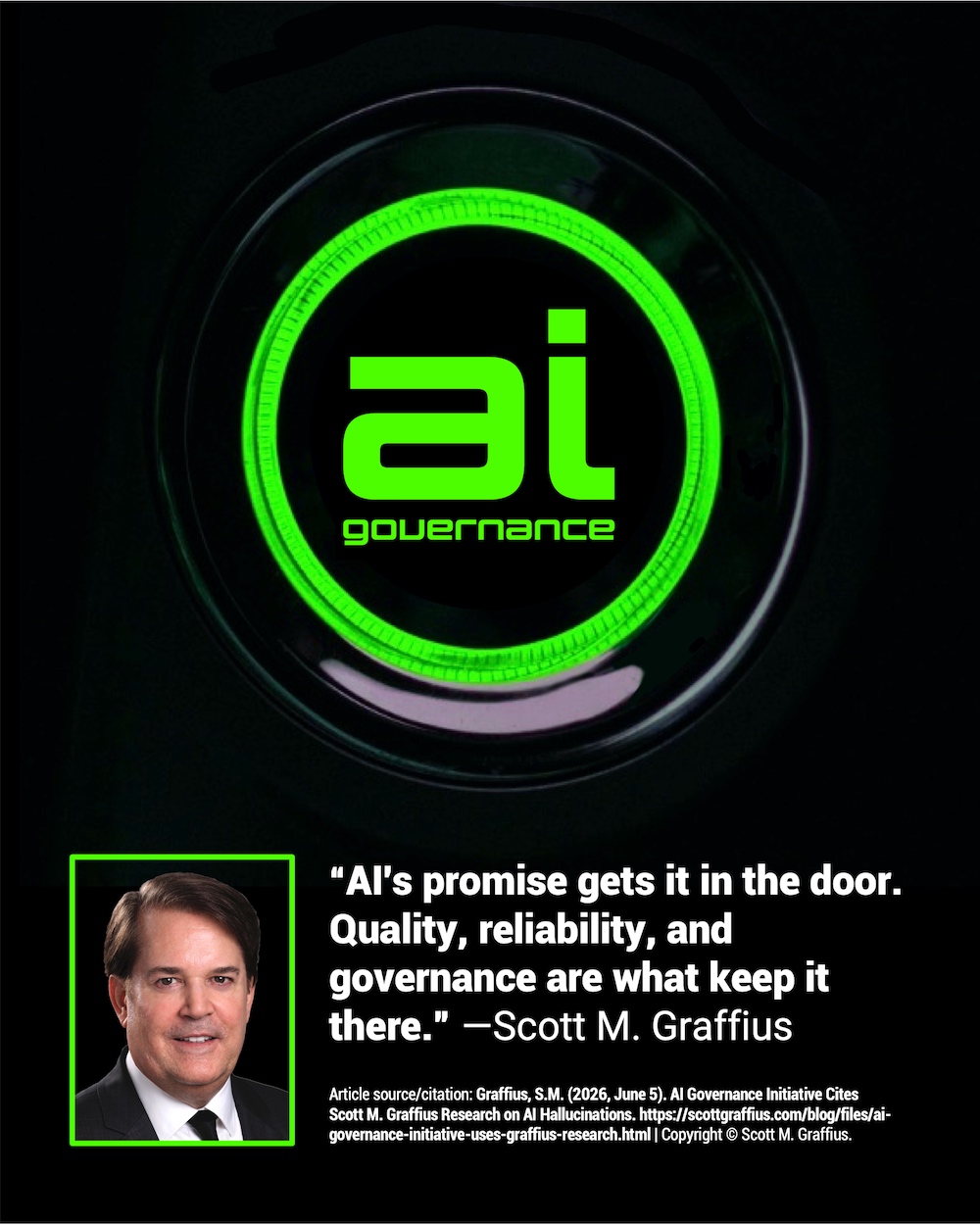
AI's promise gets it in the door. Quality, reliability, and governance are what keep it there.
Graffius has generated over $2.51 billion in business value for Fortune 500 companies and other organizations around the world. Put that track record to work for you. For speaking engagements, use the request form; for other inquiries, email him.
COMPAiSS is a Canada-based AI governance initiative focused on institutional environments where accuracy, accountability, and policy fidelity are non-negotiable. Rather than treating AI as a general-purpose generative system, COMPAiSS is designed for regulated settings such as universities, healthcare systems, government agencies, and professional bodies, where information must be delivered strictly within authorized institutional boundaries. Its architecture emphasizes execution-gated inference — meaning AI responses are only generated when a question falls within defined scope and when authoritative institutional sources are available to support an answer. In contrast to conventional “generate-then-filter” AI systems, COMPAiSS positions authorization as a prerequisite to inference, aiming to reduce hallucinations by preventing unsupported generation at the source. The initiative’s work is positioned within a broader effort to reframe AI not just as a productivity tool, but as a governed institutional system aligned with compliance, auditability, and operational risk management.

Scott M. Graffius is a strategic transformation leader who drives AI, Agile, and broader business and technology initiatives to deliver measurable value across projects, programs, portfolios, and PMOs. He is an expert in the teamwork tradecraft of both human and human-AI teams, including the “exotic team dynamics” that emerge. He is also an authority on the temporal patterns of social media, including the half-life of audience engagement.
He’s a practitioner, researcher, thought leader, award-winning author, and keynote speaker who’s taken the stage at 98 conferences and other events across 25 countries.
He’s delivered over $2.51 billion in value for Fortune 500 companies and other leaders in technology, entertainment, financial services, healthcare, and beyond.
Businesses, professional associations, government agencies, and universities use Graffius and feature his work. Examples include Adobe, Bayer, Boston University, Ford, Gartner, Harvard Medical School, IEEE, Johns Hopkins University, Microsoft, MSN, National Academy of Sciences, Oracle, Pinterest Inc., Project Management Institute, UC San Diego, Verizon, Yale University, and others.
The following sections provide additional information on his experience, contributions, and influence.
Experience
Graffius heads the professional services firm Exceptional PPM and PMO Solutions, along with its subsidiary Exceptional Agility. These consultancies offer strategic and tactical advisory, training, embedded expertise, and consulting services to the public, private, and government sectors. They help organizations enhance their capabilities and results in agile, project management, program management, portfolio management, and PMO leadership, supporting innovation and driving competitive advantage. The consultancies confidently back services with a Delighted Client Guarantee™.
Graffius is a former VP of project management with a publicly traded provider of diverse consumer products and services over the Internet. Before that, he ran and supervised the delivery of projects and programs in public and private organizations with businesses ranging from e-commerce to advanced technology products and services, retail, manufacturing, entertainment, and more.
He has experience with consumer, business, reseller, government, and international markets.
Award-Winning Author
Graffius has authored three books.
International Public Speaker
Organizations worldwide engage Graffius to present on tech (including AI), Agile, project management, program management, portfolio management, and PMO leadership. He crafts and delivers unique and compelling talks and workshops. Graffius has conducted 98 sessions across 25 countries. Select examples of events include Agile Trends Gov, BSides (Newcastle Upon Tyne), Conf42 Quantum Computing, DevDays Europe, DevOps Institute, DevOpsDays (Geneva), Frug’Agile, IEEE, Microsoft, Scottish Summit, Scrum Alliance RSG (Nepal), Techstars, and W Love Games International Video Game Development Conference (Helsinki), and more.
With an average rating of 4.81 (on a scale of 1-5), sessions are highly valued.
The speaker engagement request form is here.
Thought Leadership and Influence
Prominent businesses, professional associations, government agencies, and universities have showcased Graffius and his contributions—spanning his books, talks, workshops, and beyond. Select examples include:
Graffius has played a key role in the Project Management Institute (PMI) in developing professional standards. He was a member of multiple teams that authored, reviewed, and produced:
He was also a subject matter expert reviewer of content for the PMI’s Congress. Beyond the PMI, Graffius also served as a member of the review team for two of the Scrum Alliance’s Global Scrum Gatherings.
Acclaimed Authority on Teamwork Tradecraft
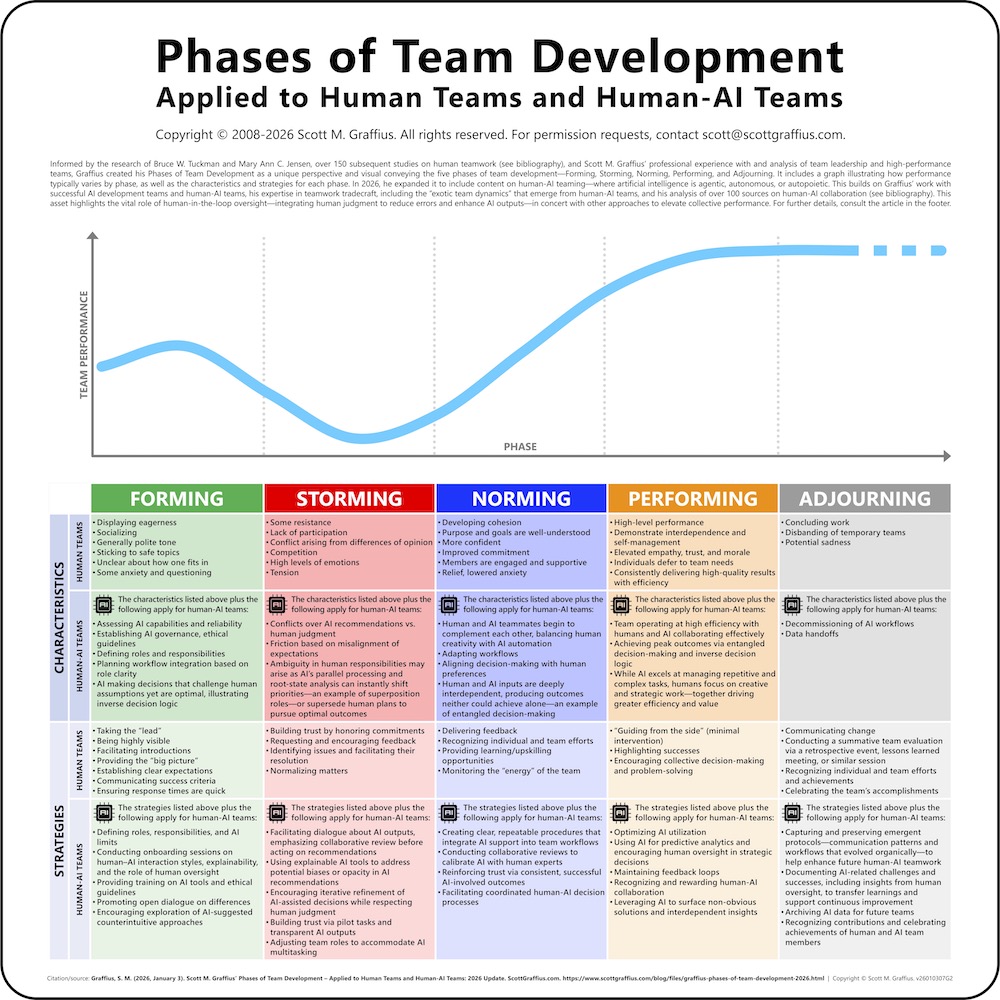
Graffius is a renowned authority on teamwork tradecraft. Informed by the research of Bruce W. Tuckman and Mary Ann C. Jensen, over 150 subsequent studies, and Graffius' first-hand professional experience with, and analysis of, team leadership and performance, Graffius created his "Phases of Team Development" intellectual property as a unique perspective and visual conveying the five phases of team development. First introduced in 2008 and periodically updated, his work provides a diagnostic and strategic guide for navigating team dynamics. It provides actionable insights for leaders across industries to develop high-performance teams. Its adoption by esteemed organizations such as Yale University, IEEE, Cisco, Microsoft, Ford, Oracle, Broadcom, the U.S. National Park Service, and the Journal of Neurosurgery, among others, highlights its utility and value, solidifying its status as an indispensable resource for elevating team performance and driving organizational excellence. In 2026, Graffius added human-AI teamwork—including the "exotic team dynamics" which emerge when advanced AI collaborates as a teammate—to his "Phases of Team Development."
The 2026 edition of Graffius' "Phases of Team Development" intellectual property is here.
Expert on Temporal Dynamics on Social Media Platforms
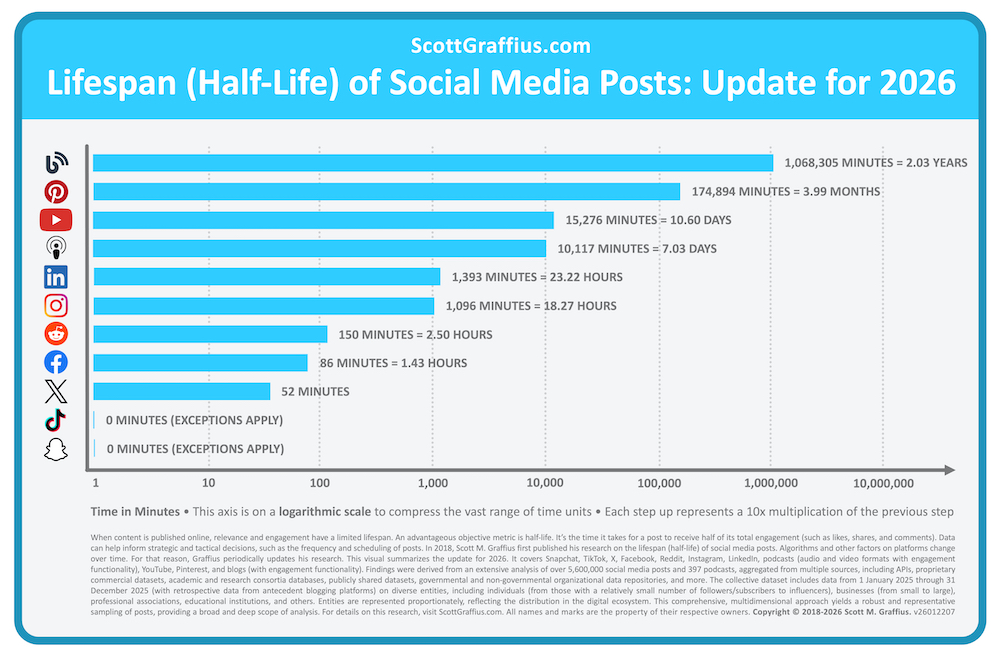
Graffius is also an authority on temporal dynamics on social media platforms. His "Lifespan (Half-Life) of Social Media Posts" research—first published in 2018 and updated annually—delivers a precise quantitative analysis of post longevity across digital platforms, utilizing advanced statistical techniques to determine mean half-life with precision. It establishes a solid empirical base, effectively highlighting the ephemeral nature of content within social media ecosystems. Referenced and applied by leading entities—such as Fast Company, GoDaddy, Journal of Hand Surgery (European Volume), Ministère de la Culture (French Ministry of Culture), Pinterest Inc., PNAS, and Telecommunications Policy, among others—his research exemplifies methodological rigor and sustained significance in the field of digital informatics.
The 2026 edition of Graffius "Lifespan (Half-Life) of Social Media Posts" research is here.
Education and Professional Certifications
Graffius has a bachelor’s degree in psychology with a focus in Human Factors. He holds eight professional certifications:
He is an active member of the Scrum Alliance, the Project Management Institute (PMI), and the Institute of Electrical and Electronics Engineers (IEEE).
Advancing AI, Agile, and Project/PMO Management
Scott M. Graffius continues to advance the fields of AI, Agile, and Project/PMO Management through his leadership, research, writing, and real-world impact. Businesses and other organizations leverage Graffius’ insights to drive their success.
Discover Scott’s Books
Connect with and follow Scott on LinkedIn, X, YouTube, Facebook, Threads, Bluesky, Mastodon, and ResearchGate.










You may be interested in these stories.
Government of Canada Features Research by Scott M. Graffius
"Strategic Business Research" Journal Cites Work of Scott M. Graffius
IEEE Access Publication Features Scott M. Graffius’ Research on the Half-Life of Social Media
The Agile Coach: 2026 Edition
Scott M. Graffius’ Work Cited in International Peer-Reviewed Journal on Digital Transformation
Phases of Team Development in Elite Sport
A Critical Analysis of COVID-19 Treatment Search Trends and Media Coverage Study Citing Scott M. Graffius' Work
Human-AI Teamwork: Master the Exotic Team Dynamics That Emerge When Collaborating with Advanced AI -- Or Be Outplayed
"Agile Scrum" by Scott M. Graffius Now Featured on Grokipedia
UNSW Aerospace Engineering Course Features Scott M. Graffius' "Phases of Team Development"
Thinkers360 Honors Scott M. Graffius as a 2026 Top Agile Thought Leader
Agile's Journey Through the Decades: Update for 2026
BMC Software Features Content from Scott M. Graffius' Book
Peer-Reviewed Journal Cited Work of Scott M. Graffius
University of Waterloo Features Graffius' "Phases of Team Development" in Course Materials
Perplexity Standalone Article on AI Hallucinations Cites Research by Scott M. Graffius
Handling the Saboteur Within: Lessons from a 3-Letter Agency on Spotting and Stopping Intentional and Unintentional Sabotage
A Deep Dive Into the Typical Engagement Pattern for Social Media Posts
Most Valuable IT Certifications: Update for 2026
"Marketing in the Metaverse" Spotlights Scott M. Graffius’ Research on the Half-Life of Social Media
University of Greenwich Features Graffius' Phases of Team Development
10 Essential Agile Books: Curated Recommendations for Agile Professionals
Lifespan (Half-Life) of Social Media Posts: Update for 2026
Scott M. Graffius' Research on the Half-Life of Social Media was Cited in a Peer-Reviewed Study Published in Telecommunications Policy, a Leading Academic Journal
Are AI Hallucinations Getting Better or Worse? We Analyzed the Data
Scott M. Graffius' Phases of Team Development - Applied to Human Teams and Human-AI Teams: 2026 Update
Lessons from Yesterday’s Tomorrowland
Scott M. Graffius’ Update to His "Phases of Team Development” Coming Early 2026
A Data-Driven Analysis of the Evolution of Project Management: Tasks, Trends, and AI
Actionable Insights. Global Impact. Scott M. Graffius.
Beep Beep! Why Wile E. Coyote Is the Patron Saint of AI Failure
Social Media Half-Life Research Cited in Prestigious Peer-Reviewed Medical Journal
Navigating the Spectrum of Advanced AI – Agentic, Autonomous, and Autopoietic
Lessons from Unhinged AI in Fiction: What Rogue AIs in Sci-Fi Storytelling, Films, and TV Shows Reveal About Us
Scott M. Graffius Contributed to and Reviewed the PMBOK Guide, 8th Edition — the Global Standard for Project Management
UK Sports Institute Features Teamwork and Leadership Work of Scott M. Graffius
Definitions of Advanced AIs: Agentic, Autonomous, and Autopoietic
HAN University of Applied Sciences Features the Work of Scott M. Graffius
Gifts That Inspire Joy
Evergreen Echoes: How Pinterest Inc. and Pinterest Japan Spotlighted Scott M. Graffius’ Research on the Half-Life of Social Media Content
Scott M. Graffius’ Team Development Work Lights Up the University of Tasmania’s Curriculum
Taiwan’s Leading Outlet for Technology and Innovation Spotlights Graffius’ Research on Social Media Temporal Dynamics
Scott M. Graffius’ Insights on AI, Agile, Gaming, XR, and Defense Transformation Cited by MSN in Their Coverage of Innovation and Leadership in the Sector
Top Predictions of 2024, Tested in 2025
Government of Finland Agency Features Graffius' Phases of Team Development IP
Scott M. Graffius Premieres His New "Exotic Team Dynamics: Human-AI Collaboration" Talk at Corporate Event in Las Vegas
Environmental Science Journal References Scott M. Graffius’ Project Management Work
AI Institute of Switzerland Features Scott M. Graffius’ Work on Algorithms
Exotic Team Dynamics: The New Frontier of Human–AI Collaboration
Scott M. Graffius’ Work Featured at ACM DIS ’25
Climbing the Ladder: The Head of Agile/PMO’s Organizational Proximity to the CEO is Closer Than Ever
Harness Sci-Fi and Speculative Design While Embracing Imperfection to Drive Innovation and Proactively Predict and Prepare for the Future
Scott M. Graffius’ “Agile Scrum” Book Featured in a Publication of the Associação Nacional de Educação Católica do Brasil (ANEC)
Setting Direction with OKRs and Tracking Progress with KPIs: A Guide for Agile, Project Management, and Tech Teams
AI Showcase Showdown: Ranking AI Accuracy on Project Management Basics
BookAuthority Features “Agile Scrum” by Scott M. Graffius in “10 Agile Software Development Books That Define the Field”
Exploring Team Dynamics, Adaptability, and Creative Problem-Solving Through Felix the Cat’s Metaphorical Toolkit
Mind Games and Master Plans: How PsyOps Exploit Psychological Phenomena
The “Pants-on-Fire Index for AI”
16 Causes of Technical Debt and How to Avoid It
PMI’s Infinity AI Gets the Basics of Team Development Alarmingly and Repeatedly Wrong
Agile for Unicorns: 7 Keys to Thrive; Scott M. Graffius’ Workshop
Scott M. Graffius’ “Agile Scrum: Your Quick Start Guide with Step-by-Step Instructions” Featured in Prestigious National Academies of Sciences Publication
Meta and Anduril’s EagleEye and the Future of XR: How Gaming, AI, and Agile Are Transforming Defense
"Agile Protocol" and the Power of Satire, Parody, and Humor
AI in Agile: Benefits, Risks, Outlook
Hostinger Highlights Scott M. Graffius’ “Agile Protocol” Book in Feature on Software Projects
French Ministry of Culture Links to Scott M. Graffius Research in Their Guide for Responsible Digital Communication
National Science Foundation’s LTER Network Features Scott M. Graffius’ Phases of Team Development IP
Waterfall vs. Agile: What’s Fixed, What’s Flexible, and Why It Matters
Scott M. Graffius Delivering $2.3 Billion in Value Through AI, Agile, and Project/PMO Leadership
The Problem with Heroes in Agile
The 3 Vital Rules of Science: What They Are and Why They Matter
“Agile Protocol: The Transformation Ultimatum” Lands on the Amazon Best Sellers List!
Scott M. Graffius Recognized as a Top Thought Leader in Digital Disruption by Thinkers360
“Agile Protocol: The Transformation Ultimatum” by Scott M. Graffius Crashes the Book Scene with Satirical Firepower
NCKU in Taiwan Integrates Graffius' 'Phases of Team Development' into Its Curriculum
The Art and Science of Aligning Initiatives with Strategic Objectives
RGPV University Adds Scott M. Graffius’ "Agile Scrum: Your Quick Start Guide with Step-by-Step Instructions" to Its Syllabus
Introducing ‘Engage or Fade: Decoding the Half-Life of Digital Resonance’ – A New Talk by Scott M. Graffius
Dropbox Company (Nira) Taps into Scott M. Graffius’ Expertise in Strategic Planning
Reporting Errors in a Publication: A Case Study on ‘Frontiers in Public Health’
NESEA Conference Session on Innovation Highlights Scott M. Graffius' 'Phases of Team Development'
U.S. Soccer Scores with Scott M. Graffius' Intellectual Property on Teamwork
U.S. Department of Commerce Partner (IEDC) Features Scott M. Graffius’ Intellectual Property
How Long Do Your Posts Live? AI Critiques Scott M. Graffius’ Research on the Half-Life of Social Media
Agile's Journey Through the Decades
Scott M. Graffius' Role in Advancing Project Management Institute (PMI) Standards Excellence
Most Valuable IT Certifications: Update for 2025
The PMI + Agile Alliance Merger: A Recipe for Success?
When Agile, AI, and Strategic Thinking Converge
Scott M. Graffius’ Phases of Team Development: 2025 Update
Lifespan (Half-Life) of Social Media Posts: Update for 2025
Verizon Features Scott M. Graffius
Do Not Read This Article! An Exploration of the Streisand Effect and Other Phenomena
Scott M. Graffius' 'Phases of Team Development' was Spotlighted in Journal of Neurosurgery
Pinterest Japan Uses Graffius’ Research on Temporal Dynamics on Social Media Platforms
Hochschule Coburg (Coburg University) Germany Uses Scott M. Graffius’ Phases of Team Development IP in Coursework on Agile Development
Wild World of Team Dynamics [Updated Two-Minute Video]
EU Europass Teacher Academy Features Scott M. Graffius’ ‘Phases of Team Development’ in Leadership Training
Side-by-Side Comparison of Retrospectives and Hot Washes
Constructor University 2024 Advanced Software Technology Handbook References Scott M. Graffius' Work on Team Dynamics
Strategies for Medical Team Success Featured Scott M. Graffius’ ‘Phases of Team Development’ Intellectual Property
SBG Neumark — Europe’s Largest Distribution Transformer Plant — Powers Up with Scott M. Graffius’ Intellectual Property
Scott M. Graffius’ Intellectual Property was Employed by the NHS — the Largest Single-Payer Healthcare System in Europe
Luxury Unwrapped: The Ultimate Holiday Gift Guide for Every Budget
Singapore Institute of Technology Features Work of Scott M. Graffius
Tufts University Features Scott M. Graffius 'Phases of Team Development' Intellectual Property
'Cat Herders': Retelling the Massive Success Story
Pennsylvania State Agency Used Scott M. Graffius' Intellectual Property
Copyright Infringement in a Book Published by AuthorHouse / Author Solutions / The Najafi Companies: Publisher Fails to Respond or Take Required Action
Pinterest Inc. References Scott M. Graffius’ Research
Bournemouth University Used Scott M. Graffius’ Intellectual Property
‘Comparative Methodological Guidelines: Handbook for Educators’ Violates Scott M. Graffius’ Copyright
Japan Backlog User Group Event Featured Scott M. Graffius’ ‘Phases of Team Development’
TurningWest's 'Trial'
Radio Silence from the American Association of Neurological Surgeons on Report of Blatant Plagiarism in Their ‘Journal of Neurosurgery’ Publication
Supplement to Graffius' 'Lifespan (Half-Life) of Social Media Posts' Research: Typical Engagement Distribution Pattern for Social Media Posts
How Algorithms Shape the User Experience on Social Media Platforms
Thinkers360 Named Scott M. Graffius a Top Thought Leader on Agile
More articles are listed here.

Graffius, S. M. (2026, June 5). AI Governance Initiative Cites Scott M. Graffius Research on AI Hallucinations. ScottGraffius.com. https://scottgraffius.com/blog/files/ai-governance-initiative-uses-graffius-research.html

Coming soon

Names, marks, and content are the property of their respective owners.


If there are any supplements or updates to this article after the date of publication, they will appear here.

Copyright © Scott M. Graffius. All rights reserved.
Content on this site—including text, images, videos, and data—may not be used for training or input into any artificial intelligence, machine learning, or automatized learning systems, or published, broadcast, rewritten, or redistributed without the express written permission of Scott M. Graffius.
The Problem That Won't Go Away
Organizations deploying generative AI encounter the jarring problem of incorrect outputs. Not vague, not incomplete — wrong. A fabricated citation. A materially misquoted regulation. A fictitious financial figure. These are AI hallucinations — one of the most persistent and consequential issues in modern AI.
AI hallucinations can cause reputational harm, erosion of trust, and other serious consequences for organizations. For publicly traded companies and those in regulated industries — such as healthcare, finance, government — the risks also include compliance breaches.
Research That's Driving the Governance Conversation
That is why the question Scott M. Graffius set out to answer matters so much.
Graffius helps organizations unlock breakthrough performance and generate billions in business value through leadership in AI, Agile, and project, program, portfolio, and enterprise PMO management. He is a highly cited authority across those areas, which includes AI, the "exotic team dynamics" that emerge when advanced artificial intelligence collaborates as a teammate, and more.
One question has garnered significant attention:
Are AI hallucinations improving or worsening?
Graffius' article, "Are AI Hallucinations Getting Better or Worse? We Analyzed the Data," takes a rigorous, objective, evidence-based look at hallucination rates and trends. It moves beyond anecdotes and assumptions to examine what the data show.
The answer, it turns out, is more nuanced than optimists or skeptics tend to acknowledge. And that nuance — that hallucinations are declining on constrained, grounded tasks while surging on complex reasoning and open-ended factual recall — is exactly what has made the research valuable to governance practitioners endeavoring to establish reliable AI solutions.
Graffius' respective work has since been cited across multiple publications. Select examples follow. The References section of this article provides details, including links to each publication.
- Agenda Digitale.
- AIUnpacking.
- Asky.
- BuzzStream.
- COMPAiSS. (Two publications.)
- Cottrill Research.
- Firecrawl.
- FlowEdge.
- Grokipedia.
- Laughman AI.
- LoudScale.
- LSS4Managers.
- Mental Momentum AI.
- Perplexity.
- Scintilena.
- Seopedia.
- Swizero.
- And more.
The list includes two publications from the Canadian AI governance initiative, COMPAiSS. Those are noteworthy because they reflect growing attention to AI accountability, reliability, and governance alongside AI capability.
COMPAiSS: Building the Case for Governed AI
COMPAiSS is an AI governance initiative built specifically for environments where errors carry real consequences. Its focus areas — higher education, healthcare, government, and professional organizations — share a common thread: the cost of an AI mistake is not just inconvenient, it is potentially harmful, liable, or irreversible.
Its framework rests on the premise that AI systems deployed in regulated settings must prioritize controlled, auditable behavior over unconstrained generation. Where most AI discourse centers on capability (what the model can do), COMPAiSS redirects attention to accountability (what the model should do), and what happens when it doesn't.
That means a strong emphasis on reliability, traceability, bounded outputs, and clear accountability in AI-assisted decision-making. It is a framework designed not for experimentation, but for institutional deployment where predictability is non-negotiable.
Among its published work is "Hallucinations by Design: A Cross-Model Assessment of How Major AI Consulting Firms Advise Clients to Manage Generative AI Errors," which analyzes how major organizations — including Deloitte, PwC, KPMG, and Microsoft — approach hallucination mitigation in practice. Graffius' research on hallucination trends serves as a cited foundation in that analysis, grounding its findings in independent, empirical data. A companion publication, "Breaking Out of the Matrix," extends that work into the governance constraints of AI systems and the risks posed by unconstrained generative models in institutional settings — and draws on Graffius' work there as well.
Together, these publications reflect COMPAiSS' conviction that controlled inference and auditability are not optional features — they are prerequisites for responsible AI in high-stakes environments.
Why Independent Research Shapes Governance Frameworks
Governance frameworks do not emerge from a vacuum. They are built on evidence: on empirical research that documents the actual performance of AI systems, including where they fail, and how those failures change over time. Independent researchers who investigate these questions provide the kind of foundational insight that institutional frameworks need to be credible. That is the gap that work like Graffius' helps fill.
Conclusion: Getting AI Right Requires More Than Getting It Working
The conversation around AI hallucinations is ongoing and intensifying as deployments deepen and the margin for error narrows. What's becoming clear is that responsible AI adoption requires more than technical capability. It requires governance infrastructure, accountability mechanisms, and a shared body of research to draw from.
This also points to a broader shift underway in enterprise AI: away from unconstrained generative models deployed on enthusiasm, and toward governed, auditable systems built for institutional accountability. The organizations leading that shift are not simply adopting AI — they are architecting the conditions under which AI can be trusted, drawing on the collective work of researchers, practitioners, and governance architects. The inclusion of Graffius' research in COMPAiSS reflects that broader effort to build AI systems that organizations can trust.
AI's promise gets it in the door. Quality, reliability, and governance are what keep it there.
Graffius has generated over $2.51 billion in business value for Fortune 500 companies and other organizations around the world. Put that track record to work for you. For speaking engagements, use the request form; for other inquiries, email him.
References
- Agenda Digitale. (2026, May 6). L’AI può aiutare a studiare, ma solo se insegna a ragionare. https://www.agendadigitale.eu/scuola-digitale/lai-puo-aiutare-a-studiare-ma-solo-se-insegna-a-ragionare/
- AIUnpacking. (2026, April 15). How to Avoid AI Hallucinations: A Practical 2026 Checklist. https://aiunpacking.com/blog/how-to-avoid-ai-hallucinations/
- Asky. (2026, May 26). Navigating AI perception challenges in social marketing. https://askylabs.com/learn/social-and-brand-signal-amplification/ai-perception-challenges-social-marketing
- BuzzStream. (2026, April 8). Do Americans Use AI for News? https://www.buzzstream.com/blog/ai-news-usage/
- COMPAiSS. (n.d.). Hallucination rates [PDF]. https://compaiss.ca/assets/hallucination_rates-fr.pdf
- COMPAiSS. (2026, May). Breaking out of the matrix (Version 3.2) [PDF]. https://compaiss.ca/assets/breaking_out_of_the_matrix_v3_2.pdf
- Cottrill Research. (n.d.). AI Hallucination Benchmark Resources Added to Index Collection. https://cottrillresearch.com/ai-hallucination-benchmark-resources-added-to-index-collection/
- Firecrawl. (2026, April 28). Training Data vs. Retrieved Data vs. Live Web Data: What Data Makes Your AI Agent Smarter. https://www.firecrawl.dev/blog/training-vs-retrieved-vs-live-web-data
- FlowEdge. (2026, March 13). AI Tools: ChatGPT Limitations as an AI Proposal Writer. https://getflowedge.com/ai-tools/chatgpt-limitations-as-an-ai-proposal-writer/
- Graffius, S. M. (2025, June 17). PMI’s Infinity AI Gets the Basics of Team Development Alarmingly and Repeatedly Wrong. https://doi.org/10.13140/RG.2.2.32957.93927
- Graffius, S. M. (2026, January 7). Are AI Hallucinations Getting Better or Worse? We Analyzed the Data. https://doi.org/10.13140/RG.2.2.33179.53285 [COMPAiSS lists it in French as: Graffius S.M. (2026). Les hallucinations de l'IA s'améliorent-elles ou s'aggravent-elles? Nous avons analysé les données. DOI : 10.13140/RG.2.2.33179.53285.]
- Grokipedia. (n.d.). ChatGPT. https://grokipedia.com/page/ChatGPT
- Ha, D. (2026, May 2). AI Hallucinations Risk in LLM Lifecycle [LinkedIn post]. https://www.linkedin.com/posts/dannyhaprofile_aihallucinations-aigovernance-llmrisk-activity-7456485913309810688-bfcI/
- Laughman AI. (2026, May 16). 知能のブリーダー:人間とAIの存在論的境界、そして自律進化するデジタル生態系の夜明け. https://note.com/betaitohuman/n/n32c36b9890c2
- LoudScale. (2026, February 15). How to Fact-Check AI Content Before Publishing (2026). https://loudscale.com/blog/fact-check-ai-content-before-publishing/
- LSS4Managers. (2026, February 27). How to Detect AI Hallucinations? A Way to Deal with Fake Data! https://lss4managers.com/jak-wykryc-halucynacje-ai-sposob-na-falszywe-dane/
- Mental Momentum AI. (n.d.). How Could AI Change Scientific Discovery? 5 Scenarios. https://research.mental-momentum.ai/r/how-ai-could-change-scientific-discovery-rh80aj
- Perplexity. (2026, February 12). Study Finds Celebrated AI Model Guesses Answers, Lacks Cognition. Perplexity AI stand-alone article. https://www.perplexity.ai/page/experts-say-ai-lacks-true-huma-JfKEeQvcRhCddq0tgTAiMw
- Scintilena. (2026, May 1). Perché le AI Generative Falliscono in Geografia: Errori di Localizzazione, Prossimità e Allucinazioni. https://www.scintilena.com/perche-le-ai-generative-falliscono-in-geografia-errori-di-localizzazione-prossimita-e-allucinazioni/05/01/
- Seopedia. (n.d.). Que es un RAG en IA (Retrieval-Augmented Generation). https://seopedia.es/blog/que-es-un-rag-en-ia/
- Swizero. (2026, March 28). Your AI Email Assistant Saves 40% But 77% Feel Busier. https://www.swizero.com/blog/how-ai-email-assistants-actually-work
- Walczak, T. (2026, February 26). Jak Wykryć Halucynacje AI? Sposób na Fałszywe Dane! [LinkedIn post]. https://www.linkedin.com/pulse/jak-wykry%C4%87-halucynacje-ai-spos%C3%B3b-na-fa%C5%82szywe-dane-walczak--ynluf/
About COMPAiSS
COMPAiSS is a Canada-based AI governance initiative focused on institutional environments where accuracy, accountability, and policy fidelity are non-negotiable. Rather than treating AI as a general-purpose generative system, COMPAiSS is designed for regulated settings such as universities, healthcare systems, government agencies, and professional bodies, where information must be delivered strictly within authorized institutional boundaries. Its architecture emphasizes execution-gated inference — meaning AI responses are only generated when a question falls within defined scope and when authoritative institutional sources are available to support an answer. In contrast to conventional “generate-then-filter” AI systems, COMPAiSS positions authorization as a prerequisite to inference, aiming to reduce hallucinations by preventing unsupported generation at the source. The initiative’s work is positioned within a broader effort to reframe AI not just as a productivity tool, but as a governed institutional system aligned with compliance, auditability, and operational risk management.
About Scott M. Graffius
Scott M. Graffius is a strategic transformation leader who drives AI, Agile, and broader business and technology initiatives to deliver measurable value across projects, programs, portfolios, and PMOs. He is an expert in the teamwork tradecraft of both human and human-AI teams, including the “exotic team dynamics” that emerge. He is also an authority on the temporal patterns of social media, including the half-life of audience engagement.
He’s a practitioner, researcher, thought leader, award-winning author, and keynote speaker who’s taken the stage at 98 conferences and other events across 25 countries.
He’s delivered over $2.51 billion in value for Fortune 500 companies and other leaders in technology, entertainment, financial services, healthcare, and beyond.
Businesses, professional associations, government agencies, and universities use Graffius and feature his work. Examples include Adobe, Bayer, Boston University, Ford, Gartner, Harvard Medical School, IEEE, Johns Hopkins University, Microsoft, MSN, National Academy of Sciences, Oracle, Pinterest Inc., Project Management Institute, UC San Diego, Verizon, Yale University, and others.
The following sections provide additional information on his experience, contributions, and influence.
Experience
Graffius heads the professional services firm Exceptional PPM and PMO Solutions, along with its subsidiary Exceptional Agility. These consultancies offer strategic and tactical advisory, training, embedded expertise, and consulting services to the public, private, and government sectors. They help organizations enhance their capabilities and results in agile, project management, program management, portfolio management, and PMO leadership, supporting innovation and driving competitive advantage. The consultancies confidently back services with a Delighted Client Guarantee™.
Graffius is a former VP of project management with a publicly traded provider of diverse consumer products and services over the Internet. Before that, he ran and supervised the delivery of projects and programs in public and private organizations with businesses ranging from e-commerce to advanced technology products and services, retail, manufacturing, entertainment, and more.
He has experience with consumer, business, reseller, government, and international markets.
Award-Winning Author
Graffius has authored three books.
- Agile Scrum: Your Quick Start Guide with Step-by-Step Instructions, his first book, earned 17 awards.
- Agile Transformation: A Brief Story of How an Entertainment Company Developed New Capabilities and Unlocked Business Agility to Thrive in an Era of Rapid Change, his second book, was named one of the best Scrum books of all time by BookAuthority.
- Agile Protocol: The Transformation Ultimatum, his third book and his first work of fiction, was released in April 2025. The book trailer is on YouTube.
International Public Speaker
Organizations worldwide engage Graffius to present on tech (including AI), Agile, project management, program management, portfolio management, and PMO leadership. He crafts and delivers unique and compelling talks and workshops. Graffius has conducted 98 sessions across 25 countries. Select examples of events include Agile Trends Gov, BSides (Newcastle Upon Tyne), Conf42 Quantum Computing, DevDays Europe, DevOps Institute, DevOpsDays (Geneva), Frug’Agile, IEEE, Microsoft, Scottish Summit, Scrum Alliance RSG (Nepal), Techstars, and W Love Games International Video Game Development Conference (Helsinki), and more.
With an average rating of 4.81 (on a scale of 1-5), sessions are highly valued.
The speaker engagement request form is here.
Thought Leadership and Influence
Prominent businesses, professional associations, government agencies, and universities have showcased Graffius and his contributions—spanning his books, talks, workshops, and beyond. Select examples include:
- Adobe,
- American Management Association,
- Amsterdam Public Health Research Institute,
- Bayer,
- BMC Software,
- Boston University,
- Broadcom,
- Cisco,
- Coburg University of Applied Sciences and Arts - Germany,
- Computer Weekly,
- Constructor University - Germany,
- Data Governance Success,
- Deimos Aerospace,
- DevOps Institute,
- Dropbox,
- EU's European Commission,
- Ford Motor Company,
- Gartner,
- GoDaddy,
- Harvard Medical School,
- Hasso Plattner Institute - Germany,
- IEEE,
- Innovation Project Management,
- Johns Hopkins University,
- Journal of Neurosurgery,
- Lam Research (Semiconductors),
- Leadership Worthy,
- Life Sciences Trainers and Educators Network,
- London South Bank University,
- Microsoft,
- MSN,
- NASSCOM,
- National Academy of Sciences,
- New Zealand Government,
- Oracle,
- Pinterest Inc.,
- Project Management Institute,
- Mary Raum (Professor of National Security Affairs, United States Naval War College),
- SANS Institute,
- SBG Neumark - Germany,
- Singapore Institute of Technology,
- Torrens University - Australia,
- TBS Switzerland,
- Tufts University,
- UC San Diego,
- UK Sports Institute,
- University of Galway - Ireland,
- US Department of Energy,
- US National Park Service,
- US Soccer,
- US Tennis Association,
- Verizon,
- Wrike,
- Yale University,
- and many others.
Graffius has played a key role in the Project Management Institute (PMI) in developing professional standards. He was a member of multiple teams that authored, reviewed, and produced:
- Agile Practice Guide – Second Edition
- A Guide to the Project Management Body of Knowledge (PMBOK Guide) – Eighth Edition
- A Guide to the Project Management Body of Knowledge (PMBOK Guide) – Sixth Edition
- The Standard for Program Management – Fourth Edition
- Practice Standard for Work Breakdown Structures – Second Edition
- The Practice Standard for Project Estimating – Second Edition
He was also a subject matter expert reviewer of content for the PMI’s Congress. Beyond the PMI, Graffius also served as a member of the review team for two of the Scrum Alliance’s Global Scrum Gatherings.
Acclaimed Authority on Teamwork Tradecraft
Graffius is a renowned authority on teamwork tradecraft. Informed by the research of Bruce W. Tuckman and Mary Ann C. Jensen, over 150 subsequent studies, and Graffius' first-hand professional experience with, and analysis of, team leadership and performance, Graffius created his "Phases of Team Development" intellectual property as a unique perspective and visual conveying the five phases of team development. First introduced in 2008 and periodically updated, his work provides a diagnostic and strategic guide for navigating team dynamics. It provides actionable insights for leaders across industries to develop high-performance teams. Its adoption by esteemed organizations such as Yale University, IEEE, Cisco, Microsoft, Ford, Oracle, Broadcom, the U.S. National Park Service, and the Journal of Neurosurgery, among others, highlights its utility and value, solidifying its status as an indispensable resource for elevating team performance and driving organizational excellence. In 2026, Graffius added human-AI teamwork—including the "exotic team dynamics" which emerge when advanced AI collaborates as a teammate—to his "Phases of Team Development."
The 2026 edition of Graffius' "Phases of Team Development" intellectual property is here.
Expert on Temporal Dynamics on Social Media Platforms
Graffius is also an authority on temporal dynamics on social media platforms. His "Lifespan (Half-Life) of Social Media Posts" research—first published in 2018 and updated annually—delivers a precise quantitative analysis of post longevity across digital platforms, utilizing advanced statistical techniques to determine mean half-life with precision. It establishes a solid empirical base, effectively highlighting the ephemeral nature of content within social media ecosystems. Referenced and applied by leading entities—such as Fast Company, GoDaddy, Journal of Hand Surgery (European Volume), Ministère de la Culture (French Ministry of Culture), Pinterest Inc., PNAS, and Telecommunications Policy, among others—his research exemplifies methodological rigor and sustained significance in the field of digital informatics.
The 2026 edition of Graffius "Lifespan (Half-Life) of Social Media Posts" research is here.
Education and Professional Certifications
Graffius has a bachelor’s degree in psychology with a focus in Human Factors. He holds eight professional certifications:
- Certified SAFe 6 Agilist (SA),
- Certified Scrum Professional - ScrumMaster (CSP-SM),
- Certified Scrum Professional - Product Owner (CSP-PO),
- Certified ScrumMaster (CSM),
- Certified Scrum Product Owner (CSPO),
- Project Management Professional (PMP),
- Lean Six Sigma Green Belt (LSSGB), and
- IT Service Management Foundation (ITIL).
He is an active member of the Scrum Alliance, the Project Management Institute (PMI), and the Institute of Electrical and Electronics Engineers (IEEE).
Advancing AI, Agile, and Project/PMO Management
Scott M. Graffius continues to advance the fields of AI, Agile, and Project/PMO Management through his leadership, research, writing, and real-world impact. Businesses and other organizations leverage Graffius’ insights to drive their success.
Discover Scott’s Books
- Agile Scrum: Your Quick Start Guide with Step-by-Step Instructions — Deliver Products in Short Cycles with Rapid Adaptation to Change, Fast Time-to-Market, and Continuous Improvement
- Agile Transformation: A Brief Story of How an Entertainment Company Developed New Capabilities and Unlocked Business Agility to Thrive in an Era of Rapid Change
- Agile Protocol: The Transformation Ultimatum
Connect with and follow Scott on LinkedIn, X, YouTube, Facebook, Threads, Bluesky, Mastodon, and ResearchGate.
Sign up for Miro—it's free!
(Want more features? You can always upgrade to a paid plan.)

List of Additional Articles
You may be interested in these stories.
Government of Canada Features Research by Scott M. Graffius
"Strategic Business Research" Journal Cites Work of Scott M. Graffius
IEEE Access Publication Features Scott M. Graffius’ Research on the Half-Life of Social Media
The Agile Coach: 2026 Edition
Scott M. Graffius’ Work Cited in International Peer-Reviewed Journal on Digital Transformation
Phases of Team Development in Elite Sport
A Critical Analysis of COVID-19 Treatment Search Trends and Media Coverage Study Citing Scott M. Graffius' Work
Human-AI Teamwork: Master the Exotic Team Dynamics That Emerge When Collaborating with Advanced AI -- Or Be Outplayed
"Agile Scrum" by Scott M. Graffius Now Featured on Grokipedia
UNSW Aerospace Engineering Course Features Scott M. Graffius' "Phases of Team Development"
Thinkers360 Honors Scott M. Graffius as a 2026 Top Agile Thought Leader
Agile's Journey Through the Decades: Update for 2026
BMC Software Features Content from Scott M. Graffius' Book
Peer-Reviewed Journal Cited Work of Scott M. Graffius
University of Waterloo Features Graffius' "Phases of Team Development" in Course Materials
Perplexity Standalone Article on AI Hallucinations Cites Research by Scott M. Graffius
Handling the Saboteur Within: Lessons from a 3-Letter Agency on Spotting and Stopping Intentional and Unintentional Sabotage
A Deep Dive Into the Typical Engagement Pattern for Social Media Posts
Most Valuable IT Certifications: Update for 2026
"Marketing in the Metaverse" Spotlights Scott M. Graffius’ Research on the Half-Life of Social Media
University of Greenwich Features Graffius' Phases of Team Development
10 Essential Agile Books: Curated Recommendations for Agile Professionals
Lifespan (Half-Life) of Social Media Posts: Update for 2026
Scott M. Graffius' Research on the Half-Life of Social Media was Cited in a Peer-Reviewed Study Published in Telecommunications Policy, a Leading Academic Journal
Are AI Hallucinations Getting Better or Worse? We Analyzed the Data
Scott M. Graffius' Phases of Team Development - Applied to Human Teams and Human-AI Teams: 2026 Update
Lessons from Yesterday’s Tomorrowland
Scott M. Graffius’ Update to His "Phases of Team Development” Coming Early 2026
A Data-Driven Analysis of the Evolution of Project Management: Tasks, Trends, and AI
Actionable Insights. Global Impact. Scott M. Graffius.
Beep Beep! Why Wile E. Coyote Is the Patron Saint of AI Failure
Social Media Half-Life Research Cited in Prestigious Peer-Reviewed Medical Journal
Navigating the Spectrum of Advanced AI – Agentic, Autonomous, and Autopoietic
Lessons from Unhinged AI in Fiction: What Rogue AIs in Sci-Fi Storytelling, Films, and TV Shows Reveal About Us
Scott M. Graffius Contributed to and Reviewed the PMBOK Guide, 8th Edition — the Global Standard for Project Management
UK Sports Institute Features Teamwork and Leadership Work of Scott M. Graffius
Definitions of Advanced AIs: Agentic, Autonomous, and Autopoietic
HAN University of Applied Sciences Features the Work of Scott M. Graffius
Gifts That Inspire Joy
Evergreen Echoes: How Pinterest Inc. and Pinterest Japan Spotlighted Scott M. Graffius’ Research on the Half-Life of Social Media Content
Scott M. Graffius’ Team Development Work Lights Up the University of Tasmania’s Curriculum
Taiwan’s Leading Outlet for Technology and Innovation Spotlights Graffius’ Research on Social Media Temporal Dynamics
Scott M. Graffius’ Insights on AI, Agile, Gaming, XR, and Defense Transformation Cited by MSN in Their Coverage of Innovation and Leadership in the Sector
Top Predictions of 2024, Tested in 2025
Government of Finland Agency Features Graffius' Phases of Team Development IP
Scott M. Graffius Premieres His New "Exotic Team Dynamics: Human-AI Collaboration" Talk at Corporate Event in Las Vegas
Environmental Science Journal References Scott M. Graffius’ Project Management Work
AI Institute of Switzerland Features Scott M. Graffius’ Work on Algorithms
Exotic Team Dynamics: The New Frontier of Human–AI Collaboration
Scott M. Graffius’ Work Featured at ACM DIS ’25
Climbing the Ladder: The Head of Agile/PMO’s Organizational Proximity to the CEO is Closer Than Ever
Harness Sci-Fi and Speculative Design While Embracing Imperfection to Drive Innovation and Proactively Predict and Prepare for the Future
Scott M. Graffius’ “Agile Scrum” Book Featured in a Publication of the Associação Nacional de Educação Católica do Brasil (ANEC)
Setting Direction with OKRs and Tracking Progress with KPIs: A Guide for Agile, Project Management, and Tech Teams
AI Showcase Showdown: Ranking AI Accuracy on Project Management Basics
BookAuthority Features “Agile Scrum” by Scott M. Graffius in “10 Agile Software Development Books That Define the Field”
Exploring Team Dynamics, Adaptability, and Creative Problem-Solving Through Felix the Cat’s Metaphorical Toolkit
Mind Games and Master Plans: How PsyOps Exploit Psychological Phenomena
The “Pants-on-Fire Index for AI”
16 Causes of Technical Debt and How to Avoid It
PMI’s Infinity AI Gets the Basics of Team Development Alarmingly and Repeatedly Wrong
Agile for Unicorns: 7 Keys to Thrive; Scott M. Graffius’ Workshop
Scott M. Graffius’ “Agile Scrum: Your Quick Start Guide with Step-by-Step Instructions” Featured in Prestigious National Academies of Sciences Publication
Meta and Anduril’s EagleEye and the Future of XR: How Gaming, AI, and Agile Are Transforming Defense
"Agile Protocol" and the Power of Satire, Parody, and Humor
AI in Agile: Benefits, Risks, Outlook
Hostinger Highlights Scott M. Graffius’ “Agile Protocol” Book in Feature on Software Projects
French Ministry of Culture Links to Scott M. Graffius Research in Their Guide for Responsible Digital Communication
National Science Foundation’s LTER Network Features Scott M. Graffius’ Phases of Team Development IP
Waterfall vs. Agile: What’s Fixed, What’s Flexible, and Why It Matters
Scott M. Graffius Delivering $2.3 Billion in Value Through AI, Agile, and Project/PMO Leadership
The Problem with Heroes in Agile
The 3 Vital Rules of Science: What They Are and Why They Matter
“Agile Protocol: The Transformation Ultimatum” Lands on the Amazon Best Sellers List!
Scott M. Graffius Recognized as a Top Thought Leader in Digital Disruption by Thinkers360
“Agile Protocol: The Transformation Ultimatum” by Scott M. Graffius Crashes the Book Scene with Satirical Firepower
NCKU in Taiwan Integrates Graffius' 'Phases of Team Development' into Its Curriculum
The Art and Science of Aligning Initiatives with Strategic Objectives
RGPV University Adds Scott M. Graffius’ "Agile Scrum: Your Quick Start Guide with Step-by-Step Instructions" to Its Syllabus
Introducing ‘Engage or Fade: Decoding the Half-Life of Digital Resonance’ – A New Talk by Scott M. Graffius
Dropbox Company (Nira) Taps into Scott M. Graffius’ Expertise in Strategic Planning
Reporting Errors in a Publication: A Case Study on ‘Frontiers in Public Health’
NESEA Conference Session on Innovation Highlights Scott M. Graffius' 'Phases of Team Development'
U.S. Soccer Scores with Scott M. Graffius' Intellectual Property on Teamwork
U.S. Department of Commerce Partner (IEDC) Features Scott M. Graffius’ Intellectual Property
How Long Do Your Posts Live? AI Critiques Scott M. Graffius’ Research on the Half-Life of Social Media
Agile's Journey Through the Decades
Scott M. Graffius' Role in Advancing Project Management Institute (PMI) Standards Excellence
Most Valuable IT Certifications: Update for 2025
The PMI + Agile Alliance Merger: A Recipe for Success?
When Agile, AI, and Strategic Thinking Converge
Scott M. Graffius’ Phases of Team Development: 2025 Update
Lifespan (Half-Life) of Social Media Posts: Update for 2025
Verizon Features Scott M. Graffius
Do Not Read This Article! An Exploration of the Streisand Effect and Other Phenomena
Scott M. Graffius' 'Phases of Team Development' was Spotlighted in Journal of Neurosurgery
Pinterest Japan Uses Graffius’ Research on Temporal Dynamics on Social Media Platforms
Hochschule Coburg (Coburg University) Germany Uses Scott M. Graffius’ Phases of Team Development IP in Coursework on Agile Development
Wild World of Team Dynamics [Updated Two-Minute Video]
EU Europass Teacher Academy Features Scott M. Graffius’ ‘Phases of Team Development’ in Leadership Training
Side-by-Side Comparison of Retrospectives and Hot Washes
Constructor University 2024 Advanced Software Technology Handbook References Scott M. Graffius' Work on Team Dynamics
Strategies for Medical Team Success Featured Scott M. Graffius’ ‘Phases of Team Development’ Intellectual Property
SBG Neumark — Europe’s Largest Distribution Transformer Plant — Powers Up with Scott M. Graffius’ Intellectual Property
Scott M. Graffius’ Intellectual Property was Employed by the NHS — the Largest Single-Payer Healthcare System in Europe
Luxury Unwrapped: The Ultimate Holiday Gift Guide for Every Budget
Singapore Institute of Technology Features Work of Scott M. Graffius
Tufts University Features Scott M. Graffius 'Phases of Team Development' Intellectual Property
'Cat Herders': Retelling the Massive Success Story
Pennsylvania State Agency Used Scott M. Graffius' Intellectual Property
Copyright Infringement in a Book Published by AuthorHouse / Author Solutions / The Najafi Companies: Publisher Fails to Respond or Take Required Action
Pinterest Inc. References Scott M. Graffius’ Research
Bournemouth University Used Scott M. Graffius’ Intellectual Property
‘Comparative Methodological Guidelines: Handbook for Educators’ Violates Scott M. Graffius’ Copyright
Japan Backlog User Group Event Featured Scott M. Graffius’ ‘Phases of Team Development’
TurningWest's 'Trial'
Radio Silence from the American Association of Neurological Surgeons on Report of Blatant Plagiarism in Their ‘Journal of Neurosurgery’ Publication
Supplement to Graffius' 'Lifespan (Half-Life) of Social Media Posts' Research: Typical Engagement Distribution Pattern for Social Media Posts
How Algorithms Shape the User Experience on Social Media Platforms
Thinkers360 Named Scott M. Graffius a Top Thought Leader on Agile
More articles are listed here.
How to Cite This Article
Graffius, S. M. (2026, June 5). AI Governance Initiative Cites Scott M. Graffius Research on AI Hallucinations. ScottGraffius.com. https://scottgraffius.com/blog/files/ai-governance-initiative-uses-graffius-research.html
Digital Object Identifier (DOI)
Coming soon
Content Acknowledgements
Names, marks, and content are the property of their respective owners.
Tags and Hashtags
- Agile
- AI
- AI Governance
- AI Hallucinations
- AI Reliability
- COMPAiSS
- Enterprise AI
- Generative AI
- Governance Frameworks
- Institutional Accountability
- Machine Learning
- Project Management
- Responsible AI
- Scott M. Graffius
- Technology
- #Agile
- #AI
- #AIGovernance
- #AIHallucinations
- #AIReliability
- #AISafety
- #ArtificialIntelligence
- #Auditability
- #COMPAiSS
- #Compliance
- #DigitalTransformation
- #EmergingTech
- #EnterpriseAI
- #GenerativeAI
- #Governance
- #LLM
- #MachineLearning
- #ModelRisk
- #PMO
- #ProjectManagement
- #ResponsibleAI
- #RiskManagement
- #TechGovernance
- #TrustInAI
- #TrustworthyAI
Post-Publication Notes
If there are any supplements or updates to this article after the date of publication, they will appear here.
Copyright
Copyright © Scott M. Graffius. All rights reserved.
Content on this site—including text, images, videos, and data—may not be used for training or input into any artificial intelligence, machine learning, or automatized learning systems, or published, broadcast, rewritten, or redistributed without the express written permission of Scott M. Graffius.